

Inbound Lead Follow-Up: A Data-Backed Playbook for 2026
You got 47 demo requests last month. Your reps emailed maybe 30 of them - eventually. Twelve bounced. Eight had wrong phone numbers. The rest got a single "just checking in" email four days later.
That's not a lead quality problem. That's an inbound lead follow-up problem.
63% of B2B companies never respond to inbound leads at all. The average response time sits above 29 hours. By then, your prospect has already booked a demo with someone else.
The fix isn't complicated: respond in under 5 minutes, run a defined multichannel cadence, and verify contact data before sequencing. Bounced emails and dead numbers silently kill follow-up before it starts.
The Speed-to-Lead Math
The Lead Response Management Study found that contacting leads within 5 minutes makes them 21x more likely to enter the sales process versus waiting 30 minutes. After one hour, qualification likelihood drops 60x compared to the first five minutes.
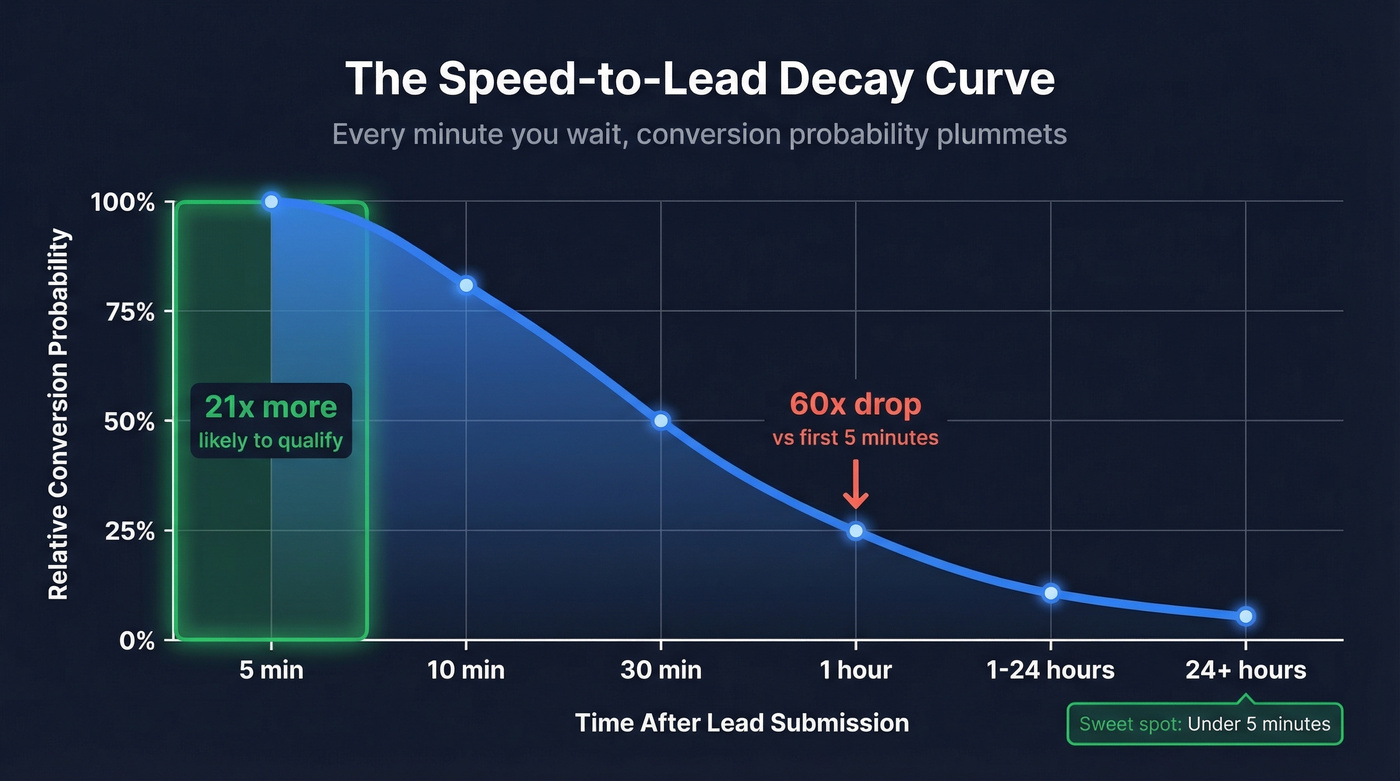
Here's the decay curve in plain terms: at 5 minutes, you're at baseline conversion. By 10 minutes, you're at 80%. At 30 minutes, 50%. One hour, 25%. Between 1 and 24 hours, roughly 10%. Wait a full day and you're scraping 5%.
We've seen teams cut their response time from 4 hours to under 10 minutes and double their meeting rate overnight - no cadence changes, no new tools, just speed. If your average response time is measured in hours, you're losing the majority of your qualified pipeline before a rep ever picks up the phone. Responding quickly is the single highest-leverage fix most teams can make.
Benchmarks That Separate Top Performers
Ask any SDR manager what kills their inbound conversion, and the answer is almost always the same: reps don't follow up fast enough, and when they do, half the contact info is wrong. RevenueHero's 2026 benchmark across 1M+ form fills puts numbers to the gap:
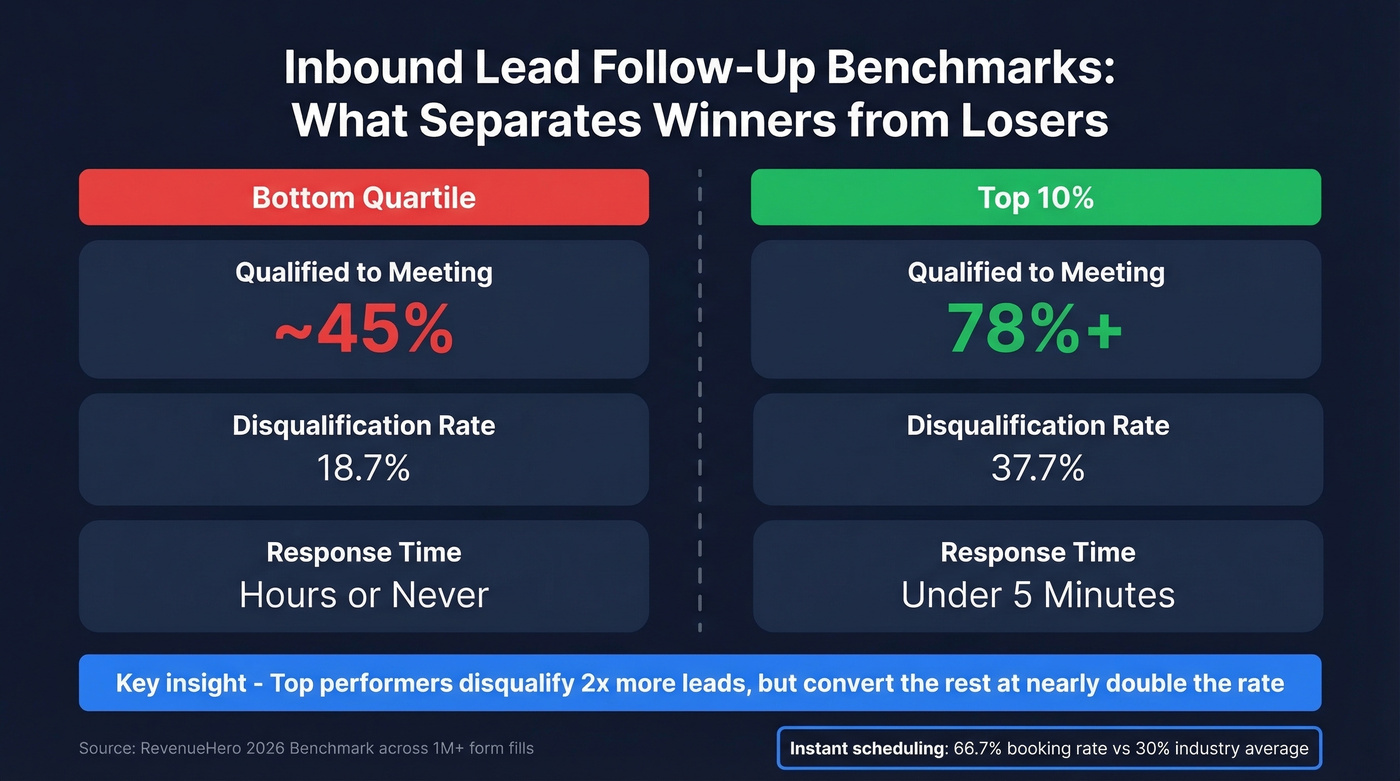
| Metric | Bottom Quartile | Median | Top 10% | Best |
|---|---|---|---|---|
| Qualified to Meeting | ~45% | 62% | 78%+ | 88% |
| Disqualification Rate | 18.7% | - | 37.7% | - |
Enterprise teams convert at a 70.1% median, mid-market at 61.2%, and SMB at 63.2%. The counterintuitive insight: top performers disqualify twice as many leads. They convert more by being ruthlessly selective about who gets rep time.
Chili Piper's data across roughly 4 million form submissions tells a similar story. Companies with instant scheduling book meetings for 66.7% of qualified submissions, versus a 30% industry average. Only 8% of top B2B SaaS companies offer it. That's the clearest competitive advantage available for teams looking to convert at scale.
The 14-Day Multichannel Cadence
Here's the cadence that pulls 18-25% reply rates for SaaS:
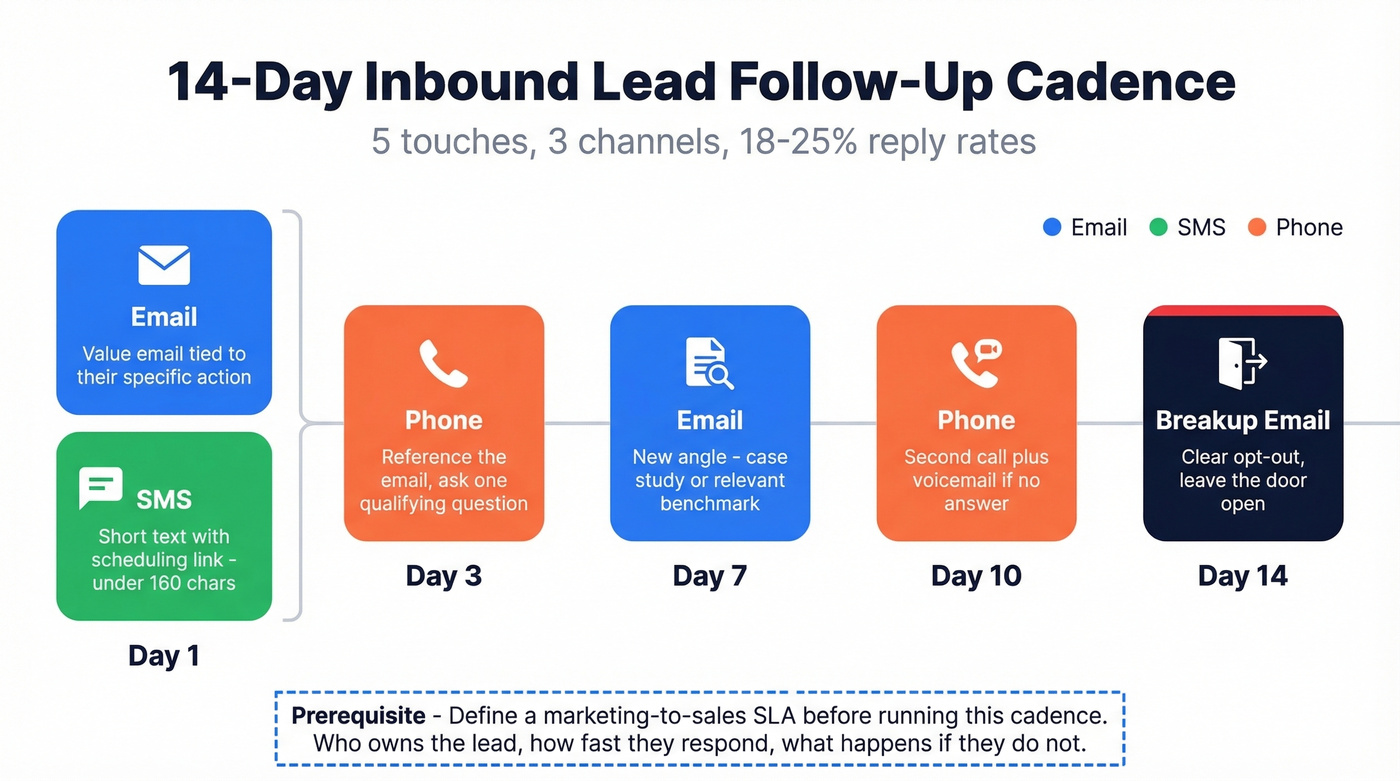
| Day | Channel | Action |
|---|---|---|
| 1 | Value email tied to their specific action | |
| 1 | SMS | Short text confirming receipt with a scheduling link |
| 3 | Phone | Reference the email, ask one qualifying question |
| 7 | New angle - case study or benchmark | |
| 10 | Phone | Second call + short voicemail if no answer |
| 14 | Breakup email - clear opt-out, door open |
Adding SMS on Day 1 alongside email lifts response rates because texts get read within minutes, not hours. Keep the message under 160 characters and link directly to your scheduling page.
Most deals require 5-12 touchpoints, but only 8% of reps follow up more than five times. That gap is where pipeline disappears. Five touches over 14 days is the minimum, not the ceiling.
One prerequisite that rarely gets documented: a marketing-to-sales SLA. If there's no written agreement on response time, lead routing, and handoff criteria, the cadence above won't run consistently. The SLA doesn't need to be complex - define who owns the lead, how fast they respond, and what happens if they don't. This matters most for hand-raisers and demo requests, where the lead has explicitly signaled buying intent and any delay erodes that momentum.
Here's the thing about AI auto-responders: early adopters report up to 70% more leads qualified, which sounds great. But an instant AI reply followed by a 48-hour human follow-up is worse than a 5-minute human response. Speed without substance is just noise.

Your 5-minute response time means nothing if the email bounces. Prospeo verifies contact data through a 5-step process - 98% email accuracy, 125M+ verified mobiles - so every inbound lead gets reached on the first try.
Stop losing inbound leads to bad data. Verify before you sequence.
Follow-Up Email Templates That Work
Day 1 - First Touch
Subject: Quick question about your [demo request / download]
Hi [Name],
You [requested a demo / downloaded our guide on X] - so I'm guessing [specific pain point] is on your radar.
We helped [similar company] cut [metric] by [result]. Happy to walk you through how in 15 minutes.
Does [specific day] work for a quick call?
This template works because it references the prospect's specific action, names a relevant result, and proposes a concrete next step. Skip "just checking in" or "circling back." HubSpot's sales team found that subject lines with a specific question consistently outperform generic follow-ups. If you want more options, borrow from these sales follow-up templates and adapt them to inbound intent.
Day 14 - Breakup
Subject: Should I close your file?
Hi [Name],
I've reached out a few times and haven't heard back - totally fine. I'll stop after this. If [pain point] comes back up, just reply here and we'll pick up where we left off.
A well-crafted breakup email often generates the highest reply rates of the entire sequence. The implied loss of access triggers action.
Three Fixes That Convert Leads to Deals
1. Add instant scheduling to your demo form. This alone lifts meeting booking from 30% to 66.7% for qualified form submissions. Adding a live call option pushes it to 69.2%. Removing the "double form" problem - where leads re-enter info they already submitted - lifts conversions another 50%.
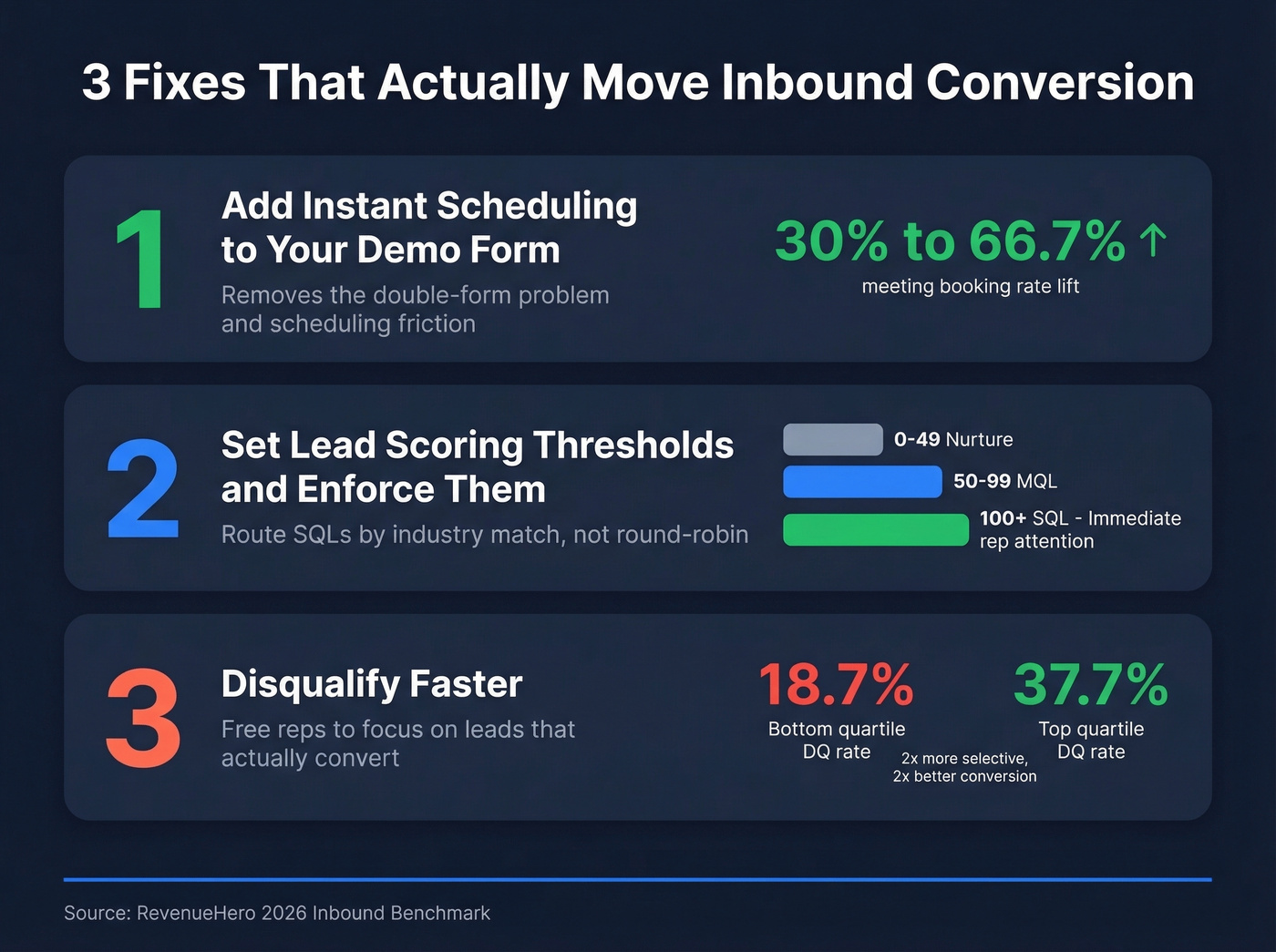
2. Set lead scoring thresholds and enforce them. A simple framework: 0-49 stays in nurture, 50-99 is an MQL, 100+ is an SQL that gets immediate rep attention. Add negative scoring for competitor emails and free domains. Route SQLs to the rep with the most relevant industry experience - matching matters more than round-robin fairness. If you need a tighter model, use a dedicated lead scoring rubric and align it to your ideal customer profile.
3. Disqualify faster. In our experience, this is the fix teams resist most and benefit from most. Top-quartile teams disqualify 37.7% of leads versus 18.7% for the bottom quartile. Saying "this isn't a fit" early frees reps to spend real time on follow-up that actually converts. Let's be honest - most teams hoard leads because it feels safer. It isn't. This is one of the most common sales pipeline challenges we see in inbound-heavy motions.
The Contact Data Problem Nobody Talks About
Picture this: 47 new inbound leads hit your CRM on Monday. By Wednesday, 38 are marked "no contact" - 12 emails bounced, 8 phone numbers were disconnected, 18 went to voicemail on numbers that are probably stale. Your cadence was perfect. Your data wasn't.
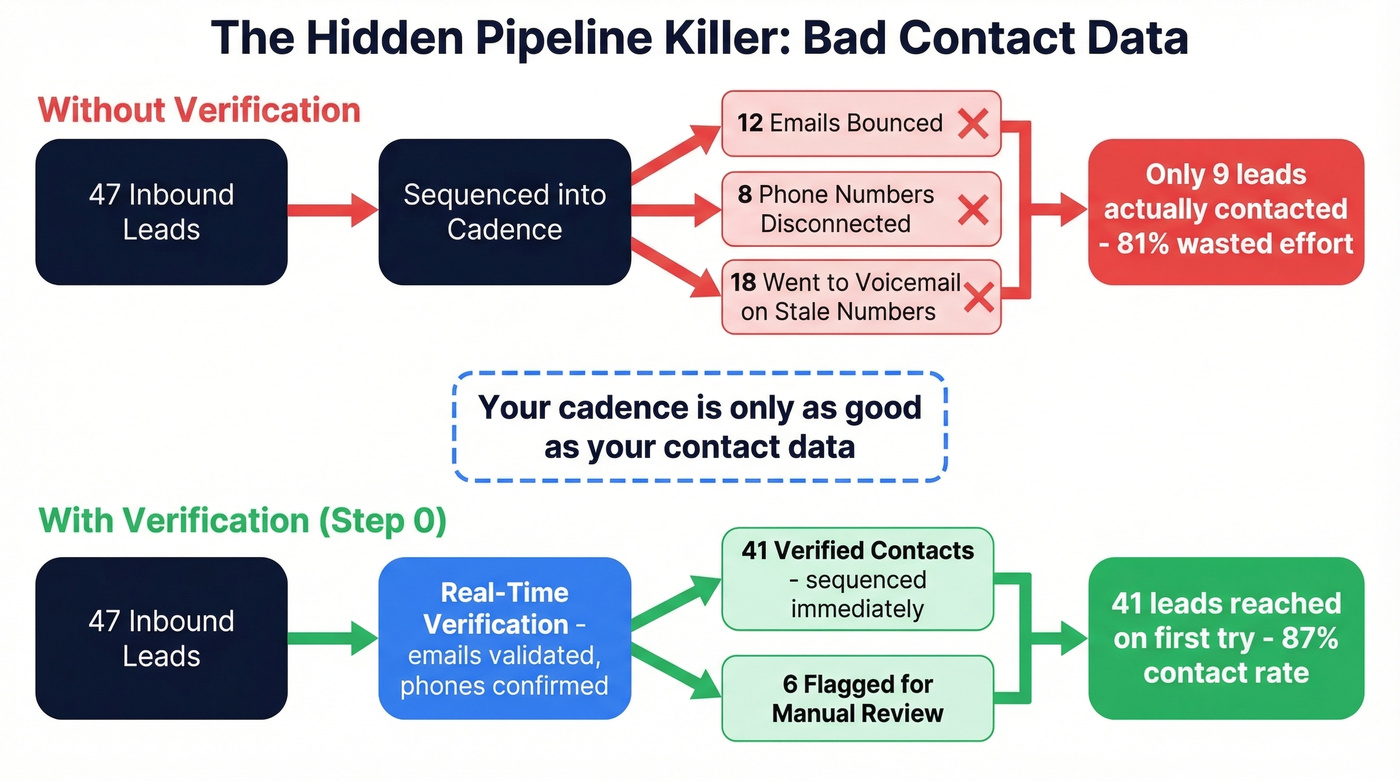
Bad contact data silently kills follow-up before the cadence even starts. Even the most disciplined sequence falls apart when the email address doesn't exist or the phone number rings out to a fax machine. We've talked to teams running beautiful 7-touch sequences with 40%+ bounce rates - they didn't have a follow-up problem, they had a data problem wearing a follow-up disguise.
Real-time verification before sequencing catches these dead contacts. Prospeo handles this with 98% email accuracy and a 30% pickup rate on verified mobiles, with a 7-day data refresh cycle so you're not calling numbers that went stale six weeks ago. The Chrome extension lets reps verify a contact directly from their CRM in seconds, so Step 0 never becomes a bottleneck. If you're comparing vendors, start with these data enrichment services and then go deeper on email bounce rate and the underlying email deliverability mechanics.
That 14-day cadence only works when every email lands and every phone number connects. Prospeo refreshes 300M+ profiles every 7 days - not 6 weeks - so your inbound follow-up hits real inboxes and live numbers.
Your cadence is only as good as your contact data. Fix it at $0.01 per email.
FAQ
How fast should you respond to an inbound lead?
Under 5 minutes. Leads contacted within 5 minutes are 21x more likely to qualify than those contacted at 30 minutes. After one hour, likelihood drops 60x. Speed is the single most important variable - even ahead of message quality.
How many follow-up touches does an inbound lead need?
At least 5-7 across email, phone, and SMS over 14 days. Most deals require 5-12 touchpoints, but only 8% of reps reach that number. Committing to the full cadence - not just the first touch - is what separates top-quartile teams.
What if your lead's contact info is wrong?
Verify before you sequence. Real-time email and phone verification catches bounced addresses and disconnected numbers before reps waste cadence touches. Tools like Prospeo verify contacts in one click from your CRM - 98% accuracy, with a free tier of 75 emails and 100 extension credits per month.
What's the best channel for following up?
Email is the default first touch, but multichannel wins. Pairing a Day 1 email with a same-day SMS and a Day 3 phone call consistently outperforms email-only sequences. Demo requests warrant a phone call; content downloads start better with email.