

How to Build an Inbound Sales Funnel That Actually Converts
Last quarter, your content team drove 500 inbound leads. Sales closed three. Marketing says the leads were good. Sales says they were garbage. The real problem? Nobody can point to a single conversion benchmark that tells you where the funnel broke.
Here's the thing about inbound: it isn't free. Expect 3-6 months for initial results, and 6-12 months before SEO-driven inbound really compounds. If you need pipeline this quarter, pair inbound with outbound. This playbook assumes you're building for the medium term, and it gives you the benchmarks, the scoring model, and the workflows that most funnel guides skip entirely.
What Is an Inbound Sales Funnel?
An inbound sales funnel maps the journey from anonymous visitor to closed customer - specifically through the lens of sales qualification and closing, not just marketing awareness. The marketing funnel gets people to raise their hand. The sales funnel determines whether that hand-raiser has budget, authority, need, and timeline.
The funnel isn't dead. The flywheel is a philosophy; the funnel is a measurement framework. You need both. Modern buyers don't move linearly - 60% of consumers take six or more actions before deciding to buy from a new brand - but you still need stage definitions to measure where deals stall and where they accelerate. Revenue ops teams love to argue about whether MQL is even a useful metric anymore, and fair enough, but without stage definitions you can't measure anything, let alone improve it.
The business case is straightforward. Inbound marketing costs 62% less per lead than outbound and generates 54% more leads. In B2B SaaS specifically, organic leads cost $164 on average versus $310 for paid. Nurtured leads purchase 47% more than non-nurtured ones. The economics work - if the funnel is built right.
The 5 Stages of Inbound Sales
Attract (Awareness)
Strangers become visitors through SEO content, paid social, webinars, and podcast appearances. The key metric here is visitor volume by channel, because not all traffic converts equally. Webinar traffic often converts to leads at lower rates but closes at higher rates downstream, which is why teams that obsess over top-of-funnel volume while ignoring bottom-of-funnel content like pricing pages, comparison pages, and case studies leave money on the table.
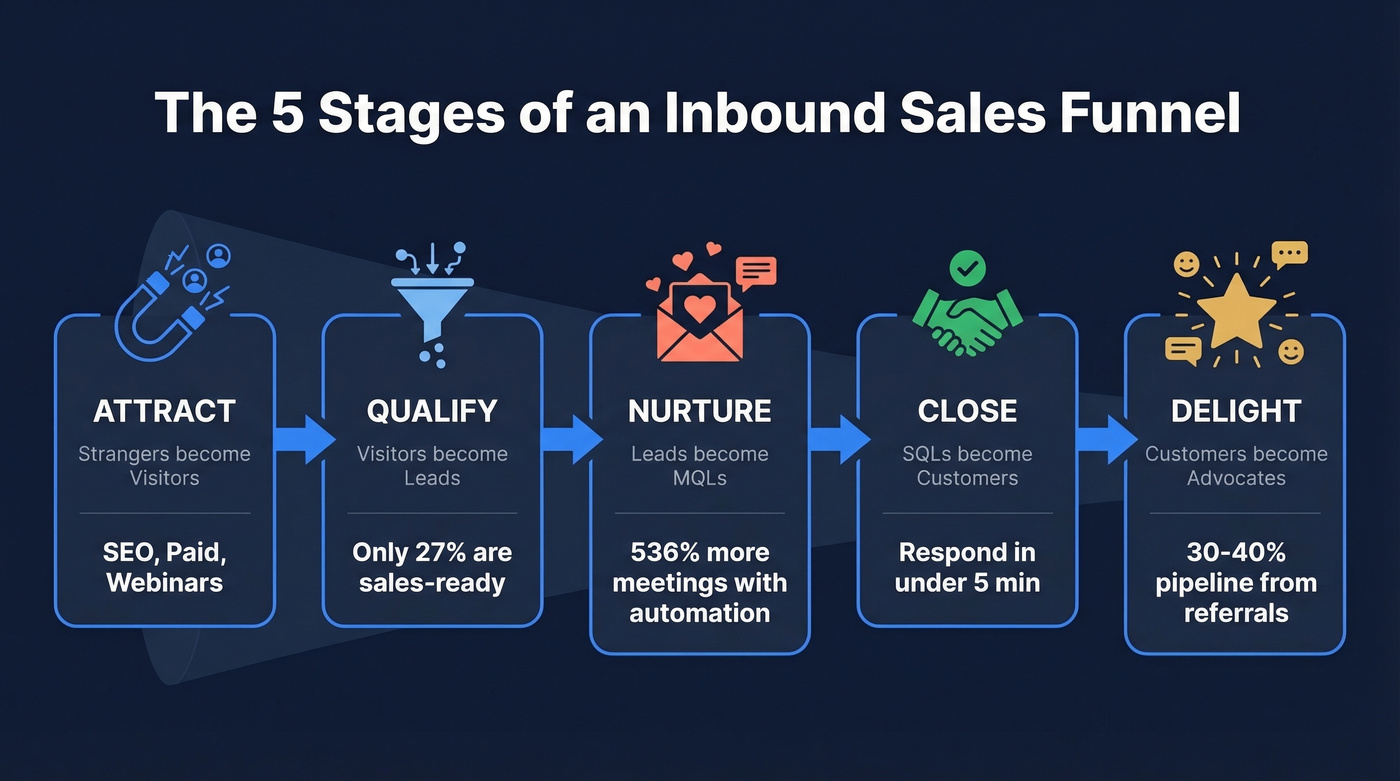
Prioritize content that converts over content that impresses.
Qualify (Consideration)
This is where most teams bleed money: only about 27% of inbound leads are actually sales-ready. The other 73% aren't bad leads - they're just not ready. Lead scoring separates signal from noise at this stage, routing qualified leads to sales and everyone else to self-serve resources or nurture sequences. Skip this step and your reps will waste half their week on people who downloaded an ebook out of curiosity.
Nurture (Evaluation)
One team we studied saw a 536% increase in booked meetings after automating their nurture workflows. The difference wasn't better content - it was consistent, timed engagement. Email sequences, retargeting, and case studies keep your solution top-of-mind while the buyer builds internal consensus. The goal is moving leads from MQL to SQL through demonstrated engagement and intent signals, not just time passing.
Close (Decision)
Speed kills - in a good way. Responding within five minutes makes you 9x more likely to convert an inbound lead, and 78% of buyers go with the first vendor that connects with them. This is where demos, proposals, and negotiation happen. If your average response time is measured in hours, you're losing deals before sales even knows they exist.
Delight (Retention)
Closed deals aren't the end. Expansion revenue, referrals, and case studies all come from post-sale experience. Teams that treat onboarding as a sales function - not just a CS function - see higher net revenue retention. In our experience, the best-performing funnels generate 30-40% of new pipeline from existing customer referrals.
Stage-by-Stage Conversion Benchmarks
Understanding the stages is only half the battle. If you don't know what "good" looks like at each transition, you can't diagnose what's broken.
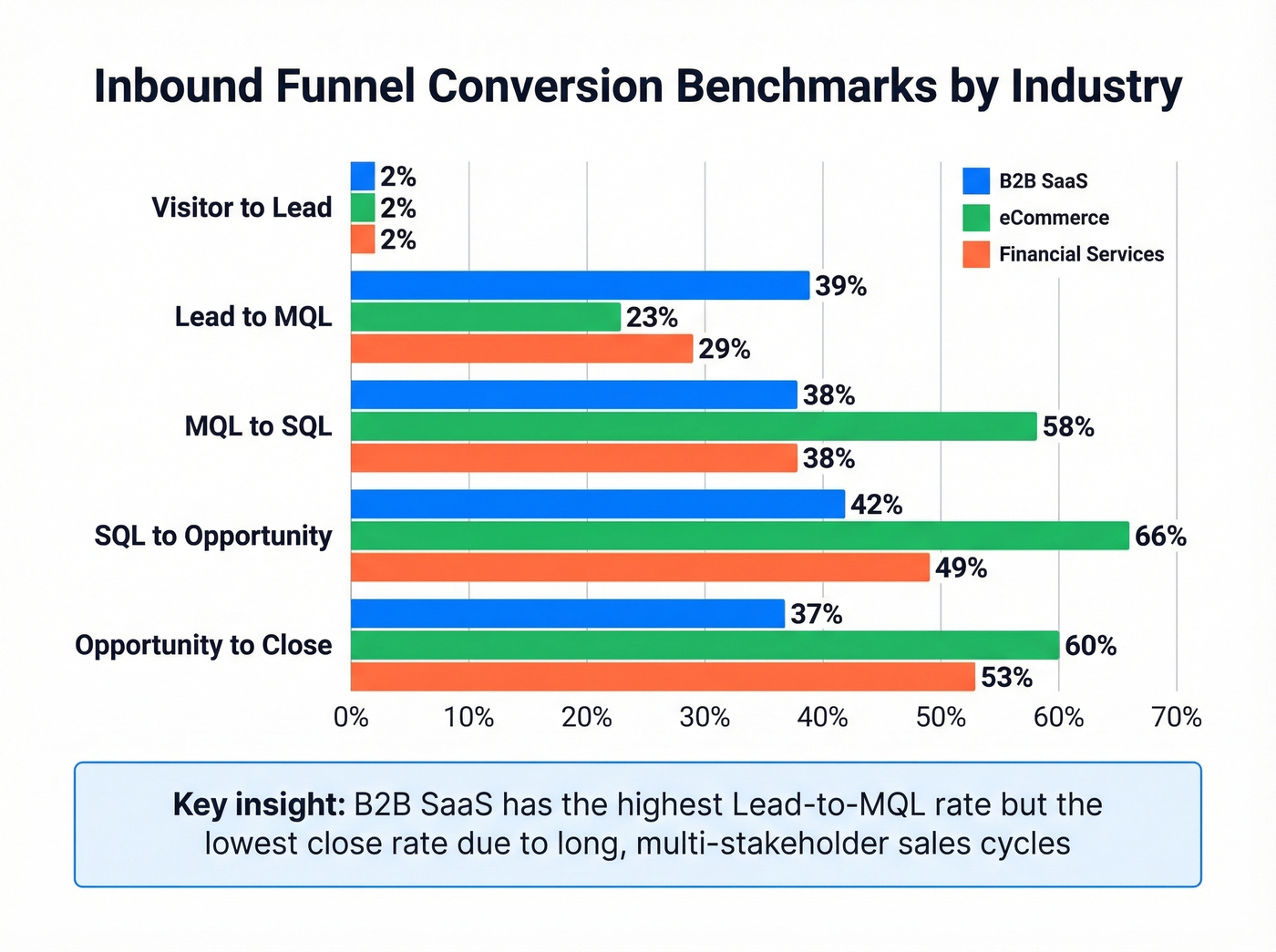
Cross-industry ranges: Visitor-to-Lead 1-3%, Lead-to-MQL around 31%, MQL-to-SQL 15-35%, SQL-to-Opportunity 30-55%, Opportunity-to-Close 15-40%. If your numbers fall below these ranges, you've got a leak.
Here's how those averages break down by industry:
| Stage Transition | B2B SaaS | eCommerce | Financial Services |
|---|---|---|---|
| Visitor to Lead | 1-3% | 1-3% | 1-3% |
| Lead to MQL | 39% | 23% | 29% |
| MQL to SQL | 38% | 58% | 38% |
| SQL to Opportunity | 42% | 66% | 49% |
| Opportunity to Close | 37% | 60% | 53% |
B2B SaaS has the highest lead-to-MQL rate, but it closes at a lower rate than eCommerce and financial services - that's the nature of long, multi-stakeholder sales cycles. eCommerce converts at every stage after MQL because the buying decision is simpler and faster.
For product-led growth companies, the benchmarks shift. Free trial to paid conversion runs about 18-29% - CRM tools convert at roughly 29%, while broader SaaS averages 18-25%. Freemium to paid is much lower, around 3.4%, which is why PLG companies optimize activation metrics, not just lead volume.
We've found that teams falling below these ranges usually have a data quality problem, not a content problem.

You just read that email bounces cost you -25 points per lead. Bad data doesn't just hurt your score - it wrecks deliverability and kills your nurture sequences. Prospeo's 5-step email verification delivers 98% accuracy, so your inbound leads actually reach a real inbox.
Stop losing scored leads to bad email data.
Build a Lead Scoring Model
Most teams either score leads too loosely (everyone's an MQL) or don't score them at all. Here's a point-value model we've adapted from a HubSpot implementation documented by Belkins:
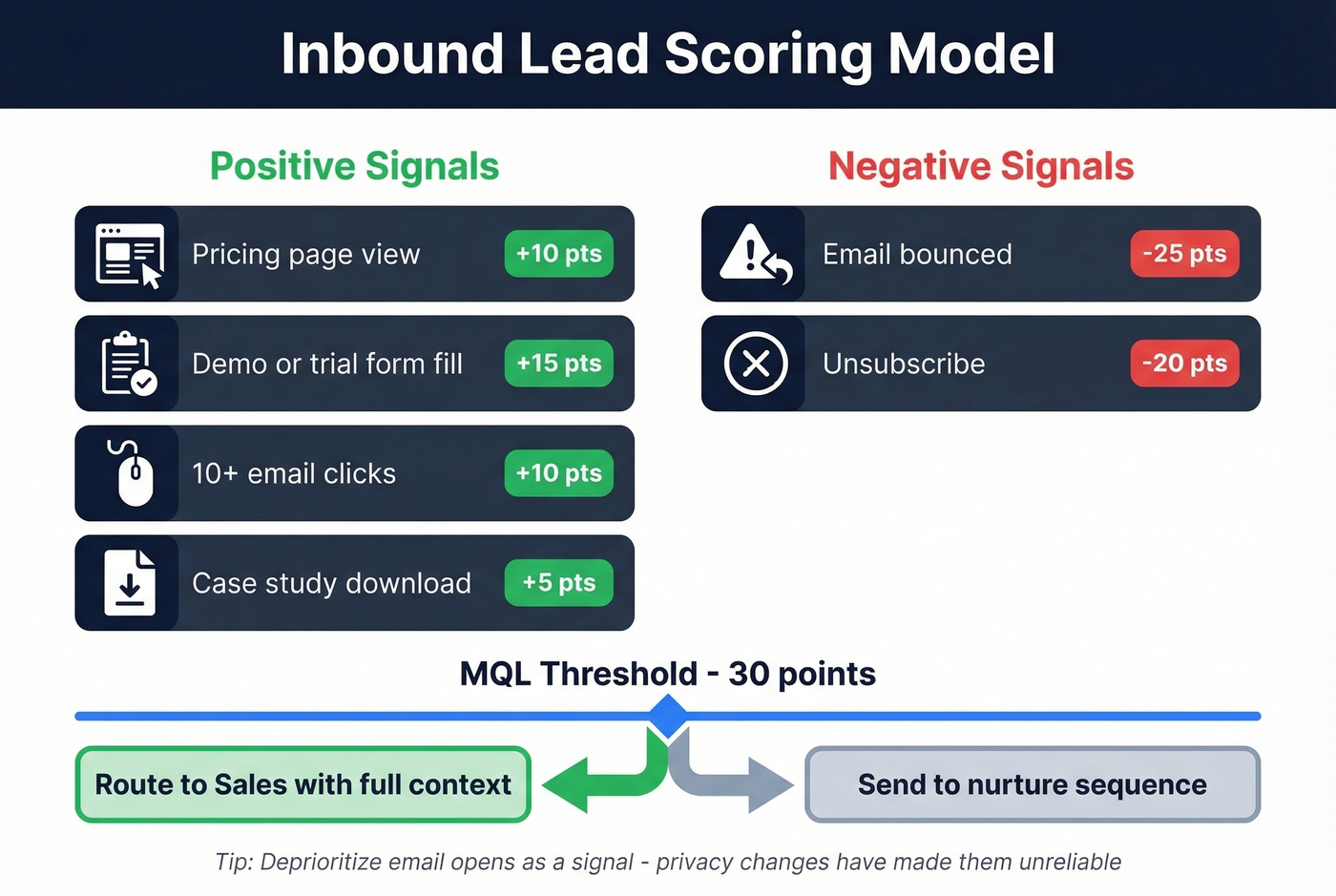
| Signal | Points | Rationale |
|---|---|---|
| Pricing page view | +10 | High purchase intent |
| Form fill (demo/trial) | +15 | Active hand-raise |
| 10+ email clicks | +10 | Sustained engagement |
| Case study download | +5 | Solution evaluation |
| Email bounced | -25 | Bad data, remove from pipeline |
| Unsubscribe | -20 | Disengaged, stop routing |
Set your MQL threshold at 30 points - anything above gets routed to sales with context on which signals fired. And deprioritize email opens as a scoring signal. Privacy changes in Apple Mail and Outlook have inflated open rates to the point where they're meaningless. On-site behavior is where the real intent signal lives.
If you want a second framework to sanity-check your stage logic, compare it to the AIDA model and see where your handoffs differ.
Where Inbound Funnels Leak
The same five mistakes kill inbound funnels over and over. Each one has a data-backed fix.
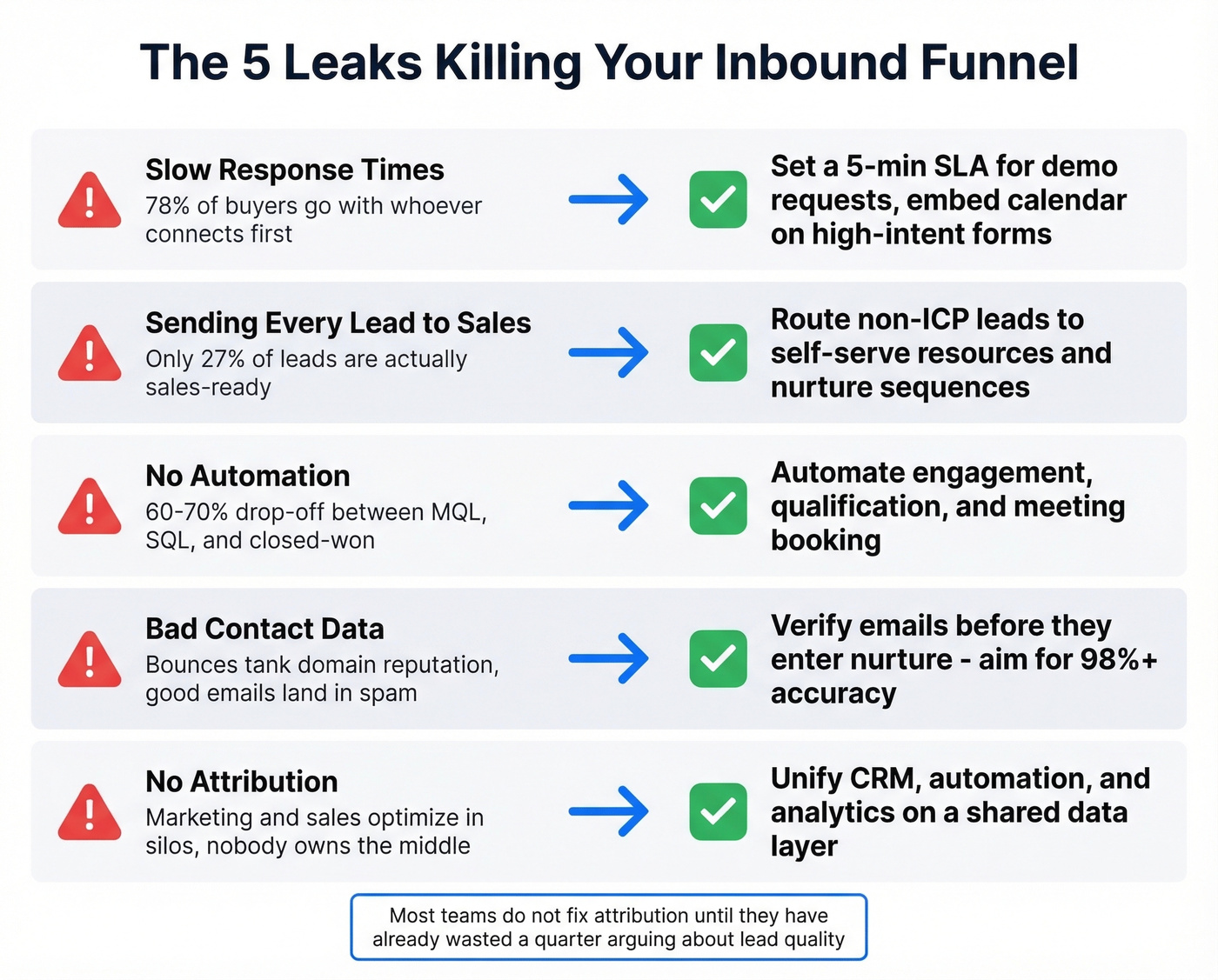
Slow Response Times
78% of buyers go with the first vendor that connects with them. Embed a calendar directly on high-intent forms and set a 5-minute response SLA for demo requests, 15 minutes for all other inbound leads. Anything slower and you're handing deals to competitors who showed up first.
Sending Every Lead to Sales
Only 27% of inbound leads are sales-ready. Routing the other 73% to a rep wastes their time and creates a terrible buyer experience - the prospect gets a pushy call when they just wanted a whitepaper. Route non-ICP leads to self-serve resources like on-demand demos, trial signups, or educational content sequences instead.
If your handoffs are messy, standardize your lead status definitions so marketing and sales stop arguing about "quality."
No Automation
When follow-up relies on humans alone, you see 60-70% drop-off between MQL, SQL, and closed-won. Manual processes simply can't match the speed and consistency that inbound demands. Automate engagement, qualification, and meeting booking. The results compound fast.
Bad Contact Data
This is the silent funnel killer. You sent 200 nurture emails. 47 bounced. 12 hit spam traps. Your domain reputation tanks, and now even the good emails land in spam. The biggest leak isn't bad content - it's bad data.
Prospeo's 98% email accuracy and 7-day data refresh cycle means the contacts entering your nurture sequences are verified and current, at roughly $0.01 per email. Its 5-step verification process includes catch-all handling, spam-trap removal, and honeypot filtering - exactly the kind of hygiene that keeps your sender reputation intact. One customer, Stack Optimize, maintains 94%+ deliverability and under 3% bounce rate across all their clients using this approach.

If you're seeing bounces spike, start with email bounce rate diagnostics, then work backward into list hygiene and acquisition sources.
No Attribution
When marketing optimizes for lead volume and sales optimizes for close rate, nobody owns the middle of the funnel. MQL-to-SQL conversion - the handoff zone - is where most value gets destroyed. If your CRM, marketing automation, and analytics tools don't share a common data layer, you're optimizing in silos. Let's be honest: most teams don't fix this until they've already wasted a quarter arguing about lead quality.
To keep the debate grounded, align on a single set of funnel metrics and review them weekly.
Automation Workflows That Move the Needle
Welcome Series
Trigger: New lead submits any gated content form. Send 3-7 emails over 7-14 days. The first email delivers the asset immediately, emails 2-3 provide related value, and by email 4, segment based on engagement. High-engagement leads get a demo CTA. Low-engagement leads get a softer educational track. Track click-through and reply rates, not opens.
If you need copy that doesn't sound like a robot, pull from these sales follow-up templates and adapt them to inbound intent.
Speed-to-Lead
Trigger: High-intent form submission like a demo request or pricing page visit plus form fill. Route immediately to the available rep in the right territory. Embed a calendar on the confirmation page with 8-12 time slots available - fewer slots mean more scheduling friction and lower booking rates. If no booking within 5 minutes, trigger an automated email with a direct calendar link.
Re-engagement
Trigger: Lead goes cold with no engagement in 30+ days. First touch at day 1, second at day 3, third at day 5 with an incentive - a new resource, an exclusive webinar invite, or a limited-time offer. This sequence recovers leads that would otherwise be written off entirely. Skip this workflow if your list is under 500 contacts; the ROI on building it won't justify the setup time until you have volume.
The Inbound Funnel Tech Stack
You don't need 15 tools. You need five categories covered well.
| Category | Recommended Tools | Starting Price |
|---|---|---|
| CRM | HubSpot, Salesforce, monday CRM | Free-$15/user/mo |
| Marketing Automation | ActiveCampaign, HubSpot | ~$29/mo |
| Contact Data & Enrichment | Prospeo | Free (75 emails/mo) |
| Scheduling & Routing | Calendly, Chili Piper | ~$15-$30/user/mo |
| Analytics | Google Analytics, HubSpot | Free |
HubSpot's free CRM tier handles most early-stage needs. Salesforce runs $25-$165/user/mo depending on edition and makes sense once you need deeper customization and advanced reporting. monday CRM is a solid lightweight option for smaller teams at free/$12/user/mo.
If you're still deciding what "CRM" even means for your org, start with these examples of a CRM to map features to funnel stages.
For scheduling, Calendly starts around $15-$16/user/mo. Chili Piper starts around $25-$30/user/mo and adds intelligent routing and round-robin distribution that larger teams need.
Hot take: If your average deal size is under $8k, you probably don't need a $165/user/mo CRM or a six-figure data platform. A free CRM, a $29/mo automation tool, and verified contact data will outperform an enterprise stack that nobody actually uses. We've seen this play out with teams at Meritt, who tripled their pipeline from $100K to $300K/week using a lean stack instead of an enterprise one.
If you're shopping for vendors, compare options in our roundup of data enrichment services before you commit.
Only 27% of inbound leads are sales-ready - which means you need enrichment data to score and route the rest. Prospeo returns 50+ data points per contact at a 92% match rate, giving your lead scoring model the signals it needs to separate real buyers from ebook tourists.
Enrich every inbound lead with 50+ data points for $0.01 each.
FAQ
What's the difference between an inbound sales funnel and a marketing funnel?
The marketing funnel focuses on generating awareness and capturing leads through content, ads, and SEO. The sales funnel picks up where marketing hands off - qualifying leads, routing them to reps, running demos, and closing deals. The two overlap at the MQL-to-SQL handoff, which is why shared definitions and SLAs between both teams matter so much.
How long does it take to see results?
Expect 3-6 months for initial results if you're starting from scratch - enough time to publish foundational content, set up lead scoring, and build your first automation workflows. SEO-driven inbound compounds over 6-12 months as content ranks and backlinks accumulate. Paid channels can accelerate the top of funnel while organic matures.
What's a good inbound lead conversion rate?
For B2B SaaS, visitor-to-lead runs 1-3%, and lead-to-MQL averages around 31% across industries. Downstream conversion depends heavily on data quality. If your contact data is stale or unverified, nurture emails bounce and sales can't reach qualified leads. Keeping your enrichment tight with verified, regularly refreshed data directly improves every conversion rate below the MQL line.