

Inbound SDR vs Outbound SDR: Benchmarks, Pay, and How to Choose in 2026
You're staring at two offer letters. One pays $80K OTE with a commission cap. The other promises $85K OTE, uncapped, but requires 13 outbound meetings a month to hit plan. Reddit threads are all over the place - some say take the inbound gig, others say outbound builds real skills. The inbound SDR vs outbound SDR decision shapes your next two years, and most advice you'll find is too vague to act on.
Whether you're an SDR choosing between roles or a sales leader designing your team structure, this question comes down to data - not vibes. Here are the numbers that matter in 2026.
The Short Answer
Choose inbound if you want predictable earnings, a smoother ramp, and you thrive on speed and responsiveness.
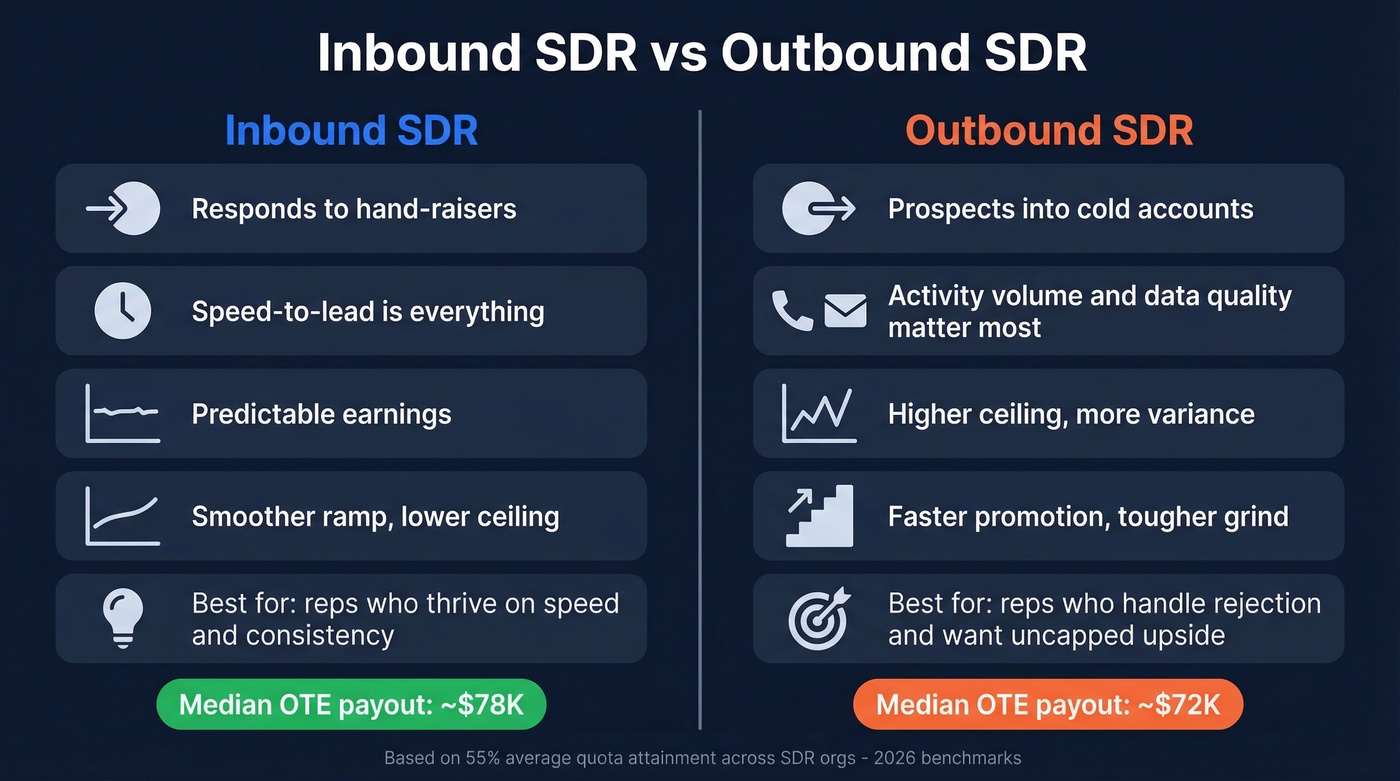
Choose outbound if you want a higher earning ceiling, faster career progression, and you can handle rejection at scale.
If you're a sales leader, stop splitting the team. Build all-bound SDRs aligned to AE territories.
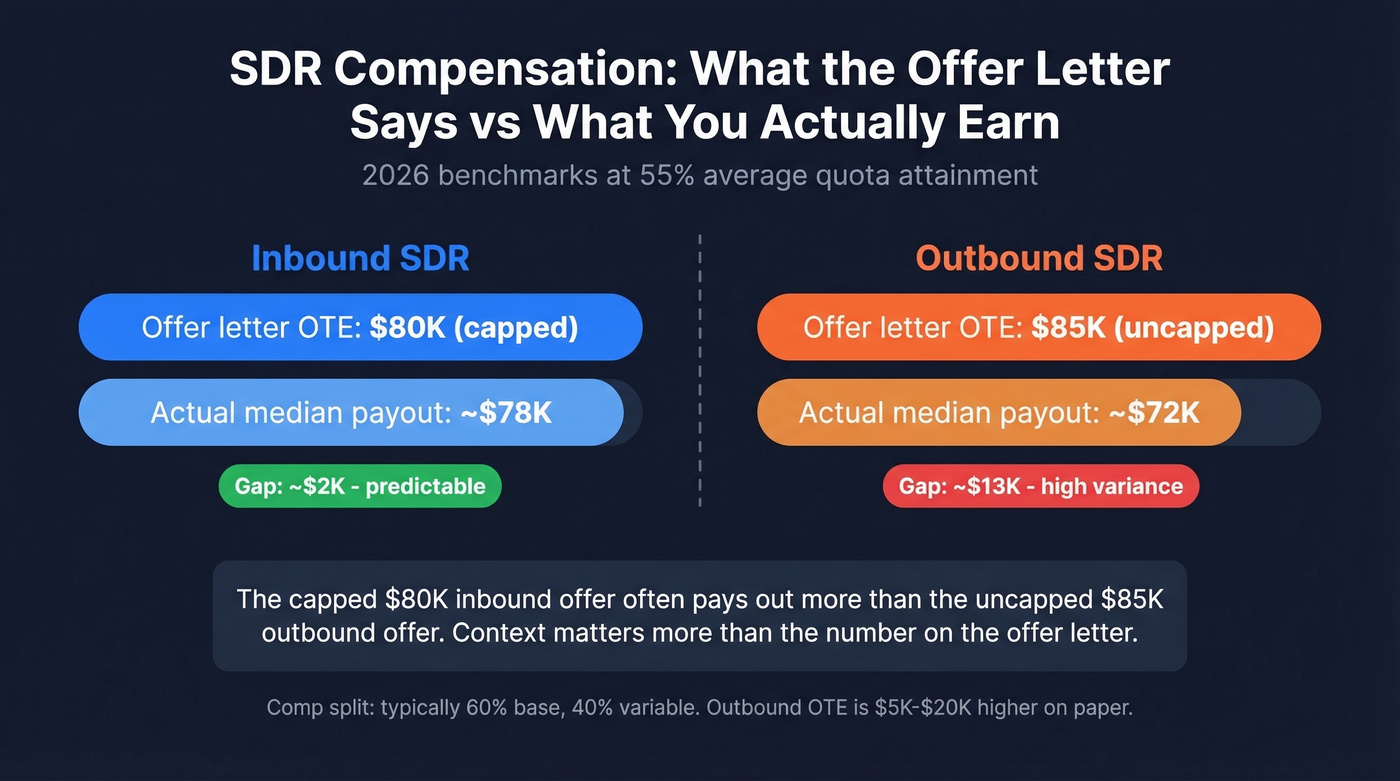
One number to keep in mind: average quota attainment across SDR orgs is roughly 55%. That $85K outbound OTE? In reality, it's closer to $72K for the median rep. The capped $80K inbound OTE suddenly looks competitive. Context matters more than the number on the offer letter.
What Each Role Actually Looks Like
Inbound SDR
An inbound SDR responds to marketing-generated leads - demo requests, content downloads, webinar attendees, chatbot conversations. The job is qualification: take the hand-raiser, run them through BANT or MEDDIC, and hand a qualified opportunity to an AE. Speed-to-lead is the defining metric. Respond in five minutes and you're 21x more likely to qualify that lead than if you wait 30 minutes. The daily rhythm is reactive, fast, and repetitive.
What "Outbound SDR" Actually Means Day-to-Day
An outbound SDR proactively prospects into cold accounts. Nobody asked to hear from you. The outbound SDR meaning boils down to one thing: you create pipeline from scratch through multi-channel sequencing - cold calls, cold emails, social touches - aimed at booking meetings with people who don't know your name yet.
Activity volume and data quality are the two levers that matter. A typical outbound rep makes 40-50 calls and sends 10-40 emails per day. The math is unforgiving: only 2% of cold calls result in an appointment. Add the complexity of buying committees - 7+ stakeholders on many B2B decisions and 11.5-month buying cycles - and outbound becomes a multi-threaded game, not a pure numbers game.
| Dimension | Inbound SDR | Outbound SDR |
|---|---|---|
| Lead source | Marketing (MQLs) | Self-sourced (cold) |
| Initiation | Prospect reaches out | Rep reaches out |
| Primary channels | Phone, email, chat | Cold call, email, social |
| Key metric | Speed-to-lead | Meetings booked |
| Daily activity | ~15 leads/day | 40-50 calls + 10-40 emails |
| Reports to | More often Marketing-led | Sales-led (90%) |
| Territory alignment | 40% aligned to AEs | 82% aligned to AEs |
That territory alignment gap is telling. A benchmark study across 351 B2B companies found that 82% of SDR teams overall align to AE territories, but only 40% of inbound-only teams do. Inbound SDRs often operate in a silo, disconnected from the accounts their AEs actually care about.
KPIs That Actually Matter
Inbound SDR Metrics
Inbound is a speed game, not a volume game. The qualification rate drop-off is brutal:
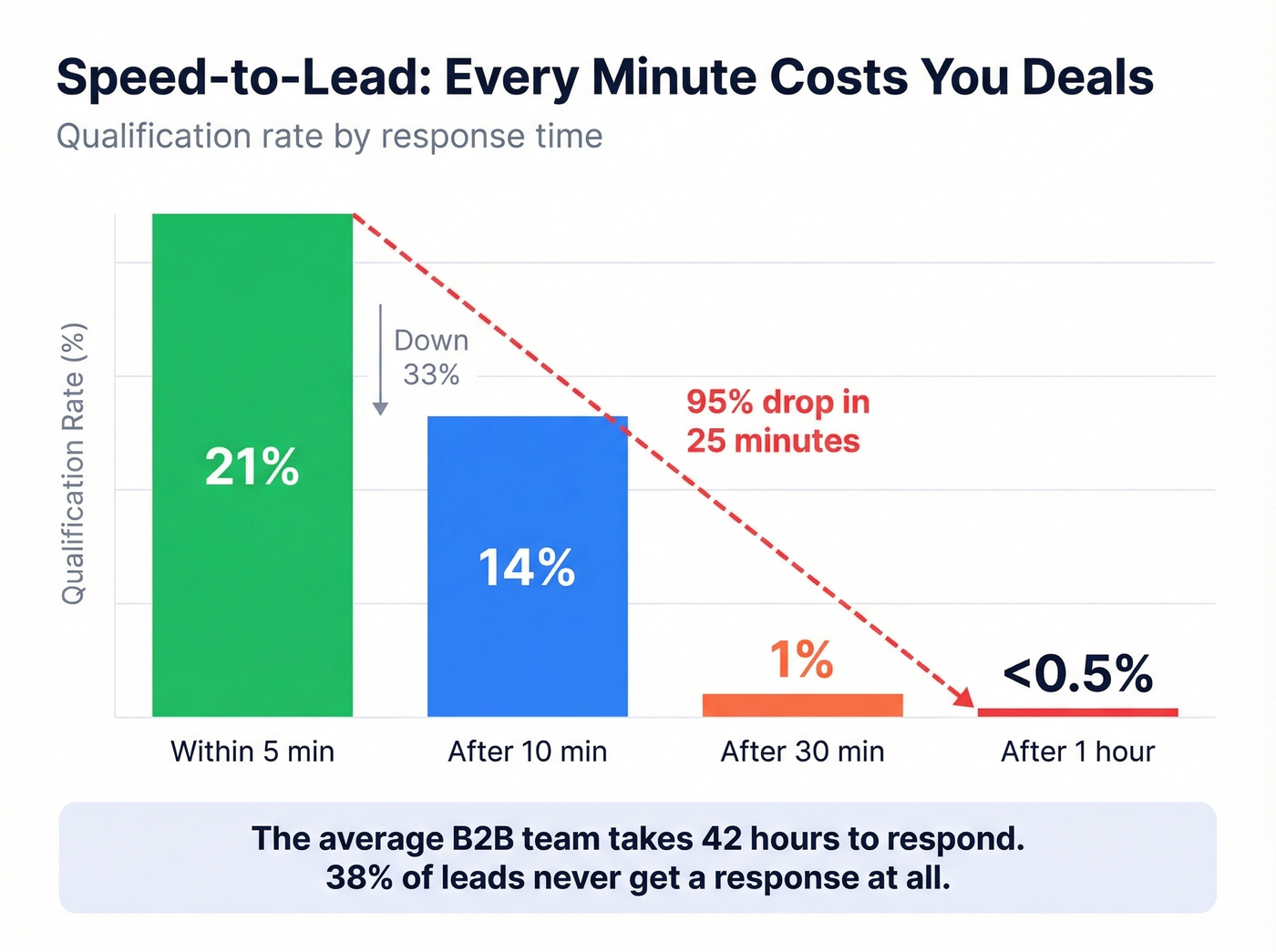
| Response time | Qualification rate |
|---|---|
| Within 5 min | 21% |
| After 10 min | 14% |
| After 30 min | 1% |
| After 1 hour | <0.5% |
Here's the thing: the average B2B sales team takes 42 hours to respond to a new lead. 38% of leads never get a response at all. Response times vary by company size - small teams average 48 minutes, mid-market teams average 1h 38m, and enterprise teams average 1h 28m. That's not a marketing problem. It's an inbound SDR operations problem. Inbound strategies account for roughly 44% of sales pipeline, which means nearly half your revenue engine depends on someone picking up the phone fast enough.
If you're trying to fix this systematically, start with lead routing and a clear lead status taxonomy so nothing falls through the cracks.
Outbound SDR Metrics
Only 2% of cold calls result in appointments. 80% of calls go to voicemail. Connect rates hover around 5-10% for many teams. Reps spend just 33% of their time actually selling - the rest disappears into research, CRM updates, and admin.
The median pipeline generated per SDR is $3M annually, with a typical outbound quota expectation of around 15 meetings per month. We've seen teams where the top 20% of outbound reps generate 3-4x the pipeline of the bottom 20%, and the difference almost always comes down to list quality and call discipline - not some magical sales gene.
If you want to improve the inputs, focus on repeatable sales prospecting techniques and a consistent cold calling system.
A Day in the Life
| Time block | Inbound SDR | Outbound SDR |
|---|---|---|
| 8:00-9:00 AM | Triage overnight leads | Research accounts, build lists |
| 9:00-11:30 AM | Respond to MQLs (<5 min) | Primary cold calling block |
| 11:30 AM-12:00 PM | Log dispositions in CRM | Sequence follow-ups, personalize |
| 1:00-3:00 PM | Follow up morning leads | Second calling block + social |
| 3:00-4:00 PM | AE handoffs, schedule meetings | AE handoffs, update pipeline |
| 4:00-5:00 PM | Review metrics, prep for tomorrow | Review metrics, prep call list |
The inbound day is interrupt-driven. New leads dictate your schedule. The outbound day is self-directed - you control the tempo, but you also own every ounce of pipeline creation. Neither is "easier." They're different kinds of hard.
Outbound burns people out because the emotional toll of daily rejection is real, and it's a major reason outbound reps flame out before promotion. Inbound reps hit a different wall: "My lead volume dried up and now I'm missing quota through no fault of my own." We've watched both scenarios play out dozens of times, and there's no clean answer for which is worse - it depends entirely on what kind of stress you handle better.
SDR Compensation in 2026
Here are the 2026 ranges from Betts Recruiting:
| Region | Entry base | Entry OTE | 6-mo base | 6-mo OTE |
|---|---|---|---|---|
| Remote | $55K-$70K | $70K-$95K | $60K-$75K | $85K-$100K |
| Central/Eastern | $55K-$70K | $70K-$85K | $60K-$75K | $85K-$100K |
| NY/SF/Pacific | $55K-$70K | $80K-$90K | $60K-$75K | $80K-$100K |
Emerging markets typically run 10-15% below these ranges.
The median SDR base sits around $60K with a median OTE of $85K. The typical comp split is 60% base / 40% variable. Early-stage startups often run 70/30 to reduce risk for new hires.
Outbound OTE is typically $5K-$20K higher than inbound, with more variable upside and fewer commission caps. On paper, outbound wins. In practice, the gap narrows fast.
Average quota attainment is roughly 55%. That $85K outbound OTE becomes ~$72K for the median rep. The "capped" $80K inbound OTE pays out closer to plan because inbound quotas are more predictable - marketing either generates leads or it doesn't, and the rep's control over volume is limited but so is the downside. Remember that Reddit poster weighing $80K capped vs $85K uncapped? The capped offer was probably the safer bet.
Let's be honest about deal size too: if your average deal is under ~$10K, outbound economics get ugly fast. The math only works when deal sizes justify the cost of a human prospecting into cold accounts. Below that threshold, invest in inbound infrastructure and let marketing do the heavy lifting.
Promotion timelines have stretched. Pre-pandemic, SDR-to-AE promotion averaged about 12 months. Post-pandemic, it's climbed 28% to 15-16 months on average.
If you want to sanity-check offers, it helps to understand OTE in sales and how variable comp actually pays out.

Only 2% of cold calls convert to appointments - and bad data makes it worse. Prospeo gives outbound SDRs 98% accurate emails and 125M+ verified mobile numbers with a 30% pickup rate, so every dial and send counts.
Stop burning outbound reps on dead contacts. Start with data that connects.
Tech Stack by Motion
The tools an SDR uses depend heavily on their motion. The same benchmark study across 351 companies makes this clear:
| Tool category | Inbound | Outbound | All-bound |
|---|---|---|---|
| Sales engagement | 72% | 77% | 84% |
| LinkedIn Sales Nav | 56% | 81% | 88% |
| Contact data/intel | 56% | 74% | 82% |
Outbound SDRs are only as productive as their data. If 25%+ of your contacts are stale - wrong emails, disconnected numbers, people who changed jobs two months ago - connect rates crater and your domain reputation tanks. This is the single biggest controllable lever for outbound performance, and most teams underinvest in it.
If you're evaluating tools, start with a ranked list of SDR tools and then go deeper on data enrichment services.

Prospeo covers 300M+ professional profiles with 98% email accuracy and 125M+ verified mobile numbers that deliver a 30% pickup rate - roughly 3x the industry average. The key differentiator is a 7-day data refresh cycle; most providers refresh around every 6 weeks, which means your outbound reps are calling numbers and emailing addresses that went stale three weeks ago. GreyScout cut rep ramp time from 8-10 weeks to 4 weeks after switching their data source - that's the kind of impact clean data has on outbound velocity.
Skip this if your team is purely inbound with no outbound motion. But if your reps are dialing and emailing cold accounts, data quality isn't optional - it's the difference between a 2% connect rate and a 10% one.
Whether your SDRs work inbound or outbound, list quality is the difference between hitting quota and missing by 45%. Prospeo refreshes 300M+ profiles every 7 days - not every 6 weeks - so your reps always reach real buyers at current companies.
Give every SDR on your team enterprise-grade data at $0.01 per email.
The All-Bound Argument
Most sales leaders get the inbound/outbound split wrong. It creates more problems than it solves.
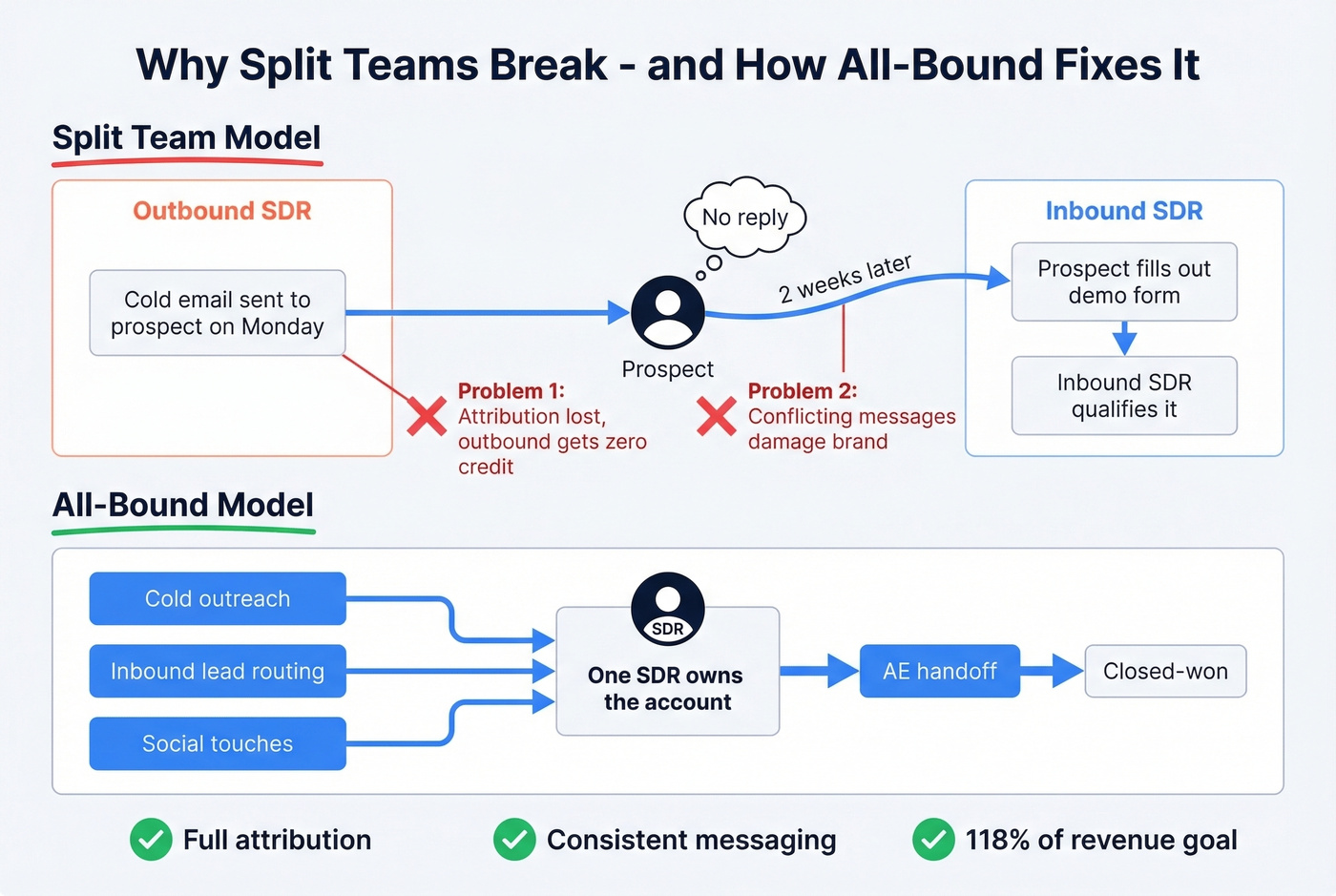
Two failure scenarios show up in almost every team we've audited. First, attribution loss: an outbound SDR cold-emails a prospect, the prospect doesn't reply, but two weeks later fills out a demo form. The inbound SDR qualifies it, the AE closes it, and outbound gets zero credit for the touch that started the conversation. Over time, this kills outbound morale and distorts pipeline reporting.
Second, brand damage. A prospect receives a cold email from your outbound team on Monday and a completely different nurture sequence from marketing on Wednesday. The messaging doesn't match. The tone is off. The prospect thinks your company is disorganized - because it is.
The all-bound model fixes both. Benchmark data shows all-bound teams adopt more tools (84% use sales engagement platforms vs 72% for inbound-only) and align better to AE territories. One outbound leader documented their team finishing at 118% of closed-won goal - not meetings booked, actual revenue - by focusing on pipeline equality and systems efficiency rather than splitting reps by motion.
Making all-bound work requires infrastructure: shared routing logic so inbound leads go to the SDR who owns that account, unified CRM views across both motions, and a single sequencing platform so prospects never get conflicting messages from different parts of your org. It's harder to set up. It's worth it.
If you're rebuilding the operating model, map it to your sales process optimization work so handoffs and attribution don't break.
Career Path: SDR to AE
Average SDR ramp time is 3.0 months - the lowest since 2010. Average tenure sits at 1.9 years, which means most SDRs get one shot at promotion before they start looking externally. The SDR-to-AE ratio across the industry is 1:2.4, so there are seats to fill.
Outbound SDRs tend to promote faster because AE roles require cold prospecting skills. An AE who can't self-source pipeline is a liability, and hiring managers know it. But the best training ground is all-bound - reps who can qualify a hot inbound lead at 9 AM and cold-call a VP at 2 PM develop the full skill set AEs need. Required experience at hire has rebounded to an average of 1.2 years, so if you're a new grad, expect to spend at least a year in the seat before promotion conversations get serious.
If you're planning your first year, build a real 30-60-90 day plan so you can show progress beyond activity volume.
What About AI SDRs?
AI is automating the repetitive parts of both roles - initial outreach sequencing, lead routing, data enrichment, even basic qualification via chatbots. Qualified's entire positioning now centers on AI SDRs handling inbound conversations.
But AI isn't replacing human SDRs in 2026. It's replacing the worst parts of the job. The reps who thrive will be the ones who handle both inbound qualification and outbound prospecting, using AI tools to reclaim the 67% of time that currently goes to non-selling activities. The hybrid SDR + AI model is where the market is heading. If you're choosing a role right now, pick the one that teaches you the most skills, not the one that feels safest from automation.
Which Role Should You Choose?
If you're an SDR choosing between roles: Outbound if you want faster career progression and can handle rejection. Inbound if you want predictable earnings and a smoother ramp. All-bound if you can find it - it's the best of both worlds and the strongest resume builder.
For sales leaders designing teams: Stop splitting. Build all-bound SDRs, align them to AE territories, and invest in data quality over headcount. A team of 5 reps with clean data outperforms a team of 8 reps dialing stale numbers.
For reps being moved from inbound to outbound: Your targets will likely be lower, and the conversation style is completely different. But outbound skills make you more promotable. The consensus on r/sales is that the transition is harder but worth it - outbound reps in many orgs are actually hitting targets while inbound reps aren't, because inbound lead volume dried up.
Most companies have an inbound SDR problem they think is a marketing problem. The real issue is speed-to-lead (42-hour average response time) and qualification rigor. Fix those before you hire another headcount.
FAQ
Is inbound or outbound SDR harder?
Outbound is harder day-to-day - only 2% of cold calls convert to appointments, and quota attainment averages roughly 55%. Inbound is less emotionally draining but demands extreme speed; respond within five minutes or lose 80%+ of qualification potential. Different kinds of hard, different burnout patterns.
Do outbound SDRs earn more?
On paper, yes - outbound OTE runs $5K-$20K higher with uncapped commissions. In practice, average quota attainment of ~55% means a capped $80K inbound OTE often nets more take-home than an $85K outbound OTE where the median rep earns ~$72K.
What's the typical SDR-to-AE timeline?
Expect 15-16 months on average, up 28% from the pre-pandemic norm of roughly 12 months. Outbound SDRs tend to promote slightly faster because AE roles require cold prospecting skills that inbound reps don't develop as deeply.
How do outbound SDRs get accurate contact data?
The best outbound teams use data platforms with high verification rates and frequent refresh cycles. Prospeo verifies emails at 98% accuracy on a 7-day refresh cycle - compared to the 6-week industry average - which directly reduces bounce rates and protects sender reputation.
What is an all-bound SDR?
An all-bound SDR handles both inbound qualification and outbound prospecting, typically aligned to specific AE territories. Benchmark data across 351 B2B companies shows all-bound teams adopt more tools (84% use sales engagement platforms vs 72% for inbound-only) and reduce attribution gaps between marketing and sales.