

How to Increase Your Email Response Rate: A Data-Backed Playbook
Your reply rate didn't break overnight. It eroded. Across 16.5 million cold emails, average reply rates slid from 6.8% in 2023 to 5.8% in 2024, and the decline hasn't stopped. Office365 inbox placement collapsed from 77% to 51% in a single year. If you're trying to increase your email response rate, the ground has shifted - and most teams haven't adjusted yet.
Change Three Things This Week
Here's the thing: if you verify your entire list and kill bounces, turn off open tracking pixels, and cut every email to under 75 words, you'll move the needle more than rewriting subject lines 50 times. Everything else in this article builds on that foundation.
Good Email Response Rates in 2026
| Performance Tier | Reply Rate | Context |
|---|---|---|
| Average | 3.4-5.1% | Instantly 2026, Sopro 2026 |
| Strong | 5.5-8% | Top-quartile campaigns |
| Elite | 10%+ | Top 10%, trigger-event targeting |
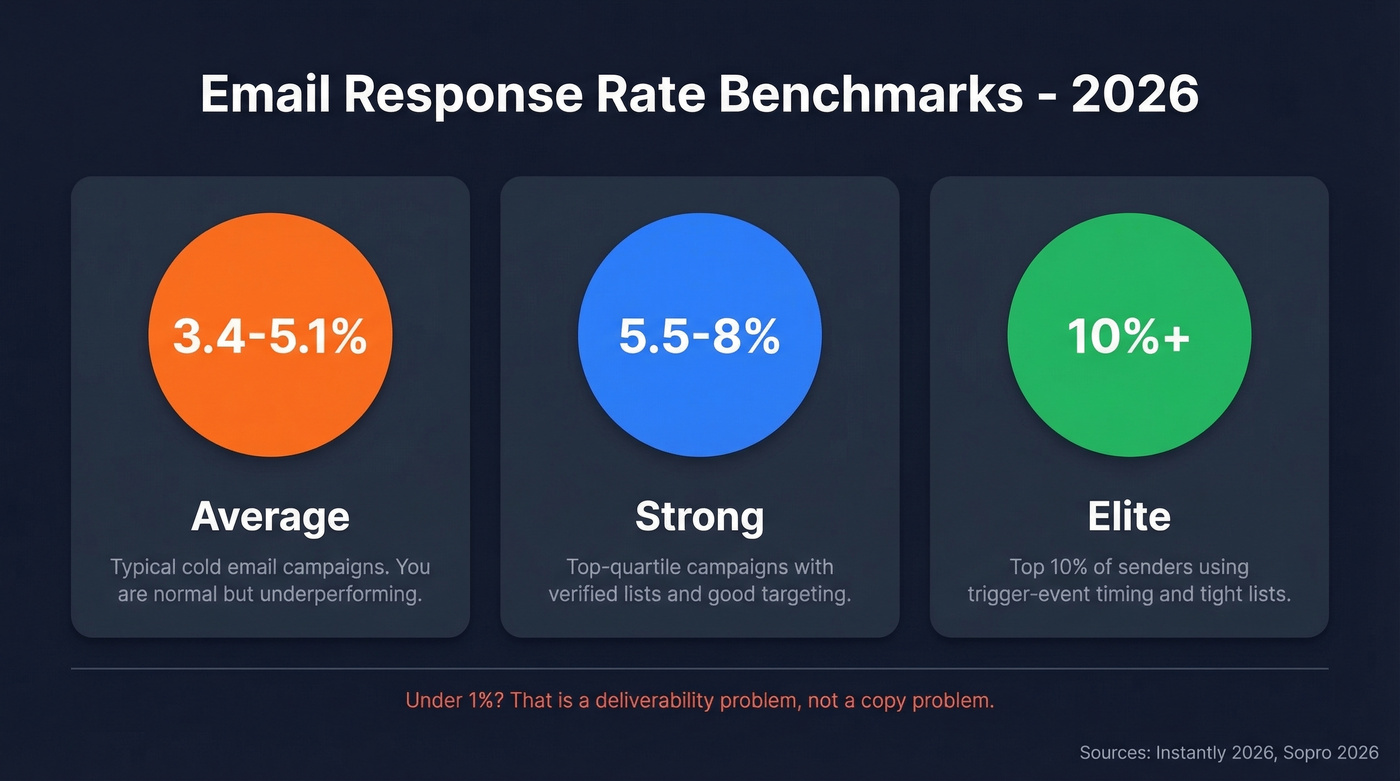
Instantly's 2026 benchmark report puts the overall average at 3.43% across billions of interactions. Sopro's data from 151 million outreach points lands at 5.1%. Between 1-3%? You're normal but underperforming. Under 1%? That's a deliverability or data quality problem, not a copy problem.
How to measure it: Use delivered emails as your denominator, not sent. An email that bounced never had a chance to get a reply, so including it masks the real issue.
Why Reply Rates Keep Declining
Fewer of your emails are reaching the inbox. That's the whole story.
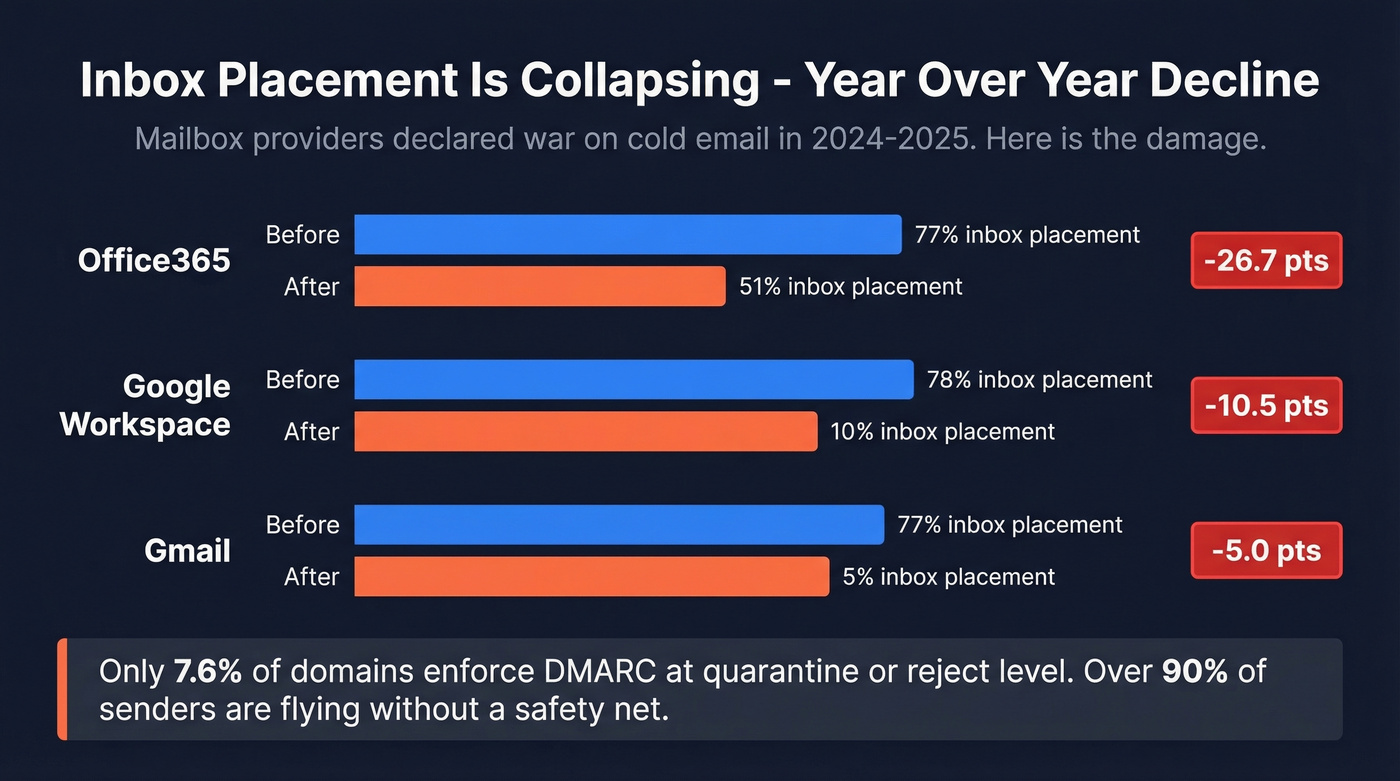
Mailbox providers declared war on cold email in 2024-2025, and they're winning. Google and Yahoo enforced authentication requirements in February 2024. Microsoft followed in May 2025. Office365 inbox placement dropped about 26.7 percentage points year-over-year. Gmail fell about 5.0 points. Google Workspace dropped about 10.5.
Only 7.6% of domains enforce DMARC at quarantine or reject level. The vast majority of senders are flying without a safety net while providers tighten filters around them.

Bounce rates above 2% are actively destroying your sender reputation and tanking reply rates. Prospeo's 5-step verification - with catch-all handling, spam-trap removal, and honeypot filtering - delivers 98% email accuracy. Snyk's 50 AEs went from 35-40% bounces to under 5% and added 200+ opportunities per month.
Clean data is the fastest path to higher reply rates. Start free.
Three Core Fixes That Actually Move the Needle
Most advice focuses on subject lines and personalization. Those matter, but they're irrelevant if your emails land in spam.
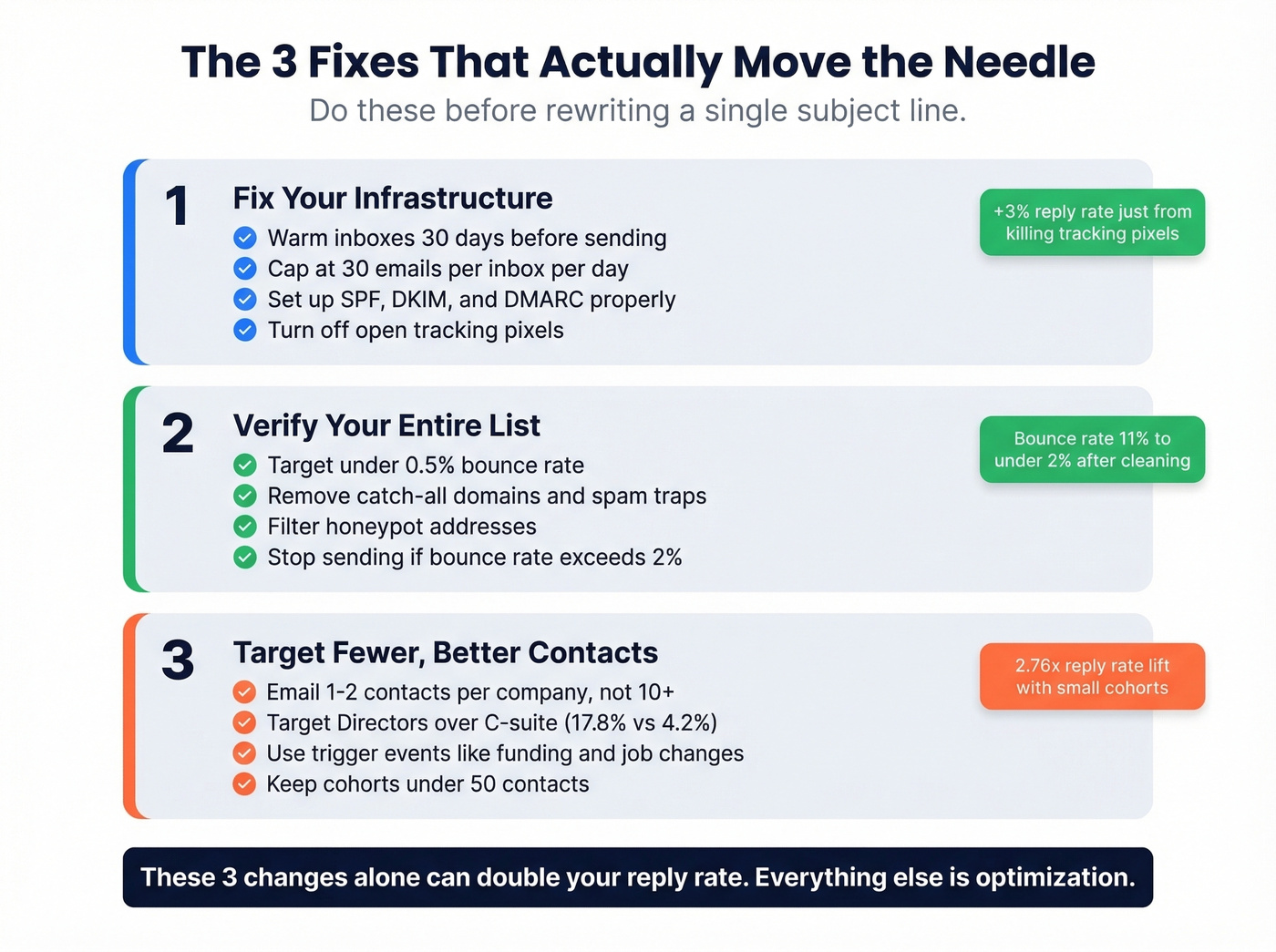
Fix Your Infrastructure First
Warm every inbox for 30 days before sending a single cold email. Ramp volume gradually - 5 per day, then 15, then 30. Never exceed 30 per inbox per day, and rotate across 4-6 inboxes minimum. Confirm SPF, DKIM, and DMARC are properly configured. Getting DMARC enforcement right puts you ahead of over 90% of domains.
Schedule sends for 6-9am local time in your prospect's timezone, Tuesday through Thursday. One Reddit practitioner documented their rebuild: they scaled from 3 domains to 7, capped each at 26 emails per day, and watched reply rates climb from 3% to 6% in 62 days. The single highest-leverage change? Turning off open tracking pixels. That alone produced a 3% higher response rate because tracking pixels flip your email from plain text to HTML, which is exactly what spam filters flag.
Verify Your List Before You Send
Bad data kills reply rates before your email is even read. That same Reddit practitioner's bounce rate was 11% before they cleaned their list. After verification, it dropped below 2%. The Instantly playbook sets the target at under 0.5%. Anything above 2% means your domain reputation is actively degrading with every send.
Spam complaint thresholds are equally unforgiving - exceed 0.3% and mailbox providers start filtering you. Every bounced email and every spam complaint compounds, dragging your entire sending infrastructure down.
We've seen this pattern repeatedly with our own outreach and with teams we've worked alongside. Prospeo's 5-step verification process handles catch-all domains, spam-trap removal, and honeypot filtering, delivering 98% email accuracy. Meritt saw bounce rates drop from 35% to under 4% after switching, and Snyk's 50-person AE team went from 35-40% bounces to under 5%. You can verify 75 emails per month free, no credit card required.
To keep bounce rates down long-term, monitor your email bounce rate and run periodic checks with an email reputation tools stack.
Trigger-event targeting produced 2.3x more replies in every dataset we cited. Prospeo tracks 15,000 intent topics, job changes, funding rounds, and headcount growth - so you reach the right contact within 48 hours of the signal that matters. All refreshed every 7 days, not the 6-week industry average.
Stop spraying into the void. Target buyers showing intent right now.
Target Fewer, Better Contacts
Volume is the enemy of reply rates. Emailing 1-2 contacts per company yields a 7.8% reply rate. Email 10+ contacts at the same company and that drops to 3.8%. Compare that to one operator who blasted 147,000 cold emails and got just 1.2% positive replies. Cohorts of 50 or fewer contacts produce a 2.76x reply rate lift compared to broad blasts.
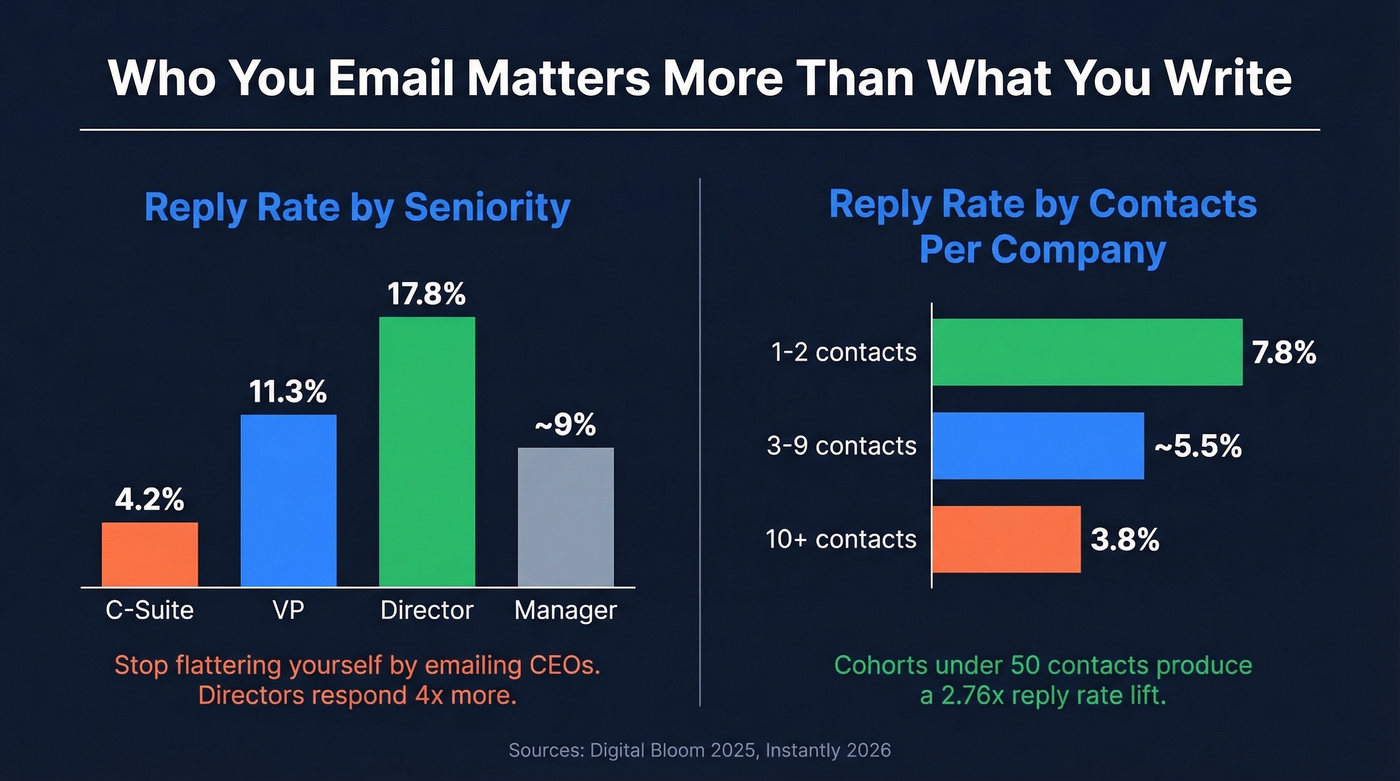
Seniority matters too, and not the way most people assume. Directors respond at 17.8%. C-suite? Just 4.2%. VPs land at 11.3%. If you've been hammering CEOs and CMOs, drop one level - one study saw response rates jump from 3.1% to 16.4% by shifting from CMOs to Marketing Directors.
Let's be honest: if your deal size is under $15k, you almost certainly don't need to reach the C-suite. Directors have budget authority, respond 4x more often, and actually use the products they buy. Stop flattering yourself by emailing CEOs.
The biggest lever we've seen is trigger-event timing. One practitioner tracked 908 emails that produced 112 meetings and 28 closed deals. Their edge was sending within 48 hours of a trigger event - a new hire, a funding round, a job posting. Layering buyer intent with job changes and company growth signals lets you time outreach precisely instead of spraying into the void.
If you want a repeatable system for this, build it into your sales prospecting techniques and formalize your ideal customer profile so reps don't default to volume.
Write Shorter Emails With Better Hooks
Lead with your hook, not your pitch. Timeline-based hooks - referencing something recent and specific - average a 10% reply rate versus 4.4% for problem-based hooks. That's a 2.3x gap from the opening line alone.
Here's the skeleton that works:
Line 1: Trigger event reference. Specific, recent. Line 2: One-sentence value prop tied to that event. Line 3: Single CTA question. "Worth a 15-min call Tuesday?" beats "Let me know if you'd like to learn more."
Every dataset points the same direction on length: shorter wins. Instantly's benchmark says under 80 words outperforms. One operator cut email length from 141 to 56 words and doubled their reply rate. Keep it plain text and skip the bullet points - they signal "salesperson, delete" per SalesGravy's guidance. When testing subject lines, run at least 250 contacts per variant and measure positive reply rate, not opens.
For more structure, use a proven B2B cold email sequence and tighten your email copywriting so the hook does the heavy lifting.
Follow Up Strategically
58% of all replies come from the first email. Follow-ups contribute the remaining 42%, but there's a cliff: spam complaints jump from 0.5% on the first email to 1.6% by the fourth.
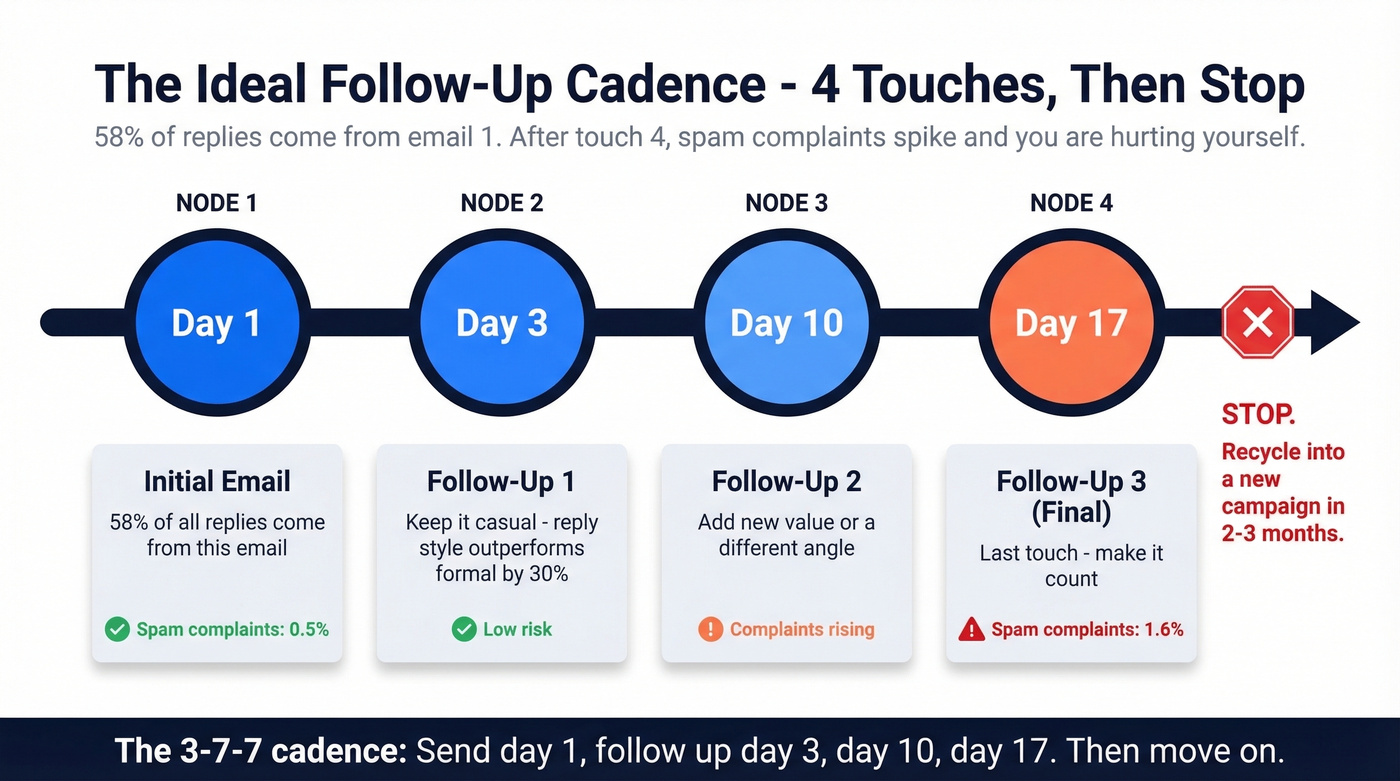
A strong baseline is three follow-ups after the initial email, four total touches. One proven cadence is 3-7-7: send day one, follow up day three, day ten, day seventeen. Step-2 follow-ups that feel like casual replies outperform formal follow-ups by about 30%. After three follow-ups with no response, stop. Recycle those prospects into a fresh campaign in 2-3 months with a new angle.
If you need copy you can deploy fast, keep a library of cold email follow-up templates and sales follow-up templates so reps don't improvise.
The three changes that improve reply rates most: verify your list to under 0.5% bounce rate, turn off open tracking, and target fewer contacts with trigger-event timing. Everything else is optimization on top of a working foundation.
Email Response Rate FAQ
What's a good cold email response rate in 2026?
The average is 3.43% based on Instantly's 2026 data. Strong campaigns hit 5.5-8%, and elite campaigns exceed 10%. Under 1% almost always signals a deliverability issue, not a messaging problem.
How many follow-up emails should I send?
Three follow-ups after your initial email, four total touches. The first email generates 58% of replies, and spam complaints spike sharply after the fourth touch. Recycle non-responders into a new campaign in 2-3 months with a fresh angle.
Does email length affect response rates?
Dramatically. Emails under 75-80 words outperform longer ones across every dataset we've reviewed. One practitioner cut from 141 to 56 words and doubled their reply rate. Use plain text, a single CTA, and lead with a timeline-based hook.
How can I verify my email list affordably?
Use a verification tool with catch-all handling, spam-trap removal, and honeypot filtering. Target a bounce rate under 0.5%. Prospeo offers 75 free verifications per month with 98% accuracy - enough for small campaigns or testing. If you're above 2% bounce rate, stop sending and clean your list immediately.