

How to Write Intro Emails That Actually Get Replies
A RevOps lead we work with sent 1,000 AI-generated intro emails last quarter. Personalization tokens, fancy templates, the works. Zero replies. Then she paused, wrote 14 emails by hand - each one referencing something specific about the prospect's business - and booked 3 meetings. That's not a fluke. That's the pattern we see over and over again.
You don't need 15 templates. You need one framework, verified data, and the discipline to send fewer, better emails.
The Framework in 30 Seconds
- Structure: Observation, Relevance, Value, CTA. Every introduction email hits these four beats.
- Length: Under 150 words. If your email looks like homework, it's getting archived.
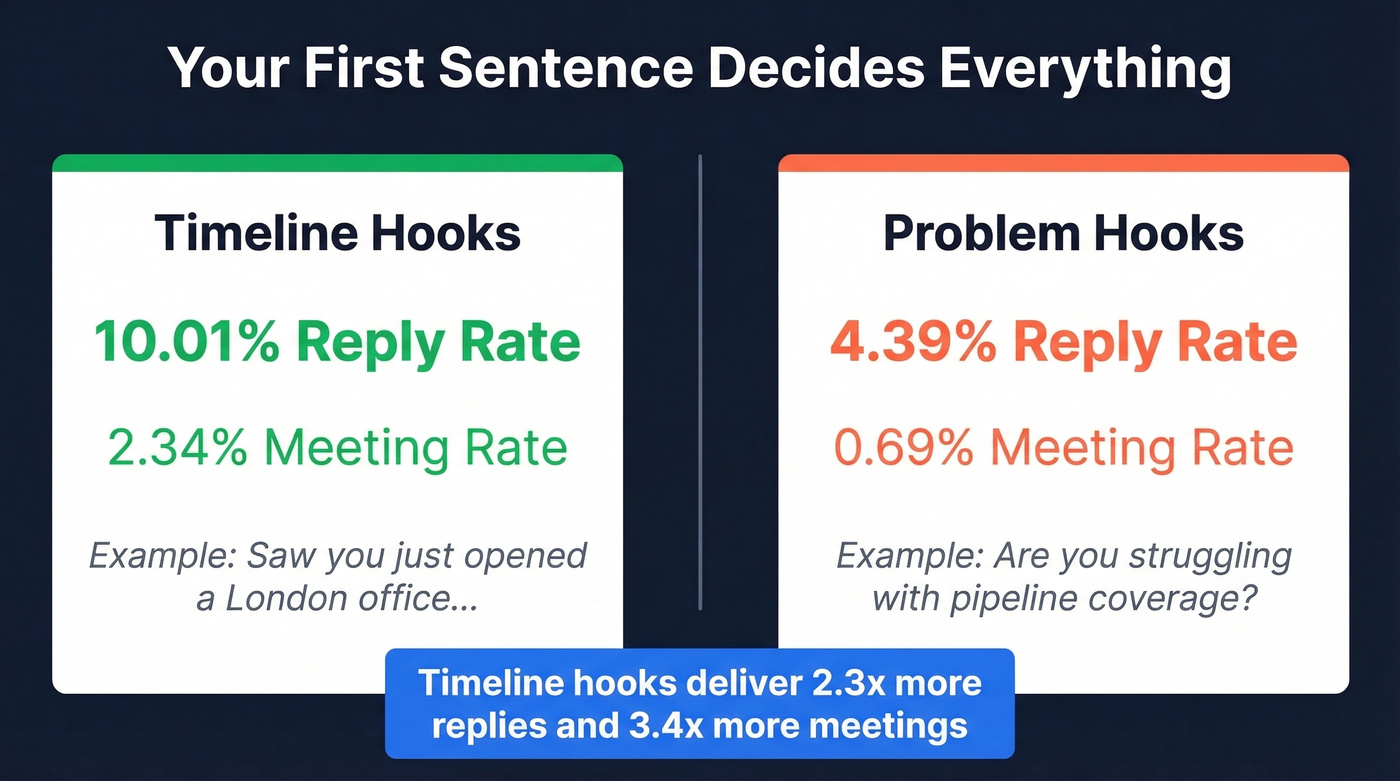
- Hook: Timeline hooks pull a 10.01% reply rate - 2.3x higher than problem hooks. Stop opening with "Are you struggling with..."
- The step everyone skips: Verify your list before you send. A 35% bounce rate doesn't just waste emails - it torches your domain reputation.
What the Data Says
Average B2B cold email reply rates sit around 3-5.1% based on 2026 benchmarks. Most teams live here and assume it's normal. It's not - it's the floor for generic outreach.
The biggest lever is your opening hook. Timeline hooks - where you reference a specific event or deadline relevant to the prospect - hit a 10.01% reply rate and a 2.34% meeting rate. Problem hooks ("Are you struggling with X?") land at 4.39% and 0.69%. That's a 2.3x lift in replies and 3.4x more meetings booked, just from changing your first sentence.
Personalization depth beats personalization tokens. An analysis of 11M emails found meaningful personalization drives 52% higher reply rates. Smaller cohorts of 50 contacts or fewer outperform broad blasts by 2.76x.
On the receiving end, 71% of ignored emails lack relevance, 43% fail on personalization, and 36% lack trust signals. Sending 1,000 emails before you've proven 14 work is the most expensive mistake in outbound. We've seen this across dozens of teams - the ones who slow down and verify their data first consistently outperform the ones blasting at scale.
The 4-Part Framework
1. Observation - Show you've done your homework. Reference something specific: a recent hire, a product launch, a funding round, a job posting that signals a pain point. This isn't "I saw your website." It's "I noticed you're hiring three SDRs in EMEA, which usually means outbound is working and you need more pipeline." Psychologically, this triggers reciprocity - you invested effort, so they feel a pull to engage.
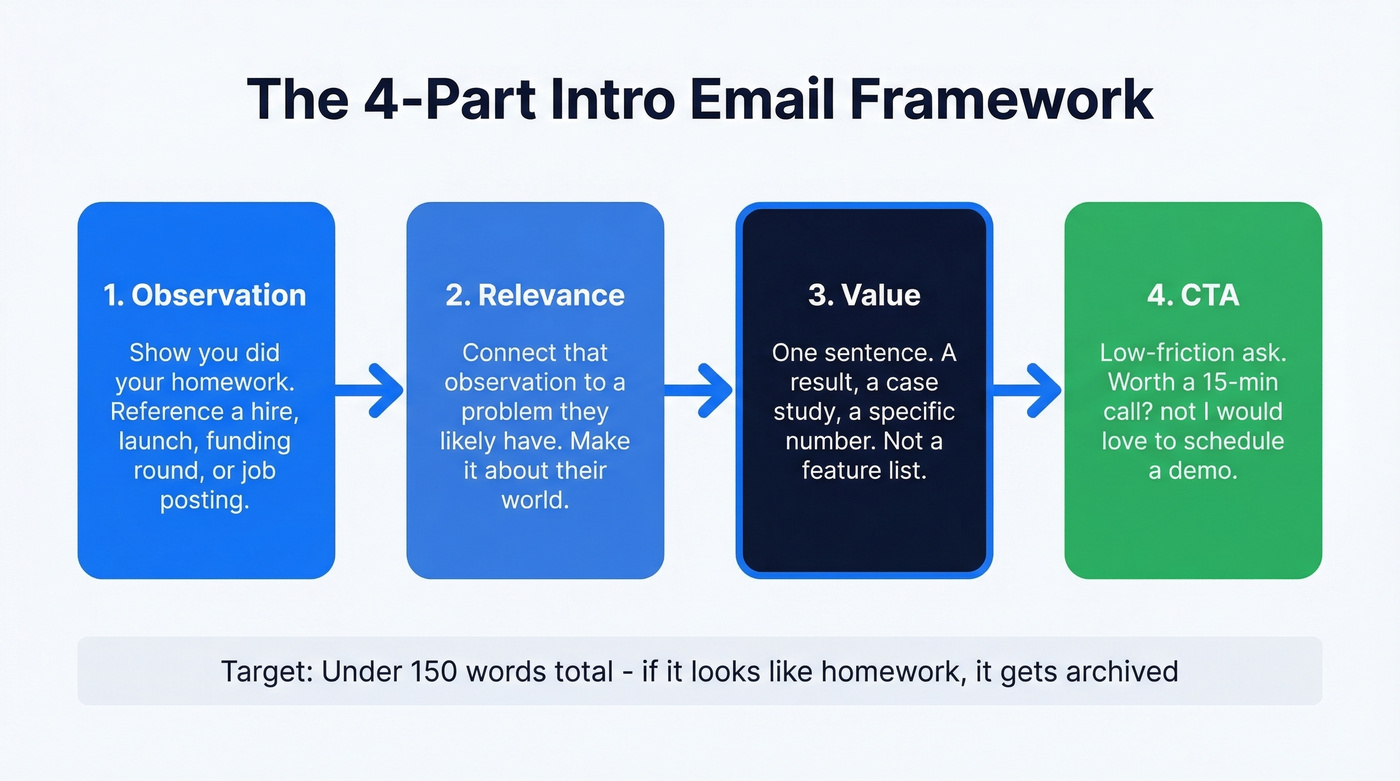
2. Relevance - Connect that observation to a problem they likely have. Make it about their world, not yours.
3. Value - One sentence on what you bring. A result, a case study, a specific number. Not a feature list. (If you need help tightening this, use a few sample elevator pitches as a starting point.)
4. CTA - Low-friction ask. "Worth a 15-minute call next week?" beats "I'd love to schedule a demo to walk you through our platform's capabilities." For more options, see email wording to schedule a meeting.
Let's compare two versions:
Before: "Hi Sarah, my name is Jake and I work at Acme. We help companies improve their sales process. I'd love to set up a call to discuss how we can help your team. Are you available this week?"
After: "Hi Sarah - saw you just opened a London office (congrats). Most US teams expanding into EMEA hit a wall on local data coverage within the first quarter. We helped [similar company] build a verified EMEA pipeline in 3 weeks. Worth a quick call Thursday?"
The second email is 52 words. It's specific. It's about her problem.
One more thing: skip gendered titles like "Mr." or "Mrs." unless you're certain of someone's preference. Use their first name. For group greetings, "Hi team" or "Hi everyone" always works better than "Hi guys" or "Dear Sir/Madam." Getting it wrong creates an instant negative impression.
Subject Line Science
SendGrid's data shows the best-performing subject lines are just 2-4 words, while the average sits at 6. Shorter wins because most prospects read email on their phones - and mobile clients are brutal with character limits.
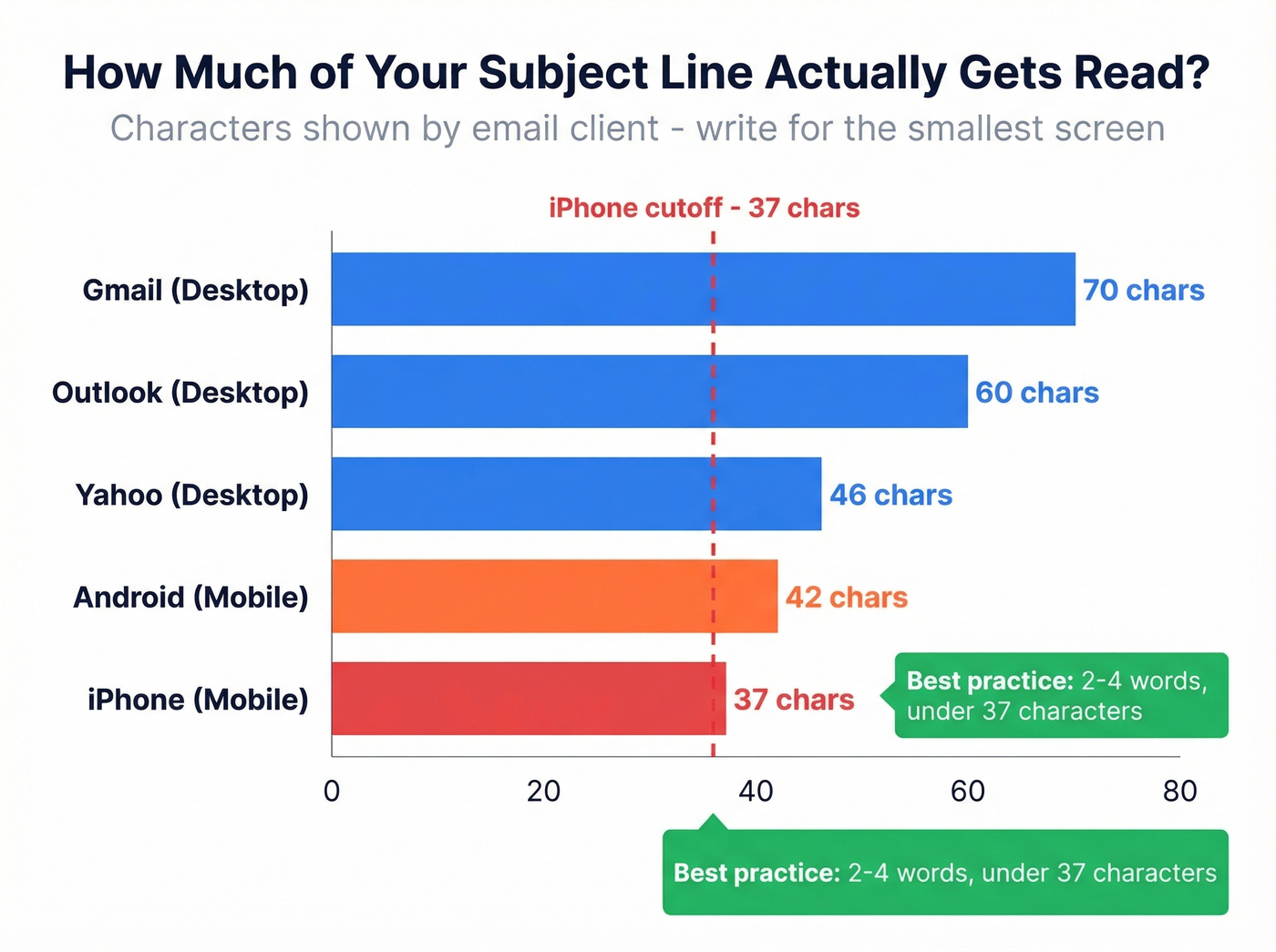
| Client/Device | Characters Shown |
|---|---|
| Gmail (desktop) | ~70 |
| Outlook (desktop) | 50-70 |
| Yahoo (desktop) | ~46 |
| iPhone (mobile) | 33-41 |
| Android (mobile) | 35-50 |
If your subject line is 60 characters, half your audience sees a truncated mess. Write for the iPhone constraint and you'll be fine everywhere. If you want more tested ideas, pull from these email subject line examples.
Avoid spam triggers: excessive exclamation points, dollar signs, phrases like "100% free" or "double your income." Fake "Re:" subject lines aren't just sleazy - a 2025 Washington State Supreme Court ruling created $500-per-email penalties for misleading subject lines, with at least eight lawsuits already filed.
Good subject lines are honest and specific. "EMEA pipeline question" beats "Quick question." "Congrats on the funding" beats "Exciting opportunity."

You just read it: a 35% bounce rate torches your domain reputation. Prospeo's 5-step email verification delivers 98% accuracy - so your carefully crafted intro emails actually land in inboxes, not the void.
Stop writing perfect emails to dead addresses.
Templates by Scenario
Cold Sales Outreach
This uses the timeline-hook approach - the highest-performing opener in the data.
Subject: [Company]'s EMEA expansion
Hi [Name] - noticed [Company] just posted three SDR roles in London. Teams scaling outbound in EMEA usually hit a data quality wall fast.
We helped [similar company] build 2,000 verified EMEA contacts in their first week and book 14 meetings in 30 days.
Worth 15 minutes next Tuesday?
Why it works: specific observation, relevant problem, concrete result, low-friction CTA. Under 60 words.
For enterprise or C-suite prospects, swap the casual opener for something like "I noticed [Company] recently expanded its SDR team into EMEA - congratulations on the growth." Same structure, slightly more polished tone. Read the room.
Partnership or Collaboration
Subject: [Your company] + [Their company]
Hi [Name] - our audiences overlap but our products don't compete. [Your company] serves [segment] and we keep hearing them ask about [their problem your partner solves].
Would a co-hosted webinar or content swap make sense? Happy to share our audience numbers if helpful.
Mutual benefit, stated upfront. No vague language about "alignment."
Networking / Informational Interview
Subject: Your talk at [event]
Hi [Name] - your [specific talk/post/article] changed how I think about [topic]. I'm building [relevant thing] and would love to hear how you approached [specific challenge].
Any chance you'd have 15 minutes for a coffee chat this month? Totally understand if timing doesn't work.
Low pressure. Specific compliment. Easy out.
New Job - Introducing Yourself
Subject: New [role] - excited to join
Hi team - I'm [Name], joining as [role] starting [date]. Previously I was at [company] where I [one relevant accomplishment].
Outside work, I'm into [one personal detail]. Looking forward to meeting everyone. Feel free to grab time on my calendar for a quick intro.
Brief, warm, shows personality. Nobody wants a three-paragraph corporate bio in their inbox.
Client Handoff
Subject: New CSM
Hi [Name] - I'm [Name], your new CSM at [Company]. [Previous CSM] brought me up to speed, and I'm excited to work with your team.
I'd love a quick 15-minute call to cover how you define success with [product], any open items, and your priorities for next quarter.
[Calendar link]
PS - Saw your team just launched [specific thing]. Congrats.
The PS personalization hook turns a transactional handoff into a human moment. It takes 30 seconds to research and makes the email memorable. (If you want more variations, use these handoff email templates.)
Warm Intro Between Two People
Most people do warm introductions wrong. They CC both parties without asking either one first. Use double opt-in instead - email the person you're introducing to first, without the other party CC'd:
Subject: Intro to [Name] - [one-line context]
Hi [Name] - a colleague of mine, [Name], is [one-line context]. I think you two could help each other with [specific overlap]. Want me to connect you?
If they say yes, then you send the connecting email. Referred leads convert 4x more often - warm introductions are worth doing right.
Here's the thing: if your average deal size is under $15K, you probably don't need a 12-step automated sequence. You need 50 well-researched introduction emails per week, sent to verified addresses, with genuine observations in every one. Volume is the crutch teams reach for when their messaging isn't working.
Follow-Up Sequences That Work
80% of meetings aren't set on the first email. If you're sending one intro email and moving on, you're leaving most of your pipeline on the table.
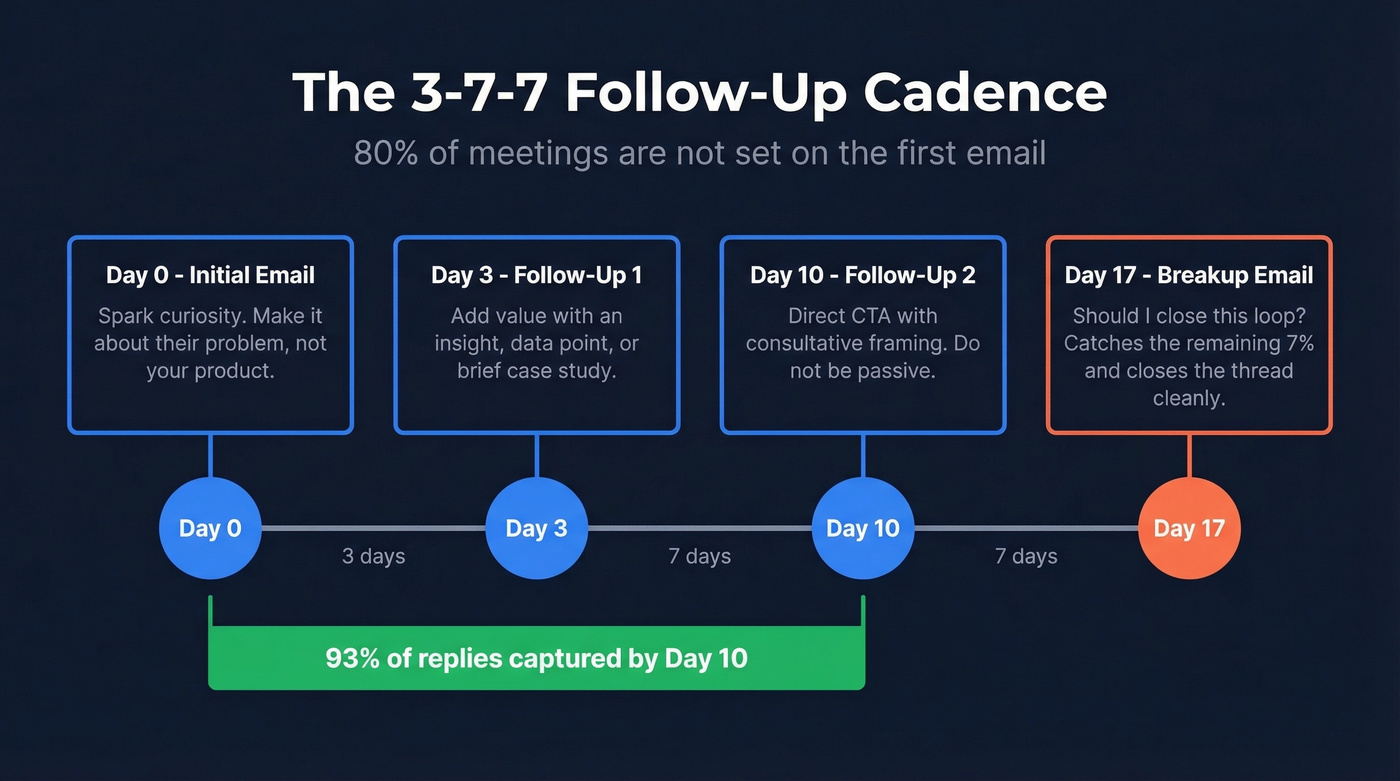
The 3-7-7 cadence captures 93% of replies by Day 10:
- Day 0: Initial email - spark curiosity, make it about their problem
- Day 3: Follow-up #1 - add value with an insight, data point, or brief case study
- Day 10: Follow-up #2 - direct CTA, consultative framing
- Day 17: Breakup email - "Should I close this loop?" This catches the remaining ~7% and cleanly closes the thread
Each email has a different job. Don't pitch in email one and don't be passive in email three. The second follow-up should add something useful - not just "bumping this to the top of your inbox." If you need plug-and-play options, use these sales follow-up templates.
Reddit threads on r/sales consistently flag the same mistake: giving up after one email. In our experience, two to four follow-ups spaced a few days apart is the sweet spot. More than that and you're annoying people.
Mistakes That Kill Your Emails
Opening with "My name is..." - Nobody cares who you are until they care what you can do for them. Lead with the observation, not your bio.
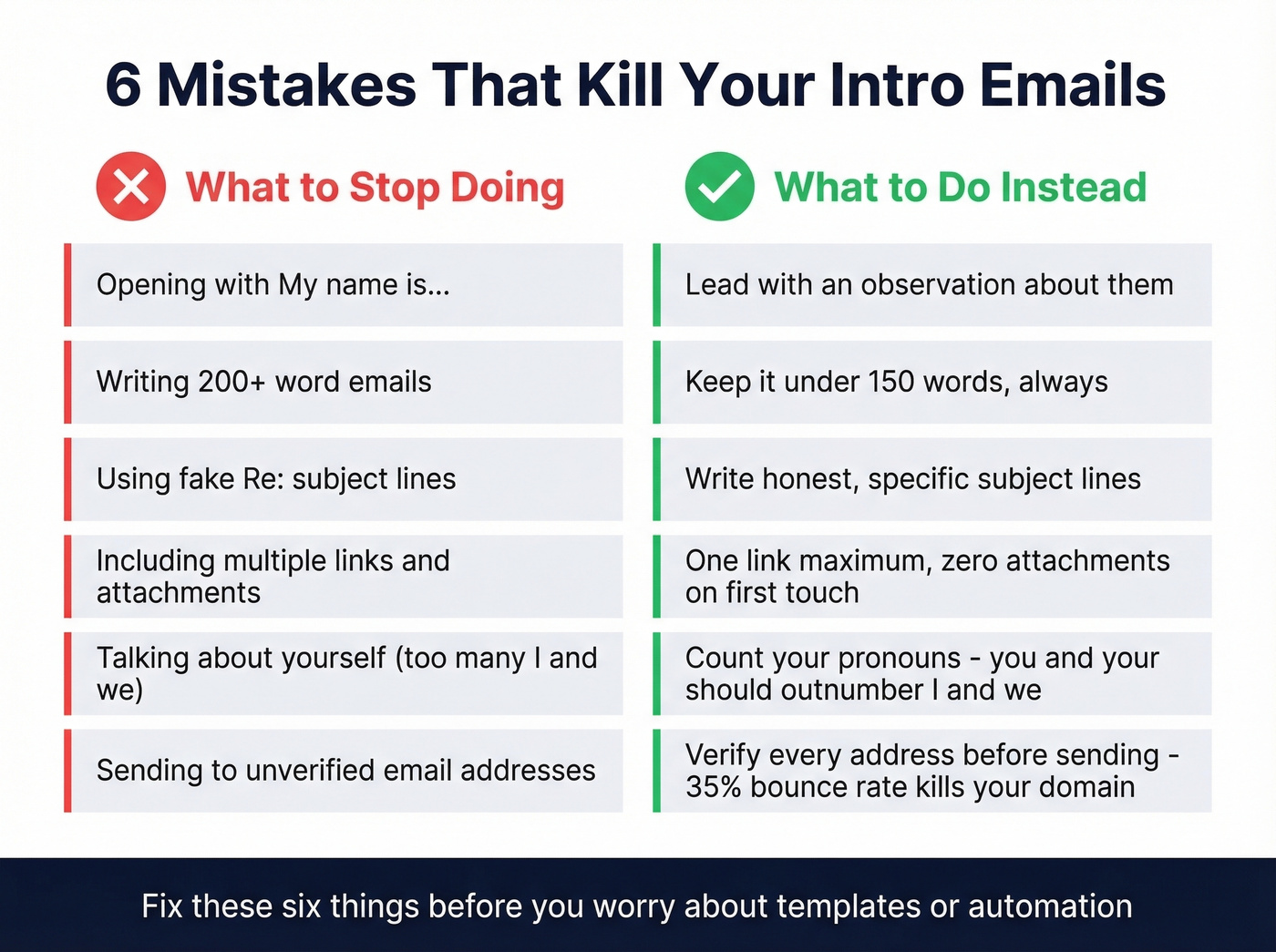
Going over 150 words. Community threads on r/emailmarketing echo this constantly: long emails get treated as homework. Keep it tight.
Fake "Re:" subject lines - Legally actionable. Don't.
Too many links or attachments - Every link is a deliverability risk on a first touch. One link maximum. Zero attachments.
Talking about yourself - Count the "I" and "we" in your email. If they outnumber "you" and "your," rewrite it.
Sending to unverified addresses - This is the silent killer. You send 200 emails, 35% bounce, and suddenly your domain reputation is in the gutter. Every email you send for the next month lands in spam - including the ones to valid addresses. I've watched teams spend months recovering from a single bad send. Run your list through a verification tool like Prospeo before hitting send - its 5-step verification process catches spam traps, honeypots, and catch-all domains in real time with 98% accuracy, and the free tier covers 75 emails per month. (More on this in our email deliverability guide and email bounce rate breakdown.)
Smaller cohorts of 50 contacts outperform blasts by 2.76x. Prospeo's 30+ filters - buyer intent, job changes, funding rounds - let you build hyper-targeted lists so every intro email references something real. At $0.01 per verified email, sending fewer and better finally makes economic sense too.
Build the 50-person list that outperforms your 1,000-person blast.
Compliance You Can't Ignore
CAN-SPAM applies to B2B email. The FTC is explicit: "The law makes no exception for business-to-business email." Penalties reach $51,744 per non-compliant email.
Your compliance checklist:
- Accurate header information - your "From" name and email must be truthful
- Honest subject lines - no deceptive "Re:" or misleading framing
- Valid physical address - a real street address or registered PO box in every email
- Functional unsubscribe - must work for at least 30 days after sending
- Honor opt-outs within 10 business days
Beyond CAN-SPAM, GDPR penalties reach EUR 20M or 4% of global annual revenue. Canada's CASL can hit $10M per violation. When you're sending intro emails internationally, know which laws apply. On the technical side, authenticate your sending domain with SPF, DKIM, and DMARC before you send a single email - and verify every address beforehand so your messages reach real inboxes, not bounce logs. (If you need a checklist, start with how to verify DKIM is working.)
FAQ
How long should an intro email be?
Under 150 words for cold outreach - three to five sentences max. Professional introductions like new job announcements or client handoffs can stretch slightly longer but should still fit on one phone screen without scrolling.
What's the best subject line for an introduction email?
Two to four words that reference something real - their company name, a recent event, or a shared connection. SendGrid's data confirms shorter subject lines outperform. Never use fake "Re:" prefixes; they carry legal risk.
How many follow-ups should I send after an intro email?
Three to four on a 3-7-7 cadence. 93% of replies come by Day 10. After four touches with no response, send a breakup email and move on - persistence has diminishing returns past that point.
Do I need to comply with CAN-SPAM for B2B emails?
Yes - the FTC makes no exception for business email. Penalties reach $51,744 per message. Every email needs a physical address, honest subject line, and functional unsubscribe link.
How do I verify email addresses before sending?
Use a verification tool to catch invalid addresses, spam traps, and catch-all domains before you hit send. Prospeo's 5-step verification process delivers 98% accuracy, and the free tier covers 75 verifications per month - enough to protect a small campaign.