

How to Introduce Yourself in an Email That Actually Gets a Reply
The average professional receives 121 emails per day. Yours gets about three seconds - and 47% of recipients decide whether to open based on the subject line alone. Introducing yourself in an email sounds simple until you're staring at a blank compose window, overthinking every word. Stop overthinking. What actually moves reply rates is length, timing, and whether your email lands in the first place.
What You Need (Quick Version)
Three rules separate intro emails that get replies from ones that get deleted:
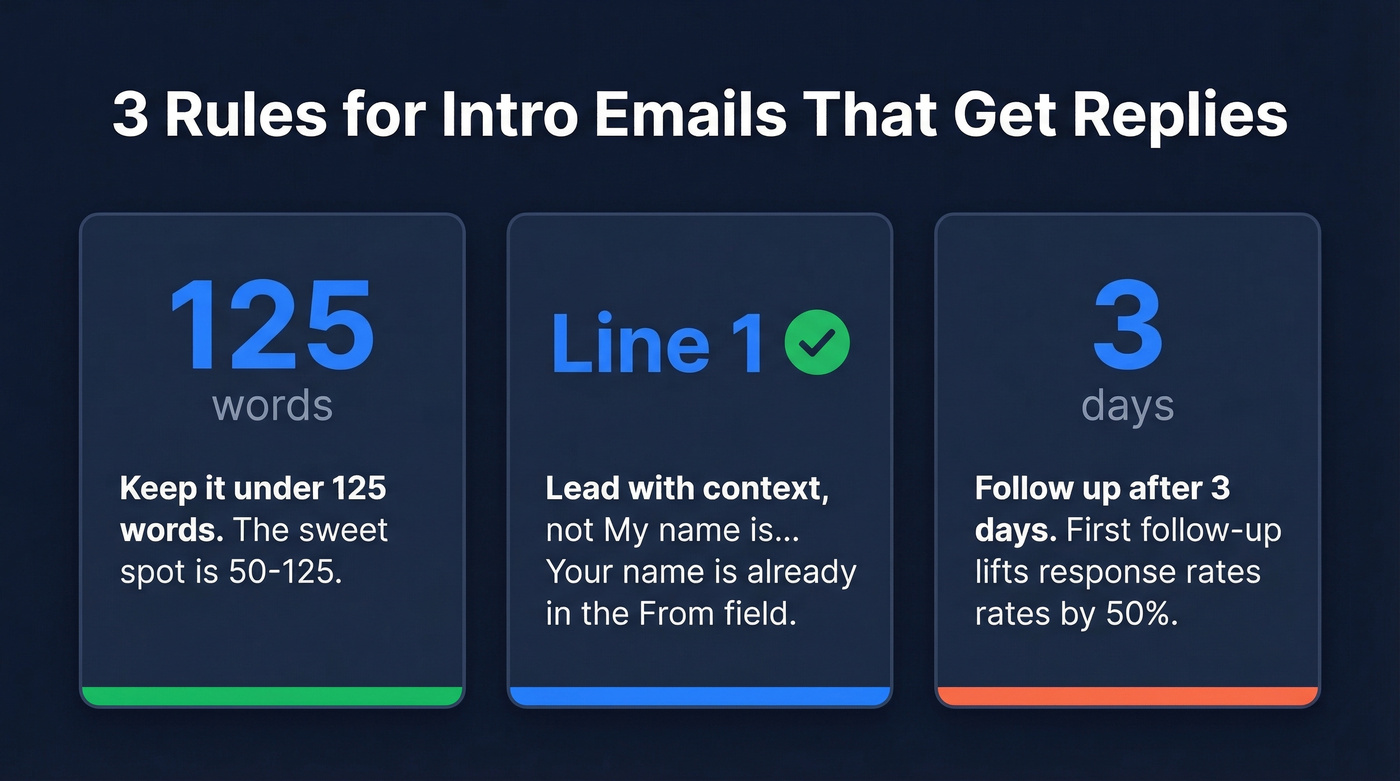
- Keep it under 125 words. The sweet spot is 50-125 words. Shorter is almost always better.
- Lead with context, not "My name is..." Your name's already in the From field and your signature. Don't waste your opening line restating it.
- Follow up after 3 days. The first follow-up lifts B2B response rates by 50%. Most replies come from email #2, not email #1.
How to Write Your Introduction Email
Short, Specific Subject Line
Twilio SendGrid's data shows the best-performing subject lines are 2-4 words. Shorter consistently wins - especially on mobile, where truncation is brutal. One founder on r/Entrepreneur A/B tested subject lines across a cold outreach campaign:
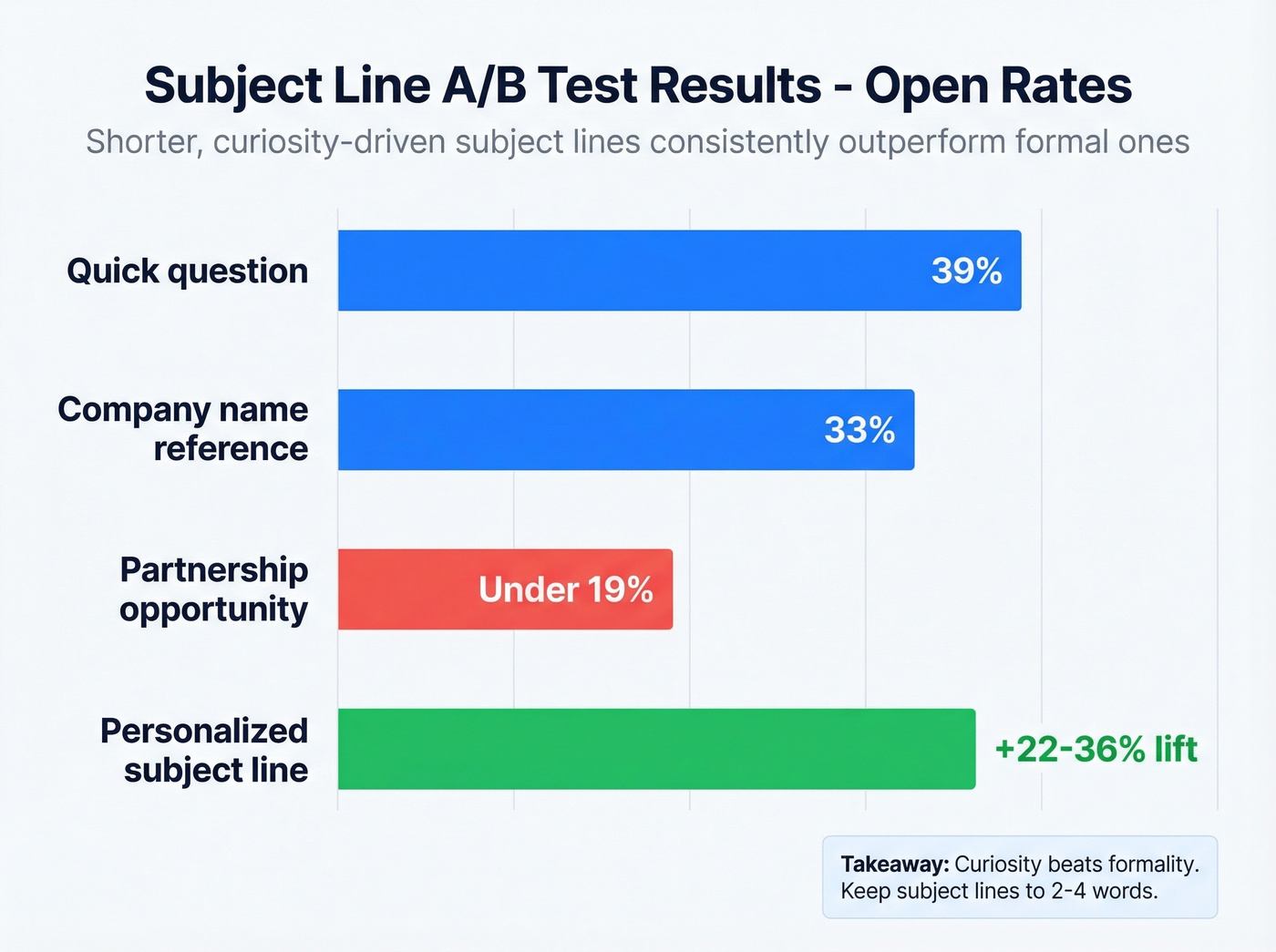
| Subject Line Style | Open Rate |
|---|---|
| "Quick question" | 39% |
| Company name reference | 33% |
| "Partnership opportunity" | <19% |
| Subject-line personalization (benchmark) | +22-36% lift |
"Quick question" crushed "Partnership opportunity" by 20+ points. Curiosity beats formality every time. And subject lines drive spam complaints too - 69% of recipients mark emails as spam based on the subject line alone.
Over 60% of emails are opened on mobile, and many inboxes chop subject lines around 33-50 characters. iPhone often shows ~33-41 characters; Android ~35-50. Once you're past ~40-50 characters, a big chunk of your audience reads a truncated version. Keep it tight.
Lead With Context, Not Credentials
There's a recurring debate on Reddit about whether starting with "My name is..." feels odd in professional emails. The consensus: it's redundant. Your name is in the From field and your signature. Opening with it wastes your most valuable real estate.
Instead, lead with a shared connection, a specific observation, or the reason you're writing. "I saw your talk at SaaStr last week" beats "My name is Sarah and I work at Acme Corp" every time. Whether you're reaching out to a prospect or a future colleague, context outperforms credentials as an opener.
Identity + Ask in Two Sentences
After the context hook, give the reader two things in two sentences: who you are and what you want. "I run partnerships at [Company] - we help mid-market SaaS teams reduce churn by 15-20%." One sentence of identity, one sentence of value. Don't stack three paragraphs of background before the point.
If you want more examples of intros that convert, start with these company introduction email examples.
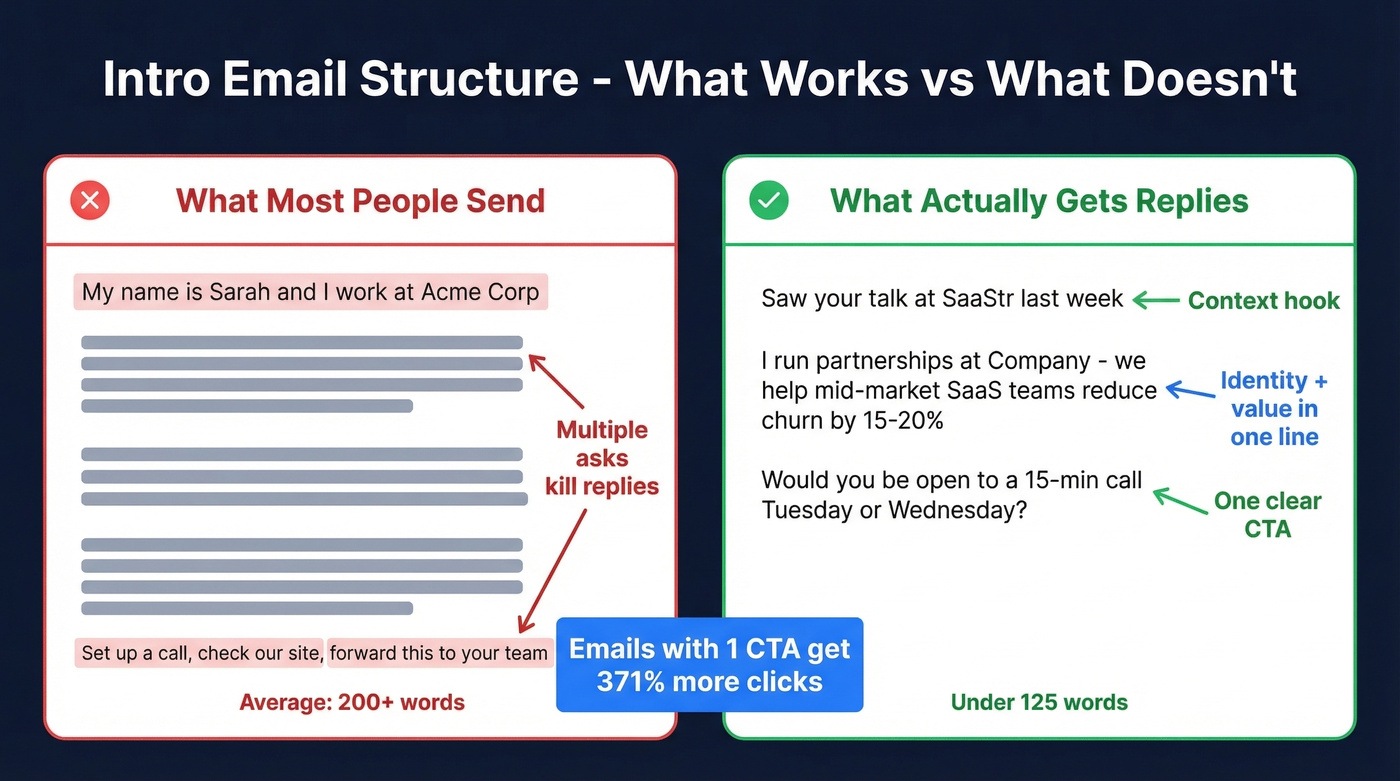
Emails with one clear CTA get 371% more clicks than emails with multiple asks. This is the single biggest structural mistake in intro emails. Bad: "I'd love to set up a call, or if you prefer, check out our site, and also feel free to forward this." Good: "Would you be open to a 15-minute call next Tuesday or Wednesday?" One ask. Specific. Easy to say yes or no to.
Close with a brief "Thanks for your time" and a clean signature: name, title, company, phone. Skip the inspirational quotes and the five social media icons.
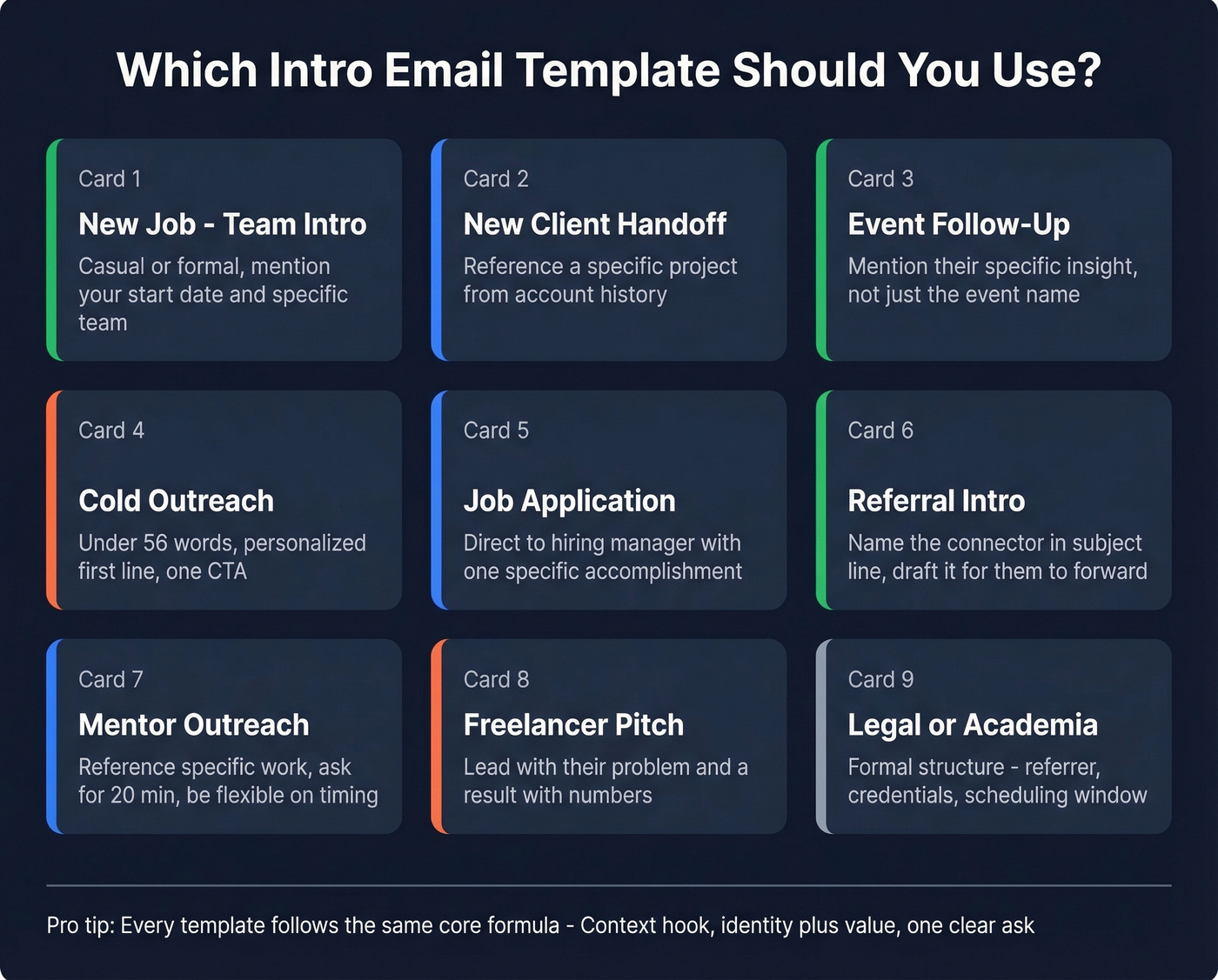
Templates for Every Scenario
New Job - Email to the Team
Casual version:
Subject: Quick hello - new [Role]
Hi [Team/Name],
I'm joining [Company] as the new [Role] starting [Date]. I'll be working with [their team] on [specific area].
I'd love to learn what's working well and where I can be most useful. Coffee or a quick call this week?
[Your Name]
Formal version:
Subject: Introduction - [Your Name], [Role]
Dear [Team/Name],
I'm pleased to be joining [Company] as [Role], effective [Date]. I'll be supporting [their team/function] on [specific area] and look forward to contributing to [initiative].
I'd welcome the opportunity to connect this week. Please let me know a convenient time.
Best regards, [Your Name]
The casual version works for startups and lateral peers. The formal version is better for large organizations or when you're addressing senior leadership.
New Client or Account Manager
Subject: Your new point of contact at [Company]
Hi [Client Name],
I'm [Your Name], taking over as your account manager from [Previous Person]. [Previous Person] briefed me on [specific project] - I'm up to speed and ready to keep things moving.
Can we schedule a 20-minute intro call this week? I want to make sure the transition is smooth for your team.
[Your Name], [Title]
Why this works: Referencing a specific project from the account history signals you've done your homework. Clients dread re-explaining everything to a new contact.
Networking - Event Follow-Up
Casual version:
Subject: Great meeting you at [Event]
Hi [Name],
We spoke at [Event] about [topic]. Your point about [specific insight] stuck with me - it's exactly the challenge we're tackling at [Company].
Would you be open to continuing that conversation over a quick call next week?
[Your Name]
Formal version:
Subject: Following up from [Event] - [Your Name]
Dear [Name],
It was a pleasure speaking with you at [Event] regarding [topic]. Your perspective on [specific insight] was particularly relevant to our current work at [Company].
I'd welcome the chance to continue our discussion. Would you have time for a brief call next week?
Best regards, [Your Name]
Cold Outreach to a Prospect
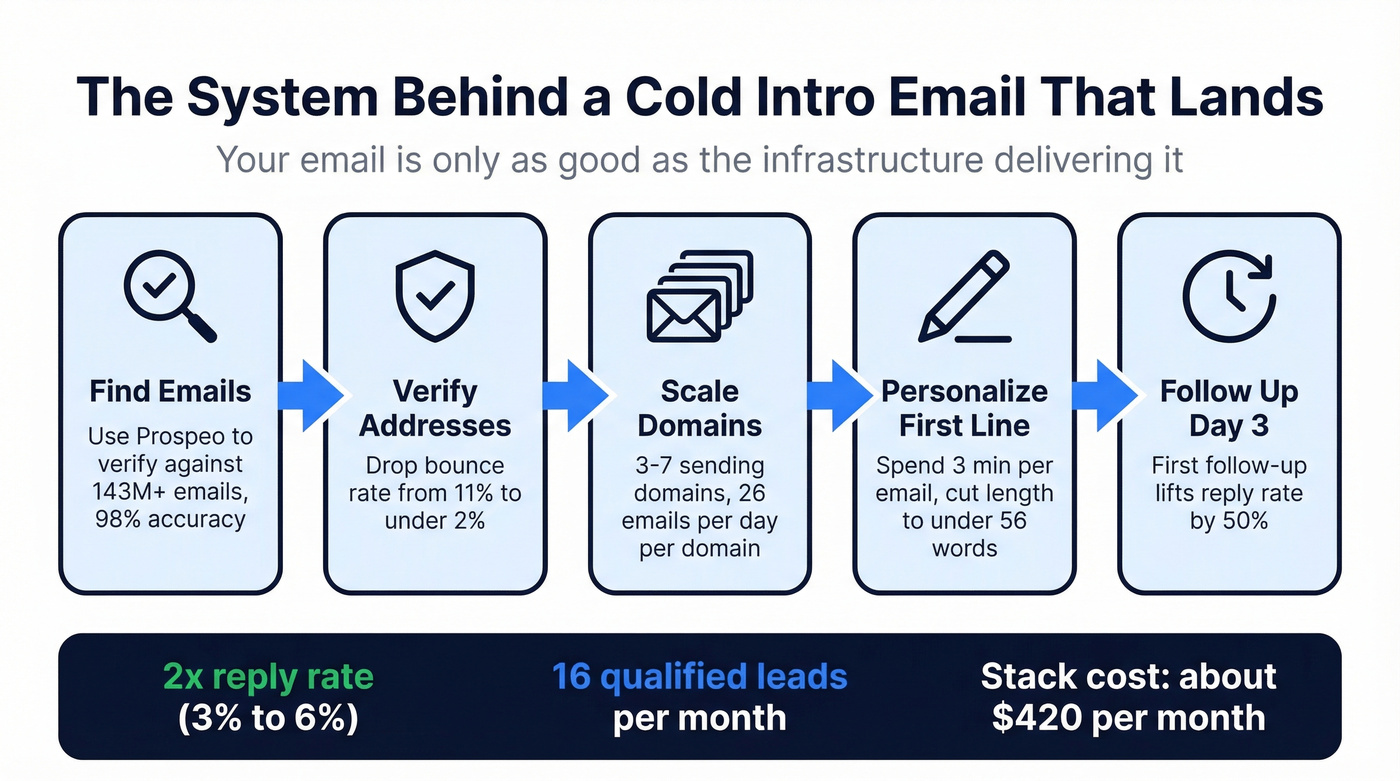
Here's the thing: this is where most intro emails fall apart. Sending a cold introduction to a stranger demands sharper personalization than any other scenario. A founder on r/Entrepreneur doubled their reply rate from 3% to 6% by cutting emails from 141 words to under 56 and spending ~3 minutes personalizing the first line.
If you're building a full sequence (not just a single intro), use this B2B cold email sequence framework.
Subject: Quick question
Hi [Name],
Noticed [Company] just [specific signal - new hire, funding round, product launch]. When teams hit that stage, [specific pain point] usually becomes a bottleneck.
We help [similar companies] solve that - [one-line result]. Worth a 15-minute call?
[Your Name]
The infrastructure behind this matters. That same founder scaled from 3 to 7 sending domains, capped sends at 26 emails per day per domain, and dropped their bounce rate from 11% to under 2%. Total stack cost: ~$420/month, generating 16 qualified leads monthly. The takeaway: your intro email is only as good as the system delivering it. Verify addresses before you send - tools like Prospeo check against 143M+ verified emails with 98% accuracy, so you're not burning domain reputation on dead addresses.
If you’re troubleshooting bounces and list quality, this email bounce rate guide breaks down what to fix first.

Job Application to a Hiring Manager
Subject: [Role Title] - [Your Name]
Hi [Hiring Manager],
I applied for the [Role] through [channel] and wanted to introduce myself directly. I've spent [X years] in [relevant field], most recently at [Company] where I [specific accomplishment].
I'm drawn to [something specific about their company]. Happy to share more context - would a brief call work?
[Your Name]
Skip this template if you're applying to a company that explicitly says "no direct outreach to hiring managers." Ignoring that instruction signals you don't follow directions - the opposite of what you want.
Referral / Warm Introduction
Subject: [Connector's Name] suggested I reach out
Hi [Name],
[Connector] mentioned you'd be a great person to talk to about [topic]. I'm [one sentence of context]. [Connector] thought we'd be able to help each other on [specific area].
Would you have 15 minutes this week or next?
[Your Name]
Here's the move most people miss: draft this email for your connector to forward. Write a two-sentence blurb they can paste into their own message - something like "Hey [Name], my friend [You] does [thing] and I think you two should connect. Forwarding their note below." Your connector is doing you a favor. Make it effortless for them.
Mentor or Senior Leader
Subject: Admired your work on [specific thing]
Dear [Name],
I'm [Your Name], a [role/stage] at [Company/School]. I've followed your work on [specific project or publication] and it's shaped how I think about [topic].
I'd be grateful for 20 minutes of your time to ask a few questions about [specific area]. Happy to work around your availability.
Respectfully, [Your Name]
Freelancer Pitching Services
Subject: [Specific result] for [their company type]
Hi [Name],
I help [type of company] with [specific service]. Recently worked with [similar company] and [specific result with numbers].
Noticed [specific observation about their business]. I have a few ideas - worth a quick chat?
[Your Name], [Title/Company]
Common mistake here: leading with your credentials instead of their problem. Nobody cares that you have 10 years of experience until they know you understand their situation.
Legal / Academia / High-Formality
Following the Harvard Law networking email structure: reference the referrer, show domain-specific interest, add 1-2 credibility lines, then make a clear request with a scheduling window. A formal self-introduction in these fields demands more structure than a casual cold pitch.
Subject: Informational interview request - [Your Name], [School/Firm]
Dear [Title] [Last Name],
[Referrer] suggested I contact you regarding your work in [practice area]. I'm a [year] student at [School] with a focus on [area], and your [specific case/publication] is directly relevant to my research.
Would you be available for a brief conversation in the next two weeks? I'm happy to meet at your convenience.
Respectfully, [Full Name] [Email] | [Phone]
Vendor or Partnership Inquiry
Subject: [Your Company] + [Their Company]
Hi [Name],
I'm [Your Name] at [Company]. We [one sentence about what you do]. I think there's a natural fit between [your offering] and [their audience/product].
Would you be open to a 15-minute call to explore this?
[Your Name]
Re-Introduction After a Long Gap
Subject: It's been a while - [Your Name]
Hi [Name],
We last connected [when/where/context]. I've since moved to [new role/company] and your work on [specific thing] came to mind.
I'd love to reconnect - are you free for a quick call this month?
[Your Name]
Internal Cross-Functional Intro
Subject: Intro - [Your Name] from [Your Team]
Hi [Team/Name],
I'm [Your Name] from [Department]. We'll be collaborating on [project] over the next [timeframe]. My focus will be [specific responsibility].
I'd love to sync early so we're aligned. Does [specific time] work for a quick kickoff?
[Your Name]

That cold intro template above only works if it actually reaches someone's inbox. Bad email addresses kill your domain reputation and tank reply rates. Prospeo verifies against 143M+ emails with 98% accuracy - so every introduction you send lands where it should.
Stop introducing yourself to bounced inboxes. Verify first.
Best Time and Length to Send
Timing matters more than most people think. A MailerLite study of 2.1M+ campaigns found open rates peak between 8-11am local time, with Friday (49.72%) and Monday (49.44%) leading. One founder reported a 16% open rate improvement after shifting sends to Tuesday-Thursday, 8-11am in the recipient's timezone.
For cold outreach specifically, Siege Media analyzed 85,000+ personalized emails and found Monday delivered the best results - ~20% open rate, 4.3% click rate, 2.8% reply rate - with 6-9am PST as the optimal window. (For a deeper breakdown, see our guide on the best time to send cold emails.)
One caveat on open rates: Apple Mail Privacy Protection, used by roughly 46% of email clients, pre-loads tracking pixels and inflates open rates by ~18 points. We've seen teams celebrate "great open rates" that were mostly phantom loads. Track replies and clicks instead.
On length, the data is unambiguous. The founder who cut emails from 141 to 56 words doubled their reply rate. The sweet spot is 50-125 words. Most people write intro emails that are twice as long as they need to be. Cut yours in half, then see if you can cut it again.
If you want to tighten the writing without losing clarity, this email copywriting guide helps.
Let's be honest about something: if your deal size sits below $10k, you don't need a five-email nurture sequence with case studies and testimonials. You need a 50-word email, a verified address, and a follow-up three days later. Complexity is the enemy of cold outreach at lower price points.
Follow-Up Strategy
The first follow-up increases B2B response rates by 50%. Roughly 60% of replies come after the follow-up, not the initial email. If you're sending one email and giving up, you're leaving most of your replies on the table.
Wait 3 days. Keep the follow-up shorter than the original - add new value or reframe the ask, don't just repeat yourself.
If you need ready-to-send options, use these sales follow-up templates.
Subject: Re: [Original Subject]
Hi [Name],
Wanted to circle back on my note from [day]. I also came across [new relevant detail - article, data point, mutual connection] that might be useful.
Still happy to chat if the timing works. Would [specific day] be better?
[Your Name]
For cold sequences, 4-7 emails over 14-21 days is the high-performing range. Each touchpoint should add something new - a case study, a relevant stat, a different angle. Don't just bump the thread with "checking in." That's the fastest way to get archived.
Mistakes That Kill Reply Rates
Writing too much. Emails over 150 words see reduced engagement. If your intro email requires scrolling on mobile, it's too long.
Generic first lines. "I hope this email finds you well" tells the reader nothing and signals a mass blast. We've tested this ourselves - swapping a generic opener for a specific observation about the recipient's company lifted reply rates by double digits in our outreach campaigns.
Opening with "My name is..." wastes your best real estate. Lead with why you're writing.
No clear CTA. If the reader finishes your email and doesn't know what you're asking for, they'll do nothing. One specific ask - not three options.
Sending to an invalid address is the most expensive mistake on this list. Bounce rates above 5% trigger spam filters and damage your domain reputation. One bounced email is wasted effort; a pattern of bounces tanks deliverability for every email you send after that. If you're doing cold outreach, warm up your domains, set up SPF/DKIM/DMARC authentication, and verify every address before you hit send.
If you’re working on inbox placement end-to-end, use this email deliverability guide.
Salesy subject lines. "Partnership opportunity" and "Exciting offer" are spam-filter magnets. Curiosity and brevity win. For more ideas, browse these email subject line examples.
The founder who doubled their reply rate also dropped bounce rates from 11% to under 2%. That's not just better copy - it's cleaner data. Prospeo's 5-step verification catches spam traps, honeypots, and catch-all domains before they torch your sending reputation.
Great intro emails deserve verified contacts. Start at $0.01 per email.
How to Measure Success
HubSpot's 2026 benchmark puts the average open rate at 42.35%, but that number is inflated by Apple's privacy features. Track replies and clicks instead. For cold intro emails, a 7-10% response rate is a solid benchmark. Below 5%? Revisit your subject lines, email length, and list quality. Above 10%? Your targeting and personalization are working - scale it.
The email that gets replies isn't the one with the cleverest template. It's the one that's short, specific, sent at the right time, to a verified address, with a follow-up queued three days later. Whether you're introducing yourself in an email to a new team or a cold prospect, stop obsessing over the perfect draft and start optimizing the system around it.
FAQ
How formal should my email introduction be?
Match the recipient's industry and seniority. Startups and peers get first names and a conversational tone. Legal, academia, and C-suite contacts warrant full names and formal structure. When you're unsure, err slightly formal - you can loosen up once they reply casually.
What's the ideal word count for an intro email?
Aim for 50-125 words. For cold outreach, stay under 75. One founder cut emails from 141 to 56 words and doubled their reply rate from 3% to 6%. Shorter emails respect the reader's time and force you to sharpen your message.
Should I follow up if I don't hear back?
Always. The first follow-up increases B2B response rates by 50%, and roughly 60% of replies come after the follow-up rather than the initial email. Wait 3 days, then send a shorter message that adds new value - a relevant article, data point, or reframed ask.
How do I find someone's email for a cold introduction?
Use a verified email finder instead of guessing formats like firstname@company.com. Sending to an invalid address bounces, wastes effort, and damages domain reputation. Prospeo's free tier gives you 75 verified lookups per month - enough to test your first campaigns without risk.
What's the biggest mistake when emailing someone you've never met?
Opening with a generic greeting like "I hope this finds you well" instead of a specific reason for reaching out. Your first sentence must answer "why should I care?" - reference their recent work, a mutual connection, or a concrete observation. If you can't articulate a clear reason, you're not ready to send.