

How to Write an Introduction Email for a Business Proposal That Gets a Reply
The average cold email reply rate is 3.43%. That means 97 out of 100 proposal emails vanish - and 17% of cold emails never even reach the inbox. Your introduction email for a business proposal decides whether anyone reads what you spent hours preparing. Most people get it wrong.
Quick version:
- Solicited proposal (they asked for it): Use the 7-point executive summary framework, keep it around 150 words, and link to the proposal instead of attaching it.
- Unsolicited proposal (cold outreach): Under 80 words, one question, no attachments, and typically no links on the first touch.
- Before you write anything: Verify the email address. A bounced email damages your domain reputation.
Why the Introduction Email Matters More Than the Proposal
With 392.5 billion emails sent daily, your prospect's inbox is a warzone. They've got roughly 2.7 seconds to decide whether to read or delete yours. The intro email is the true first impression - not the proposal itself.
Here's the thing: most proposal emails fail not because the offer is weak, but because the sender wrote a mini-essay instead of a compelling hook. In a lot of deals, you don't need a long document up front. You need a tight email that starts a conversation.
Solicited vs. Unsolicited: Two Different Emails
These require completely different approaches.
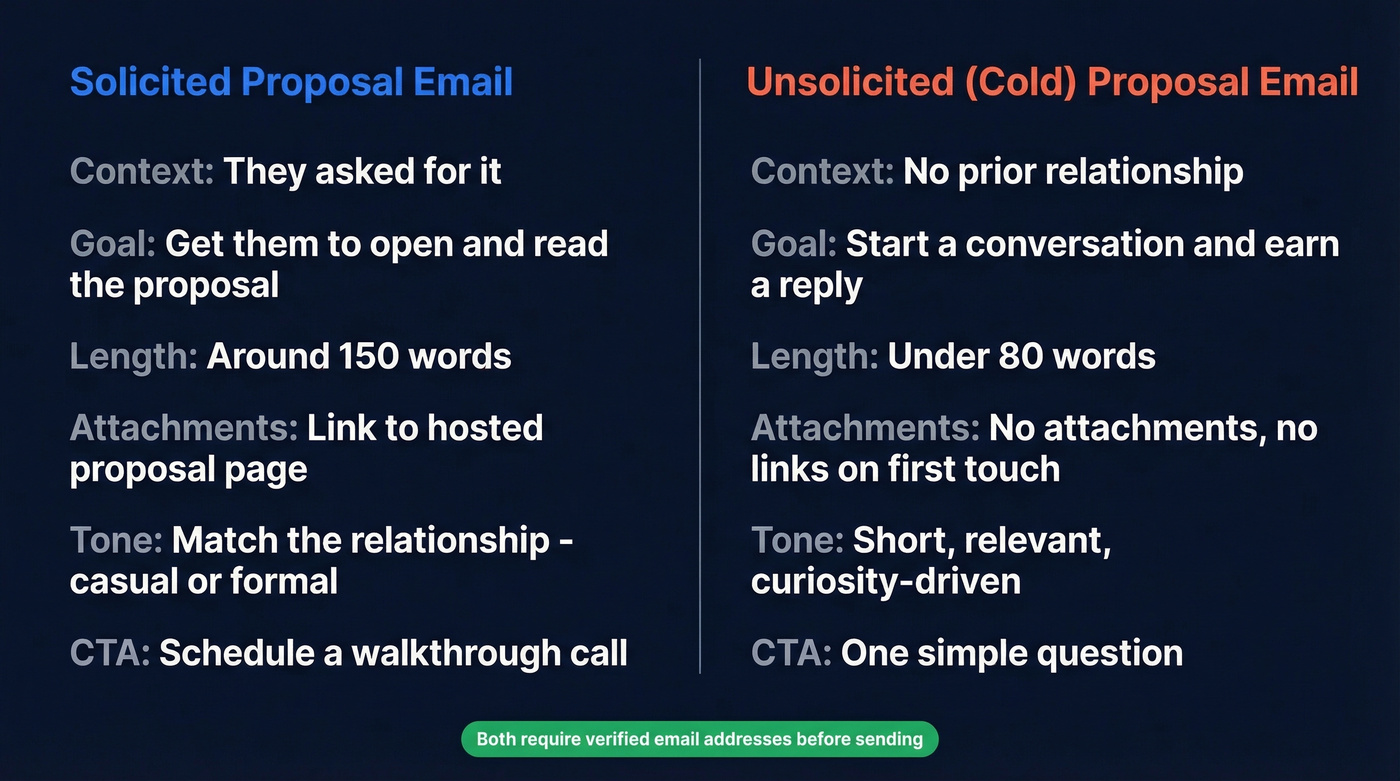
A solicited proposal email goes to someone who asked you to send it - after a discovery call, an RFP, or a "send me something" conversation. You've got context and permission. The goal is to summarize your proposal compellingly enough that they open it. Match the tone to your relationship: "Hey Sarah" for a warm referral, "Dear Ms. Chen" for a formal RFP response.
An unsolicited proposal email is cold outreach. No prior relationship. The goal isn't to deliver a proposal - it's to start a conversation. Attachments, especially PDFs, are a common deliverability and trust killer in cold outreach. Skip this approach if you haven't verified the recipient's email first; you're just burning your domain for nothing.
Subject Lines That Get Opened
69% of recipients mark emails as spam based on the subject line alone. Get this wrong and nothing else matters.
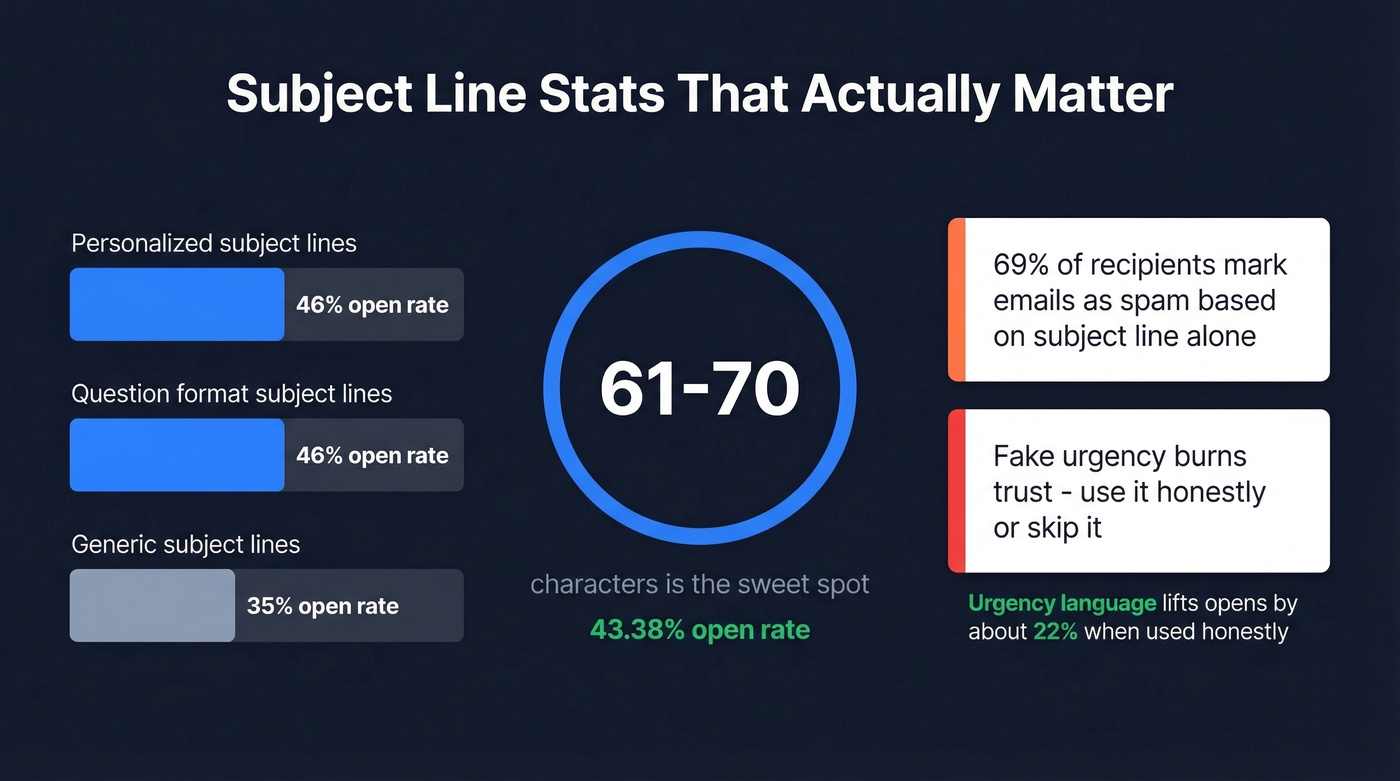
The sweet spot is 61-70 characters, which hit the highest open rates at 43.38%. Personalized subject lines and question formats both pull roughly 46% open rates, compared to 35% for generic lines. Urgency language lifts opens by about 22%, but use it honestly - fake urgency burns trust fast.
For solicited proposals, keep it specific: "Proposal: [Project Name] - Next Steps." For cold outreach, lead with relevance: "Quick question about [their specific challenge]." If you need inspiration, pull from proven email subject line examples.
How to Structure a Proposal Introduction Email
The 7-Point Framework (Solicited)
When someone's expecting your proposal, the Proposify framework adapted from Geoffrey James gives you the cleanest structure. They outline four approaches - short and sweet, full executive summary, mini executive summary, and assume the sale - but the 7-point framework covers the most ground. Hit these points in order, one to two sentences each:
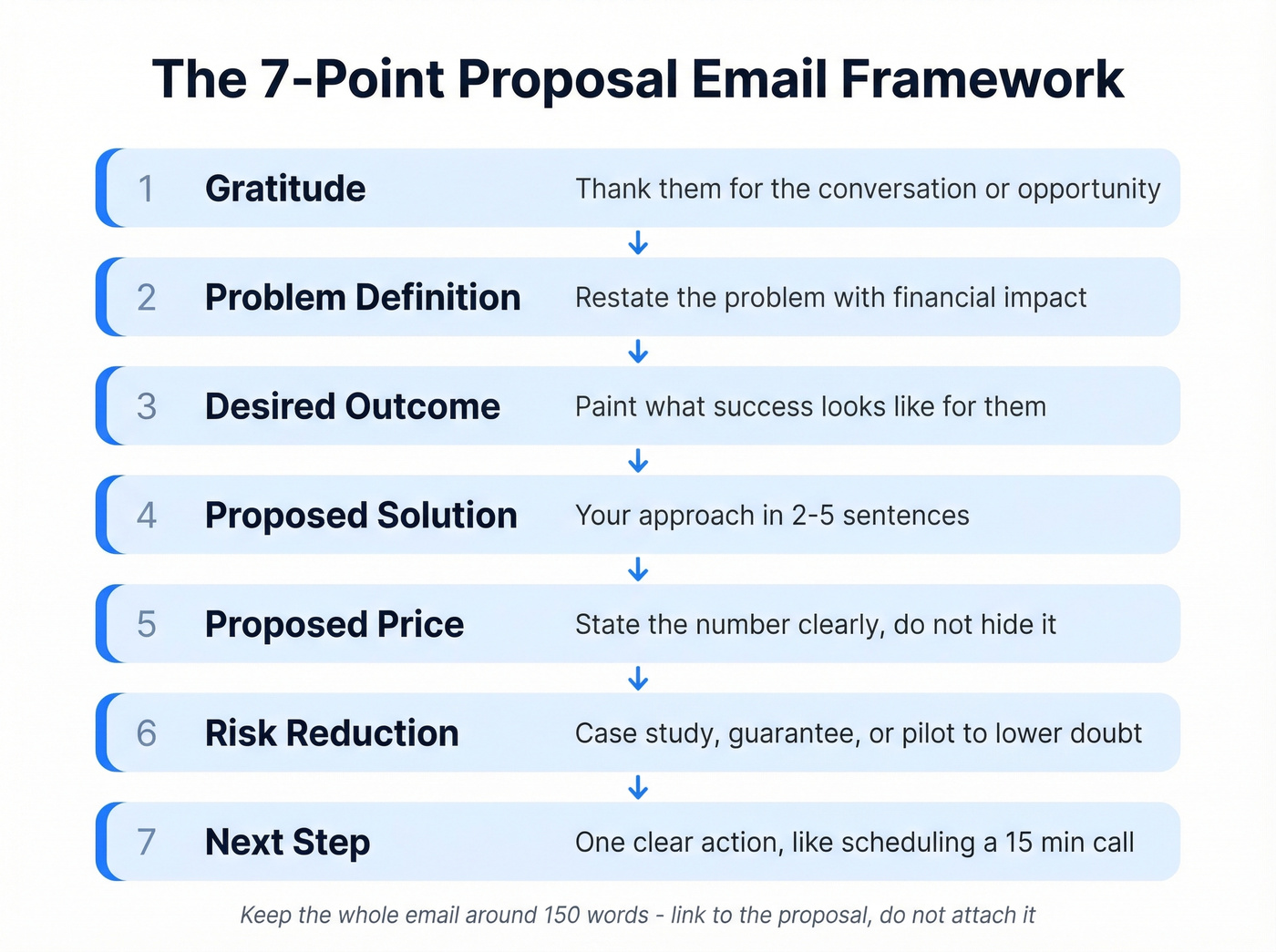
- Gratitude - Thank them for the conversation or opportunity.
- Problem definition - Restate the problem, including financial impact.
- Desired outcome - What success looks like for them.
- Proposed solution - Your approach in two to five sentences.
- Proposed price - Don't hide the number.
- Risk reduction - Guarantee, pilot, or case study that lowers perceived risk. Frame this for the CFO who'll review the proposal without context from your discovery call; buying committee members who weren't in the room need concrete proof, not relationship trust.
- Next step - One clear action. "Can we schedule 15 minutes Thursday to walk through this?"
Keep the whole email around 150 words. Link to a hosted proposal page rather than attaching a PDF - you'll get open tracking and avoid inbox size limits. (If you want to go deeper on tracking, see email tracking pixels.)
The Cold Proposal Formula (Unsolicited)
Cold proposal emails follow different rules entirely. One practitioner on r/sales reported booking 6-7 meetings per week with this formula: under 90 words, two-sentence paragraphs, one question, no links, no attachments. We've seen the same pattern across our own outreach - the emails that book meetings are embarrassingly short. The instinct to "add more value" is what kills them.
Your "proposal" doesn't belong in a cold email. The email's only job is to earn a reply. Once they respond, you've opened the door to send the actual document. If you're building a full sequence, use a proven B2B cold email sequence.

Your proposal email is only as good as the address it lands on. 17% of cold emails never reach the inbox - and every bounce damages your sender reputation. Prospeo verifies emails at 98% accuracy with 5-step verification, spam-trap removal, and catch-all handling. At $0.01 per email, there's no excuse to send blind.
Verify every address before you send that proposal.
Templates for Every Scenario
Solicited Proposal Email
Subject: [Project Name] Proposal - Next Steps
Hi [Name],
Thanks for the conversation on [day]. You mentioned [specific problem] is costing your team roughly [financial impact] per quarter.
We've put together a proposal that addresses this with [solution summary]. The investment is [price range], and we've included a case study from [similar company] who saw [specific result].
Here's the full proposal: [link]
Would Thursday at 2pm work to walk through it together?
Cold Proposal Email
Subject: Quick question about [their challenge]
Hi [Name],
Noticed [specific observation about their company]. We helped [similar company] solve [related problem] - they cut [metric] by [result].
Worth a 10-minute call to see if that's relevant for you?
Partnership Proposal Email
Partnership proposals lead with mutual audience overlap, not your product features. Start with what you've observed about their business.
Subject: [Your Company] + [Their Company] - mutual win
Hi [Name],
I've been watching how your team approaches [their market/audience]. Our customers overlap significantly - we helped [partner name] generate [specific result] through a similar partnership last quarter.
Open to exploring what this could look like?
Internal Proposal Email
Internal proposals need dollar-denominated problem statements. Your boss thinks in budget impact, not features. Bullet points work better here than prose - executives skim.
Subject: Proposal: [Solution] to fix [Problem]
Hi [Boss Name],
Quick proposal for your review:
- Problem: [Issue] is costing us ~[dollar amount] per [time period]
- Solution: [Approach] at [investment cost]
- Expected payback: [Timeframe]
- Full breakdown: [link]
Can I get 15 minutes on your calendar this week?
Verify Before You Send
17% of cold emails never reach the inbox. They bounce, get spam-filtered, or hit dead addresses. Every bounce chips away at your domain reputation, and Gmail's spam complaint threshold is just 0.1%.
Step zero before writing any business proposal email is making sure the address is real. We use Prospeo's email finder for this - it verifies emails in real time with 98% accuracy using a 5-step process that catches spam traps and honeypots. The free tier covers 75 emails per month, which is plenty for targeted proposal outreach. One customer, Meritt, dropped their bounce rate from 35% to under 4% after switching. (If you're troubleshooting bounces, start with email bounce rate.)

Follow-Up Sequence
58% of replies come from the first email. That means 42% come from follow-ups - and most people never send them.
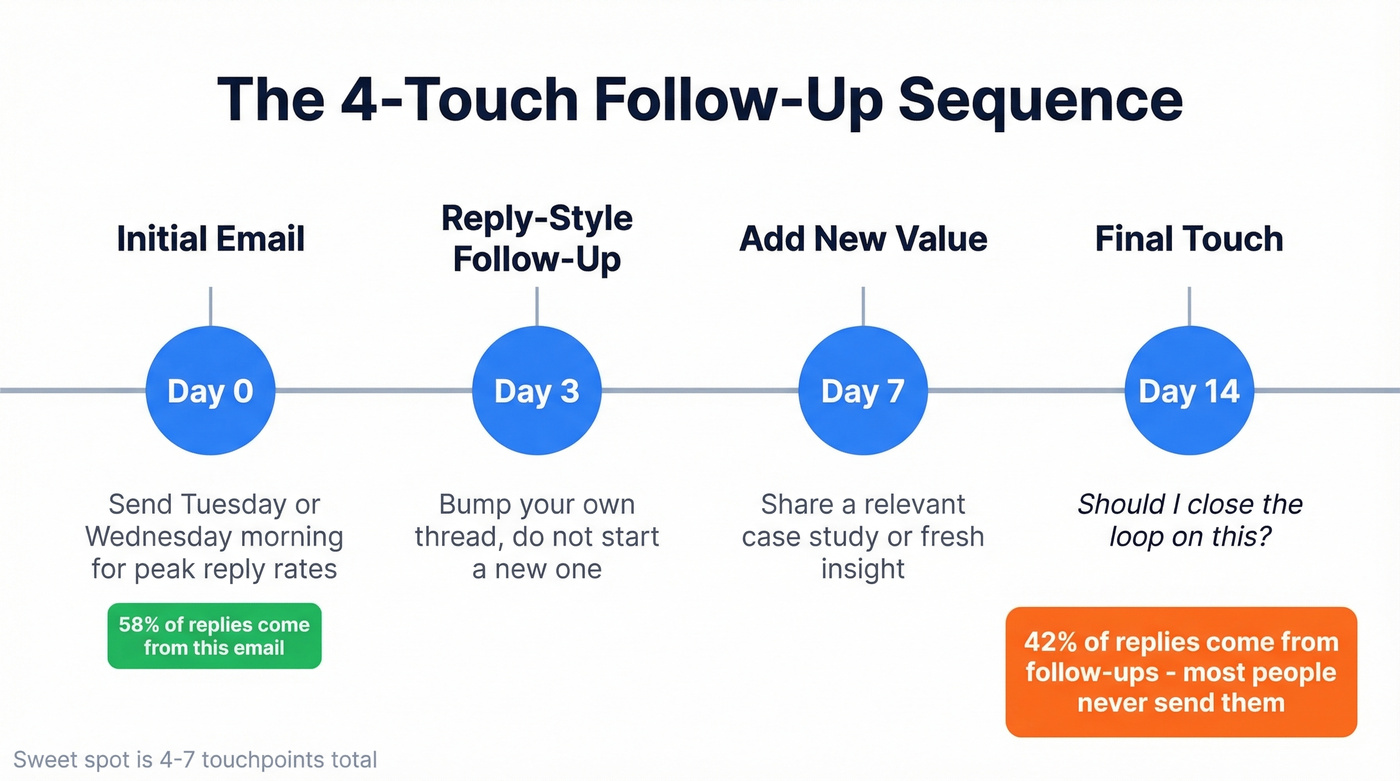
Let's be honest: the "reply-style" follow-up consistently outperforms formal re-sends by roughly 30% in our testing. Just bump your own thread with a short nudge instead of writing a whole new email. The sweet spot is 4-7 touchpoints total, and 22% of opens happen within the first hour, so timing matters. For plug-and-play copy, use these sales follow-up templates or more specific cold email follow-up templates.
Here's a sequence that works:
- Day 0 - Initial email, sent Tuesday or Wednesday morning for peak reply rates.
- Day 3 - Reply-style follow-up. Bump your own thread, don't start a new one.
- Day 7 - Add new value. Share a relevant case study or insight.
- Day 14 - Final touch: "Should I close the loop on this?"
Mistakes That Kill Proposal Emails
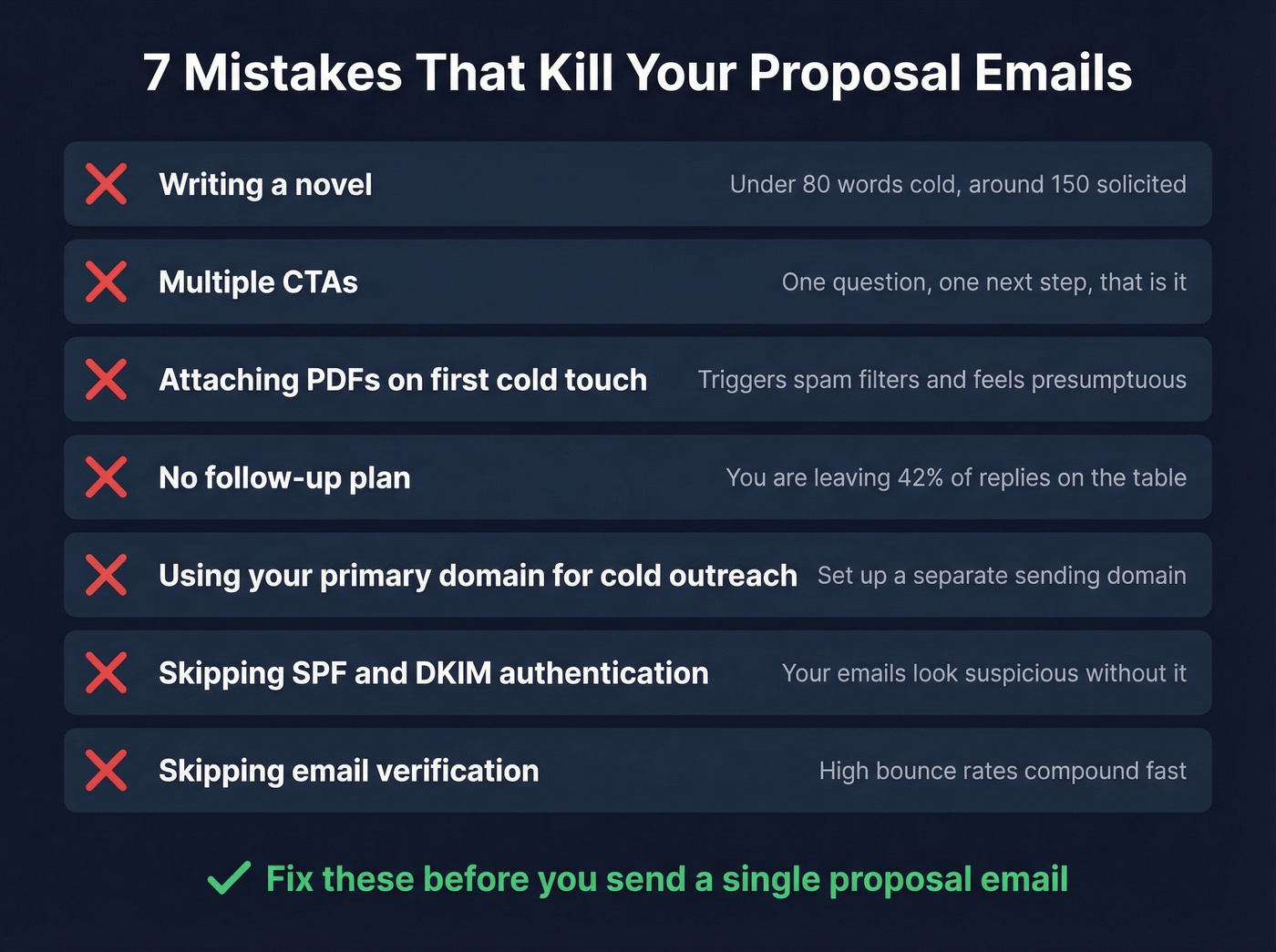
- Writing a novel. Under 80 words for cold, around 150 for solicited. No exceptions.
- Multiple CTAs. One question. One next step. That's it.
- Attaching PDFs on first cold touch. Attachments trigger spam filters and feel presumptuous.
- No follow-up plan. You're leaving 42% of potential replies on the table.
- Using your primary domain for cold outreach. Set up a separate sending domain.
- Skipping SPF/DKIM authentication. Your emails look suspicious to inbox providers without it (use an SPF record example to sanity-check yours).
- Skipping email verification. High bounce rates compound fast. Verify addresses before they damage your sender score.
Writing the perfect proposal introduction email means nothing if you're emailing the wrong person. Prospeo's database gives you 300M+ professional profiles with 30+ filters - job title, department, company size, even buyer intent - so your proposal lands with the actual decision-maker, not a gatekeeper.
Find the right contact, then send the right email.
FAQ
Should I attach the proposal or link to it?
For solicited proposals, link to a hosted version - you get open tracking and avoid inbox size limits. For cold outreach, never attach on the first email. Earn interest first, then send the document after they reply.
How long should a proposal introduction email be?
Around 150 words for solicited proposals where you've got an existing relationship. Under 80 words for cold outreach. Instantly's 2026 benchmark data confirms shorter emails consistently outperform longer ones in reply rate.
How do I make sure my proposal email doesn't land in spam?
Verify the recipient's email address before sending, set up SPF/DKIM/DMARC authentication, avoid HTML-heavy formatting, and never send cold emails from your primary domain. Tools like Prospeo catch spam traps and honeypots during verification, which is where most deliverability problems start.
What's the best day to send a business proposal email?
Tuesday and Wednesday mornings consistently produce the highest reply rates. 58% of replies come from the first email, and 22% of opens happen within the first hour - so send when your prospect is most likely at their desk.