

How to Run an Introductory Meeting That Actually Leads Somewhere
You just got a calendar invite from a prospect you've been chasing for three months. Thirty minutes on the books. The pressure's real - 71% of senior executives say meetings are unproductive, and professionals waste nearly 47% of their meeting time on conversations that go nowhere. Your introductory meeting is competing against every bad meeting this person sat through last week. If yours doesn't earn its time slot, there won't be a second one.
The difference between an intro meeting that leads somewhere and one that dies on the vine isn't charisma or a killer slide deck. It's preparation, structure, and a clear next step.
What You Need (Quick Version)
- Research the person, verify their contact info, send a one-paragraph agenda. That's 80% of the work.
- Keep it to 30 minutes. Share an agenda beforehand. Listen more than you talk.
- Follow up within 3-5 days with a summary and a concrete next step - not a vague "let's stay in touch."
What Is an Introductory Meeting?
An introductory meeting is a first conversation between two or more parties who don't yet have a working relationship. The goal isn't to close a deal, finalize a project plan, or evaluate someone's performance. It's to establish rapport, understand each other's context, and figure out whether there's a reason to keep talking.
These first meetings show up in several contexts:
- Sales or client development - your first sit-down with a prospect or new client
- Internal team onboarding - a new hire meeting colleagues across departments
- Vendor or partner evaluation - exploring whether a service provider or partner is a fit
- Networking or referral - a warm introduction from a mutual connection
- Interview-adjacent - informal conversations that precede formal hiring processes
Here's what an intro meeting is not: it's not a pitch. It's not a kickoff. It's not a demo. Walk in with a 20-slide deck and a pricing sheet, and you've already lost the room.
Intro Meeting vs. Discovery Call vs. Kickoff
Let's be honest - people call everything an "intro meeting." Half the time you actually need a discovery call, a kickoff, or just an email. These three meeting types sit on a spectrum, and confusing them creates avoidable friction in B2B sales.
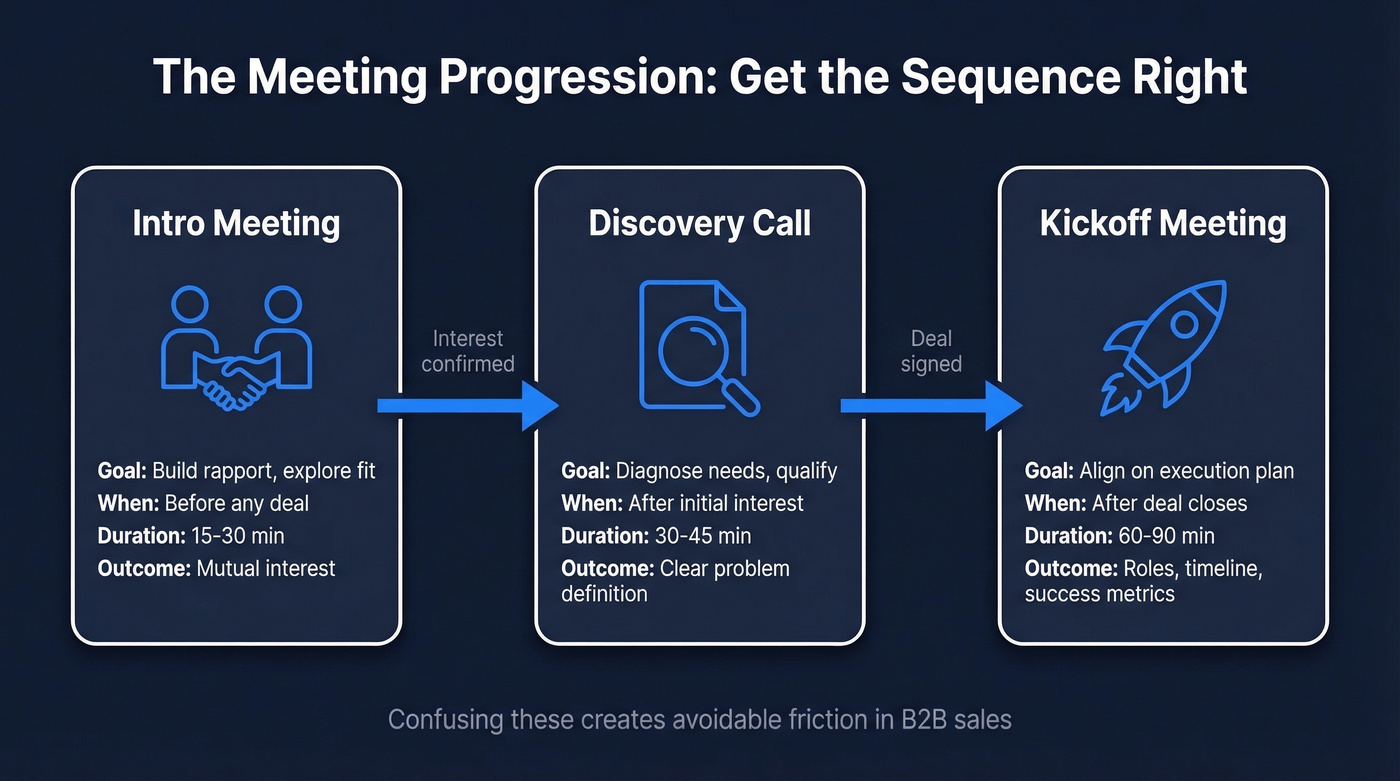
Think of it as a progression: the introductory meeting is the coffee date that might turn into a discovery call. The discovery call is where you diagnose. The pitch or kickoff is where you prescribe.
| Meeting Type | Purpose | Timing | Duration | Key Outcome |
|---|---|---|---|---|
| Intro meeting | Build rapport, explore fit | Before any deal | 15-30 min | Mutual interest |
| Discovery call | Diagnose needs, qualify | After initial interest | 30-45 min | Clear problem definition |
| Kickoff | Align on execution plan | After deal closes | 60-90 min | Roles, timeline, success metrics |
A good kickoff can follow the 30-30-30 structure: the first 30 minutes define success criteria, the middle 30 connect goals to processes, and the final 30 assign concrete next actions with owners.
If you're scheduling a "kickoff" before the deal is signed, you're really running a discovery call. And if you're running a "discovery call" with someone who doesn't know your name yet, you need an intro meeting first. Get the sequence right.
How to Prepare for Your First Meeting
Preparation is where most intro meetings are won or lost. We've seen reps walk into calls with zero research and wonder why the prospect ghosted them afterward. Don't be that person.
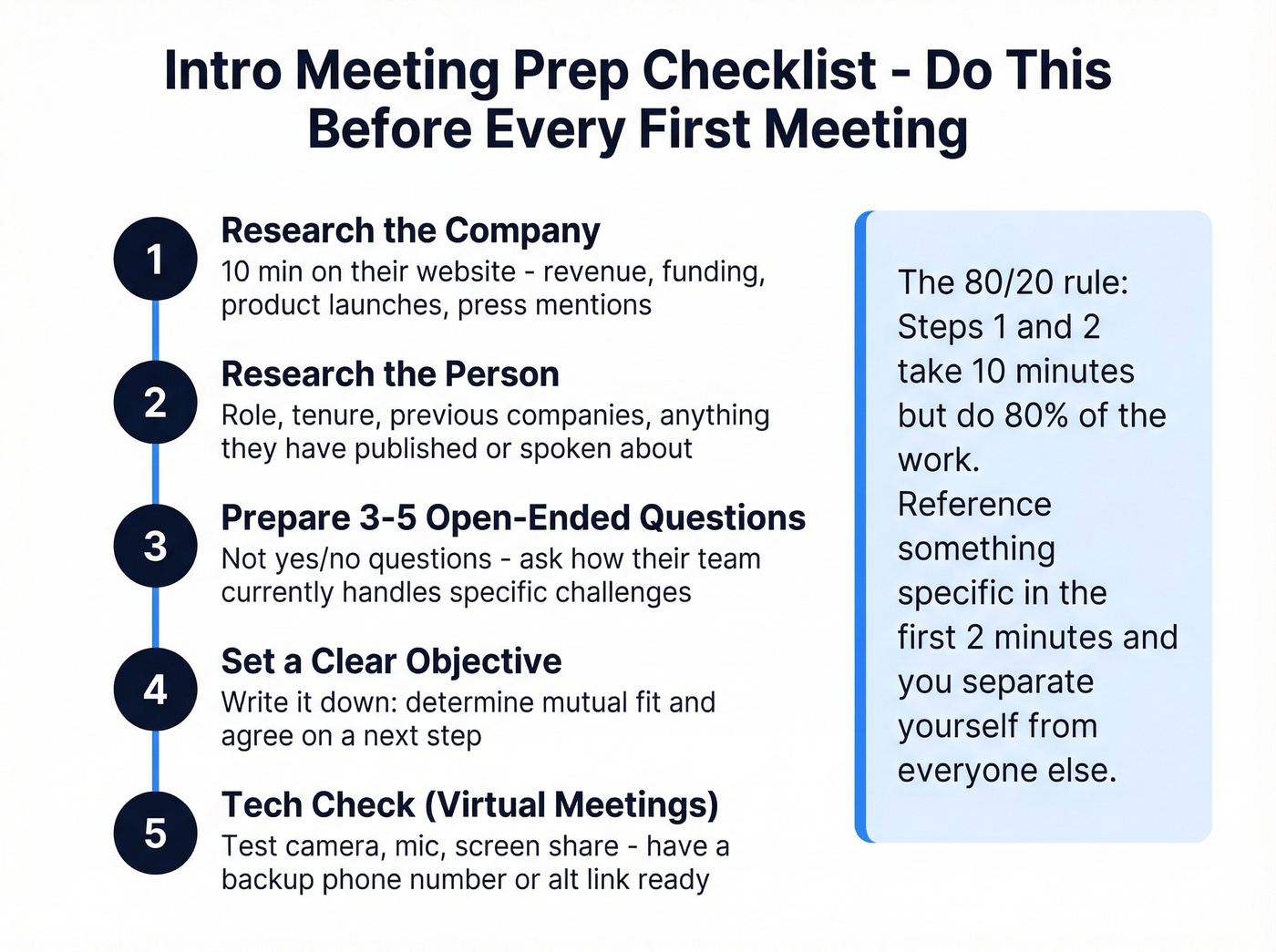
- Research the company. Revenue range, recent funding, product launches, press mentions. Ten minutes on their website and a quick news search gets you 80% of the way there.
- Research the person. Their role, tenure, previous companies, anything they've published or spoken about. This isn't stalking - it's professionalism.
- Prepare 3-5 open-ended questions. Not "Do you use a CRM?" but "How does your team currently handle X?" Open-ended questions surface real information (and map cleanly to better discovery questions).
- Set a clear objective. What does success look like for this meeting? Usually it's "determine mutual fit and agree on a next step." Write it down.
- Tech check for virtual meetings. Test your camera, mic, and screen share. Have a backup plan if Zoom crashes - a phone number or Google Meet link.
When you reference something specific about their business in the first two minutes, you've signaled that this isn't spray-and-pray outreach. That single move separates you from most of the people requesting meetings.
How to Request an Introductory Meeting
The meeting request email is your first impression. Keep it under 150 words. Follow a simple five-part framework: subject line, opening line (who you are and why you're emailing), context (the connection), value proposition, and a clear CTA (more examples in our guide to email wording to schedule a meeting).
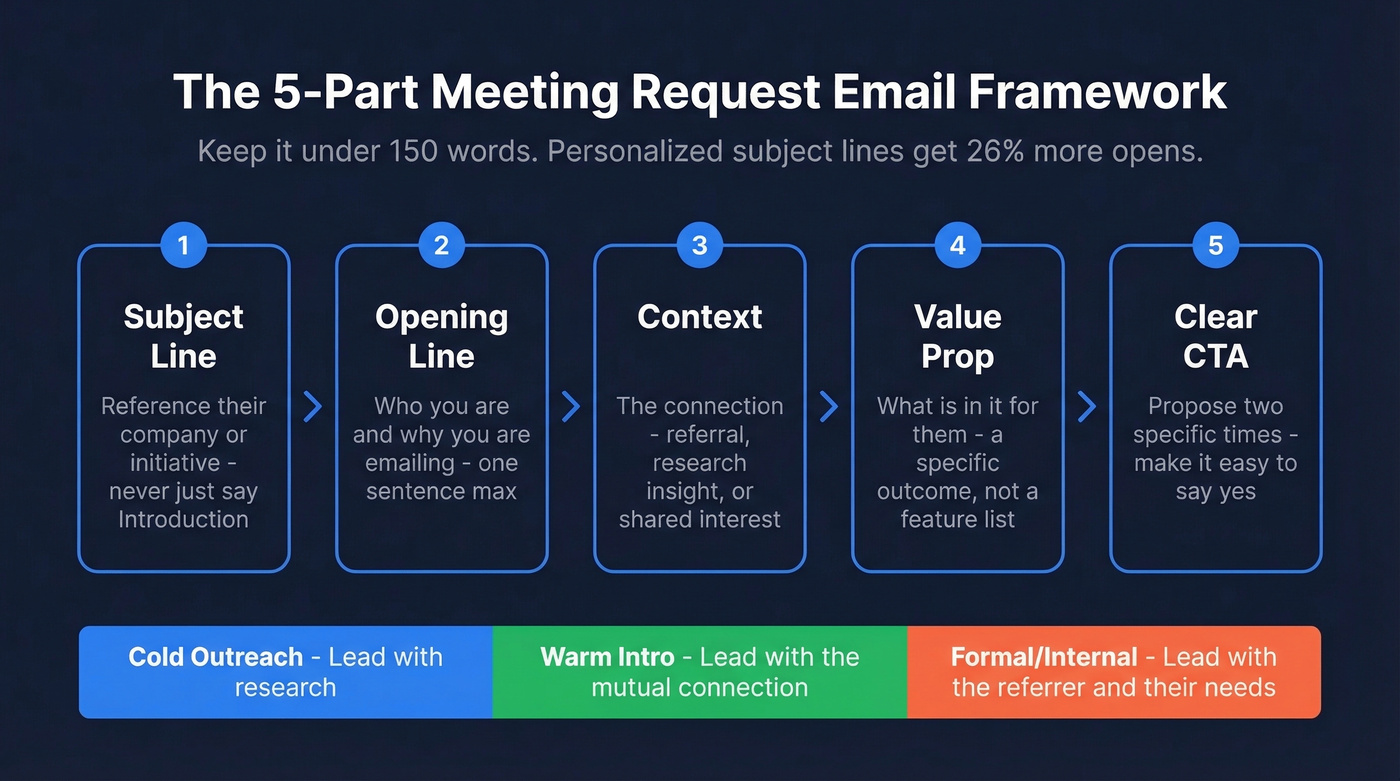
Personalized subject lines get 26% more opens than generic ones. "Quick question about [their initiative]" beats "Introduction" every time (and you can steal more patterns from these email subject line examples).
Cold Outreach
Subject: [Their company]'s [specific initiative] - quick question
Hi [First Name],
I'm [Your Name] at [Your Company]. We help [type of company] [specific outcome] - recently worked with [similar company] on [brief result].
I noticed [specific observation about their business]. I'd love to spend 20 minutes learning how your team handles [relevant challenge] and share what's worked for similar teams.
Would [Day] at [Time] or [Day] at [Time] work?
Best, [Your Name]
Use when: You have no prior connection. Lead with research, not your resume (and if you're building pipeline, these sales prospecting techniques help).
Warm Introduction
When someone referred you, the mutual connection does the heavy lifting. Keep the email to three or four sentences: mention who connected you, what you do, and propose a specific time. No blockquote template needed - the shorter this email is, the better it performs. Something like: "[Mutual contact] suggested we connect about [topic]. I lead [function] at [Company]. Would a 15-minute call work this week?" That's it.
Formal / Internal
Subject: Introduction - [Your Name], [Your Role]
Hi [First Name],
I'm [Your Name], the new [Role] on the [Team] team. [Manager/colleague] suggested I reach out to set up a quick intro so I can understand how our teams work together.
I'd love 15 minutes to learn about your priorities and how I can be most useful. Does [Day] or [Day] work?
Looking forward to it, [Your Name]
This works because it's short, it names the referrer, and it frames the meeting as being about them, not you. New hires who send these early build cross-functional relationships faster than those who wait for introductions to happen organically.

You spent 10 minutes researching the prospect. Don't waste it by emailing the wrong address. Prospeo verifies emails through a 5-step process - 98% accuracy, 7-day refresh - so your meeting request actually lands in their inbox.
Every intro meeting starts with a delivered email. Make sure yours arrives.
Great prep means knowing who you're meeting and having the right contact info before you reach out. Prospeo gives you 50+ data points per contact - job title, company size, tech stack, funding - so your first two minutes prove you did the homework.
Research the person and verify their info in one step. Start free today.
Agenda Templates by Scenario
A shared agenda transforms an intro meeting from "let's see where this goes" into a structured conversation. Even a three-bullet outline signals respect for the other person's time.
First Sales Meeting with a Prospect (30 min)
- 0-5 min: Opening and rapport. Thank them for the time. Reference something specific from your research. Set the agenda.
- 5-15 min: Their situation and needs. This is the core. Ask about their current challenges, priorities, and what success looks like. Listen.
- 15-22 min: Your relevant experience. Not a pitch - a tailored overview of how you've helped similar companies with similar problems.
- 22-27 min: Q&A. Let them ask anything. This is where objections surface early.
- 27-30 min: Next steps. Agree on a specific action - a follow-up call, a proposal, an introduction to another stakeholder.
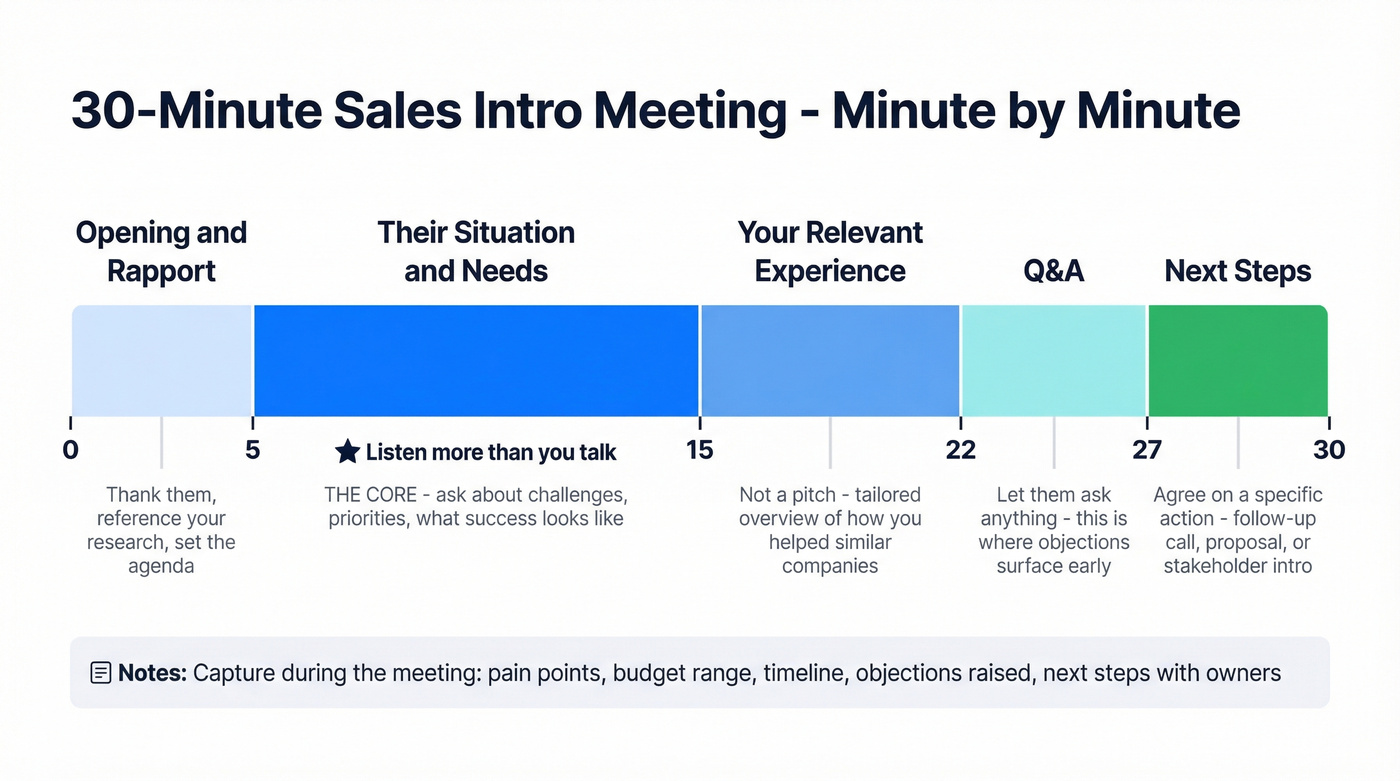
Take notes during the meeting capturing pain points, budget range, timeline, objections raised, and next steps with owners.
Internal Team Intro (45 min)
Your new manager sends a Slack message: "Setting up intro meetings with everyone on the team this week. 15 min each." You're meeting #7 of 12. Make it count.
- 0-10 min: Icebreaker. Keep it light. Good openers: "What's one thing you're working on right now that you're excited about?" or "What's the most interesting project you've tackled this quarter?"
- 10-20 min: Roles and context. What does each person own? Where do your responsibilities overlap?
- 20-30 min: Communication preferences. Slack vs. email? Async vs. sync? Morning person or afternoon person?
- 30-40 min: Expectations and goals. What does this person need from you? What do you need from them? This is also a good moment to ask, "Where do you see your career in 2-3 years?" - it signals genuine interest and often reveals collaboration opportunities you wouldn't have found otherwise.
- 40-45 min: Open questions.
Vendor or Partner Intro (20 min)
- 0-3 min: Mutual context. How did you connect? What prompted the conversation?
- 3-10 min: Their capabilities. Let them explain what they do and who they serve best.
- 10-16 min: Your needs and constraints. Be specific about budget, timeline, and deal-breakers.
- 16-20 min: Fit assessment and next steps. Is there enough alignment to justify a deeper conversation? If yes, schedule it now.
What to Say in the First 60 Seconds
The opening moments set the tone for everything that follows. Whether it's an AE's first call with a new lead or a founder meeting a potential partner, use the Present-Past-Future framework: who you are now, relevant background, and why you're here.
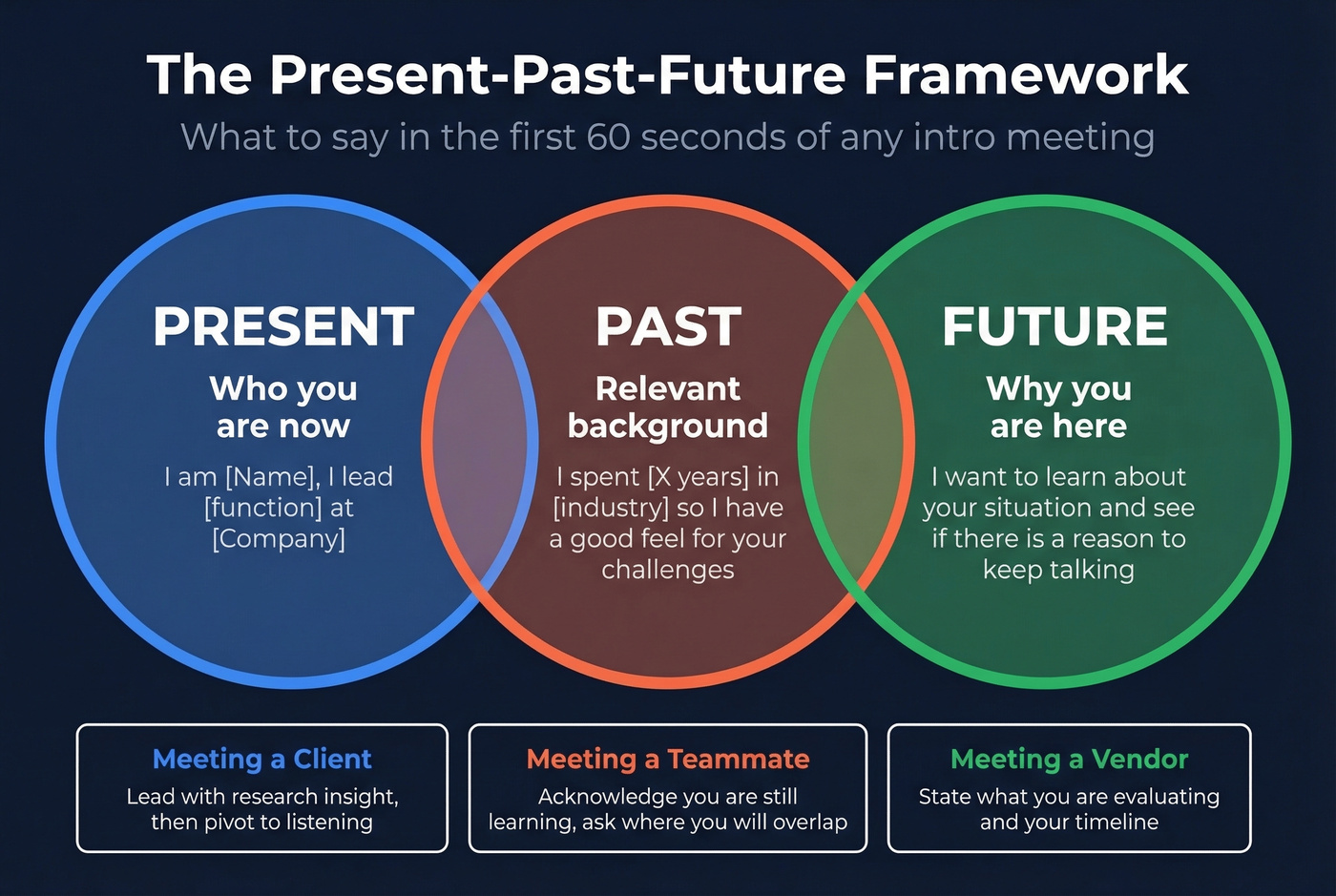
Meeting a potential client: "I'm [Name], I lead [function] at [Company]. Before this, I spent [X years] in [relevant industry/role], so I've got a pretty good feel for the challenges you're facing with [specific area]. I'm here because [mutual contact/research insight] suggested we might be able to help - but honestly, I want to learn about your situation first."
Meeting a new team member: "I'm [Name], I just joined as [Role] on the [Team] team. I spent the last few years at [Previous Company] doing [relevant work]. I'm still getting up to speed, so this conversation is really about understanding how you work and where we'll overlap."
Meeting a vendor or partner: "I'm [Name], [Role] at [Company]. We're currently evaluating [category of solution] because [specific trigger]. I'd love to hear how you've helped companies like ours, and I'll share what we're looking for so we can figure out if there's a fit."
Each script is three to four sentences. The goal isn't to impress - it's to orient the conversation and hand the mic to the other person. In cross-level meetings where hierarchy can create awkward silence, a structured self-introduction helps flatten the dynamic and gives everyone permission to speak freely.
Virtual Intro Meeting Best Practices
Remote workers attend 50% more meetings than in-office staff. Respect their time by making virtual intros tight and structured. Default to 15-30 minutes for virtual meetings versus 30-45 for in-person.
Camera on, always. Nearly half of professionals say cameras improve engagement and focus. If you're asking someone for 20 minutes, show your face.
Share the agenda at least a day ahead. This lets the other person prepare and signals that you take the meeting seriously. Even CEOs - who spend 72% of their work time in meetings - appreciate knowing what they're walking into.
Mute notifications and close tabs. A Slack ping mid-conversation tells the other person they're not your priority. I've been on calls where someone's eyes visibly drift to a notification, and the conversation never fully recovers.
End two minutes early. Back-to-back meetings are the norm. Giving someone a buffer before their next call is a small gesture that builds surprising goodwill.
Mistakes That Kill Intro Meetings
Look - most intro meetings don't fail because of bad chemistry. They fail because of avoidable structural mistakes.
Leading with a pitch instead of discovery. There's a common pattern on r/freelance: "I tell them about me and my services, show them a sample of my work, show them my rates." That's backwards. Discovery first, then tailored proof, then next steps. If you're talking about pricing in an intro meeting, you've skipped key steps.
Talking more than you listen. An intro meeting is about learning, not performing. We've sat through calls where the other person talked for 25 of 30 minutes and we remembered nothing they said. If you're doing most of the talking, you're not learning anything.
Overusing jargon. Throwing around acronyms and industry shorthand in a first conversation builds walls, not bridges. People don't buy what they don't understand.
Overpromising. It's tempting to say yes to everything in a first meeting. Don't. Overpromising in the intro creates problems you'll spend months cleaning up.
No clear next steps. "Let's stay in touch" isn't a next step. "I'll send a proposal by Friday and we'll reconvene next Tuesday at 2pm" is.
Skipping the follow-up. The meeting isn't over when the call ends. It's over when you send the recap. No follow-up means the conversation evaporates (use these sales follow-up templates if you need a starting point).
Sending meeting requests to unverified emails. A bounced email is a dead intro meeting. Verify first - tools like Prospeo handle this in seconds, and it's the difference between getting on someone's calendar and getting flagged as spam.
Hot take: If your average contract value is under $5k, you probably don't need a 30-minute intro meeting at all. A well-crafted async video or a five-minute phone call will qualify faster and cost you less pipeline time. Save the structured sit-down for deals worth the preparation.
How to Follow Up After an Introductory Meeting
Send your follow-up within 24 hours. If you don't hear back, follow up again in 3-5 days. Best send times are mid-morning or early afternoon on weekdays (more timing guidance here: best time to send cold emails).
Subject: Great connecting - next steps from our call
Hi [First Name],
Thanks for the time today. Quick recap:
Key discussion points:
- [Their main challenge/priority]
- [Your relevant experience or solution area]
Action items:
- [Your action] - by [date]
- [Their action, if any] - by [date]
Next meeting: [Day] at [Time] - [calendar link].
Looking forward to it.
[Your Name]
The follow-up email proves you were listening, creates accountability, and keeps momentum alive. Skip it, and you're starting from zero next time.
FAQ
How long should an introductory meeting be?
Default to 15-30 minutes for virtual and 30-45 for in-person. Shorter is almost always better - book 20 minutes and let the conversation earn more time naturally. If you consistently run over, your agenda needs tightening.
Should I send an agenda before an intro meeting?
Always. Share it at least 24 hours ahead. Even a three-bullet outline signals respect for their time and consistently improves meeting outcomes. No agenda means no structure, which means no clear next step.
What's the difference between an introductory meeting and an interview?
An introductory meeting is mutual exploration - both sides evaluate fit. An interview has a clear power dynamic where one side evaluates the other. If you're unsure which you're walking into, ask beforehand. The preparation is different.
How do I verify a prospect's email before requesting a meeting?
Use a real-time email verification tool before sending your invite. Prospeo's Chrome extension verifies emails from any professional profile or website with 98% accuracy across 300M+ profiles - its free tier includes 75 emails and 100 extension credits per month, so you can validate contacts without spending anything.
The best introductory meeting is one that makes the second meeting inevitable. Nail the prep, respect the clock, and always leave with a next step on the calendar.