

Lead Attribution Is Broken - Here's How to Fix It in 2026
You're spending $8K/month on Google Ads and $3K on content. Google Ads reports 60 conversions. Your CRM shows 80 new leads, but 30 list "Direct" as the source. Did ads actually drive 60? Or 40? Or 75? You genuinely don't know.
That's the lead attribution problem, and it's costing you real money. When attribution breaks, the wrong channels get funded. Your CMO doubles down on paid because last-click says it's working, while the blog content that actually started those conversations gets its budget slashed. Careers get built and killed on these numbers.
Here's the irony: 76% of marketers say they have or will have strong attribution capability within 12 months. Yet most teams still can't answer the most basic question in marketing - what's working?
The Short Version
Set up UTM tracking for lead sources, add a "How did you hear about us?" form field, and configure GA4 properly before buying any attribution software. That covers 80% of what most teams need. No single model works in 2026 - combine software-tracked data with self-reported data for a complete picture. And clean your CRM data first. Attribution models built on bounced emails and stale records produce garbage outputs.
What Is Lead Attribution?
Lead attribution connects a lead to the marketing touchpoint - or touchpoints - that created or influenced them. It answers the question every CMO asks at budget time: which channels actually drive pipeline?
The typical B2B buyer touches 5-15 marketing touchpoints before converting. Your prospect - call her Sarah, a VP of Ops at a mid-market SaaS company - reads a blog post, clicks a retargeting ad two weeks later, attends a webinar, and then books a demo. Lead source attribution assigns credit across those interactions so you can understand which channels deserve investment.
Don't confuse this with revenue attribution. Lead attribution tracks which channels create leads. Revenue attribution follows those leads through the pipeline to closed-won deals and requires deeper CRM integration plus much longer tracking windows. Most teams should nail source-level tracking first.
Attribution Models Explained
| Model | Credit Distribution | Best For |
|---|---|---|
| First-Touch | 100% to first interaction | Understanding discovery |
| Last-Touch | 100% to final interaction | Measuring closers |
| Linear | Equal across all touches | Simple multi-touch |
| Time-Decay | More to recent touches | Short sales cycles |
| U-Shaped | 40/40/20 (first/last/middle) | Balanced view |
| W-Shaped | Weighted across key funnel stages | Full-funnel B2B |
| Algorithmic | ML-weighted by actual impact | High-volume teams |
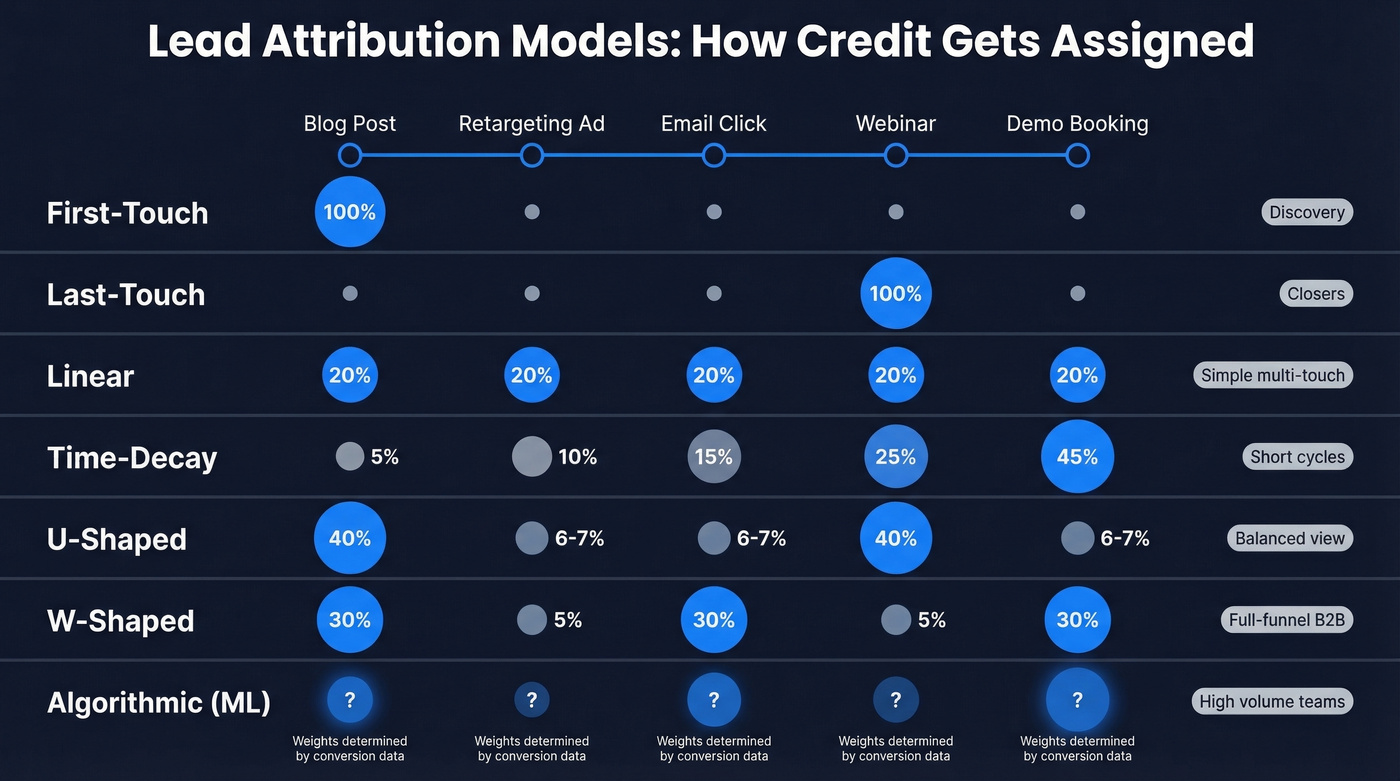
Single-Touch Models
Let's follow Sarah's journey. She reads your blog post, clicks a retargeting ad, attends a webinar, and books a demo. First-touch gives 100% credit to the blog post. Last-touch gives 100% to the webinar - the final interaction before the demo booking. Both are useful as directional signals. Neither tells the full story.
If you're still using last-touch as your primary model, you're lying to yourself about what's working. It over-credits bottom-funnel channels and starves the top-of-funnel activities that created the lead in the first place.
Multi-Touch Models
Linear splits credit equally - 25% to each of Sarah's four touchpoints. Simple, but it treats a casual blog visit the same as a high-intent webinar. Time-decay weights recent touches more heavily, which makes sense for shorter sales cycles but undervalues awareness channels.
U-shaped attribution typically gives 40% to the first touch, 40% to the last touch, and splits the remaining 20% across everything in between. W-shaped adds emphasis to key funnel milestones like first touch, lead creation, and opportunity creation, giving you a fuller-funnel view without pretending every touchpoint matters equally.
Multi-touch attribution can drive a 20% boost in ROI by redistributing spend toward underappreciated channels. That's real money left on the table by teams clinging to last-click.
Algorithmic / Data-Driven Models
Algorithmic models use machine learning to assign credit based on actual conversion patterns. Google's data-driven attribution is commonly described as Shapley-value-based. Markov chain models map the probability of conversion with and without each touchpoint, isolating true incremental impact.
The catch: you need volume. These models require hundreds of monthly conversions to produce stable results. For many teams, algorithmic attribution is aspirational, not practical.
Why No Single Model Works in 2026
Most attribution guides give you seven models and tell you to "choose the one that fits your business." That's useless advice. The real answer is that no single model captures reality anymore - and the privacy landscape just made things worse.
The iOS 26 Problem
Apple announced iOS 26 at WWDC on June 9, 2025, and rollout began September 15, 2025. Safari's Advanced Fingerprinting Protection is now enabled by default, injecting noise into Canvas, WebGL, and AudioBuffer APIs. Worse, Safari strips click identifiers like gclid, fbclid, msclkid, and dclid in certain contexts.
With roughly 1.56 billion active iPhones worldwide - about 150 million in the US alone - that's not a niche problem. More of your paid traffic now shows up as "Direct," and there's no way to reverse-engineer it after the fact. UTMs often survive the stripping, which makes UTM tracking for lead sources more important than ever.
Dark Social: The 90% Gap
A SparkToro test of 1,000+ visits found that 100% of traffic from TikTok, Slack, Discord, and WhatsApp was marked as "direct." Facebook Messenger fared slightly better at 75% misattributed. A 12-month Refine Labs study found a 90% measurement gap between software-based attribution and self-reported customer data for dark social channels - podcasts, communities, word of mouth.
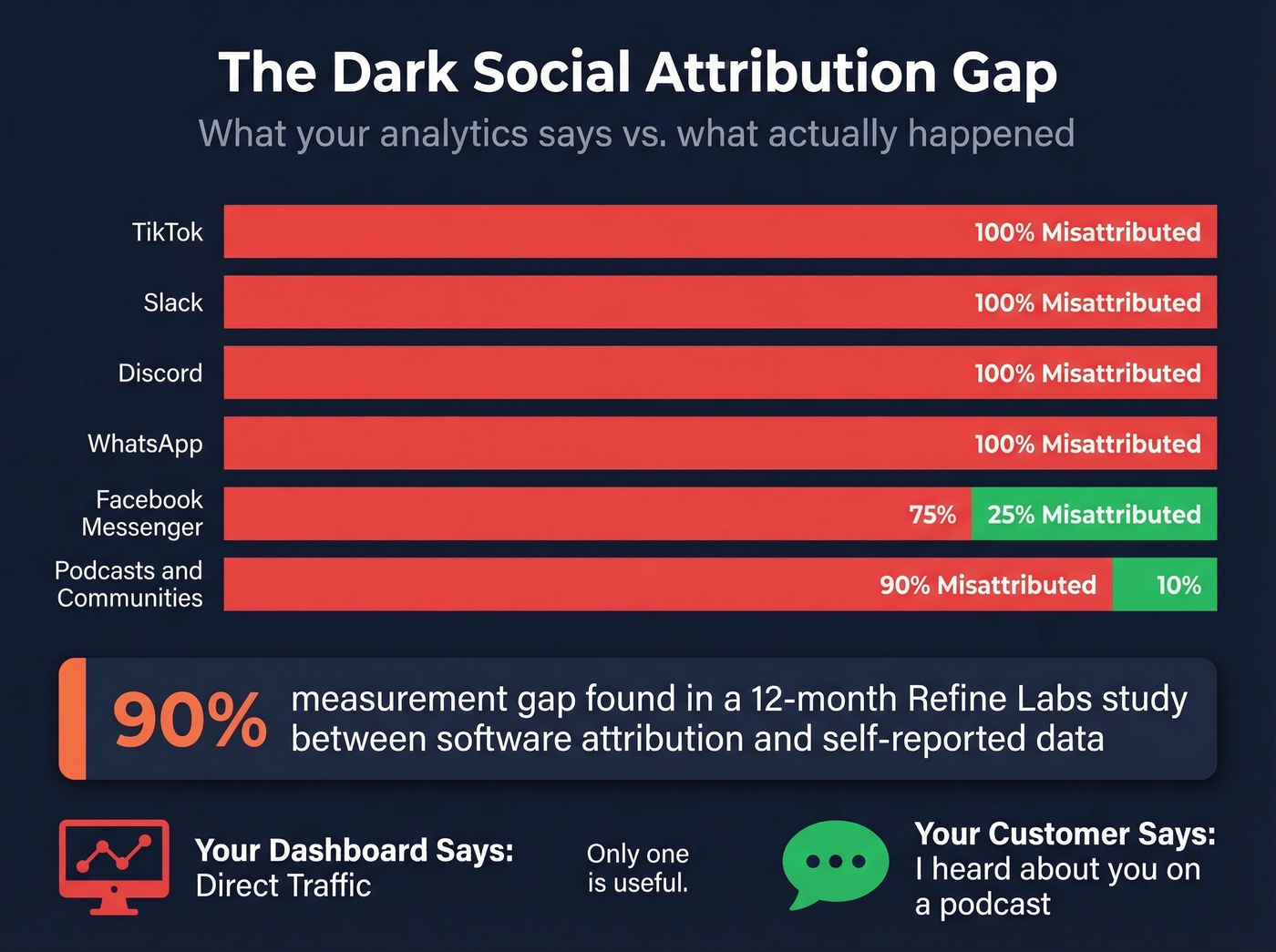
That gap is enormous. Your attribution dashboard says "Direct." Your customers say "I heard about you on a podcast." Both are true. Only one is useful.
The Blended Measurement Framework
Forbes framed the solution as a blended measurement architecture: multi-touch attribution for digital journeys, marketing mix modeling for macro and offline effects, incrementality testing to validate causal lift, and first-party analytics to connect marketing to behavior beyond clicks.
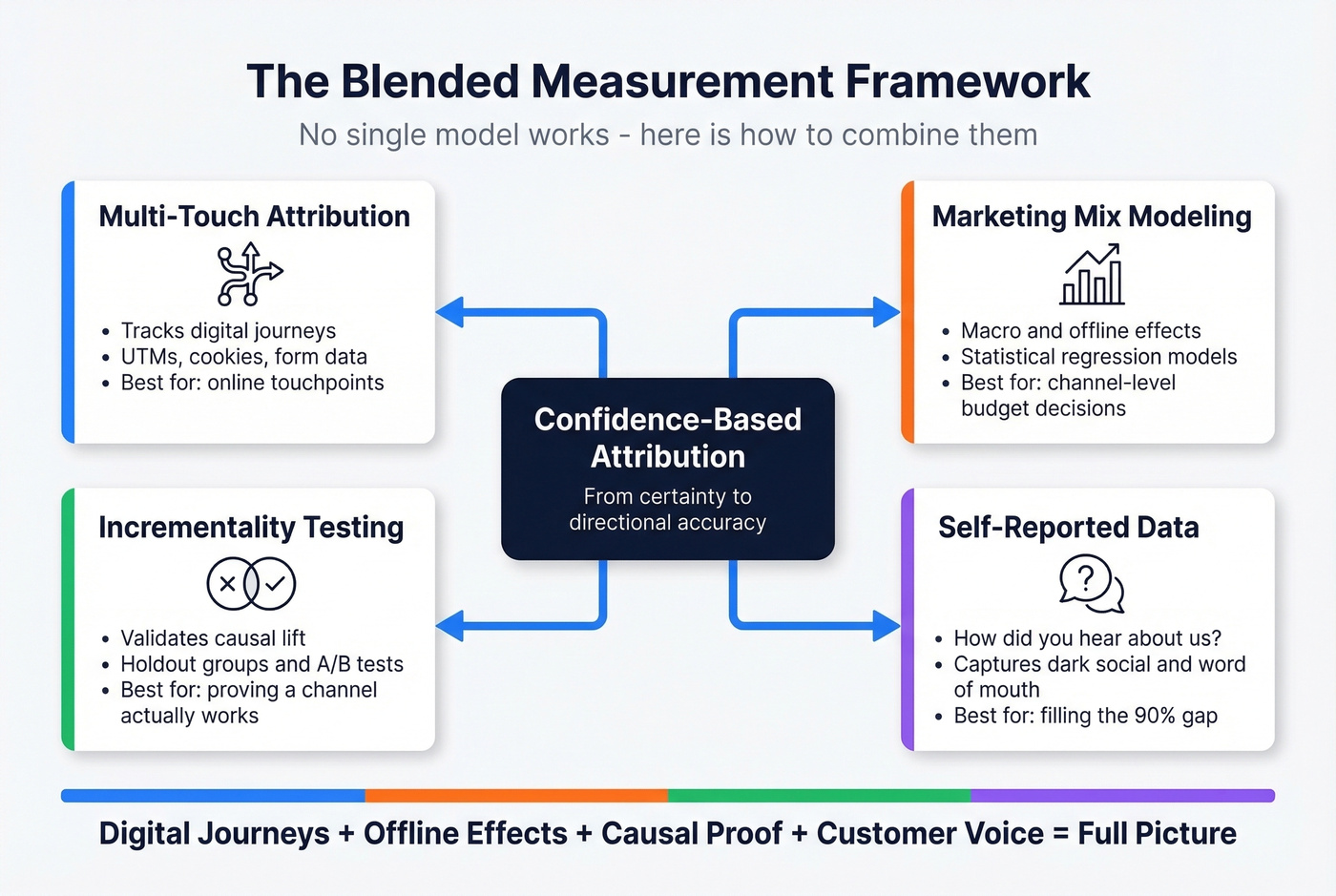
The shift is from certainty to confidence. You won't know exactly what drove a conversion, but you can build a system that gets you close.
B2B Attribution Is Structurally Different
B2B isn't just "longer sales cycles." It's structurally different from B2C in ways that break most attribution tools.
Buying committees of 6-10 stakeholders each have their own touchpoint history, and your attribution tool only tracks the one who filled out the form. Sales cycles run weeks to months, so standard 30-day attribution windows miss early-stage touches entirely - Sarah's blog post from three months ago gets zero credit. Three people at Acme Corp might engage independently before anyone books a demo, and most attribution platforms still default to individual-level tracking. That means you're doing the account-level rollup manually in spreadsheets.
Here's the thing: attribution isn't just a measurement exercise for B2B teams. It's how marketing proves it's a revenue center, not a cost center. The model you choose determines which team gets credit, and alignment between marketing and sales depends on agreeing on how that credit is assigned. Conference conversations, sales calls, and partner referrals rarely get tracked at all, which means the channels sales trusts most are often invisible to the attribution system marketing relies on.

Attribution built on bounced emails and stale records produces garbage outputs. Prospeo's 7-day data refresh and 98% email accuracy mean your CRM actually reflects reality - so your attribution models track real pipeline, not phantom leads.
Fix your data before you fix your attribution model.
Self-Reported Attribution
Adding "How did you hear about us?" to your forms sounds almost too simple. It is simple - and it captures signals that no software can detect.
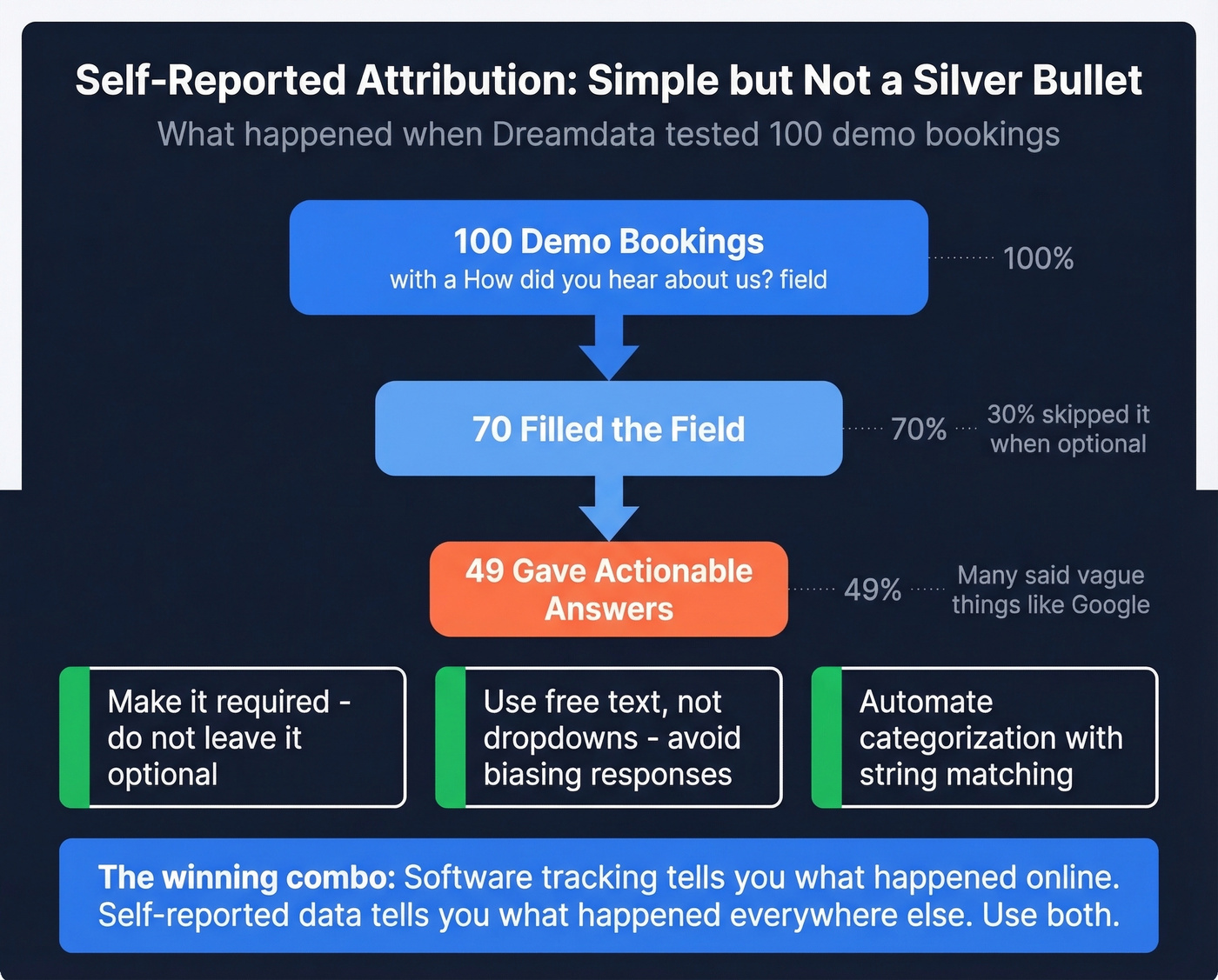
Dreamdata ran a test on 100 demo bookings. About 70% filled the field. After filtering for usable answers, only 49 out of 100 produced actionable self-reported data. Many responses were vague - "Google" doesn't tell you whether that's organic, paid, or a Maps listing.
Self-reported attribution is underrated, but it's not a silver bullet. Make the field required - roughly 30% skip it when it's optional. Use free-text instead of a dropdown to avoid biasing responses, then categorize answers via string-matching automation. The combination of software tracking plus self-reported answers is what gives you the full picture.
How to Build Your Source Tracking System
UTM Strategy and Hygiene
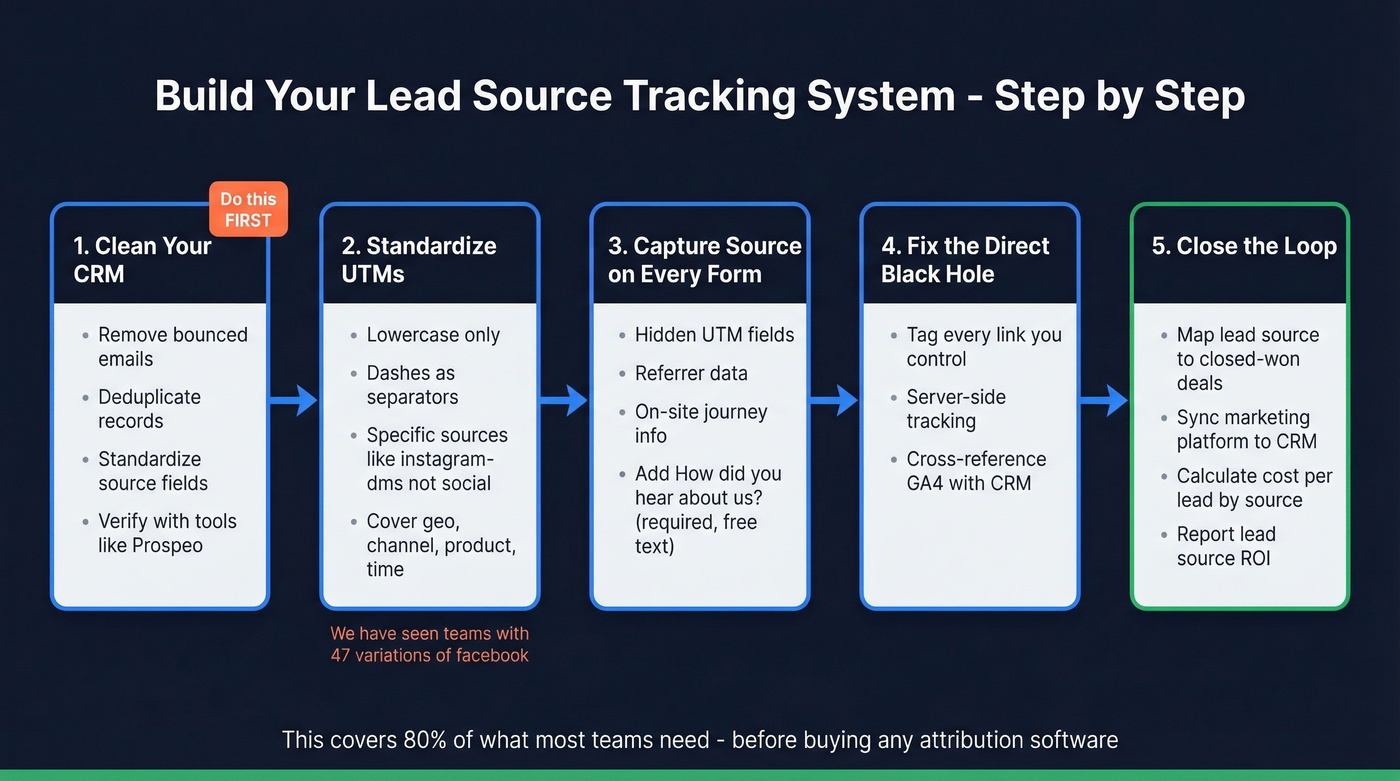
Standardize everything. Lowercase only, dashes as separators, structured taxonomy covering geo, channel, product, and time. Use specific sources - "instagram-dms" not "social." We've seen teams with 47 variations of "facebook" in their UTM source field. That's not a data problem. It's a discipline problem, and no attribution tool fixes it for you.
If you're rebuilding your acquisition engine at the same time, it helps to align UTMs with your broader lead generation workflow so source data stays consistent from click to CRM.
Capture Source Data With Every Form
Most form tools stop at the submission. You get an email address but no context about where that person came from. The fix: capture UTM parameters, referrer data, and on-site journey information with every form submission. One practitioner on r/GrowthHacking described going from "we got 100 leads" to "40 from SEO, 30 from paid, 30 from referrals" just by adding hidden fields.
This is especially painful if you're running a stack like Webflow + Paperform + Front + ActiveCampaign. You don't want 20 different forms for 20 campaigns. Pass UTM values as hidden fields into a single form and let your CRM sort the rest.
Fix the "Direct" Black Hole in GA4
GA4 lumps genuinely unknown traffic into "Direct" alongside real direct visits and doesn't flag the difference. Mitigate it with aggressive UTM tagging on every link you control, server-side tracking where possible, and cross-referencing GA4 data with your CRM's source fields.
If you’re unsure what “server-side” actually implies operationally, start with the basics of a tracking domain so your data collection doesn’t break as browsers tighten privacy.
Closed-Loop Reporting and Lead Source ROI
The goal is connecting marketing touches to closed-won deals inside your CRM. Map every lead source to its eventual outcome - did that webinar attendee become a customer? This requires syncing your marketing platform with your CRM's opportunity and deal stages. Without closed-loop reporting, you're measuring lead volume, not lead quality.
Most teams that implement this discover their "best" lead source by volume is their worst by close rate. Once you can see sales by lead source alongside close rates and deal sizes, you can calculate lead source ROI with real numbers instead of guesses. That's when budget conversations shift from opinion to evidence.
To make this actionable, pair attribution with a simple set of lead generation metrics so you’re not optimizing for “leads” that never become pipeline.
Lookback Window Configuration
A 30-day lookback window in B2B is almost useless. Configure your attribution windows per channel: 90 days minimum for content and SEO, 30-60 days for paid, and 180 days for events and conferences. If your deals take 120 days to close, a 30-day window ignores two-thirds of the journey.
If you want a sanity check on what “normal” looks like, compare your funnel to the average B2B lead conversion rate benchmarks before you blame attribution.
Clean Your CRM Data First
Your attribution is only as good as the data in your CRM. If 15% of your emails bounce, those leads never received nurture sequences - and your model credits touchpoints for leads that were dead on arrival. Prospeo verifies emails at 98% accuracy and refreshes records every 7 days, so your attribution reports reflect contacts that actually exist. Clean data in, accurate attribution out.
If you’re evaluating vendors, start with a shortlist of data enrichment services and compare refresh cadence + match rates, not just “number of contacts.”

Attribution Mistakes That Waste Budget
Over-reliance on last-click. Run first-touch and last-touch reports side by side. The delta between them reveals your blind spots.
Ignoring offline and cross-channel interactions. Add a self-reported field and use referral codes or QR codes for offline campaigns. We've worked with teams that discovered 30%+ of their pipeline originated from channels their attribution dashboard couldn't see.
Inaccurate data collection. Broken tags, inconsistent UTMs, duplicate records. Audit your tracking monthly and enforce naming conventions. Fatty15 found that summing vendor-reported revenue across platforms exceeded their actual revenue. Every vendor was double-counting.
If you suspect email issues are skewing your “lead quality” read, check your email bounce rate and fix deliverability before you “fix” channel mix.
Short attribution windows for long sales cycles. Extend to 90-180 days minimum and configure lookback windows per channel.
Misinterpreting attribution data. Correlation bias and confirmation bias are real. The channel that gets the most last-touch credit isn't necessarily the most effective - it's often just the last step in a journey that started somewhere else entirely. Cross-reference with self-reported data and run incrementality tests on your highest-spend channels.
Measuring Lead Source Effectiveness
Once your tracking is in place, the real work begins: evaluating which channels actually move the needle. Measuring lead source effectiveness goes beyond counting form fills. You need to track the qualified lead percentage per channel to understand where your best prospects originate.
A channel generating 200 leads per month means nothing if only 5% qualify for sales conversations, while a smaller channel converting 40% into qualified opportunities is clearly the better investment. Build a dashboard that shows volume, qualification rate, pipeline contribution, and cost per qualified lead for each source. Review it monthly and reallocate spend toward channels with the highest downstream conversion rates, not just the highest top-of-funnel volume.
If you don’t already have a consistent definition of “qualified,” implement a lightweight lead scoring model so attribution isn’t optimizing for the wrong outcomes.
Tools Worth Considering
| Tool | Best For | Pricing |
|---|---|---|
| GA4 | Everyone (baseline) | Free |
| HubSpot | CRM-native attribution | Free CRM; paid plans vary by tier |
| Ruler Analytics | SMB revenue attribution | From ~$250/mo |
| Northbeam | DTC/ecommerce | From $1,000/mo |
| HockeyStack | B2B full-funnel | Custom pricing |
| Attribution App | Multi-touch modeling | Custom pricing |
| Segment | Data infrastructure | Tiered pricing |
Here's the contrarian take most attribution guides won't give you: for a lot of smaller teams, GA4 + HubSpot's attribution reporting + a self-reported field beats a $1,000/mo platform. Not because the dedicated tools are bad, but because the operational overhead is usually higher than the incremental insight you'll get early on.
Skip dedicated attribution software if your average deal size is under $10K. The cost of the tool will eat into the marginal gains it reveals. GA4, a clean CRM, and a self-reported field will get you 80% of the way there.
For teams with the volume to justify dedicated tooling, HockeyStack and Northbeam are strong options in their respective lanes - B2B and DTC. ClickUp scaled from $4M to $150M ARR after implementing full-funnel omnichannel tracking, which is proof that getting attribution right isn't just about reporting. It's about growth.
But none of these tools fix bad data. If your CRM is full of stale contacts, clean it before you build attribution on top of it. Garbage in, garbage out - no model is smart enough to overcome a database where 15% of emails bounce.
If you’re still deciding what should “own” attribution long-term, it’s worth aligning with RevOps early - see what a RevOps Manager typically owns across systems and reporting.
Your attribution dashboard says 30 leads came from "Direct" because the contact data was too stale to trace. Prospeo enriches CRM records with 50+ data points at a 92% match rate - giving your models the clean inputs they need to actually work.
Stop attributing pipeline to "unknown" - enrich your CRM today.
FAQ
What's the difference between lead attribution and revenue attribution?
Lead attribution tracks which channels create leads. Revenue attribution follows those leads through the pipeline to closed-won dollars, connecting marketing spend to actual revenue. Revenue attribution is more actionable but requires CRM integration, opportunity tracking, and longer lookback windows. Master lead-level tracking first.
Which attribution model is best for B2B?
No single model works. Start by running first-touch and last-touch reports side by side - the gap reveals what you're missing. Add a self-reported field for dark social coverage. Move to multi-touch or algorithmic models once you have enough conversion volume, typically 300+ monthly conversions, for stable results.
How does iOS 26 affect marketing attribution?
Safari now strips click identifiers like gclid and fbclid while injecting noise into fingerprinting APIs. More traffic shows as "Direct" with no way to recover the original source. Mitigate with server-side tracking, stronger UTM discipline across every link you control, and self-reported attribution fields on forms.
How do you keep attribution data accurate?
Start with clean CRM data - verify emails, remove duplicates, and enrich records on a weekly cycle. Enforce UTM naming conventions, capture source data with every form submission, and cross-reference software-tracked data with self-reported responses. No single source is complete, but the combination gets you close.