

Lead Follow Up: The 2026 System That Actually Works
Your SDR just ran a 200-lead sequence. 47 emails bounced, 12 phone numbers were disconnected, and the remaining touches landed in a black hole of silence. The sequence wasn't the problem - the data was.
Here's the math: 80% of sales require 5-12 touchpoints to close, yet only 8% of reps follow up more than five times. That gap is where pipeline goes to die. We've watched teams pour money into sequencing tools, A/B test subject lines for weeks, and still wonder why nothing converts - all while sitting on a contact list with a 30% bounce rate.
Getting lead follow up right comes down to three things: verified contact data so emails land and calls connect, a multichannel cadence you run every single time, and templates you actually send instead of 18 you bookmark and forget.
Why Speed and Persistence Determine Win Rates
The most cited study in sales follow-up comes from a March 2011 HBR paper by Oldroyd, McElheran, and Elkington. They analyzed 2.2 million leads across 1,200 companies. Leads contacted within 5 minutes had a 21% qualification rate. Leads contacted after 30 minutes? One percent. A separate MIT analysis of 1.25 million leads found contacts reached within 5 minutes were 100x more likely to convert than those reached at the half-hour mark.
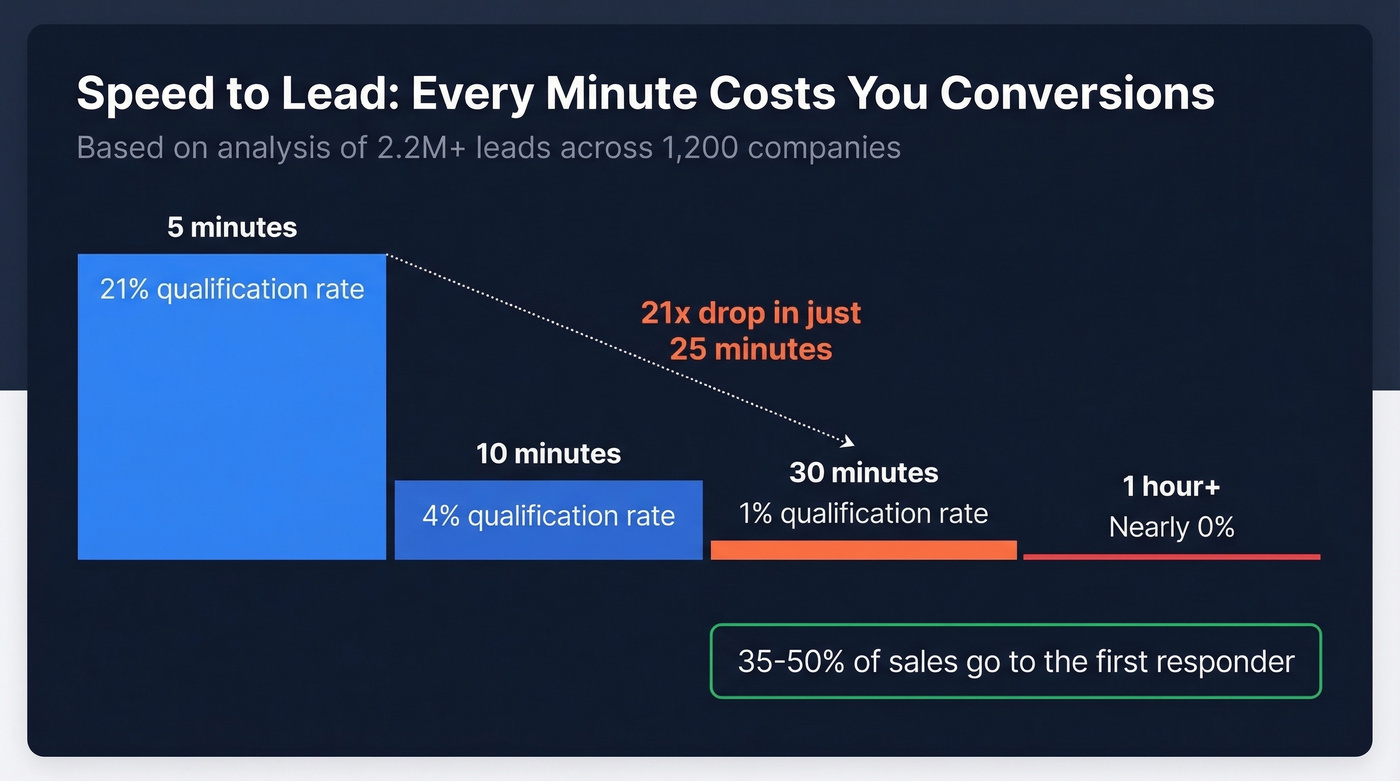
But here's the nuance most guides skip: the speed-to-lead rule applies to inbound leads - someone fills out a form, requests a demo, raises a hand. Outbound timing works differently because you're initiating the conversation, so consistency and persistence matter more than raw speed. Having a response plan for inbound requests, even a simple one that routes form fills to the right rep within minutes, is what separates teams that convert from teams that leak.
What doesn't change across either motion: 35-50% of sales go to the vendor that responds first. Show up, and you're already ahead.
Step Zero: Verify Your Data First
Nobody talks about this step because it's unsexy. It's also the single highest-leverage thing you can do before launching any follow-up process.
When Meritt, a staffing firm, audited their outbound data, they found a 35% bounce rate. After cleaning up their records, that rate dropped below 4% and pipeline tripled from $100K to $300K per week. That's not a marginal improvement - it's a completely different business.

In our experience, the bounce rate issue is the silent killer most teams don't see coming. Your domain gets flagged, deliverability craters, and the damage takes weeks to undo. Fix the data first, then worry about templates and timing. Prospeo's 98% email accuracy and 7-day data refresh cycle mean your contact records don't go stale between list-building and sequence launch - covering 300M+ professional profiles, 143M+ verified emails, and 125M+ verified mobile numbers with a 30% pickup rate.
If you want to go deeper on bounce prevention, start with bounce rate benchmarks and an email deliverability checklist.
The 10-Day Lead Follow Up Cadence
High-growth organizations average 16 touchpoints per prospect within 2-4 weeks. You don't need 16 on day one. You need a structured cadence that mixes channels and escalates naturally.
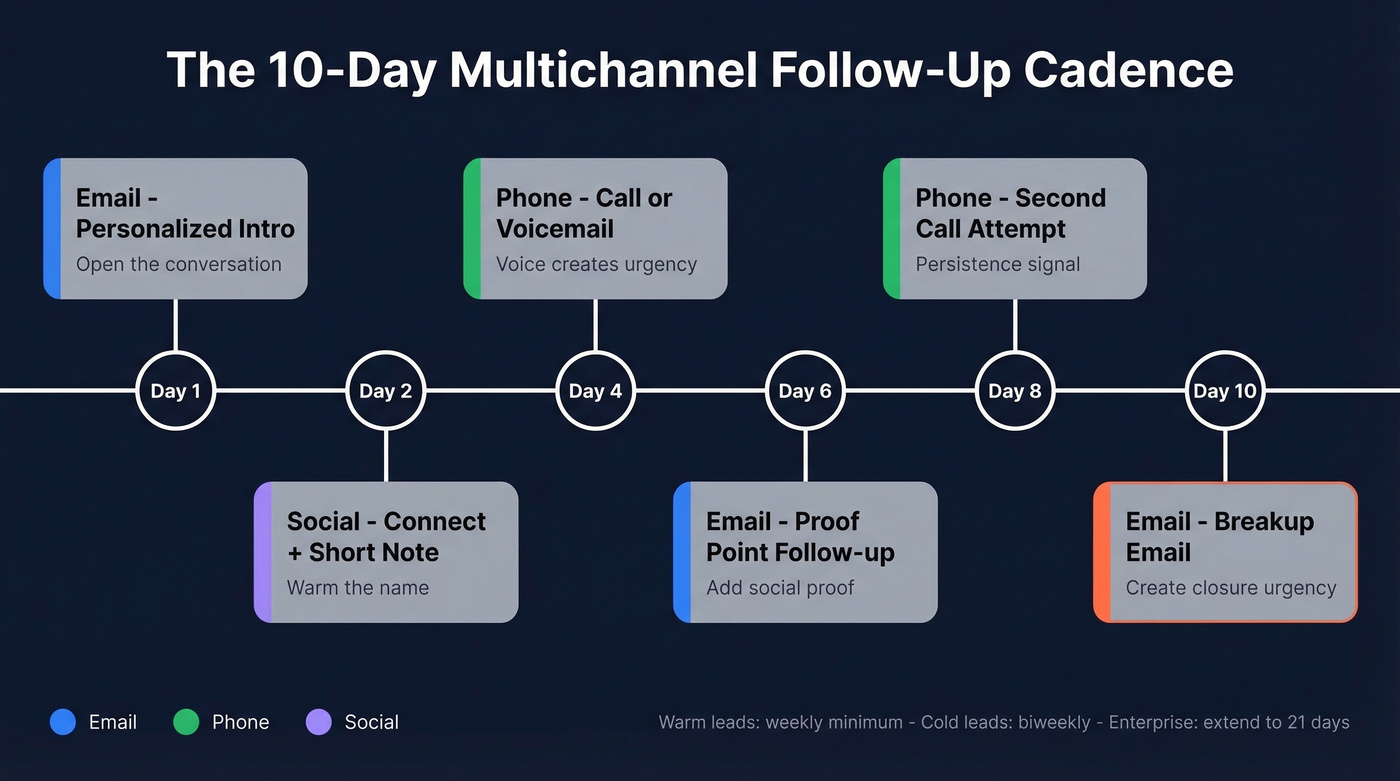
| Day | Channel | Action | Purpose |
|---|---|---|---|
| 1 | Personalized intro | Open the conversation | |
| 2 | Social | Connect + short note | Warm the name |
| 4 | Phone | Call, leave voicemail if no answer | Voice creates urgency |
| 6 | Follow-up with proof point | Add social proof | |
| 8 | Phone | Second call attempt | Persistence signal |
| 10 | Breakup email | Create closure urgency |
The key isn't the exact days - it's the channel rotation. Email-only sequences are dead. When a name shows up in someone's inbox, their feed, and their voicemail within the same week, it registers differently than another drip email they'll never open.
For warm leads, follow up weekly at minimum. For cold, biweekly. Enterprise deals might stretch the full cadence to 21 days, while SMB motions compress to 7.
Templates That Get Replies
The sweet spot for follow-up emails is 50-125 words. The benchmark to beat: 8.5% of sales outreach emails receive responses. These five templates consistently outperform that number.
If you want more plug-and-play options, pull from these follow-up templates and cold email follow-up templates.
After No Response
Subject: Quick question about [specific initiative]
Hi [Name], I sent a note last week about [specific value prop]. Totally understand if the timing's off - but if [pain point] is still on your radar, I'd love 15 minutes to show you how [Company] solved it. Worth a look?
This works because it's low-pressure. You're acknowledging the silence instead of pretending it didn't happen.
After a Demo
Subject: Next steps from our call
[Name], thanks for the time today. You mentioned [specific pain point they raised] - I've attached a case study from [similar company] that maps to exactly that. Happy to loop in [relevant stakeholder] if it makes sense to explore further.
Notice the specificity. Referencing the exact pain point they mentioned builds continuity and proves you were actually listening, not running a script.
After Sending a Quote
Subject: Any questions on the proposal?
Hi [Name], wanted to check if you've had a chance to review the proposal. If there's anything that doesn't line up with what you need, I'd rather adjust now than have it sit. What's the best way to move this forward?
The Value-Add Touch
Subject: Thought you'd find this useful
[Name], came across [article/report/data point] relevant to [their initiative]. No ask here - just thought it'd be useful. Let me know if you want to dig into how this applies to [Company].
The Breakup Email
Subject: Should I close your file?
Hi [Name], I've reached out a few times and haven't heard back. I'll close out your file for now, but if [pain point] comes back up, I'm here.
The breakup email consistently gets the highest reply rate of any sequence because it triggers loss aversion. This follows the 4-email cold sequence structure that top teams run: intro, social proof, resource, breakup. Don't skip it.

Every bounced email in your follow-up sequence damages your domain and kills your cadence. Prospeo's 98% email accuracy and 7-day data refresh mean your 10-day cadence actually reaches real inboxes - not spam folders.
Stop following up with ghosts. Start with verified contacts.
Subject Lines That Get Opened
Personalized subject lines generate 22.2% higher open rates than generic ones. Patterns that work:
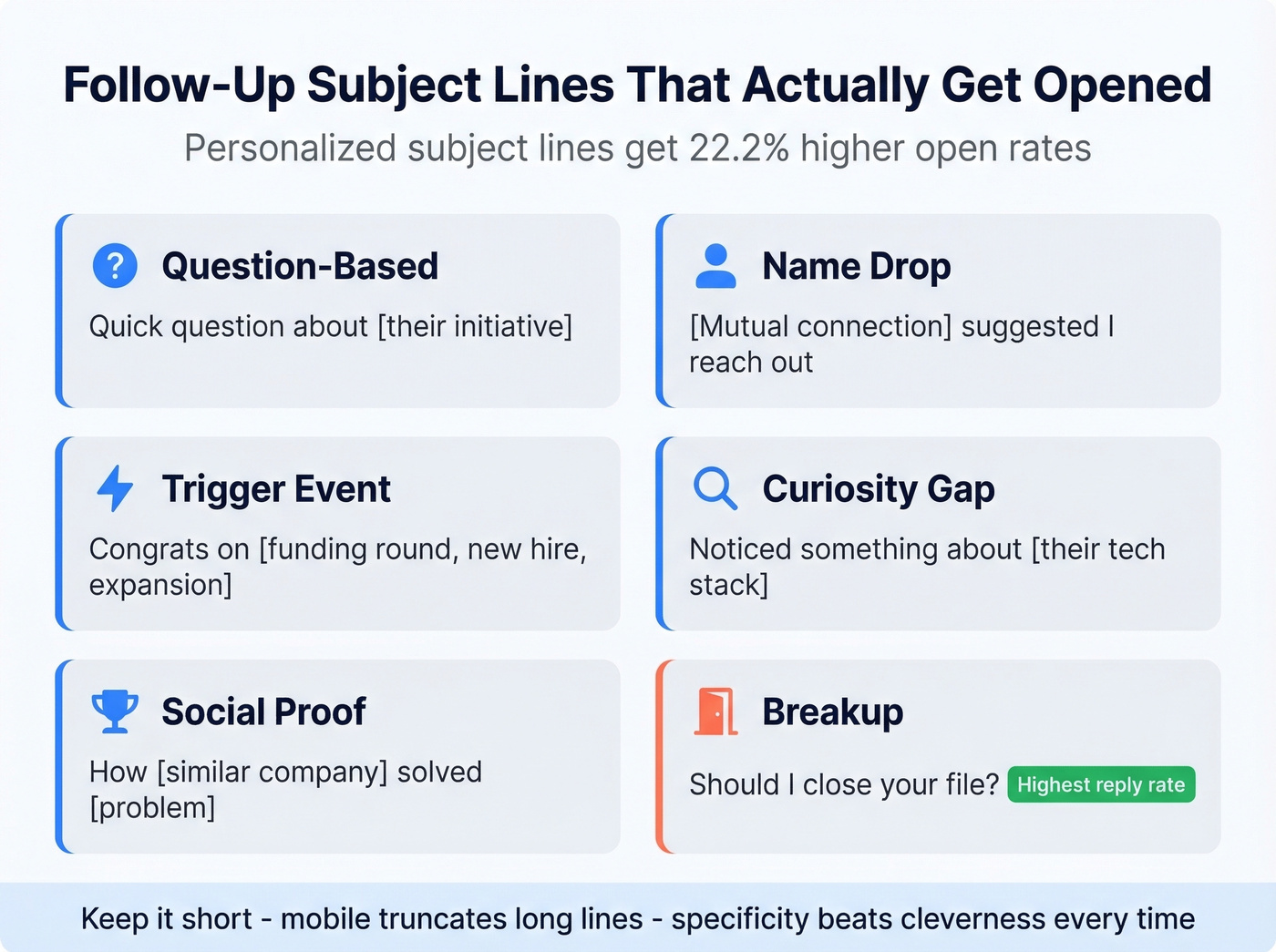
- Question-based: "Quick question about [their initiative]"
- Name-drop: "[Mutual connection] suggested I reach out"
- Trigger event: "Congrats on [funding round / new hire / expansion]"
- Curiosity gap: "Noticed something about [their tech stack]"
- Social proof: "How [similar company] solved [problem]"
- Breakup: "Should I close your file?"
Keep them short. Mobile truncates long subject lines, and specificity beats cleverness every time. If you need more ideas, use these email subject line examples or a tighter prospecting subject line framework.
Best Days, Times, and Channels
| Channel | Best Timing |
|---|---|
| Tue/Thu, 8-10 AM | |
| Phone | Tue/Thu, 4-5 PM |
| SMS | Tue/Thu, 10-11 AM (SMS open rates hover around 98%) |
Tuesday and Thursday consistently outperform other days. The 8-10 AM and 4-5 PM windows catch prospects before their day fills up or as they're winding down. Avoid 1-2 PM - response rates crater during the post-lunch slump.
Let's be honest about something: if your average deal size is under $15k, you probably don't need a 16-touch enterprise cadence. A tight 6-touch, 10-day sequence with verified direct dials will outperform a bloated 21-day email-only drip every time. A verified mobile number that actually connects is worth more than 10 emails to a generic inbox. Inside sales prospecting lives and dies by phone data quality - if your dials don't connect, your reps burn hours for nothing.
Mistakes That Kill Pipeline
If you're doing anything in the "don't" column, fix it this week.
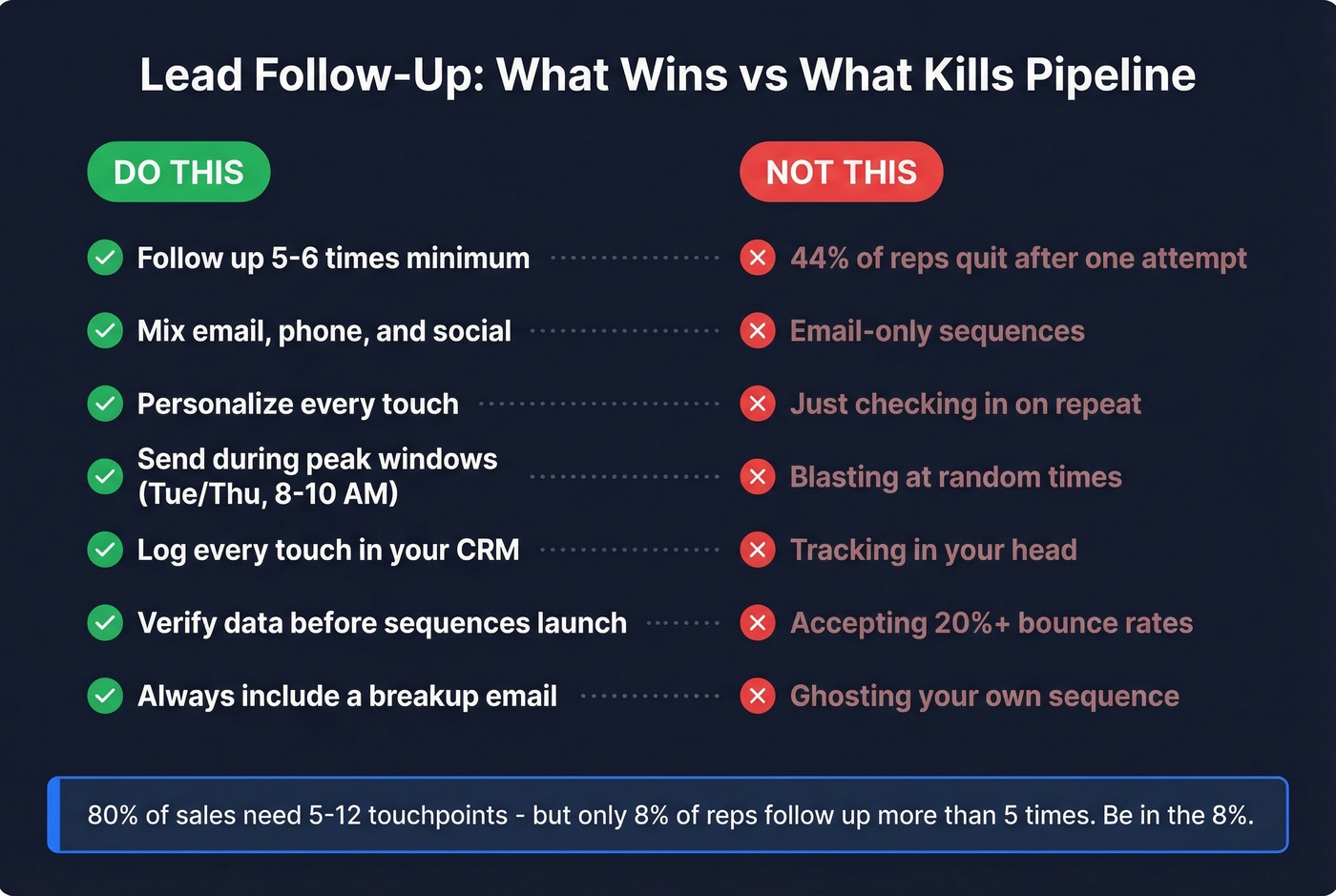
- ✅ Follow up 5-6 times minimum - ❌ 44% of reps quit after one attempt
- ✅ Mix email, phone, and social - ❌ Email-only sequences
- ✅ Personalize every touch - ❌ "Just checking in" on repeat
- ✅ Send during peak windows - ❌ Blasting at random times
- ✅ Log every touch in your CRM - ❌ Tracking in your head
- ✅ Verify data before sequences launch - ❌ Accepting 20%+ bounce rates
- ✅ Always include a breakup email - ❌ Ghosting your own sequence
Here's the thing: if your CRM doesn't have a follow-up workflow, it's an expensive address book. We've seen teams realize their domain was flagged only after deliverability had already cratered for weeks. That damage compounds fast and takes even longer to reverse.
How to Standardize Your Sales Follow-Up Process
Over 30% of sales activities - scheduling, follow-ups, pipeline updates, reporting - can be automated. But automation without a repeatable framework just scales chaos faster. The goal is to standardize your process so every rep runs the same cadence, with the same data quality bar, regardless of territory or deal size.
If you're building this into onboarding, bake it into your 30-60-90 day plan and define the non-negotiable sales activities each rep must log.
CRM: HubSpot has a free tier that covers the basics, with paid plans scaling by feature set. Pipedrive starts around $14/user/mo and is cleaner for pure sales teams that don't need marketing automation bolted on.
Sales engagement: Outreach and Salesloft run around $100-150/user/mo and are built for enterprise cadences. For smaller teams, Instantly at $30-97/mo and Lemlist at $39-99/mo cover multichannel sequences without the enterprise overhead. Skip Outreach if you're under 10 reps - you'll pay for features you won't use for another year.
Data verification: Prospeo handles this at roughly $0.01/email with a free tier of 75 email verifications plus 100 Chrome extension credits per month. No contracts, no sales calls - upload a CSV or connect via API and verify before you send. Native integrations with HubSpot, Salesforce, Instantly, Lemlist, and Smartlead mean verified data flows straight into your sequences without manual exports.
Meritt cut their bounce rate from 35% to under 4% and tripled pipeline to $300K/week. Your follow-up templates don't matter if half your emails never land. Prospeo gives you 143M+ verified emails and 125M+ direct dials at $0.01/lead.
Clean data turns a 5-touch cadence into closed revenue.
FAQ
How many times should you follow up with a lead?
At least 5-6 times across email, phone, and social before sending a breakup message. 80% of deals need 5-12 touchpoints, but most reps quit after one or two. A documented cadence ensures no prospect falls through the cracks before hitting that threshold.
What's the best time to follow up?
Tuesday and Thursday between 8-10 AM or 4-5 PM local time consistently produce the highest response rates. Avoid 1-2 PM - engagement drops sharply during the post-lunch window.
How do you follow up without being annoying?
Add value every touch - a relevant case study, a useful stat, a specific insight about their business. If every message says "just checking in," you're nagging, not following up. Rotate channels so the same inbox doesn't get hammered three days in a row.
What tools help automate lead follow up?
Outreach and Salesloft handle enterprise cadences at $100-150/user/mo. Instantly ($30-97/mo) and Lemlist ($39-99/mo) suit smaller teams. Pair any of these with a verification layer like Prospeo at $0.01/email - its native integrations push clean records directly into your sequences so you're not burning sends on dead addresses.