

The Lead Funnel Guide With Actual Numbers
79% of marketing leads never convert into sales. Not because companies aren't generating enough traffic - because they're losing people between stages. Slow follow-up, generic messaging, and bad contact data quietly kill a lead funnel that looks healthy on the surface.
This guide gives you the benchmarks to diagnose where yours is breaking, the scoring model to fix qualification, and the build steps to get it right from scratch.
What Is a Lead Funnel?
A lead funnel maps the journey from "stranger who's never heard of you" to "qualified prospect ready for a sales conversation." It bridges marketing and sales - the system that turns anonymous traffic into named, scored, routable leads. In practice, it's the lead management structure that keeps both teams aligned on who's ready to buy and who still needs nurturing.
The lead generation software market hit $7.4B in 2025 and is projected to reach $16.2B by 2034, growing at 9.1% CAGR. That growth reflects a simple reality: every revenue team needs a structured way to move prospects through stages, and most are still doing it poorly. 91% of marketers say lead generation is their top priority. 61% say it's their greatest challenge. The gap between those two numbers is where most funnels live.
Lead Funnel vs Marketing Funnel vs Sales Funnel
These terms get used interchangeably, and that causes real problems - especially at the MQL-to-SQL handoff where marketing and sales blame each other for bad leads.
| Lead Funnel | Marketing Funnel | Sales Funnel | |
|---|---|---|---|
| Focus | Stranger to qualified lead | Attract, educate, nurture | Qualify, close, retain |
| Framework | TOFU / MOFU / BOFU | AIDA (Awareness to Action)) | SQL to Discovery to Close |
| Owned by | Marketing + RevOps | Marketing | Sales |
| Ends at | MQL or SQL handoff | Lead capture / MQL | Closed Won / Post-sale |
Here's a practical way to think about it: the marketing funnel covers awareness and nurture, the sales funnel covers qualification through close, and the lead funnel is the connective tissue that makes the handoff between the two measurable and repeatable.
The confusion matters because teams that conflate these end up with marketing running campaigns that generate "leads" sales can't close, and sales complaining about lead quality when the real issue is a missing middle-funnel nurture step.
The 5 Lead Funnel Stages
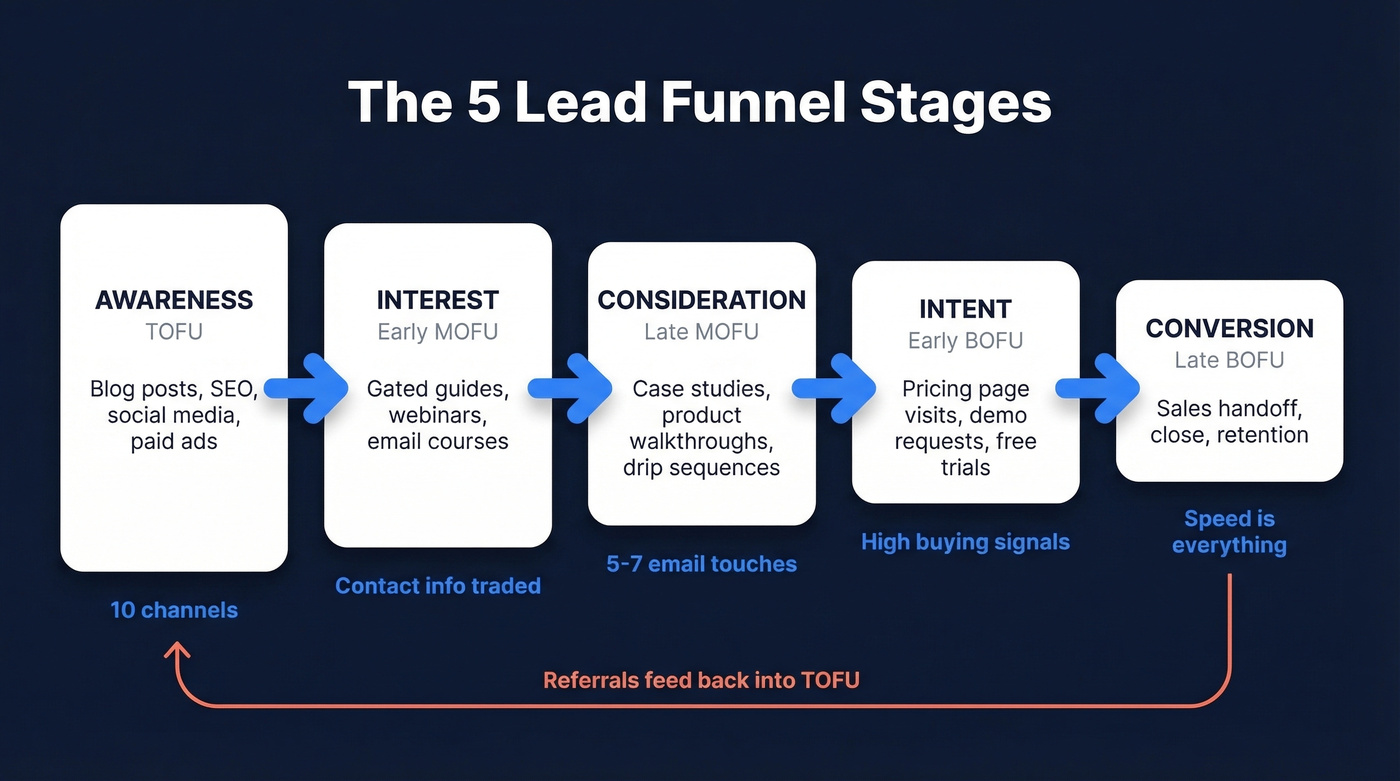
B2B customers now engage across roughly 10 channels before making a purchase - up from 5 in 2016. Your lead funnel needs to meet them across all of those touchpoints, not just the ones you control.
Awareness (TOFU)
The prospect doesn't know you exist. Your job is to show up where they're already looking - blog posts, SEO content, social media, paid ads, podcast appearances. Anything that gets you in front of the right audience without asking for anything in return. The metric here is reach and traffic, not conversions. Trying to sell at this stage is the fastest way to waste budget.
Interest (Early MOFU)
Now they know you exist and they're evaluating whether you're worth their time. Gated guides, webinars, email courses, and comparison pages earn their place here. The prospect is trading contact information for something genuinely useful. Your content should educate and build trust, not pitch.
Consideration (Late MOFU)
The prospect is comparing options. Case studies, detailed product walkthroughs, and multi-touch email nurture sequences live here - the 5-7 email drip that moves someone from "downloaded a PDF" to "ready for a conversation." This stage separates funnels that produce pipeline from funnels that produce a bloated CRM.
Intent (Early BOFU)
The prospect is actively evaluating solutions. They're visiting your pricing page, attending a live demo, or asking for references. Content at this stage is direct: ROI calculators, free trials, customer testimonials, implementation guides.
Conversion (Late BOFU)
The handoff to sales happens here, and speed matters enormously. Teams lose deals when they take too long to respond to demo requests while a competitor responds in minutes. The funnel doesn't end at conversion, either - retention and advocacy feed directly back into the top of the funnel through referrals, which convert at nearly double the rate of PPC at the Lead-to-MQL stage.
Funnel Benchmarks: What Good Looks Like
This is the section most guides skip or fill with vague platitudes. Let's fix that.
Benchmarks by Industry
Stage-to-stage conversion rates from First Page Sage's 2026 benchmarks report, covering data collected 2017-2025 across a roughly 65% B2B client base:
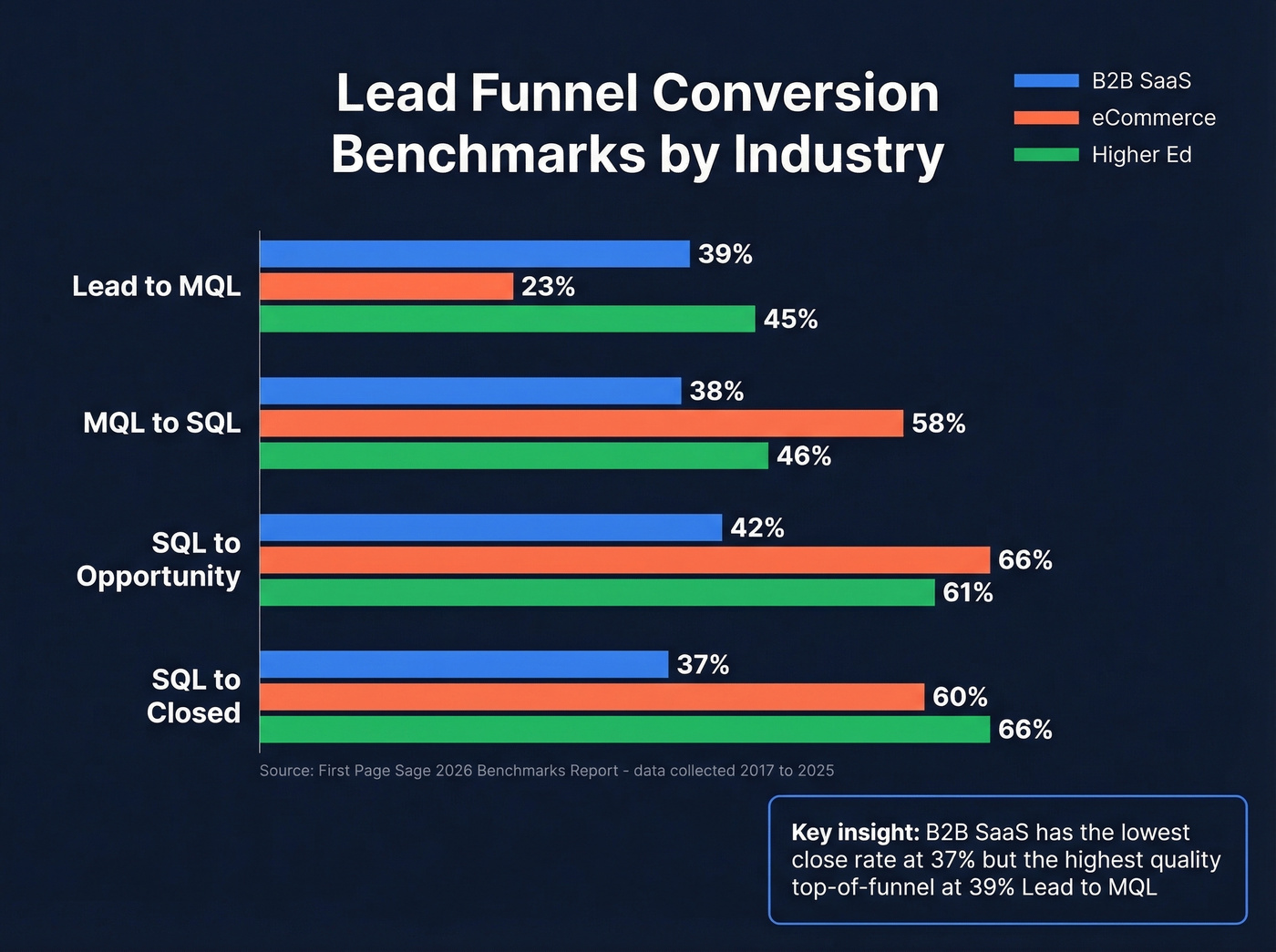
| Industry | Lead to MQL | MQL to SQL | SQL to Opp | SQL to Closed |
|---|---|---|---|---|
| B2B SaaS | 39% | 38% | 42% | 37% |
| eCommerce | 23% | 58% | 66% | 60% |
| Higher Ed | 45% | 46% | 61% | 66% |
Visitor-to-lead rates are much lower and vary wildly: B2B SaaS averages 1.1%, financial services 1.9%, manufacturing 2.2%, and legal services is an outlier at 7.4%. For SaaS specifically, visitor-to-lead is typically 1.5-2.5% on average, with top performers reaching 8-15%.
Acquisition Cost by Deal Size
This benchmark changes how you think about funnel investment:
| ACV Band | Typical CAC Range |
|---|---|
| SMB ($5K-$25K ACV) | $1K-$4K |
| Mid-market ($25K-$100K ACV) | $4K-$15K |
| Enterprise ($100K-$500K ACV) | $15K-$50K |
| Enterprise+ ($500K+ ACV) | $50K-$150K |
If your average deal size sits below $15K, you probably can't afford a funnel that requires manual qualification at every stage. Automate scoring, automate routing, and save human touch for the deals that justify it. Most teams over-engineer their funnel for their deal size.
Benchmarks by Channel
Not all traffic converts equally. Lead-to-MQL rates by acquisition channel:
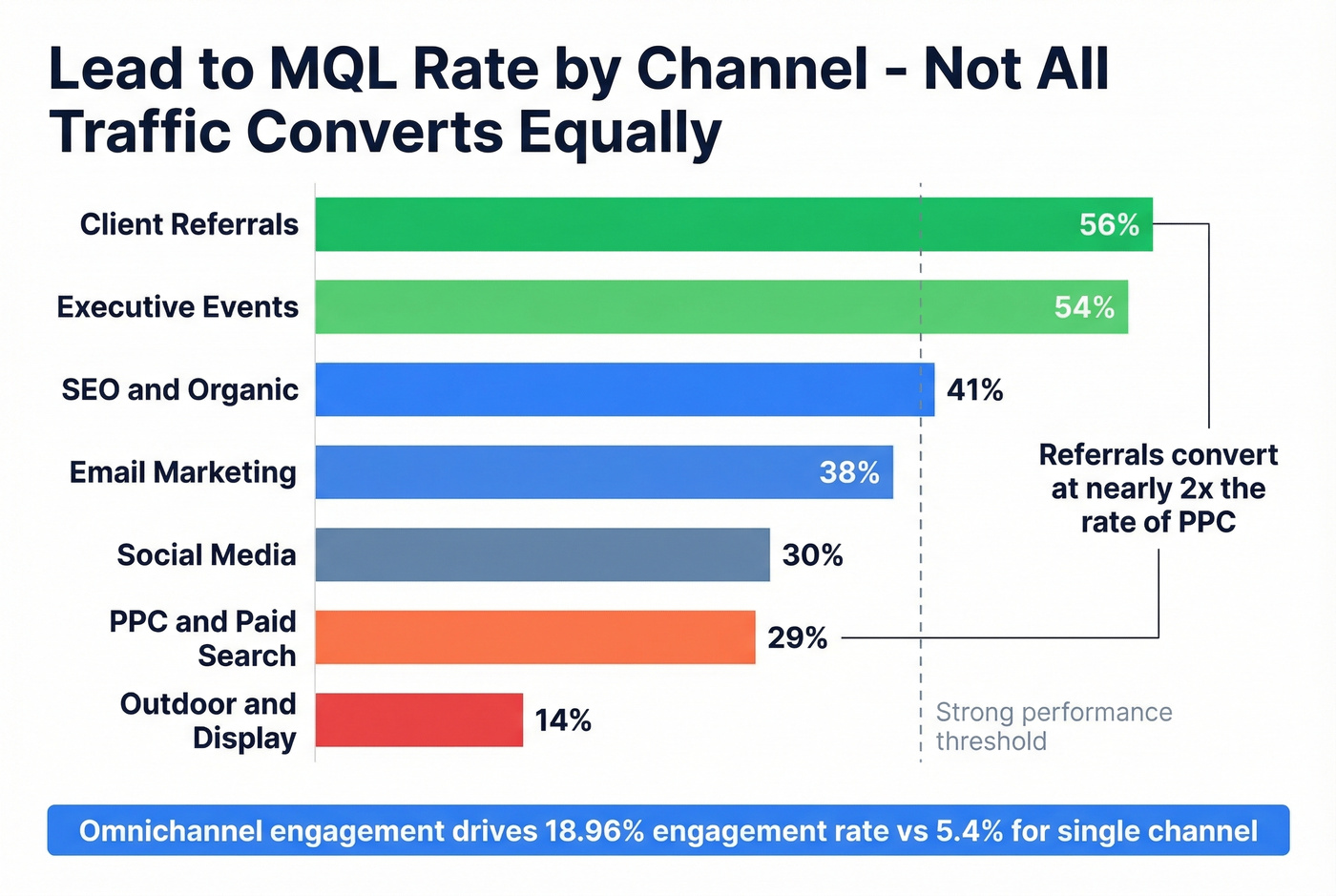
| Channel | Lead to MQL |
|---|---|
| Client referrals | 56% |
| Executive events | 54% |
| SEO / organic | 41% |
| Email marketing | 38% |
| Social media | 30% |
| PPC / paid search | 29% |
| Outdoor / display | 14% |
Referrals and events crush paid channels at the MQL stage because the leads arrive with higher intent and trust. PPC leads convert at nearly half the rate of referrals - something to remember when your paid team asks for more budget without improving qualification.
Omnichannel engagement - email plus social plus retargeting plus direct - drives an 18.96% engagement rate versus 5.4% for single-channel approaches. If your funnel only has one touchpoint per stage, you're leaving conversion on the table.
How Long Each Stage Takes
Funnel velocity is the benchmark most teams ignore, and it's often more diagnostic than conversion rates:
- Visitor to Lead: 1-3 days
- MQL to SQL: 8-15 days
- Opportunity to Close (SMB): 30-45 days
- Opportunity to Close (Enterprise): ~120 days
If your MQL-to-SQL handoff takes longer than 15 days, you've got a qualification or routing problem. If enterprise deals are closing faster than 90 days, you're likely discounting too aggressively or selling to the wrong segment. We've audited funnels where the velocity data told a completely different story than the conversion rates - a 40% MQL-to-SQL rate looks great until you realize it's taking 35 days.

Bad contact data is the silent killer at every funnel stage. When 79% of leads never convert, the problem often starts with bounced emails and wrong numbers - not your messaging. Prospeo delivers 98% email accuracy and 125M+ verified mobiles, refreshed every 7 days.
Stop losing leads to bad data between funnel stages.
B2B vs B2C: Your Funnel Isn't the Same
Most "lead funnel" advice is written for B2C and doesn't translate to B2B cycles.
| Dimension | B2B | B2C |
|---|---|---|
| Cycle length | Weeks to months | Minutes to days |
| Decision-makers | 3-10 stakeholders | Usually 1 |
| Buying trigger | Logic, ROI, risk | Emotion, impulse, price |
| CAC | $1K-$150K+ | $5-$200 |
| Deal value | $5K-$500K+ | $10-$500 |
B2B funnels need more nurture touchpoints, longer drip campaigns, and content that addresses multiple stakeholders with different concerns. The CFO cares about ROI. The end user cares about ease of use. The IT team cares about security. Your funnel content needs to speak to all of them, which is why B2B funnels that try to shortcut the middle stages almost always underperform.
Why Most Funnels Fail
Stop building more stages. Most teams need fewer stages with better handoffs. Three things kill funnels:
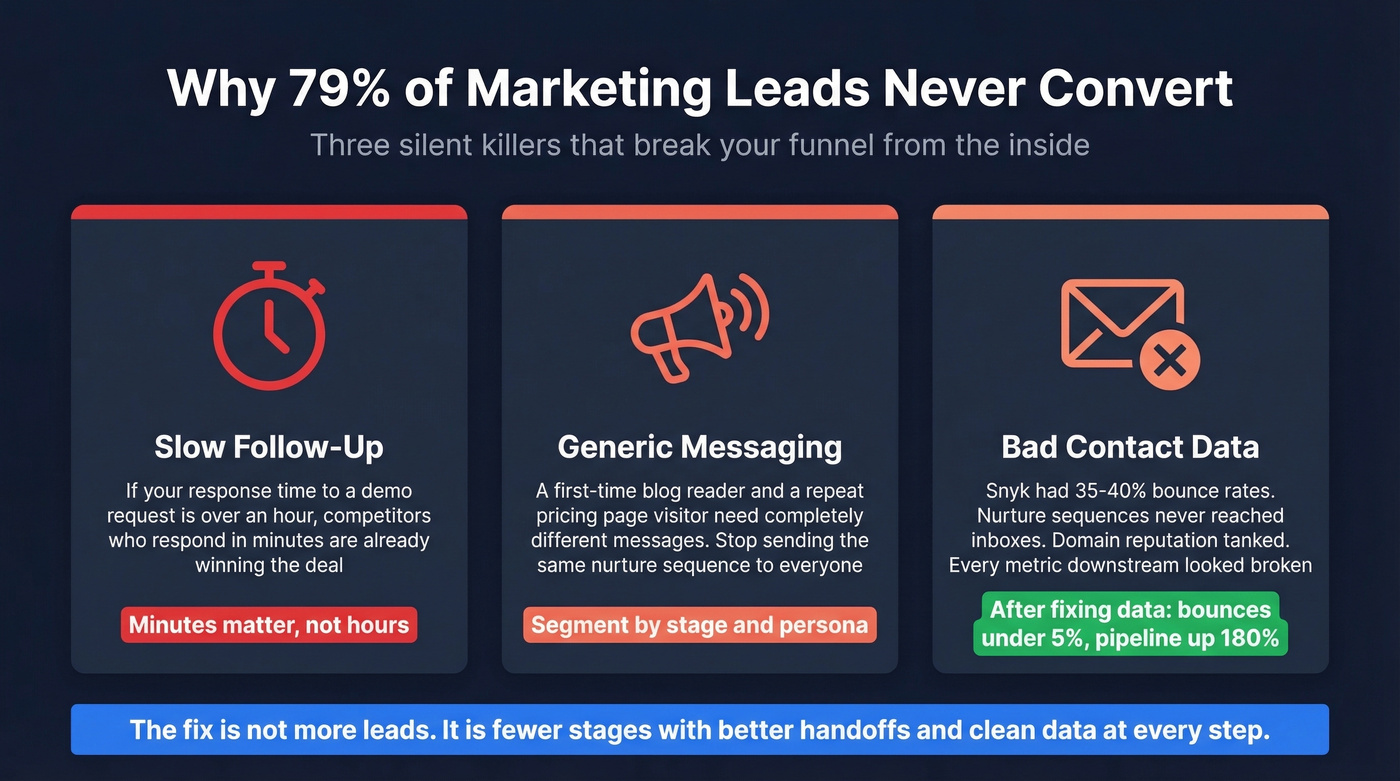
Slow follow-up. The consensus on r/digital_marketing is blunt: funnels fail because leads get ignored, not because of low traffic. More leads won't save bad follow-ups or unclear messaging. If your average response time to a demo request is over an hour, you're losing deals to competitors who respond in minutes.
Generic messaging. Treating every lead like they're ready to buy kills trust. A first-time blog reader and a repeat pricing-page visitor need completely different messages. Segment by stage, segment by buyer persona, and stop sending the same nurture sequence to everyone.
Bad data. This is the silent funnel killer. Snyk was running bounce rates of 35-40% - their nurture sequences never reached inboxes, domain reputation tanked, and every metric downstream looked broken. After switching to Prospeo for verified contact data, bounce rates dropped under 5% and AE-sourced pipeline jumped 180%. You can't nurture a lead whose email doesn't work.
How to Build a Lead Funnel in 5 Steps
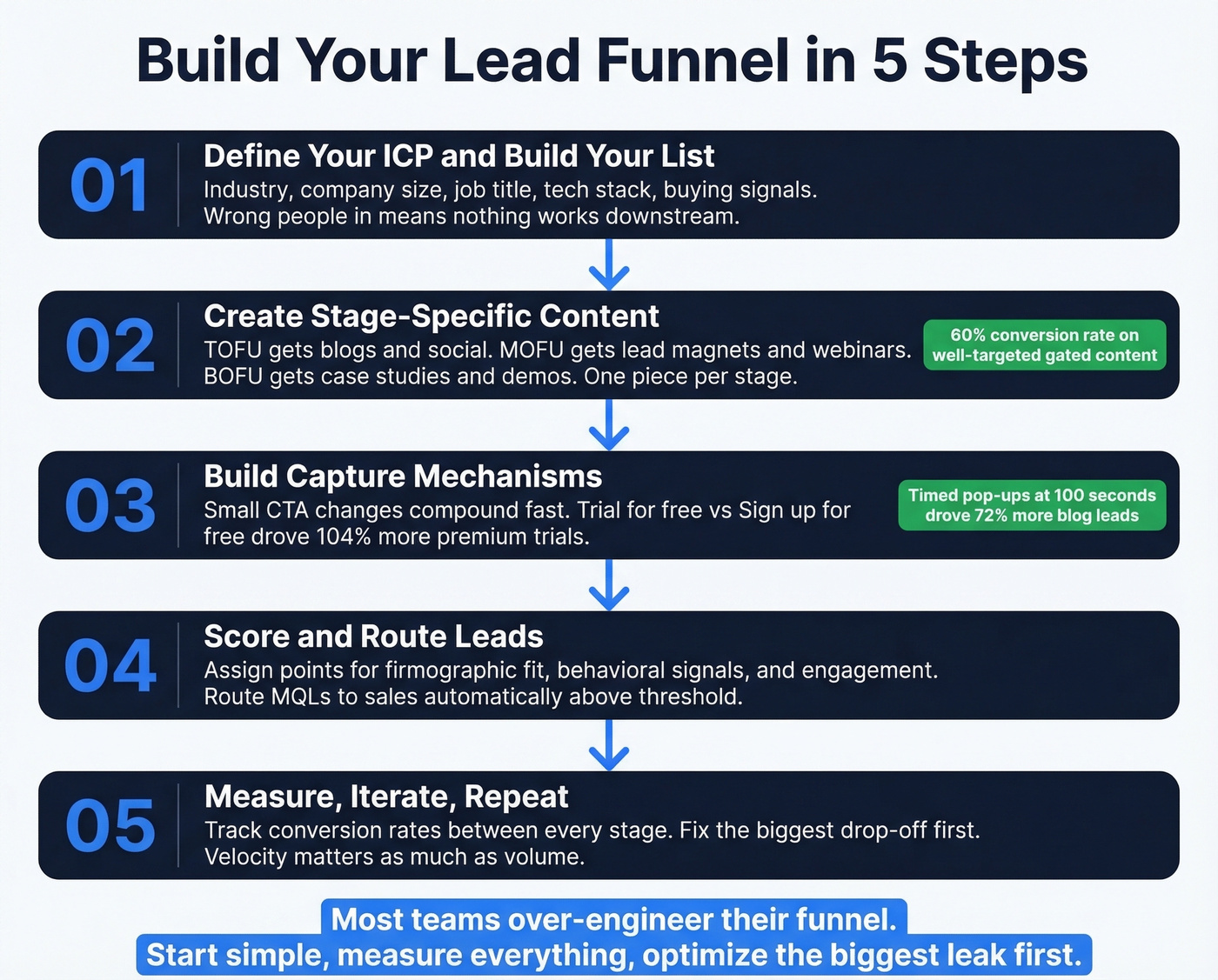
Step 1: Define Your ICP and Build Your List
Everything starts here. If you're filling the funnel with the wrong people, no amount of optimization downstream will save you. Define your ideal customer profile by industry, company size, job title, tech stack, and buying signals. Then build a list that matches.
If you need a starting point, use an ideal customer profile template and scoring rubric.
Step 2: Create Stage-Specific Content
Map content to funnel stages. TOFU gets blog posts, social content, and ungated guides. MOFU gets lead magnets, webinars, and email courses. BOFU gets case studies, demos, and ROI calculators. Each piece should serve exactly one stage and move the prospect to the next.
Later (the social media platform) achieved a 60% average conversion rate on gated content landing pages and generated 100,000+ new leads - proof that well-targeted lead magnets still work when the content genuinely helps. The key is matching depth to stage: surface-level content at the top, progressively more specific and solution-oriented as prospects move down.
Step 3: Build Capture Mechanisms
Skip this step if your landing pages already convert above 3%. For everyone else, small changes here compound fast.
Going (the travel deals company) swapped "Sign up for free" for "Trial for free" on a single CTA and saw a 104% month-over-month increase in premium trial starts. Broomberg added timed pop-ups triggered at 100 seconds and generated 72% more blog leads. These aren't redesigns - they're afternoon experiments with outsized returns.
For tools, Unbounce or Leadpages run $49-99/mo for landing pages, with your CRM handling form submissions and routing. If you're still evaluating options, start with a few examples of a CRM to match your funnel complexity.
Step 4: Set Up Nurture Sequences
We've tested dozens of nurture structures, and the one that consistently works for B2B funnels follows this rhythm: an immediate thank-you email confirming the download or signup, a follow-up 24-48 hours later with related content, then a 5-7 email drip over 2-3 weeks that progressively qualifies interest.
ActiveCampaign, starting around $29/mo, handles this well for teams under 10K contacts. HubSpot's CRM + workflows can cover basic sequences if you're just starting.
Marketing automation done right drives a 451% increase in qualified leads. Done wrong - blasting the same generic sequence to every lead - it just accelerates unsubscribes. If your team needs copy that doesn’t sound automated, keep a set of sales follow-up templates on hand.
Step 5: Measure What Matters
Three metrics per stage: conversion rate (stage-to-stage), time-in-stage (velocity), and cost per qualified lead.
If Lead-to-MQL is below 30%, your targeting or content is off. If MQL-to-SQL takes longer than 15 days, your scoring or handoff process needs work. If cost per SQL is climbing while volume stays flat, you've got a channel efficiency problem.
Run a weekly funnel review - 15 minutes, one dashboard, stage-by-stage. The teams that catch problems early are the ones reviewing weekly, not quarterly. Total leads generated means nothing if SQL-to-Close is 5%. (If you want a clean dashboard spec, use this funnel metrics tracking guide.)
How to Score and Qualify Leads
Lead scoring separates "downloaded a PDF once" from "VP of Engineering who visited pricing three times this week." You need two dimensions: fit (who they are) and engagement (what they've done). We've tested single-score systems against this two-dimension approach, and the two-dimension model consistently outperforms.
Here's an implementable model:
| Signal | Points |
|---|---|
| Director-level or above | +25 |
| Company 200-1,000 employees | +15 |
| Pricing page visit | +10 |
| Demo booking | +20 |
| Case study download | +5 |
| No engagement 30+ days | -10 |
Set your MQL threshold at 60-80 points. When a lead crosses that line, it routes to sales automatically. The distribution is predictable: about 40% of leads score 41-60, roughly a third score 61-80, and fewer than 10% hit 81-100. That top 10% is where your sales team should spend their time.
360 Learning saw a 40% increase in conversion rates after implementing structured scoring with clear thresholds. The platforms that handle this natively - HubSpot scoring tables, Pardot scoring + A-F grading, Marketo threshold triggers at 70+ - all work. The model matters more than the tool. For a deeper build, use this lead scoring guide.
Optimization: Where the Real Gains Live
Conversion rate optimization on an existing funnel is one of the highest-ROI activities in marketing because you're improving conversion on traffic you've already paid for.
Teams using AI-driven lead scoring report 76% higher win rates, and the impact compounds. One insurance company achieved 90%+ accuracy identifying high-conversion leads, with top-scoring prospects converting at 3.5x the rate of average leads. An enterprise chatbot implementation drove a 496% increase in pipeline from chatbot-generated leads.
Look - you don't need AI to start optimizing. The biggest lifts come from basics: faster follow-up, better segmentation, verified data, and stage-appropriate content. AI scoring amplifies those fundamentals. It doesn't replace them. If follow-up speed is your bottleneck, borrow a few sales prospecting techniques that reduce time-to-first-touch.
If your funnel only has one touchpoint per stage, start there. Multi-channel engagement nearly quadruples engagement rates, and it's the single cheapest optimization most teams haven't tried.
If your CAC doesn't justify manual qualification, automate with data you can trust. Prospeo's 30+ search filters - buyer intent, technographics, funding, headcount growth - let you score and route leads before a rep ever touches them. At $0.01 per email, even SMB funnels stay profitable.
Qualify leads automatically with intent data across 15,000 topics.
FAQ
How many stages does a lead funnel have?
Most models use 3-5 stages. Simpler three-stage funnels (TOFU/MOFU/BOFU) work better for teams that need speed over granularity. The five-stage model - awareness, interest, consideration, intent, conversion - gives more diagnostic precision for B2B teams with longer sales cycles.
What's a good funnel conversion rate?
B2B SaaS benchmarks: 39% Lead-to-MQL, 38% MQL-to-SQL, 37% SQL-to-Closed Won. If you're below those numbers, fix qualification criteria and follow-up speed before adding more top-of-funnel volume.
Lead funnel vs sales pipeline?
A lead funnel covers stranger to qualified lead (marketing-driven). A sales pipeline tracks opportunities from SQL through close (sales-driven). They overlap at the MQL-to-SQL handoff - misalignment here is the #1 cause of "bad leads" complaints.
What tools do I need to build one?
Four essentials: a landing page builder like Leadpages or Unbounce ($49-99/mo), a CRM (HubSpot free tier works), verified contact data from Prospeo (free tier: 75 emails/mo), and email automation through ActiveCampaign (~$29/mo). That's a functional setup for under $150/mo total.