

The Lead Gen Business Model: How It Works, What It Pays, and How to Start
You don't need a SaaS product, a venture round, or even a team to build a business that prints recurring revenue. You need a website that ranks, a niche where leads are expensive, and one local business willing to pay for customers you send them. That's it. The lead gen business model is one of the few online businesses where a solo operator can realistically hit $5K-$10K/month within a year - and the global lead generation industry is [projected to reach $295 billion by 2027](https://www.businesswire.com/news/home/20210126005925/en/Global-Content-Marketing-Market-Trajectory-Analytics-Report-2020-2027-Lead-Generation-is-Projected-to-Account-for-US%24295.1-Billion-of-the-Total-%24829.6-Billion-Industry - ResearchAndMarkets.com).
The lead generation software market alone was about $7.4B in 2025 and is on track to hit $16.2B by 2034, growing at a 9.1% CAGR. Here's how the model actually works, what the economics look like, and how to start without overthinking it.
You generate leads - via SEO, ads, or outreach - and sell them to businesses that need customers. You make money three ways: per-lead fees ($50-$300), monthly retainers ($1K-$5K), or a hybrid of both. Best starting point: pick a high-CPL niche (legal, finance, HVAC), build one ranked local page, verify your contact data, and land one paying client. Everything else is optimization.
What Is a Lead Generation Business?
A lead gen business generates potential customer inquiries - form fills, phone calls, verified contact info - and sells those leads to companies willing to pay for them. You're the middleman between demand and supply, and you get paid every time you connect the two.
This isn't affiliate marketing, where you earn a commission after a sale closes. And it's not an agency model, where you're managing a client's campaigns under their brand. Lead gen is simpler: you own the asset that produces leads, and you sell the output.
Think of HomeAdvisor. Homeowners search for contractors, fill out a form, and HomeAdvisor sells that lead to plumbers, roofers, and electricians. Kelley Blue Book does something similar - users request a cash offer for their car, and KBB passes that contact info to local dealers. Both are lead generation businesses at massive scale, but the same mechanics work for a one-person operation targeting a single metro area.
The real advantage for smaller operators is what Empire Flippers calls "tenant switching." You own the website, the rankings, the traffic. If a client stops paying, you don't lose the asset - you redirect leads to their competitor down the street. That kind of leverage doesn't exist in traditional agency work, where the client owns the ad account and the brand.
How Lead Gen Businesses Make Money
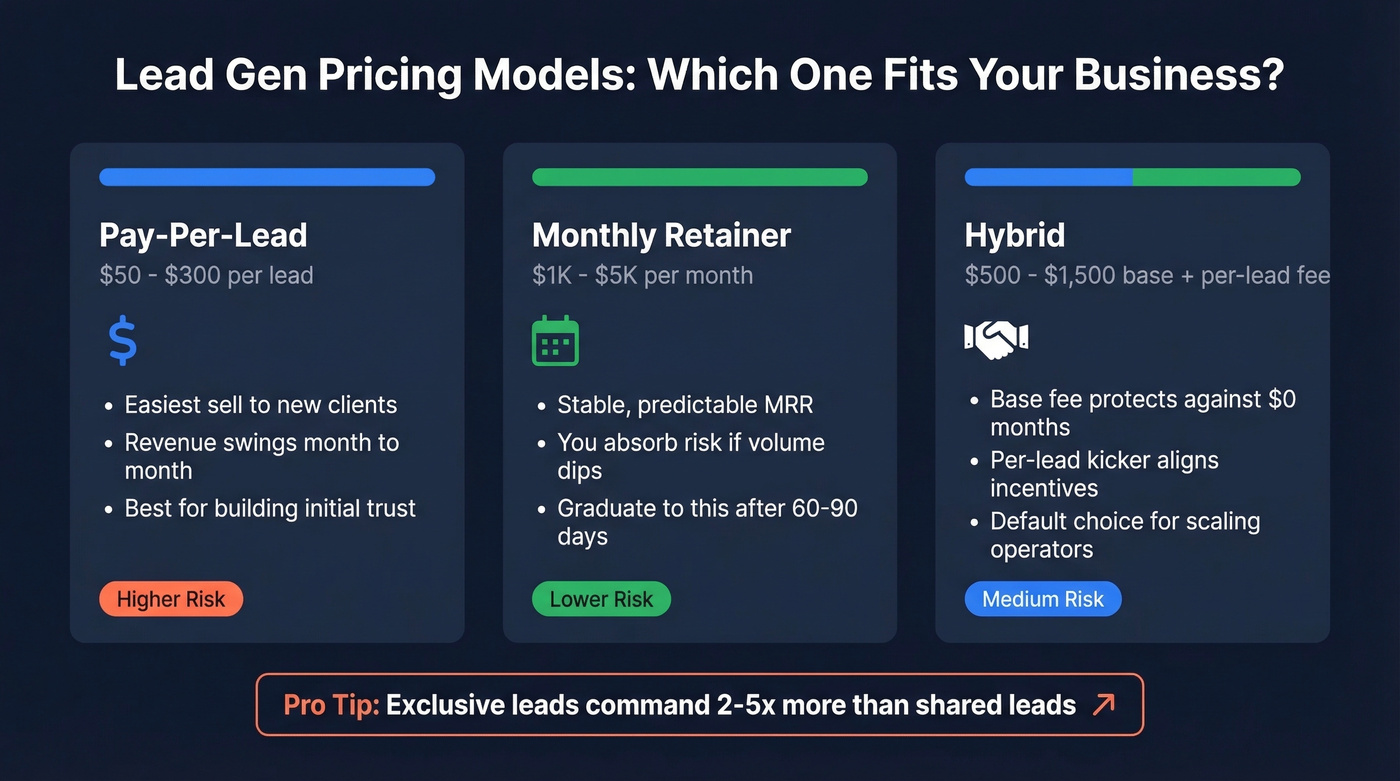
Three core pricing models exist, and which one you pick shapes your entire operation.
| Model | Typical Range | Best For | Risk Level |
|---|---|---|---|
| Pay-per-lead | $50-$300/lead | New clients, high trust | Higher (volatile) |
| Retainer | $1K-$5K/mo | Stable relationships | Lower (predictable) |
| Hybrid | $500-$1,500 base + PPL | Scaling operators | Medium (balanced) |
Pay-per-lead is the easiest sell to a new client because they only pay for results. The typical range runs $50-$300 per qualified meeting, though high-value niches like legal or financial services push well above that. The downside: your revenue swings month to month, and you'll argue about what counts as "qualified."
Retainers give you stable MRR. A local business pays $1K-$5K/month for a guaranteed flow of leads. You eat the risk if lead volume dips, but the predictability lets you plan and invest in growth. Most operators graduate to retainers once they've proven their lead quality over 60-90 days.
Hybrid is the default compromise - a base fee of $500-$1,500 plus a per-lead kicker. It protects you from $0 months while still aligning incentives with the buyer.
One pricing lever most beginners miss is exclusivity. Exclusive leads - sent to one buyer only - command 2-5x what shared leads do. If you're generating 30 leads a month in personal injury law, selling each exclusively at $200 is a very different business than selling shared leads at $50. The consensus on r/Entrepreneur and r/DigitalMarketing is that exclusive leads build stronger client relationships and lower churn, even though they cap your per-lead revenue.
What Leads Cost by Niche
Niche selection is the single biggest lever in this business. The spread between a cheap lead and an expensive one is enormous.
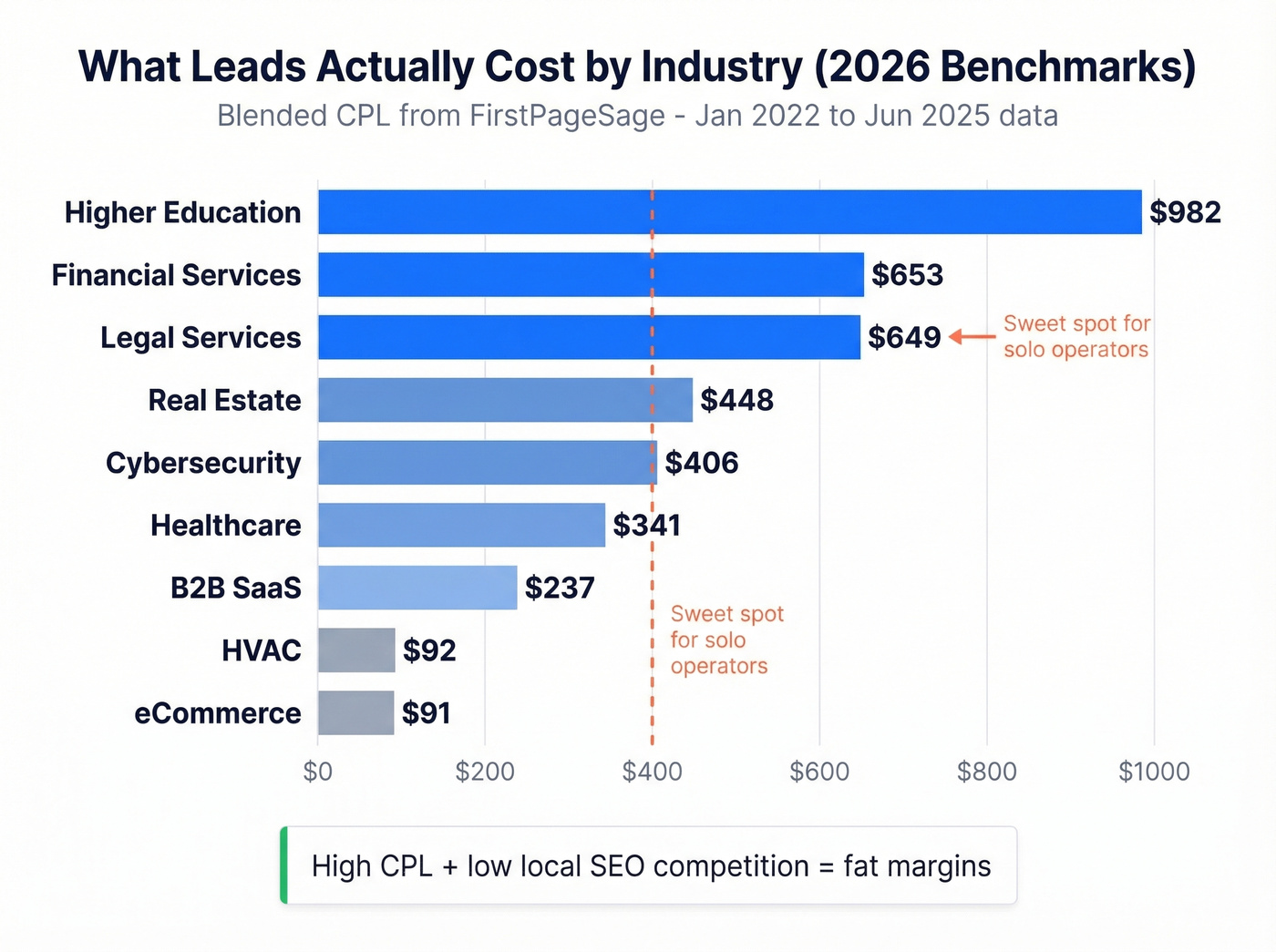
Here are blended CPL benchmarks from FirstPageSage's 2026 report (data window: Jan 2022-Jun 2025), broken out by paid and organic channels:
| Industry | Paid CPL | Organic CPL | Blended CPL |
|---|---|---|---|
| Higher Education | $1,261 | $705 | $982 |
| Financial Services | $761 | $555 | $653 |
| Legal Services | $784 | $516 | $649 |
| Oil & Gas | $505 | $392 | $447 |
| Real Estate | $480 | $416 | $448 |
| Cybersecurity | $411 | $404 | $406 |
| Healthcare | $361 | $320 | $341 |
| Staffing & Recruiting | $310 | $256 | $283 |
| IT / Managed Services | $298 | $228 | $263 |
| B2B SaaS | $310 | $164 | $237 |
| HVAC | $115 | $69 | $92 |
| eCommerce | $98 | $83 | $91 |
Legal, financial services, and higher education are where the real money is. A $649 blended CPL in legal means businesses are already conditioned to pay hundreds per lead. If you can generate those leads organically through SEO, your cost basis drops dramatically while the sale price stays high.
HVAC and eCommerce look cheap, but that's the point. A $92 lead in HVAC means the business you're selling to expects to pay under $100. Your margins get thin fast unless you're generating massive volume. We've seen operators do well in HVAC, but they're running 10+ city sites, not one.
The sweet spot for a solo operator? Legal services in mid-size metros, home services in underserved suburbs, or financial services where organic competition is beatable. High CPL plus low local SEO competition equals fat margins.
Let's be honest: if your average contract value is under $2,000, lead gen probably isn't the right model. Lead gen economics only work when the business buying your leads makes enough per customer to justify paying $100-$600 for an introduction. That's why legal, finance, and home services dominate this space - and why "lead generation for restaurants" is a graveyard of failed experiments.
Lead Gen Business Model Variants
Marketplace Model
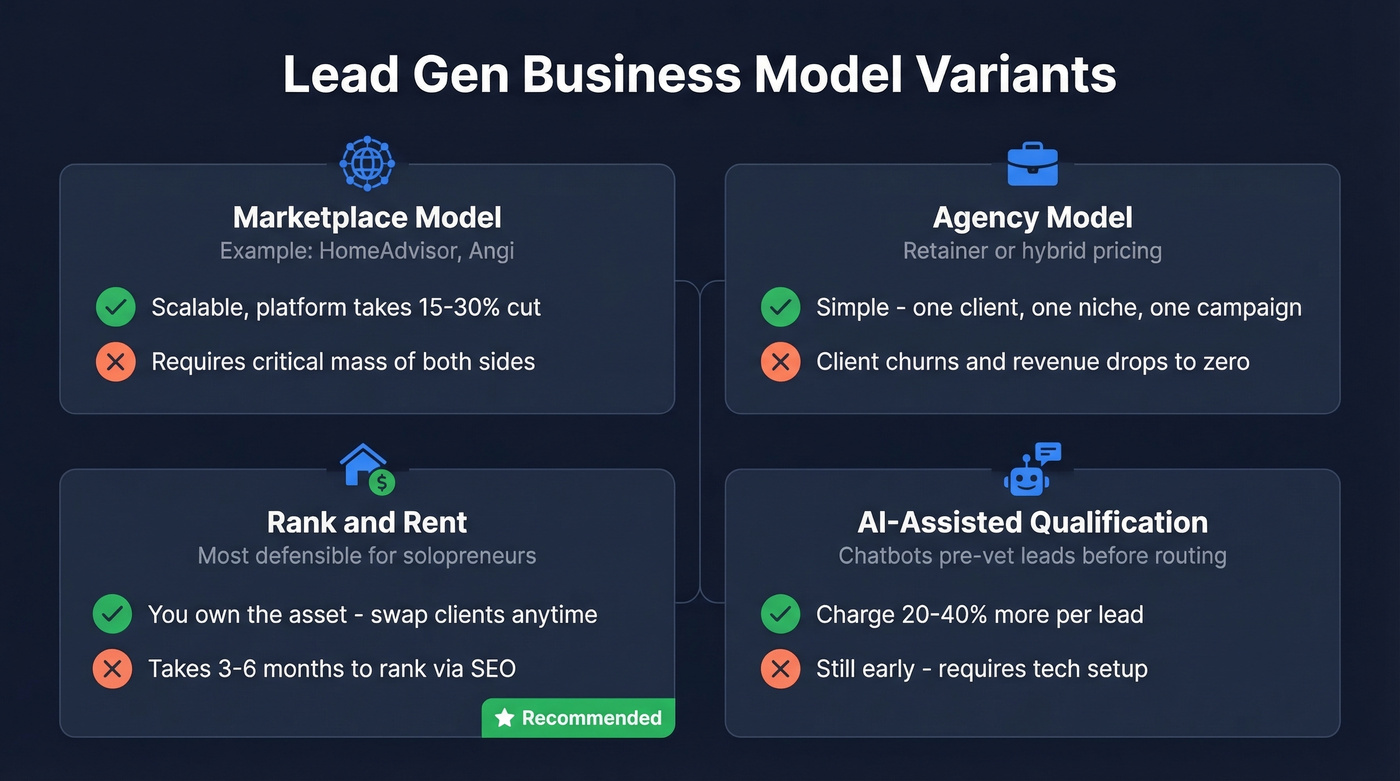
HomeAdvisor (now Angi) is the textbook example. The platform aggregates demand from consumers, matches them with service providers, and takes a cut per lead. You don't need to be HomeAdvisor-sized to run this - niche marketplaces for wedding vendors, tutors, or commercial cleaning services work on the same principle. The platform takes 15-30% or charges a flat fee per lead.
Agency Model
Here you're generating leads on behalf of a specific client, using either their brand or yours. Pricing is typically retainer or hybrid. The advantage is simplicity - one client, one niche, one campaign. The disadvantage is dependency. If that client churns, your revenue drops to zero overnight.
Rank-and-Rent
This is the most defensible variant for solopreneurs. You build a local website, rank it for geo-specific keywords like "emergency plumber Austin" or "pest control Tampa," and either rent the site to a local business or sell the leads it generates.
One operator documented a boxing gym site that delivered 97 leads in a single month. With a 1-in-3 conversion rate and $2,000 lifetime value per member, that's roughly $64K in potential revenue for the gym. Even if you're charging $1,000-$2,000/month to rent that site, the ROI for the business is obvious and the sale practically makes itself.
The niches that work best for rank-and-rent are local services with high urgency and low online sophistication: tree removal, pest control, cosmetic clinics, home renovation, fitness. These are businesses that need customers but don't have the time or skill to do SEO themselves. You fill that gap.
AI-Assisted Lead Qualification
Operators are starting to use AI agents to pre-qualify inbound leads before routing them to buyers. A chatbot on your rank-and-rent site asks budget, timeline, and scope questions, then scores the lead before it ever reaches your client. This lets you charge more because the buyer gets pre-vetted prospects instead of raw form fills. Still early, but the operators experimenting with this report 20-40% higher per-lead pricing.

Selling leads at $200-$600 each only works if the data is real. Prospeo's 5-step verification delivers 98% email accuracy and 125M+ verified mobile numbers - so every lead you sell actually connects to a real buyer. At $0.01 per email, your margins stay fat even in high-CPL niches.
Build a lead gen business on data that won't get you fired by clients.
How to Start a Lead Gen Business
Pick a High-CPL Niche
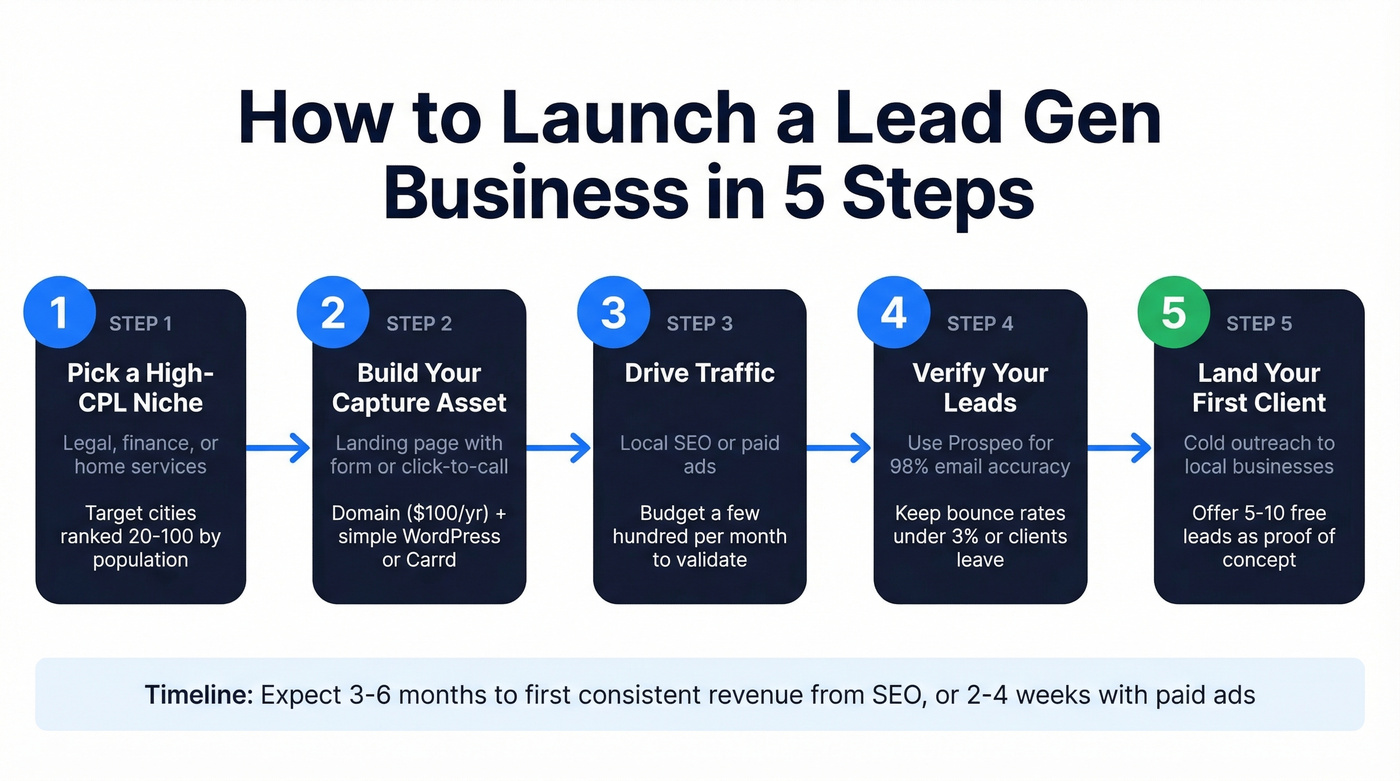
Niche choice is 80% of the outcome. Go back to the CPL table. If you're building in a niche where leads sell for $91 each, you need massive volume to make real money. If you're in legal ($649 blended) or financial services ($653), you need far fewer leads to hit $5K/month. Pick a niche where businesses already spend heavily on customer acquisition, then find a metro where local SEO competition is weak - usually cities ranked 20-100 by population, not the top 10.
If you want a broader playbook beyond local SEO, see our guide on how to start a lead generation company.
Build Your Lead Capture Asset
Your minimum viable asset is a landing page with a form or click-to-call button. For rank-and-rent, you'll want a full local site with service pages, a Google Business Profile, and local citations. Domain cost runs about $100/year. ClickFunnels ($97/mo) is the popular funnel builder, but Carrd or a simple WordPress site works fine if you're bootstrapping. Don't overthink the design - leads come from rankings and relevance, not aesthetics.
Drive Traffic
For rank-and-rent, local SEO is your primary channel. Target geo-modified keywords, build local backlinks, and optimize your Google Business Profile. Expect 3-6 months before you're ranking consistently. If you want faster results, run Google Ads or Meta Ads to your landing page - budget a few hundred dollars per month to start. Paid traffic lets you validate a niche before committing to the SEO grind.
Find and Verify Leads
Here's the thing: delivering bad leads will kill your client relationships faster than anything else. If 4 out of 10 phone numbers are dead or 3 out of 10 emails bounce, your client stops paying - and they're right to.
Prospeo handles this well. Upload your lead list or use the email finder to locate and verify professional emails, and you'll get 98% email accuracy with a 7-day data refresh cycle. The free tier gives you 75 emails + 100 Chrome extension credits/month, which is enough to validate your first niche. Stack Optimize built their entire lead gen operation on Prospeo and keeps client bounce rates under 3% - that's the standard you're aiming for.
If you’re comparing vendors, start with our breakdown of data enrichment services and lead enrichment.
Land Your First Client
Cold outreach to local businesses in your chosen niche. Call, email, or walk in. Offer 5-10 free leads as proof of concept - this eliminates risk for the business owner and gives you a case study. Start with pay-per-lead pricing to make the first deal easy. Once you've proven lead quality over 30-60 days, propose a retainer. Most operators land their first paying client within 2-4 weeks of active outreach if they've already got leads flowing.
If you need copy you can send today, use these sales follow-up templates and cold email follow-up templates.
Your Lead Gen Tech Stack
You don't need 15 tools. You need five.
| Function | Tool | Cost |
|---|---|---|
| CRM | HubSpot CRM | Free plan; paid from $15/mo/user |
| Outreach | Instantly or Smartlead | ~$30-$97/mo |
| Data & Verification | Prospeo | Free tier; ~$0.01/email |
| Automation | Zapier | Free-$19.99/mo |
| Funnel Builder | ClickFunnels or Carrd | $97/mo or $19/yr |
For a solo operator, your all-in monthly cost is $50-$200. A small agency running multiple niches spends $500-$2K/month. Scaling operations with dedicated ad spend and multiple team members push into the $2K-$5K/month range.
The data and verification layer is where most operators underinvest. At roughly a penny per email, verification is the cheapest insurance policy in the business - and the one that determines whether clients stick around or churn after month one. If you’re troubleshooting deliverability, start with email bounce rate and the email deliverability guide.
Compliance You Can't Ignore
This section separates real operators from hobbyists. If you're selling leads - especially leads that involve phone calls or text messages - you need to understand TCPA, CAN-SPAM, and privacy regulations. Getting this wrong doesn't just lose clients; it creates legal liability.
The big TCPA story from 2025: the FCC's "one-to-one consent" rule, which would've required comparison-shopping sites to obtain consent for one seller at a time, was vacated by the Eleventh Circuit in Insurance Marketing Coalition Limited v. FCC, 127 F.4th 303 (11th Cir. 2025). Later in 2025, the FCC issued a final rule formally eliminating the one-to-one consent requirement.
This means lead generators can still collect consent for multiple buyers via a single disclosure - for now. But don't treat this as a free pass. The regulatory environment shifts constantly, and the CFPB has separately scrutinized comparison-shopping sites that manipulate lead routing to favor certain buyers.
Revocation-of-consent rules became enforceable on April 11, 2025. Consumers can now revoke consent in any reasonable manner - text, email, verbal. You must honor revocation within 10 business days. You're allowed one confirmation text, sent within 5 minutes, containing zero marketing content.
CAN-SPAM is simpler: include a physical address, honor opt-outs within 10 days, don't use deceptive subject lines.
Look - most lead gen businesses that get sued aren't doing anything exotic. They're reselling leads without proper consent documentation, or they're ignoring opt-out requests. Build your consent tracking into your workflow from day one and you'll be ahead of 90% of operators.
Why Lead Generation Businesses Fail
No lead acceptance criteria in contracts. If you don't define what counts as a "qualified lead" in writing, you'll spend half your time arguing about refunds. Spell out the criteria: geography, intent signal, contact validity, response window. Put it in the contract before you send the first lead.
Single-client dependency. One client paying you $3K/month feels great until they cancel. Diversify to at least 3 clients within your first 6 months. Revenue concentration is the #1 killer of early-stage operations, and we've watched it happen to operators who had everything else dialed in.
Bad contact data. Imagine delivering 10 leads and your client reports that 4 had dead phone numbers and 2 emails bounced. That's a trust-destroying moment you don't recover from. Verify every lead before delivery - 98% email accuracy is the baseline, not a luxury.
Ignoring compliance. TCPA violations carry penalties of $500-$1,500 per call or text. One bad campaign can generate six-figure liability.
Choosing a low-CPL niche. If leads in your niche sell for $50-$90, you need enormous volume to build meaningful revenue. A niche where leads sell for $300+ gives you margin to absorb slow months, refund disputes, and client churn. Start high, scale wide later.
Skip the lead gen model entirely if you're not willing to invest 3-6 months in building a ranked asset or don't have the budget for paid traffic while you wait. This isn't a get-rich-quick play - it's a real business that rewards patience and execution.
Running 10+ city sites for rank-and-rent? Prospeo's 30+ search filters let you target by geo, industry, job title, and buyer intent across 300M+ profiles. Enrich your CRM with 50+ data points per contact and sell exclusive leads that actually convert.
Scale your lead gen operation without scaling your bounce rate.
FAQ
How much can you make with a lead gen business?
Solo operators with 3-5 clients in a high-CPL niche typically earn $5K-$15K/month. Pay-per-lead pricing runs $50-$300 per qualified lead; retainers range from $1K-$5K/month per client. The ceiling rises with more niches, more ranked sites, and exclusive lead agreements.
Is lead generation profitable?
Yes - operators using organic SEO in high-CPL niches like legal or financial services often see 70-80% profit margins because their main costs are hosting and verification tools. In a $600+ CPL niche, even a handful of leads per month covers expenses. Below $100 CPL, you need serious volume to make the math work.
What's the best niche for a lead gen business model?
Legal services ($649 blended CPL), financial services ($653), and higher education ($982) top the charts. These industries already pay hundreds per lead, so your margins stay healthy at modest volume. Avoid niches under $100 CPL unless you can scale to 10+ city sites quickly.
How do you verify leads before selling them?
Run every email through a verification tool and validate phone numbers against live databases before delivery. Prospeo's bulk verification returns 98% accuracy at roughly $0.01/email, with a 7-day refresh cycle that catches stale records. Anything below 95% deliverability will erode client trust fast.
How long does it take to land your first client?
Paid ads can generate leads within weeks; local SEO takes 3-6 months to rank. Once you have leads to show, expect 2-4 weeks of active cold outreach to close your first paying client. Offering 5-10 free leads as a trial shortens the sales cycle dramatically.