

Lead Generation and Nurturing: The Complete 2026 Playbook
You generated 500 leads last month. Twelve converted. Marketing says the leads were qualified. Sales says they were garbage. The CEO wants to know why cost-per-acquisition tripled.
Sound familiar?
Here's the uncomfortable truth: 80% of leads that don't qualify today will buy from someone within the next 24 months. The question is whether they'll buy from you - and whether you have a system for lead generation and nurturing that keeps earning attention until timing flips. These two motions are supposed to work as a unified system, but most teams treat them as separate line items on a marketing budget, pouring money into the top of the funnel while ignoring the middle entirely.
What You Need (Quick Version)
Lead generation fills the funnel. Nurturing converts it. Most teams over-invest in gen and under-invest in nurture, which is why so many pipelines are full of "interested" leads that never turn into revenue. If you only do three things after reading this, make them these:
- Build a lead scoring model that separates fit from intent (exact point values below).
- Segment your nurture sequences by entry point - not one drip for everyone.
- Verify your contact data before sending a single email. High bounce rates wreck deliverability faster than bad copy ever will.
Here's our contrarian take: flip your gen-to-nurture budget ratio for six months and watch what happens. Most teams spend 80% on generation and 20% on nurture. Reverse it. You already have thousands of contacts sitting in your CRM - start converting them before you buy more.
Lead Gen vs. Lead Nurturing
96% of visitors who come to your website aren't ready to buy. That single stat explains why you need both generation and nurturing - and why they're fundamentally different motions.
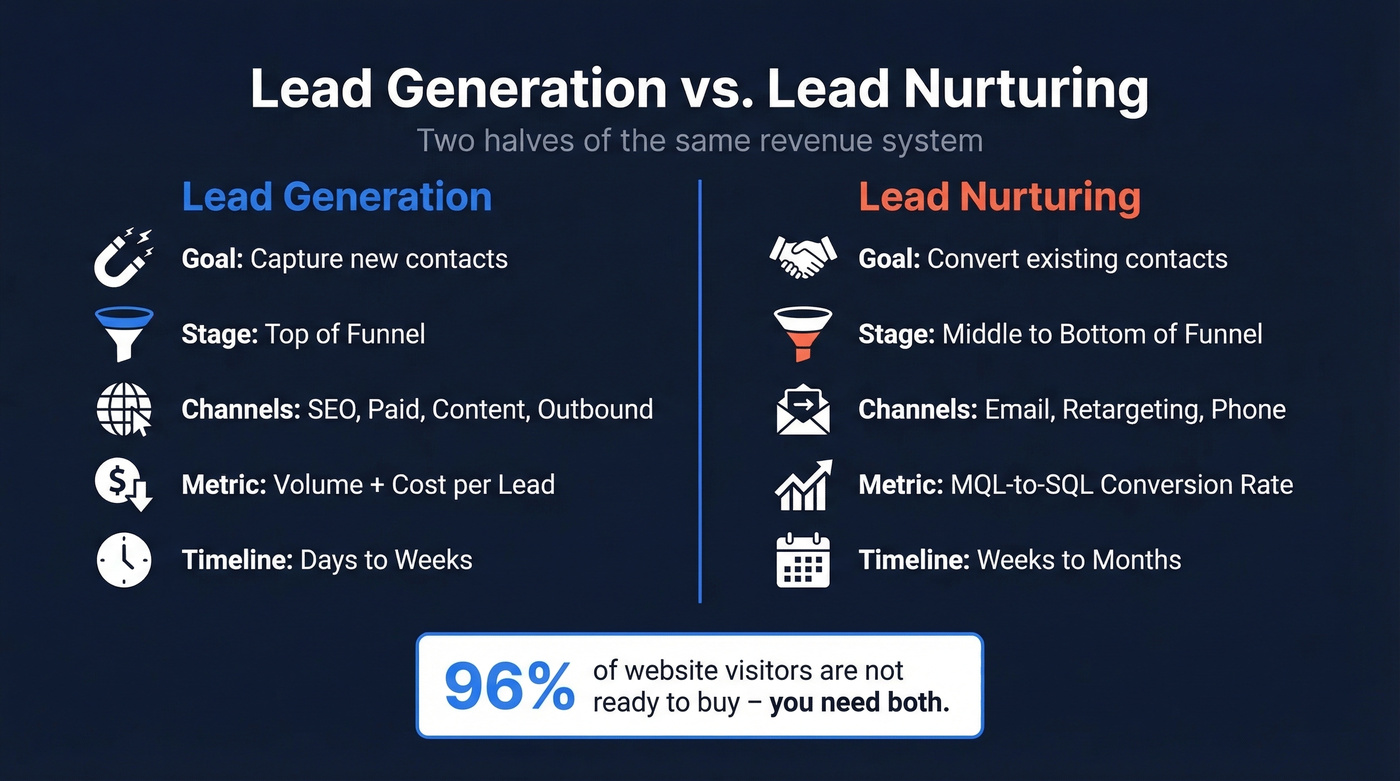
| Dimension | Lead Generation | Lead Nurturing |
|---|---|---|
| Goal | Capture new contacts | Convert existing contacts |
| Funnel stage | Top of funnel | Middle to bottom |
| Channels | SEO, paid, content, outbound | Email, retargeting, phone |
| Success metric | Volume + cost per lead | MQL-to-SQL conversion rate |
| Timeline | Days to weeks | Weeks to months |
Generation is about reach. Nurturing is about relevance. The teams that win treat these as two halves of the same system.
What Is Lead Generation? (Benchmarks Included)
Lead generation is the process of attracting and capturing contact information from people who fit your ideal customer profile. Everything else - the channels, the tactics, the tools - is just plumbing.
But not all plumbing is equal. SEO-driven leads close at 14.6%, compared to 1.7% for outbound leads. That's an 8x difference in close rate from a single channel decision. Your mix should reflect your sales cycle, not whatever the latest thought leader is hyping.
Conversion benchmarks worth knowing, per First Page Sage's 2026 report:
| Industry | Avg. Visitor-to-Lead Rate |
|---|---|
| B2B SaaS | 1.1% |
| IT & Managed Services | 1.5% |
| Software Development | 1.1% |
| Legal Services | 7.4% |
If you're in SaaS and converting above 1.5%, you're outperforming. Below 0.8%, your gen engine needs work before you worry about nurturing.
Modern B2B deals involve buying committees, not single buyers. Capturing one contact isn't enough - you need to map the committee and multi-thread into the account. A single champion won't close the deal when finance, technical leadership, and procurement all have veto power. This is where data quality becomes the bottleneck. If you're building prospect lists with unverified emails and stale phone numbers, you're feeding garbage into your nurture engine from the start.
Why Most Nurturing Fails
Lead nurturing is the process of building relationships with prospects who aren't ready to buy yet - through targeted content, timely follow-ups, and relevant touchpoints that move them from "I downloaded your whitepaper" to "Let's talk pricing."
The problem? Most teams are terrible at it. Only 29% of brands nurture their existing customers beyond the initial purchase, let alone their prospects. And the nurturing that does exist is often a generic five-email drip that treats every lead identically, regardless of how they entered the funnel or what they care about.
That 29% stat reveals a bigger blind spot: nurturing doesn't end at the sale. Onboarding sequences, adoption nudges, renewal campaigns - these are all nurture motions. The best teams run post-sale programs that are just as sophisticated as their pre-sale ones, because expanding an existing account is 5-7x cheaper than acquiring a new one. If your nurture strategy stops at "closed-won," you're leaving the easiest revenue on the table.
48% of businesses say most of their leads require "long cycle" nurturing with many influencers, and targeting content by buying stage yields 72% higher conversion rates. That's not a marginal improvement - it's the difference between a nurture program that works and one that's just noise in someone's inbox.
Let's be honest about what we've seen in the wild: most nurture sequences are lazy follow-up. The classic "Hey, just checking in - are you ready to buy now?" email isn't nurturing. It's pestering. Real nurturing means delivering value at every touchpoint and knowing when a lead has crossed the threshold from MQL to SQL. Without a scoring model to tell you when that happens, your sales team is playing a lottery.

You just read it: bad data wrecks deliverability faster than bad copy. Every bounced email costs you -25 points in your own scoring model and damages your sender reputation. Prospeo's 5-step verification delivers 98% email accuracy - so your nurture sequences actually reach the inbox. At $0.01 per email, cleaning your entire CRM costs less than one wasted sales call.
Stop nurturing leads you can't reach. Verify first.
How to Build a Lead Scoring Model
Lead scoring isn't optional. Without it, every lead looks the same - and your AEs waste time chasing contacts who downloaded one ebook six months ago while genuinely interested buyers sit in a sequence getting ignored.
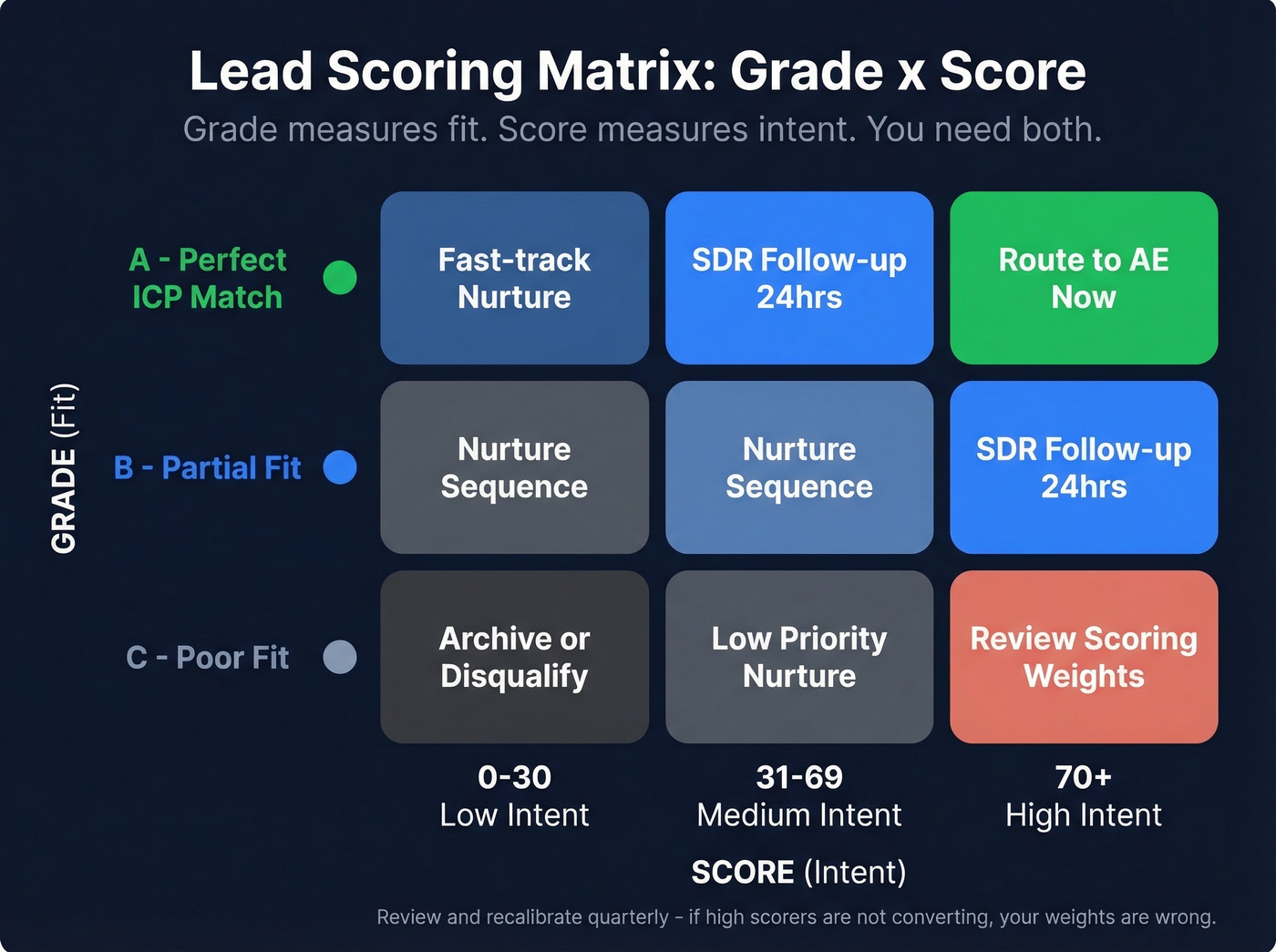
The framework that works best combines two dimensions: Grade (fit) and Score (intent). Grade measures whether the lead matches your ICP - company size, industry, job title, tech stack. Score measures behavioral signals - what they've done on your site, in your emails, and with your content. A lead graded "A" with a score of 95 is a perfect-fit company showing high intent. A lead graded "C" with a score of 25 goes into nurture.
The Point-Value Table
Here's a concrete scoring model you can implement this week:
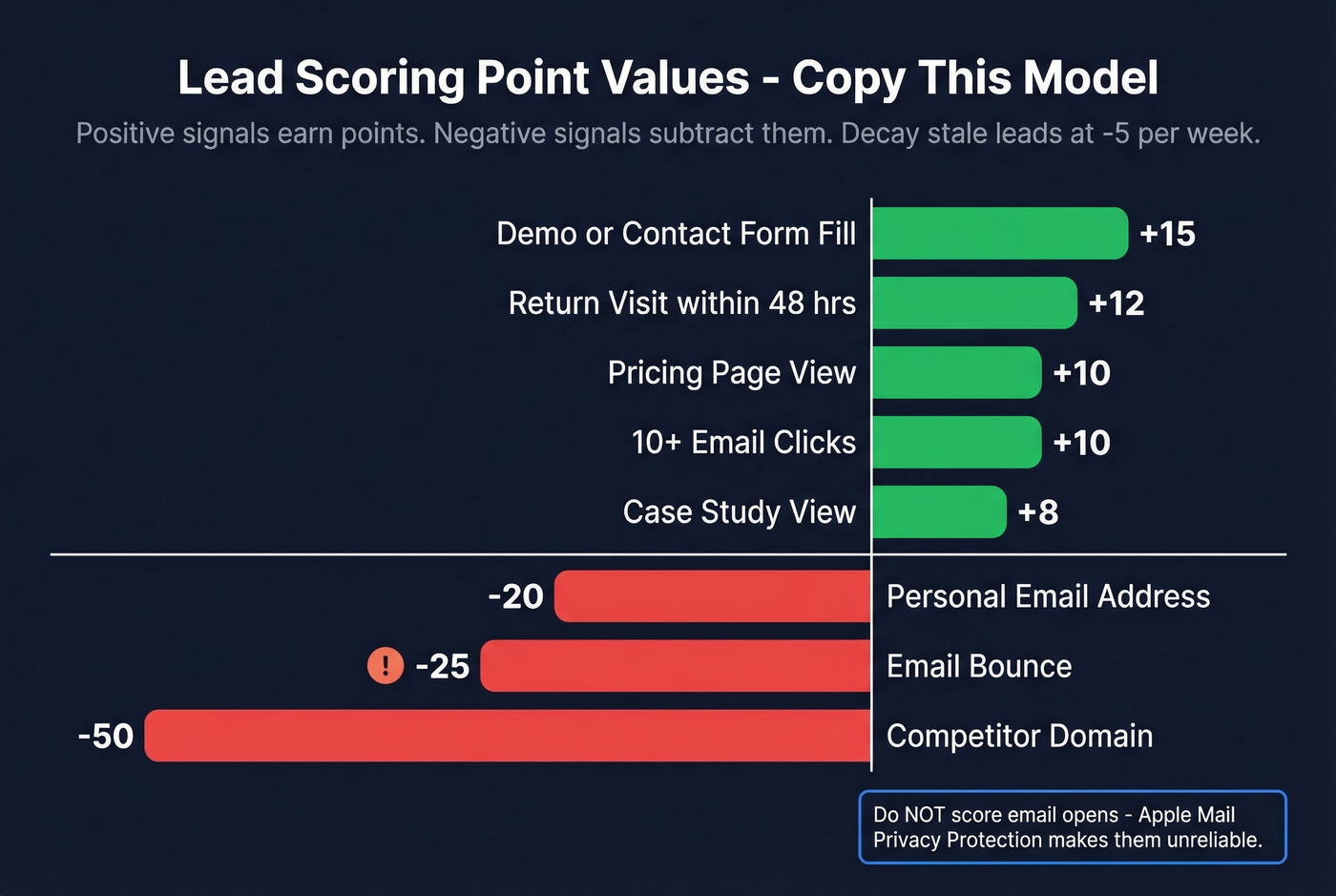
| Signal | Points |
|---|---|
| Pricing page view | +10 |
| Demo/contact form fill | +15 |
| Case study view | +8 |
| Return visit within 48 hrs | +12 |
| 10+ email clicks | +10 |
| Email bounce | -25 |
| Personal email address | -20 |
| Competitor domain | -50 |
Two critical rules. First, don't score email opens - Apple Mail Privacy Protection makes them unreliable, and every serious practitioner has moved away from this metric. Second, add time-based decay. A lead who hit your pricing page six months ago isn't hot anymore. We use -5 per week of inactivity to prevent stale leads from clogging the pipeline.
The Routing Matrix
Once you have scores, you need routing rules. Without them, scoring is just an academic exercise.
| Grade + Score | Action |
|---|---|
| A + 70+ | Route to AE immediately |
| B + 50+ | SDR follow-up within 24 hrs |
| C or below + under 30 | Nurture sequence |
Here's the thing most guides skip: scoring is a feedback loop, not a set-it-and-forget-it system. If your high scorers aren't converting, your weights are wrong. If low scorers are converting, you're missing signals. Review and refine quarterly at minimum.
3 Nurture Sequences You Can Steal
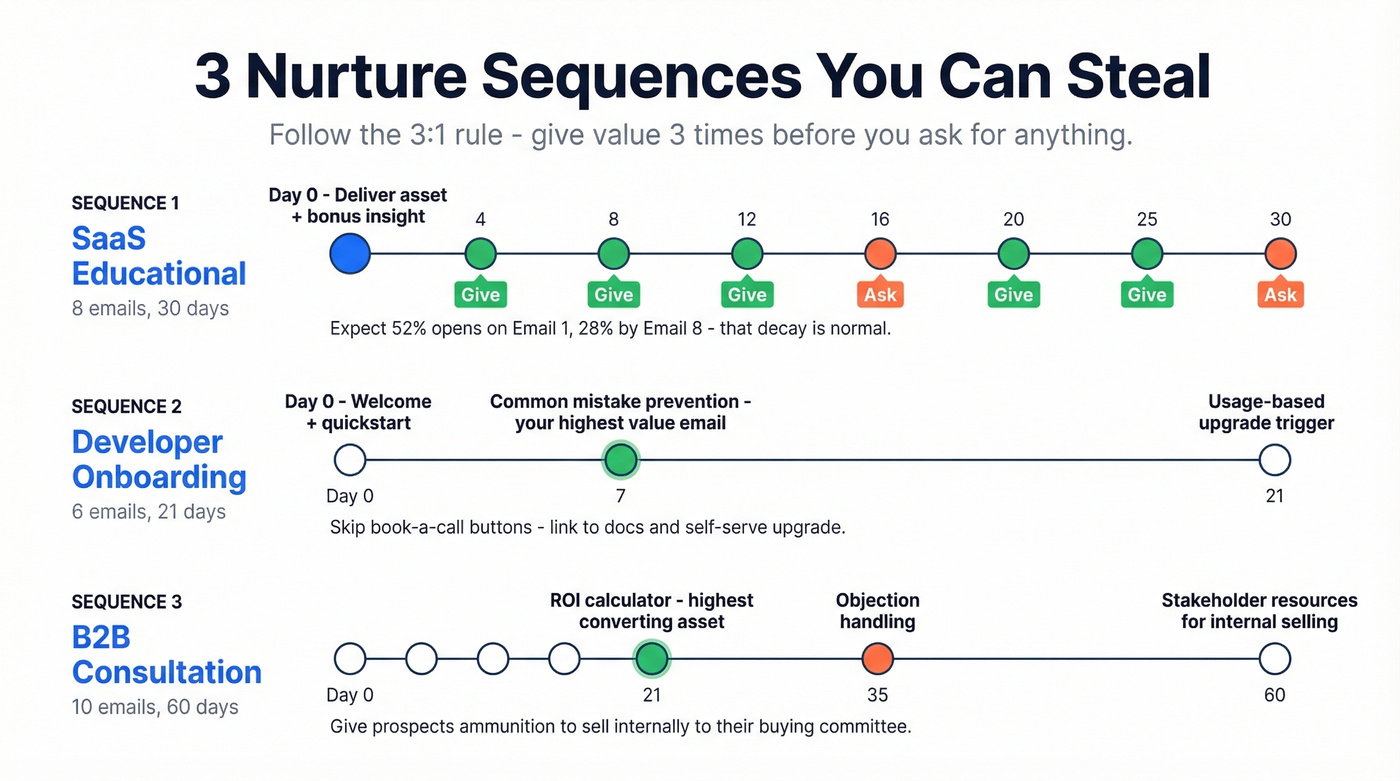
Before getting into specific sequences, one framing principle: the 3:1 give-to-get ratio. Deliver value three times before you ask for anything. Three educational, useful, or entertaining emails for every one that includes a demo CTA or pricing push. Break this ratio and your unsubscribe rates will tell you immediately.
SaaS Educational Sequence (8 Emails, 30 Days)
This is your workhorse for content-download leads. The cadence: days 0, 4, 8, 12, 16, 20, 25, and 30.
Day 0 is the most important email you'll send. Deliver the asset they requested, add one bonus insight they didn't expect, and set expectations for what's coming. Don't sell. Don't pitch. Just be useful.
Here's what performance decay looks like in practice:
| Open Rate | CTR | |
|---|---|---|
| Email 1 (Day 0) | 52% | 12% |
| Email 4 (Day 12) | 38% | 7% |
| Email 8 (Day 30) | 28% | 4% |
That decay is normal. If your Email 8 is still hitting 28% opens, your sequence is performing well. If opens drop below 20% by Email 5, re-segment or shorten rather than pushing more emails into the void.
Developer Tools Onboarding (6 Emails, 21 Days)
Developer audiences hate fluff, so this sequence is shorter, more technical, and tied directly to product usage. Cadence: days 0, 3, 7, 10, 14, and 21.
The key email is a "common mistake prevention" message on day 7 - it positions you as helpful rather than salesy. Days 10 and 14 introduce advanced use cases that showcase paid-tier features without hard-selling them. The upgrade trigger isn't a calendar CTA; it's tied to usage thresholds or rate limits. When a developer hits the free tier ceiling, that's your moment. Skip the "book a call" button entirely - link to docs and a self-serve upgrade page instead.
B2B Consultation Nurture (10 Emails, 60 Days)
For high-ticket services with long sales cycles, you need a longer runway. Ten emails over 60 days, with cadence weighted toward the front: days 0, 3, 7, 14, 21, 28, 35, 42, 50, and 60.
The ROI calculator email around day 21 is your highest-converting asset - give them a spreadsheet or interactive tool that quantifies the cost of inaction. An objection-handling email around day 35 addresses the three most common reasons deals stall. The back half includes stakeholder resources like one-pagers and comparison docs for multi-threaded deals, because this sequence acknowledges that the prospect isn't the only decision-maker and gives them ammunition to sell internally.
The consensus on r/sales is that long-cycle nurture workflows become "lead graveyards" when the sequence is just time-delayed spam. The difference is whether each email earns the next open.
5 Mistakes That Kill Your Pipeline
1. One-size-fits-all sequences. A CMO who downloaded your pricing guide and an intern who grabbed a blog PDF are not the same lead. Segment by persona and entry point. Segmented campaigns drive up to 760% more revenue than generic blasts. That's not a typo.
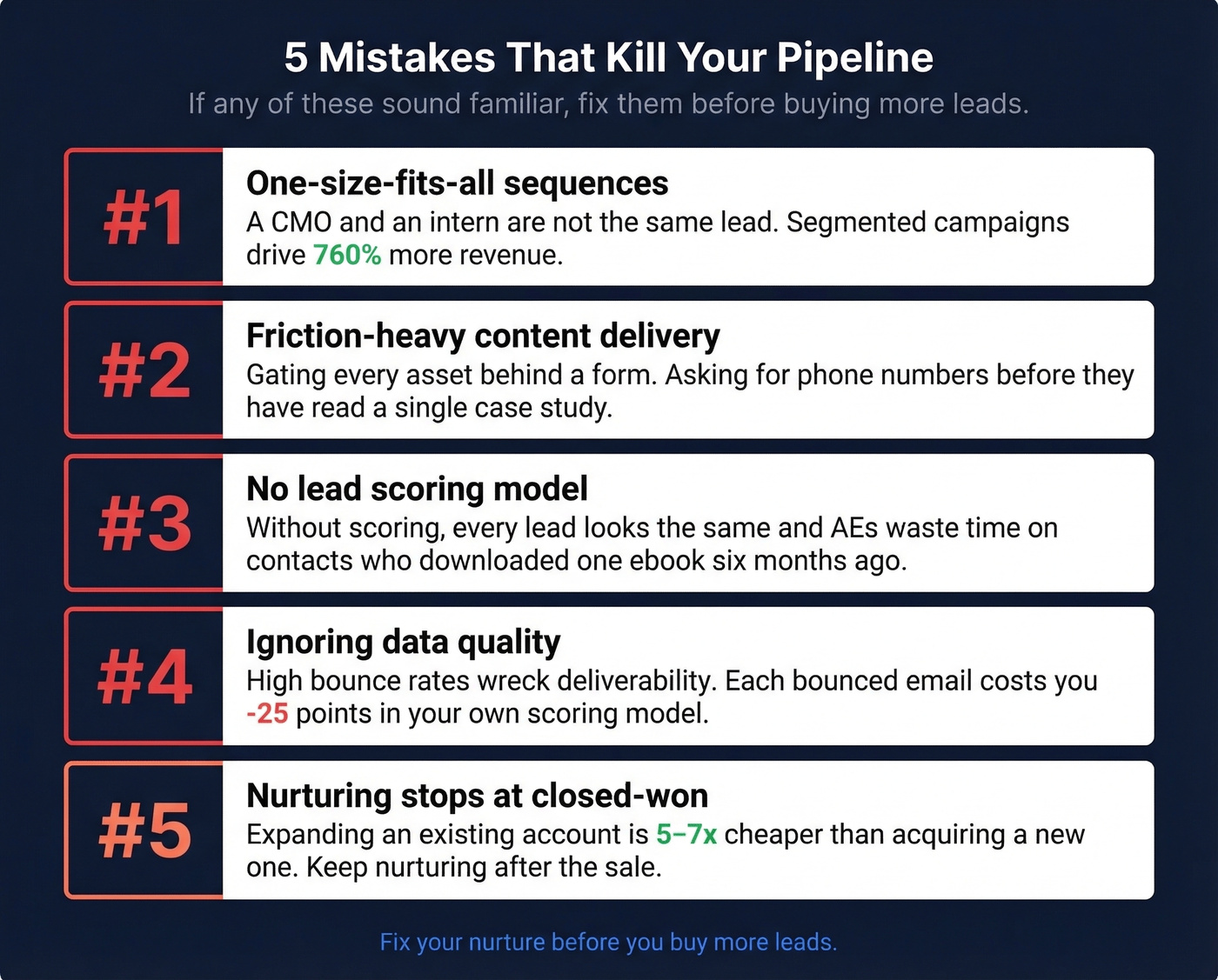
2. Friction-heavy content delivery. Gating every asset behind a form. Putting a demo CTA in every email. Asking for a phone number before they've read a single case study. Stick to the 3:1 give-to-get ratio. Earn the ask.
3. Email-only nurturing. Email is the backbone, but it shouldn't be the entire skeleton. The best-performing nurture programs use "Surround Sound" orchestration - email plus retargeting ads plus occasional phone touches. When a lead sees your brand in their inbox, their social feed, and a display ad in the same week, you're building familiarity that a single channel can't match. Don't overlook seller-led nurturing either: AEs sharing relevant content from their own profiles builds trust faster than any company-branded email.
4. Bad data destroying deliverability. This is the unsexy mistake that ruins everything downstream. If you're sending to bad addresses, your sender reputation degrades with every send. Your beautifully crafted nurture sequence doesn't matter if it's landing in spam. If you need a deeper fix, start with an email deliverability audit.
We've seen this pattern repeatedly. One security company had 50 AEs prospecting 4-6 hours per week with bounce rates running 35-40%. After switching to verified contact data through Prospeo, bounces dropped under 5% and AE-sourced pipeline increased 180%. The nurture content didn't change - the data did.
5. Slow response times. Leads contacted within 5 minutes are 100x more likely to qualify than those contacted after 30 minutes. If your "nurture" starts with a 48-hour delay because someone has to manually review the lead, you've already lost. Automate the first touch.
How to Reactivate Dormant Leads
There are probably 3,000 Closed Lost leads sitting in your CRM right now. Your CEO is asking why you need more ad budget when you've already generated thousands of contacts. Fair question.
80% of leads that don't qualify today will buy from someone within 24 months. Dormant leads aren't dead - they're waiting for the right moment. The reactivation framework is a Context Switch in three steps:
- Acknowledge the gap. "It's been a while since we connected" - be human about it, not robotic. (If you're tempted to write "just checking in," use this professional follow-up wording instead.)
- Provide new value. A new feature that resolves their prior objection. A case study from their industry. A framework they haven't seen. Something that makes re-engaging feel worthwhile, not like a "just checking in" email.
- Low-friction CTA. Not "book a 30-minute demo." Try "worth a peek?" or "want the one-pager?" Remove every barrier to re-engagement.
The bar for reactivation emails is incredibly low because almost nobody does them well. A single well-crafted context-switch email to your dormant list will outperform most teams' entire re-engagement efforts. If your average deal size is under $15k, a reactivation campaign targeting your existing database will almost certainly generate more revenue per dollar than any new acquisition campaign you could run.
Tools for Lead Generation and Nurturing
You don't need ten tools. You need the right three or four, connected properly.
| Tool | Best For | Starting Price |
|---|---|---|
| Prospeo | Verified contact data + enrichment | Free tier; ~$0.01/email |
| HubSpot | SMB/mid-market all-in-one | Free CRM; from $15/user/mo |
| ActiveCampaign | Budget-friendly automation | ~$29/mo |
| Pipedrive | Sales-focused pipelines | $12/user/mo |
| Close | Inside sales teams | $49/user/mo |
| Salesforce + Pardot | Enterprise | Custom (typically $30-100k+/year) |
| Marketo Engage | Enterprise automation | Custom (typically ~$1,000-3,000+/mo) |
Building from scratch? Start with HubSpot's free CRM for email and pipeline management, plus a verified data source for clean contacts. That combination gives you a CRM, basic automation, and a database that won't bounce - all for under $50/month. Add complexity later. Most teams buy too many tools too early.
Already on Salesforce? Pair it with Pardot for automation and an enrichment layer so your nurture sequences aren't sending to stale contacts.
Skip Act-On unless you're mid-market with a $900/month automation budget and specific needs around adaptive scoring. For most teams, ActiveCampaign punches well above its weight at a fraction of the cost.
If you're evaluating options, compare data enrichment services and sales prospecting databases before you commit.
Multi-threading into buying committees requires more than one verified contact per account. Prospeo gives you 300M+ profiles with 30+ filters - buyer intent, tech stack, department headcount, job changes - so you can map the full committee and feed each stakeholder into the right nurture track. Teams using Prospeo book 35% more meetings than Apollo users.
Build scored, segmented prospect lists in minutes, not days.
FAQ
What's the difference between lead generation and lead nurturing?
Lead generation captures new contacts at the top of the funnel through channels like SEO, paid ads, and outbound. Lead nurturing converts those contacts through targeted email sequences, retargeting, and timely follow-ups until they're sales-ready. Generation fills the pipeline, nurturing converts it - one without the other is either an empty funnel or a leaky one.
How long should a nurture sequence be?
SaaS products typically need 6-8 emails over 30 days, while enterprise or consultation services need 8-10 emails over 60 days. Watch engagement decay - if open rates drop below 20%, shorten the sequence or re-segment your audience rather than pushing more emails into the void.
What's a good lead-to-customer conversion rate?
B2B SaaS averages 1.1% for website-visitor-to-lead conversion, with overall MQL-to-customer rates ranging from 2-5%. Nurtured leads produce 20% more sales opportunities than non-nurtured leads, so investing in nurture sequences directly lifts these numbers.
How do you score leads for sales readiness?
Combine fit (company size, industry, job title = Grade A-F) with intent (page views, form fills, email clicks = Score 0-100). Route leads scoring 70+ with a Grade A or B to sales immediately. Everyone else enters nurture sequences - let behavioral signals tell you when they're ready.
What tools do you need for lead generation and nurturing?
At minimum, you need a CRM (HubSpot's free tier works), an email automation platform, and a verified data source for clean contact information. Add retargeting and intent data as you scale. The most common mistake is buying a $30k platform before you've built a single scoring model.