

Lead Generation Call Centers: What They Cost, How They Work, and Why Most Fail
You're paying $8,000 a month for an outsourced lead generation call center. After 90 days, they've booked three meetings - two with the wrong persona. The SDR manager shrugs and asks for another quarter to "optimize."
This scenario plays out constantly, and the root cause is almost never the scripts or the dialers. It's the data feeding the whole operation.
What Is a Lead Generation Call Center?
A lead generation call center is a dedicated team - in-house or outsourced - whose sole job is turning cold contacts into qualified sales conversations. Not customer support. Not inbound ticket routing. Outbound prospecting at scale.
The distinction matters because the economics, tech stack, and compliance requirements are completely different from a traditional call center. Inbound call centers handle people who already want to talk to you. Outbound lead gen centers interrupt strangers and try to earn about 90 seconds of their attention.
On the B2B side, these operations target specific decision-makers at companies matching your ICP - a VP of Engineering at a Series B SaaS company, or a facilities manager at a regional hospital network. B2C call centers cast wider nets with higher volume and lower qualification bars. This article focuses on B2B, where the stakes per conversation are higher and the margin for error on data quality is razor-thin.
Modern outbound calling operations rarely work in a phone-only silo. The best teams layer email sequences, LinkedIn touches, and even SMS around the calling cadence, turning each dial into one touchpoint within a coordinated multi-channel play. If your provider only does phone, you're leaving pipeline on the table.
The Numbers You Need Before Anything Else
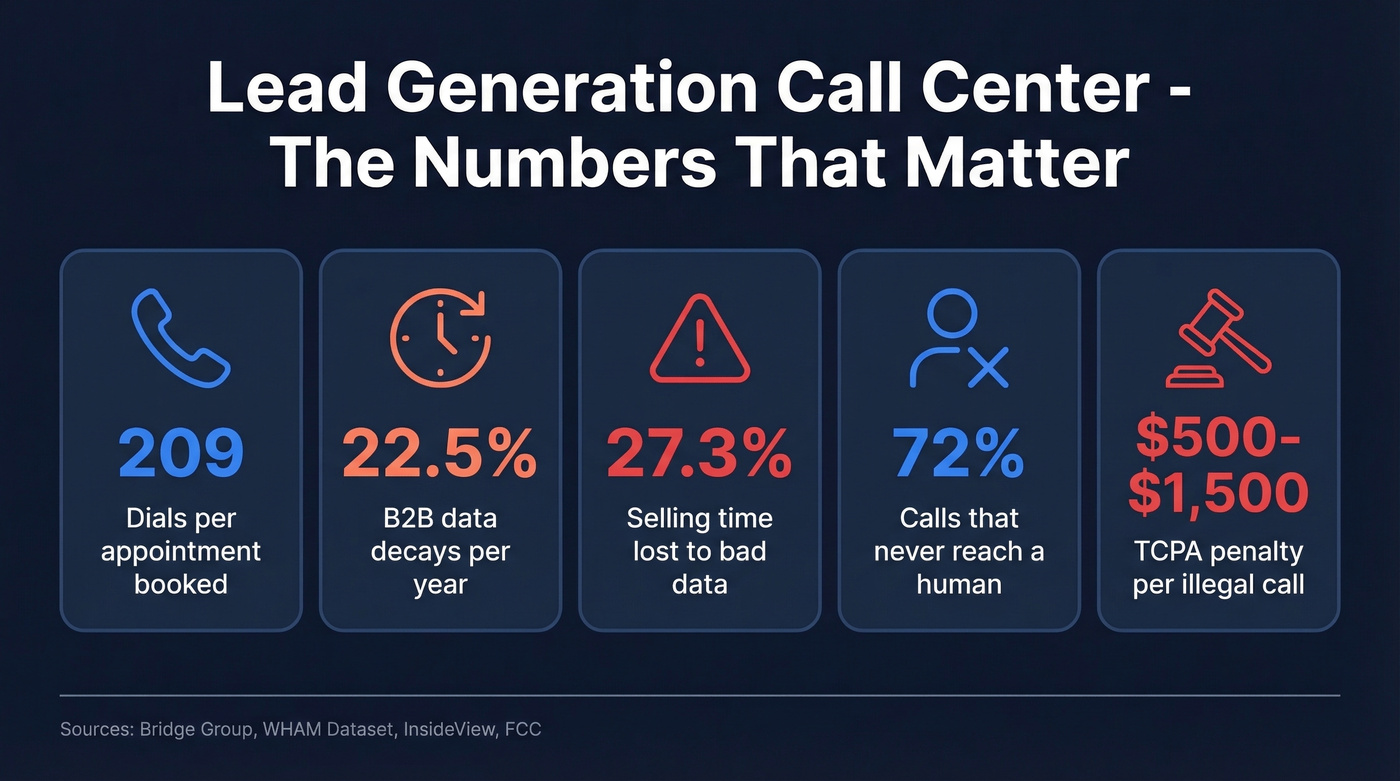
- Budget realistically. A fully loaded in-house SDR costs $110k-$160k/year. Outsourced agencies run $2k-$20k+/month. There's no cheap path to quality pipeline.
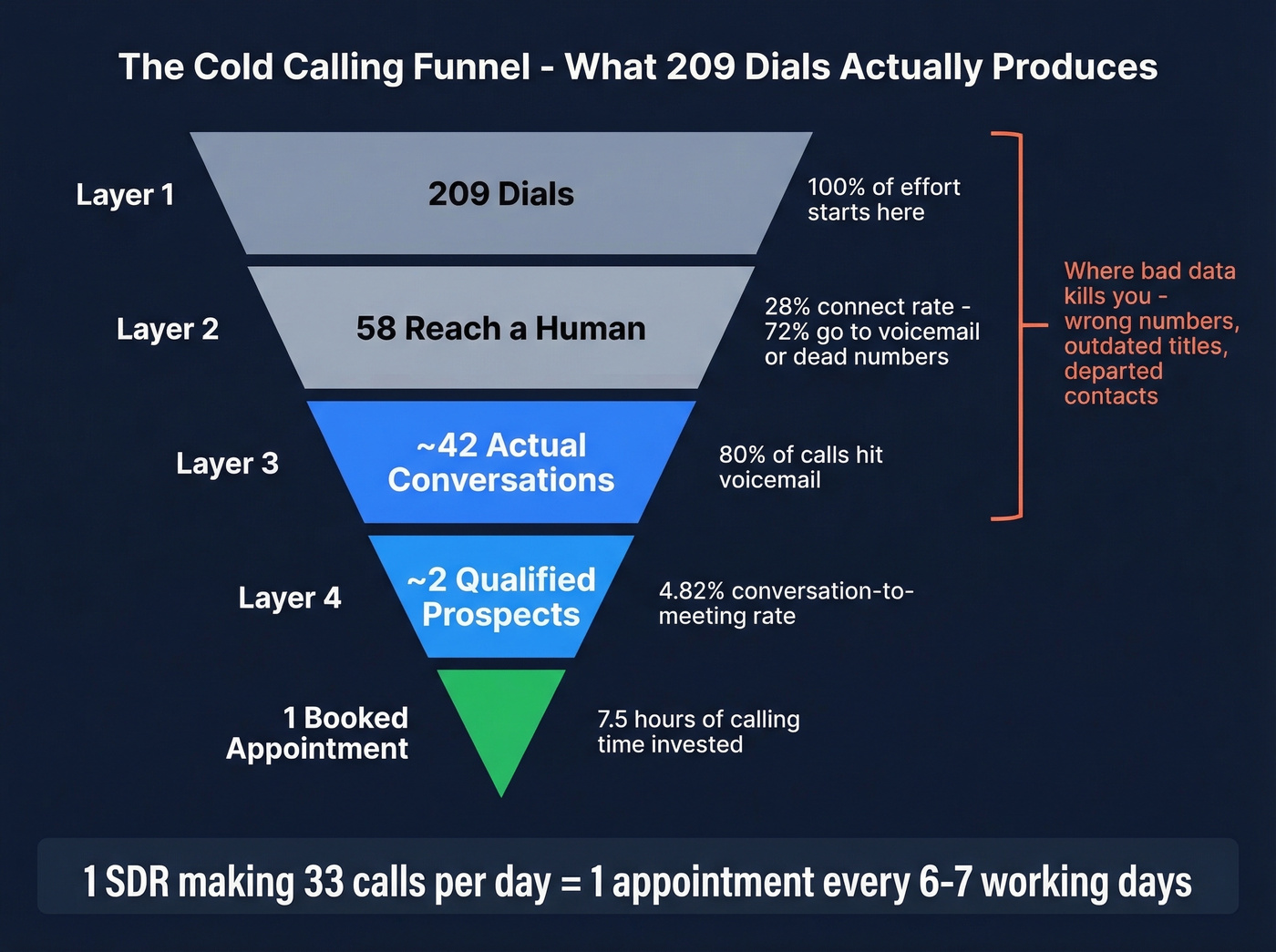
- Know the math. It takes roughly 209 dials to book one appointment. That's the benchmark. If a vendor promises dramatically better, ask for proof.
- Expect failure. 20-25% of outsourced lead gen relationships fail within two years. Half fail within five. Sales reps lose 27.3% of their selling time to bad contact data - the upstream problem poisons everything downstream.
- Fix the data first. B2B data decays 22.5% per year. If your list is older than 90 days, it's meaningfully degraded.
- Understand the legal exposure. TCPA violations carry $500-$1,500 per call in penalties. Lawsuits are up 95% year-over-year. This is the fastest way to turn a "lead gen" program into a legal problem.
How the Workflow Actually Operates
The workflow looks simple on paper. In practice, each step has failure modes that compound downstream.
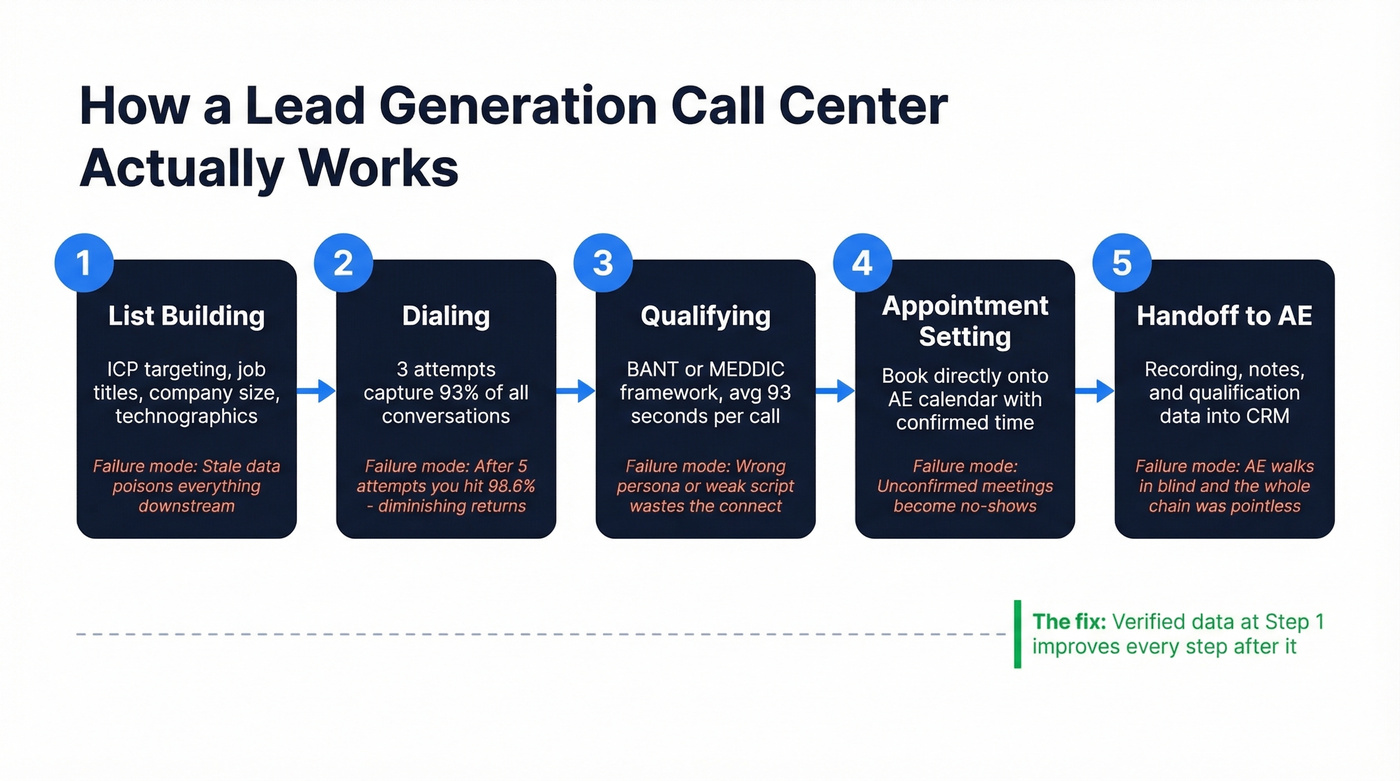
Step 1: List building. You identify target accounts and contacts matching your ICP - job titles, industries, company size, technographics. This is where most programs silently fail. A list built from stale data means every subsequent step wastes money. (If you want a more operational breakdown, map it to a lead generation workflow.)
Step 2: Dialing. Agents work through the list using a dialer - preview, progressive, or predictive depending on volume and compliance requirements. The WHAM dataset shows three call attempts capture 93% of all conversations you'll ever get from a prospect. After five attempts, you've hit 98.6%. Diminishing returns kick in hard.
Step 3: Qualifying. When someone actually picks up, the agent runs a qualification framework - BANT, MEDDIC, or a custom script. Average cold call length runs about 93 seconds. Not much time. (If you're standardizing qualification, use a MEDDIC baseline.)
Step 4: Appointment setting. Qualified prospects get booked directly onto an AE's calendar, usually with a confirmed time and a brief summary of the conversation.
Step 5: Handoff. The meeting details, call recording, and qualification notes transfer to the CRM. Sloppy operations lose deals here - if the AE walks into a meeting blind, the whole chain was pointless. A clean handoff email helps prevent context loss.
Cold Calling Benchmarks That Matter
Most call center vendors don't publish their actual conversion rates. That's not an accident. Here are the numbers they don't want you comparing against:
| Metric | Benchmark | Source |
|---|---|---|
| Success rate | 4.82% of conversations | WHAM dataset |
| Dials per appointment | 209 | Bridge Group |
| Calls to voicemail | 80% | RAIN Group |
| Never reach a human | 72% | InsideView |
| Avg call length | 93 seconds | WHAM |
| Calling time per appt | 7.5 hours | Baylor University |
If your team makes 33 cold calls per day - a common inside-sales benchmark - one SDR books roughly one appointment every six to seven working days. That's the baseline.
The 4.82% success rate measures conversations-to-meetings, not dials-to-meetings. The dial-to-meeting rate is far lower once you factor in the 72% of calls that never reach a human. Understanding this math upfront saves you from signing a contract based on fantasy projections. (To pressure-test your funnel, track lead generation metrics weekly.)
Real Costs and Pricing Models
Every model has real tradeoffs. There's no universally "right" answer, but there is a right answer for your stage and budget.
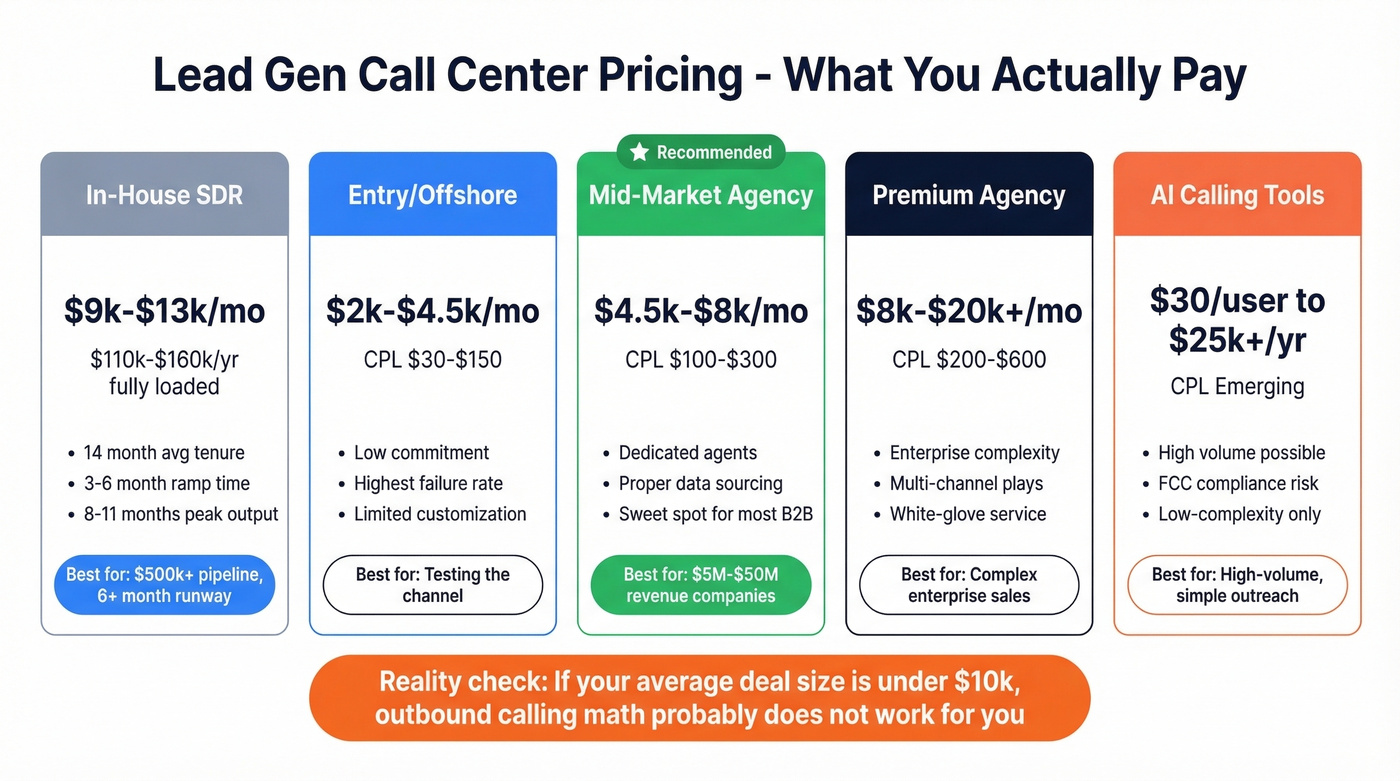
| Model | Monthly Cost | CPL Range | Best For |
|---|---|---|---|
| In-house SDR | $9k-$13k loaded | Varies | Companies with $500k+ pipeline targets and 6+ month runway |
| Entry/offshore | $2k-$4.5k | $30-$150 | Testing the channel with low commitment |
| Mid-market agency | $4.5k-$8k | $100-$300 | Most B2B companies ($5M-$50M revenue) |
| Premium agency | $8k-$20k+ | $200-$600 | Enterprise with complex sales cycles |
| AI calling tools | $30/user/mo-$25k+/yr | Emerging | High-volume, low-complexity outreach |
CCSI prices its nearshore model at $10-$15/hour including overhead. OnBrand24 prices outbound at $35/hour with a 200-hour minimum pilot.
The in-house math. A fully loaded SDR costs $110k-$160k/year. Base salary runs $55k-$75k. Add 20-30% for benefits and taxes, plus $8k-$15k in recruiting costs per hire. Tech stack costs land between $800 and $2,500 per seat per month, and management overhead eats another chunk. SHRM estimates cost-per-hire exceeds $4,700, and replacing a departed SDR costs 6-9 months of their salary in lost productivity and recruiting. Average SDR tenure is 14 months, and ramp time runs 3-6 months - so you're paying full freight for roughly 8-11 months of peak productivity before the cycle resets. (If you're building the role from scratch, use a 30-60-90 day plan to reduce ramp waste.)
The outsourcing math. Entry-level agencies at $2k-$4.5k/month look attractive until you realize the cheapest option is the most common reason outsourced programs fail. Mid-market agencies at $4.5k-$8k hit the sweet spot for most B2B companies - enough budget for dedicated agents and proper data sourcing, without the premium markup. Vendors like MarketStar claim 8:1 to 13:1 ROI on outsourced sales spend, but those numbers assume you pick the right partner and invest in proper onboarding.
The CPL reality check. Raw leads from outsourced call centers typically cost $30-$400 depending on industry and targeting specificity. Qualified meetings at the SQL level run $300-$600. For context, blended digital CPLs across industries range from $92 (HVAC) to $982 (higher education). B2B SaaS averages $237, financial services hits $653. Call center leads aren't cheap, but they're often higher-intent than inbound form fills.
Here's the thing: if your average deal size is under $10k, you probably don't need a dedicated outbound calling operation. The math doesn't work. You'll spend $300-$600 per qualified meeting, close 20-30% of those, and barely break even after agent costs. Put that budget into email sequences and intent-triggered outreach instead.

You just read that sales reps lose 27.3% of selling time to bad contact data and B2B data decays 22.5% per year. Prospeo refreshes every 7 days - not 6 weeks - and delivers 98% email accuracy with 125M+ verified mobile numbers. At $0.01 per email, fixing the data feeding your call center costs less than one wasted dial.
Stop burning 7.5 hours per appointment on dead numbers.
The Tech Stack That Makes or Breaks Results
We've seen SDR managers pull a report and discover 40% of the phone numbers in their calling list are disconnected. That's not a hypothetical - it's what happens when data verification isn't the first line item in your tech stack.
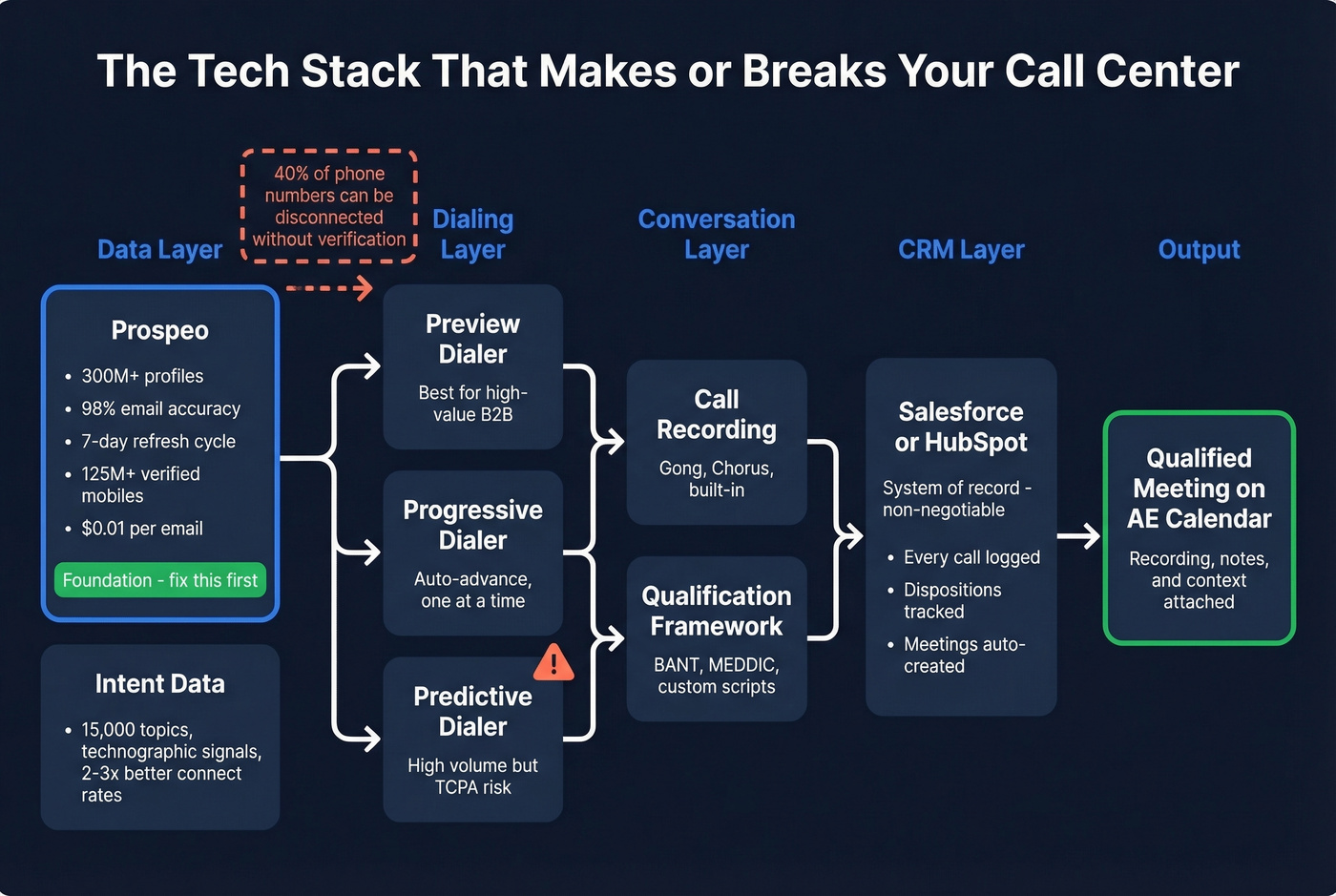
Dialers. Preview dialers show the agent contact info before connecting - best for high-value B2B conversations. Progressive dialers auto-advance through the list but connect one at a time. Predictive dialers run multiple simultaneous calls and route live answers to available agents - powerful for volume, but they carry TCPA compliance risk if not configured carefully. (If you're evaluating calling platforms, start with Dialpad alternatives.)
CRM. Salesforce or HubSpot as the system of record. Non-negotiable. Every call, disposition, and meeting needs to flow back automatically. If your CRM setup is messy, review examples of a CRM and standardize fields before scaling.
Call recording and analytics. You can't coach what you can't measure. Gong, Chorus, or built-in dialer recording - pick one.
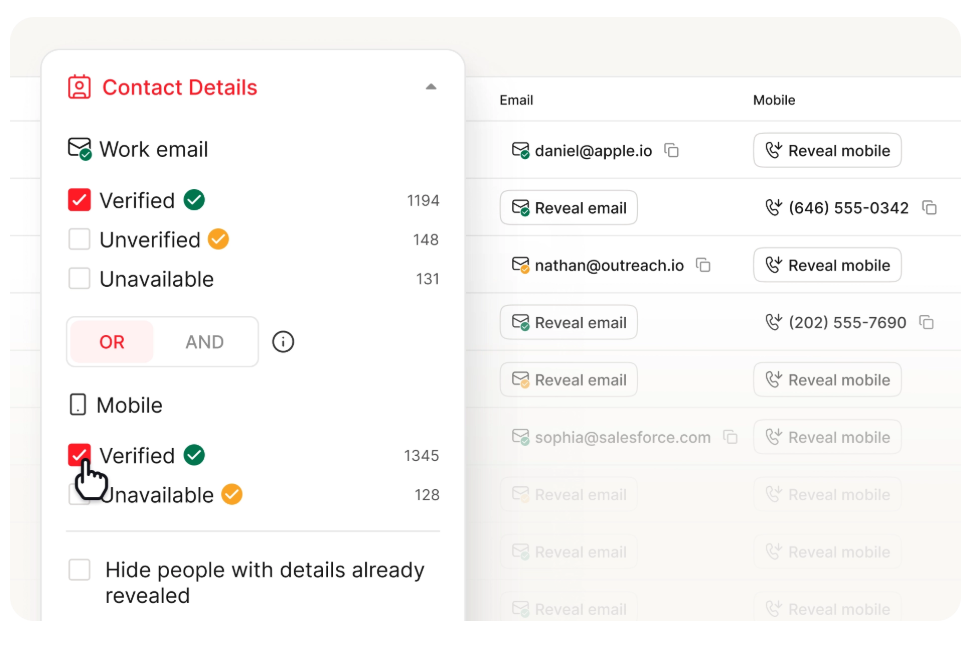
Data verification and list building. This is the prerequisite for everything else. Before a single dial is made, your list needs to be verified. Tools like Prospeo handle this with 300M+ professional profiles, 98% email accuracy on a 7-day refresh cycle, and 125M+ verified mobile numbers. The 30+ search filters - including intent data across 15,000 topics and technographic signals - let you build targeted lists that match your ICP before agents ever pick up the phone. At roughly $0.01 per email, it's the cheapest line item in your stack and the one with the highest ROI. (If you're comparing vendors, see our breakdown of data enrichment services.)
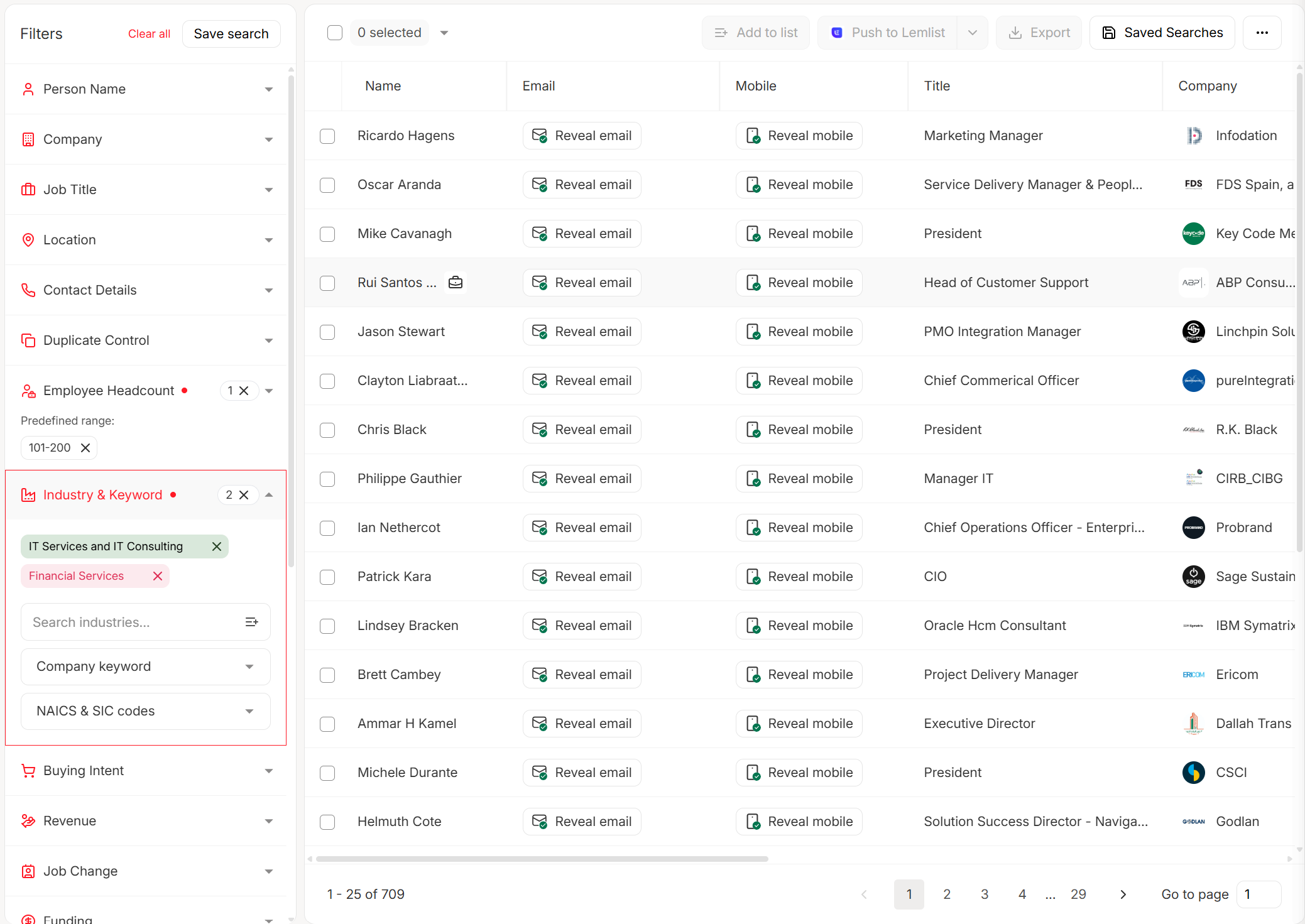
Intent data. Layering intent signals on top of your contact list means agents call prospects who are actively researching solutions in your category. This alone can shift connect-to-meeting rates by 2-3x compared to cold lists with no intent signal. (For segmentation mechanics, use intent based segmentation.)
AI in Outbound Calling
AI cold calling is real, but it's overhyped. The current stack includes LLM-driven dialogue, emotion detection, voice synthesis, and real-time CRM integration. Some platforms handle thousands of calls simultaneously, 24/7, at a fraction of human agent cost. Pricing ranges from $30/user/month for basic AI-assisted tools to $25,000+ annually for enterprise AI voice agents that handle full conversations autonomously.
The FCC ruled in February 2024 that AI-generated voices count as "artificial/prerecorded" under the TCPA. Every AI cold call requires the same prior express written consent as a robocall. The compliance exposure is massive, and most AI calling vendors gloss over this in their sales pitch.
The hybrid model wins. Use AI for call scoring, disposition logging, follow-up scheduling, and parallel dialing. Keep humans on the actual conversations. The empathy gap in AI voice agents is still too wide for complex B2B qualification - and the legal risk of getting it wrong is too high. (If you're building a broader stack, compare SDR tools before committing.)
Compliance in 2026
The rules have changed fast, and the penalties have teeth. TCPA lawsuits surged roughly 95% year-over-year, with class actions up 285% in September alone. This isn't a background risk - it's the primary operational threat to any calling program.
TCPA penalties run $500-$1,500 per violation. Per call. A 10,000-dial campaign with compliance gaps can generate seven-figure exposure overnight.
AI voices are regulated. The FCC's February 2024 ruling classified AI-generated voices as "artificial/prerecorded" under TCPA. Consent is required absent narrow exceptions.
Consent revocation got easier. As of April 2025, consumers can revoke consent by "any reasonable method" - texting STOP, saying it on a call, sending an email. Your systems need to process these in real time.
The one-to-one consent rule was vacated by the 11th Circuit in January 2025, but the underlying consent requirements still apply, and state laws are filling the gap. The FCC's "revoke all" provision was delayed until April 2026, but it's still on the table - plan for it now. Texas SB 140 took effect September 2025, expanding scope and tying violations to the Deceptive Trade Practices Act. Other states are following.
STIR/SHAKEN and caller ID reputation matter more than ever. If your outbound numbers get flagged as spam, your connect rates crater regardless of list quality. And the Supreme Court's McLaughlin v. McKesson decision means district courts aren't bound by FCC interpretations in civil TCPA cases - compliance standards now vary by jurisdiction.
Why Most Programs Fail
The failure rates are sobering. Clutch research shows 20-25% of outsourced lead gen relationships fail within two years. Half fail within five. The consensus on r/sales is even more blunt - threads regularly surface from buyers asking whether lead gen agencies actually work, which tells you how common disappointment is when the fundamentals aren't handled upfront.
Here are the mistakes that kill programs, ranked by how often we see them:
1. Choosing the cheapest option. Entry-level agencies at $2k/month often rely on scraped lists, generic templates, and minimal data hygiene. You get volume, not pipeline.
2. Skipping the strategy phase. If you can't articulate your ICP in specific, filterable terms - job titles, company size, tech stack, buying triggers - no agency can target effectively on your behalf. (Use an ideal customer profile template to make this concrete.)
3. Never asking how leads are sourced. If a vendor won't explain exactly where their contact data comes from and how it's verified, walk away. B2B data decays at 22.5% annually. The upstream data problem poisons everything downstream.
4. Weak KPI tracking. "We'll send you leads" isn't a KPI framework. You need dial-to-connect rate, connect-to-meeting rate, meeting-to-opportunity rate, and pipeline generated - tracked weekly.
5. Inadequate agent training. Your outsourced team needs to understand your product, your buyer's pain points, and your competitive landscape. A 30-minute onboarding call doesn't cut it.
6. No pilot structure. Committing to a 12-month contract without a defined pilot is how you end up in the scenario from the top of this article - three meetings, two wrong personas, and a vendor asking for more time.
Let's be honest: most of these failures trace back to data. Run your list through a verification tool before your first dial. It's the cheapest insurance against a wasted campaign.
How to Vet a Provider
The Clutch directory lists 3,070+ lead generation call center companies, with top providers like Martal Group carrying a 4.8/5 rating across 106 reviews. OnBrand24 quotes $35/hour with a 200-hour minimum pilot. CCSI's nearshore model runs $10-$15/hour including overhead. That's a wide range - from full-service operations to a specialized cold calling agency that focuses narrowly on phone outreach.
Ask these questions before signing anything:
- How do you source and verify contact data? If the answer is vague, that's your answer.
- What's your compliance process for TCPA, state DNC lists, and AI voice regulations?
- What KPIs do you commit to, and what happens if you miss them?
- What does the pilot look like? Insist on a 200-hour minimum with defined metrics.
- How do you train agents on my product and ICP? What does ongoing coaching look like?
- Can I listen to call recordings during the pilot?
The best predictor of outsourced success isn't the vendor's pitch deck. It's whether they ask you hard questions about your ICP, your sales process, and your data quality before they quote a price. Skip any vendor who jumps straight to pricing - they're selling hours, not outcomes.
209 dials per appointment assumes your list is accurate. With 72% of calls never reaching a human, bad phone data turns that number into 400+. Prospeo's 125M+ verified mobiles hit a 30% pickup rate - nearly 3x the industry average. Feed your SDRs numbers that actually connect.
Triple your connect rate before you triple your headcount.
FAQ
What's a realistic cost per lead?
Raw leads from outsourced call centers typically cost $30-$400 depending on industry and targeting specificity. Qualified meetings at the SQL level run $300-$600. For comparison, blended digital CPLs average $237 for B2B SaaS and $653 for financial services. Call center leads tend to be higher-intent but more expensive per unit.
How many calls to book one meeting?
About 209 dials per appointment, based on Bridge Group data. Only 4.82% of conversations convert to a meeting, and three call attempts capture 93% of all conversations you'll ever get from a prospect. Budget 7.5 hours of active calling time per booked appointment.
What's the difference between a lead gen call center and a cold calling agency?
A lead generation call center handles the full top-of-funnel workflow: list building, cold outreach, qualification, and appointment booking. A cold calling agency typically focuses on the dialing stage - starting with a pre-built list and concentrating on booking meetings. For teams that need end-to-end prospecting, choose the former. If you already have a clean, verified list, an agency is often cheaper and faster.
Is AI cold calling legal in 2026?
Yes, but the compliance bar is high. The FCC classified AI-generated voices as "artificial/prerecorded" under the TCPA in February 2024, so every AI cold call requires prior express written consent - each violation carries $500-$1,500 in penalties. Most B2B teams use AI for call scoring, scheduling, and analytics rather than the actual conversation.
The single most impactful thing you can do before launching any lead generation call center program - in-house or outsourced - is verify your data. Everything else is downstream. Start there.