

Lead Generation Data: What It Is, Why Most of It Is Garbage, and How to Fix That
Poor data quality costs organizations $12.9 million per year on average. Lost productivity, misallocated budgets, missed sales. That's not a rounding error. That's a line item nobody approved.
And when your lead generation data is wrong, everything downstream breaks. 92% of B2B buyers already have a vendor in mind before they start evaluating, and the average buying cycle runs 10.1 months. If your data is stale, you're not just wasting sends - you're missing the narrow window where a prospect is actually reachable. We watched a team launch a 5,000-contact campaign last year with "verified" data from a well-known provider. Bounce rate: 28%. Domain reputation tanked within 72 hours. That's not a data problem. It's a revenue problem disguised as a technical one.
What You Need (Quick Version)
You don't need seven tools. You need three.
- Prospeo - 98% email accuracy, 7-day data refresh, self-serve with no contracts.
- Apollo - 275M contacts, 1,200 free credits/month, built-in sequencing.
- Cognism - Strong European compliance, DNC scrubbing, verified mobiles.
Trial all three. Keep what works for your ICP and territory.
What Is Lead Generation Data?
Lead generation data is any information that helps you identify, qualify, and contact potential buyers. Most teams only think about two types - contact info and maybe firmographics - but the category actually covers six distinct types, and the ones you're ignoring are probably the ones that matter most.
| Data Type | What It Tells You | Example Use Case |
|---|---|---|
| Contact | Name, email, phone, title | Cold outreach targeting |
| Firmographic | Revenue, headcount, industry | ICP filtering |
| Technographic | Tech stack, tools in use | Competitive displacement |
| Intent | Active research signals | Timing outbound to buying windows |
| Behavioral | Website visits, content downloads | Lead scoring and prioritization |
| Demographic | Seniority, department, location | Persona-based segmentation |
The problem isn't access - it's accuracy. 58% of organizations say data accuracy is still a significant problem, and that stat has been consistent for years. The tools have gotten better. The underlying data decay hasn't slowed down.
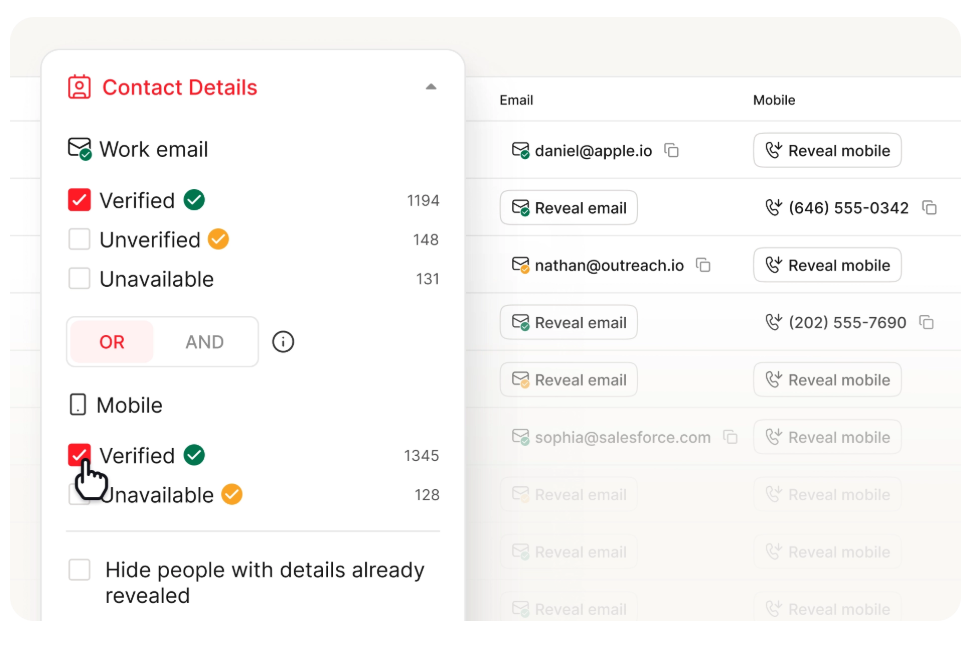
Here's the thing: most teams over-index on contact data and ignore intent and technographic signals entirely. That's like knowing someone's number but never checking if they're in the market. When you layer firmographic, behavioral, and intent data together, you build targeting that reflects buying readiness - not just reachability.
Why Quality Beats Database Size
Database size is the most overrated metric in B2B data. A provider with 500M contacts sounds impressive until you realize a third of those records are outdated, duplicated, or flat-out wrong.
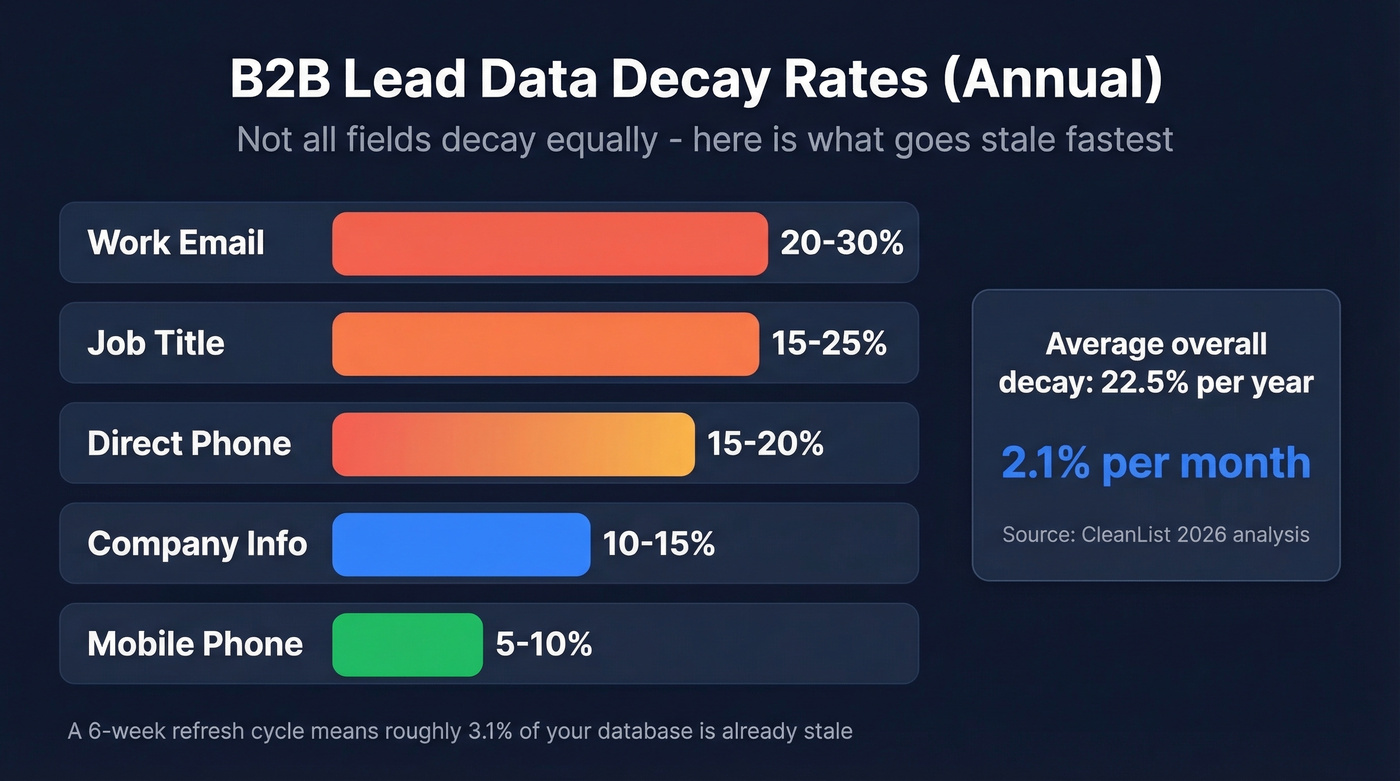
B2B lead data decays at roughly 22.5% per year - about 2.1% per month. But not all fields decay equally:
| Data Field | Annual Decay Rate |
|---|---|
| Work email | 20-30% |
| Job title | 15-25% |
| Direct phone | 15-20% |
| Company info | 10-15% |
| Mobile phone | 5-10% |
ZeroBounce's analysis of 11 billion+ email addresses found that only 62% of submitted emails were valid. At least 23% of any email list degrades yearly, and high-turnover sectors like tech and staffing can hit 30-40%.

Verification changes the math completely. Without it, expect 15-30% bounce rates on outbound campaigns. With proper verification, you should land at 2-5%. That's the difference between a healthy sender reputation and getting flagged by Google.
At 2.1% monthly decay, a six-week refresh cycle means roughly 3.1% of your database has already gone stale. A 7-day refresh cycle cuts that exposure window by about 86%. If you're not verifying before every campaign, you're burning money and domain reputation simultaneously.
The AI Lead Gen Reality Check
Most "AI lead generation" tools are a rebrand, not an innovation.
A practitioner on r/coldemail tested four AI lead generation platforms head-to-head, running 500 accounts through each. Bounce rates ranged from 19% to 31%, reply rates from 2% to 4%. Their manual prospecting baseline? 8% bounce, 6% reply. The humans won on both deliverability and engagement.
The core issue is that most AI tools repackage the same underlying databases and layer a filtering algorithm on top. If the source data is stale, no amount of "AI-powered targeting" fixes it. Garbage in, garbage out.
Automated enrichment, real-time verification, and intent signal processing are genuinely useful AI applications. Data discovery - where algorithms surface net-new accounts matching your ICP from unstructured web data - is one area where AI adds real value. But if a vendor's pitch is "our AI finds better leads," ask where the data comes from. If they can't answer clearly, they're selling you a wrapper, not a product.
Where to Get B2B Lead Data
Lead generation data comes from three categories. Understanding the tradeoffs saves you from buying the wrong tool.
B2B Contact Databases
Purpose-built platforms that aggregate, verify, and sell professional contact data. Prospeo, Apollo, and ZoomInfo are the common picks. Prospeo leads on accuracy with 98% verified emails and a 7-day refresh cycle. Apollo's free tier makes it accessible for bootstrapped teams. ZoomInfo's depth makes it the enterprise default - at enterprise prices. These databases are the primary lead data sources for most outbound teams.

Enrichment Platforms
Tools like Cognism, Lusha, and Clearbit take your existing contacts and fill in the gaps - verified emails, phone numbers, firmographic data, intent signals. These work best layered on top of a primary database. Think of enrichment as turning raw records into campaign-ready contacts. If you're comparing vendors, start with this breakdown of data enrichment services.
First-Party Sources
Website forms, ad lead forms, webinar registrations, event badge scans. These are the cheapest leads you'll ever collect, and often the highest intent. The tradeoff is scale - you can't build a 10,000-contact outbound list from inbound forms alone. First-party data is the foundation; third-party data is the accelerant.

You just read that bad lead data costs orgs $12.9M per year and decays at 2.1% per month. Prospeo's 7-day refresh cycle cuts your stale-data exposure by 86% compared to the 6-week industry average - and every email ships at 98% verified accuracy for ~$0.01 each.
Stop burning domain reputation on data that expired last month.
What Lead Data Actually Costs
Pricing in this space ranges from free to absurd, and the correlation between price and quality is weaker than vendors want you to believe.
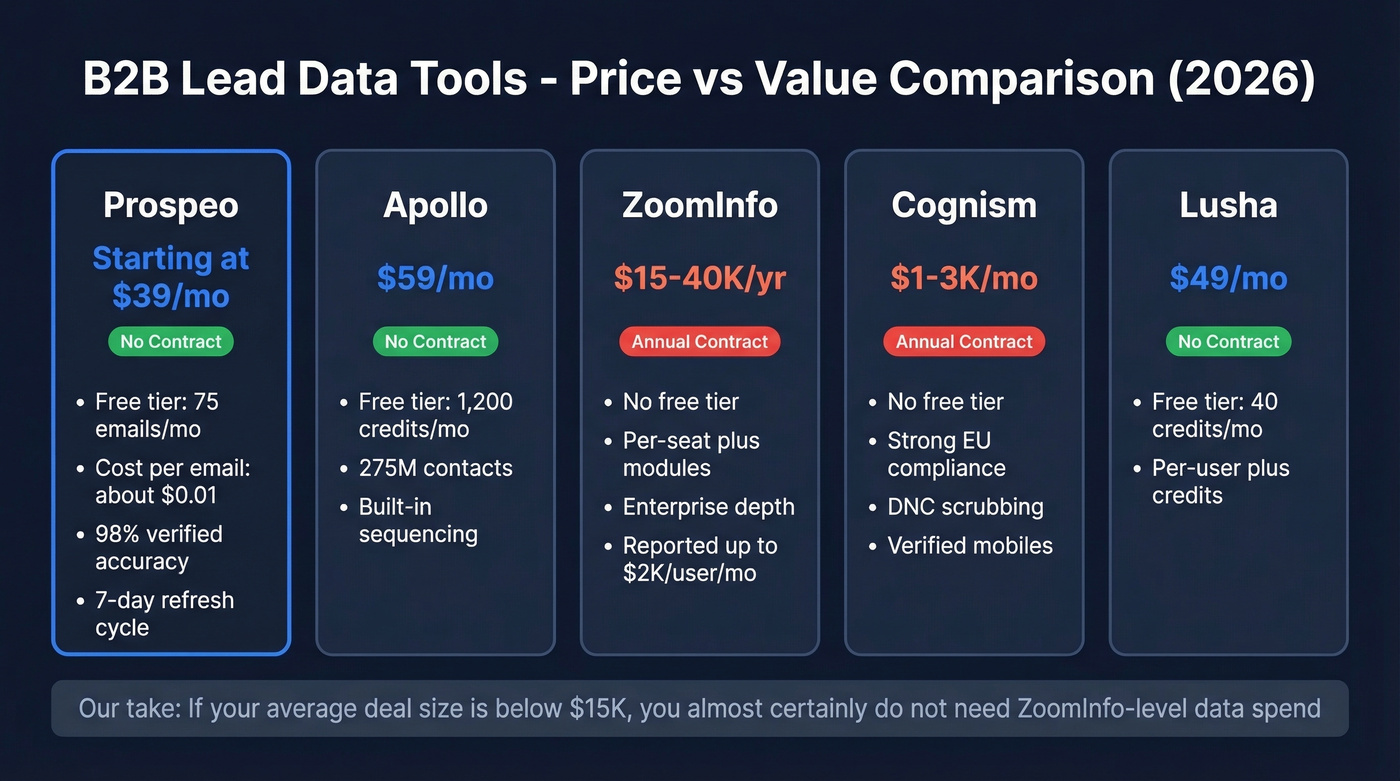
| Tool | Starting Price | Free Tier | Pricing Model | Contract |
|---|---|---|---|---|
| Prospeo | ~$39/mo | 75 emails/mo + 100 extension credits/mo | Credits (~$0.01/email) | No |
| Apollo | ~$59/mo | 1,200 credits/mo | Per-user + credits | No |
| ZoomInfo | ~$15-40K/yr | No | Per-seat + modules | Annual |
| Cognism | ~$1-3K/mo | No | Flat rate | Annual |
| Lusha | ~$49/mo | 40 credits/mo | Per-user + credits | No |
| Lead411 | $49/mo | 7-day trial | Per-user | No |
| SalesIntel | ~$69/mo | No | Per-user | Annual |
One Reddit user reported a ZoomInfo quote of nearly $2,000 per user per month. Base contracts start at $15-40K/year for small teams, but per-user pricing for full-feature access climbs fast. For a 10-seat team, that's $240K/year. Let's be honest: ZoomInfo is overpriced for 90% of the teams buying it.
Our take: If your average deal size sits below $15K, you almost certainly don't need ZoomInfo-level data spend. A $39/month verified database paired with a free sequencer will outperform a $40K/year platform that your reps only use for email lookups. If a vendor won't tell you what they cost before a 45-minute demo, they're not confident you'd pay it.
Cost Per Lead by Channel
Here's what B2B campaigns actually cost by channel, per Sopro's benchmarks:
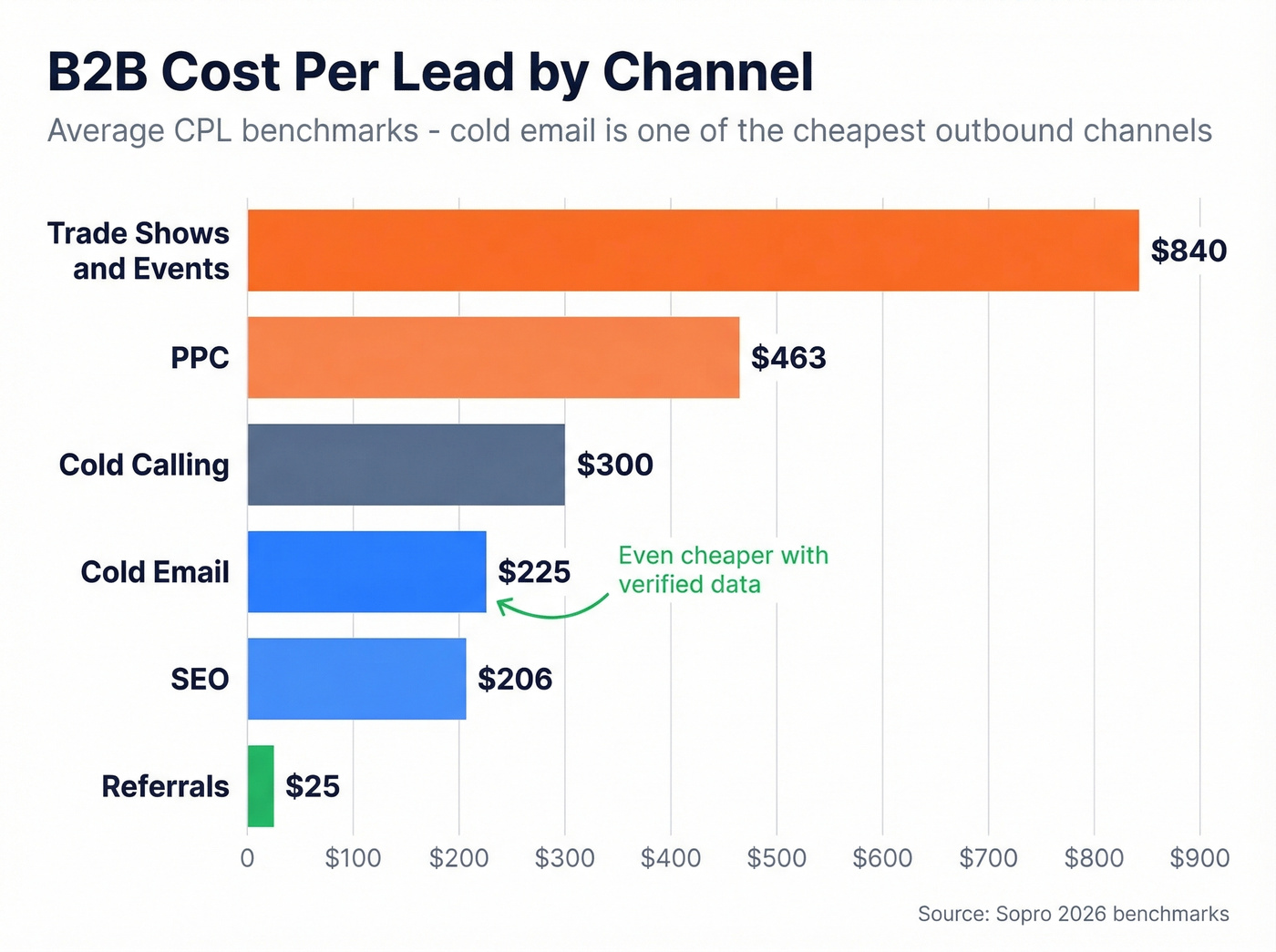
| Channel | Avg CPL |
|---|---|
| Trade shows/events | $840 |
| PPC | $463 |
| Cold calling | $300 |
| Cold email | $225 |
| SEO | $206 |
| Referrals | $25 |
Cold email at $225/lead is already one of the cheaper channels. Using a verified database drops that further because you're not wasting sends on bounced addresses. If you're building a stack on a budget, start with these free lead generation tools.
Cost Per Lead by Industry
CPL varies dramatically by vertical. If you're in legal or enterprise software, expect to pay more for every qualified lead:
| Industry | Avg CPL |
|---|---|
| Legal | $650 |
| Software Development | $595 |
| IT & Managed Services | $501 |
| Staffing | $497 |
| Financial Services | $461 |
| Manufacturing | $391 |
| Construction | $227 |
| B2B SaaS | $188 |
These numbers explain why data accuracy matters disproportionately in high-CPL verticals. A 25% bounce rate on a legal services campaign wastes roughly $162 per bad contact. The same bounce rate in B2B SaaS wastes $47. Both hurt, but one is four times more painful.
How to Operationalize Your Data
Having good lead generation data isn't enough. You need a workflow that moves contacts from database to revenue without leaking quality at every handoff.
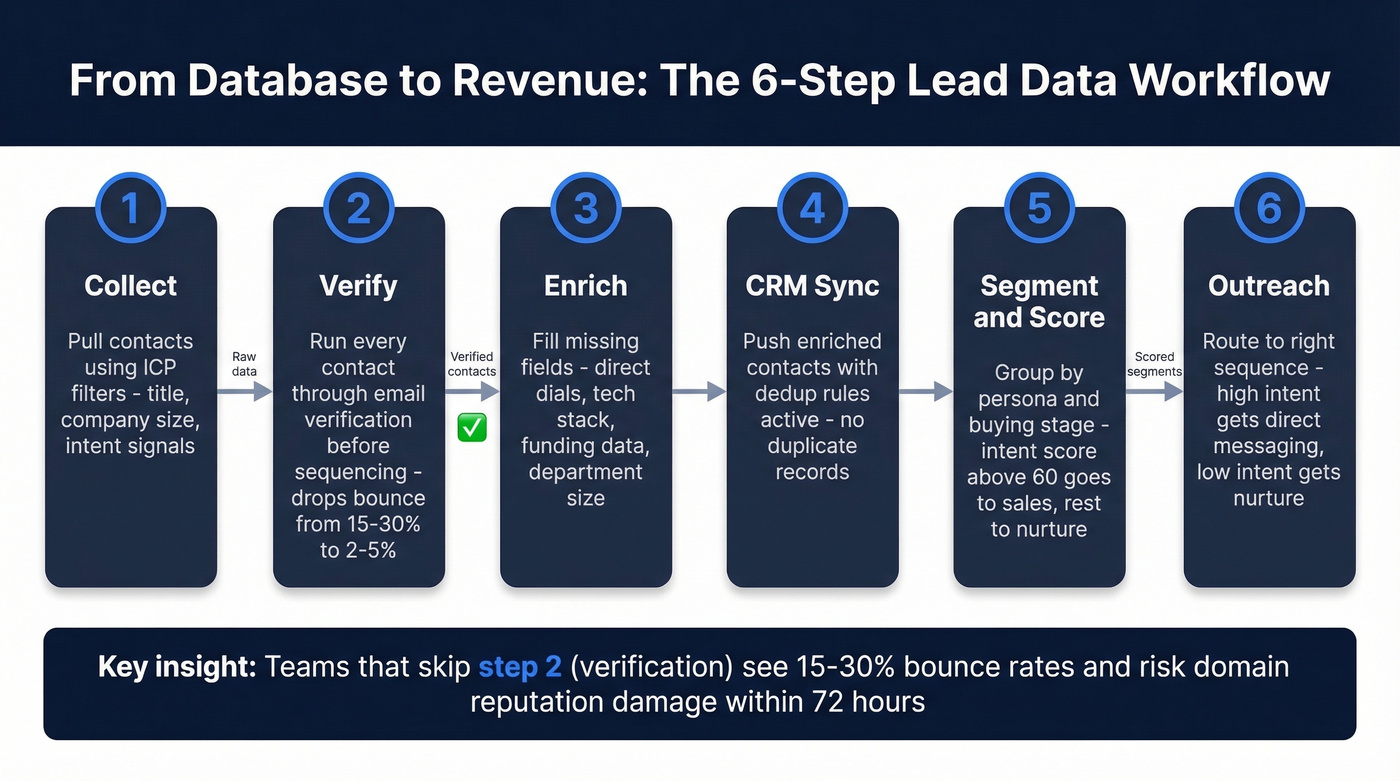
1. Collect - Pull contacts using ICP-aligned filters. Job title + company size + intent signal is the minimum viable targeting criteria. A lead discovery dataset built from multiple signals outperforms single-source lists every time. If you need a repeatable process, use this lead generation workflow.
2. Verify - Run every contact through verification before it touches your sequencer. This step alone takes bounce rates from 15-30% down to 2-5%. If you're troubleshooting bounces, see email bounce rate.
3. Enrich - Fill in missing fields: direct dials, technographic data, recent funding rounds, department headcount. The richer the record, the better your personalization and routing. For a deeper implementation guide, read firmographic and technographic data.
4. CRM sync - Push enriched contacts into your CRM with deduplication rules active. We've seen teams create thousands of duplicate records in the first week of a new data tool because they skipped this step. Don't be that team. If you're evaluating systems, start with these examples of a CRM.
5. Segment and score - Group contacts by persona, buying stage, or intent signal. Contacts scoring above 60 on your intent model get fast-tracked to sales; everyone else goes into nurture. A VP of Engineering researching your competitor's category isn't the same outreach as a cold contact with no signal. For scoring models, see lead scoring and intent based segmentation.
6. Outreach - Route segments to the right sequence. High-intent contacts get direct, value-forward messaging. Low-intent contacts go into nurture.
The most common failure modes are slow activation where leads sit in a queue for days, no nurture after initial capture, and misaligned marketing-to-sales handoffs where MQLs get rejected because nobody agreed on the definition.
Compliance Essentials
Compliance isn't optional, and the fines aren't theoretical. TCPA violations run $500 to $1,500 per violation - per call, per text. A 1,000-contact campaign with bad consent documentation is a seven-figure liability.
- Lawful basis - In B2B, legitimate interest is the most common GDPR basis. Document it.
- Opt-out handling - Every outreach must include an unsubscribe mechanism. Process opt-outs within a few days.
- DNC scrubbing - Check every phone list against federal and state Do Not Call registries before dialing.
- Audit trails - Log when and how consent was obtained for every contact.
- Deletion requests - Have a documented process for GDPR/CCPA deletion requests and respond within required timelines.
- Vendor DPAs - Every data provider you use should have a Data Processing Agreement on file. If they don't offer one, that's a red flag.
GDPR and CCPA have roughly doubled the cost of verified opt-in leads while shrinking available lists. Budget accordingly.
Best Tools for B2B Lead Data
Prospeo
Use this if you care about data accuracy above all else, want self-serve access without annual contracts, and need verified emails and mobiles that actually connect.
Prospeo's database covers 300M+ professional profiles with 143M+ verified emails and 125M+ verified mobile numbers. The 98% email accuracy comes from proprietary infrastructure running a 5-step verification process that handles catch-all domains, spam traps, and honeypots. The 7-day refresh cycle means you're working with data that's weeks fresher than competitors running on 6-week refresh averages. Search filters cover buyer intent across 15,000 Bombora topics, technographics, job changes, headcount growth, and funding signals. Native integrations push directly to Salesforce, HubSpot, Smartlead, Instantly, Lemlist, Clay, Zapier, Make, and more.
Real results: Meritt tripled their pipeline from $100K to $300K per week after switching, with bounce rates dropping from 35% to under 4%.
Pair with Instantly or Lemlist if you need sequencing - Prospeo handles the data, they handle the sends. If you're building a modern outbound motion, these outbound lead generation tools are a good starting point.
Apollo
Apollo's 275M-contact database and 1,200 free credits per month make it the obvious starting point for teams with zero budget. The all-in-one platform combines database search, email sequencing, and basic CRM functionality. Paid plans start at ~$59/month per user.
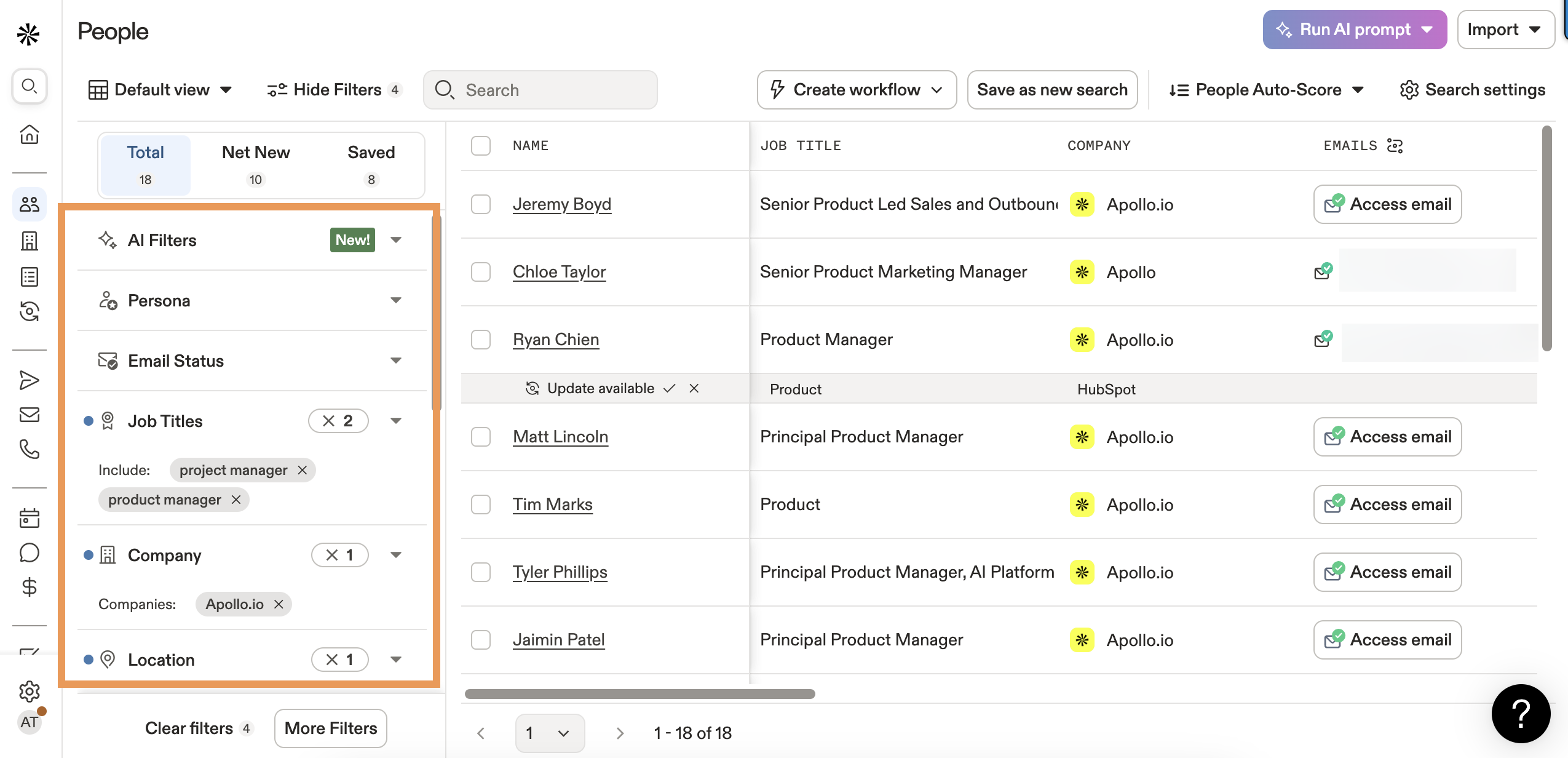
The tradeoff is accuracy. Email accuracy runs around 79% - workable for volume plays, but you'll see higher bounce rates than with a verification-first tool. Data freshness is also a concern, with refresh cycles slower than weekly. The free tier is great for testing; for production campaigns, verify Apollo contacts through a separate tool before sending.
ZoomInfo
ZoomInfo is the enterprise default for a reason: the US database depth is strong, the intent data is strong, and the platform covers everything from prospecting to conversation intelligence. Email accuracy runs around 87%, solid but not best-in-class. Mobile coverage is a known gap - one buyer reported accurate mobile data on only about 15% of leads.
The problem is cost. Base contracts start at $15-40K/year for small teams, and annual commitments are standard. Skip this if you're a team under 20 reps or your deal sizes don't justify five-figure data spend.
Cognism
Cognism's strength is European coverage and compliance infrastructure. Bombora-powered intent data, mobile-verified phone numbers, and automatic DNC list scrubbing make it the go-to for teams where regulatory risk is a real concern. SingleStore reported 300% more dials after implementing Cognism. Pricing runs ~$1,000-3,000/month on annual contracts. Skip this if your territory is primarily North America and you don't need the compliance overhead.
Lusha
Lusha's Chrome extension and self-serve model make it the fastest path from "I need this person's email" to having it. Free plan gives you 40 credits/month; paid starts at ~$49/month. Best for ad-hoc prospecting by individual reps, not systematic list building or bulk exports.
Lead411
Lead411 starts at $49/month with a 7-day free trial and positions itself on unlimited exports. The Pro plan includes Bombora intent data. Worth a trial if you're price-sensitive and want intent signals without Cognism-level pricing.
SalesIntel
SalesIntel is positioned around human-verified data, with 95% accuracy highlighted in industry comparisons. Pricing typically starts around ~$69/month for individual use. The human verification angle is interesting for niche verticals where automated verification misses nuances, but for most teams the volume tradeoff isn't worth it.
Most providers give you a massive database and call it a day. Prospeo gives you 300M+ profiles verified through a 5-step process, 30+ filters including intent and technographics, and enrichment that returns 50+ data points at a 92% match rate. No contracts, no sales calls.
Layer contact, firmographic, and intent data in one platform - starting free.
Lead Generation Data FAQ
How often should I clean my lead database?
Verify your list before every outbound campaign and refresh the full database at least quarterly. B2B contact data decays roughly 22.5% per year - about 2.1% per month. Tools with automatic 7-day refresh cycles reduce this burden significantly and keep records current between manual audits.
What's a good bounce rate for outbound email?
Under 5% is the target for any production campaign. Without verification, expect 15-30% bounces on a typical B2B list. With proper verification you should consistently hit 2-5%. Anything above 5% means your data source needs an upgrade - and your sender reputation is taking damage with every send.
Is buying lead data GDPR compliant?
Yes, if the provider has a lawful basis for processing, honors opt-out requests, offers Data Processing Agreements, and scrubs against do-not-contact lists. Providers that can't produce a DPA on request aren't worth the regulatory risk.
What's a good free tool for verified B2B contact data?
Prospeo's free tier gives you 75 verified emails plus 100 Chrome extension credits per month - enough for small teams running real campaigns. Apollo offers 1,200 free credits monthly but with lower accuracy (~79%). For ad-hoc lookups, Lusha's free plan provides 40 credits. Start with whichever matches your priority: accuracy or volume.
What's the difference between lead generation data and a lead discovery dataset?
Lead generation data is the broad category covering any information used to identify and contact prospects - emails, phone numbers, firmographics, intent signals. A lead discovery dataset is a curated, filtered set of net-new contacts matching your ICP criteria, assembled from multiple sources and enrichment layers. Think of the former as raw material and the latter as the refined product ready for outreach.