

Lead Generation Definition: What It Actually Means (With Data)
The average qualified-lead conversion rate across 14 industries is 2.9%. For every 100 people who interact with your marketing, fewer than three become real opportunities. The lead generation definition most people learn - "the process of attracting and converting prospects" - is technically correct and practically useless. It's not about filling a spreadsheet with names. It's about building a system that reliably turns strangers into pipeline.
What Is Lead Generation, Really?
Lead generation is the process of identifying potential buyers for your product or service and capturing their contact information so you can start a sales conversation. That's the textbook version. Accurate, but it misses the point.
Here's the practitioner reframe: leads already exist. Your job isn't to "generate" them out of thin air - it's to find the right people, get in front of them, and qualify whether they're worth pursuing. A thread on r/sales nails this distinction: "hundreds of leads created" isn't success unless those prospects show concrete buying interest - a quote request, a demo booking, a reply that says "tell me more."
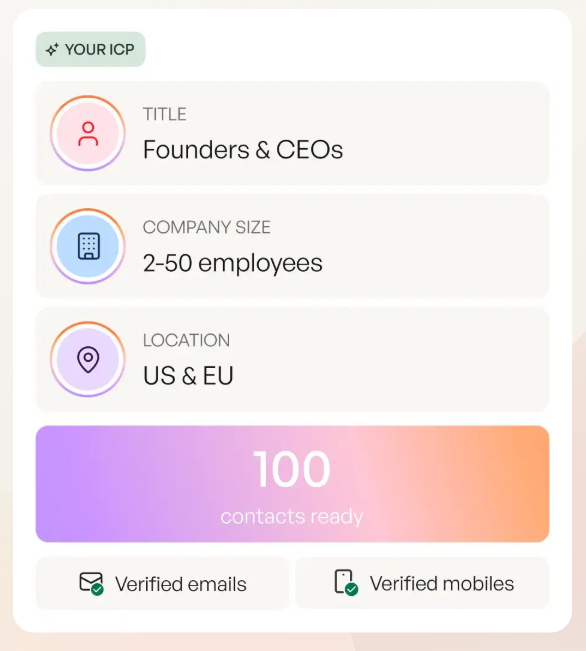
The real work is qualification. Anyone can Google 500 companies in a sector and dump them into a CRM. The value is in moving from that big, messy list to a smaller set of accounts that actually match your ideal customer profile and show intent to buy.
The Short Version
Before we go deep, here's the condensed take:
- Lead generation is finding and qualifying potential buyers - not just collecting names.
- 2.9% is the average qualified-lead conversion rate. Above that, you're doing well. Below, your qualification or nurturing is broken.
- The biggest mistake teams make is chasing volume over quality. Two thousand webinar registrants mean nothing if 1,800 of them are students.
- The fastest win you can implement today: respond to inbound leads within five minutes. That single change increases contact rates by 900%. Wait 30 minutes and your close probability drops by 80%.
What Counts as a Lead?
A lead is anyone who's shown some level of interest in what you sell and whose contact information you've captured. But not all leads are equal, and treating them the same is one of the fastest ways to waste your sales team's time.
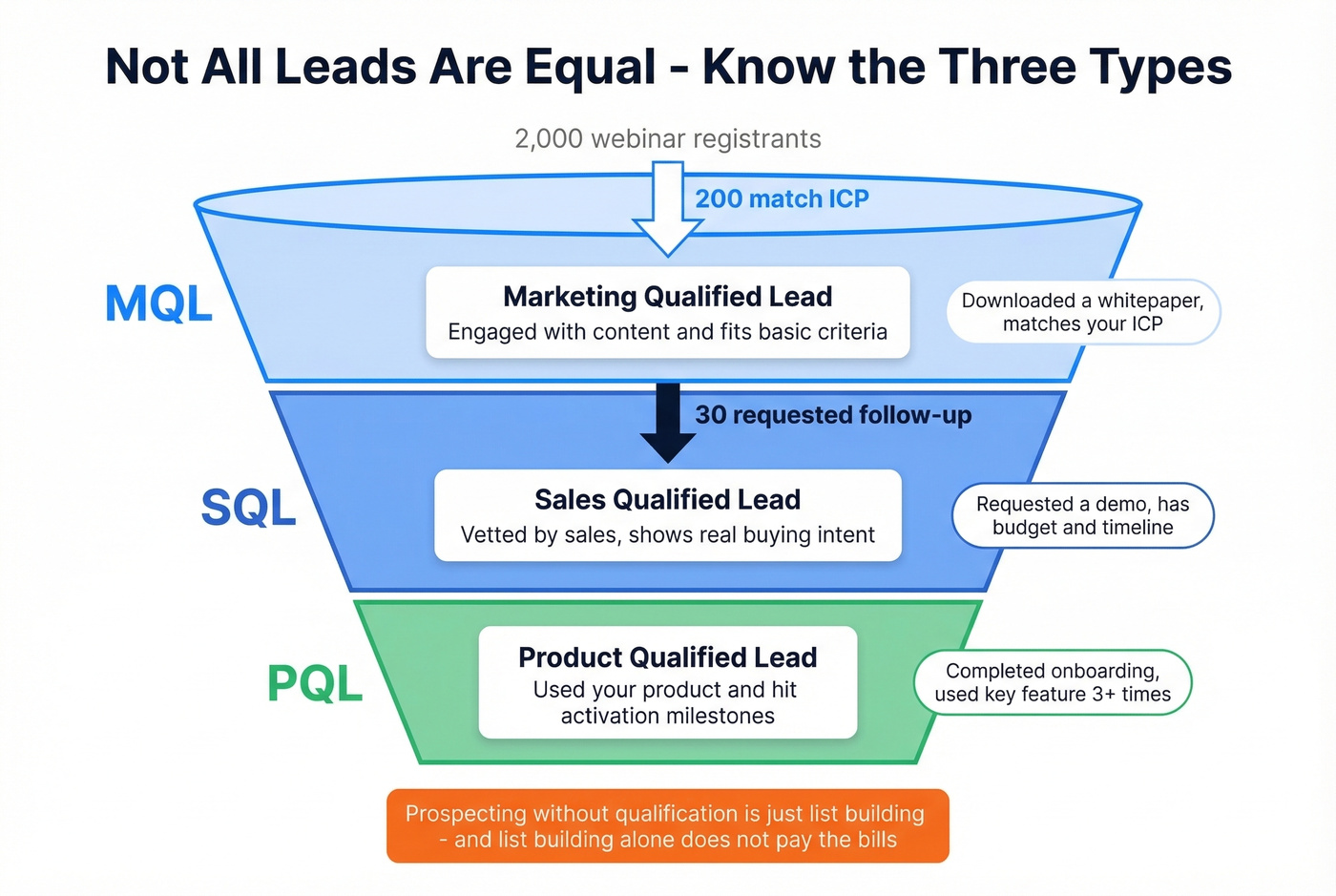
Three types matter:
| Lead Type | Definition | Example |
|---|---|---|
| MQL | Marketing Qualified Lead - engaged with content, fits basic criteria | Downloaded a whitepaper, matches your ICP |
| SQL | Sales Qualified Lead - vetted by sales, shows buying intent | Requested a demo, has budget and timeline |
| PQL | Product Qualified Lead - used your product, hit activation milestones | Completed onboarding, used a key feature 3+ times |
Let's make this concrete. You run a webinar and get 2,000 registrants. Exciting, right? Then you look at the list: 1,800 are students, consultants, and competitors. The 200 who match your ICP and actually attended are your MQLs. The 30 who requested a follow-up call? Those are your SQLs. Prospecting without qualification is just list building - and list building alone doesn't pay the bills.
How the Process Works
The process breaks down into five stages. Every team runs some version of this, whether they've formalized it or not.
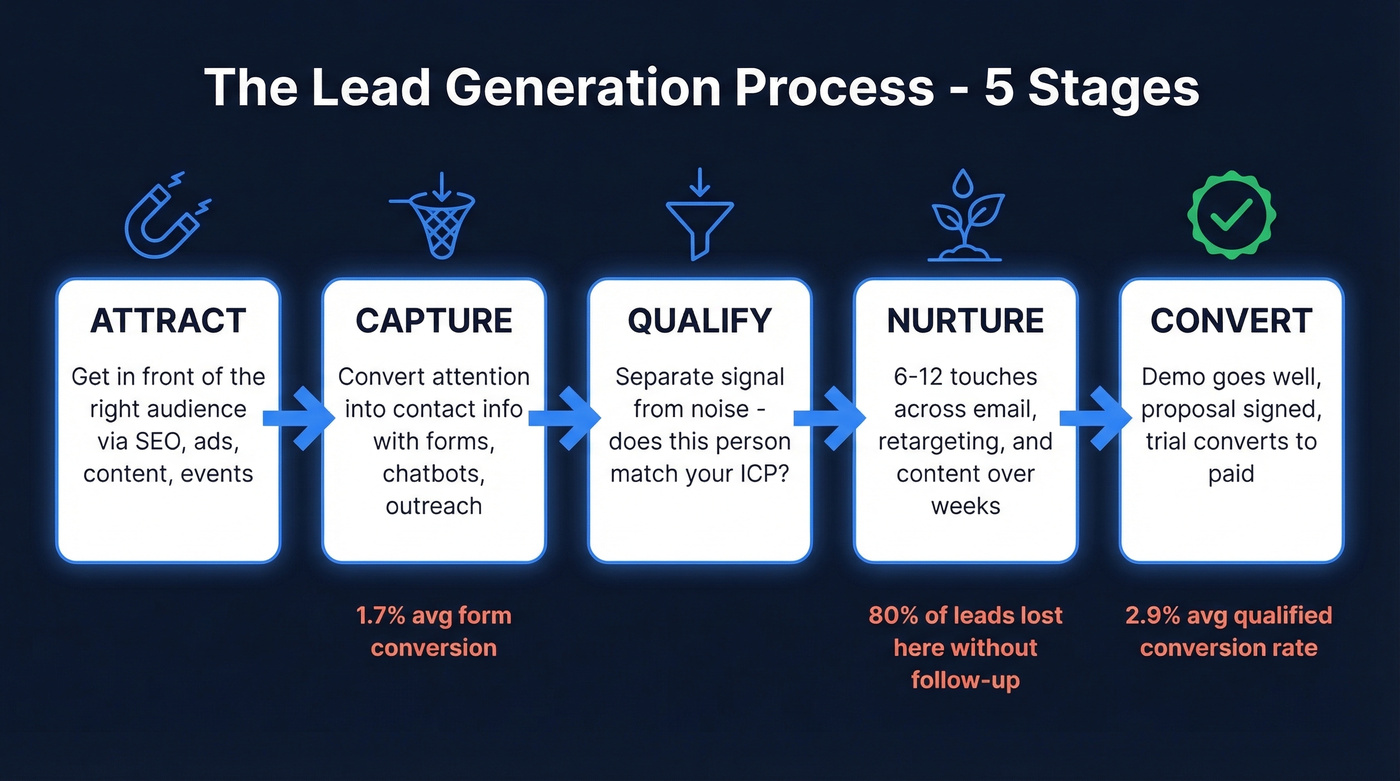
Attract. Get in front of the right audience through content marketing, paid ads, SEO, social media, events, or outbound prospecting. The channel matters less than the targeting - are you reaching people who actually have the problem you solve?
Capture. Convert attention into contact information. Landing pages, forms, gated content, chatbots, direct outreach. The average form conversion rate across industries is just 1.7%, so every friction point you remove matters.
Qualify. Separate signal from noise. Does this person match your ICP? Do they have budget, authority, and a real timeline? This is where MQLs become SQLs - or get recycled back to marketing for more nurturing.
Nurture. Most leads aren't ready to buy today. The typical nurturing cycle runs 6-12 touches across email, retargeting, and content. 80% of new leads never become customers due to lack of nurturing. That's not a lead quality problem. It's a follow-up problem.
Convert. The lead becomes a customer. A demo goes well, a proposal gets signed, a free trial converts to paid. This is where pipeline becomes revenue.
Inbound vs Outbound
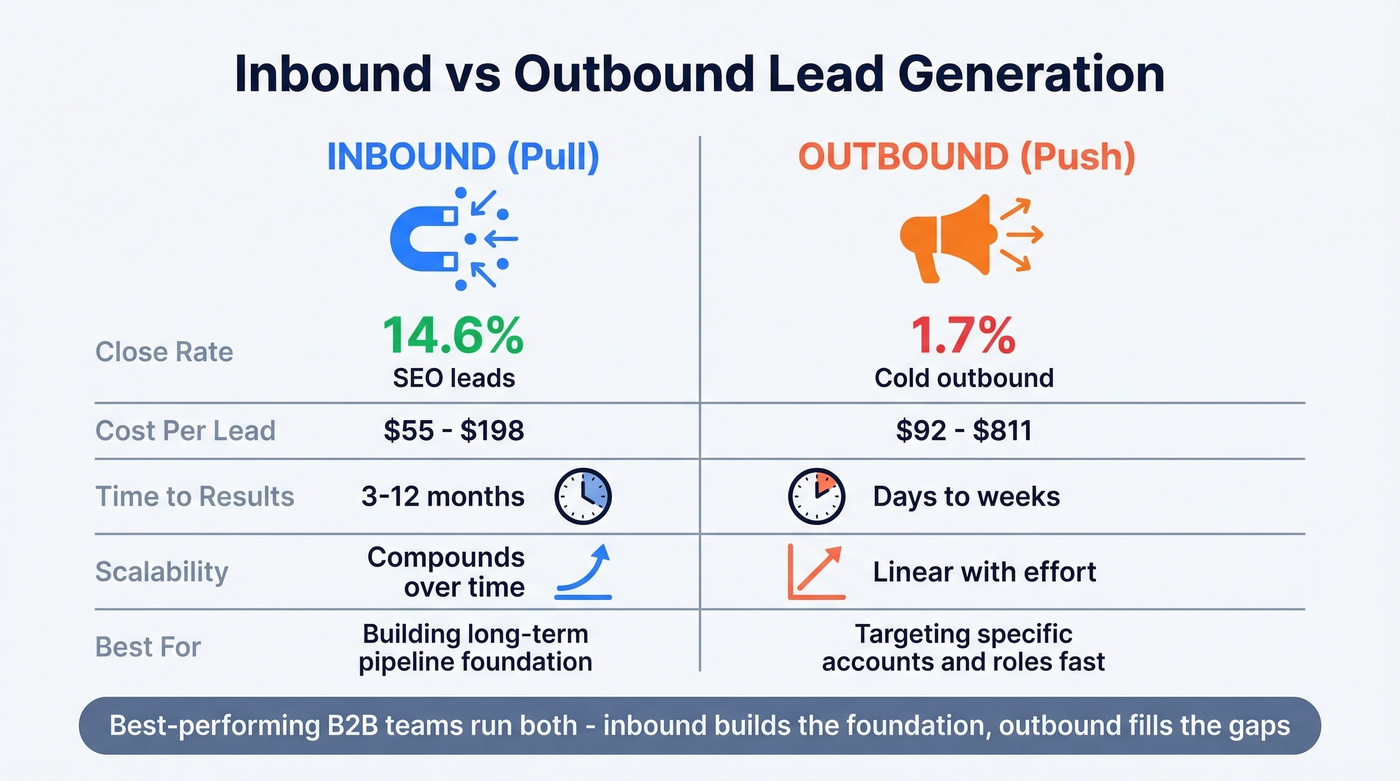
Inbound pulls prospects toward you. Outbound pushes your message to them. Both work. The right mix depends on your sales cycle, deal size, and how much time you have.
| Dimension | Inbound | Outbound |
|---|---|---|
| Approach | Pull (content, SEO, social) | Push (cold email, calls, paid ads) |
| Close rate | ~14.6% (SEO leads) | ~1.7% (outbound) |
| CPL range | $55-$198 (varies by channel) | $92-$811 (SEM to trade shows) |
| Time to results | 3-12 months | Days to weeks |
| Scalability | Compounds over time | Linear with effort |
The close rate gap is striking - SEO-sourced leads close at 14.6% versus 1.7% for outbound. That doesn't mean outbound is bad. It means inbound leads arrive with more intent already built in. Outbound lets you target specific accounts and roles that would never find your blog post.
We've watched teams blow their entire quarterly budget on a single conference and come back with a box of business cards that never convert. Channel selection isn't just about lead volume - it's about cost per qualified opportunity. Webinars run about $72 per lead, SEM around $92, and trade shows can hit $811.
Most B2B teams that perform well run both. Inbound builds the foundation; outbound fills gaps in specific verticals or accounts you can't wait to find you.

You just read that 80% of leads never convert due to lack of nurturing - but bad data kills even more. When 35% of your emails bounce, no nurturing sequence can save you. Prospeo's 98% email accuracy and 7-day data refresh mean every lead in your pipeline is actually reachable.
Real lead generation starts with data you can actually trust.
B2B vs B2C: Different Games
These are fundamentally different playbooks, and using a B2C approach in B2B is a recipe for wasted budget.
| Dimension | B2B | B2C |
|---|---|---|
| Target | Decision-makers at companies | Individual consumers |
| Sales cycle | Weeks to months | Minutes to days |
| Content tone | Informative, ROI-focused | Emotional, aspirational |
| Primary channels | Email, professional networks, events | Social, influencers, paid ads |
| Deal size | $5K-$500K+ | $10-$500 typical |
B2B buying committees now average 8-13 decision-makers. You're not convincing one person - you're building consensus across finance, legal, IT, and the end user. This is why B2B prospecting emphasizes nurturing and multi-threading over quick wins. When contracts run six or seven figures, nobody signs after reading a single blog post.
B2C moves faster because the stakes are lower and decisions are more emotional. A well-targeted Instagram ad can drive a purchase in minutes. Try that in B2B and you'll get crickets.
Benchmarks That Actually Matter
Let's talk numbers - the benchmarks that tell you whether your efforts are working or just burning budget.
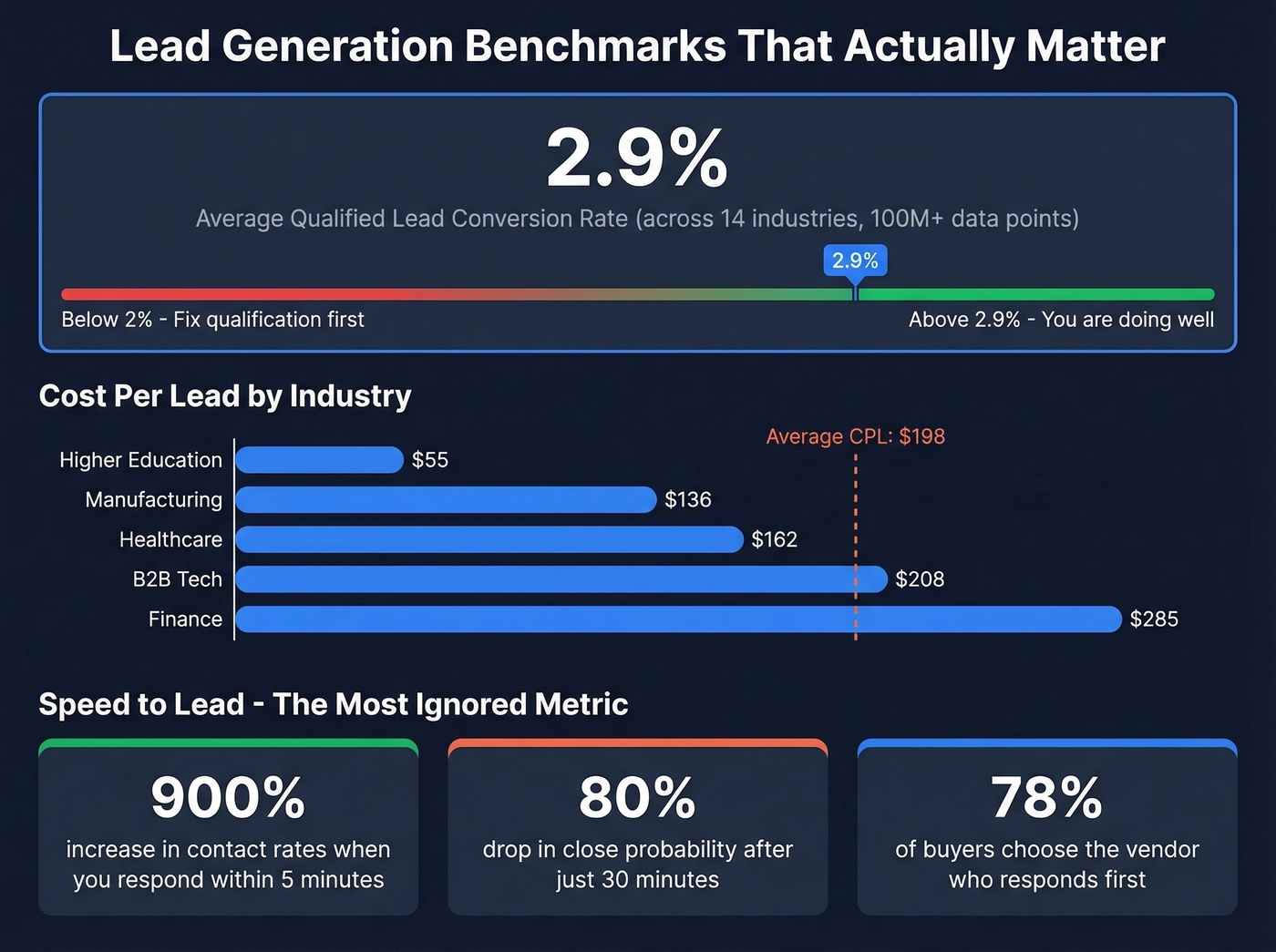
The average qualified-lead conversion rate is 2.9% across 14 industries, based on 100M+ data points. Below 2%, focus on tightening qualification and speeding up follow-up before adding more volume.
Cost per lead varies wildly by industry. The average CPL across all industries is $198, but the range tells a more useful story:
- Higher education: $55
- Manufacturing: $136
- Healthcare: $162
- B2B tech: $208
- Finance: $285
Speed-to-lead is the benchmark most teams ignore and the one with the biggest ROI. Responding within five minutes increases contact rates by 900%. Wait 30 minutes and your close probability drops by 80%. And 78% of buyers choose the vendor who responds first. In our experience, the teams that fix speed-to-lead first see the fastest improvement in conversion rates - faster than any tool swap or messaging overhaul.
Here's the thing: most teams track lead volume as their primary metric. That's a vanity number. The benchmarks that predict revenue are conversion rate, CPL, and speed-to-lead. Everything else is decoration.
Essential Tools
You don't need 15 tools. You need the right ones for your workflow.
Prospecting and Data
This is where your pipeline starts - finding the right people and getting verified contact information.
Prospeo is where we'd point you first. Its database covers 300M+ professional profiles, including 143M+ verified emails at 98% accuracy and 125M+ verified mobile numbers, all refreshed on a 7-day cycle (the industry average is six weeks, which tells you how stale most databases get). Pricing is dead simple: roughly $0.01 per email, a free tier with 75 emails per month, no contracts, no sales calls required. One proof point - Meritt tripled their pipeline from $100K to $300K per week after switching, with bounce rates dropping from 35% to under 4%.

For enterprise orgs running full-stack GTM, ZoomInfo is the incumbent. Strong US database, deep intent data, and a massive feature set including chat, workflow automation, and ABM tools. Expect $15K-$40K+ per year, and you'll need to talk to sales. Worth it for large orgs with complex GTM motions. Skip it if you're a team of five.
Bootstrapped and need prospecting plus sequencing in one tool? Apollo is your play. Generous free tier, paid plans from ~$49-$99/mo per user. The catch: email accuracy runs lower than dedicated verification platforms, so verify before you send.
Capture: Forms and Landing Pages
Unbounce and OptinMonster handle the landing page and lead capture side. Unbounce starts around ~$90-$150+/mo. OptinMonster runs ~$20-$50+/mo. Both solve the same problem: converting traffic into contact information.
CRM and Automation
HubSpot is the best all-in-one for SMBs. Free CRM, with paid marketing tiers starting around ~$20-$50+/mo. The ecosystem is deep and the learning curve is manageable. If you're starting from zero, start here.
Salesforce is the enterprise standard, starting around ~$25/user/mo and scaling up by edition and add-ons. More powerful, more complex, more expensive. You'll need an admin.
The selection principle is straightforward: pick tools based on whether you're running primarily inbound or outbound, and make sure everything syncs bidirectionally with your CRM. A disconnected stack creates data silos that kill your ability to measure anything.
Qualifying leads across 8-13 decision-makers means you need direct contact data for every stakeholder - not just one gatekeeper. Prospeo's 30+ search filters let you target by buyer intent, job changes, and department headcount so your outbound hits SQLs, not dead ends. At $0.01 per email, scaling from MQL to SQL costs less than your morning coffee.
Find the right buyers with 300M+ profiles and 125M+ verified mobiles.
Mistakes That Kill Your Pipeline
Four patterns we see repeatedly - each one is fixable.
Buying lead lists instead of building your own. You spend $2,000 on 5,000 "decision-makers" and your domain reputation ends up in the gutter within two weeks. Purchased contacts didn't opt in, don't know you, and are riddled with spam traps and invalid addresses. Build your own list with verified data. The upfront effort pays off in dramatically better response rates and a domain that stays out of spam folders.
Treating every lead the same. A whitepaper download and a demo request aren't the same signal. Without lead scoring and ICP-based qualification, your reps waste cycles on people who were never going to buy. We've seen teams triple their SQL rate just by implementing a basic scoring model - nothing fancy, just weighting demo requests higher than content downloads.
No follow-up strategy. One email, no reply, move on. That's not a follow-up strategy - that's giving up. The data says 6-12 touches across multiple channels. Build a sequence. Automate what you can. Don't let good leads die because nobody followed up on day three. If you need a starting point, steal a few sales follow-up templates.
Weak lead magnets. "Subscribe to our newsletter" isn't a value proposition. Templates, calculators, benchmark reports, and ROI tools convert because they deliver immediate, tangible value. If your lead magnet doesn't make someone's job easier in the next 10 minutes, rethink it.
How to Measure Success
Leads generated is a vanity metric. Here are the five KPIs that actually predict revenue.
Cost Per Lead (CPL) = Total spend / leads generated. If you spent $10,000 and got 200 leads, your CPL is $50. Compare this to the $198 industry average to see where you stand.
Lead-to-Customer Conversion Rate = Customers / total leads x 100. If 1,000 leads produced 50 customers, that's 5% - well above the 2.9% average.
MQL-to-SQL Ratio tells you how well marketing and sales are aligned on lead quality. If marketing passes 500 MQLs and sales accepts 50 as SQLs, your 10% ratio suggests a definition gap between the two teams.
Customer Acquisition Cost (CAC) = Total sales and marketing spend / new customers. This is the number your CFO cares about. Everything else is context. If you want the full breakdown, start with CAC.
Pipeline Contribution is the only metric that truly matters. How much revenue did your efforts put into the pipeline? Not leads, not MQLs - dollars. If you're reporting anything else to the exec team, you're reporting the wrong thing.
What's Shifting: AI and Intent Data
The meaning of lead generation in 2026 is moving from volume-based list building to pipeline intelligence - using AI and data signals to identify and prioritize the accounts most likely to buy.
Three concrete ways this is playing out right now:
Predictive scoring combines CRM history, behavioral signals, and firmographic data to predict which leads are most likely to convert. Instead of scoring leads on a simple point system (downloaded whitepaper = 10 points), AI models weigh hundreds of variables and surface patterns humans miss. (If you're going deeper here, B2B predictive analytics is the next read.)
Intent data flags accounts that are actively researching solutions in your category. When a target company's employees start consuming content about "CRM migration" or "sales automation," that's a buying signal you can act on before they ever fill out a form. This is where agentic AI is taking over - automating the account research, enrichment, and list-building that used to eat hours of an SDR's week. For a practical implementation, see intent based segmentation.
First-party data is becoming essential as third-party cookies fade. The teams winning in 2026 are building their own data assets through high-value capture mechanisms - ROI calculators, benchmark tools, interactive assessments - rather than relying on third-party tracking.
Here's our hot take: if your average deal size is under $10K, you probably don't need intent data or predictive scoring yet. Fix your speed-to-lead, nail your ICP definition, and build a real follow-up sequence first. The AI layer is powerful, but it's an accelerant - not a foundation.
FAQ
What's the difference between lead generation and demand generation?
Demand generation creates awareness across an entire market; lead generation captures specific contact information from that interest. Think of demand gen as filling the top of the funnel with the right audience, and lead gen as converting that attention into names, emails, and pipeline you can actually work.
How much does lead generation cost?
The average cost per lead across industries is $198, ranging from $55 in higher education to $285 in finance. Your CPL depends heavily on channel mix and whether you're running inbound or outbound - SEO leads cost less per acquisition but take months to build.
What's a good lead conversion rate?
The average qualified-lead conversion rate is 2.9% across 14 industries. Below 2%, focus on tightening qualification criteria and improving speed-to-lead before adding more volume. Above 5%, you're outperforming most benchmarks.
What tools do I need to start?
At minimum you need a prospecting database with verified contacts, a CRM, and an email sequencing tool. Prospeo's free tier (75 verified emails/month) paired with HubSpot's free CRM covers the basics without upfront cost. Intent data and landing page builders are optimization layers for later.
Is buying lead lists worth it?
No. Purchased contacts didn't opt in, rarely convert, and damage your sender reputation. Build your own list with verified data instead. The upfront effort pays off in dramatically better response rates and a domain that stays out of spam folders.