

The Small Business Lead Generation Playbook: Strategies and Tools That Work in 2026
You spend $2,000 on Google Ads. You get 47 leads. Three answer the phone. One buys a $400 service. That's not lead generation for small business - that's an expensive lottery ticket.
Most small businesses fail at lead gen because they buy tools before building a system. Seventy-nine percent of marketing leads never convert to sales. The problem isn't volume - it's infrastructure.
What You Need (Quick Version)
You need a system, not 20 tools. Start with three things: a CRM (HubSpot's free tier), a verified data source for outbound, and one capture mechanism - a landing page paired with a lead magnet. Then pick two channels. SEO builds long-term ROI. Outbound email or Google Local Services Ads get leads this month.
That's the entire starting stack. Everything else is optimization.
ROI Benchmarks That Matter
Most lead gen advice is vibes. Here's actual data.
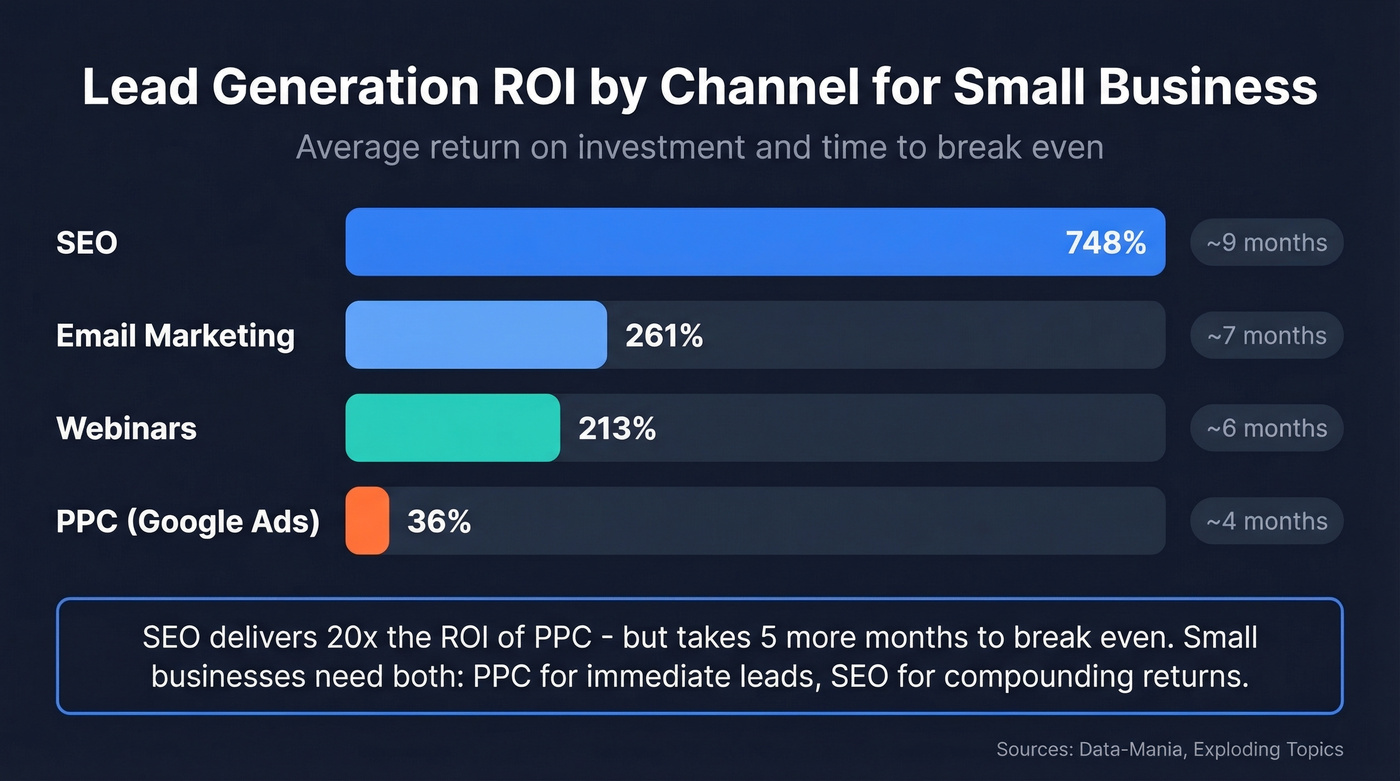
| Channel | Average ROI | Break-Even Timeline |
|---|---|---|
| SEO | 748% | ~9 months |
| Email marketing | 261% | ~7 months |
| Webinars | 213% | ~6 months |
| PPC (Google Ads) | 36% | ~4 months |
The gap between SEO and PPC is staggering. PPC gets you leads faster, but the ROI is brutal for small budgets. SEO takes nine months to break even, then it compounds - three years in, you're looking at a 9.1x return on every dollar spent.
A few more numbers worth internalizing: the average cost per lead across industries is $198, SEO leads have historically closed at around 14.6% compared to 1.7% for outbound, and responding to a lead within five minutes increases contact rates by 900%. Speed matters more than most people think.
Average landing page conversion sits at 2.35%. Top performers hit 11%+. The difference isn't magic - it's specificity, a clear offer, and a form that doesn't ask for twelve fields.
Build Your Foundation First
Here's a reframe worth stealing: unless you're getting thousands of visitors a month, your website isn't a platform. It's a landing page. Stop treating your homepage like a brochure and start treating it like a conversion machine.
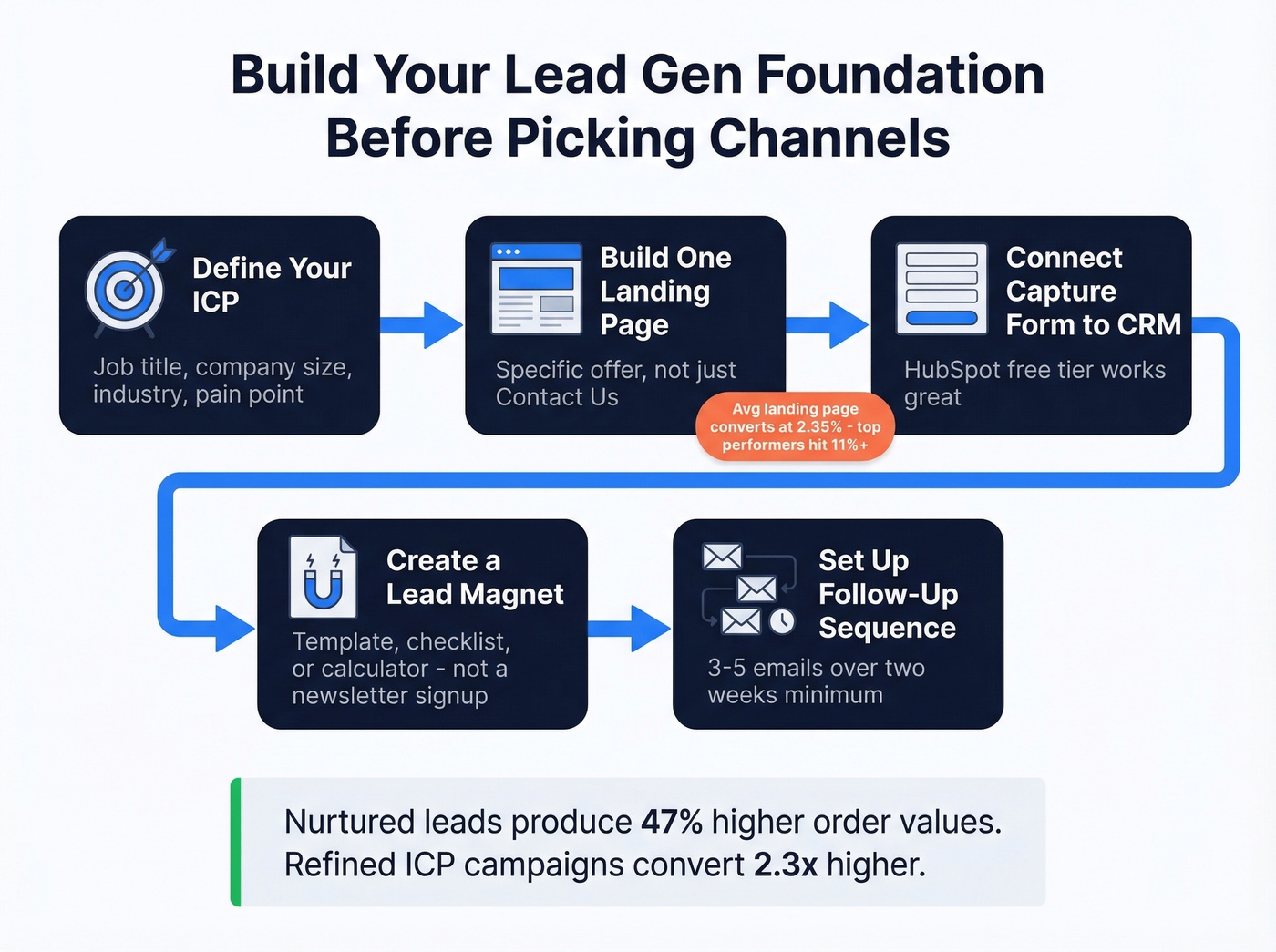
Before you pick channels or tools, nail this foundation:
- ICP definition - who exactly are you selling to? Job title, company size, industry, pain point. Write it down. Refined ICP campaigns convert 2.3x higher than campaigns built on vague targeting.
- One landing page with a specific offer (not "contact us")
- A capture form connected to a CRM
- A lead magnet worth exchanging an email for - a template, checklist, or calculator, not "subscribe to our newsletter"
- A follow-up sequence - at minimum 3-5 emails over two weeks. Nurtured leads produce 47% higher order values than leads you let go cold.
The math is simple. If your landing page converts at 5%, you need 1,000 visitors to generate 50 leads. If your close rate is 10%, that's 5 customers. Work backward from your revenue goal to figure out how much traffic you actually need.
Think in three layers. Top-of-funnel content - blog posts, social, short video - drives awareness. Mid-funnel assets - ebooks, webinars, checklists - capture contact info. Bottom-of-funnel content - case studies, free trials, consultations - converts leads to customers. You don't need all three on day one, but you need to know where each piece fits.
Strategies by Business Type
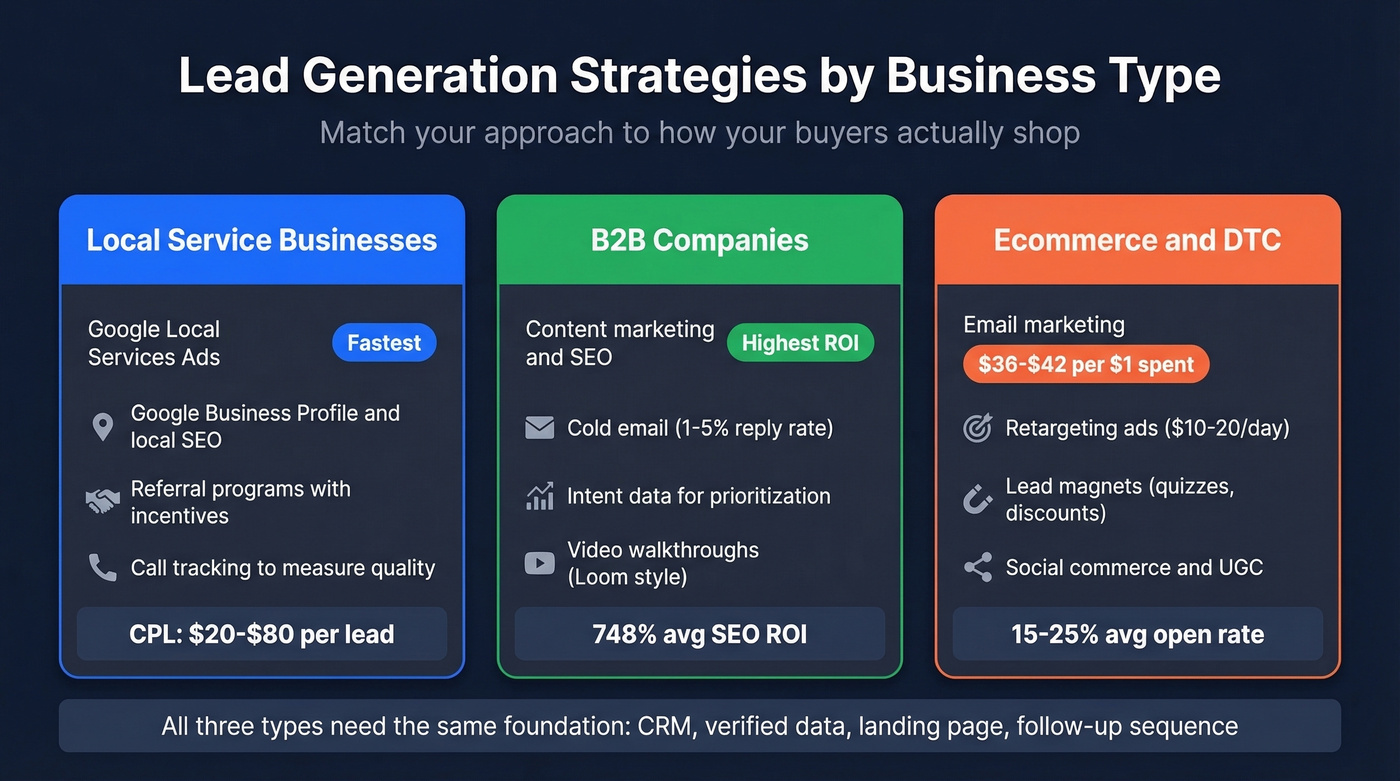
A plumber and a SaaS startup have completely different playbooks. The key is matching your approach to the way your buyers actually shop.
Local Service Businesses
Google Local Services Ads are the fastest path to leads for local businesses. They're pay-per-lead (not pay-per-click), they show above regular search ads with trust badges, and you can test them by prepaying a few hundred dollars. CPL often falls in the $20-$80 range.
The tradeoff: limited control over targeting and ad copy. Google determines your keywords automatically. Lead quality varies - some calls are tire-kickers, some are gold. Use call tracking to measure which leads actually convert, not just which ones come in.
Beyond LSAs, local SEO is non-negotiable. Claim your Google Business Profile, get reviews, and build citations. Don't underestimate referral programs either - one makeup artist we came across built roughly 80% of her client base through a simple 20% referral discount. For local service businesses, word-of-mouth is still the highest-converting channel. A structured referral incentive just makes it predictable.
B2B Companies
Content marketing and SEO are your long-term foundation. That 748% ROI doesn't happen overnight, but nothing else compounds the same way. Small businesses are 23% more likely to see ROI from blog content than enterprises - a genuine advantage of being nimble.
Here's the thing: if your average deal size is under $5K, you probably don't need a complex marketing automation stack. A CRM, a verified email source, and a 5-touch follow-up sequence will outperform a $500/month tool stack that nobody on your team actually uses.
For immediate pipeline, cold email works. Reply rates run 1-5% when done well. That's not email marketing targeting opted-in subscribers - cold email targets net-new prospects you've identified as fitting your ICP. Different purpose, different benchmarks, different compliance rules. And given that 97% of people now ignore cold calls entirely, email is the more viable outbound channel for most small teams.
Layer in intent data to prioritize prospects who are actively researching solutions like yours. B2B buyers now engage across 10 channels on average, up from 5 in 2016, so meeting them where they're already looking gives you a real edge over spray-and-pray outreach.
Video is worth considering too - 78% of B2B marketers already use it, and over half plan to increase investment. Even a simple Loom walkthrough of your product can outperform a polished PDF.
One non-negotiable before you send a single cold email: verify every address. Bounce rates above 5% trigger spam filters, and one bad send to an unverified list can tank your deliverability for months. If you want a deeper playbook, start with email deliverability basics.
Ecommerce and DTC
Email marketing is your highest-leverage channel. ROI runs $36-$42 for every $1 spent, with average open rates of 15-25%. The key is building your list through lead magnets - a first-purchase discount, a style quiz, a free shipping threshold - not buying one.
Retargeting ads bring back the 97%+ of visitors who don't convert on their first visit. Even a small retargeting budget of $10-20/day can meaningfully improve your conversion rate. Pair it with abandoned cart email sequences and you've got a lead nurturing system that recovers revenue while you sleep. Social commerce is gaining ground fast too - user-generated content and shoppable posts on Instagram and TikTok are becoming real lead drivers for DTC brands, especially those with products under $100.

You read it above: bounce rates above 5% can tank your deliverability for months. Prospeo's 5-step email verification delivers 98% accuracy at $0.01 per email - built for small teams that can't afford to burn their domain on bad data.
Verify every lead before you hit send. 75 free emails to start.
Tools You Actually Need
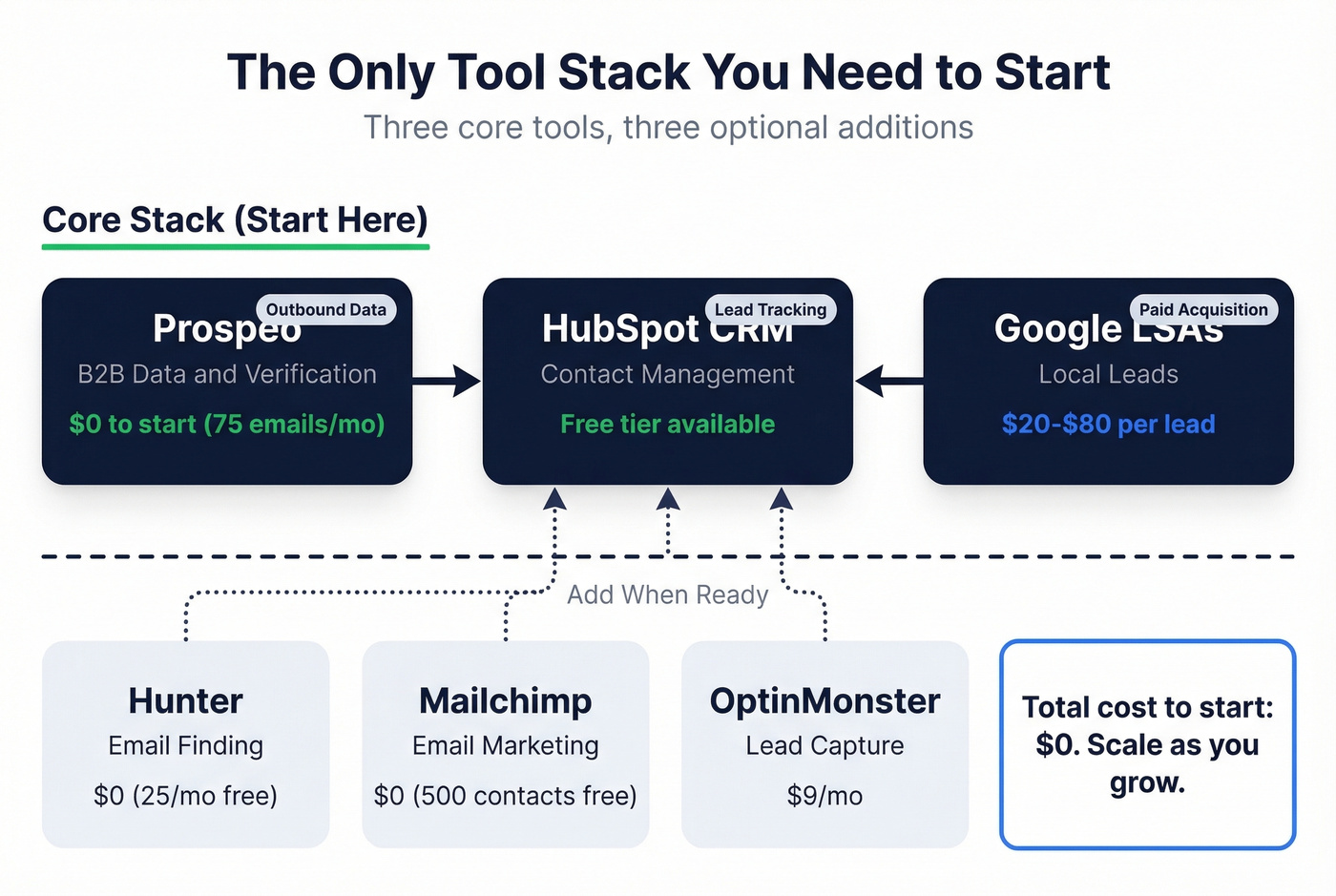
You don't need ten tools. You need the right three or four for your stage.
| Tool | Best For | Starting Price | Free Tier? |
|---|---|---|---|
| Prospeo | B2B data & verification | ~$39/mo | Yes (75 emails/mo) |
| HubSpot CRM | Contact management | $15/user/mo | Yes |
| Google LSAs | Local leads | $20-$80/lead | No |
| Hunter | Email finding | ~$49/mo | Yes (25/mo) |
| Mailchimp | Email marketing | ~$15/mo | Yes |
| OptinMonster | Lead capture | ~$9/mo | No |
Your Data Foundation
If you're doing any outbound, data quality is the whole game. In our experience, the difference between a 2% bounce rate and a 10% bounce rate isn't just deliverability - it's whether your domain survives the month. Prospeo covers 300M+ professional profiles with 98% email accuracy and a 7-day data refresh cycle, which matters when people change jobs faster than most databases can keep up.

Pricing starts free at 75 verified emails a month and scales to roughly $0.01 per email at volume. No contracts, no annual commitments. One outbound agency, Stack Optimize, built from $0 to $1M ARR using verified data and cold email alone - maintaining 94%+ deliverability and sub-3% bounce rates across every client. For a small business testing outbound for the first time, the free tier is enough to validate whether cold email works for your market before spending a dollar.
HubSpot CRM
The default CRM for small businesses, and for good reason. The free tier handles contact management, deal tracking, and basic email sequences. You'll outgrow it eventually - Starter runs $15/user/month, Professional jumps to $90/user/month - but free is the right starting point. Without a CRM, leads fall through cracks and you lose the follow-up game before it starts. If you're comparing options, start with contact management basics.
Google LSAs
Already covered above, but worth repeating: for local service businesses, LSAs are the fastest path to phone calls from people ready to buy. Budget $200-500 to test, track lead quality religiously, and scale what works.
Hunter, Mailchimp, OptinMonster
Hunter handles basic email finding if you only need occasional lookups - 25 free searches a month, paid plans from ~$49/mo. Skip it if you're doing serious outbound volume; it's better suited for one-off lookups than campaign-scale prospecting. If you're shopping around, see Hunter alternatives. Mailchimp covers email marketing with a generous free tier that works until you hit 500 contacts. OptinMonster adds pop-ups and slide-ins to capture emails on your site, starting around $9/mo. None of these are essential on day one, but they're solid additions as your system matures.
Cold email works at 1-5% reply rates - but only if your data connects you to real people. Prospeo gives small businesses the same 300M+ profile database enterprises use, with 30+ filters to nail your ICP, intent data to find in-market buyers, and zero annual contracts.
Stop paying enterprise prices for enterprise-grade lead data.
Mistakes That Kill Your Lead Gen
Buying tools before building a system. A $200/month tool stack means nothing without a landing page, a follow-up sequence, and a clear ICP. Build the system first. Buy tools to accelerate it.
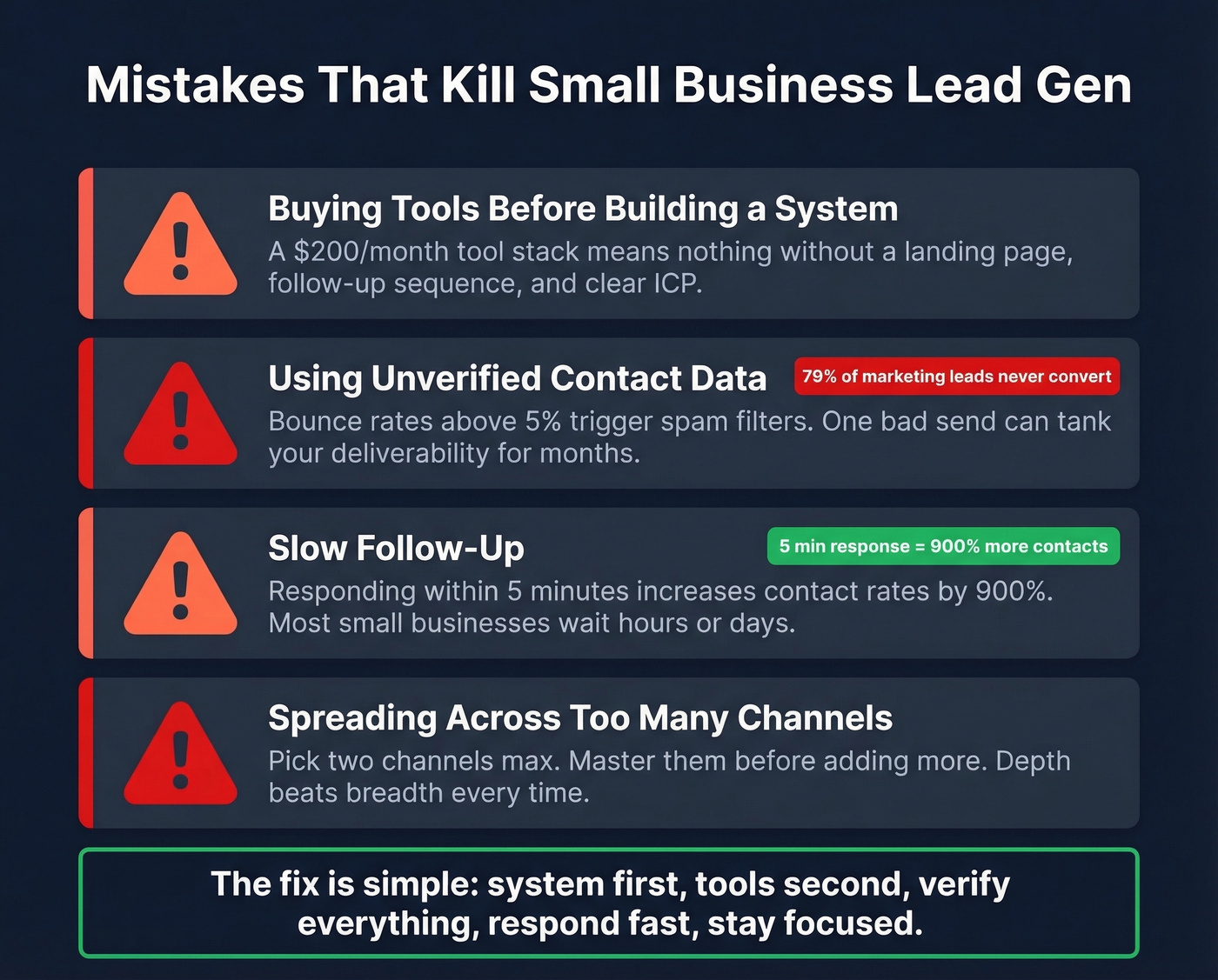
Using unverified contact data. Purchased lead lists are tempting. They're also how you destroy your email domain reputation. Bounce rates above 5% trigger spam filters. Once you're flagged, even your legitimate emails stop landing. Always verify before you send. For benchmarks and fixes, see email bounce rate. The consensus on r/sales is pretty clear: cheap data is the most expensive mistake you'll make.
Treating every lead the same. Someone who downloaded a pricing guide isn't the same as someone who read a blog post. Even basic lead scoring - assigning points for actions like visiting your pricing page or opening multiple emails - helps you focus on the leads most likely to buy. If you want a full setup, use this lead scoring guide.
Going all-in on one channel, then quitting after 30 days. 94% of successful marketers diversified their channel mix last year. Pick two channels minimum. Give each one 90 days before you judge it.
No follow-up sequence. This one drives us crazy. Responding within five minutes increases contact rates by 900%, yet most small businesses take hours or days to follow up. Automate your first response. Then build a 5-touch sequence over two weeks. The leads you already have are worth more than the leads you haven't generated yet. If you need copy you can paste, use these sales follow-up templates.
Your 30-Day Action Plan
Week 1: Define your ICP. Set up HubSpot's free CRM. Build one landing page with a specific offer and a lead magnet.
Week 2: Pick two channels. For B2B, start building a verified prospect list and draft your first 3-email cold outreach sequence. For local businesses, launch a Google LSA test with a $200-300 budget. Connect your capture form to your CRM.
Week 3: Launch. Send your first outbound campaign or activate your ads. Set up a 5-email follow-up sequence for every lead that comes in. Automate your first response so no lead waits more than five minutes.
Week 4: Measure. Track cost per lead, response rates, and conversion rates. Kill what isn't working. Double down on what is. You now have real data - not guesses - to inform month two. If you want the KPI list, track the core lead generation metrics.
Should You Outsource?
Let's be honest: 61% of outsourced lead gen partnerships fail, primarily due to misalignment on what counts as a qualified lead.
Businesses under $1M in revenue shouldn't outsource. You don't have enough data on your own conversion rates to hold an agency accountable. Run lead generation yourself for 6-12 months. Learn what works. Then outsource the channels you've validated.
When you do hire an agency, demand three things: transparency on lead sources, deliverability metrics like bounce rates and spam complaints, and attribution data that connects to actual revenue - not just meetings booked. Pipeline value matters. Meeting counts don't.
Lead Generation for Small Business FAQ
How much does lead generation cost for a small business?
The average cost per lead across industries is $198, while Google LSAs run $20-$80 per lead. SEO is cheapest long-term but takes about nine months to break even. Starting with free tools like HubSpot CRM and a free-tier data provider keeps costs near zero while you learn what converts.
What's the best channel for generating leads?
SEO delivers the highest ROI at 748% over three years. For leads this month, cold email for B2B or Google LSAs for local businesses are fastest. The strongest approach combines one long-term channel with one that delivers results immediately - diversification is why 94% of top marketers outperform single-channel competitors.
How do you build a repeatable lead gen system?
Start with a clear ICP, one landing page with a strong offer, and a CRM to track everything. Then pick two channels - SEO and cold email for B2B, or local SEO and Google LSAs for service businesses. Work backward from your revenue target to calculate the traffic and outreach volume required, then measure weekly and iterate.
What's the fastest way to get verified B2B contact data?
Use a verified database with 98%+ accuracy, search by filters like job title, industry, and company size, then export verified contacts and push them into your sequencer or CRM. Free tiers from providers like Prospeo let you validate whether outbound works for your market before committing budget.
Do small businesses need a CRM?
Yes. HubSpot's free tier handles contact management, deal tracking, and basic sequences. Without a CRM, leads slip through cracks and you can't automate follow-up - which is where most small businesses lose the most revenue. It takes five minutes to set up and costs nothing.