

How to Build a Lead Generation Plan You Can Execute Monday
Your CEO just asked for a lead generation plan by Friday. You open a blank doc, stare at it, and realize you don't actually know what goes in this thing. Most lead gen resources define the concept instead of giving you a plan. That's not helpful when you need a deliverable, not a vocabulary lesson.
Only 3-5% of your total addressable market is in-market at any given time. And 80-90% of those buyers already have a vendor shortlist before they talk to sales. Your plan isn't about capturing today's demand - it's about building enough visibility that you're on that shortlist when the other 95% finally start buying.
What You Need (Quick Version)
A lead generation plan isn't a strategy deck or a list of tactics. It's a phased execution document with five components:
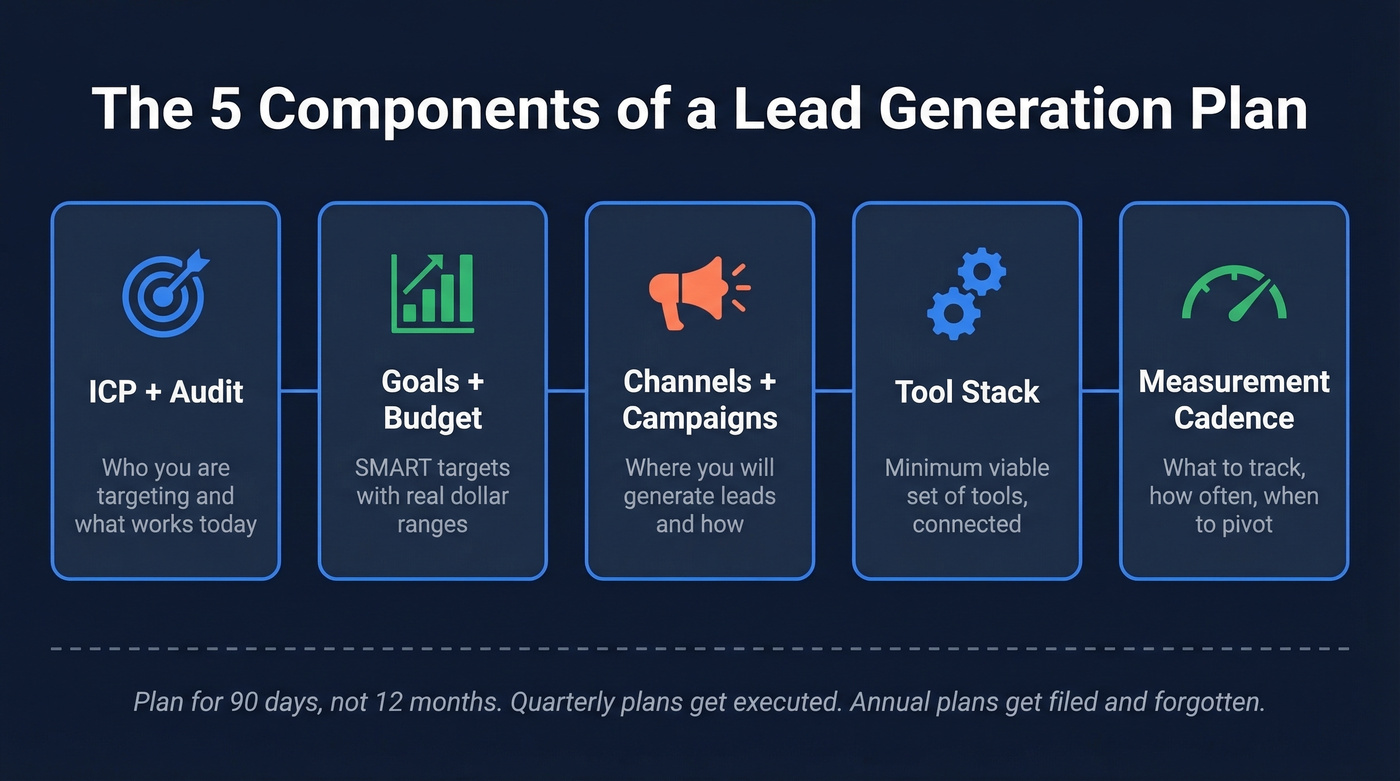
- ICP + audit - who you're targeting and what's working today
- Goals + budget - SMART targets with real dollar ranges
- Channels + campaigns - where you'll generate leads and how
- Tool stack - the minimum viable set of tools, connected
- Measurement cadence - what you'll track, how often, when to pivot
Plan for 90 days, not 12 months. Quarterly plans get executed. Annual plans get filed and forgotten.
What a Lead Gen Plan Actually Is
A strategy defines your high-level approach - inbound vs. outbound, target market, positioning. Tactics are individual moves - running ads, launching webinars, building sequences. A plan sits between them: the execution document connecting strategy to tactics with timelines, budgets, owners, and KPIs.
Think of it as your blueprint. The architectural drawing that turns abstract goals into concrete weekly actions.
The Demand Metric Lead Generation Playbook - downloaded over 9,000 times - breaks this into six stages: understand lead gen, plan your strategy, define what a "lead" is, implement technologies, run programs, evaluate ROI. Solid skeleton. But most teams skip the first two stages and jump straight to buying tools, which is exactly how you end up with a bloated MarTech stack and no pipeline to show for it.
The 95/5 rule makes this worse than it sounds. Bain's research shows that 90% of B2B buyers choose from the vendor list they had on day one of their search. If you're not visible before that search begins, your plan is fighting for scraps. You need to account for both the 5% buying now and the 95% who aren't - yet.
Phase 0 - Audit Your Foundation
Before you plan anything new, figure out what's already working. This is the step everyone skips, and it's why plans fail.
If you've ever asked yourself "why am I not generating leads," the answer almost always lives in this audit phase. One Reddit practitioner shared a 3-month action plan that mirrors this framework - audit in month 1, ABM targeting in month 2, launch in month 3. The audit isn't optional. B2B buyers consume roughly 13 pieces of content before making a purchase decision, which means your existing content library is either an asset or a liability. The audit tells you which.
Review past wins and failures. Pull your last two quarters of pipeline data. Which channels produced SQLs that actually closed? Which produced volume that went nowhere? The gap between those answers is where your plan starts.
Refresh your buyer personas. When's the last time you talked to a customer about how they found you? Personas built on assumptions decay fast. Interview 5-10 recent wins.
Audit your current tools. Gartner data shows 60% of MarTech spend is wasted due to underutilized tools. If you're paying for a tool nobody logs into, kill it. That budget funds something better.
Document your lead definitions. What's an MQL? What's an SQL? If marketing and sales give different answers, fix that before launching anything. Misaligned definitions are the root cause of most "we sent you leads" / "those weren't real leads" arguments.
Map your current funnel. Where do leads enter? Where do they stall? Where do they die? You can't improve what you haven't mapped.
Not glamorous work. But it prevents you from building on a broken foundation.
Phase 1 - Set Goals and Budget
Start with a SMART goal. Not "generate more leads" - something like "Generate 200 MQLs and 40 SQLs from mid-market SaaS companies in Q4, with a target CPL under $90 and CAC under $300."
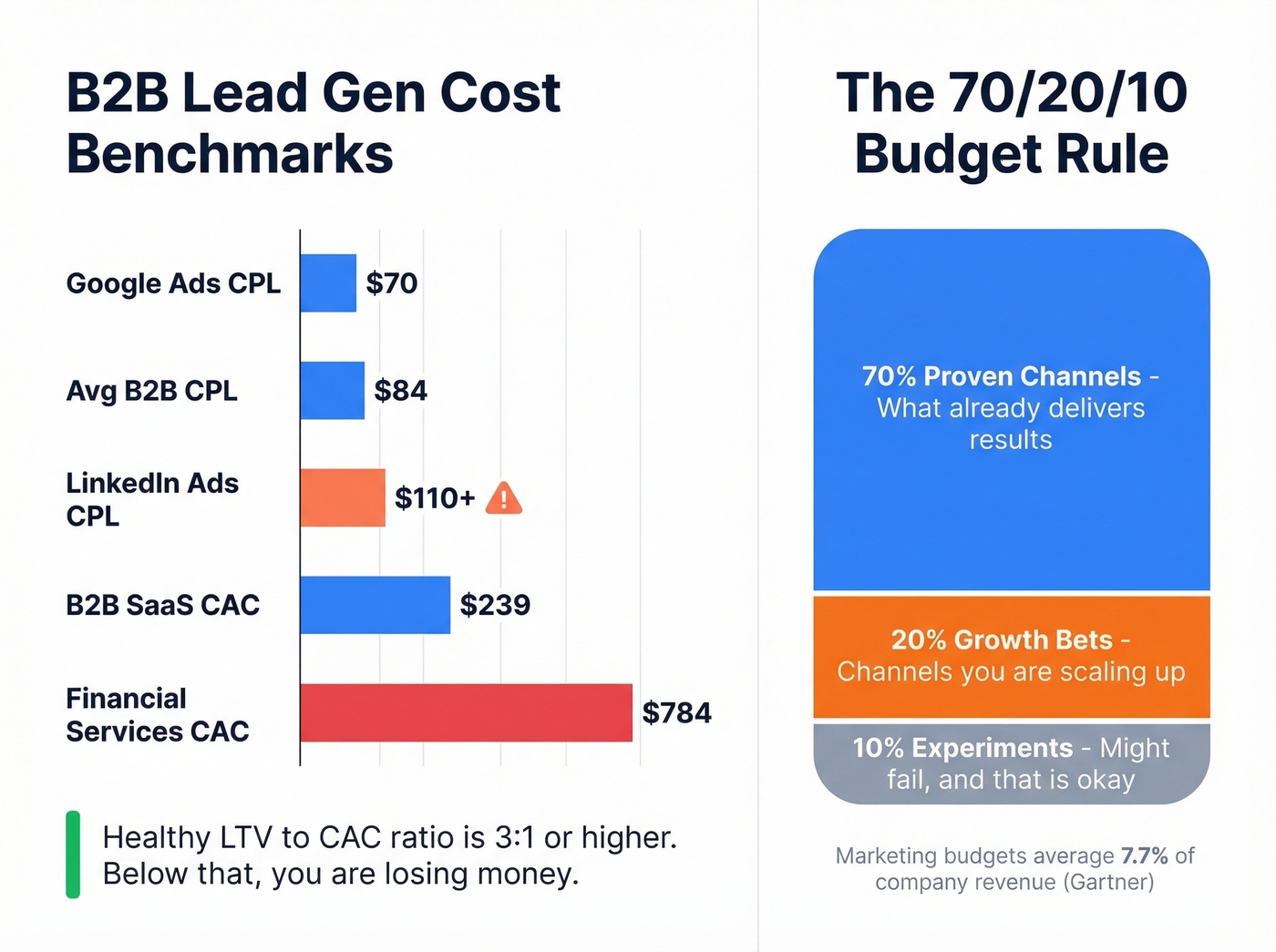
Marketing budgets average 7.7% of company revenue according to Gartner's CMO Spend Survey, and 59% of CMOs report insufficient budget to execute their strategy. That's why the 70/20/10 allocation rule matters: 70% on proven channels that already deliver, 20% on growth bets you're scaling, 10% on experiments that might fail.
For teams spending $50K+/month, consider the brand vs. performance split. Google and WARC research recommends 50-60% brand / 40-50% performance, since performance marketing shows diminishing returns past a certain threshold.
| Metric | Benchmark | Source |
|---|---|---|
| Marketing budget | 7.7% of revenue | Gartner |
| Avg B2B CPL | $84 | Flywheel |
| Google Ads CPL | $70.11 | Flywheel |
| LinkedIn Ads CPL | $110+ | Flywheel |
| B2B SaaS CAC | $239 | HubSpot |
| Financial Svcs CAC | $784 | HubSpot |
| Healthy LTV:CAC | 3:1 or higher | Industry standard |
LinkedIn runs about 57% more expensive per lead than Google Search. That doesn't mean it's worse - LinkedIn often delivers higher-intent leads for B2B - but your budget needs to account for the delta. If your LTV:CAC ratio drops below 3:1, you're spending more to acquire customers than they're worth. That's the number to watch.
Phase 2 - Pick Your Channels
Not all channels convert at the same rate or speed:
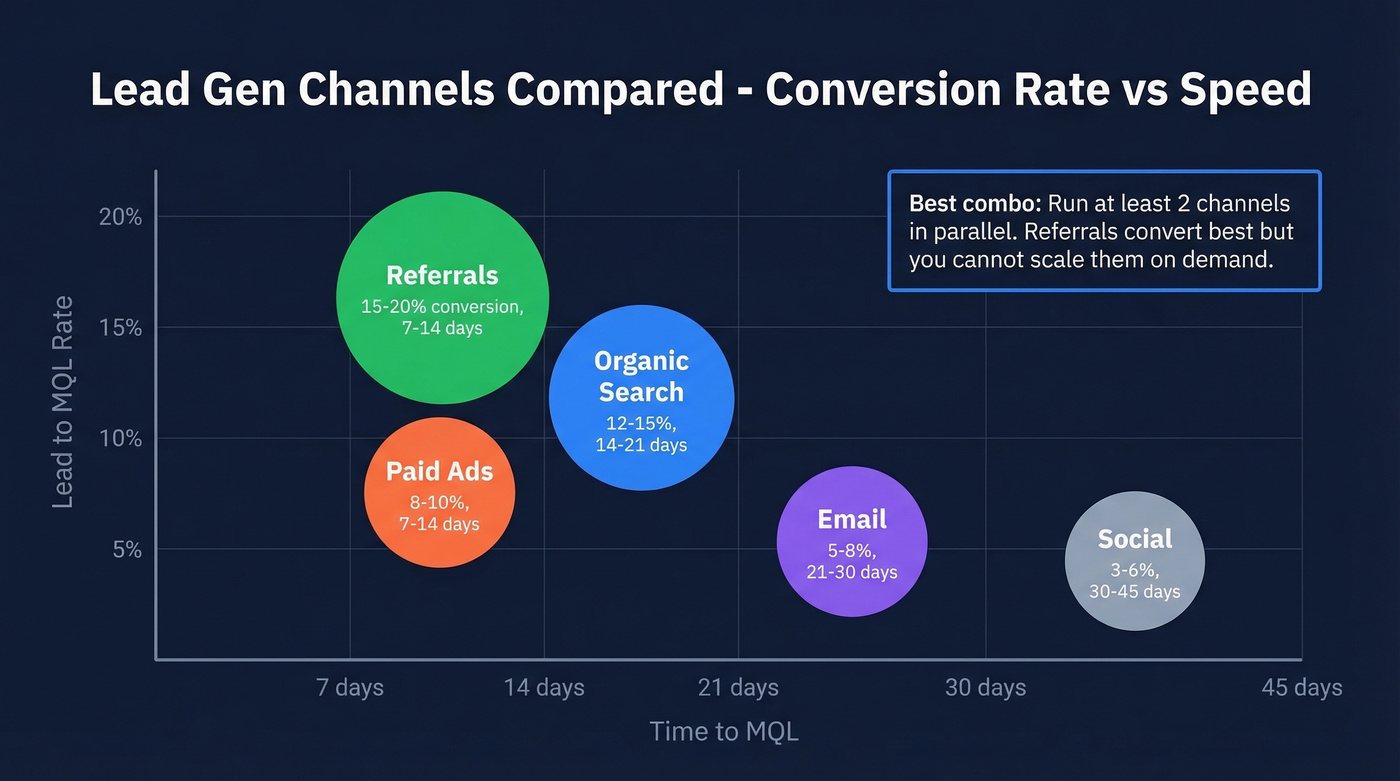
| Channel | Lead-to-MQL Rate | Time to MQL |
|---|---|---|
| Referrals | 15-20% | 7-14 days |
| Organic search | 12-15% | 14-21 days |
| Paid ads | 8-10% | 7-14 days |
| 5-8% | 21-30 days | |
| Social | 3-6% | 30-45 days |
Here's the thing: referrals convert best and fastest, but you can't build a plan around hoping for referrals. Organic search compounds over time but takes months. Paid gets you leads this week but costs real money. Most teams need at least two channels running in parallel, with a clear framework defining how those channels support each other rather than operating in silos.
Well-optimized landing pages convert at 20-25%. If you're driving paid traffic to a generic page, you're burning budget. Fix the landing page before you scale the ad spend.

Outbound prospecting deserves extra attention because it's the channel most teams underinvest in or execute poorly. The failure mode is almost always data quality. You build a list, load it into your sequencer, and a chunk of emails bounce on the first send. Your sender reputation tanks, deliverability drops, and the channel looks broken - when really, the data was broken. We've tested dozens of outbound sequences, and data quality is the variable that matters most. If you want a tighter outbound motion, borrow a few sales prospecting techniques that still work at scale.

Your lead generation plan needs a data foundation that won't tank your sender reputation on day one. Prospeo delivers 98% email accuracy through 5-step verification - with catch-all handling, spam-trap removal, and honeypot filtering. That's how teams like Snyk cut bounce rates from 35% to under 5% and generated 200+ opportunities per month.
Stop planning around bad data. Start with emails that actually land.
Phase 3 - Build Your Tool Stack
The Zapier philosophy is right: build a stack, not a suite. You don't need one platform that does everything poorly. You need focused tools that connect cleanly. If you're evaluating vendors, start with a shortlist of SDR tools that cover the basics.
Before buying any data supplier, ask two questions: where is the data sourced, and is fulfillment handled in-house or outsourced? If a vendor can't answer both clearly, walk away.
You need five tool categories:
CRM is your foundation. HubSpot's free tier handles contact management and basic pipeline tracking for most teams under 10 reps. Salesforce if you're bigger or need custom objects. If you’re still deciding, compare a few examples of a CRM to match your workflow.
Prospecting and enrichment is where most plans succeed or fail. Prospeo's B2B database gives you 300M+ professional profiles with 143M+ verified emails and 125M+ verified mobile numbers - all on a 7-day refresh cycle versus the 6-week industry average. Pricing is transparent at roughly $0.01/email with no contracts, and the free tier includes 75 emails/month. It integrates natively with HubSpot, Salesforce, Instantly, Lemlist, and Zapier.
The downstream impact of verified data is real. Meritt, one of Prospeo's customers, tripled their pipeline from $100K to $300K per week after switching their data source. Their bounce rate dropped from 35% to under 4%. If you’re comparing providers, use this data enrichment services list as a starting point.
For email automation, the choice depends on your use case. Cold outbound? Tools like Instantly or Lemlist. Marketing nurture? HubSpot Marketing Hub or ActiveCampaign. Don't use the same tool for both - cold outbound and marketing email have different deliverability requirements. If you need structure, build a repeatable B2B cold email sequence before you touch volume.
Landing pages and analytics round out the stack. Unbounce if you want dedicated landing page optimization, or just use HubSpot's built-in pages if you're already in their ecosystem. GA4 for analytics and attribution until you're ready for heavier-weight tooling.
Remember that 60% MarTech waste stat. Before adding any tool, ask: who will use this daily? If the answer is "nobody yet," don't buy it.
You just read that 60% of MarTech spend is wasted on underutilized tools. Prospeo replaces your bloated stack - database, email finder, mobile finder, enrichment, and intent data in one platform. At $0.01 per email with no contracts, your 70/20/10 budget allocation goes further from week one.
Cut the stack bloat. One platform, 300M+ verified profiles, transparent pricing.
Phase 4 - The 90-Day Execution Timeline
A 12-month plan is fiction. Markets shift, budgets change, campaigns underperform. Plan in 90-day sprints and iterate.
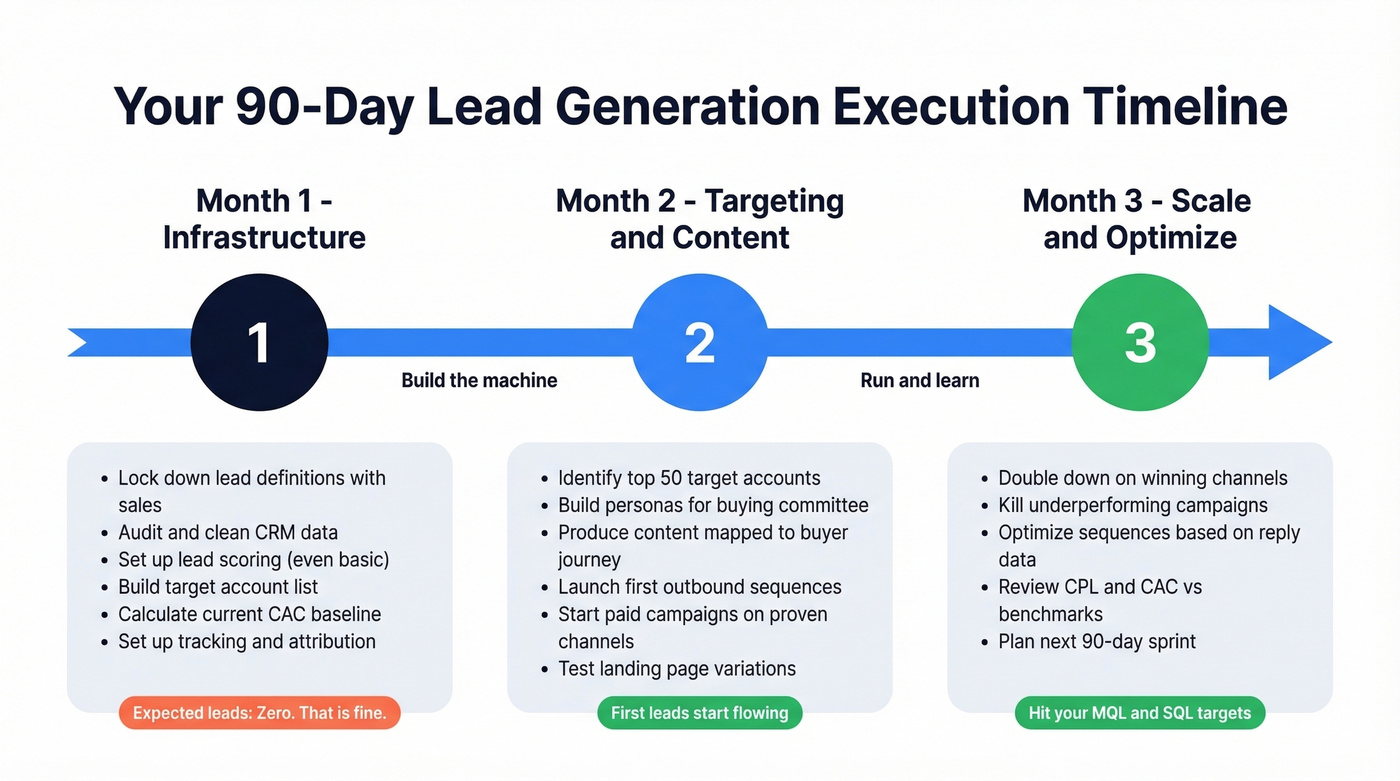
Month 1 - Infrastructure
Lock down lead definitions with sales. Agree on what constitutes an MQL, an SQL, and a disqualified lead. Set up lead scoring in your CRM - even a simple point-based system beats no scoring. (If you need a framework, this lead scoring guide is a solid baseline.)
Audit your existing data. Clean your CRM of duplicates and dead contacts. Set up tracking and attribution. Build your target account list if you're running ABM. Calculate your current CAC so you have a baseline.
This month produces zero leads. That's fine. You're building the infrastructure that makes months 2 and 3 work.
Month 2 - Targeting and Content
Identify your top 50 target accounts. Build detailed personas for each buying committee role. Start producing content mapped to the buyer journey - remember, buyers consume roughly 13 pieces of content before purchasing, so you need material for every stage.
Launch nurture sequences. A solid cadence hits Day 0 (immediate value), Day 3 (case study), Day 8 (deeper educational content), and Day 15 (soft CTA or meeting request). Build outbound prospect lists with verified data. Start warming sending domains if you're doing cold email. If you’re stuck on messaging, keep a few sales follow-up templates handy.
Month 3 - Launch and Optimize
Go live on your primary channels. Run outbound sequences. Launch paid campaigns. Activate ABM plays.
Track weekly: open rates, reply rates, MQL volume, CPL by channel. By week 3, you should have enough data to kill underperforming campaigns and double down on what's working. Don't wait until the end of the quarter to make calls - in our experience, the teams that review weekly outperform the ones that review monthly by a wide margin.
Phase 5 - Measure and Iterate
The average qualified-lead conversion rate is 2.9% across 14 industries, based on 100M+ data points. That's your baseline reality check. If you're converting at 1%, something's broken. At 5%, you're outperforming most of the market. (You can sanity-check your numbers against this average B2B lead conversion rate benchmark breakdown.)
Track these funnel benchmarks monthly:
- MQL-to-SQL rate: 13-27% is the normal range
- Deal win rate: 15-50% depending on your market
- Speed to lead: responding within 5 minutes increases conversions by up to 21x. This is the single highest-leverage metric most teams ignore - and the cheapest to fix.
- CPL and CAC by channel: compare against the benchmarks in Phase 1
Run monthly reviews. Refresh the full plan quarterly. We've seen teams build beautiful annual plans that are irrelevant by March because they never built in a review cadence. Stop planning for 12 months. Plan for 90 days, measure, adjust, repeat.
Common Pitfalls That Kill Execution
Most plans don't fail at the strategy level. They fail in execution - specifically in the handoffs and systems after a lead is captured.
Misaligned marketing-to-sales handoffs. Marketing says they delivered 500 MQLs. Sales says they were garbage. The root cause is almost always a missing shared definition of "qualified." Fix this in Month 1 or nothing else matters.
Low-quality lead sources that inflate volume. Cheap content syndication can generate thousands of "leads" that never convert. The warning sign: rising MQL volume while SQL count falls. One Reddit thread put it bluntly - "we generated 3,000 leads last quarter and closed zero. The leads were junk." If that sounds familiar, skip the volume plays and invest in fewer, better-qualified leads instead.
Fragmented data and broken attribution. Your CRM, marketing automation, and intent tools aren't connected. You can't trace a closed deal back to the campaign that sourced it. Without attribution, you're optimizing blind. If you want a clean way to diagnose leaks, use a simple lead generation workflow to map handoffs.
Slow lead activation. Manual lead routing adds hours or days between form fill and first contact. Every hour of delay kills conversion rates. Automate routing or accept the revenue loss.
Generic nurture sequences. "Hi {first_name}, just checking in" isn't nurture. It's noise. Segment by persona, stage, and behavior - or don't bother sending it.
Let's be honest: if your average deal size is under $10K, you probably don't need a complex multi-tool stack. A CRM, a verified data source, and a sequencer will outperform a bloated 8-tool setup that nobody fully uses. Complexity is the enemy of execution.
A Copyable Template
Drop this into a spreadsheet and start filling it in:
| Focus Area | Objective | Actions | KPIs | Owner / Timeline |
|---|---|---|---|---|
| Lead Gen | 200 MQLs, organic + paid, Q4 | SEO, Google Ads, outbound | MQLs, CPL, traffic | Mktg Lead / Mo 1-3 |
| Nurturing | 30% MQL-to-SQL rate | Email nurture, retargeting | MQL-to-SQL %, engagement | Demand Gen / Mo 2-3 |
| Conversion | 40 SQLs at $15K avg | Sales enablement, demos | SQLs, win rate, ACV | Sales Lead / Mo 3+ |
Fill in your own numbers. The structure matters more than the specific examples - having owners, timelines, and measurable KPIs for each focus area is what separates a lead generation plan from a wish list. Customize the rows to match your actual channels and team capacity, then revisit at the end of each 90-day sprint.
FAQ
What's the difference between a plan and a strategy?
A strategy defines your high-level approach - target market, positioning, inbound vs. outbound. A plan is the execution document with specific channels, budgets, timelines, owners, and KPIs. The strategy informs the plan; the plan makes the strategy actionable on a weekly basis.
How much should I budget for lead generation?
Marketing budgets average 7.7% of revenue. Expect $70-110 per lead on paid digital channels. Apply the 70/20/10 rule: 70% to proven channels, 20% to scaling bets, 10% to experiments.
How long before a plan produces pipeline?
Paid channels deliver leads within days. Organic search takes 3-6 months to compound. A well-executed 90-day plan shows measurable pipeline impact by month 3 - calibrate against the 2.9% average conversion rate as your baseline.
What's a good free tool for outbound data?
Prospeo's free tier includes 75 verified emails per month plus 100 Chrome extension credits - enough to test outbound sequences before committing budget. For teams running real campaigns, 98% accuracy prevents the bounce-rate damage that kills outbound channels early.