

What Is a Lead Generator? Definition, Types, and How It Works
Most definitions of "lead generator" actually define "lead generation." That's not the same thing. A lead generator is a noun - a person, a tool, or a system - not the activity itself.
Here's the definition most articles get wrong, and the one that actually matters.
Quick version: A lead generator is any person, platform, or process that identifies and qualifies potential customers for a sales team. The term covers three things: people (SDRs, agencies), software (email finders, CRMs), and systems (documented workflows with scoring and handoff rules).
What Is a Lead Generator?
A lead generator is the entity that does the work of finding buyers. It's the SDR cold-calling a prospect list. It's the software platform pulling verified emails from a database. It's the documented system that routes a webinar attendee from marketing to sales with a qualification score attached.
The distinction matters because "lead generation" describes the activity - the process of attracting and converting interest. A lead generator is the thing performing that activity. Think of it like "driver" vs. "driving." You can optimize driving all day, but if the driver is bad, nothing improves. As one r/sales poster put it, leads "already exist" - the real work is finding and qualifying them, not pretending you created them out of thin air.
This isn't just marketing jargon, either. The [CFPB formally discusses lead generators](https://www.consumerfinance.gov/compliance/circulars/consumer-financial-protection-circular-2024-01-preferencing-and-steering-practices-by-digital-intermediaries-for-consumer-financial-products-or-services/) in financial services as entities that sell information about prospective customers to lenders - a regulated business model with real compliance implications.
Why Lead Generators Matter
The global lead generation market is projected to hit $295B by 2027. Roughly 59% of companies outsource some part of their prospecting, which means most businesses are already paying for lead generators. They just don't call them that.
Here's the uncomfortable stat: 79% of leads never convert to a sale. That's not a generation problem. That's a qualification problem. Your lead generator - whether it's a person, a tool, or a process - is only as good as the quality of what it produces.
The biggest lie in lead generation is that more leads equals more revenue. It doesn't. Better data on fewer leads does. If your average deal size sits below $10K, you almost certainly don't need a $40K/year data platform - but you absolutely need accurate contact data.
Three Types of Lead Generators
People: SDRs, Specialists, and Agencies
The oldest form is a human being with a phone and a list. SDRs and BDRs research target accounts, run outreach sequences, qualify responses against criteria like BANT, and hand off warm opportunities to account executives.
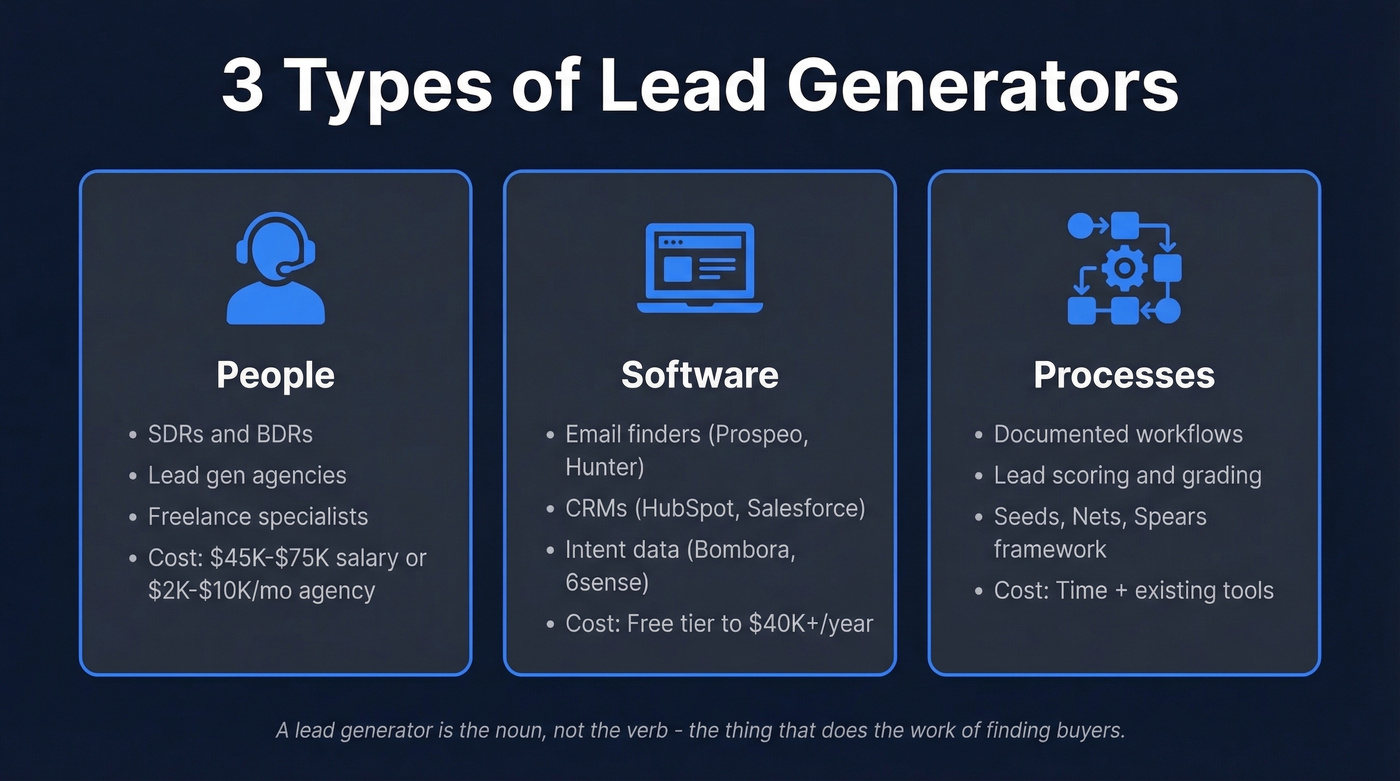
In-house, expect to pay $45K-$75K base salary for a US-based SDR, plus tools, management overhead, and ramp time. Outsourced lead gen agencies run $2K-$10K+/month depending on scope and target market. The agency model works when you need speed or lack internal headcount, but you lose control over messaging and qualification standards.
One pattern we see repeatedly: teams outsource lead gen to save money, then spend months cleaning up poorly qualified leads that waste AE time. The cheapest option rarely stays cheap.
Software: Platforms and Tools
Software-based lead generators span several categories. CRMs like HubSpot and Salesforce handle pipeline management. Email finders like Prospeo and Hunter surface verified contact data. Marketing automation platforms like Marketo and Pardot nurture leads through sequences. Intent data providers like Bombora and 6sense flag in-market buyers.
Pricing ranges from free tiers for basic CRMs to $15K-$40K+/year for enterprise intent data platforms. The critical variable across all of them is data accuracy - and we've learned this the hard way over years of testing. A tool that returns 100,000 contacts with 70% email validity will damage your sender reputation faster than one that returns 20,000 contacts at 98% accuracy. The volume game is tempting. It's also a trap.
Processes: Systems and Workflows
A lead generator can also be a documented system - the workflow that moves a stranger from first touch to closed deal. Aaron Ross's Seeds/Nets/Spears framework from Predictable Revenue breaks this into three channels: Seeds (referrals and word-of-mouth), Nets (inbound via content and SEO), and Spears (outbound prospecting).
The full workflow runs: attract, capture, score, route, nurture, convert. At the scoring stage, you're applying two complementary systems. Lead scoring assigns points based on behavior - webinar attendance, pricing page visits, content downloads. Lead grading evaluates fit against your ICP using criteria like industry, company size, title, and budget authority.
Salesforce's lead generation guide lays out BANT (Budget, Authority, Need, Timing) as a widely used qualification framework. A process-based lead generator without scoring is just a funnel with no filter. You'll generate volume, but you won't generate revenue.

You just read that 79% of leads never convert - and that stale data is one of the biggest reasons why. Prospeo refreshes every record on a 7-day cycle (not the 6-week industry average), verifies emails through a 5-step process, and delivers 98% accuracy. That's the difference between a lead generator that wastes AE time and one that books meetings.
Stop feeding your pipeline bad data. Start with 75 free verified emails.
Lead Generator Benchmarks
Numbers give you a baseline. Without them, you're guessing.
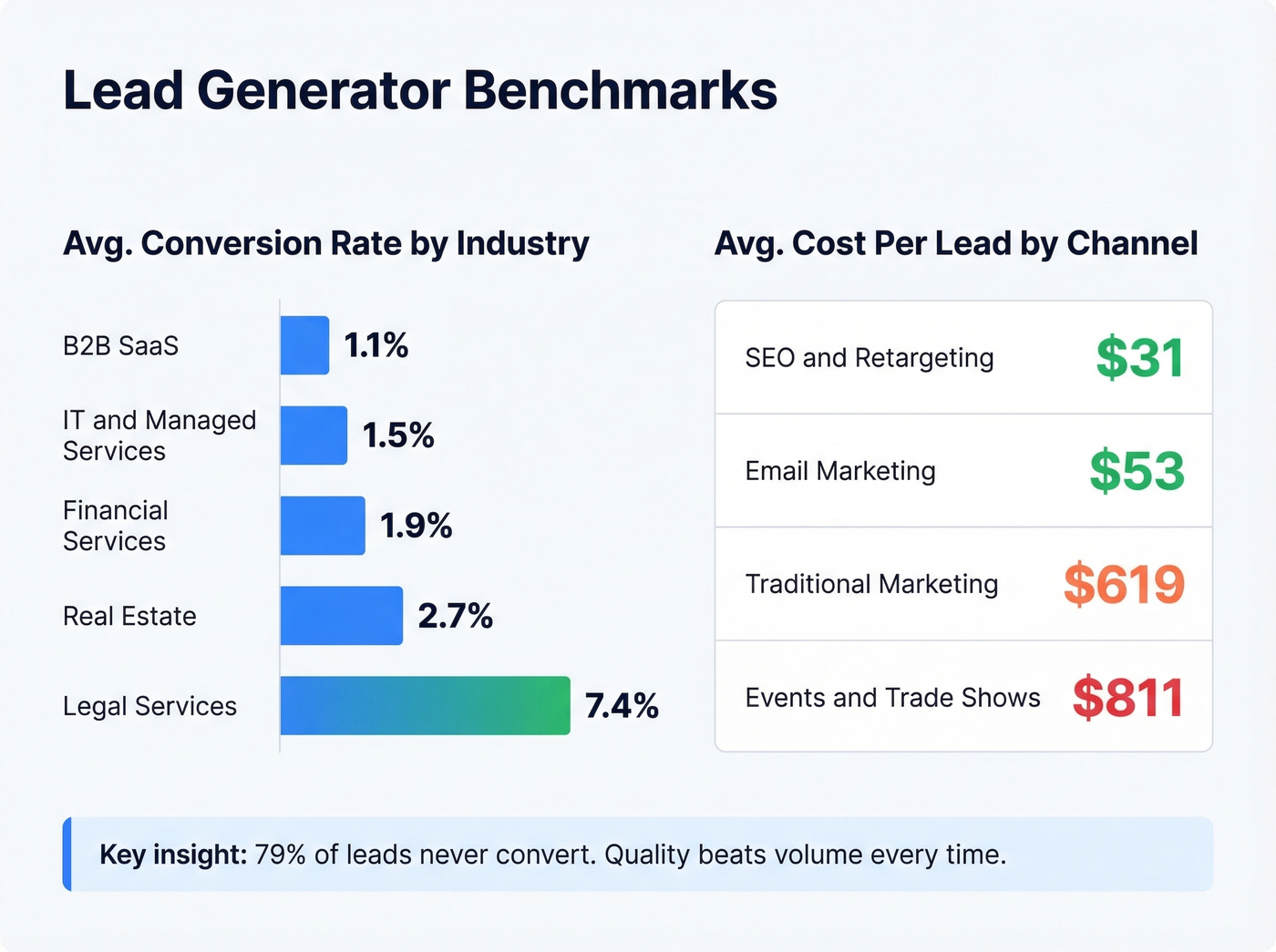
Conversion rates by industry (First Page Sage, 2022-2026 data):
| Industry | Avg. Conversion Rate |
|---|---|
| B2B SaaS | 1.1% |
| IT & Managed Services | 1.5% |
| Financial Services | 1.9% |
| Real Estate | 2.7% |
| Legal Services | 7.4% |
Cost per lead by channel (EmailToolTester, 2026):
| Channel | Avg. CPL |
|---|---|
| SEO / Retargeting | $31 |
| Email Marketing | $53 |
| Traditional Marketing | $619 |
| Events / Trade Shows | $811 |
Cost per lead by industry:
| Industry | Avg. CPL |
|---|---|
| eCommerce | $91 |
| B2B SaaS | $237 |
| Legal Services | $649 |
| Financial Services | $653 |
| Higher Education | $982 |
For MQL-to-SQL conversion, typical B2B ranges land between 15-25%. In our experience, teams below 15% are almost always running without a scoring model. Above 25% usually means either an extremely tight ICP or a qualification bar set too low. (If you want more context, see average B2B lead conversion rate.)
Common Mistakes
Let's be honest - most lead generator failures aren't mysterious. They're predictable.
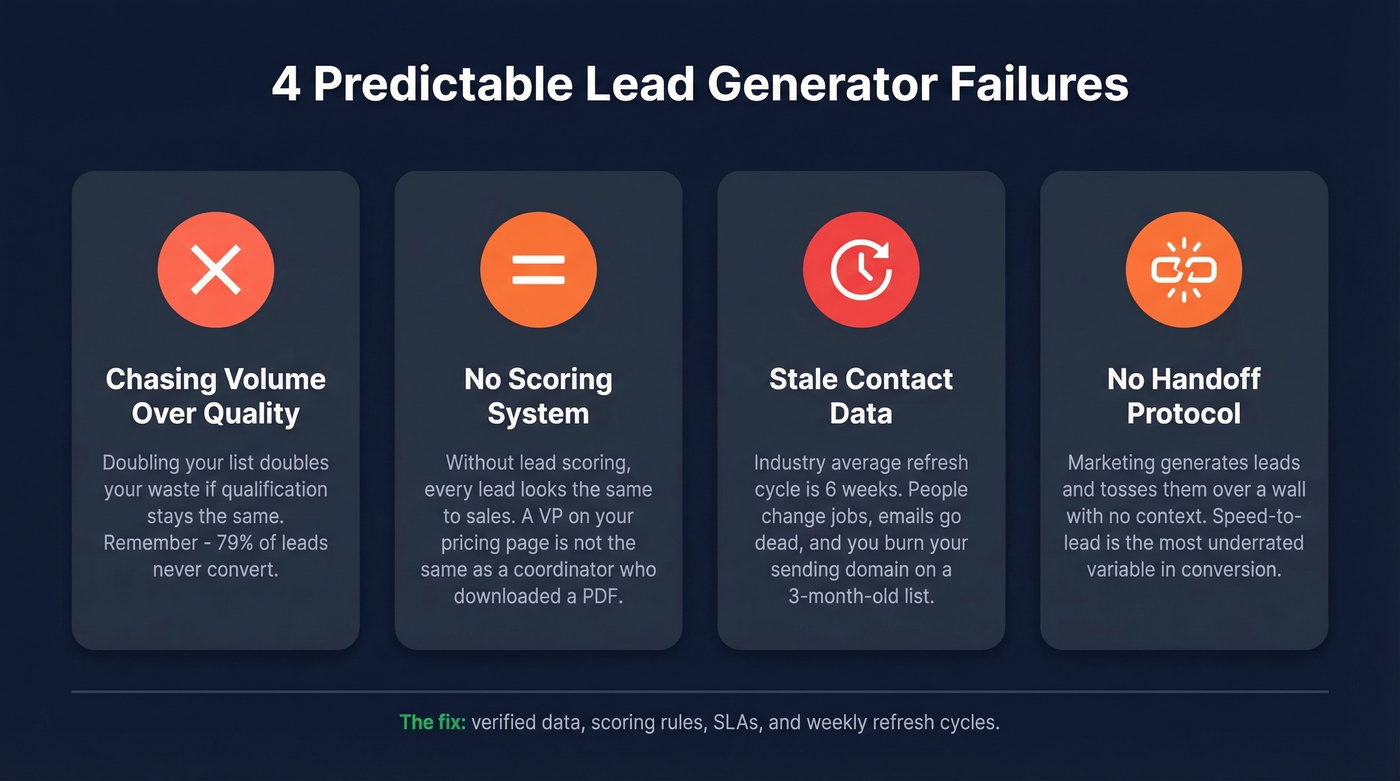
Chasing volume over quality. Remember the 79% stat. Doubling your list doubles your waste if qualification doesn't improve.
No scoring system. Without lead scoring and grading, every lead looks the same to sales. A VP who visited your pricing page three times is not the same as a coordinator who downloaded a whitepaper. Your AEs know this. Your process should too.
Stale contact data. The industry average data refresh cycle is six weeks. In that time, people change jobs, companies get acquired, and emails go dead. We've seen teams burn entire sending domains because they ran a campaign on a list that was three months old. Weekly refresh cycles close that gap and keep deliverability above 95%. (If you’re troubleshooting bounces, start with email bounce rate and email deliverability.)
No handoff protocol. If marketing generates leads and tosses them over a wall with no context or SLA on follow-up speed, you've built a lead generator with no transmission. The consensus on r/sales is that speed-to-lead is the single most underrated variable in conversion - and most teams don't even measure it. (A simple fix is standardizing your sales follow-up.)
Software Worth Evaluating
You don't need ten lead gen tools. You need three things working together: a verified contact database, a CRM, and an email sequencer. Start there. Skip anything that tries to be all three unless your team is 50+ reps.
For the contact database layer, Prospeo is the strongest option for teams that prioritize data accuracy over feature bloat. The platform covers 300M+ professional profiles with 143M+ verified emails, 98% email accuracy, 125M+ verified mobile numbers, and a 7-day data refresh cycle. You get 30+ search filters - buyer intent, technographics, headcount growth, funding signals - and real-time verification on every export. The Chrome extension has 40K+ users and works on any website or CRM. Pricing starts free at 75 emails/month, with paid plans at roughly $0.01 per email and no contracts.

For CRM, HubSpot's free tier handles most early-stage needs. Salesforce plans start around $25/user/month for entry-level tiers. For sequencing, Instantly and Lemlist typically cost $50-$100+/month depending on plan. We've tested dozens of contact databases over the years - data accuracy is the single variable that separates tools that work from tools that waste your time. (If you’re building a stack, compare outbound lead generation tools and SDR tools.)
The article makes it clear: a software-based lead generator lives or dies on data accuracy. Prospeo gives you 300M+ profiles, 30+ search filters including buyer intent and technographics, and verified contact data at $0.01 per email - 90% cheaper than ZoomInfo. No contracts, no sales calls, no stale records.
Build your lead generator on data that actually connects you to buyers.
Lead Generator vs. Lead Generation vs. Demand Generation
| Term | What It Is | Example |
|---|---|---|
| Lead generator | The noun: a person, tool, or system | An SDR, an email finder, a scoring workflow |
| Lead generation | The activity/process | Running outbound sequences |
| Demand generation | Broader market awareness | Brand campaigns, thought leadership |
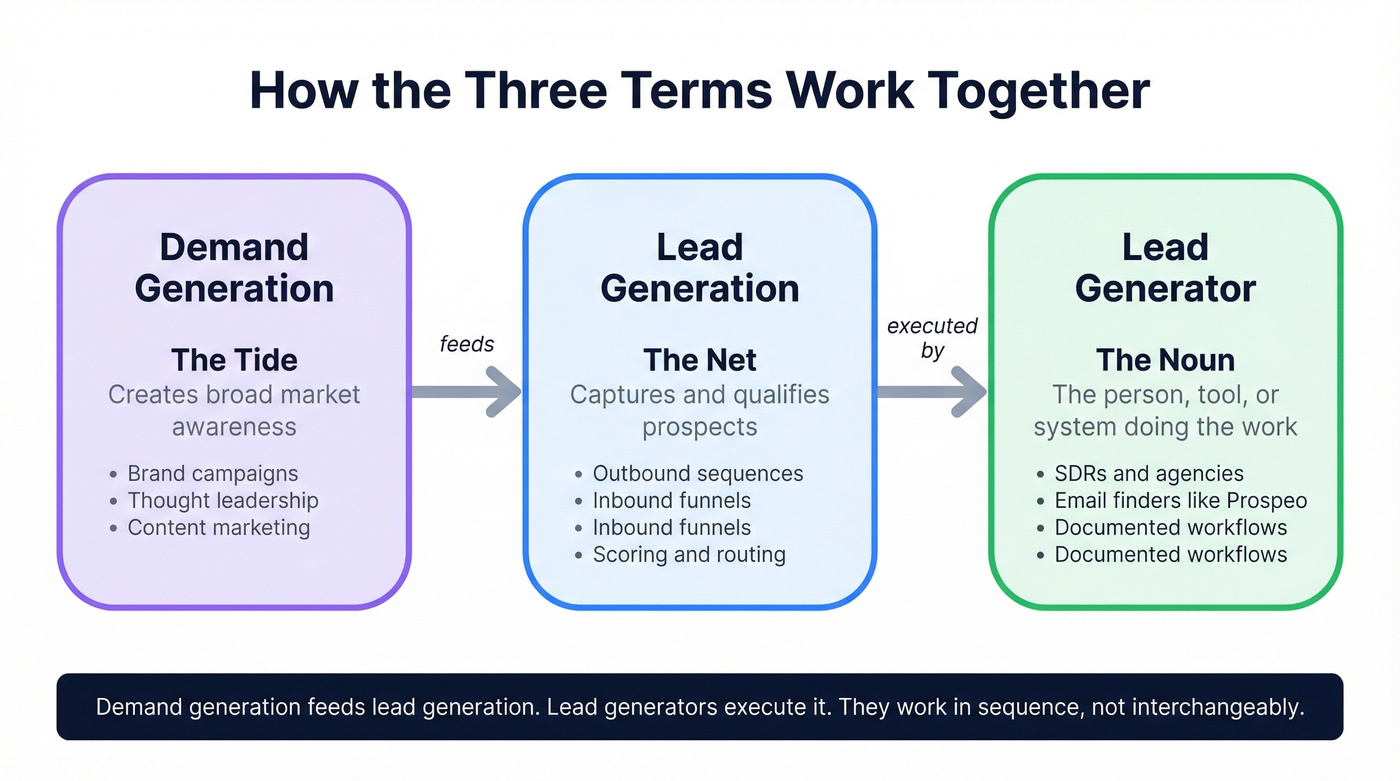
Demand generation feeds lead generation. Lead generators execute it. The three work in sequence, not interchangeably. Understanding the lead generator definition - the noun, not the verb - is the first step toward building a pipeline that actually converts. (For a practical system view, see lead generation workflow.)
FAQ
What does a lead generator do?
A lead generator identifies, attracts, and qualifies potential customers for a sales team. It can be a person (SDR or agency), a software platform (email finder, CRM), or a documented system with scoring and routing rules. The output is a qualified prospect ready for a sales conversation.
Is lead generation the same as demand generation?
No. Demand generation creates broad market awareness through brand campaigns and thought leadership. Lead generation captures specific prospects from that awareness and qualifies them against your ICP. Demand gen is the tide; lead gen is the net.
How much does a lead generator cost?
Software ranges from free tiers to $40K+/year for enterprise intent data platforms. Outsourced agencies charge $2K-$10K+/month. An in-house SDR costs $45K-$75K/year base before tools and overhead.
What's a good cost per lead?
B2B SaaS averages $237/lead, financial services $653, and eCommerce $91. SEO and retargeting are the cheapest channels at roughly $31/lead. If your CPL exceeds 5% of your average deal value, your acquisition economics likely need work.
How do I verify leads from a lead generator?
Use a platform with real-time email verification built in - look for catch-all handling, spam-trap removal, and honeypot filtering. These prevent bounced emails from destroying your sender reputation.