

Lead Intelligence: What It Is, Why It Matters, and How to Use It
B2B buyers spend just 17% of their purchase journey talking to sales reps. The rest goes to independent research, internal consensus-building, and evaluating competitors you'll never hear from. If your team doesn't know who's in-market, what they care about, and when they're ready, you're showing up late to a conversation that's already half over.
71% of buyers expect personalized interactions, and 76% get frustrated when they don't get them. Generic outreach doesn't just underperform - it actively damages your brand.
What You Need (Quick Version)
The discipline breaks into five types: tracking, intent, enrichment, predictive scoring, and verification. You don't need all five on day one. If you're building from scratch on a budget, grab two tools:
- One for outreach - Instantly or Smartlead from ~$30/mo
That's a functional outbound engine for under $50/month. Scale from there as pipeline demands it.
What Is Lead Intelligence?
Lead intelligence is the disciplined capture and analysis of contact, firmographic, and behavioral data about potential buyers. It tells you who a prospect is, what they need, and when they're ready to engage. Any serious B2B intelligence effort answers those three questions using layered data rather than gut instinct.
Don't confuse it with raw lead generation. Lead gen fills the top of your funnel - ads, content, events, cold lists. Intelligence qualifies that funnel.
It's the difference between "here are 5,000 names" and "here are 200 decision-makers at companies actively researching your category, with verified contact info and engagement signals." Your reps spend less time guessing and more time talking to people who might actually buy. That shift from volume to precision is what separates a proper intelligence platform from a basic list-building tool.
Five Types of Buyer Intelligence
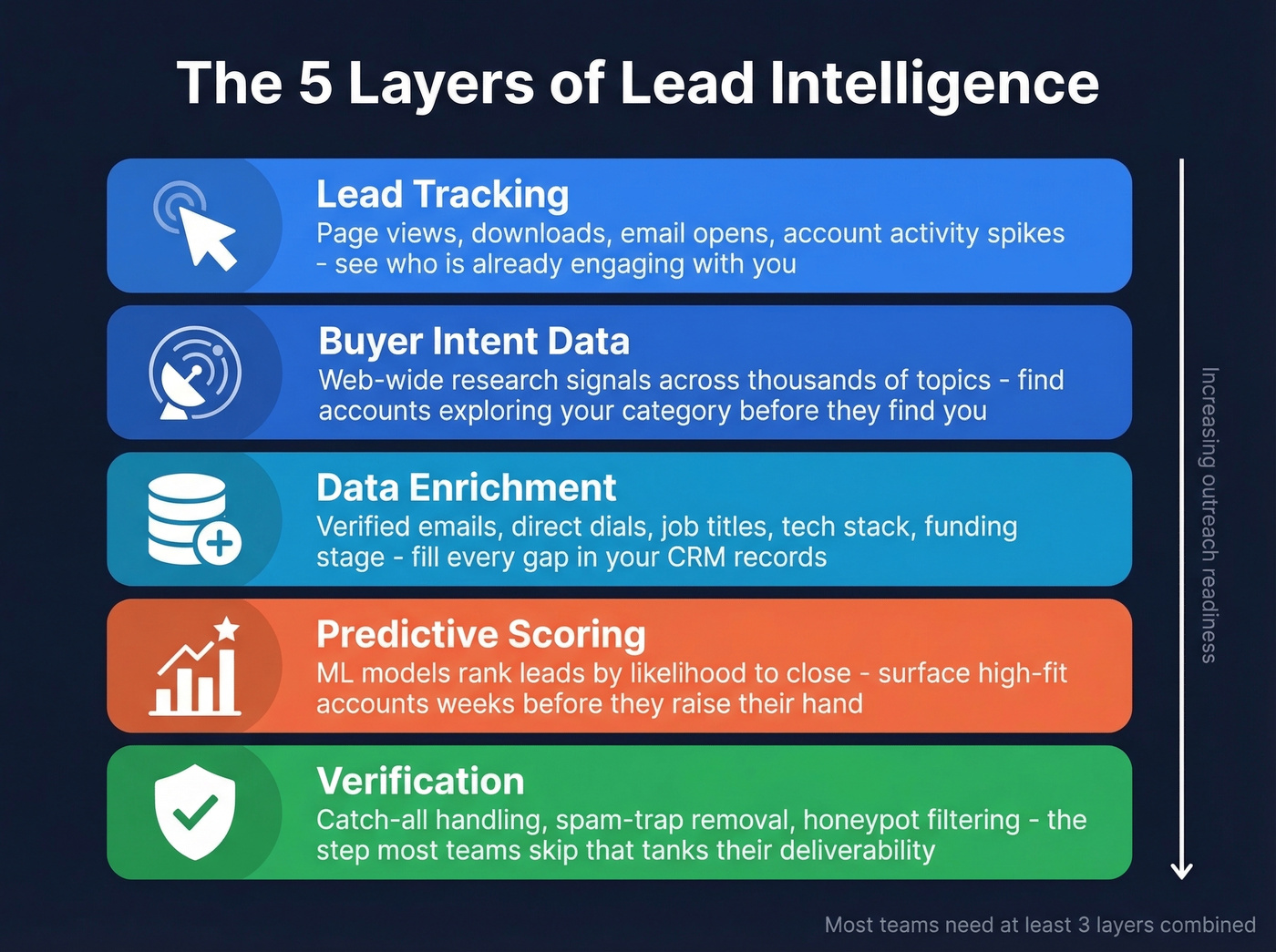
Most teams treat this as a single category. It's actually five distinct layers, and the strongest solutions combine at least three.
Lead Tracking
Tracking software monitors how prospects interact with your assets - page views, downloads, email opens, account-level activity spikes. Tools like HubSpot, Salesforce, and Leadfeeder capture these signals and surface accounts showing buying behavior. Don't overlook internal unstructured data here either: call notes, email threads, and meeting summaries are an underrated first-party source that most teams ignore completely. Some organizations pipe these signals into a data warehouse for sales intelligence reporting, giving leadership a unified view of engagement across channels. The limitation? Tracking only works on people who've already found you.
Buyer Intent Data
Intent data extends visibility beyond your own website. Third-party providers like Bombora monitor web-wide research signals across thousands of topics, flagging accounts actively exploring your category. Raw intent data isn't always actionable at the rep level, though - it needs to be paired with contact-level prospect intelligence to become useful.
Data Enrichment
Enrichment fills gaps on existing records. You've got a name and company; enrichment adds verified email, direct dial, job title, tech stack, funding stage, and headcount. This is the CRM hygiene layer. Without it, poor data quality costs companies roughly 12% of revenue annually. (If you’re comparing vendors, start with this list of data enrichment services.)
Predictive Scoring
Predictive scoring platforms use historical conversion data to rank leads by likelihood to close. Powerful when your CRM is clean and deal volume is high enough to train the model. A well-tuned scoring system can surface high-fit accounts weeks before they raise their hand. The dependency is real, though - garbage in, garbage out.
Verification
Here's the type most taxonomies leave out. You can have perfect intent signals and rich firmographic data, but if the email bounces or the phone number is dead, none of it matters. Verification sits between enrichment and outreach: catch-all domain handling, spam-trap removal, honeypot filtering. Skipping this step is how teams burn domains and tank deliverability for months. We've seen it firsthand - Snyk's team of 50 AEs cut their bounce rate from 35-40% to under 5% after adding a proper 5-step verification layer to their workflow.
Lead Intelligence vs. Sales Intelligence
These terms get used interchangeably, but they describe different scopes. Sales intelligence is the umbrella - all data used to support sales. A sales intelligence provider might offer everything from org charts to technographics to competitive insights. Lead intelligence narrows that to the individual prospect level: who to contact, when, and why.
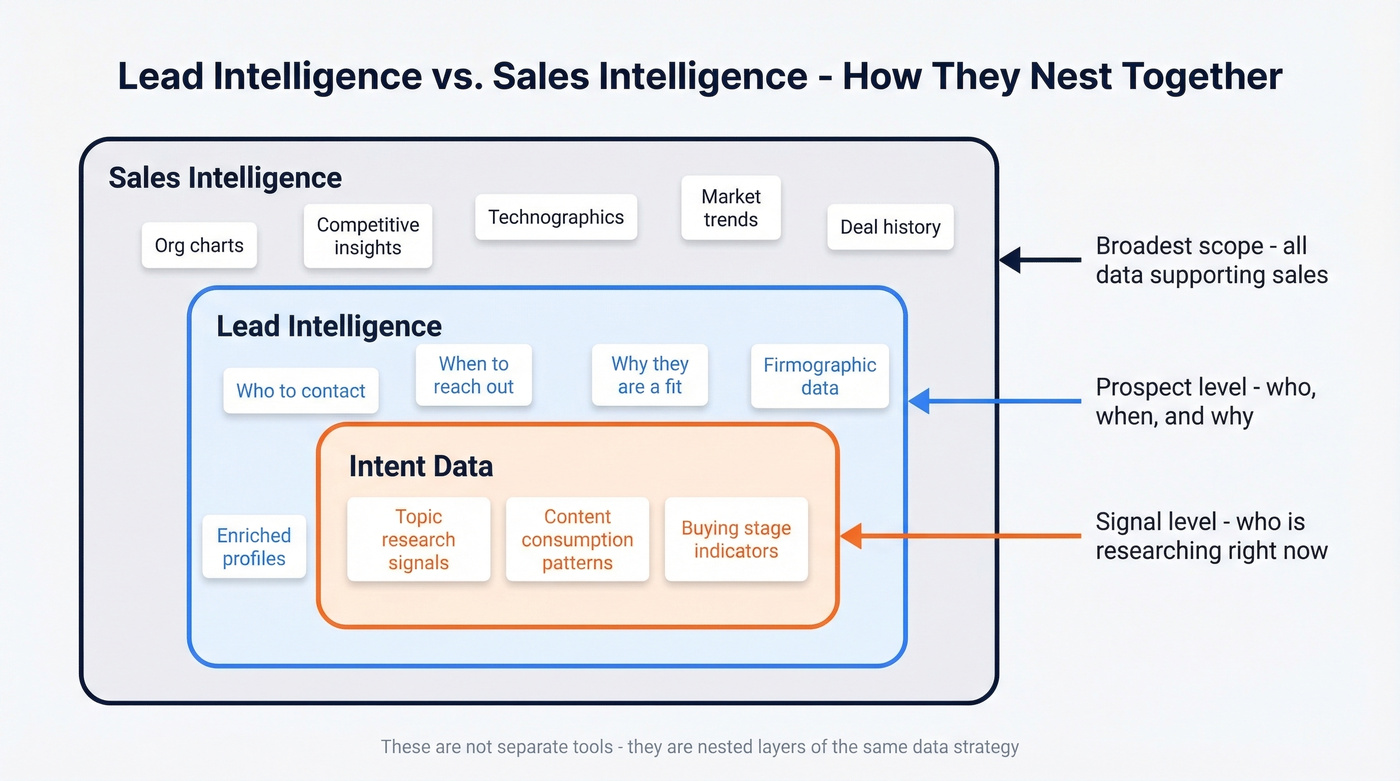
Intent data is one signal layer feeding into the broader picture, telling you who's researching now. Think of it as nested: intent data sits inside lead-level insights, which sit inside sales intelligence.

The article above breaks lead intelligence into five layers. Prospeo covers three of them in one platform: enrichment, intent data across 15,000 Bombora topics, and 5-step verification that keeps bounce rates under 4%. At $0.01 per email with 98% accuracy, you get the intelligence stack without the enterprise price tag.
Stop paying ZoomInfo prices for data that decays in six weeks.
What a Working Stack Looks Like
One practitioner's stack we came across is refreshingly practical: filtered lists, enrichment, CRM, follow-up. They described spending $3,500/month on PPC and getting just 2-3 inbound leads per week - which is exactly why outbound stacks exist.
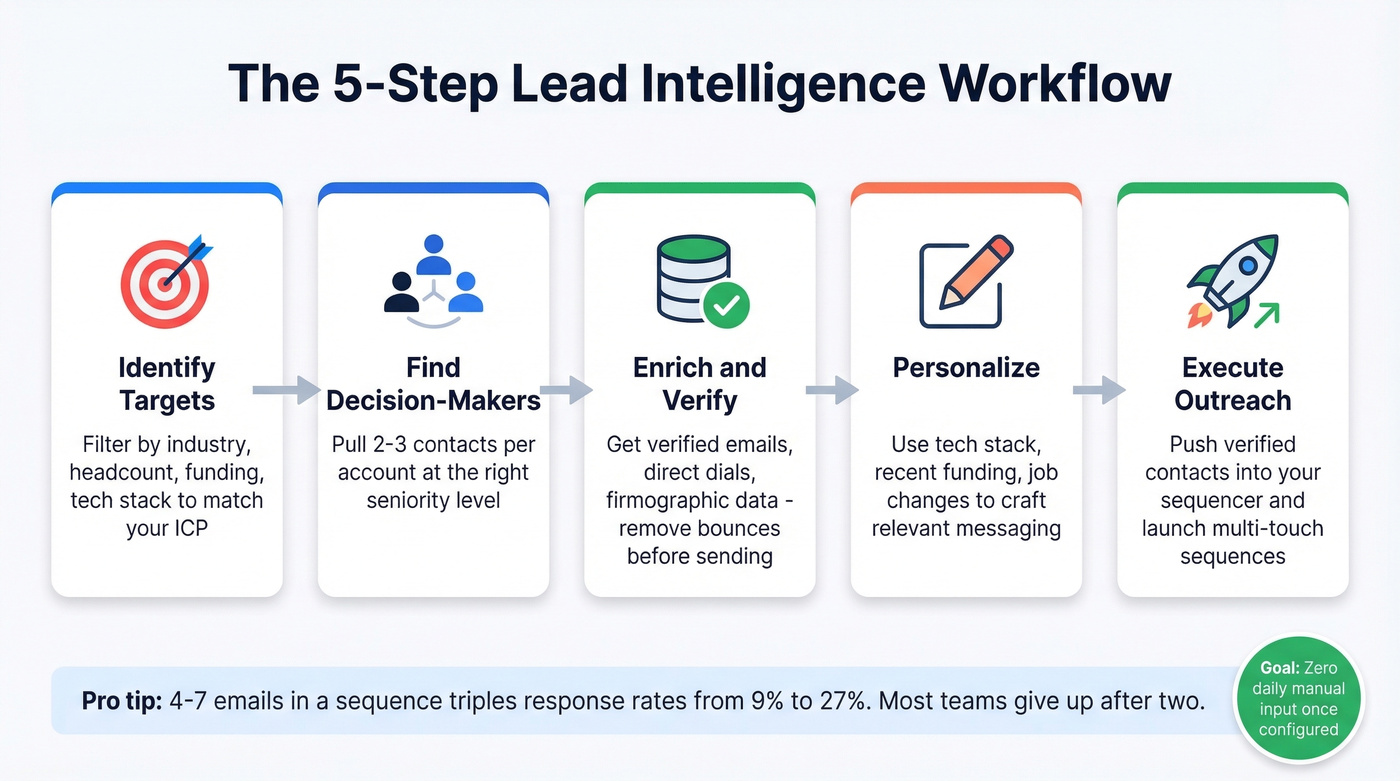
A modern automated workflow looks like this:
- Identify targets - Filter by industry, headcount, funding, and tech stack to build a list matching your ICP
- Find decision-makers - Pull 2-3 contacts per account at the right seniority level
- Enrich and verify - Run contacts through enrichment to get verified emails, direct dials, and firmographic data
- Personalize - Use enrichment data like tech stack, recent funding, and job changes to craft relevant messaging
- Execute outreach - Push verified contacts into your sequencer and launch
The key is embedding intelligence directly into your CRM workflow rather than treating it as a separate step. Teams running this with tools like n8n or Make can get to zero daily input once it's configured.
Here's a stat worth building your cadence around: sending 4-7 emails in a sequence triples response rates - from 9% to 27%. Most teams give up after two.
The ROI for Sales Teams
Enriched leads convert 20-30% better than non-enriched ones. Companies that excel at lead nurturing generate 50% more sales-ready leads at 33% lower cost, and those nurtured leads make 47% larger purchases. Automated nurturing emails drive 320% more revenue than non-automated ones.
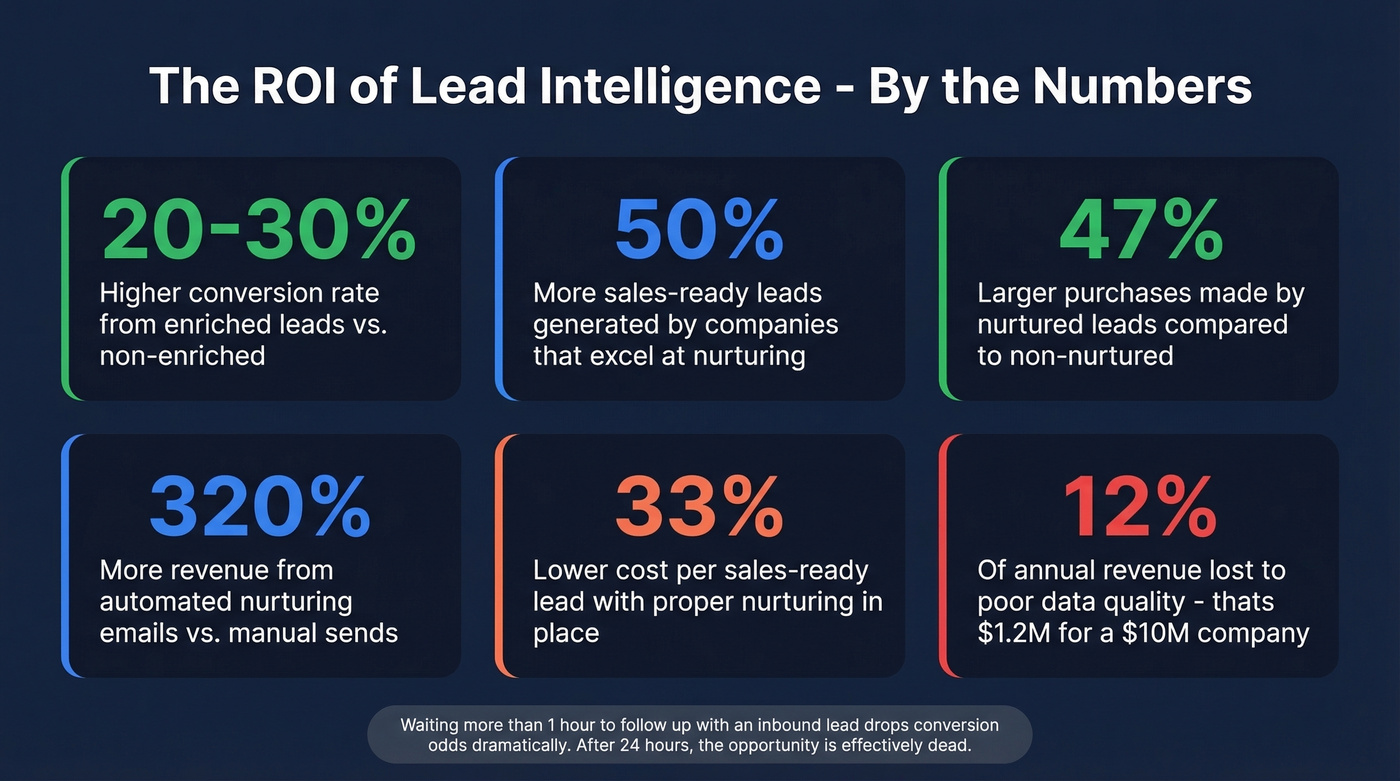
Speed matters enormously. Waiting more than an hour to follow up with an inbound lead drops conversion odds dramatically; after 24 hours, the opportunity is effectively dead.
The flip side: poor data quality costs companies roughly 12% of revenue annually. For a $10M company, that's $1.2M in pipeline leakage from bad emails, wrong numbers, and stale records. Marketing teams benefit similarly - cleaner data means better segmentation, higher ad match rates, and fewer wasted nurture touches.
Best Lead Intelligence Tools in 2026
Prospeo
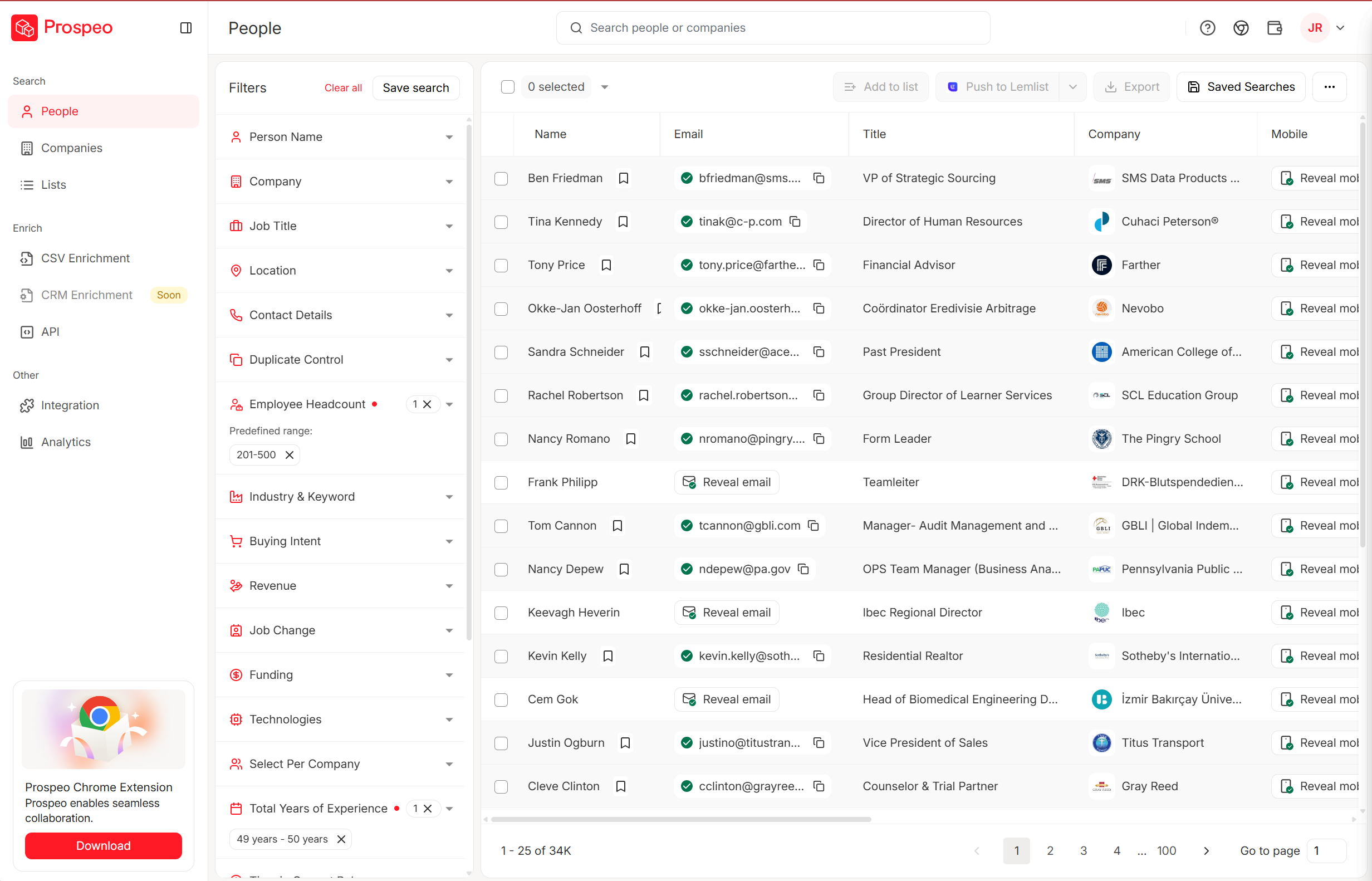
Prospeo covers 300M+ professional profiles, 143M+ verified emails, and 125M+ verified mobile numbers with 98% email accuracy and a 30% pickup rate. You can filter by buyer intent across 15,000 Bombora topics, track job changes and headcount growth, and layer in technographic signals - all from a single search with 30+ filters. Every record refreshes on a 7-day cycle; the industry average is six weeks.
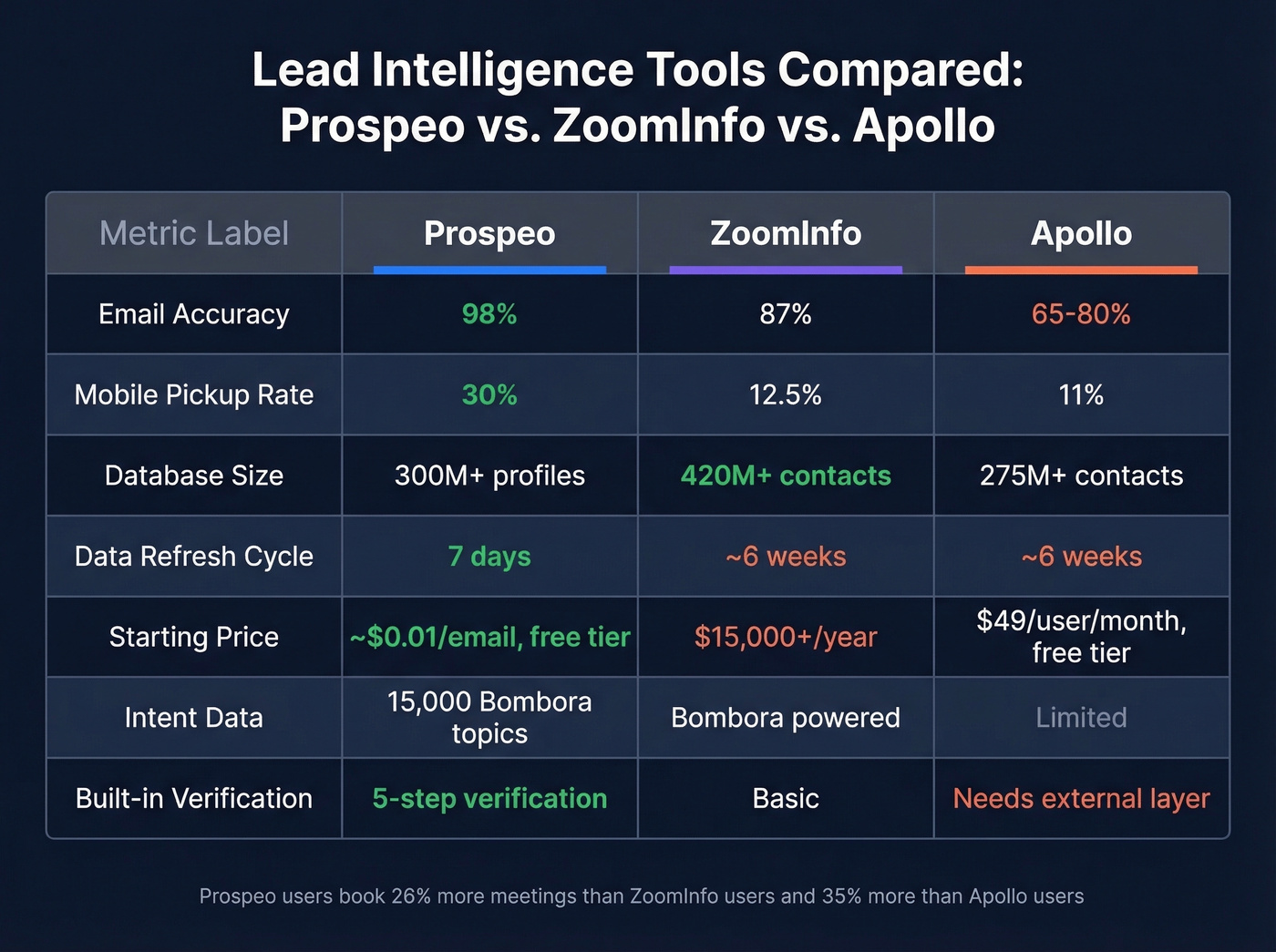
The head-to-head numbers tell the story: 98% email accuracy vs. 87% for ZoomInfo and 79% for Apollo. A 30% mobile pickup rate vs. 12.5% and 11%, respectively. Teams using Prospeo book 26% more meetings than ZoomInfo users and 35% more than Apollo users. Snyk's 50-person AE team grew their sourced pipeline 180% after switching, and Stack Optimize built from $0 to $1M ARR while maintaining 94%+ deliverability and under 3% bounce rates across all clients.
Pricing is self-serve and transparent. The free tier gives you 75 verified emails and 100 Chrome extension credits per month. Paid plans work out to about $0.01 per verified email with no contracts.
Snyk's 50 AEs cut bounce rates from 35-40% to under 5% and generated 200+ new opportunities per month. That's what happens when enrichment and verification work together - 300M+ profiles, 125M+ verified mobiles, and a 7-day refresh cycle that keeps your CRM clean while competitors run on month-old data.
Build the lead intelligence stack described above for under $0.01 per contact.
ZoomInfo
ZoomInfo is the best-known enterprise platform in this space. Its database spans 420M+ contacts, with org charts, technographics, Bombora-powered intent, and WebSights for company-level visitor identification. If you need the deepest US database with the broadest workflow integrations, it's still the benchmark.
The tradeoff is cost. A Professional plan starts around $15,000-$18,000/year for 1-3 seats with ~5,000 credits. Advanced runs $22,000-$28,000. Elite hits $35,000-$45,000+. Annual contracts only, and renewal increases of 10-20% are common. The #1 complaint on Reddit? Paying for modules you never activate. Let's be honest - if your average deal size sits below five figures, ZoomInfo-level spend is usually hard to justify.
Pricing signal: Budget $25,000-$40,000/year for a realistic mid-market deployment.
Apollo.io
Use this if: You're a small team that needs a combined database + sequencing tool without a big budget. The free tier gives you 60 mobile credits and 120 email credits per month - enough to test whether outbound works before spending a dollar. You go from search to sequence without switching tools.
Skip this if: Email accuracy is critical to your domain reputation. Apollo's accuracy runs 65-80%, which means you'll want a verification layer on top. Paid plans: $49/user/month (Basic), $79 (Professional), $119 (Organization). If you want to tighten performance, pair it with a dedicated email deliverability guide and bounce monitoring.
Cognism
The play for teams selling into Europe. Cognism's Diamond Data program delivers human-verified mobile numbers - a genuine advantage in EMEA markets where direct dials are harder to source. GDPR compliance is baked in, not bolted on. Where ZoomInfo still wins: US database depth and feature breadth. Custom pricing, typically $1,000-$3,000/month for small teams.
6sense
6sense is a different animal entirely. It combines predictive AI with account-level intent scoring to tell you which accounts are in-market before they fill out a form. There's a free plan with 50 credits/month for testing. But paid tiers jump hard - expect $60,000-$100,000+/year, with enterprise deployments reaching $200,000+. This is a tool for organizations with the budget and data maturity to extract value from predictive models. If that's not you yet, don't force it.
Instantly
Instantly combines a lightweight lead finder with email sending infrastructure, starting at $30/month. Good for solopreneurs who want one tool for both data and outreach. Don't expect deep enrichment or high accuracy - it's an execution tool, not a full-stack intelligence suite. If you’re building sequences, keep a swipe file of cold email follow-up templates handy.
CUFinder
Budget option at $34/month for basic enrichment and lead search. We haven't tested CUFinder deeply enough to recommend it confidently, but it's worth watching for teams with very tight budgets who need something beyond manual prospecting.
Comparison Table
| Tool | Best For | Starting Price | Email Accuracy | Key Strength |
|---|---|---|---|---|
| Prospeo | Data accuracy | Free / ~$0.01/email | 98% | 7-day refresh cycle |
| ZoomInfo | Enterprise depth | ~$15,000/yr | 87-90% | Database breadth |
| Apollo.io | Free starting point | Free / $49/user/mo | 65-80% | Built-in sequencing |
| Cognism | EMEA compliance | ~$1,000-$3,000/mo | 85%+ | Verified mobiles |
| 6sense | Enterprise ABM | Free / ~$60,000+/yr | N/A | Predictive intent |
| Instantly | Outbound execution | $30/mo | Limited | Send + data in one |
| CUFinder | Budget enrichment | $34/mo | Not published | Low cost of entry |
How to Choose the Right Software
Your budget determines your shortlist more than any feature matrix.
Under $100/month: Apollo's free plan or Instantly at $30/month. This is where most founders and solo SDRs should start. Don't sign an annual contract until you've proven outbound works for your business.
$100-$500/month: Scale outbound with paid plans and add a verification layer. At this tier, accuracy starts to matter - the cost difference between a 98% and 70% accurate list shows up in your domain reputation within weeks.
$500+/month: Cognism for European-focused teams. The verified mobile numbers justify the premium if EMEA is your primary market.
$15,000+/year: ZoomInfo or 6sense. Only makes sense if you have the team size and deal velocity to justify the spend. At this level you're buying enterprise-grade capabilities - deep integrations, dedicated CSMs, and platform-wide analytics. For teams that don't need all that, pairing a tool like Prospeo with a sequencer gets you 80% of the output at a fraction of the cost.
Five Mistakes That Kill Your Pipeline
1. Your ICP is too broad. "Companies with 50-5,000 employees in North America" isn't an ICP - it's a continent. Narrow to specific industries, tech stacks, funding stages, and buyer personas.
2. You're too slow on follow-up. More than an hour on an inbound lead and your conversion odds crater. Build routing rules, not manual processes.
3. You're tracking vanity metrics. Downloads and MQLs feel good in dashboards. Pipeline, conversations, and revenue are what matter. (If you need a better system, start with these lead generation metrics.)
4. You skip verification. Every unverified email is a potential bounce that damages your sender reputation. One bad campaign can tank deliverability for months. In our experience, this is the single most common mistake teams make when switching to outbound for the first time.
5. Tool sprawl without integration. Five tools that don't talk to each other create five sources of truth and zero reliable data. Pick platforms that integrate natively with your CRM and sequencer, or use middleware like Zapier or Make to connect them.
FAQ
What is lead intelligence software?
Software that collects, enriches, and scores data about potential buyers - contact info, company details, behavioral signals, and intent - so sales teams can prioritize the right leads with the right message. The best tools in 2026 combine real-time enrichment, intent signals, and built-in verification in a single workflow.
How is it different from lead generation?
Lead generation creates interest through ads, content, and events. Lead intelligence qualifies that interest by telling you who those leads are, what they care about, and when they're ready to buy. Generation fills the funnel; intelligence filters it.
What's the best free tool to start with?
Prospeo's free tier offers 75 verified emails at 98% accuracy plus 100 Chrome credits monthly - the strongest data quality at zero cost. Apollo.io provides 60 mobile and 120 email credits. 6sense gives 50 data credits. For teams where bounce rates matter most, a proper verification layer makes the difference.
How much does this software cost?
It ranges from free to $30-$119/user/month for mid-tier tools, up to $15,000-$200,000+/year for enterprise platforms like ZoomInfo and 6sense. Most SMB teams build an effective stack for under $200/month.
How often should the data be refreshed?
Weekly or more frequently. People change jobs, companies restructure, and phone numbers go stale. The industry average is roughly every six weeks, but that's too slow for active outbound campaigns. A 7-day refresh cycle significantly reduces bounce rates and keeps your sender reputation intact.