

Lead Pipeline Management: The Operating Manual CRM Vendors Won't Write
One enterprise AE on r/sales described managing 40 active deals across HubSpot and Gong while still feeling completely reactive. That's not a productivity problem - it's a lead pipeline management problem. Companies with actively managed pipelines see 28% more year-over-year revenue growth, yet 63% of sales managers say their org does a poor job of it. Reps spend just 28% of their time actually selling. The fix isn't another tool. It's a framework.
The Short Version
Define your lead stages and handoff point (Lead → MQL → SQL → Opportunity), track conversion by stage against industry benchmarks, enforce a 1-hour follow-up SLA, and verify your contact data before optimizing anything else. You need a CRM your team will actually use (HubSpot free or Pipedrive at $14/mo/user) plus a data quality layer to make sure the contacts in your pipeline are reachable. Everything below expands on that foundation.
What Is a Lead Pipeline?
Lead pipeline management is the process of tracking and advancing prospects from first touch through qualification and handoff - the stages before a deal is actively worked as an opportunity.
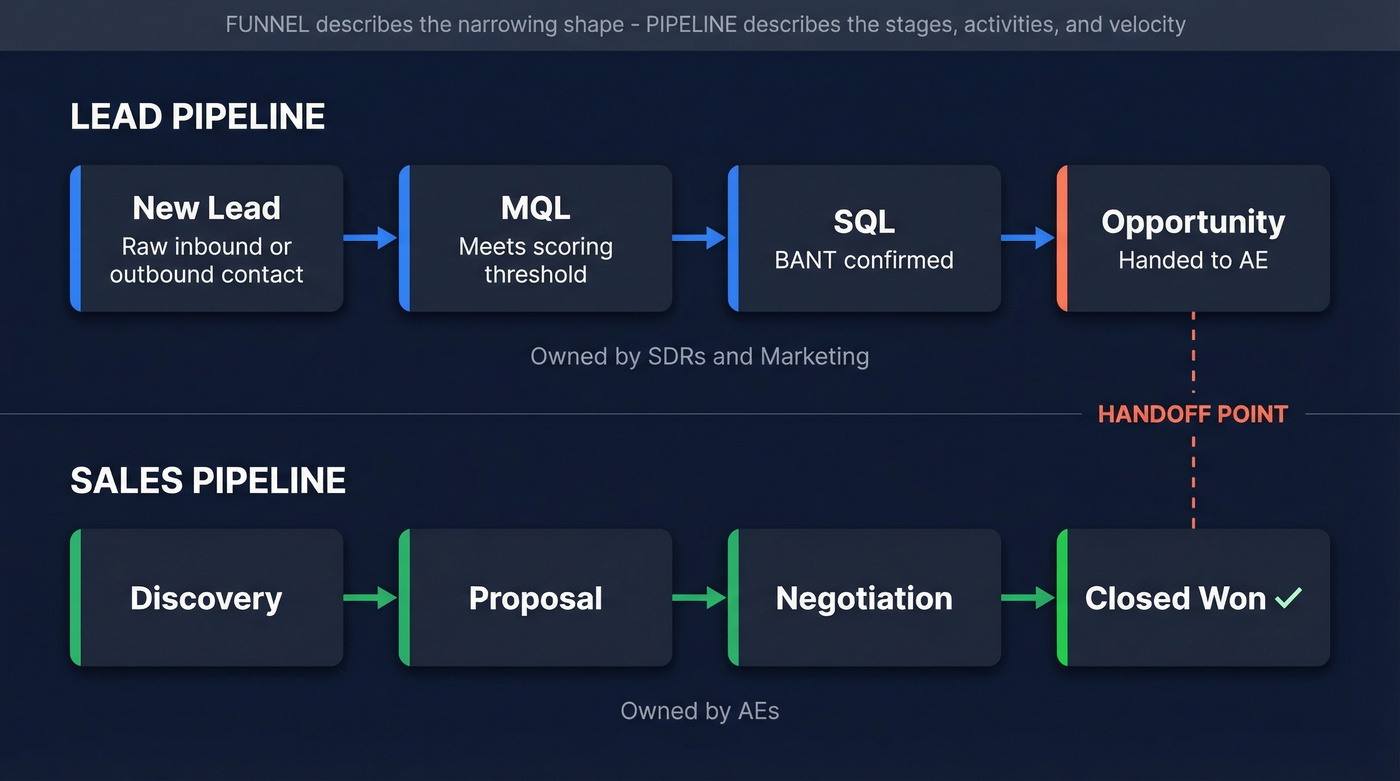
Your lead pipeline typically covers Lead → MQL → SQL → Opportunity (handoff to an AE). Your sales pipeline starts once a lead is qualified and runs through to Closed Won. A funnel describes the narrowing shape of conversion; a pipeline describes the stages, activities, and velocity within that shape. If you're managing both in one view, you're probably doing neither well.
Stages and Exit Criteria
Five to seven stages is the sweet spot for B2B. More than seven creates data-entry friction, and reps start skipping updates. We've seen this firsthand - once a pipeline crosses eight stages, CRM hygiene drops off a cliff.
| Stage | Definition | Exit Criteria | Target Time-in-Stage |
|---|---|---|---|
| New Lead | Raw inbound or outbound contact | Valid contact info confirmed | < 24 hours |
| Engaged | Responded to outreach or content | Two-way interaction logged | 3-7 days |
| MQL | Meets marketing scoring threshold | Behavioral + firmographic score hit | 5-14 days |
| SQL | Sales-qualified via discovery | BANT confirmed | 7-21 days |
| Opportunity | Handed to AE pipeline | Demo or proposal scheduled | Varies by deal size |
SMB motions should compress these timelines. If your average deal is in the four-figure range, a lead sitting in MQL for two weeks is a dead lead. Enterprise motions can stretch SQL to 30+ days, but every stage still needs a dated next step.

You just read that Snyk cut bounce rates from 35-40% to under 5% and saw AE-sourced pipeline jump 180%. That's what happens when every contact in your pipeline is actually reachable. Prospeo's 5-step verification delivers 98% email accuracy and 125M+ verified mobiles - so your stage conversion metrics reflect real buyer engagement, not bounced emails.
Stop optimizing a pipeline built on bad data. Verify first.
Benchmarks That Actually Matter
Stage Conversion by Industry
These numbers come from First Page Sage's multi-year funnel analysis and give you a realistic baseline. If your numbers fall dramatically below these, you've found your bottleneck.
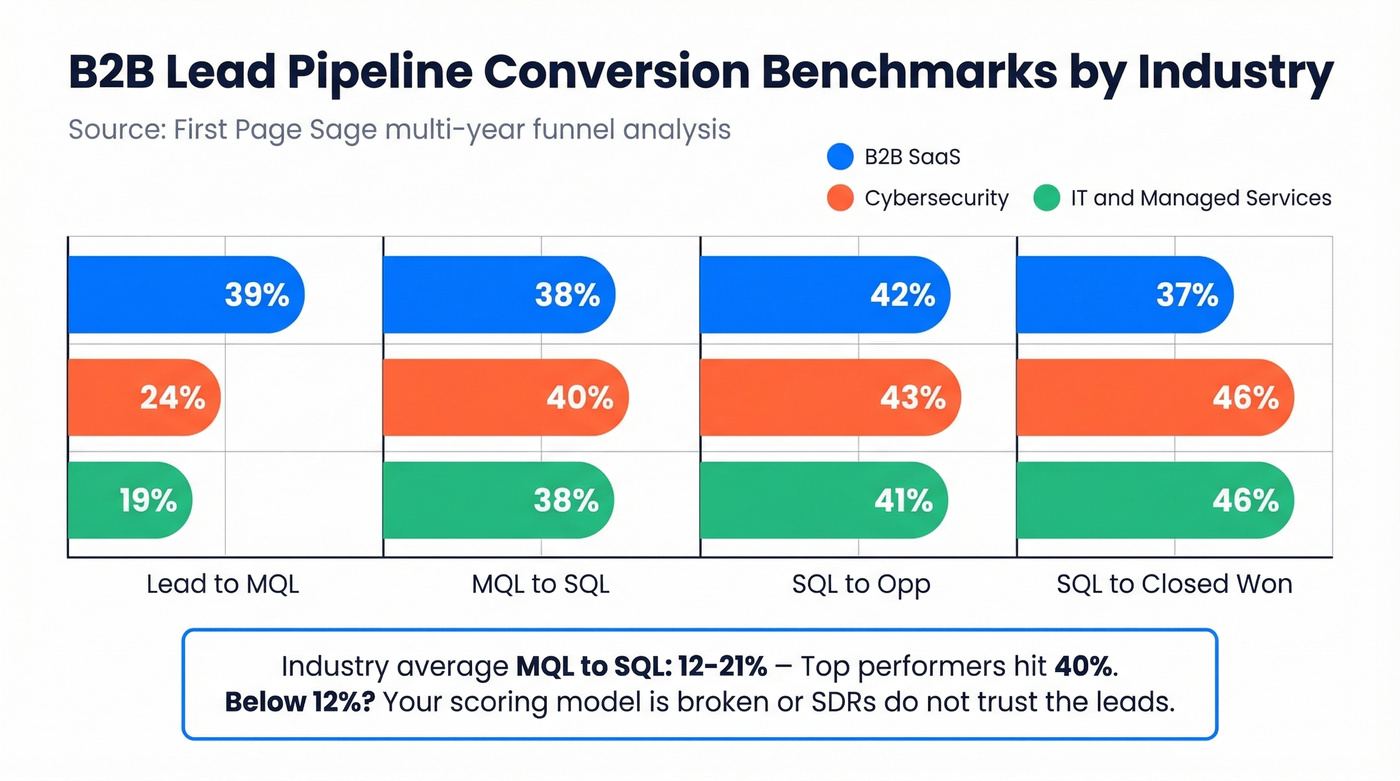
| Industry | Lead→MQL | MQL→SQL | SQL→Opp | SQL→Closed Won |
|---|---|---|---|---|
| B2B SaaS | 39% | 38% | 42% | 37% |
| Cybersecurity | 24% | 40% | 43% | 46% |
| IT & Managed Services | 19% | 38% | 41% | 46% |
Across industries, MQL→SQL averages 12-21%, with top performers hitting 40%. If you're below 12%, your scoring model is broken or your SDRs don't trust the leads marketing sends over.
Pipeline Velocity Formula
Velocity = (Opportunities x Avg Deal Size x Win Rate) / Sales Cycle Length
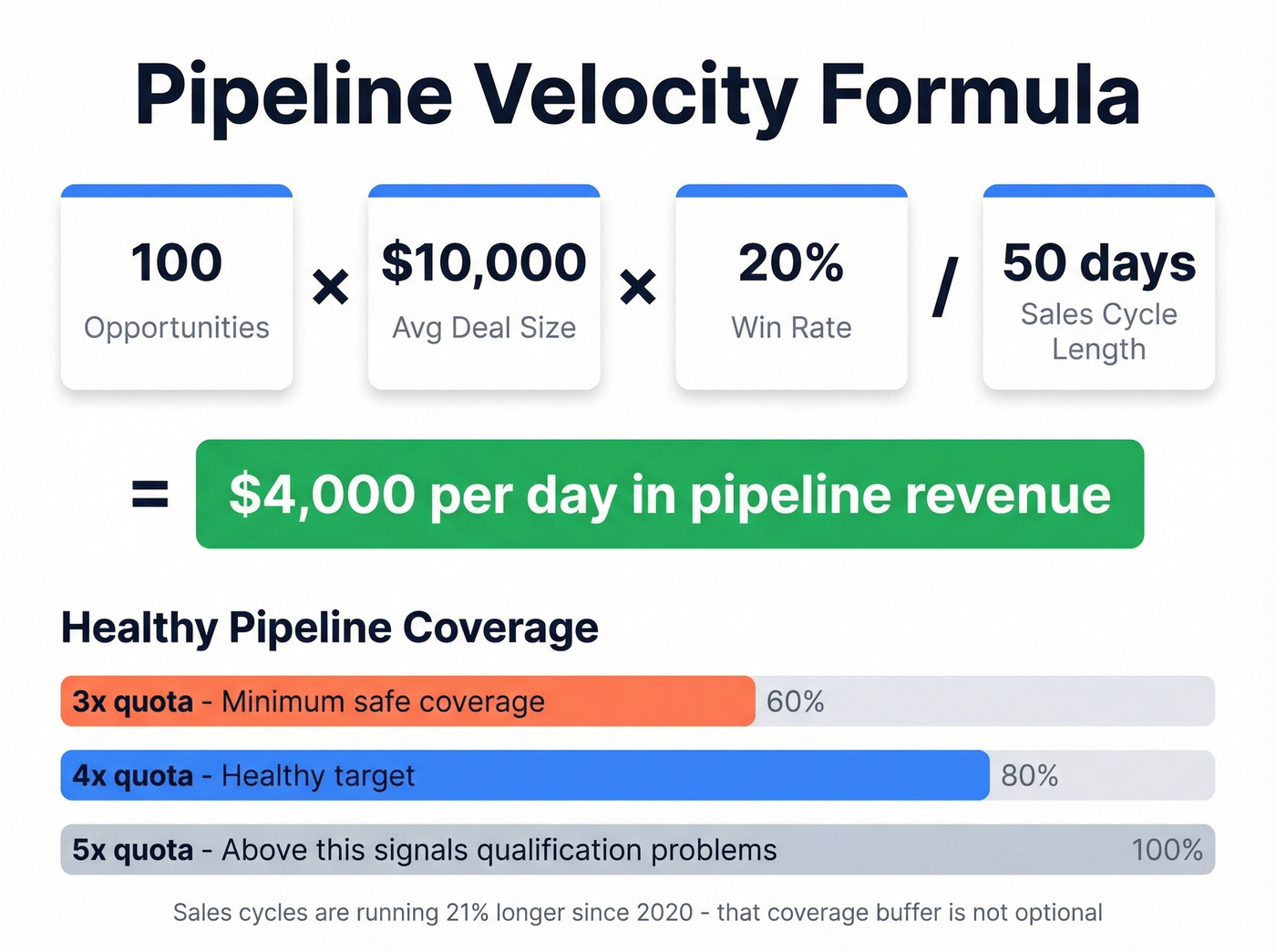
Run it: 100 opportunities x $10,000 average deal x 20% win rate / 50-day cycle = $4,000/day in pipeline revenue. Every lever you improve - more opps, higher win rate, shorter cycle - compounds.
A healthy pipeline sits at 3-5x your quota target. If your quarterly number is $500K, you need $1.5M-$2.5M in qualified pipeline. Below 3x and you're at risk. Sales cycles are running 21% longer than they were in 2020, so that coverage buffer isn't optional anymore.
Best Practices for Managing Your Pipeline
Follow up within one hour. Leads contacted in the first hour convert at 53% vs 17% after 24 hours. This single SLA change moves more pipeline than any tool purchase. If you need copy you can deploy fast, keep sales follow-up templates on hand.
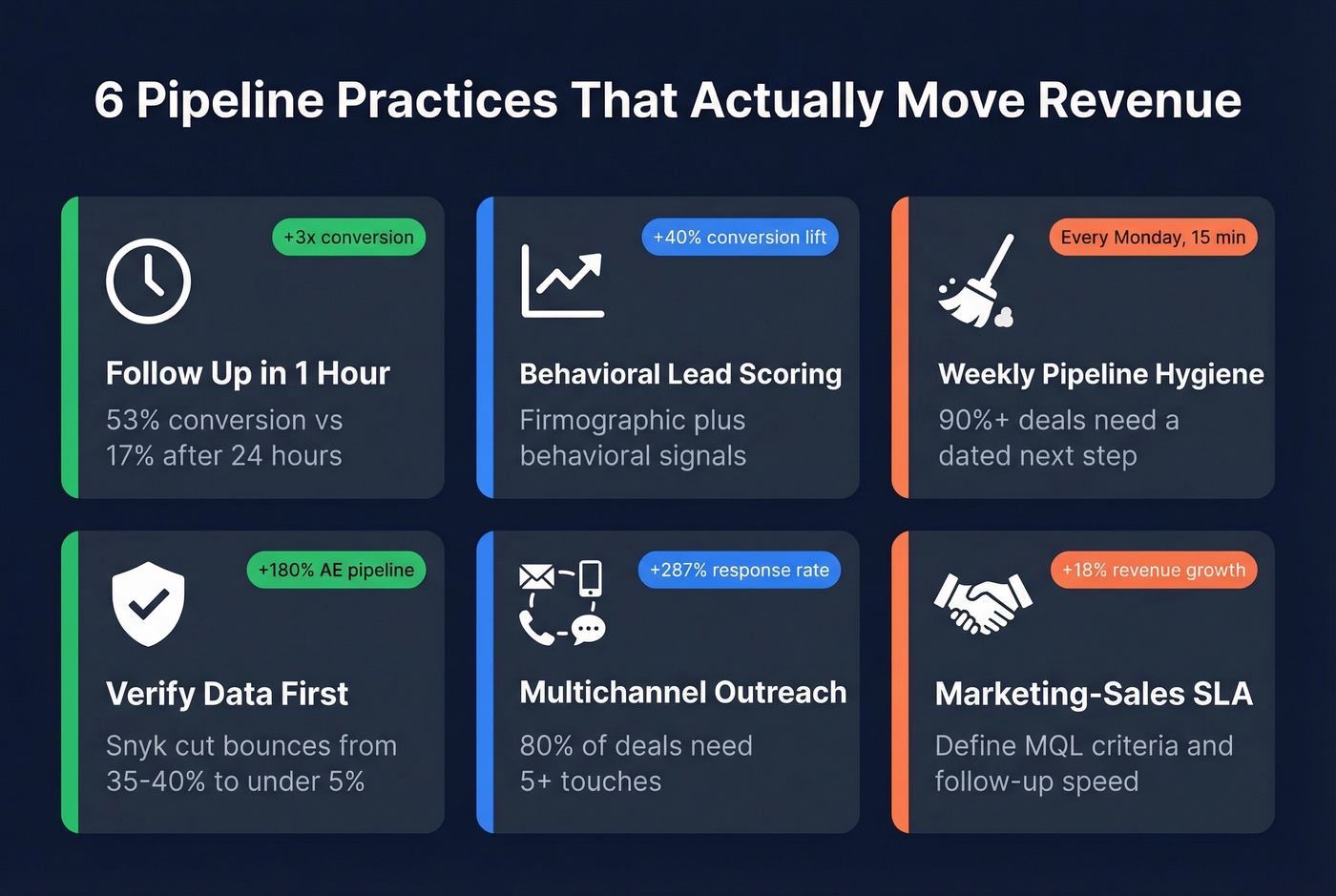
Implement behavioral lead scoring. Firmographic data tells you who fits. Behavioral signals - page visits, content downloads, email engagement - tell you who's ready. Behavioral scoring lifts conversion by up to 40%. (If your scoring is fuzzy, start with a clean lead scoring model.)
Enforce pipeline hygiene weekly. 90%+ of active opportunities should have a dated next step at all times. If a deal has no next step, it's not a deal - it's a wish. Run a 15-minute pipeline scrub every Monday. Seriously, put it on the calendar.
Verify your data before optimizing your process. Your pipeline is only as good as the contacts in it. If 30% of your emails bounce, your conversion metrics are lying to you. Snyk's 50-person AE team went from 35-40% bounce rates to under 5% after adding a verification layer - and saw AE-sourced pipeline jump 180%. (If you want to quantify the damage, track your email bounce rate by source.)

Prospect across channels, consistently. 80% of deals require 5+ touches, yet 44% of reps give up after one. Multichannel outreach drives a 287% increase in response rates over single-channel. Build prospecting blocks into every rep's calendar. Pipeline doesn't fill itself - especially without repeatable sales prospecting techniques.
Align marketing and sales on SLAs. Define what constitutes an MQL, how fast sales must follow up, and what feedback loop exists when leads don't convert. Without this, marketing blames sales for not working leads, and sales blames marketing for sending garbage. Both are usually right. Companies that define a clear sales process grow revenue 18% faster - the alignment is the process. (This is also where lead status definitions prevent reporting chaos.)
Mistakes That Kill Your Pipeline
Here's the thing: most pipeline problems aren't mysterious. They're predictable.
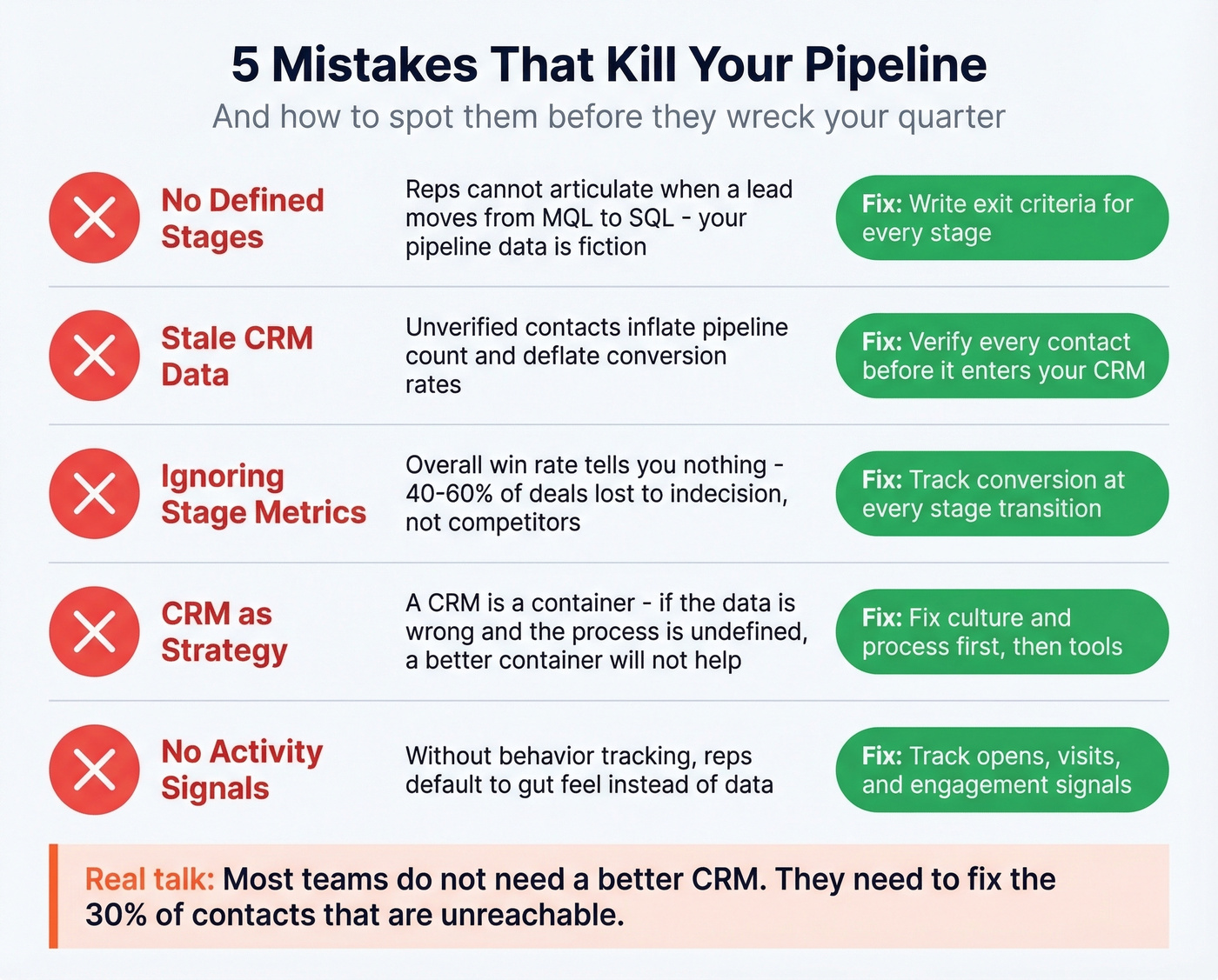
No defined stages or exit criteria. If reps can't articulate when a lead moves from MQL to SQL, your pipeline data is fiction. This is the single most common failure mode we see.
Overloading your CRM with stale data. Every unverified contact inflates your pipeline count and deflates your conversion rates. Garbage in, garbage forecasts out. A lightweight data enrichment services layer can help keep records current.
Ignoring stage-by-stage conversion data. Overall win rate tells you almost nothing. Stage conversion tells you exactly where deals die. And 40-60% of deals are lost to indecision, not competitors - so if your SQL→Opp rate is low, the problem is urgency, not positioning.
Treating pipeline management as a CRM problem. A CRM is a container. If the data inside it is wrong and the process around it is undefined, a better container won't help. This is a culture problem before it's a tool problem. If your VP doesn't use the CRM, neither will your reps. (If you're still standardizing, it helps to align on examples of a CRM your team will actually adopt.)
Neglecting prospect activity signals. Tracking prospect behavior - email opens, page visits, demo requests - is what turns a static spreadsheet into a living system. Without that visibility, reps default to gut feel instead of data.
Let's be honest: most teams don't need a better CRM. They need to fix the 30% of contacts in their existing CRM that are unreachable. Upgrading from Pipedrive to Salesforce when your bounce rate is 25% is like buying a faster car with a cracked windshield.
Tools for Lead Pipeline Management
You don't need an expensive stack. You need a CRM your team will actually use, plus clean data feeding it.
| Tool | Starting Price | Best For |
|---|---|---|
| Prospeo | Free / ~$0.01/email | Data quality for any CRM |
| HubSpot Sales Hub | Free / $90/mo/user | SMB/mid-market; free tier |
| Pipedrive | $14/mo/user | Visual simplicity, small teams |
| Salesforce | Starts at $25/mo/user | Enterprise orgs |
| Close | $29/mo/user | Inside sales teams |
| Freshsales | $9/mo/user | Budget-friendly option |
| Zoho CRM | $14/mo/user | Mid-range all-in-one |
Salesforce's $25/mo sticker price is misleading - mid-market teams typically land at $50K-$150K/year once you add implementation, admin, and integrations. For teams under 20 reps, Pipedrive or HubSpot's free tier gets you 80% of the functionality at a fraction of the overhead. Skip Salesforce unless you genuinely need the enterprise customization.
Prospeo sits in a different layer than your CRM - it's the data quality engine that feeds it. With 98% email accuracy, a 7-day data refresh cycle versus the 6-week industry average, and native integrations with Salesforce, HubSpot, Smartlead, and Instantly, it ensures the contacts entering your pipeline are actually reachable. Their CRM enrichment returns 50+ data points per contact at a 92% match rate, which means fewer dead leads clogging your stages.
Pipeline velocity depends on four levers - and data quality silently caps all of them. If 30% of your emails bounce, your opportunities, win rate, and cycle length all suffer. Prospeo refreshes 300M+ profiles every 7 days (not the 6-week industry average), so the contacts entering your pipeline are current, verified, and reachable at $0.01 per email.
Clean data compounds across every pipeline stage. Start at $0.01/lead.
FAQ
What's the difference between a lead pipeline and a sales pipeline?
A lead pipeline covers the top of the funnel - from raw lead through MQL to SQL and handoff into Opportunity. A sales pipeline picks up once a lead is qualified and tracks opportunities through to closed-won. They have different owners, metrics, and cadences. Managing them in a single view usually means neither gets the attention it needs.
How many stages should a lead pipeline have?
Five to seven for B2B. More than seven creates friction and data-entry resistance among reps. Define clear exit criteria for each stage - BANT at the SQL gate, behavioral thresholds at MQL - so reps know exactly when to advance a lead.
What's a good pipeline coverage ratio?
Between 3x and 5x your quota target. If your quarterly quota is $500K, you need $1.5M-$2.5M in qualified pipeline. Below 3x and you're at risk of missing the number. Above 5x signals qualification problems - too many unqualified deals inflating the count.
How do I keep bad data from wrecking my pipeline metrics?
Run every new contact through a verification layer before it enters your CRM. A 5-step email verification process that catches invalid addresses, spam traps, and catch-all domains prevents the 25-40% bounce rates that silently destroy conversion benchmarks and sender reputation.