

Lead Profiling: The Framework That Fixes Your "Leads Are Garbage" Problem
Marketing says the leads are fine - MQL volume is up 20% quarter over quarter. Sales says the leads are garbage - reps are burning hours chasing contacts who don't have budget, authority, or any intention of buying. If you've spent time in B2B marketing circles, you've seen this exact argument play out constantly. The real problem isn't lead volume or even lead quality. It's that nobody agreed on what a good lead looks like before the pipeline started filling up.
That's what lead profiling solves. And MQL-to-SQL conversion sits at just 25-35% for teams without a shared framework.
What Is Lead Profiling?
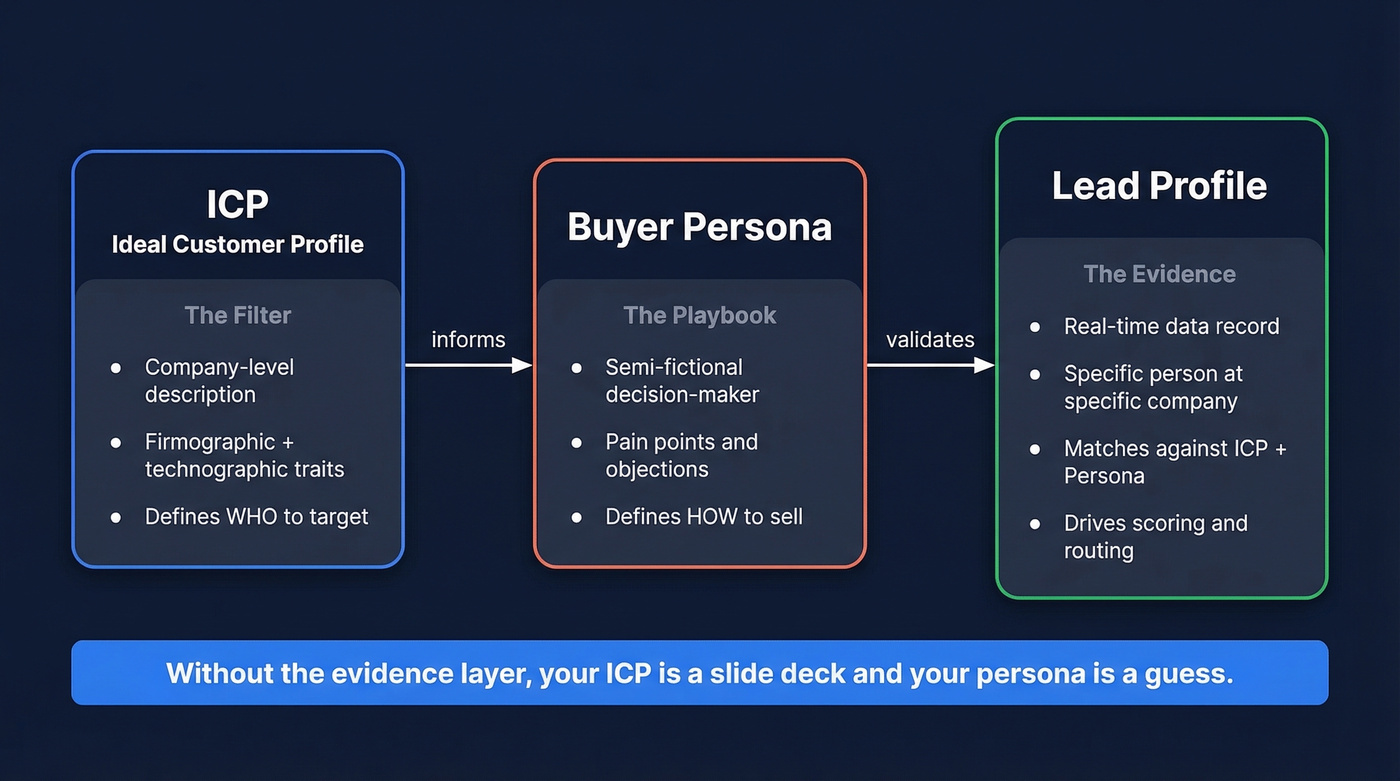
There's a lot of conflation between ICPs, buyer personas, and lead profiles. Your ICP defines who to target - a company-level description built from firmographic, technographic, and behavioral traits. Your buyer persona defines how to sell - a semi-fictional sketch of the decision-maker's pain points and objections. A lead profile is neither.
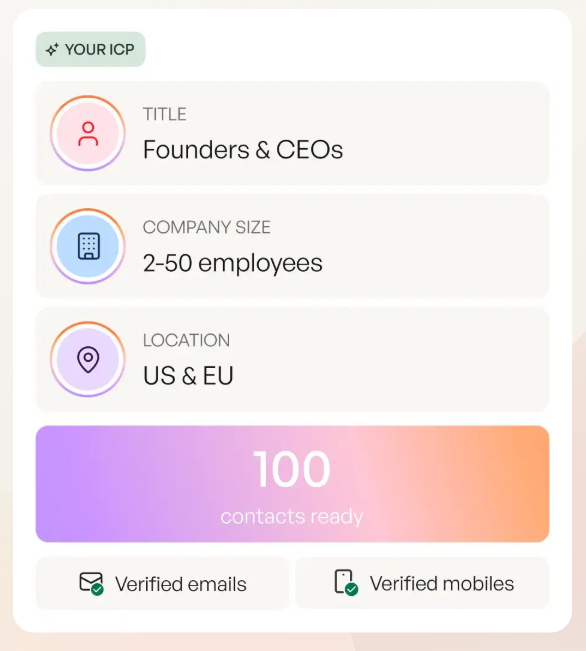
A lead profile is the real-time data record that tells you whether this specific person at this specific company matches your ICP and persona criteria. Think of it as three layers: the ICP is the filter, the persona is the playbook, and the lead profile is the evidence. That evidence includes:
- Demographic data - title, seniority, department
- Firmographic data - industry, revenue, headcount
- Behavioral data - pages visited, content downloaded
- Intent signals - funding rounds, hiring surges, tech adoption
Without that evidence layer, your ICP is a slide deck and your persona is a guess.
Why Profiling Leads Matters for Revenue
Buyers complete roughly 70% of their journey before they ever talk to sales. If your team doesn't have a rich profile on that buyer - what they've read, what they care about, where their company sits in its growth arc - the rep walks into the conversation blind.
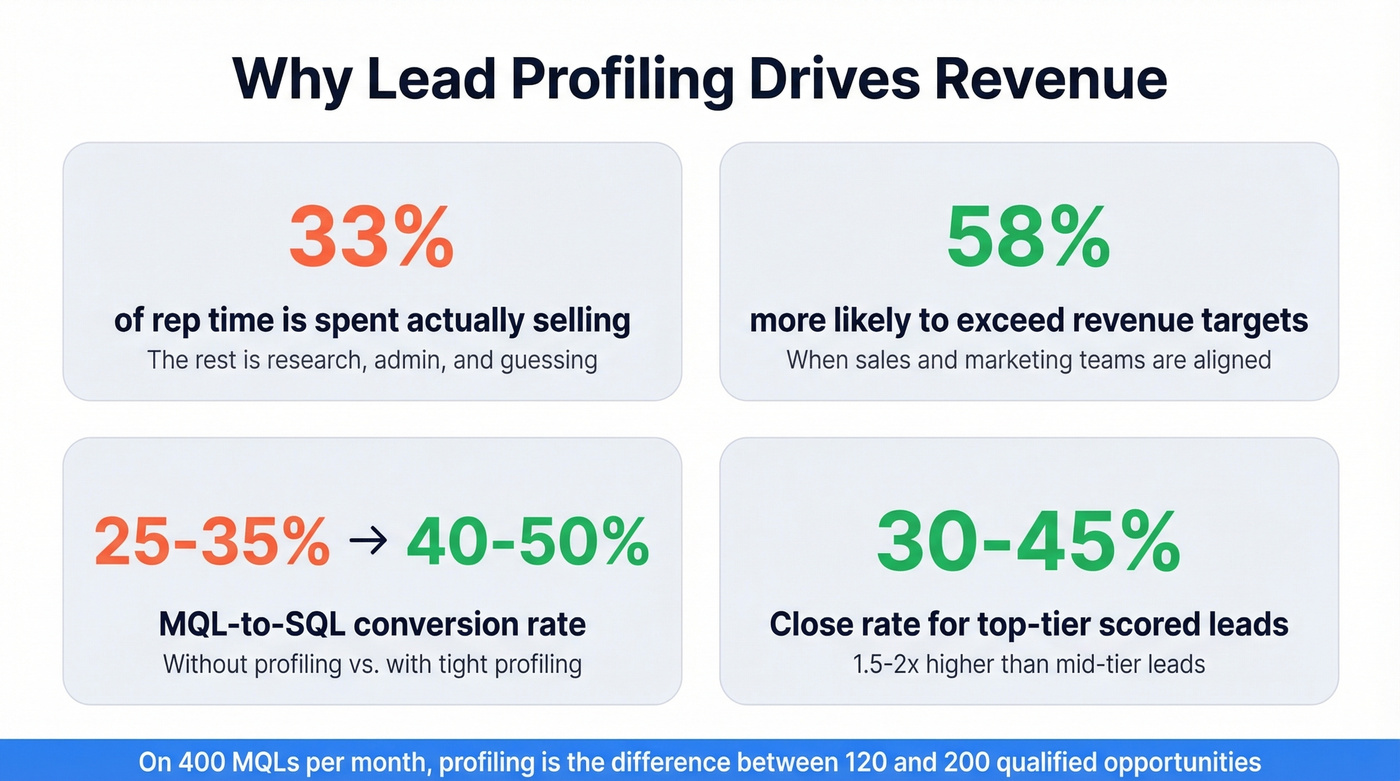
The numbers are stark. Reps spend only about 33% of their time actually selling. Aligned sales and marketing teams are 58% more likely to exceed revenue targets. Overall win rates hover around 20-30%, but leads that score in the top tier close at 30-45%. And the MQL-to-SQL gap is brutal: typical teams convert 25-35%, while organizations with tight profiling and shared definitions hit 40-50%. On 400 MQLs per month, that's the difference between 120 and 200 qualified opportunities.
No lead qualification framework works without profiling underneath it.
Here's the thing, though: if your average deal size is under $10K, you don't need a 47-field profile. You need five fields filled with accurate data and a rep who follows up within the hour. Complexity kills velocity at the SMB level.
What Goes in a Lead Profile
A useful profile covers four data categories. Skip any one and reps fill the gaps with guesswork.
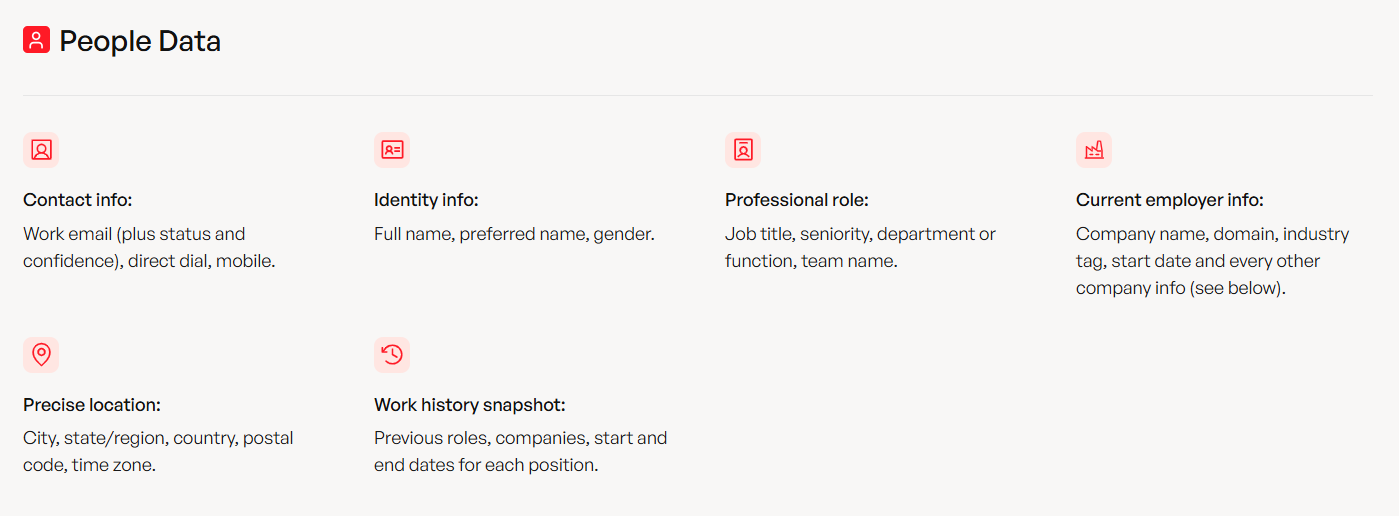
Firmographic data - industry, annual revenue, employee headcount, geographic HQ. This is your ICP match layer. It tells you whether the company is worth pursuing at all.
Demographic data - job title, department, seniority level, reporting structure. A Director of RevOps at a 200-person SaaS company is a completely different conversation than a Marketing Coordinator at a 10,000-person manufacturer, and your messaging should reflect that gap.
Behavioral data - pages visited, content downloaded, email engagement, webinar attendance. SDRs can use viewed content as a natural opener and tailor the first conversation around what the prospect already cares about.
Buyer intent data - recent funding, leadership changes, hiring surges, technology adoption, topic-level intent. Funding and hiring spikes are timing signals. Act fast while the initiative is active.
One thing we've learned working with outbound teams: 86% of consumers abandon registration when asked too much upfront. Progressive profiling - collecting data over multiple interactions rather than one giant form - drives up to 120% higher conversion rates. Let your data enrichment tool fill the gaps so your forms stay short.
A note on compliance: if you're collecting behavioral data like site visits and content engagement, make sure you have a lawful basis under GDPR . Cookie consent, legitimate interest documentation, and transparent privacy policies aren't optional. They're table stakes for any team profiling leads in European markets.

Your lead profiles are only as good as the data behind them. Prospeo enriches every contact with 50+ data points - firmographics, demographics, tech stack, and intent signals across 15,000 topics - at 98% email accuracy and a 7-day refresh cycle. No more stale CRM records killing your scoring rubric.
Fill every profile field for $0.01 per lead instead of guessing.
Build Your Scoring Rubric
Once profiles are populated, you need a system to prioritize them. We've found that a simple 100-point model works for most teams. Start by analyzing 50-100 closed-won deals from the last 12 months, identify the 3-5 traits that show up in 70-80% of wins, and weight them accordingly.
If you need a deeper walkthrough, use a dedicated lead scoring guide to pressure-test your point model.
| Signal | Points | Category |
|---|---|---|
| Pricing page visit | 10 | Behavioral |
| Case study / webinar | 8 | Behavioral |
| G2/Gartner research | 7 | Behavioral |
| Recent funding round | 5 | Trigger |
| ICP industry match | 15 | Firmographic |
| Director+ seniority | 10 | Demographic |
| Tech stack match | 10 | Firmographic |
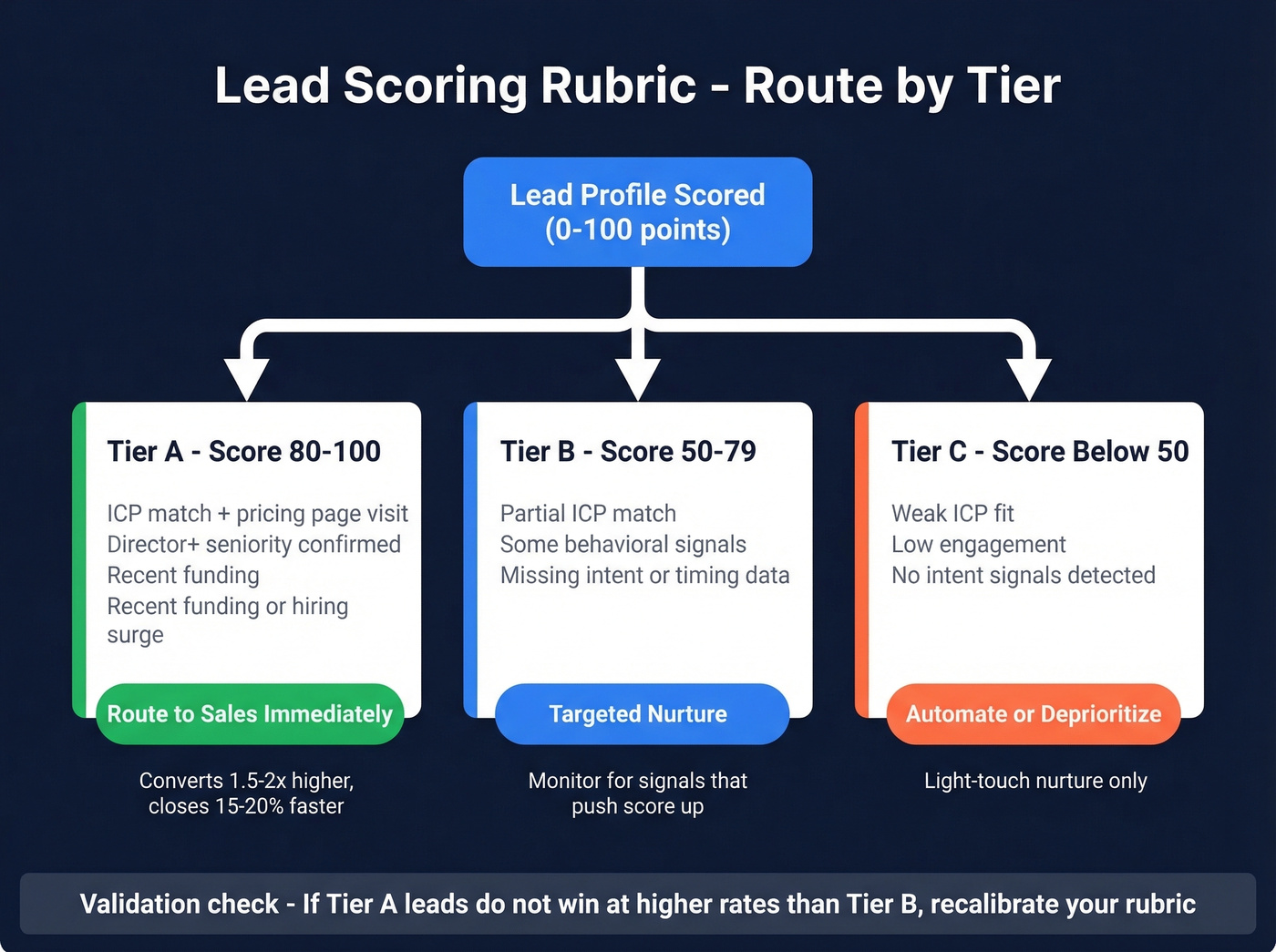
Leads scoring 80-100 should route to sales immediately. These convert at 1.5-2x the rate of mid-tier leads and close 15-20% faster. Leads at 50-79 go into targeted nurture - monitor for behavioral signals that push them up. Below 50, automate light-touch nurture or deprioritize entirely.
One practice worth adopting: build a reasoning trail into your scoring. When a lead gets routed, the rep should see why it scored high - "ICP match + pricing page visit + Series B last month" - not just a number. We've seen this cut discovery call prep time because reps walk in with context instead of a cold score.
The validation metric is simple. If your Tier A leads don't win at meaningfully higher rates than Tier B, your rubric needs recalibration.
Five Profiling Mistakes That Kill Pipeline
1. Stale data. CRM data decays about 30% per year. If you aren't enriching at least quarterly, your profiles are already rotting. Automate enrichment on a weekly or monthly cadence.
If you're evaluating vendors, compare options in our roundup of data enrichment services.
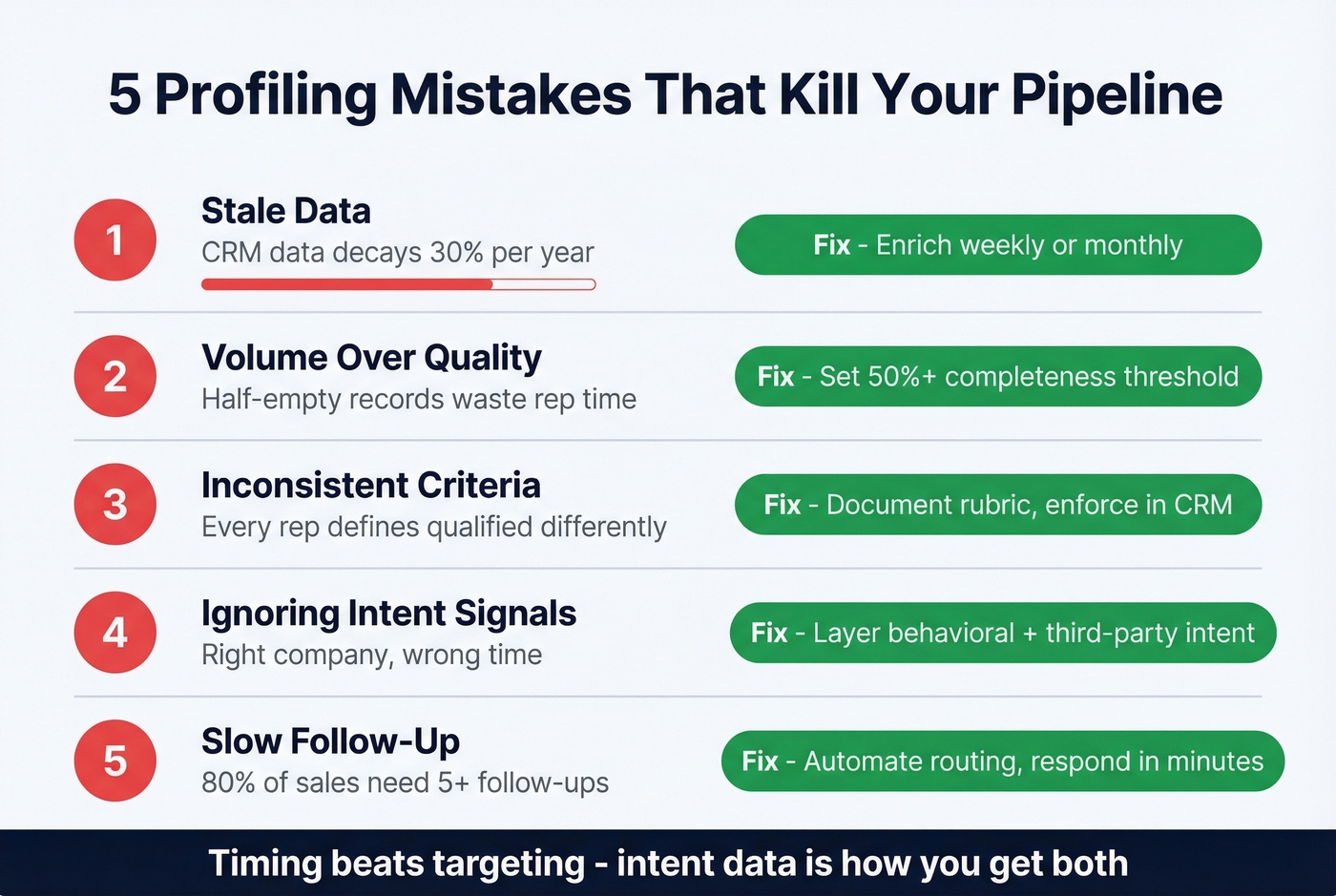
2. Volume over quality. Flooding the pipeline with loosely profiled leads lengthens sales cycles and burns rep capacity. Set a minimum profile completeness threshold - aim for 50%+ before activation - so reps aren't working half-empty records.
3. Inconsistent criteria across reps. When every rep defines "qualified" differently, forecasting becomes fiction. Document your scoring rubric and enforce it in your CRM workflow.
4. Ignoring intent signals. Firmographic fit without behavioral or intent data means you're reaching the right companies at the wrong time. Layer in content engagement, site visits, and third-party buyer intent data. The consensus on r/sales is that timing beats targeting - and intent data is how you get both.
If you want a cleaner way to operationalize this, build a process for identifying buying signals and routing them.
5. Slow follow-up. 80% of sales require five or more follow-ups to close. Letting a Tier A lead sit 48 hours is handing the deal to a faster competitor. Automate routing so top leads hit a rep's queue within minutes.
To speed this up, keep a set of proven sales follow-up templates ready for Tier A leads.
Best Lead Profiling Tools in 2026
Your profiling framework is only as good as the data feeding it. Here are the enrichment tools worth evaluating - and a few you can skip depending on your situation.
| Tool | Starting Price | Database | Email Accuracy | Best For |
|---|---|---|---|---|
| Prospeo | Free; ~$0.01/email | 300M+ profiles | 98% | Accuracy + cost |
| Apollo | Free; $49/mo paid | 275M+ contacts | - | Outbound + enrichment |
| Kaspr | $49/user/mo | 120M+ European contacts | - | European markets |
| Lusha | Free (70 credits) | Not public | - | Small teams |
| ZoomInfo | ~$15K-$50K+/yr | Not public | - | Enterprise orgs |
| Clay | $149/mo | Waterfall model | Varies | Custom workflows |
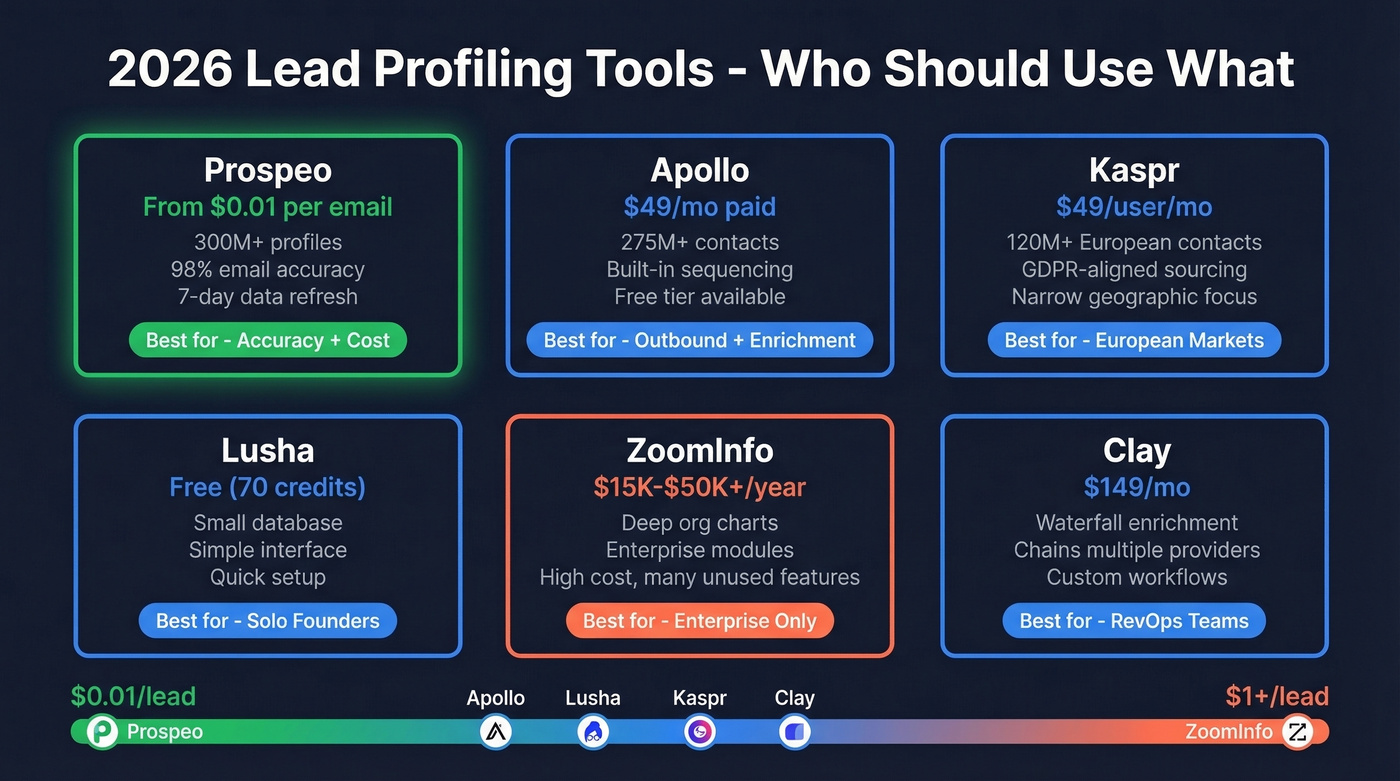
Prospeo is the strongest option for teams that need accurate data without enterprise pricing. The 300M+ profile database covers global markets, email accuracy runs 98% through a proprietary 5-step verification process, and a 7-day refresh cycle means profiles don't go stale. At about $0.01/lead versus roughly $1/lead for ZoomInfo, the cost difference is massive. GDPR compliant with native Salesforce and HubSpot integrations.
Apollo is the pick if you want outbound sequencing and enrichment in one platform. The free tier gives you 75 credits/month to test before committing, and paid plans run $49-$149/user/month. Solid all-rounder, though we've seen email accuracy trail behind dedicated verification tools.
Skip Kaspr unless you're specifically targeting European markets. Its 120M+ European contact database with GDPR-aligned sourcing is purpose-built for that use case and starts at $49/user/month. For global prospecting, it's too narrow.
Lusha works for solo founders or small teams just getting started - the free tier gives you 70 credits/month. Paid plans from $49/user/month. Don't expect enterprise-grade depth.
ZoomInfo remains the enterprise default, but at $15K-$50K+/year, it's overkill for most SMB and mid-market teams. A common complaint on Reddit threads is paying for modules you never activate. For teams with the budget and the need for deep org charts, it still delivers.
Clay takes a different approach - waterfall enrichment chaining multiple data providers. Starting at $149/month, it's best for RevOps teams building custom enrichment workflows who want to orchestrate multiple data sources rather than pick one.
If you're also building outbound motion around these profiles, pair your enrichment with modern sales prospecting techniques so reps act on the data fast.
You just read that CRM data decays 30% per year. Prospeo's weekly data refresh means your lead profiles stay current - not six weeks stale like competitors. With 92% enrichment match rates and 125M+ verified mobile numbers, your reps get the evidence layer they need to prioritize the right leads at the right time.
Give your scoring rubric data it can actually trust.
What's the difference between lead profiling and lead scoring?
Profiling collects and organizes data about a prospect - firmographics, demographics, behavior, and intent. Scoring assigns a numeric value based on that data to prioritize outreach. You can't score what you haven't profiled. The profile is the input, the score is the output.
How often should you update lead profiles?
At minimum, quarterly - CRM data decays roughly 30% per year, so profiles built on six-month-old data are already fiction. Tools with automated refresh cycles handle re-enrichment on your behalf, which eliminates the manual update problem entirely.
What data points matter most for B2B lead profiling?
Job title, company revenue, headcount, industry, tech stack, and recent intent signals like pricing page visits and funding events. Behavioral data separates a useful profile from a static contact record - without it, you know who someone is but not when to reach out.