

The 10 Best Lead Scraping Tools in 2026
You exported 5,000 leads last Tuesday. By Friday, 2,400 had bounced. Your domain reputation took a hit, your sequences stalled, and your SDR team spent the rest of the week manually verifying contacts they should've been calling. The #1 complaint on r/coldemail about popular lead scrapers? "Half the emails are stale or role accounts." That's not a data problem - it's a revenue problem.
Salespeople already spend just one-third of their day actually engaging with prospects. The rest goes to admin, data cleanup, and tool wrangling. Picking the wrong lead scraping tool makes that ratio worse. Picking the right one fixes it.
Our Picks (TL;DR)
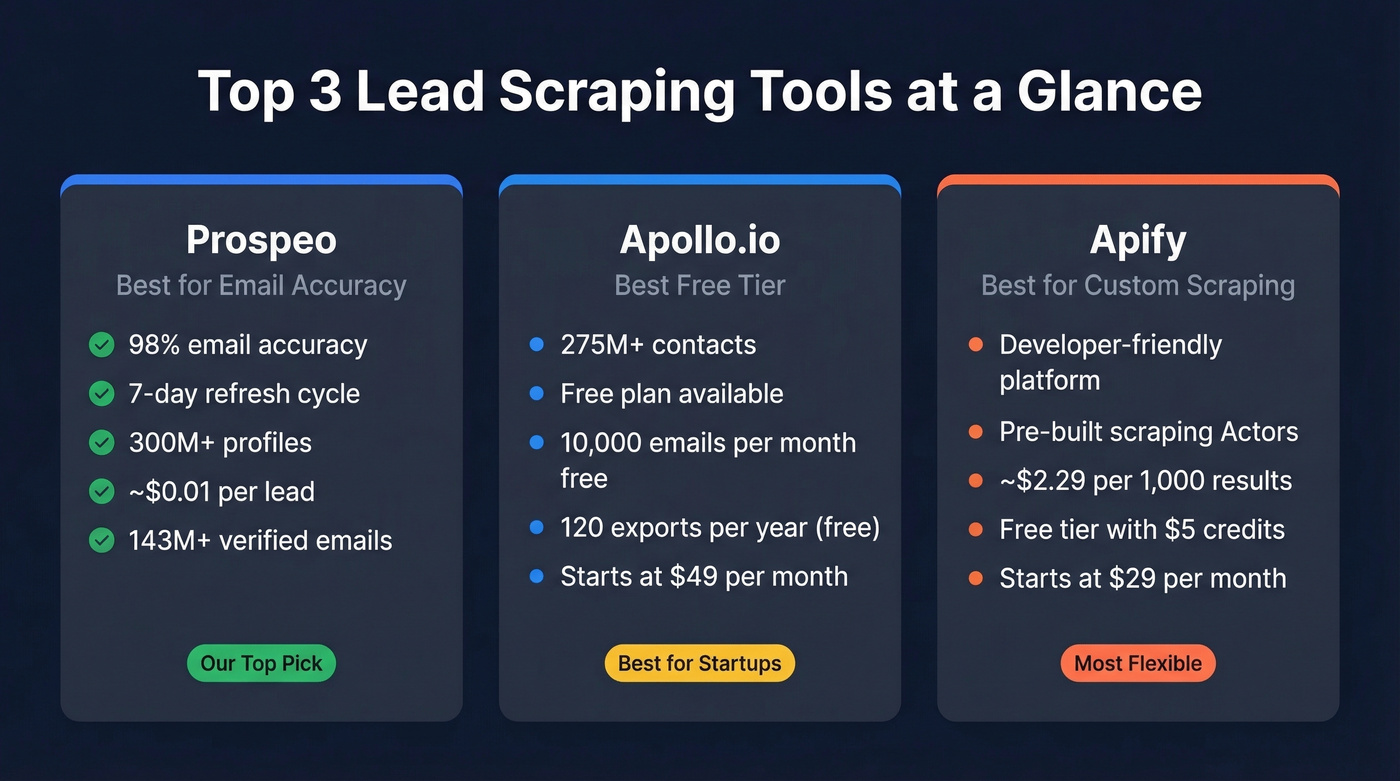
- Prospeo - Best for verified email accuracy and data freshness. 98% email accuracy, 7-day refresh cycle, ~$0.01/lead.
- Apollo.io - Best free tier for getting started. 275M+ contacts. Great for early-stage teams, but data quality degrades at scale.
- Apify - Best for custom scraping workflows beyond standard B2B contacts. Developer-friendly, credit-based, and surprisingly affordable for niche use cases.
How to Choose the Right Tool
Not all lead scrapers solve the same problem. Before you trial anything, run each option through these six criteria.

Data accuracy. This is the only metric that actually matters. 10,000 B2B leads at 70% accuracy is worse than 5,000 at 98%. Your domain reputation, reply rates, and pipeline all depend on whether the emails you're sending actually land. Ask every vendor for bounce rate benchmarks - then test them yourself with a batch of 500-1,000 contacts before committing budget. (If you're troubleshooting bounces, see our email bounce rate benchmarks and fixes.)
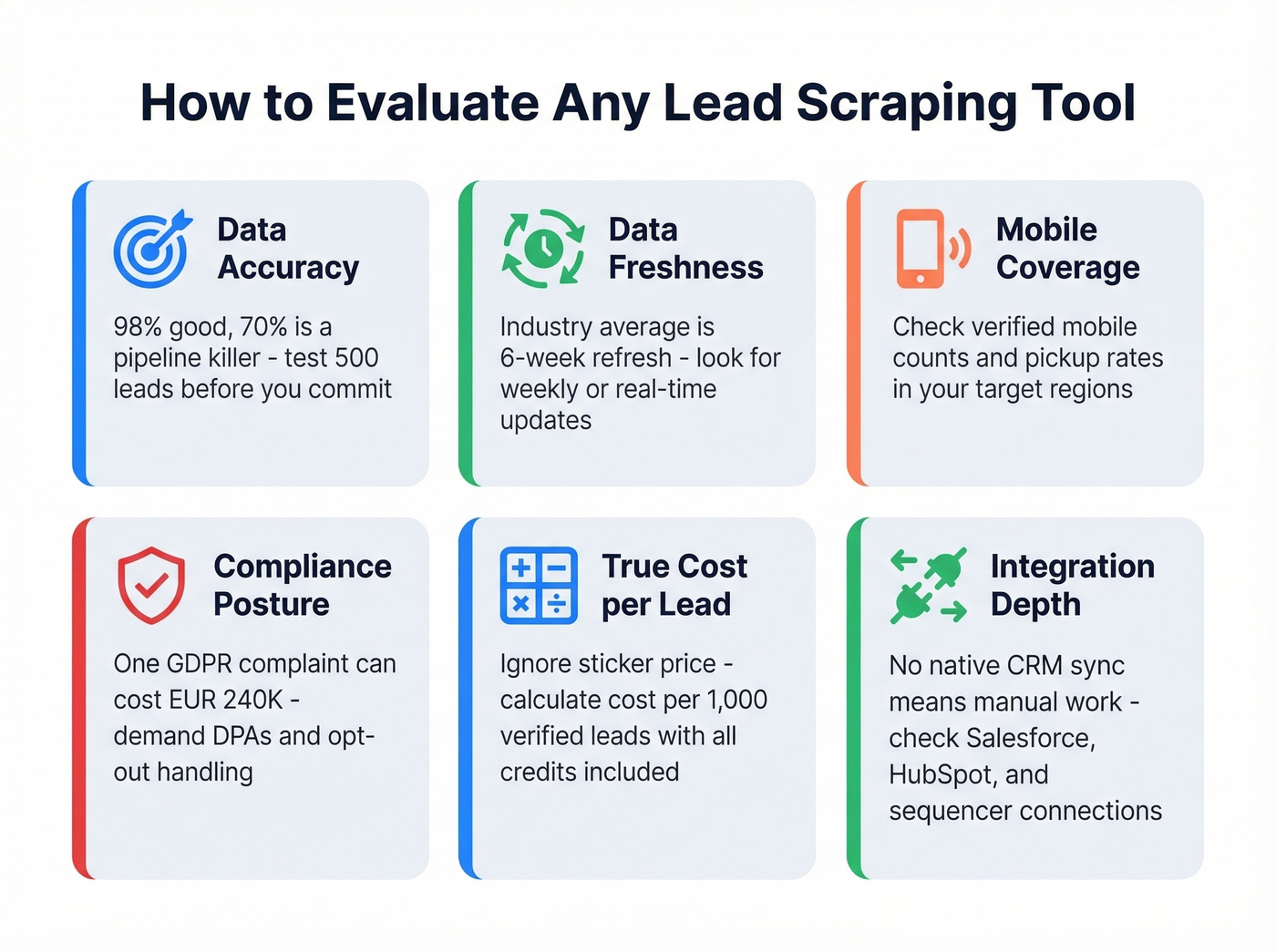
Data freshness. People change jobs every few years. If your sales intelligence platform refreshes data every six weeks (the industry average), you're working with stale records by default. Look for weekly or near-real-time refresh cycles.
Mobile number coverage. Cold calling isn't dead - it's just expensive when you're dialing wrong numbers. Check how many verified mobiles a tool actually has, and what the pickup rate looks like in your target regions. (If calling is core to your motion, build a repeatable cold calling system.)
Compliance posture. One GDPR complaint can cost you EUR 240K. Your lead scraper should handle opt-outs, offer DPAs, and not put you in a gray area. We'll cover this in detail below. (Related: Is It Illegal to Buy Email Lists?)
True cost per lead. A $69/month plan sounds cheap until you realize you need 10 credits per phone number. Do the math on cost per 1,000 verified leads - not just the sticker price.
Integration depth. A prospecting tool that doesn't push directly into your CRM or sequencer creates manual work. Look for native connections to Salesforce, HubSpot, and your outreach platform of choice. (More stack ideas: outbound lead generation tools.)
The 10 Best Lead Scraping Tools in 2026
Prospeo
Prospeo is the tool we'd pick if we could only use one data source. The database covers 300M+ professional profiles with 143M+ verified emails and 125M+ verified mobile numbers with a 30% pickup rate across all regions. The headline stat: 98% email accuracy, backed by a proprietary 5-step verification process that includes catch-all handling, spam-trap removal, and honeypot filtering. (If you want more options in this category, see data enrichment services.)

What separates Prospeo from the pack is the 7-day data refresh cycle. Most competitors refresh every 4-6 weeks, so by the time you're sending, a chunk of your list has already decayed. Weekly re-verification means fewer bounces, fewer stale contacts, and less time cleaning lists. The 30+ search filters include buyer intent data via Bombora (15,000 topics), technographics, job changes, headcount growth, and funding signals. The Chrome extension - used by 40K+ people - lets you pull verified contacts from any website or CRM in one click. (More on list building workflows: Clay list building.)
Snyk's 50-person AE team went from a 35-40% bounce rate to under 5% after switching, generating 200+ new opportunities per month. That's not a marginal improvement - that's a different pipeline.
Pricing runs ~$0.01 per email, with a free tier offering 75 verified emails and 100 Chrome extension credits monthly. No contracts, no sales calls, self-serve onboarding. Native integrations with Salesforce, HubSpot, Smartlead, Instantly, Lemlist, Clay, Zapier, and Make. (If you're comparing vendors, start with Best Sales Prospecting Databases.)
Apollo.io
Use this if: You're an early-stage team that needs volume and can't justify a paid tool yet. Apollo's database covers 275M+ contacts, and its free plan is a solid way to start building lists and testing outbound.
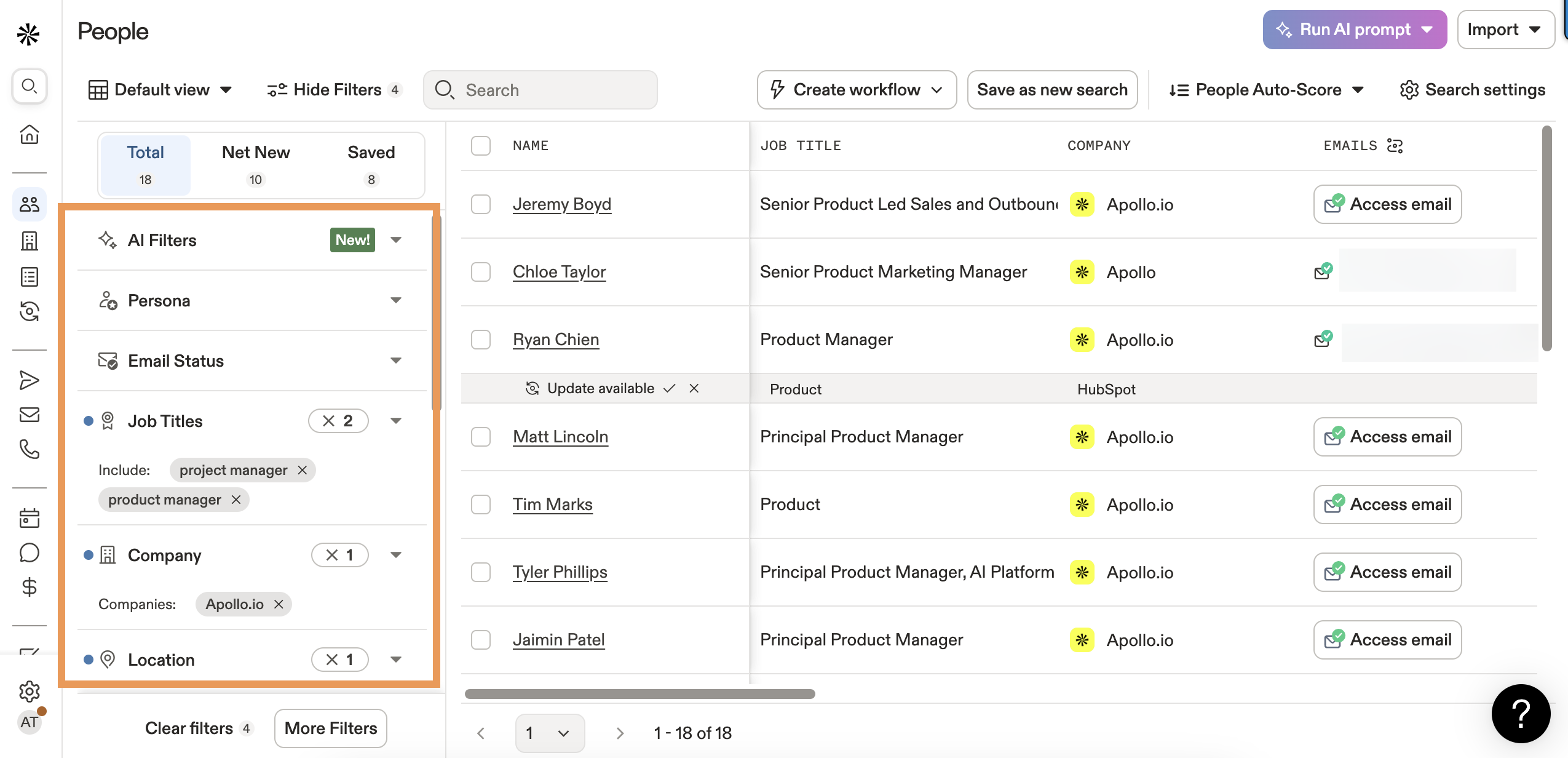
Skip this if: You're running high-volume outbound and can't afford bounces. The freshness problem is real - Reddit threads consistently flag stale emails and role accounts at scale. We've seen teams start with Apollo, hit 15-20% bounce rates on their first big campaign, and switch within a quarter. (If you're doing cold email at scale, use a structured B2B cold email sequence.)
Apollo's free plan includes unlimited email credits (10,000/month) but only 120 export credits per year, so you'll hit export limits fast if you're trying to scale on free. Paid plans start at $49/mo per user billed annually. The data is broad but not deep, and there's no weekly refresh. For getting started, it's unbeatable. For scaling, you'll outgrow it.
ZoomInfo
ZoomInfo is the enterprise default - and the tool most teams realize they're overpaying for within six months. The contact database is massive, the intent data is strong, and the workflow features are useful if you actually turn them on.
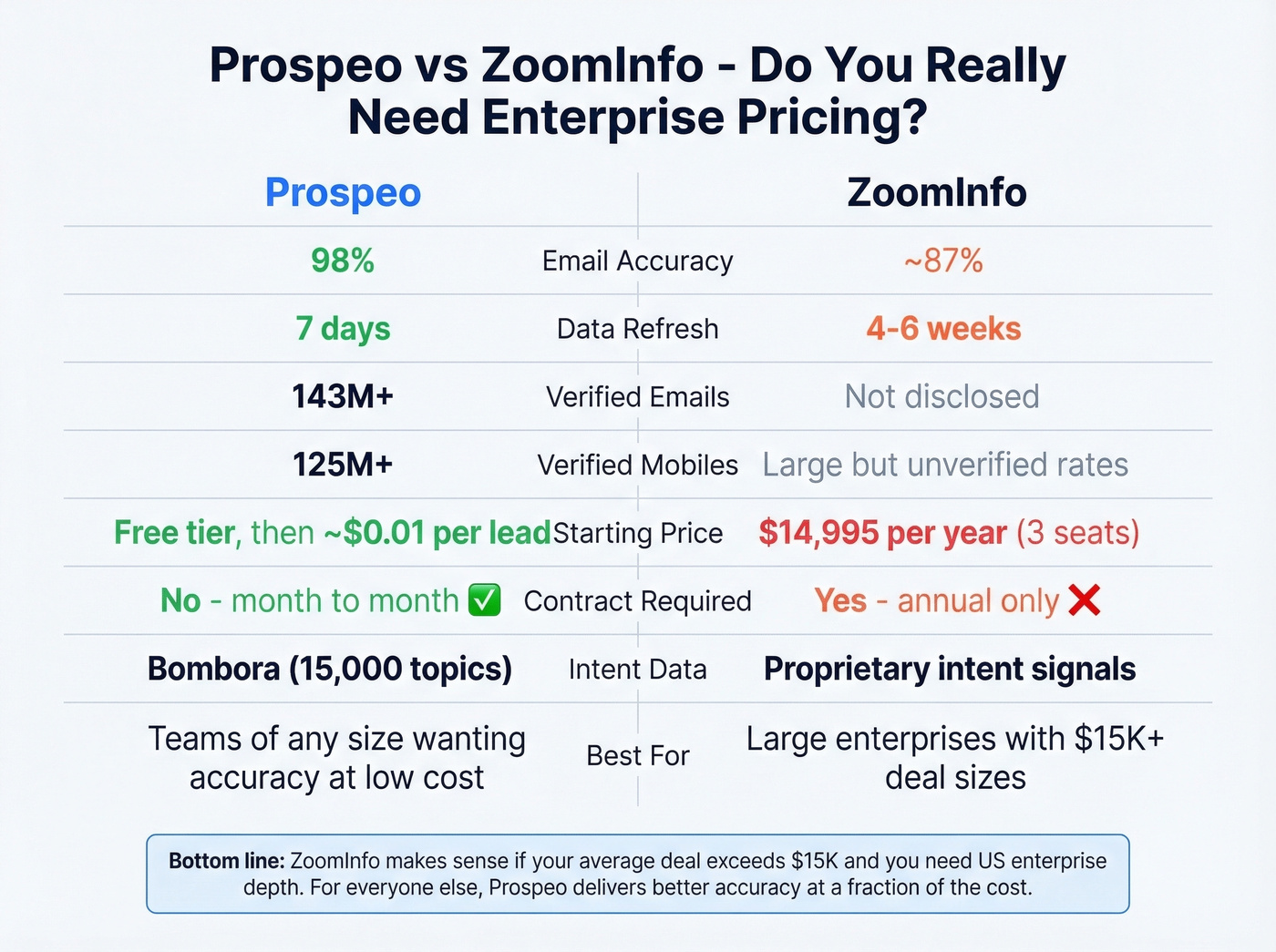
Here's the thing: if your average deal size sits below $15K, you almost certainly don't need ZoomInfo-level data. The ROI math just doesn't work.
The problem is price. Professional+ starts at $14,995/year for 3 seats. Most teams pay $30K-$75K+ once you add modules, extra seats at $2,500 each, and global data at $9,995. Vendr data shows actual spend ranges from ~$25K for a 200-person company to $160K+ for enterprises with 1,000+ employees. Annual contracts only. Credit costs range from $0.20-$0.60 each, which means your cost per 1,000 verified leads can easily exceed $1,000. One silver lining: negotiation discounts of 30-65% are common, so never pay list price.
Where ZoomInfo still wins: US database depth, workflow breadth, and brand recognition that makes procurement teams comfortable. Where it loses: price transparency, data freshness with no weekly refresh, and email accuracy around 87% - meaning you're still verifying contacts after paying enterprise prices.
PhantomBuster
PhantomBuster isn't a database - it's an automation engine. You build scraping workflows called "Phantoms" that extract data from professional profiles, company pages, and web sources, then chain them together for enrichment and outreach.
Pricing is per workspace, not per user. The catch is execution-time caps. The Start plan at $69/mo ($56/mo billed annually) gives you 20 hours of execution time per month with 5 concurrent automations. Grow at $159/mo bumps that to 80 hours and 15 slots. Scale at $439/mo gets you 300 hours and 50 slots. A complex multi-step workflow can burn through hours fast, so model your usage before committing.
Best for teams with dev resources who need custom automation beyond what a standard database offers. Not ideal as your primary lead source - you'll want to pair it with a verified data provider for the actual contact info.
Lusha
Lusha's Chrome extension is fast and the interface is clean. But the economics get ugly at scale.
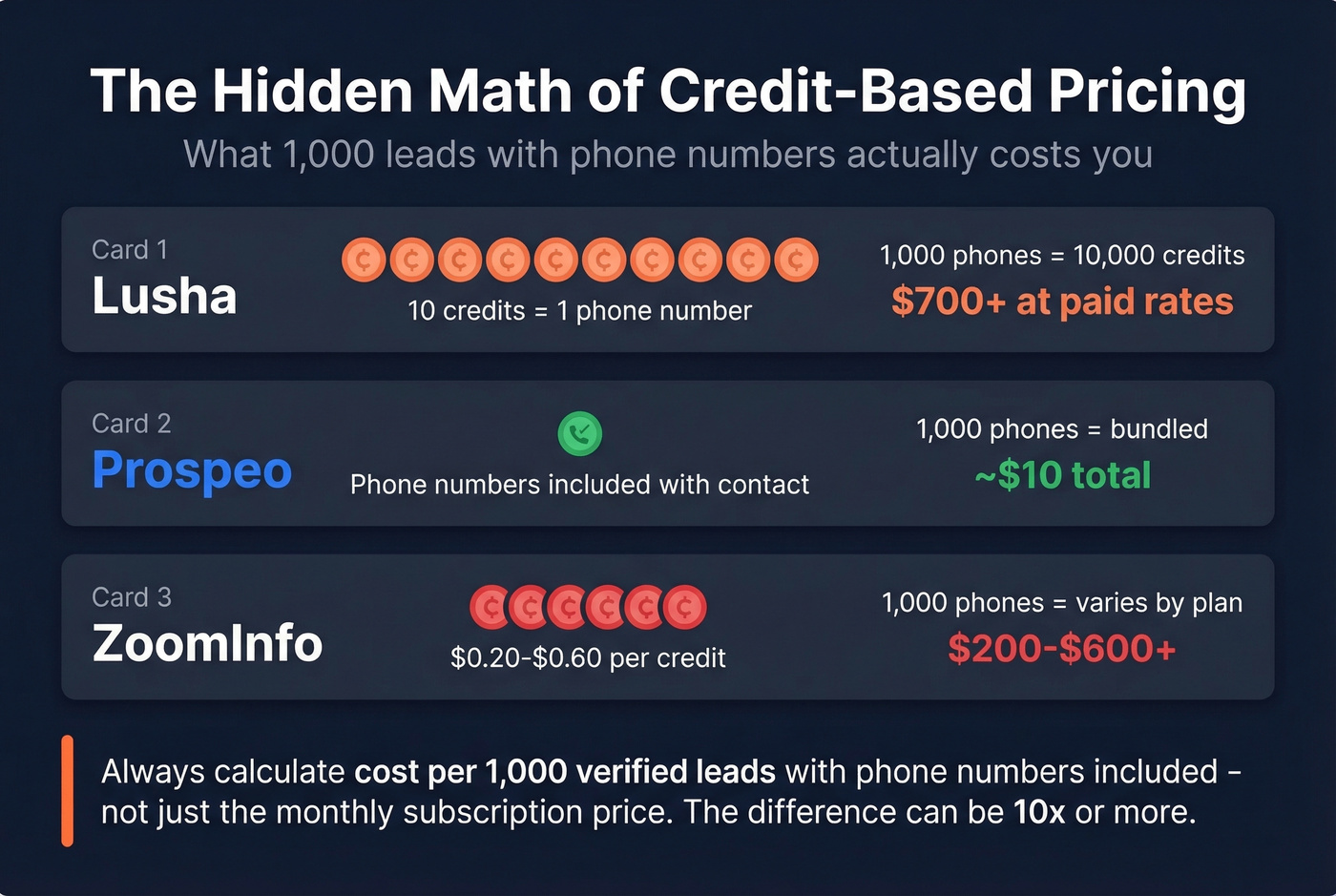
Revealing a verified email costs 1 credit. Revealing a phone number costs 10 credits. That means your 70 free monthly credits get you either 70 emails or 7 phone numbers - not both. On a paid plan starting around $49/mo, the phone-number cost is punishing for teams that rely on cold calling. At scale, Lusha's cost per mobile lead is significantly higher than tools with bundled phone data.
Lusha is dramatically cheaper and faster to deploy than ZoomInfo, which makes it a popular mid-market choice. But if you need depth and freshness, it falls short of the best options on this list. The refresh cycle lags behind weekly options, and the database is thinner than top-tier tools.
Apify
Apify is the developer's choice - a cloud scraping platform with pre-built "Actors" for common tasks and the flexibility to build custom scrapers for anything. In a test run, the Contact Details Scraper extracted 68 results in 43 seconds using $0.156 of credits. That's roughly $2.29 per 1,000 results. (If you're evaluating similar tools, see ScrapingBee alternatives.)
Paid plans start at $29/mo, with a free tier offering $5 in monthly credits. The tradeoff is technical skill - Apify requires more hands-on work than a point-and-click database. If you need to scrape niche directories, industry-specific sites, or custom data sources that no B2B database covers, Apify is the right tool. For standard contact data, a dedicated B2B platform will be faster.
Snov.io
Snov.io bundles lead finding with email outreach - scrape, verify, and send sequences from one platform. Plans start at roughly $30/mo. The database isn't as deep as Apollo or the top-tier players, but the all-in-one workflow appeals to solo founders and small teams who don't want to manage multiple tools. Email verification is built in, which saves a step and a subscription.
UpLead
UpLead's differentiator is real-time email verification - every contact is verified at the point of export, not days or weeks before. Plans run $99-$399/mo depending on credits. It's a solid choice for US-focused teams that need clean data without a separate verification step. The database is smaller than the big players, so coverage outside North America thins out noticeably. Think of UpLead as the "no surprises" option: what you export is what you get.
Lead Scrape
A downloadable desktop application for Windows and Mac at $97/year standard or $247/year business. It scrapes business directories and exports to CSV. No CRM integrations, no verification, no enrichment. This is a budget option for local lead gen - not a serious B2B prospecting tool. If you're building a list of plumbers in Phoenix, it works. For anything else, look elsewhere.
Outscraper
Outscraper specializes in Google Maps scraping - extracting business data from local listings. It's free for the first 500 businesses, then $6 per 1,000 records from 501 to 100,000, and $2 per 1,000 after that. For teams building lists of local businesses like restaurants, agencies, or contractors, it's purpose-built and efficient. For B2B contact data with emails and direct dials, it's the wrong tool entirely.

You just read about teams hitting 35%+ bounce rates from stale scraped data. Prospeo's 7-day refresh cycle and 5-step verification deliver 98% email accuracy - so every lead you export is one you can actually reach. At ~$0.01 per email, fixing your data costs less than one bounced campaign.
Stop cleaning lists. Start closing deals with data that's verified weekly.
Pricing and Accuracy Compared
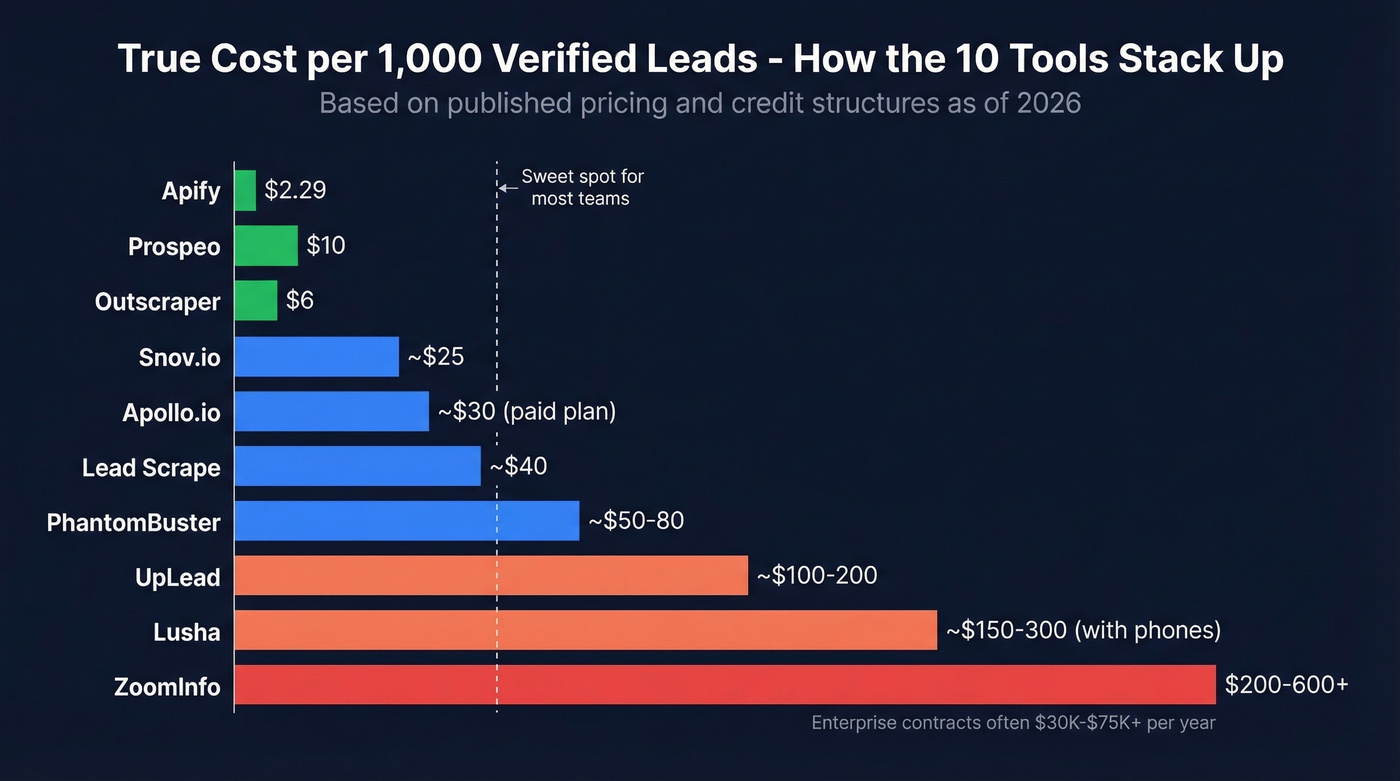
Cost per 1,000 verified leads is the metric that actually matters - not the monthly sticker price. Here's the primary comparison:
| Tool | Best For | Email Accuracy | Starting Price | Cost/1K Leads |
|---|---|---|---|---|
| Prospeo | Verified accuracy leader | 98% | Free / ~$39/mo | ~$10 |
| Apollo.io | Free-tier volume | ~79-82% | Free / $49/mo | ~$49+ |
| ZoomInfo | Enterprise depth | ~87% | $14,995/yr | ~$1,000+ |
| PhantomBuster | Custom automation | Varies | $69/mo | ~$69+ |
| Lusha | Quick lookups | ~85% | Free / ~$49/mo | ~$70 |
| Apify | Custom scraping | Varies | Free / $29/mo | ~$2.29 |
| Snov.io | All-in-one for solos | ~82% | ~$30/mo | ~$30 |
| UpLead | Real-time verification | ~90% | ~$99/mo | ~$99 |
| Lead Scrape | Local lead gen | Unverified | $97/yr | ~$97/yr flat |
| Outscraper | Google Maps data | N/A | Usage-based | ~$6 |
And the data depth breakdown:
| Tool | Mobile Numbers | Data Refresh | Key Integrations |
|---|---|---|---|
| Prospeo | 125M+ verified (30% pickup) | 7 days | Salesforce, HubSpot, Clay, Zapier |
| Apollo.io | Limited | 4-6 weeks | Salesforce, HubSpot, Outreach |
| ZoomInfo | Extensive (US-heavy) | 4-6 weeks | Salesforce, HubSpot, Salesloft |
| PhantomBuster | N/A (scrape your own) | N/A | Zapier, webhooks |
| Lusha | Moderate (expensive per reveal) | 4-6 weeks | Salesforce, HubSpot, Outreach |
| Apify | N/A | N/A | API, webhooks |
| Snov.io | Limited | 4-6 weeks | Salesforce, HubSpot, Pipedrive |
| UpLead | Moderate | Real-time | Salesforce, HubSpot, Zoho |
| Lead Scrape | None | None | CSV export only |
| Outscraper | Business phones only | N/A | API, Google Sheets |
The gap between ~$10 per 1,000 verified leads and ~$1,000+ isn't a rounding error. It's an order of magnitude.
The best lead scraping tool isn't the one with the most contacts - it's the one where contacts actually pick up. Prospeo gives you 125M+ verified mobiles with a 30% pickup rate, 143M+ verified emails, and 30+ filters including buyer intent and technographics. No contracts, no sales calls required.
Get 75 free verified emails and see the accuracy difference yourself.
Is Lead Scraping Legal in 2026?
Most lead scraping guides ignore compliance entirely. That's a mistake - one GDPR complaint away from a EUR 240K fine.
The legal picture is nuanced. In the US, the hiQ Labs v. LinkedIn decision (2017-2022) established that scraping publicly accessible data doesn't constitute "unauthorized access" under the CFAA. That's good news for scraping public business information.
But three counterweights matter. First, KASPR was fined EUR 240,000 by France's CNIL for collecting professional data without appropriate consent - public visibility doesn't remove privacy obligations under GDPR. Second, Meta v. Bright Data (2024) showed that Terms of Service restrictions can still create legal exposure even when data is technically public. Third, GDPR penalties run up to EUR 20M or 4% of global annual revenue.
Real talk: robots.txt is a crawl instruction file, not a legal contract. Respecting it is good practice, but it doesn't make you compliant. Compliance at scale requires lawful basis for processing personal data, functioning opt-out workflows, and retention policies that actually get enforced.
The safest approach? Use a GDPR-compliant database with opt-out enforcement and DPAs built in - rather than building raw scraping pipelines and hoping for the best.
How to Use a Lead Scraper Effectively
A practitioner on Reddit pulled 5,000 leads in 3 days, sent 1,400 emails, and booked 9 calls. That's a realistic benchmark for a decent B2B data source - not a moonshot, but enough to build pipeline if you're consistent.
Let's break down the workflow that actually works:
- Define your ICP. Job titles, industries, company size, geography. Tighter filters mean higher conversion downstream. (Use an ideal customer profile template to score accounts.)
- Layer intent signals. Add technographics, job changes, and headcount growth to find buyers who are actually in-market - not just people who match a job title.
- Scrape and export. Pull your list to CSV or push directly to your CRM.
- Verify emails. Non-negotiable. Even "verified" databases have decay. Run everything through verification before sending.
- Enrich with mobile and firmographic data. Direct dials, revenue, tech stack, and funding data help you prioritize who to call first.
- Launch outreach while data is fresh. Sync to your sequencer and start reaching out. Every day you wait, contacts decay.
You don't need 10 tools. You need one good data source and one good outreach tool. Everything else is overhead.
FAQ
Is lead scraping legal?
Yes, with caveats. Public data scraping is generally permitted under US law per the hiQ v. LinkedIn ruling, but GDPR requires a lawful basis for processing personal data. Use compliant tools that enforce opt-outs and offer DPAs. Scraping without a compliance framework is a gamble you'll eventually lose.
What's the best free lead scraper?
Apollo offers the largest free-tier database at 275M+ contacts with 10K email credits/month, but caps exports at 120/year. Prospeo's free plan includes 75 verified emails plus 100 Chrome extension credits monthly with full enrichment - better for small teams running real campaigns where accuracy matters more than volume.
How accurate are lead scraping tools?
Industry average hovers around 80-87%. The best tools hit 98% with multi-step verification. ZoomInfo runs about 87%, Apollo sits around 79-82% at scale. Always run a test batch of 500-1,000 contacts before committing - accuracy claims are easy to make and hard to verify without your own data.
What's the difference between lead scraping and web scraping?
Web scraping extracts any data from websites - prices, reviews, product listings, anything. Lead scraping specifically extracts contact information like emails, phone numbers, and job titles from business databases or professional profiles. Lead scraping tools add verification and enrichment layers that general web scrapers don't.
How much should a lead scraping tool cost?
Stop auditing tools and start auditing your data. Pick one lead scraping tool with verified accuracy, plug it into your outreach stack, and move on. The best option is the one that gives you contacts you can actually reach - not the one with the biggest database or the longest feature list.