

B2B Lead Sources: Benchmarks, Tracking Templates, and What Actually Converts
Your CMO asks which channels drive pipeline. You pull the report and find 47 variations of "Google" - "Google," "google," "Google Search," "Organic - Google," and the ever-popular "Goolge." Nobody trusts the data, so the budget conversation turns into gut feelings and whoever argues loudest. This is the lead sources problem, and it's more common than anyone admits.
The lead generation software market passed $7.4B in 2025 and keeps growing. B2B buyers now engage across 10 channels before purchase - up from 5 in 2016. More channels means more attribution complexity, which means your source tracking either works or it's fiction.
The Short Version
The top-converting B2B lead sources are SEO (2.6% conversion rate) and email marketing (2.4%). Everything else trails behind. If you only do two things after reading this:
- Set up a two-field CRM taxonomy (Lead Source + Lead Source Detail). This is the single highest-leverage operational fix for attribution.
- Verify your contact data before you measure anything. If a third of your emails bounce, you're measuring delivery failures, not channel performance (see email bounce rate benchmarks and fixes).
What Is a Lead Source?
A lead source is the origin where a prospect first becomes aware of your business. It answers "how did this person find us?" - not "what did we send them" or "which campaign touched them last."
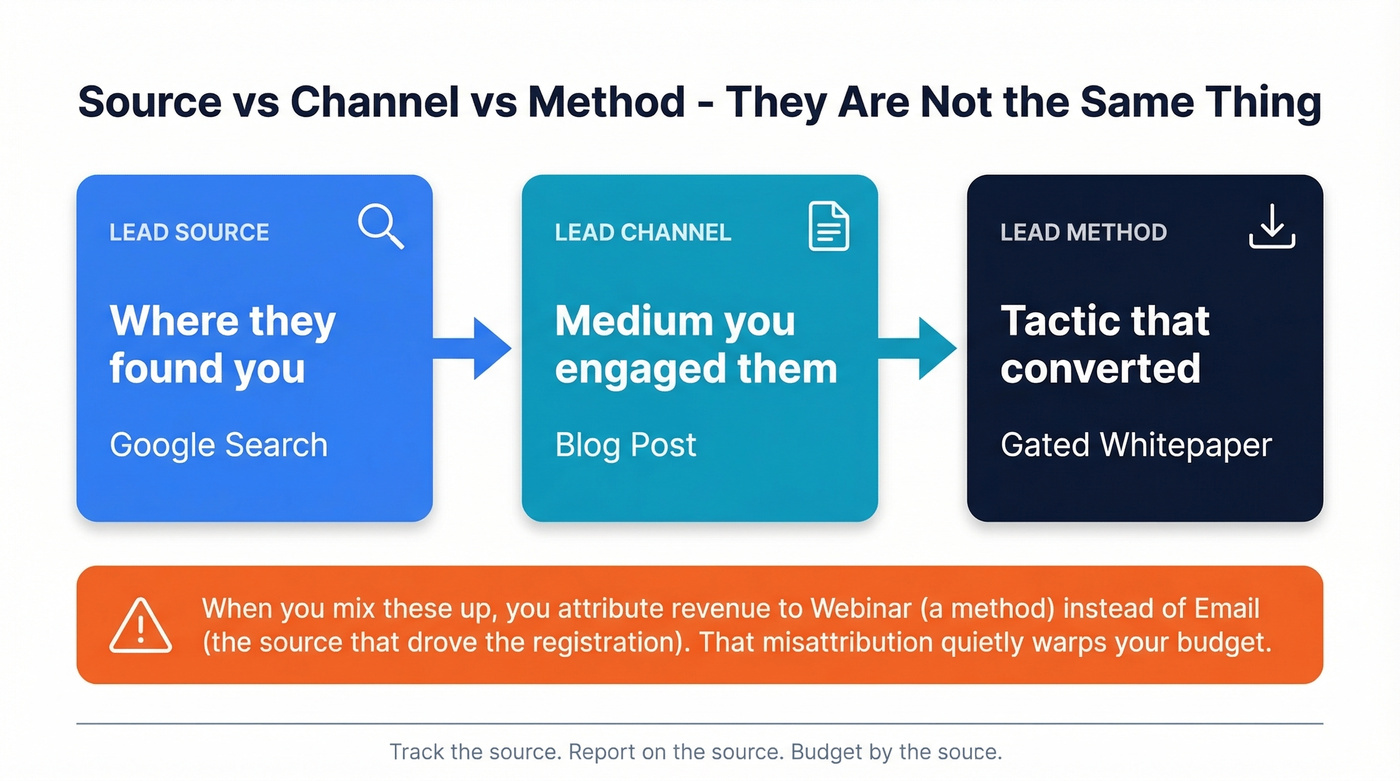
The confusion starts because teams use "source," "channel," and "method" interchangeably. They aren't the same thing.
| Concept | Definition | Example |
|---|---|---|
| Lead Source | Where they found you | Google search |
| Lead Channel | Medium you engaged them | Blog post |
| Lead Method | Tactic that converted | Gated whitepaper |
When you mix source and channel, you attribute revenue to "Webinar" (a method) instead of "Email" (the source that drove the registration). That misattribution compounds across hundreds of deals and quietly warps your budget allocation - we've seen teams shift six figures in spend based on data that was fundamentally wrong because of this exact confusion.
Best B2B Lead Sources (2026 Benchmarks)
Not all sources convert equally. Here's what the conversion rate benchmarks actually shows, ranked by B2B conversion rate:
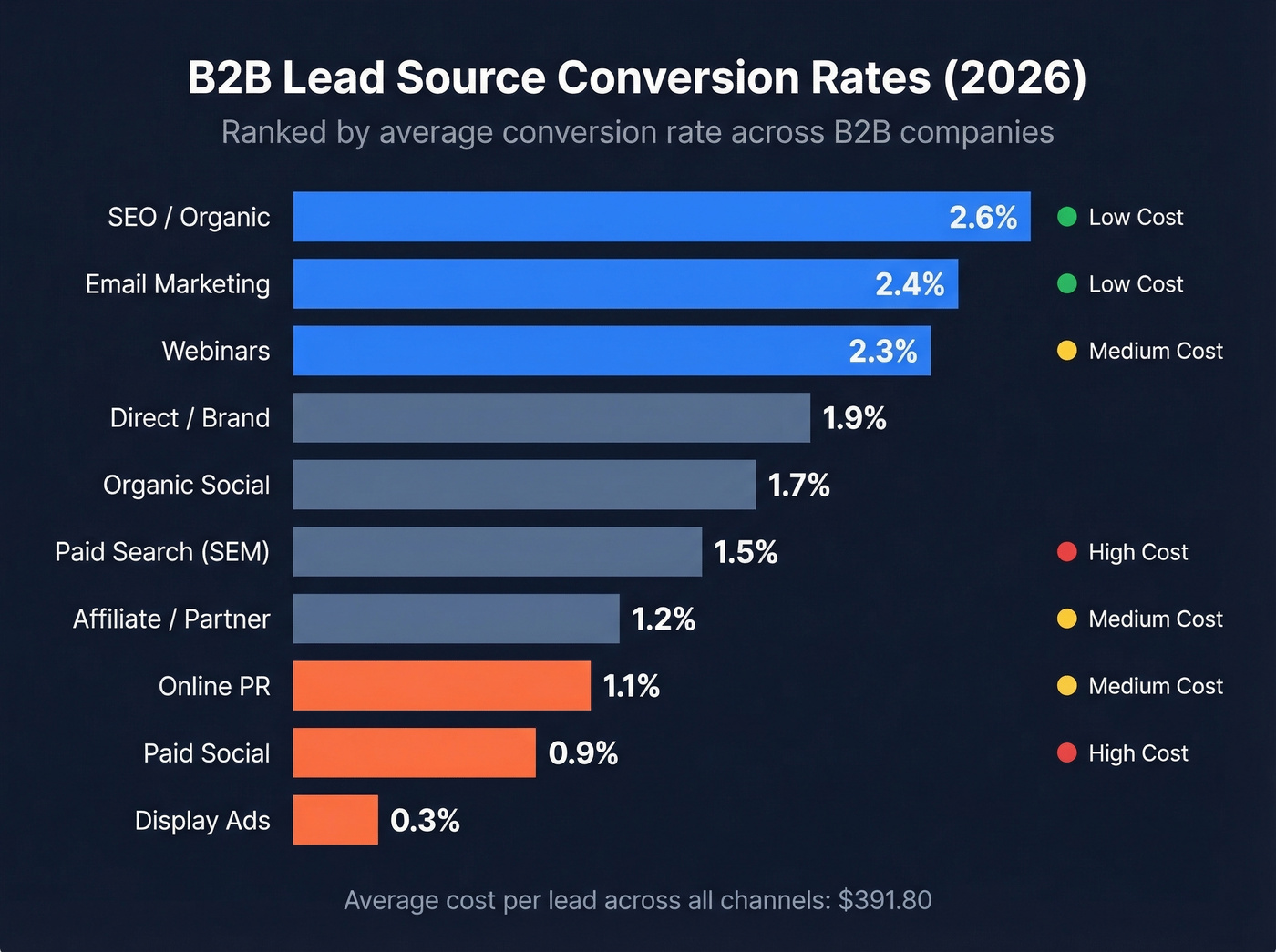
| Lead Source | Conversion Rate | Relative Cost | Scalability |
|---|---|---|---|
| SEO / Organic | 2.6% | Low (time) | High |
| Email Marketing | 2.4% | Low | High |
| Webinars | 2.3% | Medium | Medium |
| Direct / Brand | 1.9% | Low | Low |
| Organic Social | 1.7% | Low | Medium |
| Paid Search (SEM) | 1.5% | High | High |
| Affiliate / Partner | 1.2% | Medium | Medium |
| Online PR | 1.1% | Medium | Medium |
| Paid Social | 0.9% | High | High |
| Display Ads | 0.3% | High | High |
The average cost per lead across channels is $391.80. In our experience, most teams over-invest in the bottom half of this table and under-invest in the top two.
SEO / Organic Search
At 2.6%, organic search converts better than any paid channel. The tradeoff is time - 6 to 12 months before compounding kicks in. But once it does, marginal cost per lead approaches zero. Every B2B company should treat SEO as infrastructure, not a campaign (especially if you're building SEO sales leads as a repeatable motion).
Email Marketing & Outreach
Email is the highest-ROI B2B pipeline source - and it isn't close. A 2.4% conversion rate, 27.7% average open rate, and 5.1% response rate on cold outreach make it the workhorse of pipeline generation. One detail worth knowing: turning off open tracking can nearly double your reply rate (2.36% vs 1.08%).
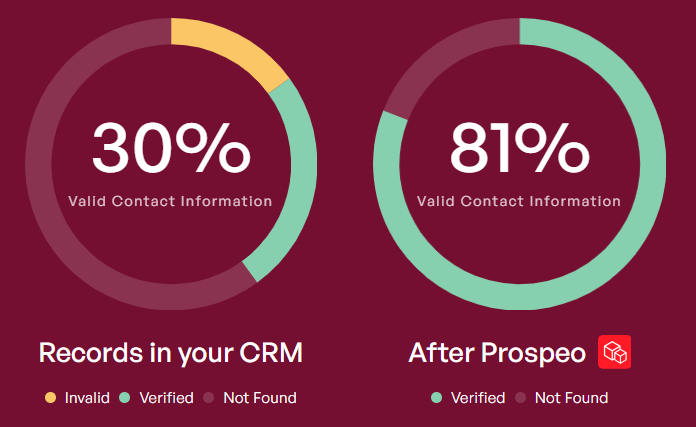
Those benchmarks assume deliverable data. If your contact list is 30% invalid, your real conversion rate craters and email looks worse than it is. Clean data isn't a nice-to-have - it's the prerequisite for measuring anything accurately (start with an email deliverability guide before scaling volume).

Webinars & Events
Webinars convert at 2.3% - third-best on this list. In-person events convert well too, but the CPL is brutal once you factor in travel, booth costs, and three days your reps aren't selling. Virtual events win on unit economics for most teams under 50 reps.
Paid Search (SEM)
SEM converts at 1.5% - respectable, but expensive. It's the fastest way to buy pipeline when you need leads this quarter. The danger is dependency: the moment you stop spending, the leads stop.
Organic Social
At 1.7%, organic social outperforms its paid counterpart by nearly 2x. The catch: "organic social" in B2B usually means one person's personal brand driving all the engagement. It works, but it doesn't transfer when that person leaves.
Paid Social
Here's the thing: paid social is a brand awareness play that gets mislabeled as lead gen. You spend $15K/month, get 200 leads, three become opportunities. That's $5,000 per opportunity - before any close. At 0.9% conversion, measure it against awareness metrics, not pipeline.
Referrals
Referrals routinely convert at 2-5x the rate of paid channels. The problem is they don't scale predictably. You can't budget for referrals the way you budget for SEM. Treat them as a bonus, not a strategy.
Content Marketing
Content is the engine behind SEO and email - it doesn't generate leads on its own. Track the distribution channel as the source, not "content marketing" generically. A blog post that ranks is an SEO lead. A blog post you emailed is an email lead. This distinction matters more than most teams realize, and getting it wrong is one of the fastest ways to inflate a channel that isn't actually performing (see what is B2B content marketing for a clean definition).
Affiliate & Partner
At 1.2%, partner leads are mid-tier converters. The real value is someone else doing the prospecting. The real risk is quality variance - partner-sourced leads need the same qualification rigor as any other source.
Direct / Brand
Direct traffic converts at 1.9%, which tells you something important: people who already know your brand convert well. This is the argument for investing in brand even when attribution is hard.
Display Ads
At 0.3%, display is lighting money on fire for lead gen purposes. Skip it as a primary pipeline source. Use it for retargeting or brand awareness with appropriate expectations.

Email converts at 2.4% - but only when your data is deliverable. Prospeo's 98% email accuracy and 5-step verification means you're measuring real channel performance, not bounce rates. At $0.01 per email, bad data is no longer an excuse.
Stop measuring delivery failures. Start measuring conversions.
Attribution & Compliance for Purchased Leads
Purchased leads add complexity most teams ignore until it's too late. When you buy leads from a vendor, your CRM should track the vendor name and their traffic channel. "Vendor - LeadCo" isn't enough. "Vendor - LeadCo - Facebook Ads" tells you whether that vendor's leads are worth renewing.
The compliance angle is real. Under TCPA, you need proof of where, when, and how consent was captured. If a vendor can't provide that documentation, those leads are a liability. TrustedForm documents consent at capture; LeadConduit standardizes and routes leads before they reach your CRM.
Track quality metrics by vendor: conversion to opportunity, revenue per lead, and rejection rate. A vendor with a $5 CPL and a 0.2% opportunity rate is more expensive than one with a $50 CPL and a 3% opportunity rate. We've watched teams celebrate "cheap leads" for two quarters before realizing they'd generated almost zero pipeline from them.
How to Track Lead Sources in Your CRM
The Two-Field Model
This is the template most guides skip. The LeanScale taxonomy gets it right with two fields:
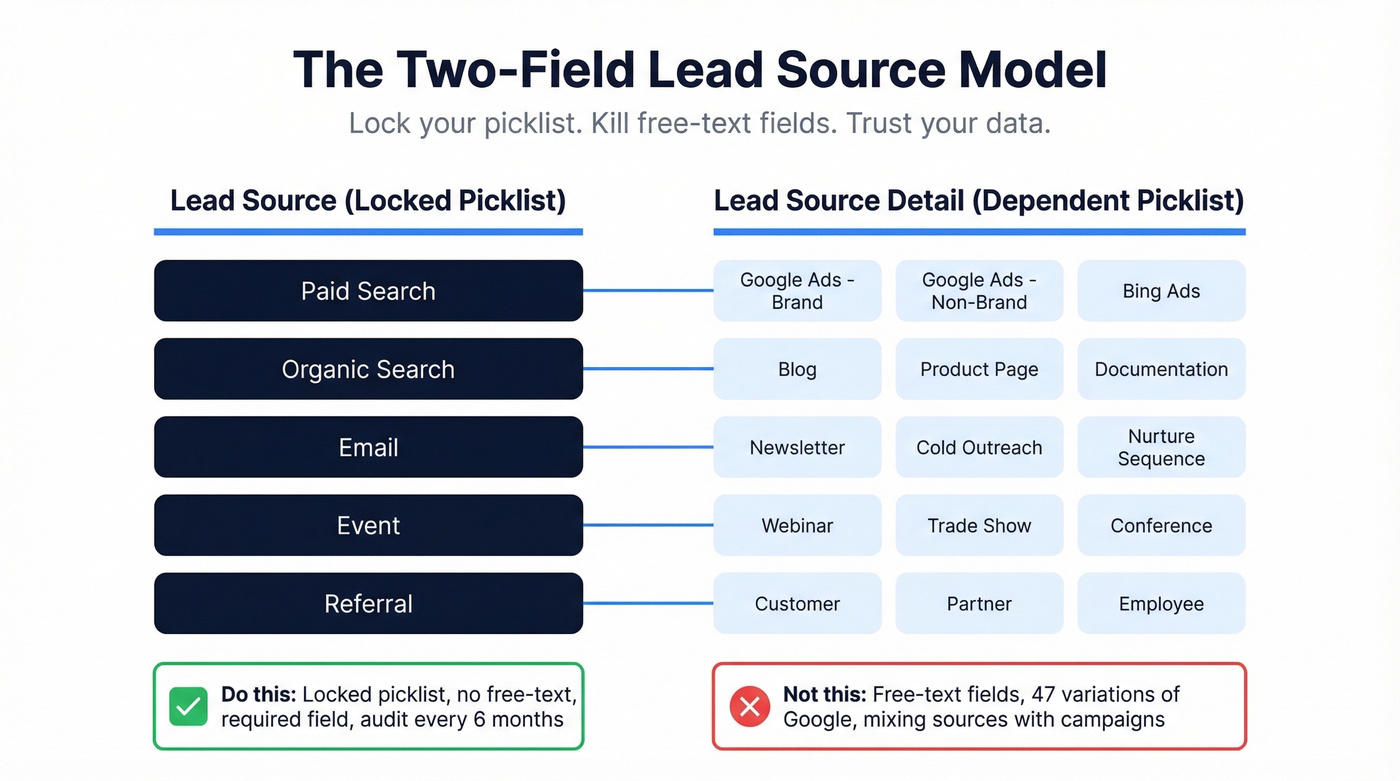
- Lead Source - a locked picklist with 8-12 broad categories
- Lead Source Detail - a dependent picklist for granularity
The field dependency logic means selecting "Paid Search" as the source only shows relevant detail options. Small business owners on Reddit describe GA and UTMs as "too complicated" - this two-field CRM model works better for most teams because it forces clean data at the point of entry.
| Lead Source (Picklist) | Lead Source Detail (Dependent) |
|---|---|
| Paid Search | Google Ads - Brand, Google Ads - Non-Brand, Bing Ads |
| Organic Search | Blog, Product Page, Documentation |
| Newsletter, Cold Outreach, Nurture Sequence | |
| Event | Webinar, Trade Show, Conference |
| Referral | Customer, Partner, Employee |
Salesforce Validation Rule
Add this validation rule to prevent deals from closing without a source:
AND(
  ISBLANK(LeadSource),
  ISPICKVAL(StageName, "Closed Won")
)
This blocks any opportunity from moving to Closed Won without a Lead Source value. Simple, effective, and it surfaces data gaps within the first week. Salesforce runs $25-$550/user/month depending on edition - this rule works on all of them (and pairs well with a broader Salesforce pricing reality check).
HubSpot Setup
HubSpot auto-populates an "Original Source" property on first touch, which is a nice head start. Add a custom "Lead Source Detail" property to mirror the two-field model. The free CRM tier handles this; paid plans at $15-$150/month/user add automation and reporting depth. The HubSpot community has solid threads on mapping Original Source values to your custom taxonomy.
5 Ways Lead Source Tracking Breaks
Inconsistent Naming
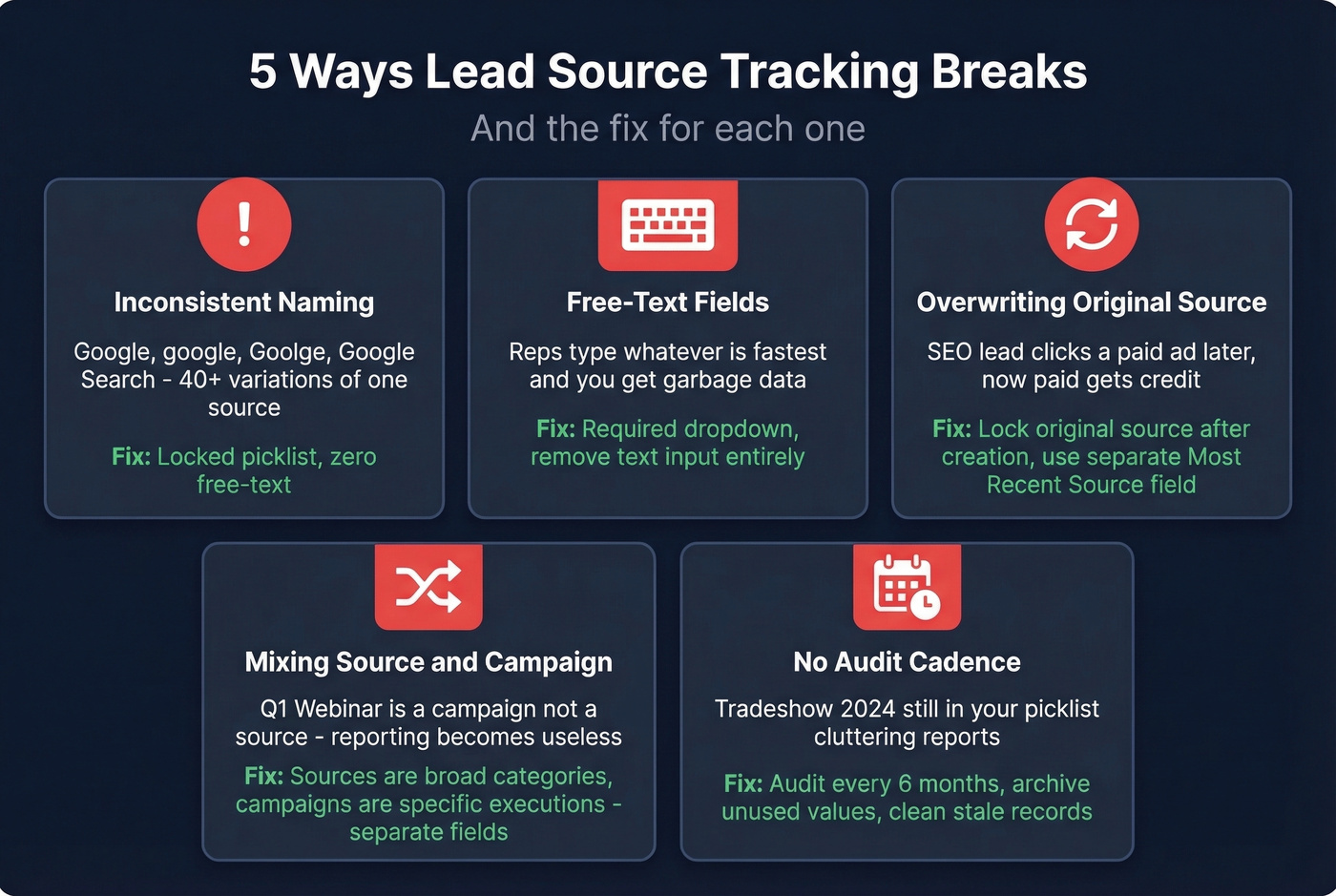
"Google," "google," "Google Search," "Organic - Google," "Goolge" - five sources that are one. We've seen CRMs with 40+ variations of a single source. On r/salesforce, new admins regularly ask how to connect Campaigns to Lead Source - the confusion is universal. The fix is a locked picklist with no free-text option. Period.
Free-Text Fields
Sales reps ignore dropdowns and type whatever's fastest. Make the field required and remove the free-text option entirely. If reps can type, they will type nonsense.
Overwriting Original Source
A lead finds you through organic search, then clicks a paid ad six months later. If your CRM overwrites the original source, you've just credited paid search for a lead that SEO earned. Lock the original source field after creation. Use a separate "Most Recent Source" field for later touches.
Mixing Source and Campaign
"Q1 Webinar" is a campaign, not a source. "Q4 Holiday Email Blast" is a campaign, not a source. When these end up in your Lead Source field, reporting becomes useless. Sources are broad categories; campaigns are specific executions.
No Audit Cadence
Fields accumulate junk. Values that made sense two years ago ("Tradeshow 2024") clutter your picklists and confuse new reps. Audit every 6 months, archive unused values, and clean stale records. Contact data decays fast - stale records are the silent killer of source reporting (this is where data enrichment services can help keep records current).
Tools for Lead Source Tracking
Let's be honest: you don't need an attribution platform. You need a clean CRM and 15 minutes of setup. We've evaluated dozens of attribution tools, and most teams buy them before locking down their picklist values, which is backwards.
CRM-Native Tracking
Salesforce and HubSpot both handle source tracking natively. If you've set up the two-field model above, you're 80% of the way there. Don't overcomplicate this (if you're still evaluating systems, see examples of a CRM to sanity-check options).
UTM Management & Call Tracking
Google Analytics (free) handles UTM-based web attribution. CallRail at $45-$100/month tracks phone call sources with dynamic number insertion. LeadSources.io (from ~$50/month) captures UTM data in form submissions and pushes it to your CRM. Unsexy plumbing tools, but essential.
Data Quality & Verification
Your tracking is only as good as your data. If a third of your emails bounce, your lead source metrics are measuring delivery failures, not channel performance. Prospeo handles this upstream with 98% email accuracy and a 7-day data refresh cycle, so records stay current rather than decaying over the typical 6-week industry window. It starts free at 75 emails/month and integrates natively with Salesforce, HubSpot, and every major sequencer (especially useful if you're building outbound lead generation tools into your stack).
You just built the perfect lead source taxonomy. Now fill it with contacts that actually connect. Prospeo gives you 300M+ profiles with 30+ filters - buyer intent, technographics, job changes, funding - so every lead enters your CRM with the right source and verified contact data.
Clean attribution starts with clean data. 75 free emails to prove it.
FAQ
What's the difference between a lead source and a lead channel?
A lead source is where the prospect first discovered your business (Google search, a referral, a social post), while a lead channel is the medium you used to engage them (blog, landing page). A lead method is the specific tactic that converted them, like a gated whitepaper. Confusing these three is the #1 cause of broken attribution.
What are the best lead sources for B2B in 2026?
SEO (2.6% conversion rate) and email marketing (2.4%) consistently outperform every other B2B channel. Referrals convert at even higher rates but don't scale predictably. Paid social (0.9%) and display (0.3%) are the worst converters - treat them as awareness plays, not pipeline generators.
How do I track lead sources in Salesforce?
Use a two-field model: "Lead Source" as a locked picklist with 8-12 broad categories, plus "Lead Source Detail" as a dependent picklist for granularity. Add a validation rule (AND(ISBLANK(LeadSource), ISPICKVAL(StageName, "Closed Won"))) to block deals from closing without attribution. This surfaces data gaps within the first week.
How do I keep lead source data accurate?
Lock your CRM fields to picklists - no free-text. Audit values every 6 months and archive anything unused. Verify contact data upstream so bounces and stale records don't distort channel metrics. Tools like CallRail and LeadSources.io handle phone and UTM attribution respectively, while email verification keeps your contact records from decaying.