

LeadEngine.ai vs QuickEnrich: They're Not Really Competitors
LeadEngine.ai vs QuickEnrich sounds like a straight head-to-head. It isn't.
LeadEngine.ai is a bundled outbound platform: enrichment plus sequencing, warm-up, and AI copy in one place. QuickEnrich is a focused enrichment API that returns emails and phone numbers, then lets your existing stack do the rest. Pick the wrong one and you'll either pay for features you won't use, or you'll end up duct-taping a workflow together mid-quarter.
Bad data isn't a minor annoyance. IBM pegs the cost of poor data quality at $3.1 trillion a year in the US economy: https://www.ibm.com/topics/data-quality
We've watched teams torch deliverability in a single afternoon because an enrichment tool pushed low-quality emails into a brand-new domain. Three months of careful warm-up, gone. That's why this decision matters more than the price difference on the pricing page. If you're trying to keep bounces down, it helps to understand the basics of email deliverability before you scale volume.
30-Second Verdict
Choose LeadEngine.ai if you're starting from zero and want one login for enrichment, sequencing, warm-up, and AI copy. You're paying $97/month minimum for the convenience and the bundled sending setup.
Choose QuickEnrich if you already run Instantly, Smartlead, Lemlist, or a custom workflow and just need a low-cost enrichment layer. At $29/month, it's built to sit behind your stack, not replace it.
What Each Tool Actually Does
LeadEngine.ai Overview
LeadEngine.ai positions itself as an all-in-one cold email platform. You get waterfall enrichment, AI-generated copy with persona-style research, a built-in sequencer, and private sending infrastructure (dedicated servers and rotating IPs). Warm-up is included, and there's an AI reply automation feature they call RevAI.

Pricing starts at $97/month for the Start plan, which includes 25K lead storage and 100K email sends per month. The Accelerate tier is $297/month, and Speed is $497/month. Annual billing drops the effective monthly cost by about a third.
One thing we'd push you to clarify before you buy: the "unlimited waterfall enrichment" language. "Unlimited" almost always has a limit somewhere (fair use, throttling, hidden caps, or exclusions). Get the exact rules in writing so you don't discover them after you've built your workflow around it.
And here's the awkward part: we couldn't find verified G2 or Capterra listings for LeadEngine.ai at the time of writing. There's also a Reddit thread asking for experiences that had no visible replies. That's not proof it's bad. It just means you should treat the marketing claims as untested until you run your own deliverability and match-rate checks.
QuickEnrich Overview
QuickEnrich is the opposite approach: enrichment only. You feed it names, company URLs, or professional profile URLs, and it returns verified emails and mobile numbers. Their site claims a 130M+ contact database and 97% accuracy, with "double-verified" emails: https://quickenrich.io/
The API is the product. QuickEnrich advertises 1,000 requests per minute per API key across endpoints, which is the kind of detail that matters if you're enriching at scale through Clay, Make, Zapier, or an internal service. One nice touch: their phone lookup endpoint doesn't charge credits when no number is found (you pay for results).
Pricing is public: $29/month to $99/month, with annual discounts: https://quickenrich.io/pricing
One frustration: their pricing page shows conflicting credit volumes across tiers. It's fixable (support can clarify), but it shouldn't be on you to reconcile the numbers. Like LeadEngine.ai, we also couldn't find verified G2 or Capterra listings for QuickEnrich, so plan on validating accuracy yourself. If you're comparing vendors broadly, this roundup of data enrichment services can help you sanity-check positioning and pricing.

Neither LeadEngine.ai nor QuickEnrich publishes independent accuracy benchmarks. Prospeo's 98% email accuracy is backed by a 5-step verification process, 143M+ verified emails, and a 7-day data refresh cycle - 6x faster than the industry average. At ~$0.01 per email, you get enterprise-grade enrichment without the enterprise contract.
Run that 500-contact test against Prospeo. Your bounce logs will do the talking.
Feature-by-Feature Breakdown
| Factor | LeadEngine.ai | QuickEnrich | Edge |
|---|---|---|---|
| Starting price | $97/month | $29/month | QuickEnrich |
| Annual discount | ~33% off | ~17% off | LeadEngine.ai |
| Database size | Not published | 130M+ contacts | QuickEnrich |
| Accuracy claim | Not published | 97% (vendor claim) | QuickEnrich |
| Email sending | Yes (private infra) | No | LeadEngine.ai |
| Warm-up | Yes | No | LeadEngine.ai |
| AI copywriting | Yes | No | LeadEngine.ai |
| API access | Limited public detail | Yes (1,000 req/min per API key) | QuickEnrich |
| Integrations | Basic | API-first | QuickEnrich (if you build) |
| Third-party reviews | None we could verify | None we could verify | Neither |
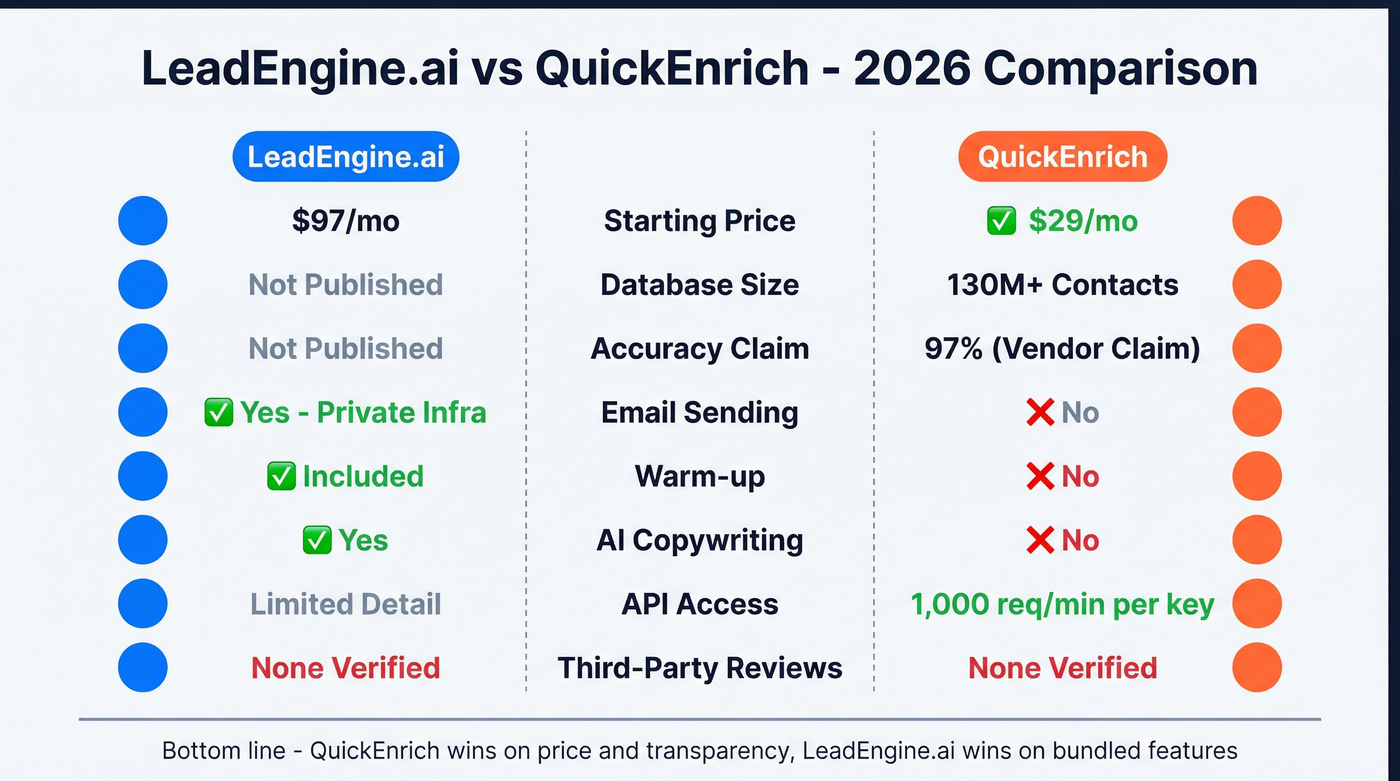
The practical comparison is this: QuickEnrich ($29/month) plus a sender like Instantly or Smartlead (often ~$30-97/month depending on plan) lands in the same ballpark as LeadEngine.ai's entry tier, but with more flexibility. If your sender changes, your enrichment doesn't have to. If your enrichment changes, your sending setup stays intact.
LeadEngine.ai's value only really shows up when you want the bundle and will actually use it. If you already have a sequencer you like, paying for another one is just paying twice. If you're building a repeatable outbound motion, it’s worth mapping your lead generation workflow so tools don’t overlap.
For price context, Clay starts at $167/month: https://www.clay.com/pricing And ZoomInfo is typically an annual contract that starts in the five figures: https://www.zoominfo.com/pricing
Key Decision Factors (The Stuff That Actually Bites You Later)
1) Do you need sending, or just data?
If you already run Instantly, Smartlead, Lemlist, Salesloft, Outreach, or even a homegrown sequencer, LeadEngine.ai's bundled sending can end up sitting there unused. We've seen teams buy an all-in-one tool because it "simplifies everything," then keep their old sender anyway because migrating domains, inboxes, and templates midstream is a pain.
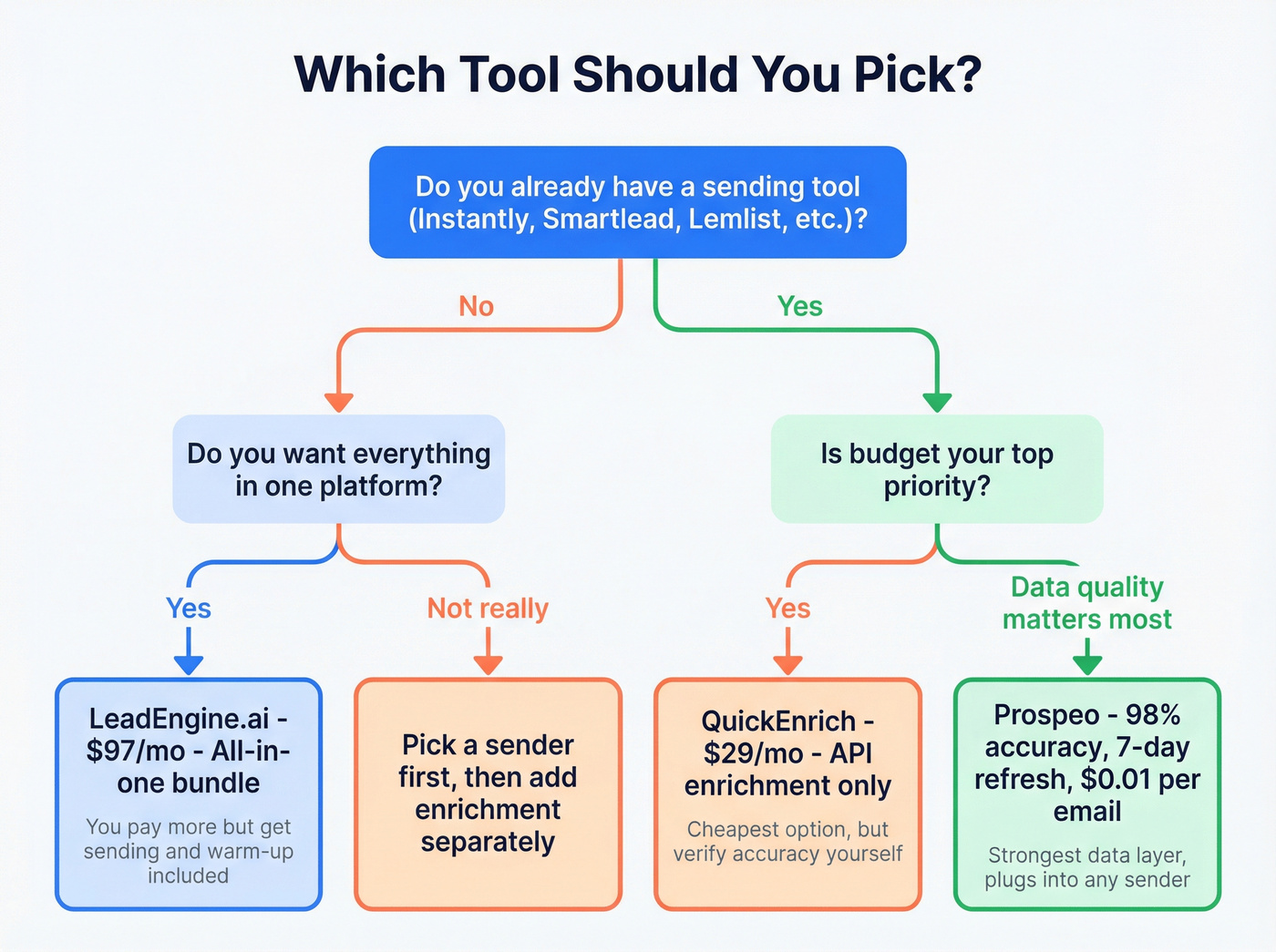
If sending is already handled, QuickEnrich (or another enrichment-first tool) is the cleaner fit. If you’re still choosing a sender, these outbound lead generation tools comparisons can narrow the shortlist.
2) Budget reality (and how it scales)
$29/month vs $97-497/month doesn't sound dramatic until you scale seats, add workspaces, or start paying for add-ons. For teams closing sub-$15k deals, that delta matters. It changes how many experiments you can run, how much list cleaning you can afford, and whether you're forced into "spray and pray" volume to justify the spend. If you’re pressure-testing ROI, track the lead generation metrics that actually correlate with pipeline.
3) The data trust gap
Neither tool publishes independent accuracy benchmarks, and neither has a review footprint we could verify. So you have to test.
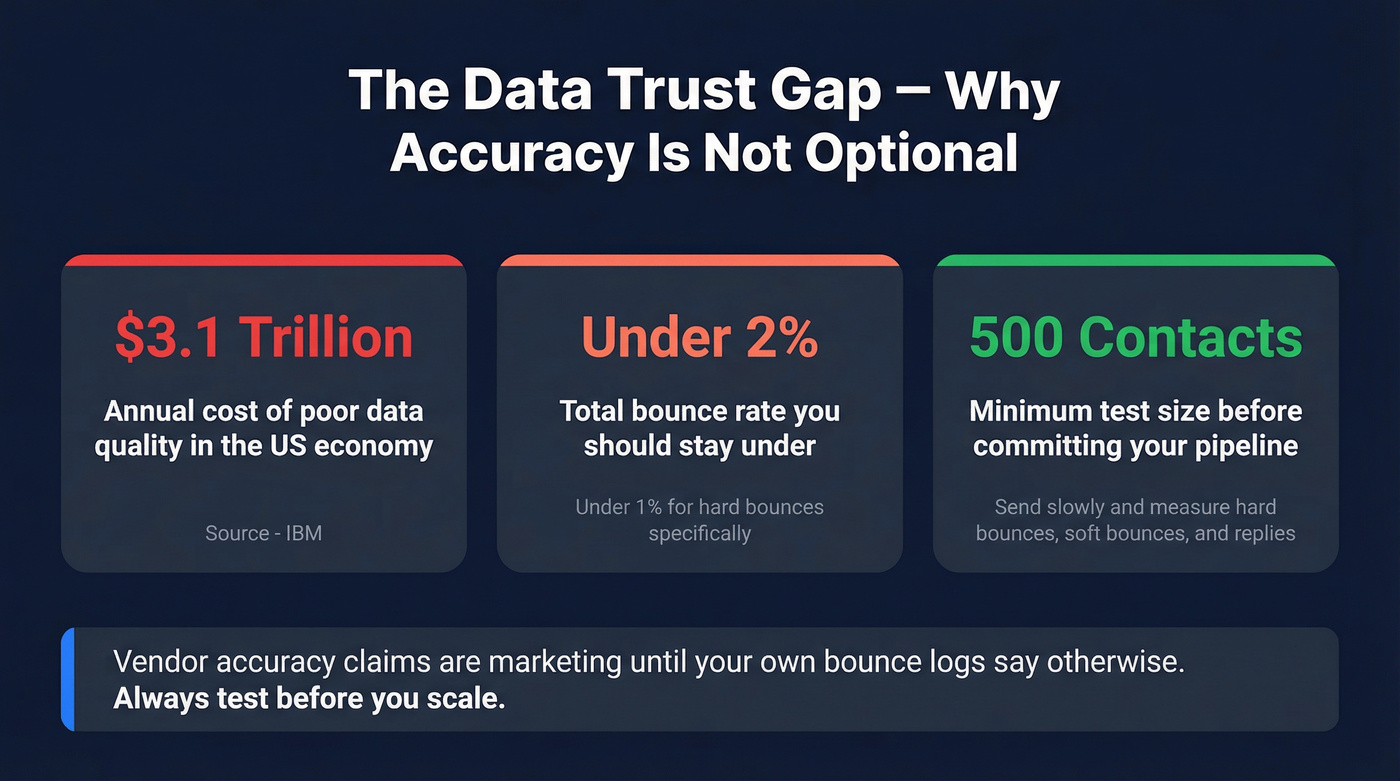
Look, it takes months to build domain reputation and seconds to wreck it. Keep bounces low. A common deliverability rule of thumb is staying under ~2% total bounces and under ~1% hard bounces, and Google Postmaster Tools is still one of the best free ways to spot trouble early: https://postmaster.google.com/
Let's be honest: vendor accuracy claims are marketing until your own bounce logs say otherwise. Run a 500-contact test in your exact ICP, send slowly, and measure hard bounces, soft bounces, and reply rates. Do it before you commit your whole pipeline to any data provider. If you need benchmarks and fixes, start with email bounce rate.
4) Community signal (or lack of it)
On r/sales and r/coldemail, the consensus is pretty consistent: data quality beats feature checklists, and "all-in-one" tools often trade accuracy for convenience. That's not a scientific benchmark, but it's a useful gut check when a tool has little third-party review coverage. If you’re refining targeting, an ideal customer profile template makes these tests far more meaningful.
A Stronger Enrichment Layer (If Data Quality Is the Point)
If what you really need is reliable enrichment, both LeadEngine.ai and QuickEnrich leave you guessing on freshness and independent accuracy.
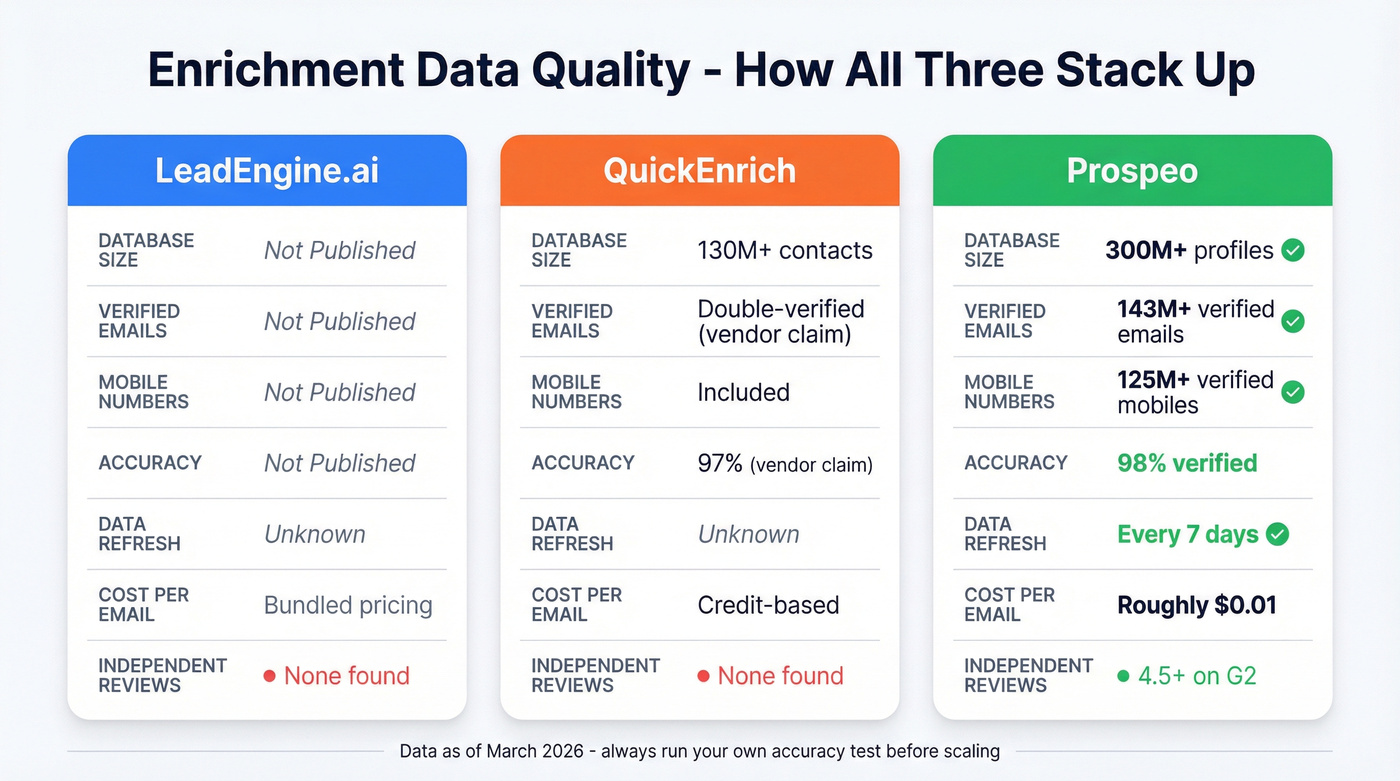
Prospeo is the option we recommend when accuracy and refresh cadence are non-negotiable. It has 300M+ professional profiles, 143M+ verified emails, and 125M+ verified mobile numbers, with 98% verified email accuracy. Records refresh every 7 days (the industry average is about 6 weeks), which matters more than people think because job changes are constant and stale contacts are a quiet deliverability killer. If you want the broader landscape, see our guide to B2B company data.

In practice, this is the scenario we see all the time: an agency pulls a list on Monday, starts sending on Tuesday, and by Friday they're wondering why bounces spiked. It's not always the copy. It's often that the list was already outdated, and the tool didn't catch it. A weekly refresh cycle plus a strict verification process saves you from that slow bleed.
Pricing is self-serve with a free tier (75 verified emails/month), and it scales at roughly $0.01 per email. No contracts, no sales calls.
Final Verdict
Choose LeadEngine.ai if you want a bundled outbound platform and you're genuinely going to use the sending, warm-up, and sequencing features.
Choose QuickEnrich if you already have outbound infrastructure and want a low-cost enrichment API you can plug into your workflow.
Choose Prospeo if you want the strongest data layer: 300M+ profiles, 98% verified email accuracy, 7-day refresh, and integrations that let you keep the rest of your stack exactly as it is.
FAQ
Can I use QuickEnrich with Instantly or Smartlead?
Yes. You can enrich via API (or export/import via CSV) and then run outreach in your sender. That's the whole point of QuickEnrich: it's separate from sending by design.
Prospeo supports the same approach, and it also offers native integrations with both Instantly and Smartlead, which saves time if you don't want to maintain a custom workflow.
Does LeadEngine.ai have a public API?
LeadEngine.ai doesn't publish detailed API documentation publicly. The product is built around its own sequencer and workflow.
If API-first enrichment is a must-have, QuickEnrich is the more obvious fit, and Prospeo is also strong here with a 92% API match rate and 50+ data points returned per enrichment.
Is LeadEngine.ai worth $97/month?
It's worth it if you need the bundle and you're starting from scratch.
If you already have a sender and warm-up in place, you're paying for overlap. In that case, a focused enrichment tool plus your existing outreach setup usually gets you to the same outcome for less money and less lock-in.
Tired of duct-taping enrichment tools to your sending stack? Prospeo plugs directly into Instantly, Smartlead, Lemlist, Clay, HubSpot, and Salesforce - with a 92% API match rate and 50+ data points per contact. No bundled features you won't use. Just verified data that protects your domain reputation.
Stop paying for unverified data. Get 98% accuracy at $0.01 per lead.