


LeadIQ Pros and Cons: What 1,160 Reviews Actually Say
One LeadIQ user dialed a prospect and got routed to a family member. Not a wrong extension - a completely wrong person. That's not a small glitch; it's the kind of thing that makes reps stop trusting the tool.
We went through 1,160 G2 reviews to separate the real LeadIQ pros and cons: what it nails day-to-day, and what quietly breaks your outbound motion. Full disclosure: we sell a competing product. We're still going to be straight with you, because bad data wastes time, burns domains, and makes teams argue about the wrong problems.
Let's break it down like a buyer.
LeadIQ at a glance
LeadIQ is a Chrome extension-first prospecting tool for SDRs who live in their browser. It captures contact data, pushes it into your CRM and sequencer, and includes Scribe AI for email drafts plus job-change alerts.
| LeadIQ | |
|---|---|
| G2 rating | 4.2/5 (1,160 reviews) |
| Core use | Browser-based prospecting |
| CRM sync | Salesforce, HubSpot |
| Sequencer sync | Outreach, Salesloft |
LeadIQ pros (where it shines)
LeadIQ's best feature isn't "data." It's speed. If your team spends half the day copying names, titles, and emails between tabs, LeadIQ can feel like a relief.
Use LeadIQ if your top priority is getting from a web page to a clean CRM record fast.
Easy to use (129 mentions) The extension workflow is quick and intuitive. In our experience, tools like this only stick when new SDRs can be productive on day one, and LeadIQ generally hits that bar.
Solid capture flow (92 mentions for contact info, 82 for lead generation) When the record is correct, the end-to-end motion is smooth: capture a contact, push to Salesforce, and drop them into a sequence without a bunch of manual steps.
Works well alongside professional profile research (67 mentions) Reps can pull details while researching prospects without bouncing between tools. That sounds small, but it adds up when you're doing 80-120 touches a day.
Integrations that match real SDR stacks (80 mentions) Salesforce is central to the product, and Outreach/Salesloft support is a big deal for teams that don't want to duct-tape their workflow with automations.
Scribe AI helps with first drafts It's not magic, and it won't fix bad positioning. But it does help reps get past the blank page and ship "good enough" personalization faster.
LeadIQ cons (where teams get burned)
Look, the fastest workflow in the world doesn't matter if the phone number is wrong. And the reviews are pretty consistent about where the pain shows up.
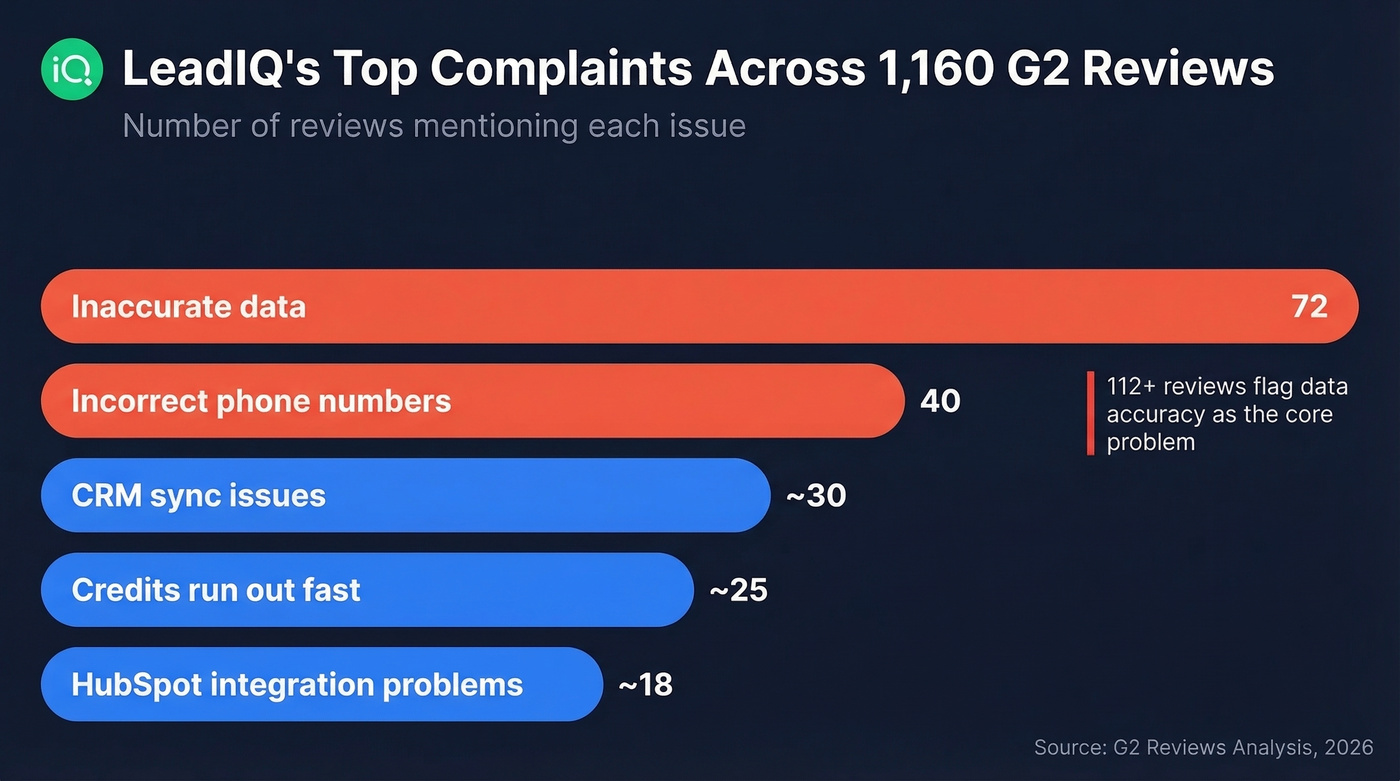
Skip LeadIQ if data accuracy is the thing you can't compromise on.
1) Data accuracy is the loudest complaint
Inaccurate data is the #1 complaint across reviews - cited 72 times. "Incorrect numbers" shows up another 40 times. That's more than 100 reviews flagging the same core issue.
The verbatims are rough. One user reported phone numbers that "routed to a family member." Another called it "fatal" that numbers were missing entirely because it was their only tool for calling. That's not a minor annoyance; it's wasted dials, broken call blocks, and a team that starts second-guessing every record.
If your outbound motion is call-heavy, this is the part to take seriously. Email mistakes hurt deliverability. Phone mistakes waste the only thing SDRs never get back: time.
If you want a framework for fixing this upstream, start with an email deliverability audit and a hard look at your email bounce rate.
2) CRM sync can get messy in real life
Several reviewers describe a common blocker: LeadIQ can't always determine what account a contact belongs to, which can stop direct imports or create cleanup work for RevOps.
And yes, Salesforce auth issues happen with every vendor. LeadIQ even has dedicated troubleshooting docs for OAuth blocks and IP restriction errors, which tells you it's not rare.
3) HubSpot setups can feel fragile
HubSpot enrichment runs through Workato, which adds a middleware layer most teams don't want to own. One reviewer put it bluntly: "Does not integrate with our HubSpot because of security issues."
If you're a HubSpot-first org with strict security review, assume you'll spend time here. Sometimes it's fine. Sometimes it turns into a small project no one asked for.
4) Credits don't roll over (and that gets expensive)
Credits expiring at the end of the billing cycle sounds like a billing detail until you live through a slow month, a territory change, or a holiday lull. Then it feels like you're paying for inventory you can't store.
If your prospecting volume is spiky, this matters more than most pricing pages admit.

The #1 LeadIQ complaint is inaccurate data - 112 reviews flagging wrong emails and phone numbers. Prospeo's 5-step verification delivers 98% email accuracy and 125M+ verified mobiles with a 30% pickup rate. No family members on the other end of the line.
Stop second-guessing every record. Start with data that connects.
LeadIQ pricing: what it actually costs in practice
LeadIQ's pricing is simple on the surface and tricky in the details because phone lookups are expensive in credit terms.
| Free | Pro | Enterprise | |
|---|---|---|---|
| Price | $0 | $200/mo | Not public |
| Users | 1 | Up to 5 | Custom |
| Credits | 50/mo | Credit-based | Custom |
| Email lookup | 1 credit | 1 credit | 1 credit |
| Phone lookup | 10 credits | 10 credits | 10 credits |
| Email + phone | 11 credits | 11 credits | 11 credits |
| Account enrichment | 3 credits | 3 credits | 3 credits |
| Rollover | No | No | - |
Here's the math buyers should do before they sign anything.
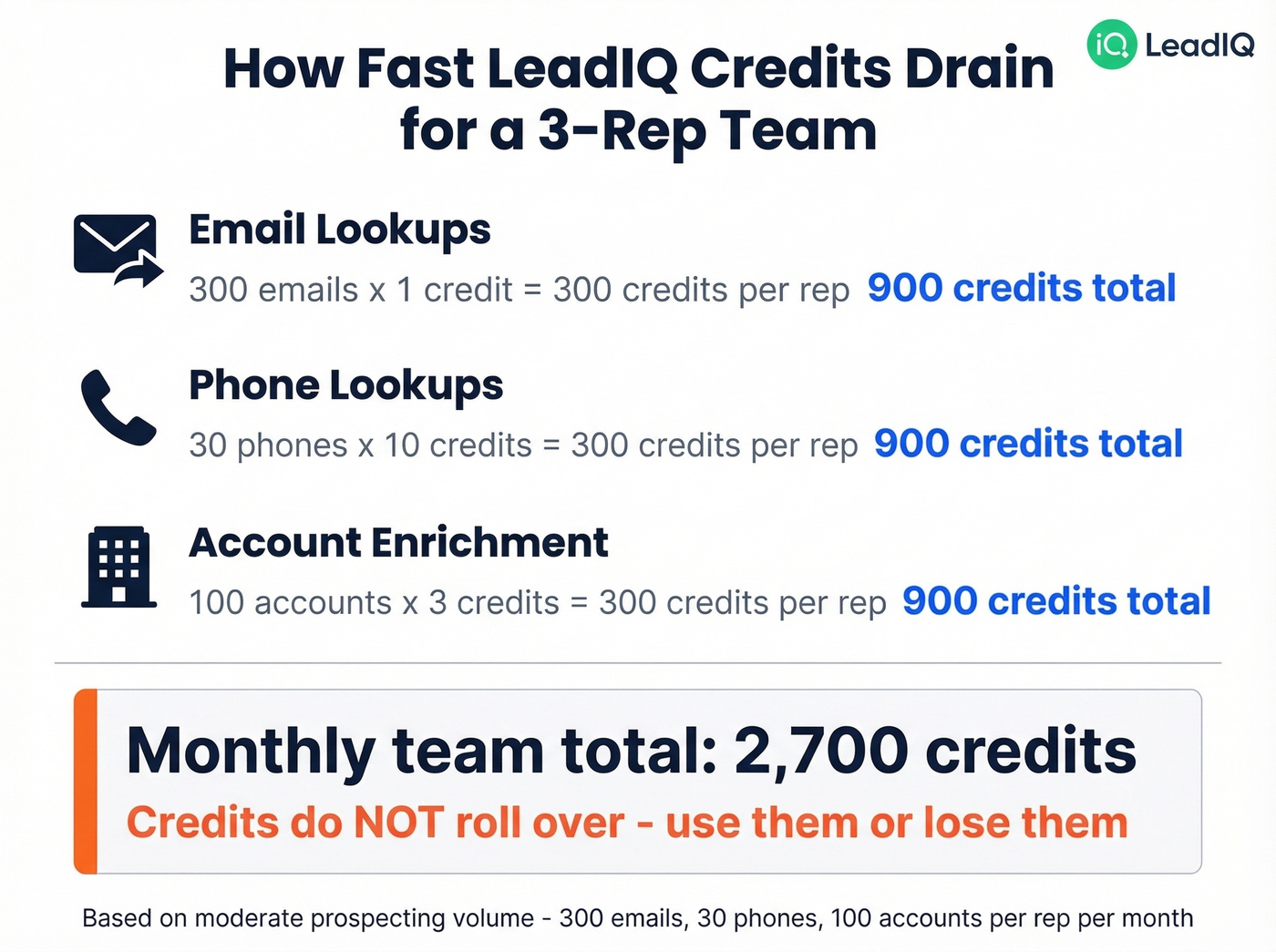
Scenario: three SDRs. Each rep needs 300 emails and 30 phone numbers per month.
- Emails: 300 x 1 credit = 300 credits per rep
- Phones: 30 x 10 credits = 300 credits per rep
- Total per rep: 600 credits
- Team total: 1,800 credits/month
Now add a very normal enrichment habit: each rep enriches 100 accounts/month.
- Account enrichment: 100 x 3 credits = 300 credits per rep
- Team enrichment total: 900 credits/month
- New team total: 2,700 credits/month
That's how teams end up feeling like the credit pool "drains fast." It's not that reps are reckless; it's that phone + enrichment changes the economics quickly.
For broader context, Dimmo's MarketBetter analysis of 93 LeadIQ purchases showed a median annual cost of $26,400, with deals ranging from $6,096 to $58,240. They also found average negotiation savings around 21%, so don't accept the first quote if you're buying for a team.
If you're comparing vendors, it helps to benchmark against other SDR tools and outbound lead generation tools.
Verdict: who LeadIQ is for (and who should pass)
LeadIQ is a workflow tool, not a data accuracy tool. If your team needs the fastest path from browser research to CRM and sequences, it delivers. The extension is genuinely strong, and the day-to-day UX is why people keep renewing.
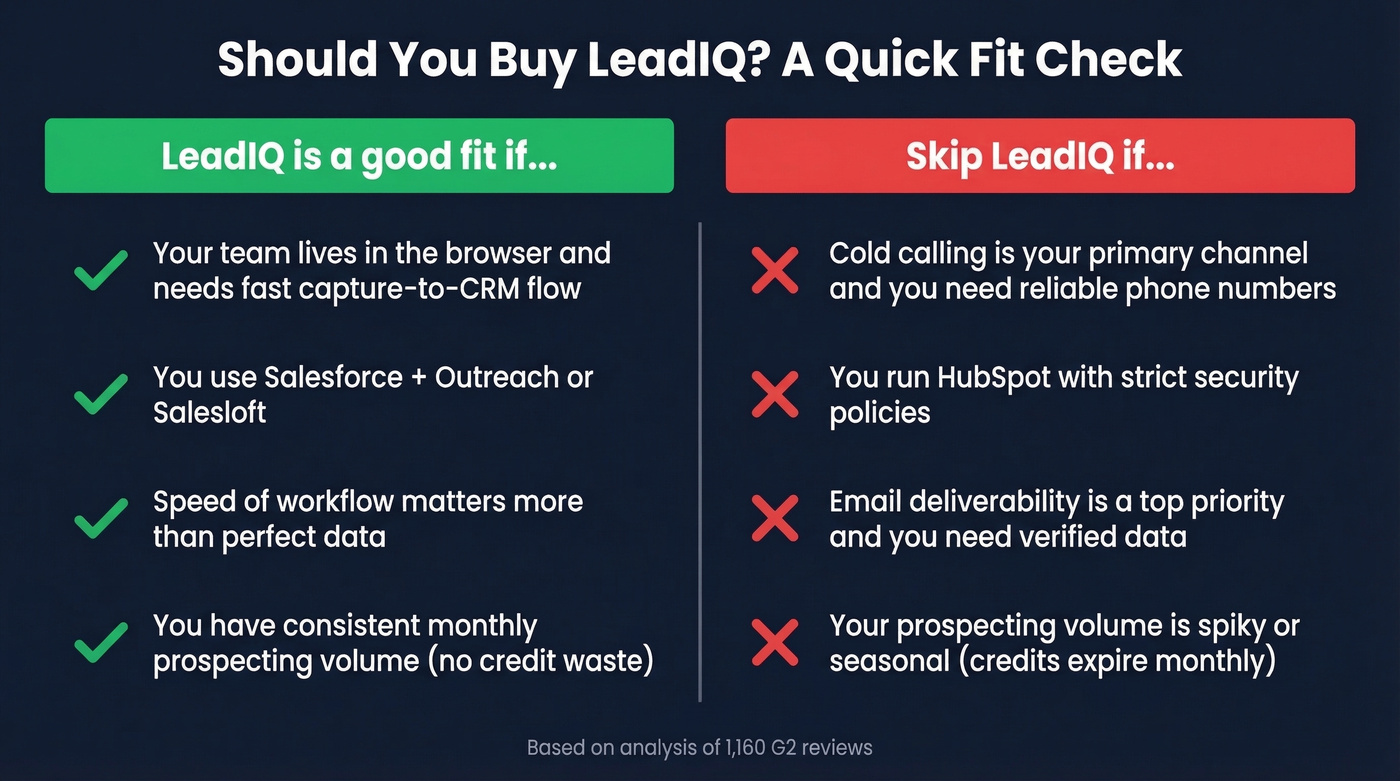
But if you're running serious cold-calling volume, the phone data complaints are too frequent to shrug off. If you're HubSpot-first and security-conscious, the Workato layer can turn "simple enrichment" into a recurring headache. And if deliverability is a priority - it is - you should plan on verifying emails elsewhere, because no vendor's dataset is perfect and the reviews don't suggest LeadIQ is the exception.
One thing we feel pretty strongly about: most teams paying around $26K/year for LeadIQ would get better results splitting that budget between a high-accuracy data provider and the workflow pieces they actually need. Convenience is nice. Paying for convenience while eating the downstream cost of bad data is not.
Run a 2-4 week pilot before you commit annual budget. Track bounce rate, reply rate, and phone connect rate against your current stack. Don't let "it feels faster" win the argument if the numbers don't back it up.
If you need a tighter outbound process for the pilot, use a few proven sales prospecting techniques and keep your sequence management consistent across reps.
Alternatives to LeadIQ (based on what you're optimizing for)

If accuracy is the whole point
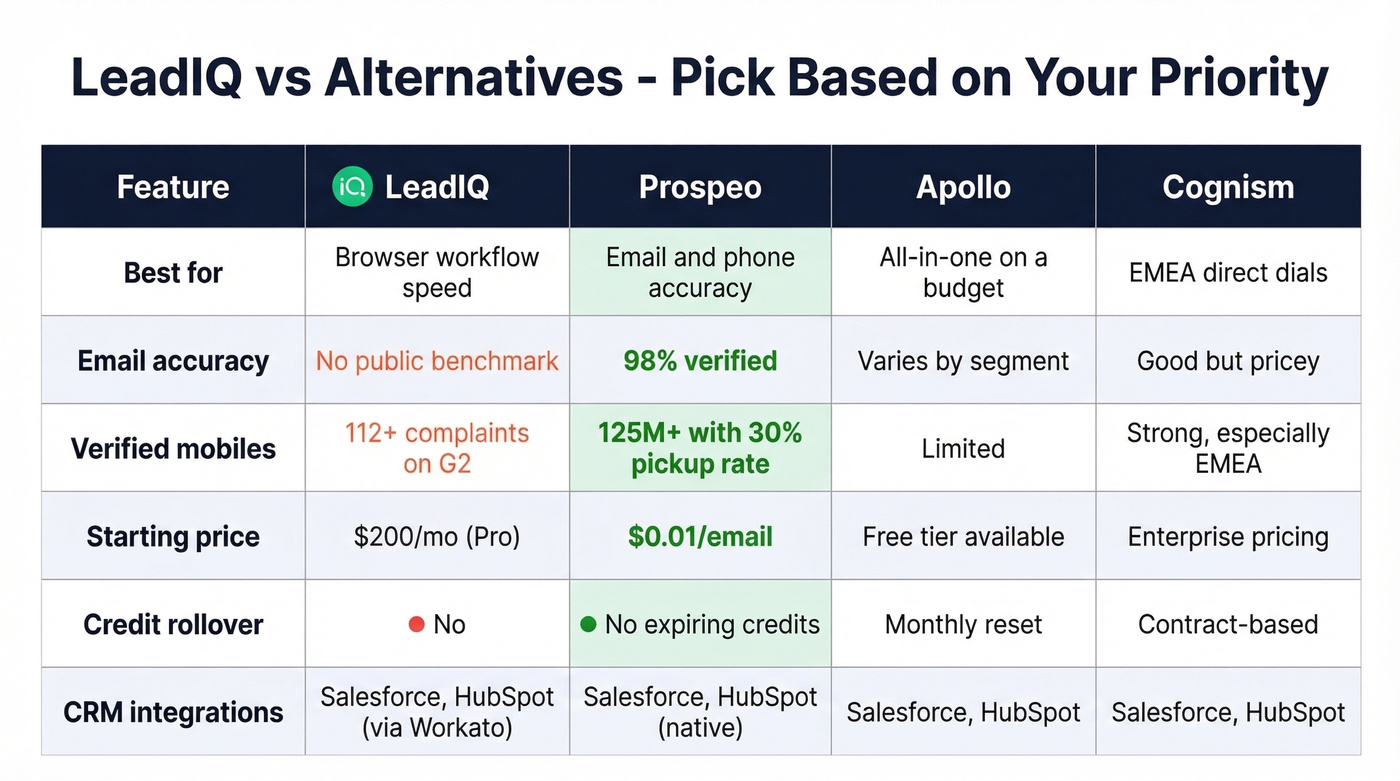
If you're weighing LeadIQ because you're tired of bounced emails and dead-end dials, tools like Prospeo are built for that exact problem. Prospeo gives you 300M+ professional profiles, 143M+ verified emails, and 125M+ verified mobile numbers, with 98% email accuracy and a 30% mobile pickup rate. Data refresh runs on a 7-day cycle, which is a big deal when you're prospecting into fast-moving org charts.
If you're evaluating vendors in this category, start with a shortlist of data enrichment services and compare against the broader set of sales prospecting databases.
Our team has seen the same pattern over and over: once data quality improves, everything else gets easier. Copy gets less defensive, deliverability stabilizes, and reps stop wasting call blocks on numbers that never had a chance.
If you want database + outreach in one place
Apollo is the common pick here: big database, built-in sequencer, and a generous free tier. It's convenient for small teams that want one login and one bill.
Skip this route if your domain reputation is already fragile or you're scaling cold email hard. All-in-one tools can be fine, but you still need to treat verification and list hygiene like a first-class job.
If direct dials are your lifeline
Cognism is often the "phone data first" option, especially for teams that care about EMEA coverage and compliance. The tradeoff is price: it's usually a real jump from LeadIQ's Pro tier.
If your pipeline is won on the phone, that jump can be worth it. If you're mostly email-first, you're probably overpaying.
Quick community gut-check: on r/sales, the recurring theme is that "workflow tools" and "data tools" get mixed up in buying decisions. Teams buy the slick extension, then get mad when the dataset doesn't match a dedicated data provider. That's not a moral failing - it's just a category mistake.
At ~$26K/year, LeadIQ's credit math gets brutal - especially when phone lookups eat 10 credits each and nothing rolls over. Prospeo starts at $0.01/email with no expiring credits, native HubSpot and Salesforce integrations, and a 7-day data refresh cycle.
Better data, 90% cheaper. No contracts, no credit traps.
FAQ
Is LeadIQ worth it for small teams?
The free tier gives you 50 credits per month - that's 50 emails or 5 phone numbers. Pro at $200/mo can feel steep if you've got fewer than three SDRs or your outbound volume isn't consistent.
If you're early, start by proving your list quality and workflow first, then pay for convenience. That's usually the right order.
How accurate is LeadIQ's data?
LeadIQ doesn't publish public accuracy benchmarks. In the G2 reviews we analyzed, inaccurate data was cited 72 times, and incorrect numbers showed up 40 more times.
If accuracy is your deciding factor, don't debate it in a meeting. Run a pilot and measure bounce rate and connect rate on a controlled list.
What's a cheaper alternative if accuracy matters?
Prospeo starts with a free tier (75 emails/month) and runs at about $0.01 per verified email on paid plans, with 98% email accuracy. If you're losing time to bad records, cost per lead isn't the number to watch anyway - cost per meeting is.
Do LeadIQ credits roll over?
No. Unused credits expire at the end of each billing cycle. If your prospecting volume swings month to month, that can turn into real waste fast.