

=== CURRENT ARTICLE (slug: leadiq-vs-salutary-data) ===
LeadIQ vs Salutary Data: Rep Tool vs Data Supplier
Comparing LeadIQ and Salutary Data is like comparing a screwdriver to a lumber shipment. One's a tool your reps use daily. The other's a raw material feed for your data infrastructure. They show up in the same "B2B contact data" category, but the LeadIQ vs Salutary Data decision is really about workflow tooling vs data supply chain - and they solve fundamentally different problems.
30-Second Verdict
Pick LeadIQ if you're an SDR team that needs a Chrome extension to capture contacts mid-prospecting and sync them into Salesforce or HubSpot. It's a rep workflow tool, not a data warehouse.
Pick Salutary Data if you're building a data pipeline, enrichment product, or RevOps infrastructure and need a curated U.S. contact feed delivered via API or full-file drops.
Head-to-Head Comparison
| Dimension | LeadIQ | Salutary Data | Winner |
|---|---|---|---|
| Product type | Rep prospecting tool | Data feed supplier | Depends on buyer |
| Database size | Not disclosed | 156M U.S. contacts | Salutary (transparent) |
| Data delivery | Chrome extension + CRM sync | Feeds, API, Web UI, CSV drops | LeadIQ for reps; Salutary for data teams |
| Pricing model | Per-seat + credits | Custom contracts | LeadIQ (predictable) |
| Price anchor | ~$45-$200/seat/month | Starts at ~$5,000 | LeadIQ (lower entry) |
| G2 rating | 4.2/5 (1,160 reviews) | 5.0/5 (1 review) | LeadIQ (sample size) |
| Coverage | Global | U.S. only | LeadIQ (breadth) |
| Integrations | Salesforce, HubSpot, Outreach, Salesloft | API, feeds, Web UI | LeadIQ (native CRM) |
| Best for | SDRs prospecting daily | Data teams, enrichment pipelines | - |
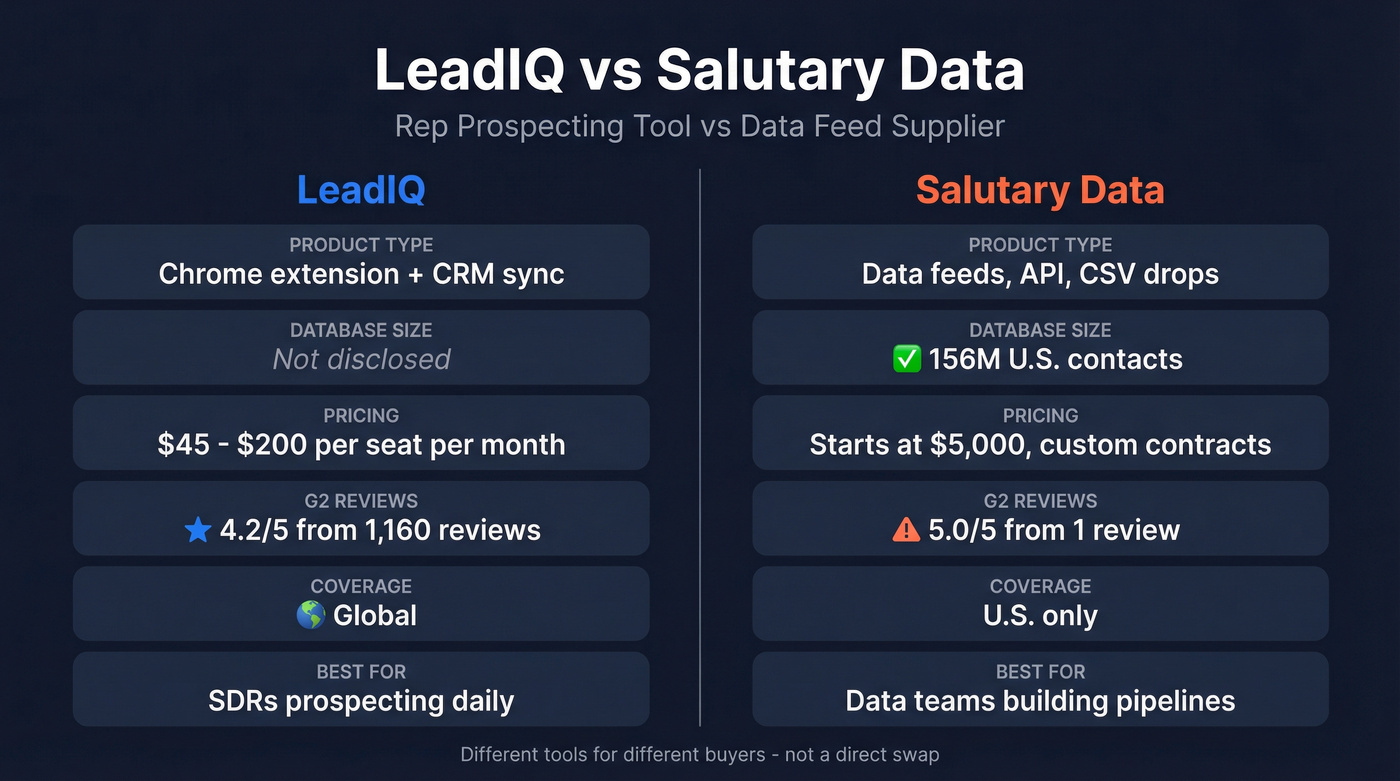
That G2 gap tells you a lot about adoption. LeadIQ has 1,160 reviews; Salutary has one. That usually means LeadIQ is used broadly day-to-day, while Salutary gets bought more like infrastructure - quietly, by data teams who don't leave G2 reviews.
They Solve Different Problems
Here's the thing: LeadIQ is a Chrome extension with CRM sync. Reps browse web sources, click a button, and contacts flow into Salesforce or HubSpot where they can be pushed into Outreach or Salesloft. It runs on credits - one credit per email, ten per phone number. That 10:1 ratio matters when your team burns through mobile lookups fast.
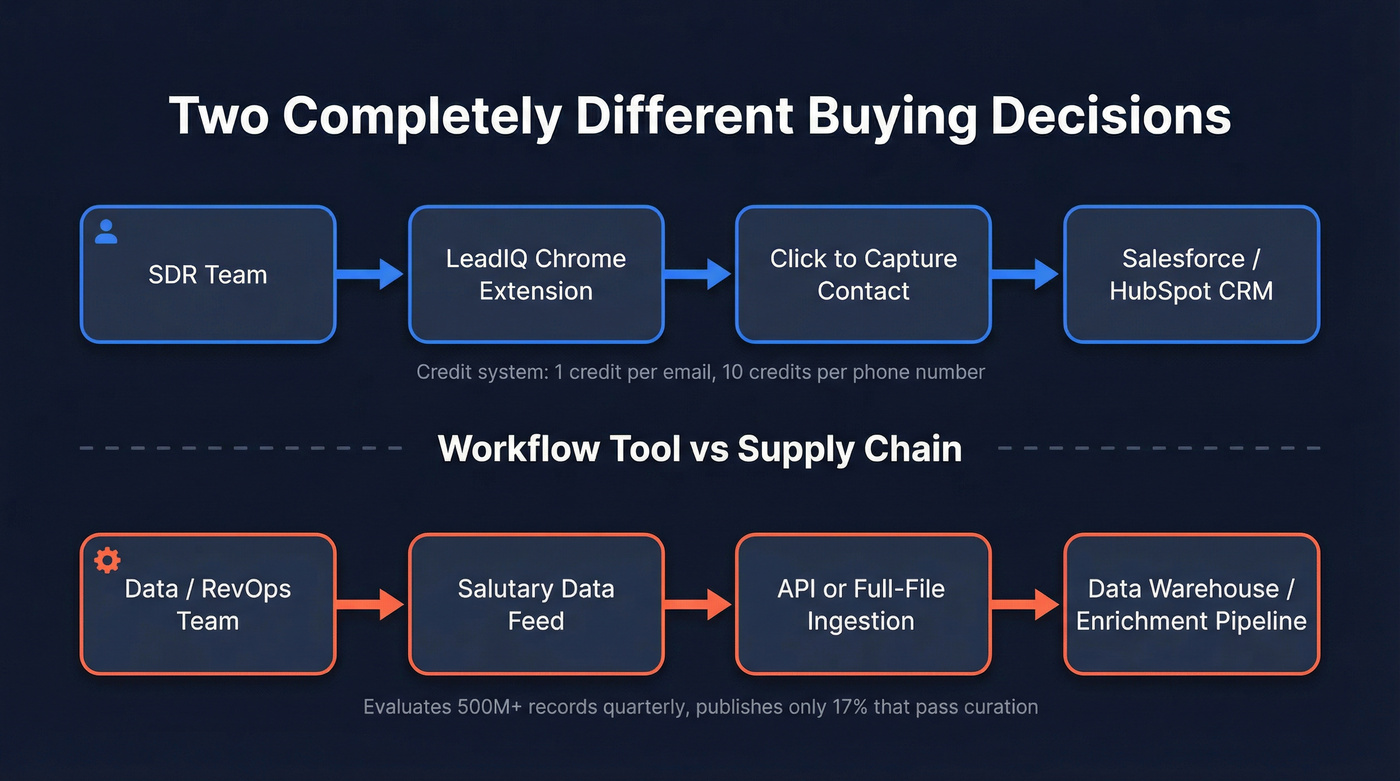
Salutary Data operates at a completely different layer. They evaluate 500M+ contact records every quarter and publish only the 17% that pass their curation standards, resulting in 156M U.S. contacts delivered as feeds, API responses, or through a web UI. Salutary also reports 90% yearly client retention and says 50+ data products rely on its feed - consistent with a supplier model where buyers build infrastructure on top of the data, not a tool they click around in.
Let's be honest: most teams searching this comparison actually need neither. LeadIQ is overkill if you just want verified emails without a credit system that punishes phone lookups. Salutary is overkill if you don't have an engineer to ingest feeds. The real question is whether you're buying a workflow or a supply chain.
If you're evaluating vendors in this category, it also helps to benchmark against other data enrichment services and broader sales prospecting techniques before you commit.

LeadIQ charges 10 credits per phone number. Salutary requires a five-figure contract just to start. Prospeo gives you 125M+ verified mobiles at 10 credits each, 98% email accuracy, and a 7-day refresh cycle - no annual commitment, no discovery calls. Start with 75 free emails.
Get verified contact data without the credit tax or the procurement cycle.
Data Quality and Coverage
Salutary publishes field-level metrics that are unusually transparent for a data supplier. We've broken accuracy and coverage apart because they tell very different stories.
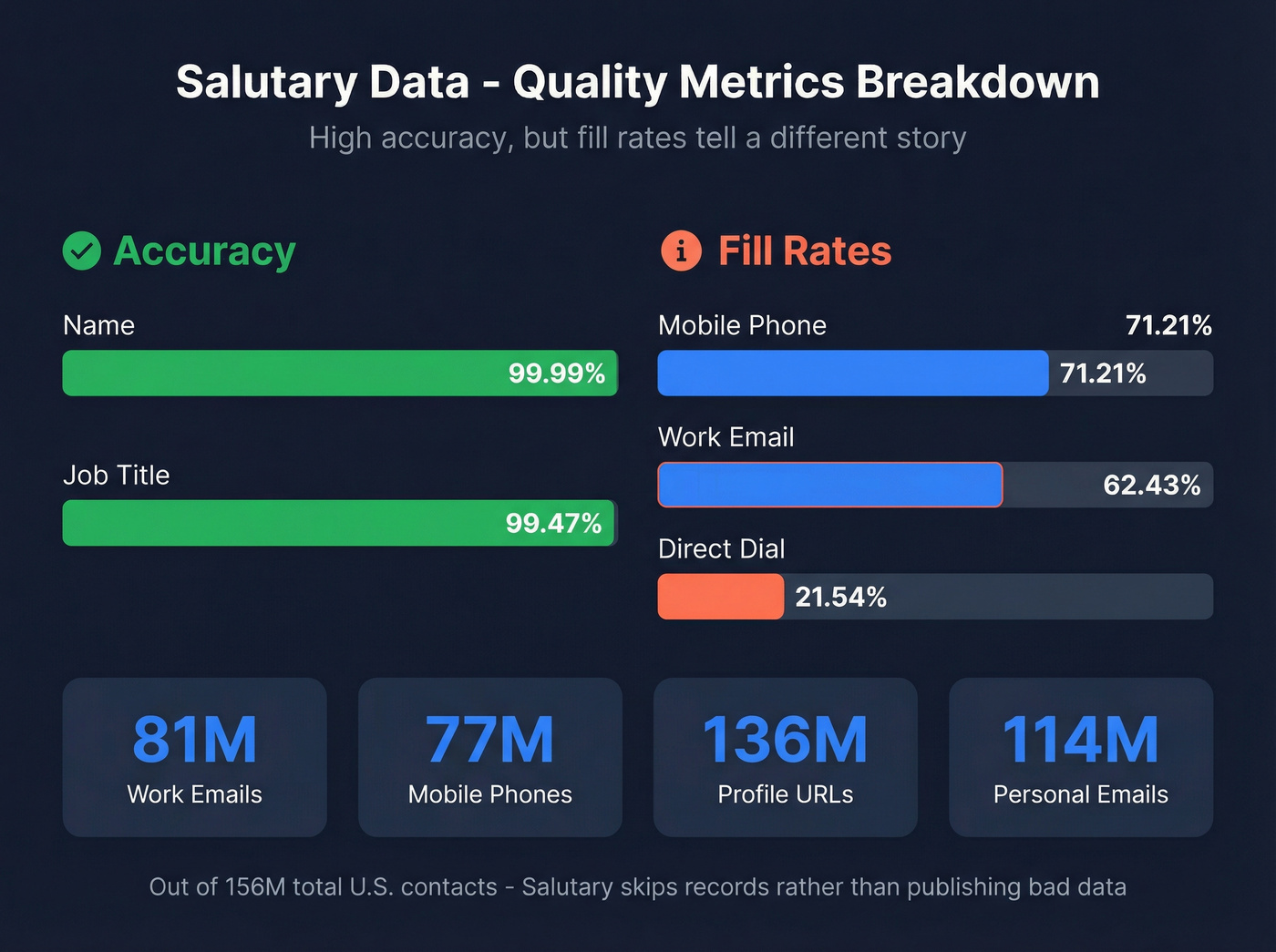
Accuracy metrics:
| Field | Accuracy |
|---|---|
| Name | 99.99% |
| Job title | 99.47% |
Coverage / fill rates:
| Field | Fill Rate |
|---|---|
| Mobile phone | 71.21% |
| Work email | 62.43% |
| Direct dial | 21.54% |
Inside those 156M contacts, Salutary breaks down to 81M work emails, 77M mobile phones, 136M unique professional profile URLs, and 114M personal emails. That 71% mobile fill on a U.S.-only dataset is strong. The 62% work email fill is lower than ideal for outbound at scale, but Salutary's model prioritizes accuracy over volume - they skip a record rather than publish a bad one.
LeadIQ has strong workflow value, but phone quality is a documented risk. Across 1,160 G2 reviews, a repeated negative theme is inaccurate data - especially phone numbers. Reps love the extension (it's genuinely fast), but the data underneath doesn't always hold up when you're dialing through a list of 200 contacts in a morning.
On compliance: LeadIQ is a rep tool pulling contact data, so buyers still need their own governance layer for GDPR/CCPA. Salutary is a supplier model - ask about permissible use rights and DNC list handling before signing. For full-file feeds, refresh cycles typically run monthly to quarterly; API enrichment can be closer to real-time depending on implementation.
If you're building a governed enrichment layer, it’s worth mapping this to your lead enrichment workflow and your RevOps Manager ownership model.
Pricing and Procurement
LeadIQ's pricing is messier than it looks. Their site shows credit-based pricing with Pro starting at $200/month, where credit volume is selected via a slider. G2's snapshot lists seat-based tiers: Essential at $45/seat/month (1,000 emails, 50 mobiles) and Pro at $89/seat/month (2,000 emails, 100 mobiles). In practice, expect seat + usage dynamics - the credit math matters. If your reps pull 100 phone numbers a month, that's 1,000 credits on mobiles alone before touching a single email.
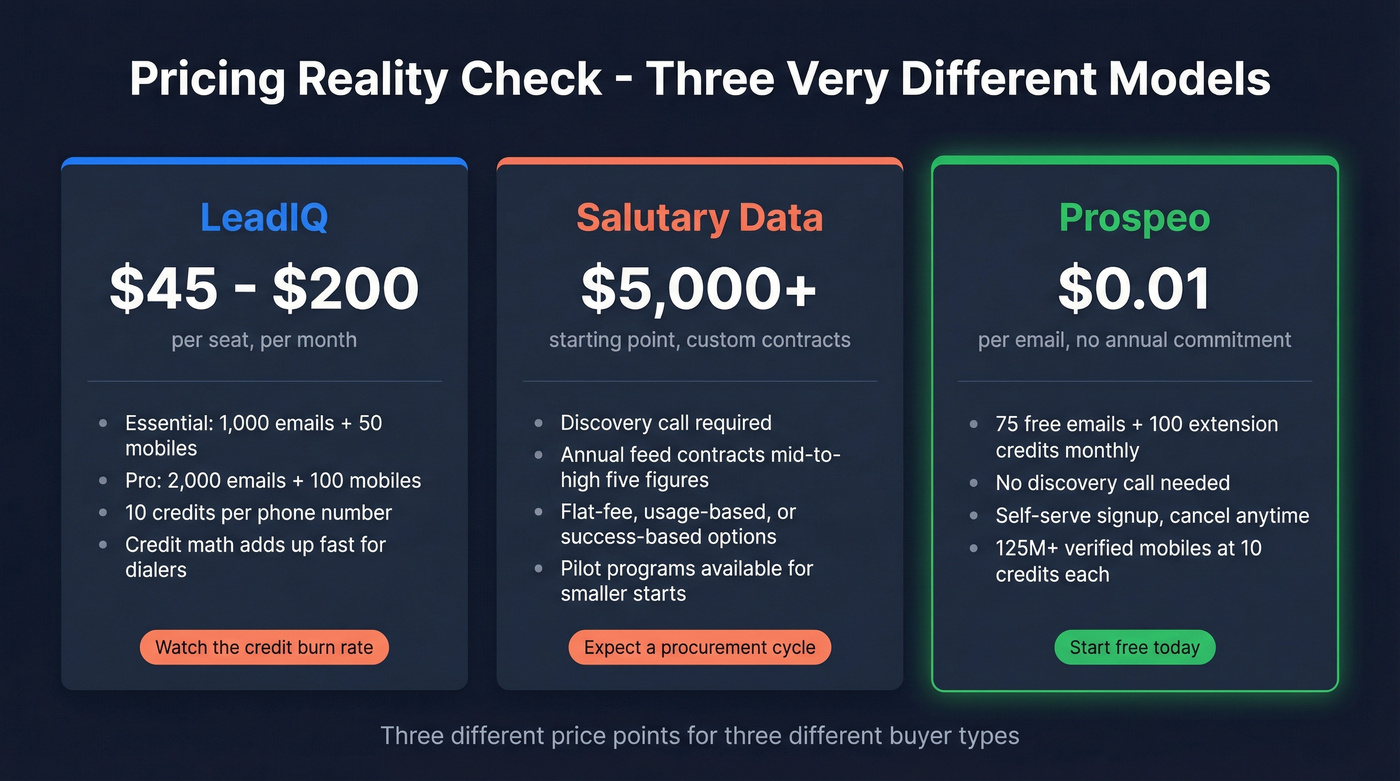
Salutary Data is a different procurement experience entirely. Pricing is custom after a discovery call. Datarade lists a $5,000 starting point, but expect mid-to-high five figures annually for many feed-style contracts depending on volume and usage rights. You'll negotiate an MSA with data licensing terms, usage rights by channel, refresh cadence agreements, and onboarding for schema mapping. They offer flat-fee annual subscriptions, usage-based structures, success-based models, pilot-to-commercial ramps, and project-based one-off CSV deliveries.
For context, Prospeo runs at roughly $0.01/email with a free tier (75 emails + 100 extension credits/month) and no annual commitment. That's a different universe from either of these.
If you're comparing cost structures across vendors, it can help to sanity-check against best sales prospecting databases and email list providers.
Who Should Pick Which
Your SDR manager says reps waste an hour a day on bad contact data. LeadIQ's workflow genuinely helps - the extension is fast and the CRM sync is tight. Just know that phone quality is a documented risk across hundreds of reviews. Budget $45-$200/seat/month depending on credit needs and test accuracy before rolling out to the full team.
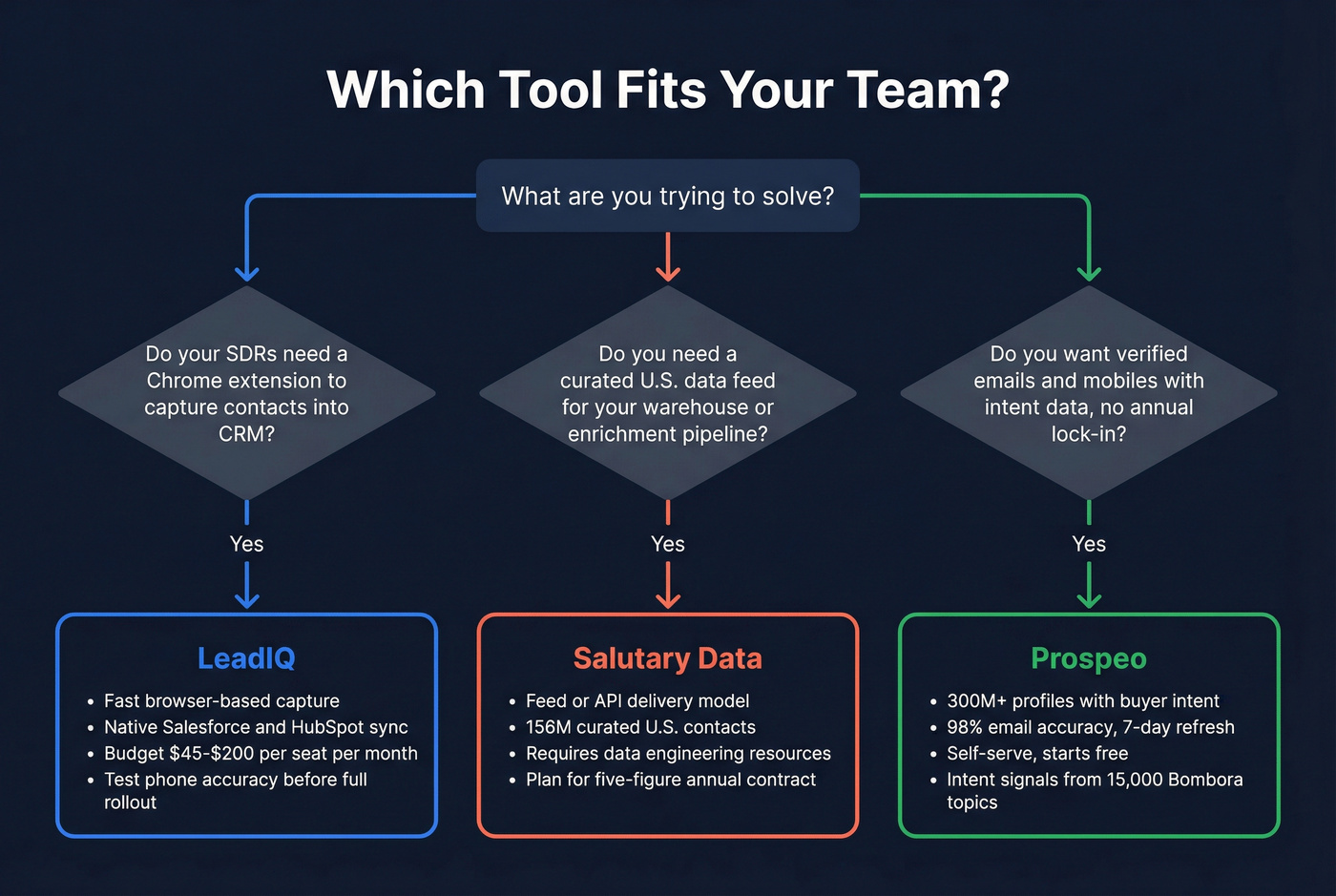
RevOps needs governed enrichment across CRM and warehouse, U.S.-only. Salutary's feed model fits. Expect a procurement cycle, a discovery call, and a contract in the five-figure range. The data quality is high, but you're buying a supply relationship, not a tool.
If your team is still standardizing the day-to-day motion, start with a clear lead generation workflow and a shortlist of SDR tools before you lock in a supplier contract.

A Faster Third Option
For teams that need more than contact data, Prospeo layers in intent signals tracking 15,000 topics via Bombora. You can filter by buyer intent, technographics, job changes, and headcount growth using 30+ search filters - a level of targeting neither LeadIQ nor Salutary offers out of the box. The consensus on r/sales tends to favor tools that let you self-serve and iterate fast rather than locking into annual contracts, and that's exactly the model here.
If you're building sequences around those signals, pair it with tighter personalized outreach and better sales follow-up templates to convert the extra targeting into replies.
Neither LeadIQ's Chrome extension nor Salutary's data feeds give you buyer intent out of the box. Prospeo tracks 15,000 intent topics via Bombora, layered with 30+ filters - technographics, job changes, headcount growth - across 300M+ profiles. At $0.01/email, it's enterprise targeting at SMB pricing.
Stop choosing between workflow and data quality - get both for a penny per lead.
FAQ
Do you need engineers to use Salutary Data?
Usually, yes. Salutary delivers data via API, full-file feeds, and project-based CSV drops - all requiring data engineering to ingest, map schemas, and maintain refresh pipelines. They offer a web UI for lighter use, but the supplier model still implies ops work. If you don't have a data team, a self-serve platform is a better fit.
How much does Salutary Data cost?
Pricing is custom after a discovery call. Datarade lists a $5,000 starting point for APIs and datasets. Annual feed contracts for curated U.S. B2B data typically run mid-to-high five figures depending on volume, delivery method, and usage rights. Pilot programs and usage-based structures are available for smaller initial commitments.
Can you use LeadIQ and Salutary Data together?
You can, but it's uncommon. Some RevOps teams use Salutary feeds to enrich their CRM at the database level, then give reps LeadIQ for real-time prospecting on top. The overlap in email and phone data makes this expensive - you're paying twice for similar contact fields. Most teams pick one layer and supplement with a verification tool for accuracy.