


LeadLander Pricing, Reviews, Pros and Cons (2026)
You'll find four different prices for LeadLander depending on where you look - $25, $55, $89, and $295 a month. Only one is current on LeadLander's own site. That kind of confusion wastes time, so let's clear it up and give you an honest assessment of whether this tool is worth the spend.
30-Second Verdict
LeadLander scores a 4.2/5 on G2 from 62 reviews, and the rating distribution skews positive - 86% of reviewers give 4 or 5 stars, with zero 1-star reviews. The current promo price is $89/month for up to 100 identified leads/month. It's a solid, simple visitor identification tool for small B2B teams with moderate website traffic. The value math works if your team actually follows up on every identified company (use these sales follow-up templates if you need a starting point).
The biggest limitation: LeadLander identifies companies, not people. You'll still need a separate tool to find the decision-maker's email and phone number - and for most outbound teams, that's the dealbreaker (see our guide to name to email).
What Is LeadLander?
LeadLander is an IP reverse-lookup tool that identifies which companies visit your website. It's owned by Upland Software and focused squarely on B2B - tracking visitor journeys, page views, and company details through a real-time dashboard that surfaces browsing behavior as it happens. It won't tell you who at that company visited, just that someone from Acme Corp hit your pricing page.
There's a 14-day free trial with no credit card required.
Current Plans and Cost
Here's what LeadLander actually charges right now (promo pricing valid through April 1, 2026):
| Small Business | Unlimited | |
|---|---|---|
| Price | $89/mo | Contact sales |
| Annual cost | ~$1,068/yr | ~$5,285/yr (Vendr median) |
| Leads/month | 100 | Unlimited |
| Domains tracked | 1 | Unlimited |
| User accounts | Unlimited | Unlimited |
| Data storage | 12 months | 12 months |
| Dedicated AM | No | Yes |
| API access | No | Yes |
| Free trial | 14 days | 14 days |
Why You'll See Four Different Prices
This is genuinely confusing, and it trips up nearly every buyer who researches LeadLander.
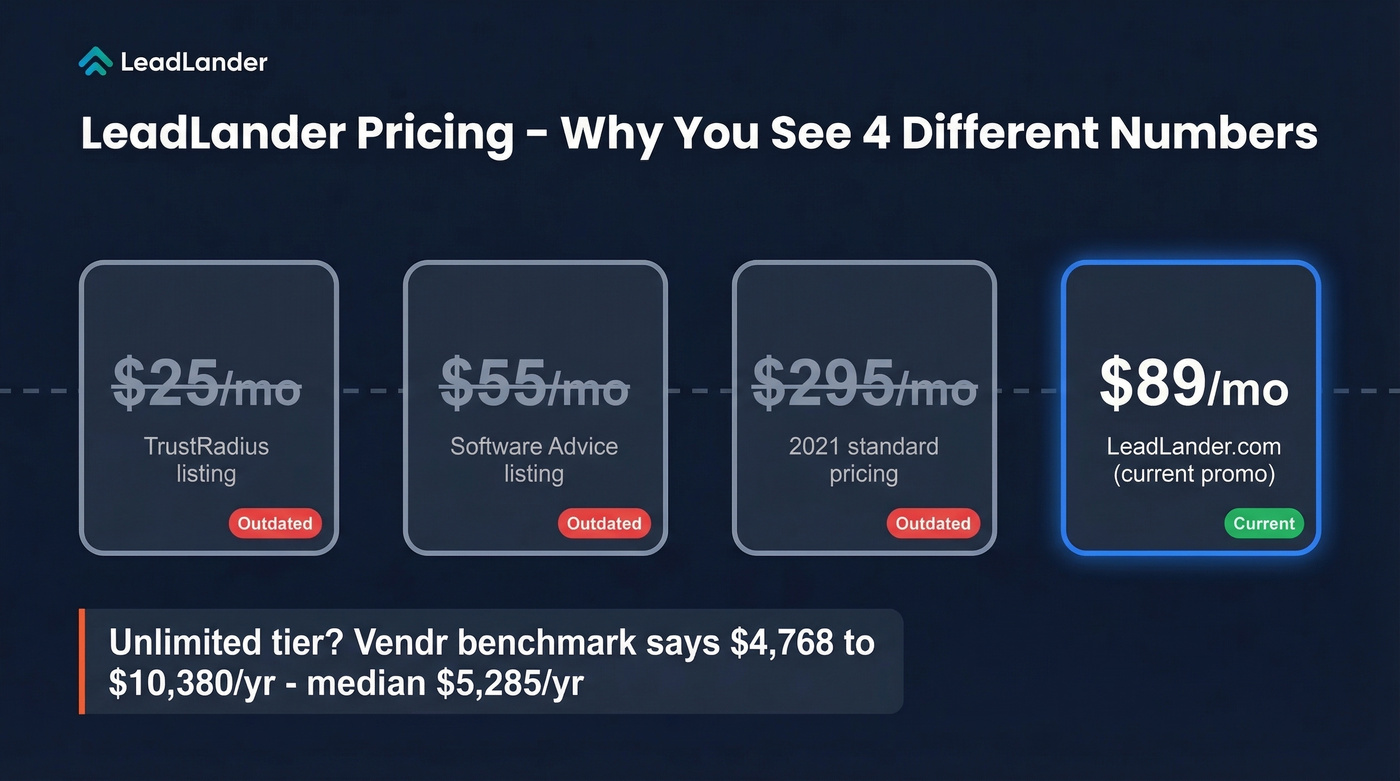
TrustRadius lists $25/user/month - that's from an older listing and doesn't match the current packaging. Software Advice shows $55/month - also outdated. An independent review from 2021 cites $295/month, which was the old standard pricing before the current promo structure. That same review noted contact information was an extra fee on top of the base price - the current Small Business plan includes access to the contact network at no additional charge, which helps explain why today's packaging looks so different from what you'll find on third-party directories.
The only number that's current on LeadLander's own pricing page is $89/month.
What do buyers actually pay for the Unlimited tier? Vendr's spend benchmark puts the median at $5,285/year, with a range of $4,768-$10,380. LeadLander doesn't publish Unlimited pricing, so you're negotiating blind. Use that Vendr range as your anchor (and if you want a framework, see anchor in negotiation).
User Reviews: Pros and Cons
What users like:
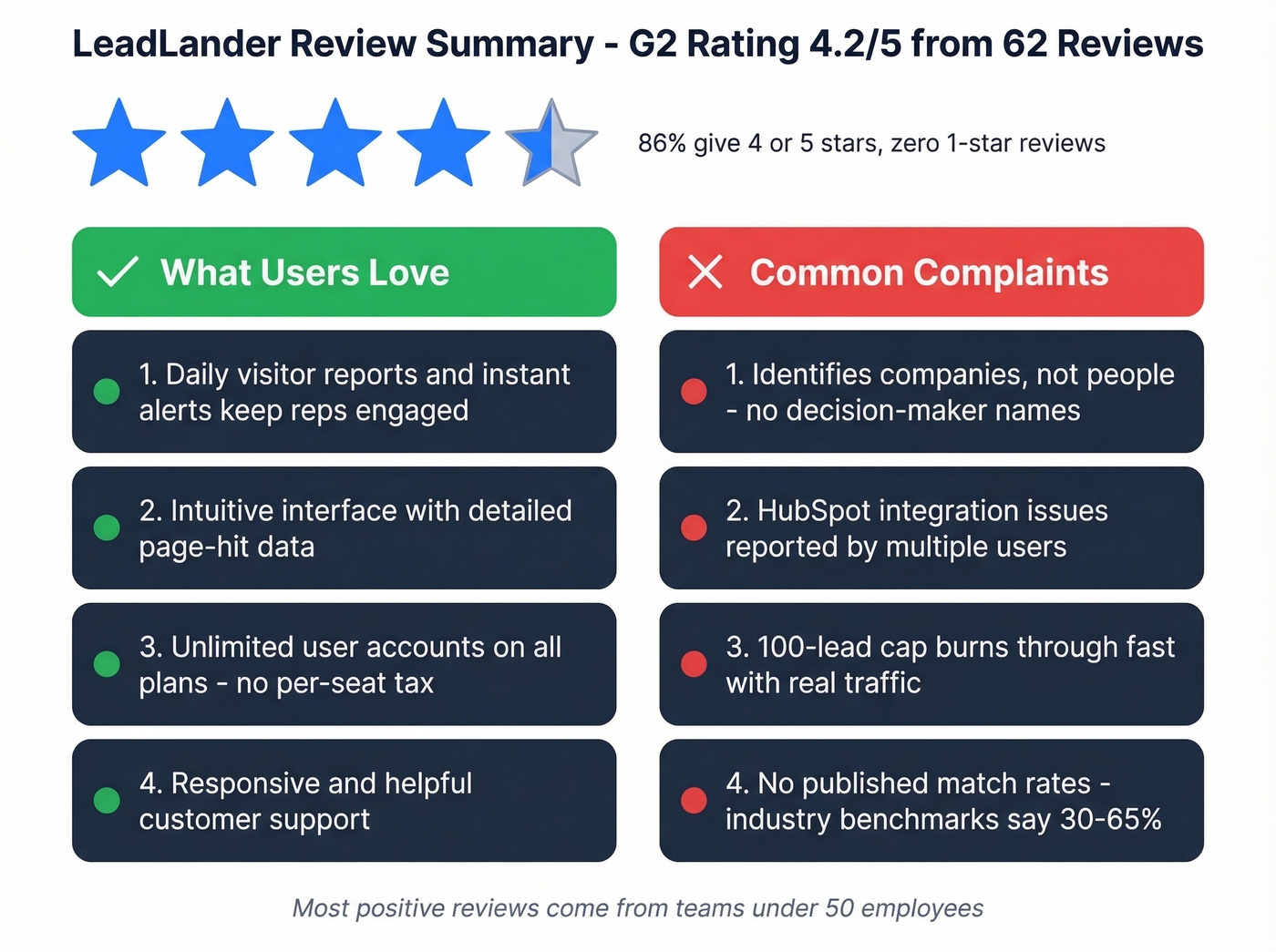
- Daily visitor reports and instant alerts keep sales teams engaged - this is one of the most consistently praised themes on G2
- Intuitive interface with detailed page-hit reporting that helps reps personalize outreach (more on personalized outreach)
- Unlimited user accounts on all plans, so there's no per-seat tax as your team grows
- Responsive customer support, which shows up repeatedly in positive reviews
What users don't like:
- Identifies companies, not people - and the contact search feature has real limitations (users mention they can't easily filter contacts by position and end up searching within each company manually)
- HubSpot integration challenges come up in multiple G2 reviews
- The 100-lead cap on the $89/month plan burns through fast with any real traffic
- No published match rates, and industry benchmarks put company-level accuracy at 30-65% under good conditions
Most positive reviews come from small teams at companies under 50 employees, typically in marketing or sales roles. LeadLander doesn't generate much discussion on Reddit or community forums - nearly all buyer sentiment lives on G2 and Capterra, which tells you something about the tool's niche positioning.


LeadLander identifies companies. But your reps need names, verified emails, and phone numbers. Prospeo's 300M+ profile database with 30+ filters turns anonymous company visits into actionable contact lists - 98% email accuracy, 125M+ verified mobiles, starting at $0.01/email.
Stop researching companies. Start reaching decision-makers.
Accuracy - What to Expect
LeadLander doesn't publish its match rates. No independent test specific to LeadLander exists publicly. In a $1B website visitor identification industry, accuracy varies wildly - company-level identification tools typically hit 30-65% match rates under good conditions, while person-level identification drops to 5-20%.
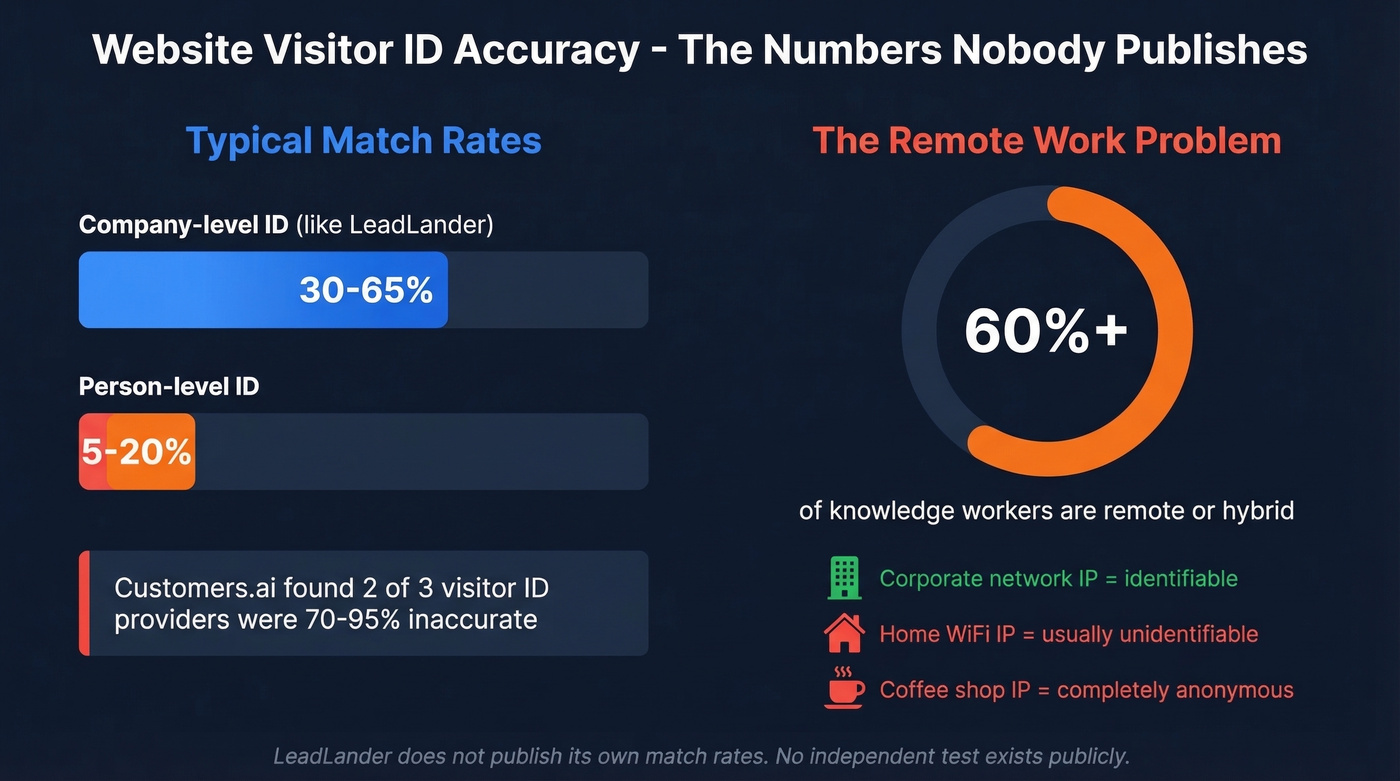
In our experience, IP-based tools perform best when your traffic skews toward enterprise visitors on corporate networks. Remote work erodes that advantage fast. Over 60% of knowledge workers are remote or hybrid, browsing from residential IPs that can't be mapped to a company. A Customers.ai industry report found two of three visitor identification providers were 70-95% inaccurate.
Here's the thing: if more than half your target accounts are sub-200-person companies with remote-first teams, IP-based visitor identification will disappoint you regardless of which vendor you pick. The technology was built for a world where everyone browsed from an office. That world is gone.
GDPR and CCPA Compliance
LeadLander is both GDPR and CCPA compliant. IP-based company identification - resolving to a business entity, not a person - can fall under GDPR's legitimate interest provision (Article 6(1)(f)). That said, update your privacy policy to disclose the tracking, provide an opt-out mechanism, and consider a DPIA if you're processing at scale.
Bridging the Contact Data Gap
LeadLander tells you Acme Corp visited your pricing page. It doesn't tell you who at Acme Corp to email, or give you a verified phone number for the VP of Engineering.
That's the fundamental gap, and it's where most teams stall.
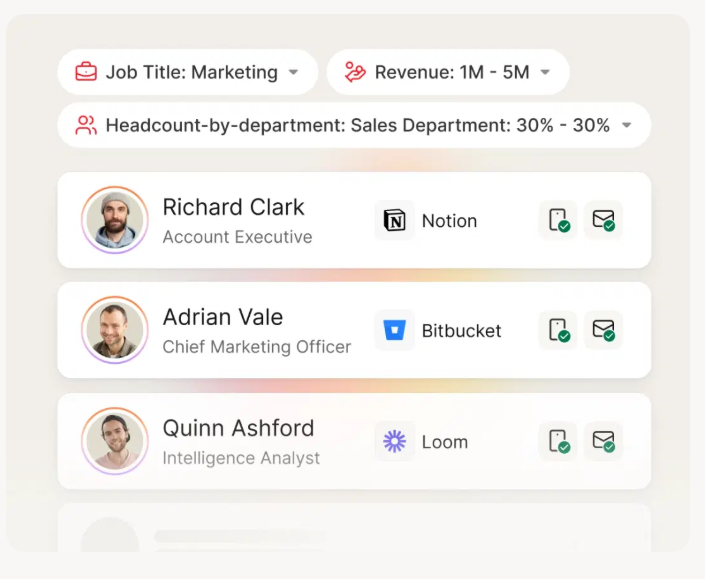
We've seen teams pair LeadLander with Prospeo to close this loop. Upload the companies LeadLander identifies, filter by role and seniority across 30+ search filters (see firmographic filters), and export verified emails and direct dials. The database covers 300M+ professional profiles with 98% email accuracy and 125M+ verified mobile numbers - and there's a free tier with no contract required. It turns "a company visited" into "here's who to call." If you're building this into a repeatable motion, map it to a simple lead generation workflow.
Is LeadLander Worth It?
LeadLander works best for small B2B teams (under 20 people) with moderate website traffic and a Salesforce-centric stack. G2 data suggests a 16-month average time to ROI, which is honest but not fast (compare against broader lead generation metrics).
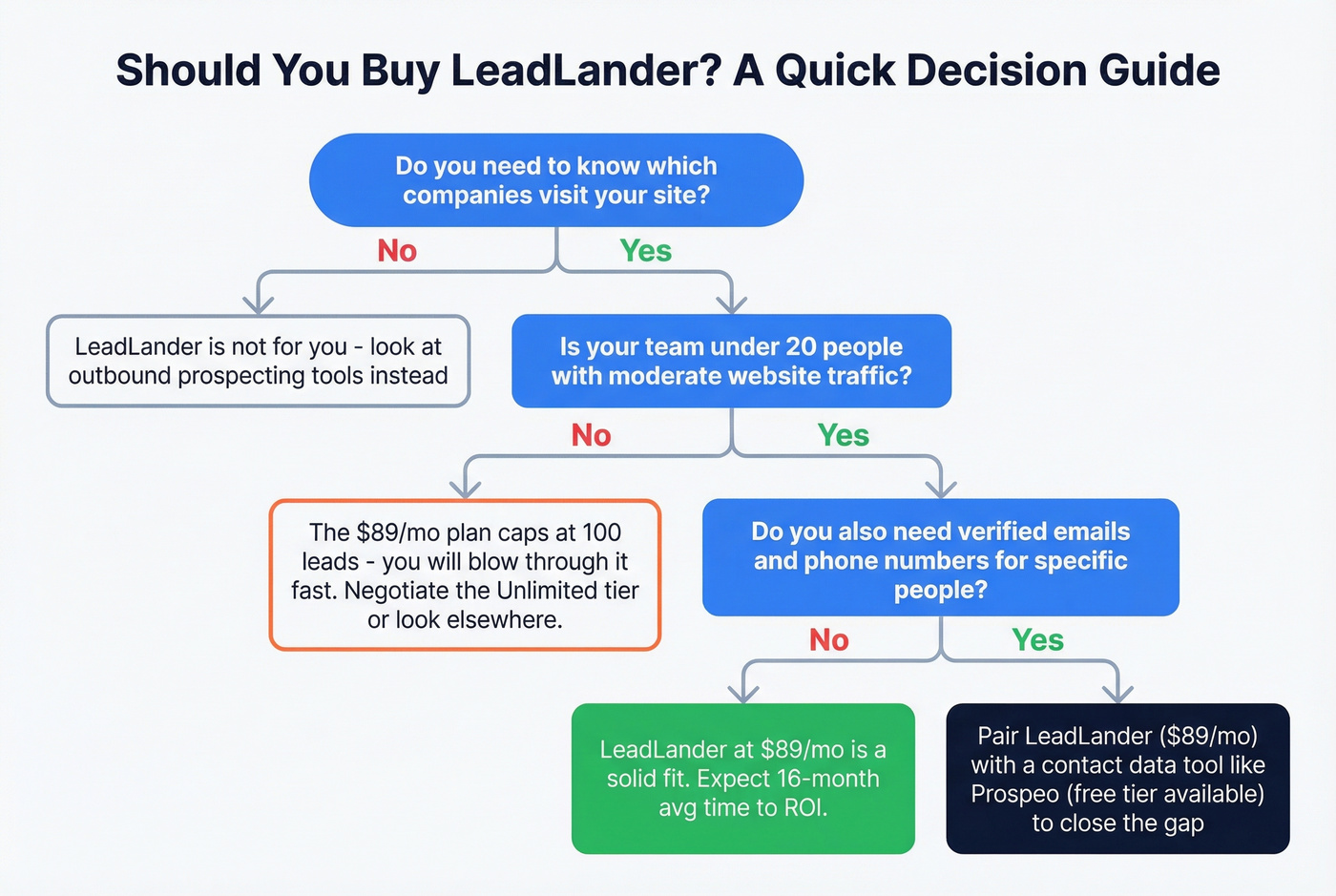
Skip it if you need person-level identification, deep integrations beyond Salesforce, or you're running a high-traffic site that'll blow past 100 leads in a week.
After weighing LeadLander's pricing, reviews, pros and cons, the bottom line is straightforward: it's a capable company-level identification tool with real limits. If your actual problem is finding verified contact data for the people behind those company visits, $89/month on LeadLander plus a free Prospeo account gets you further than a $295/month legacy plan ever did. For more options in this category, see our roundup of outbound lead generation tools.
The biggest LeadLander gap - no person-level data - is exactly what Prospeo solves. Upload your visitor list, filter by job title and seniority, and export verified emails and direct dials in minutes. No contracts, no sales calls, free tier included.
Bridge the contact gap LeadLander leaves wide open.