

LeadsForge vs Prospeo: Which Gives You Better Data for Less?
You export 2,000 leads from a shiny new prospecting tool, then half of them need extra validation credits before you can actually email anyone. That's the core tension in the LeadsForge vs Prospeo comparison - and it's not a close call.
The 30-second verdict: Prospeo wins for most teams. You get 98% verified emails out of the box, transparent pricing at ~$0.01/email, and no surprise validation surcharges. LeadsForge's conversational search UX is clever, but it's still early-stage with thin review volume and "Launching Soon" messaging on its homepage. The data isn't pre-verified, and the credit math gets ugly fast.
What Each Tool Does
LeadsForge positions itself as a conversational search engine for B2B leads. Describe your ICP in natural language and it returns a list from 500M+ contacts. It also offers lookalike audience building and competitor follower targeting, which feed into the broader Salesforge ecosystem. Worth noting: the homepage still shows a "Launching Soon" banner even though the product already has reviews on G2 and Trustpilot.
Prospeo is a standalone B2B data platform with 300M+ professional profiles, 143M+ verified emails, and 125M+ verified mobile numbers refreshed on a 7-day cycle. Every email goes through 5-step verification before export - no extra step, no extra credits. It runs its own email-finding infrastructure rather than relying on third-party data providers, and integrates natively with Salesforce, HubSpot, Lemlist, Instantly, Smartlead, Clay, and Zapier.
Feature-by-Feature Comparison
| Feature | Prospeo | LeadsForge |
|---|---|---|
| Database size | 300M+ verified profiles | 500M+ contacts (unverified) |
| Email accuracy | 98% verified | No published benchmark |
| Verified mobiles | 125M+ | Available (unverified) |
| Verification included | Yes, built-in | Extra credits required |
| Data refresh | 7 days | Not published |
| Integrations | 10+ native (Salesforce, HubSpot, Clay, etc.) | 2 listed on G2 (HubSpot Marketing Hub, Salesforge) |
| Intent data | Yes (15K topics via Bombora) | Yes |
| Chrome extension | Yes (40K+ users) | Not highlighted on G2 |
| API access | Yes (92% match rate) | Yes |
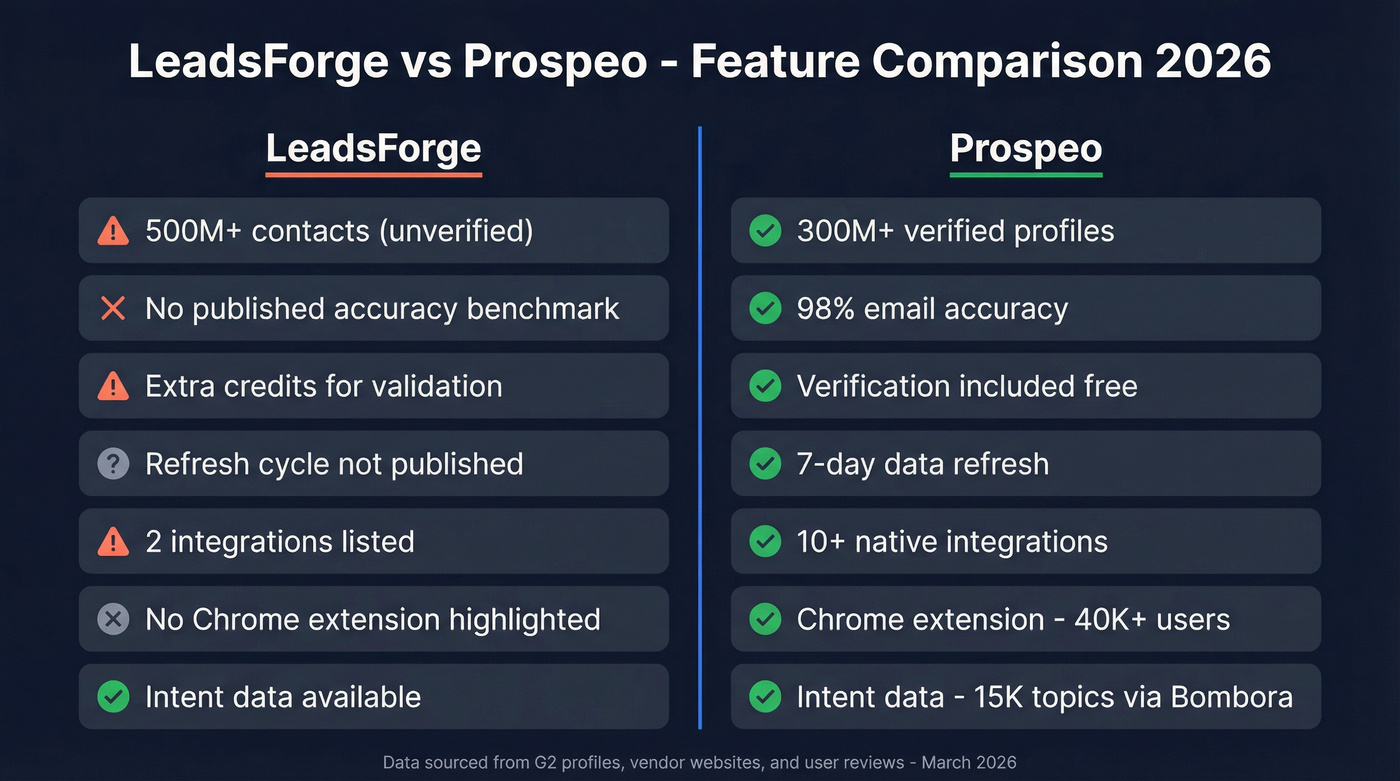
The database size gap looks dramatic until you realize Prospeo's 300M are verified and LeadsForge's 500M aren't. A smaller, verified database beats a larger, unverified one every time - we've tested this firsthand across dozens of outbound campaigns.
Pricing Breakdown
| Prospeo | LeadsForge | |
|---|---|---|
| Starting price | Free tier; paid from ~$39/mo | $49/mo (2,000 credits) |
| Email cost | ~$0.01/email | Credits + validation credits |
| Free tier | 75 emails + 100 extension credits | 100 signup credits |
| Contracts | None, cancel anytime | Credit-based monthly plan |
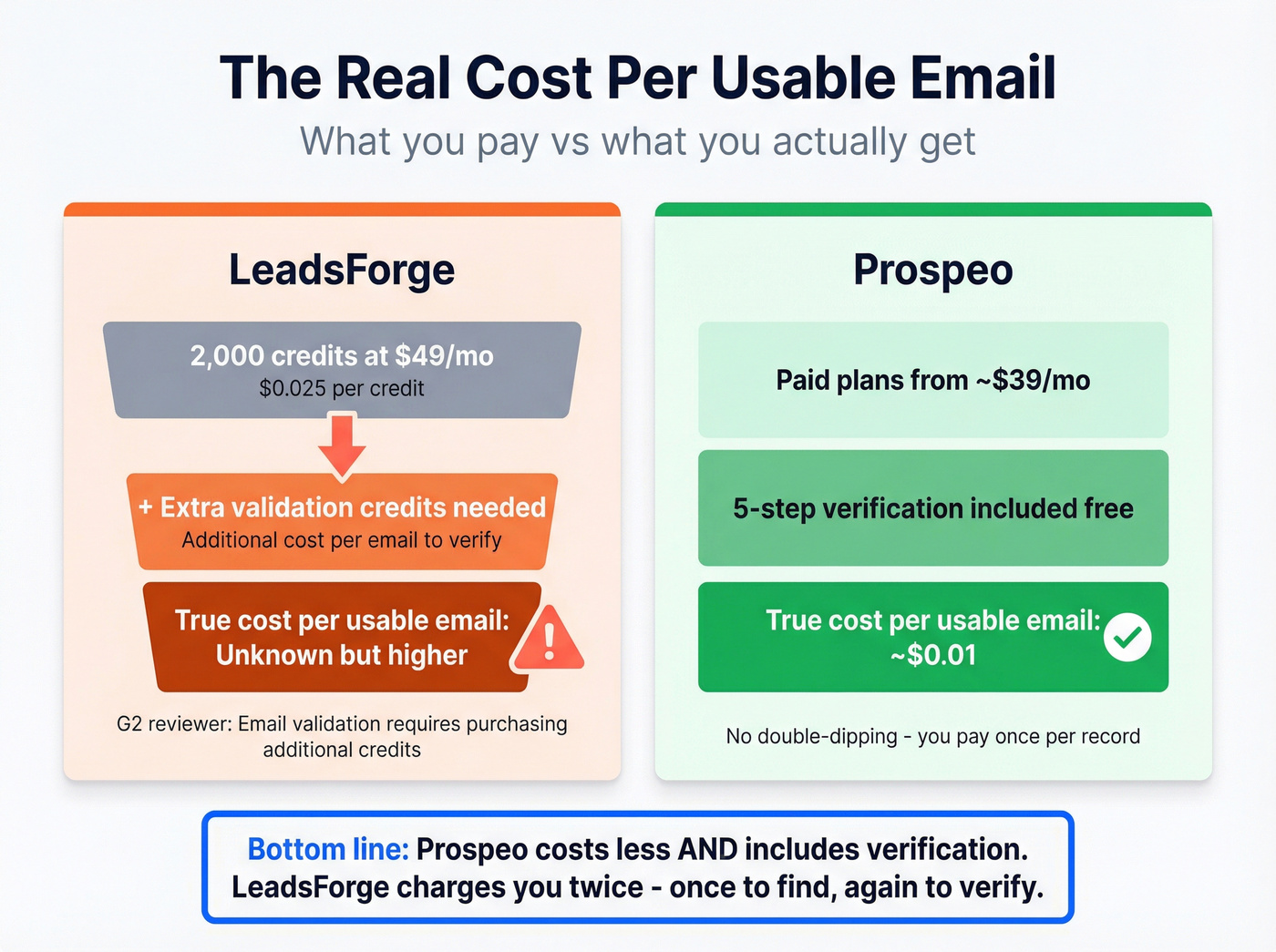
Here's the math that burns LeadsForge users. You export 2,000 leads and spend your monthly credits. Now email validation costs additional credits on top of that - a common setup is 1 credit to pull a record plus extra credits to validate and enrich. In practice, that can turn a 2,000-credit plan into far fewer than 2,000 usable, outbound-safe emails.
A G2 reviewer put it bluntly: "email validation... requires purchasing additional credits."
And here's the contradiction that should give you pause: LeadsForge's own FAQ claims emails are "validated in real time," but users still run into extra-credit validation costs. Either the built-in validation isn't thorough enough for outbound use, or the messaging is misleading. Neither is great.
Prospeo's pricing is flat. Verification is included. No double-dipping.

Why pay extra credits to validate emails you already paid to export? Prospeo includes 5-step verification on every record - 98% accuracy, 7-day refresh, ~$0.01/email. No validation surcharges, no double-dipping.
Get 75 verified emails free and see the difference in one search.
Data Quality
This is where the comparison stops being close.
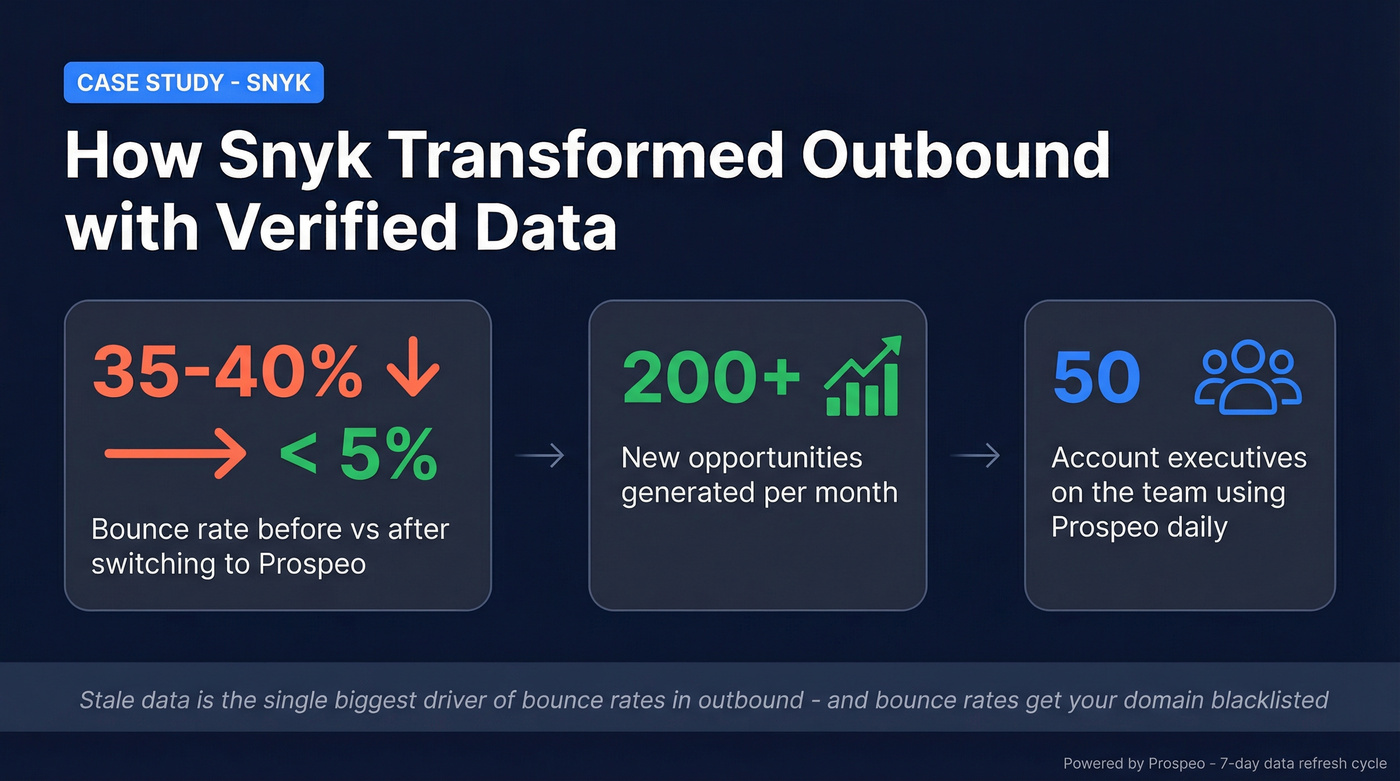
Prospeo runs every email through 5-step verification - catch-all handling, spam-trap removal, honeypot filtering - all on a 7-day refresh cycle. The industry average refresh is six weeks. That gap matters more than most people realize: stale data is the single biggest driver of bounce rates in outbound, and bounce rates are what get your domain blacklisted.
If you're trying to reduce bounces systematically, start with the basics: email bounce rate, email deliverability, and spam trap removal.
The proof is in production results. Snyk's 50-person AE team went from a 35-40% bounce rate to under 5% after switching, generating 200+ new opportunities per month. That's not a marginal improvement - it's the difference between a sequence that works and one that tanks your domain reputation.
LeadsForge publishes no accuracy benchmarks. Trustpilot reviews mention inconsistent export quality, and the company hasn't replied to negative reviews there. Not a confidence builder for a data product. One reviewer did claim a 90% personal email find rate, but that's a single data point from 11 total reviews.
What Users Say
LeadsForge - G2: 4.5/5 (12 reviews). Trustpilot: 4.0 (11 reviews). Users praise the conversational search UX and speed of list building. Complaints cluster around validation costs eating into credits, a steep learning curve across the Salesforge product family, and one reviewer calling it "cheap and bad... hard to cancel."
If you're evaluating tools like this, it helps to compare against broader categories like data enrichment services and sales prospecting databases.
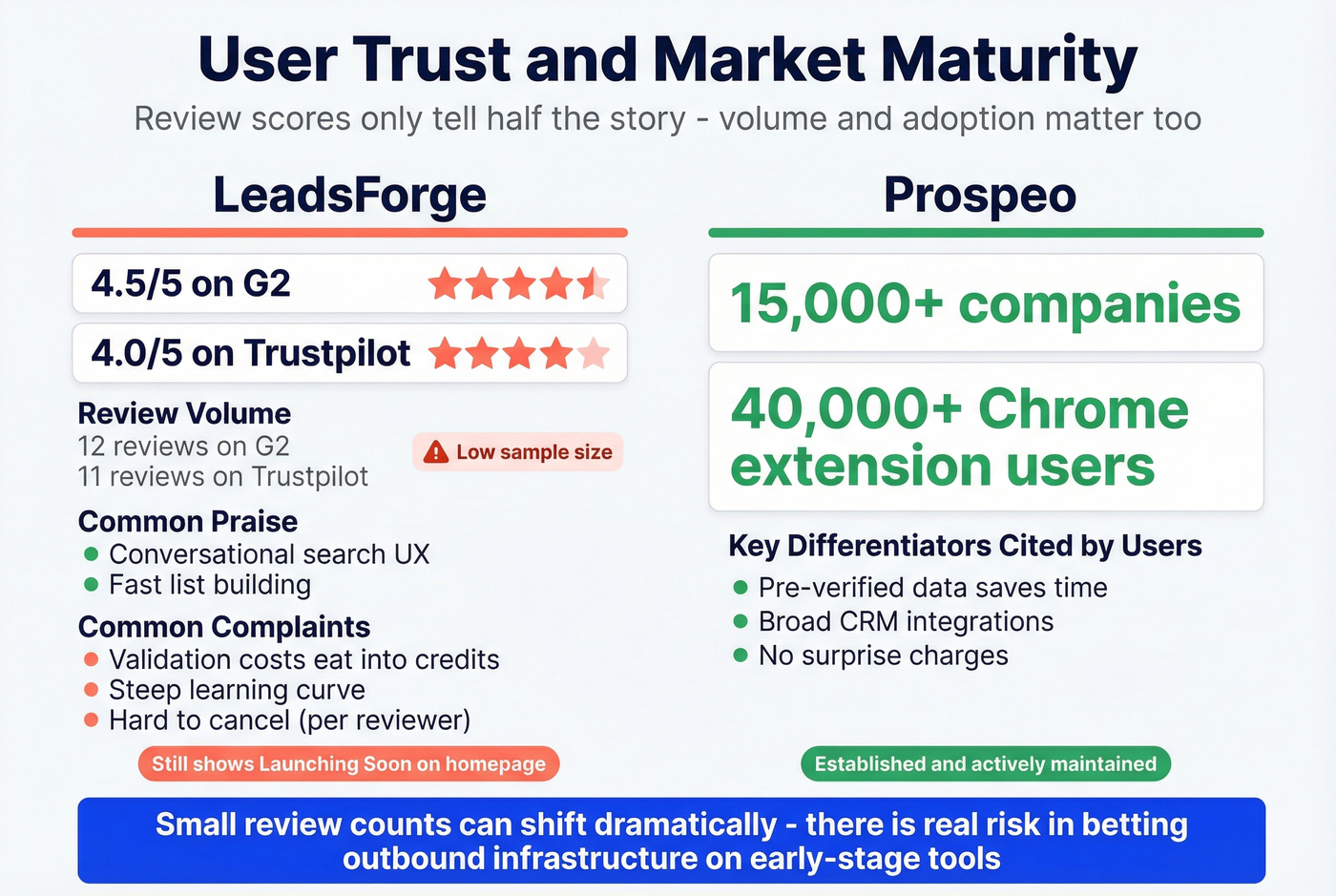
Prospeo - 15,000+ companies, 40,000+ Chrome extension users. The maturity gap is significant. We've seen this pattern before with early-stage tools: small review counts can shift dramatically in either direction, and there's real risk in betting your outbound infrastructure on a product that's still finding its footing.
Who Should Pick Which?
Pick LeadsForge if you already run the full Salesforge/Mailforge stack and you're willing to accept extra validation costs as part of the workflow. Skip it if you need standalone flexibility or broad CRM integrations.
If you're still building your outbound motion, these sales prospecting techniques can help you pressure-test your workflow before you commit to a tool.
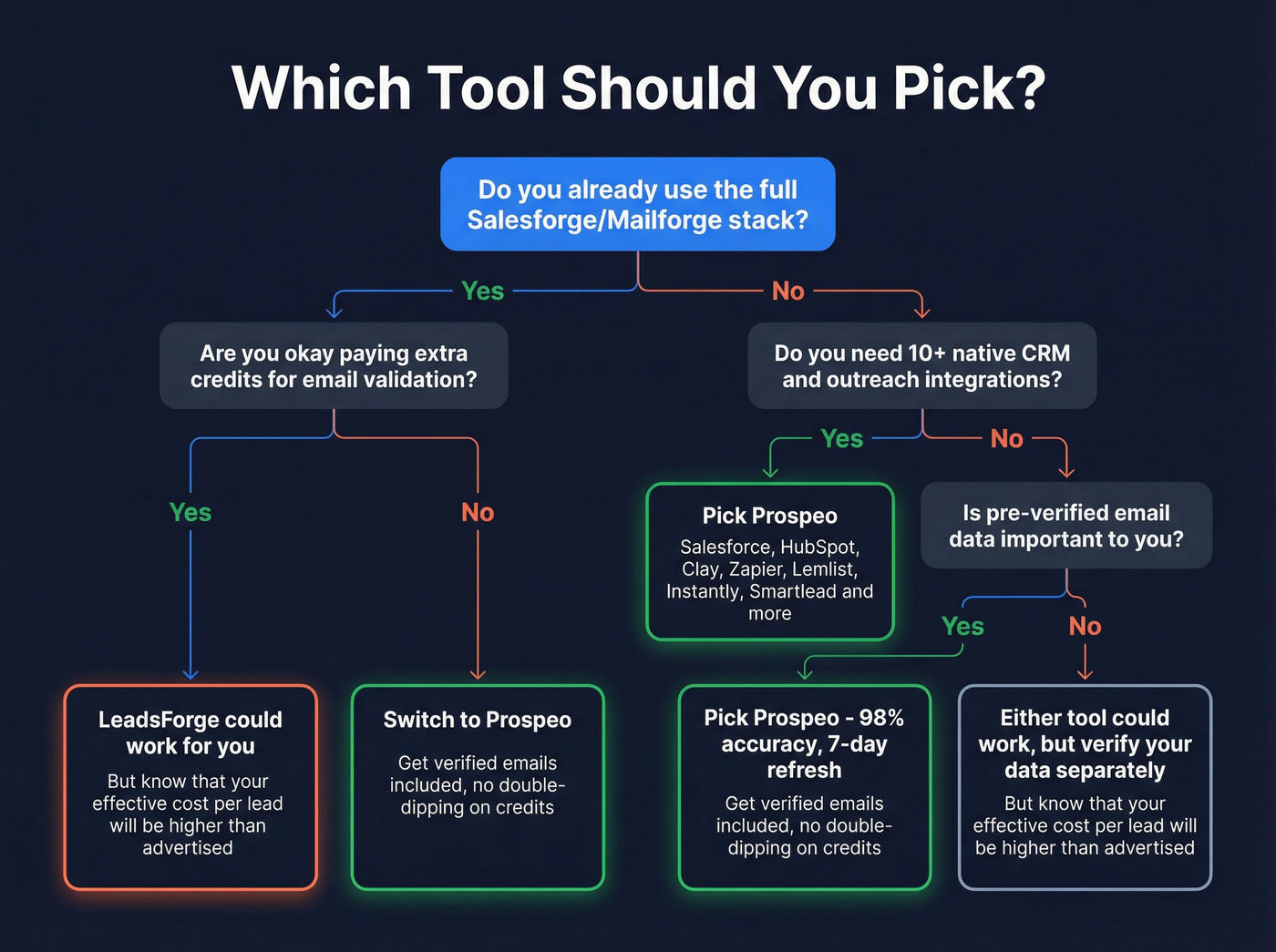
Pick Prospeo if you need verified emails and mobiles out of the box, want standalone flexibility without ecosystem lock-in, and care about integration breadth with your CRM and outreach tools. Start with the free tier - you'll know within an hour whether the data quality meets your bar.
Once you have clean data, the next bottleneck is messaging - use these sales follow-up templates to turn verified contacts into replies.
Let's be honest: LeadsForge's conversational search hints at where prospecting tools are headed. But a great search UX on top of unverified data is like a beautiful restaurant with food poisoning - the experience doesn't matter if the output makes you sick.
Snyk cut bounce rates from 35-40% to under 5% and generated 200+ opportunities per month with Prospeo's verified data. Unverified databases burn credits and domains. Verified ones build pipeline.
Stop gambling your domain reputation on unverified contact data.
FAQ
Is LeadsForge free to use?
LeadsForge gives you 100 free credits on signup, but paid plans start at $49/mo for 2,000 credits. Email validation can burn additional credits on top of search credits, so effective cost per usable lead is higher than the sticker price suggests.
Does Prospeo verify emails automatically?
Yes. Every email runs through 5-step real-time verification before export, with catch-all handling, spam-trap removal, and honeypot filtering included at no extra charge. You pay once per record.
Can I use LeadsForge without Salesforge?
Technically yes, but it's designed as part of the Salesforge ecosystem. On G2, the only integrations listed are HubSpot Marketing Hub and Salesforge - far fewer than Prospeo's 10+ native connections including Salesforce, Clay, and Zapier.
Which tool has better data accuracy?
Prospeo publishes 98% email accuracy backed by a 7-day refresh cycle and proprietary verification infrastructure. LeadsForge has no published benchmarks, and reviewers have flagged data freshness and verification transparency concerns. For outbound teams where bounce rates impact domain reputation, this isn't a close call.