


Leadzen.ai vs ZoomInfo: Are These Even Comparable?
A sales rep on r/sales posted their ZoomInfo quote last month: $20,000 a year for a 3-person team. That kind of number sends you hunting for alternatives fast. But when you're weighing Leadzen.ai against ZoomInfo and one option has zero G2 reviews and a pricing page that looks like two different products stitched together, you've got to ask: is this a real comparison, or a total mismatch?
These two tools serve fundamentally different markets. One is an enterprise GTM platform with thousands of reviews and a decade of market presence. The other is an India-first prospecting tool that barely registers on mainstream review sites.
30-Second Verdict
ZoomInfo is the pick for enterprise teams (50+ reps) with $15K+/year budgets who need global intent data, conversation intelligence, and deep CRM integrations.
Leadzen.ai is worth testing only if you're prospecting in India or PAN Asia - but zero G2 reviews and a confusing dual pricing model make it a risky bet for anything mission-critical.
Feature Comparison
The gap here isn't subtle. ZoomInfo is a full GTM suite; Leadzen.ai is a prospecting tool with a regional focus.
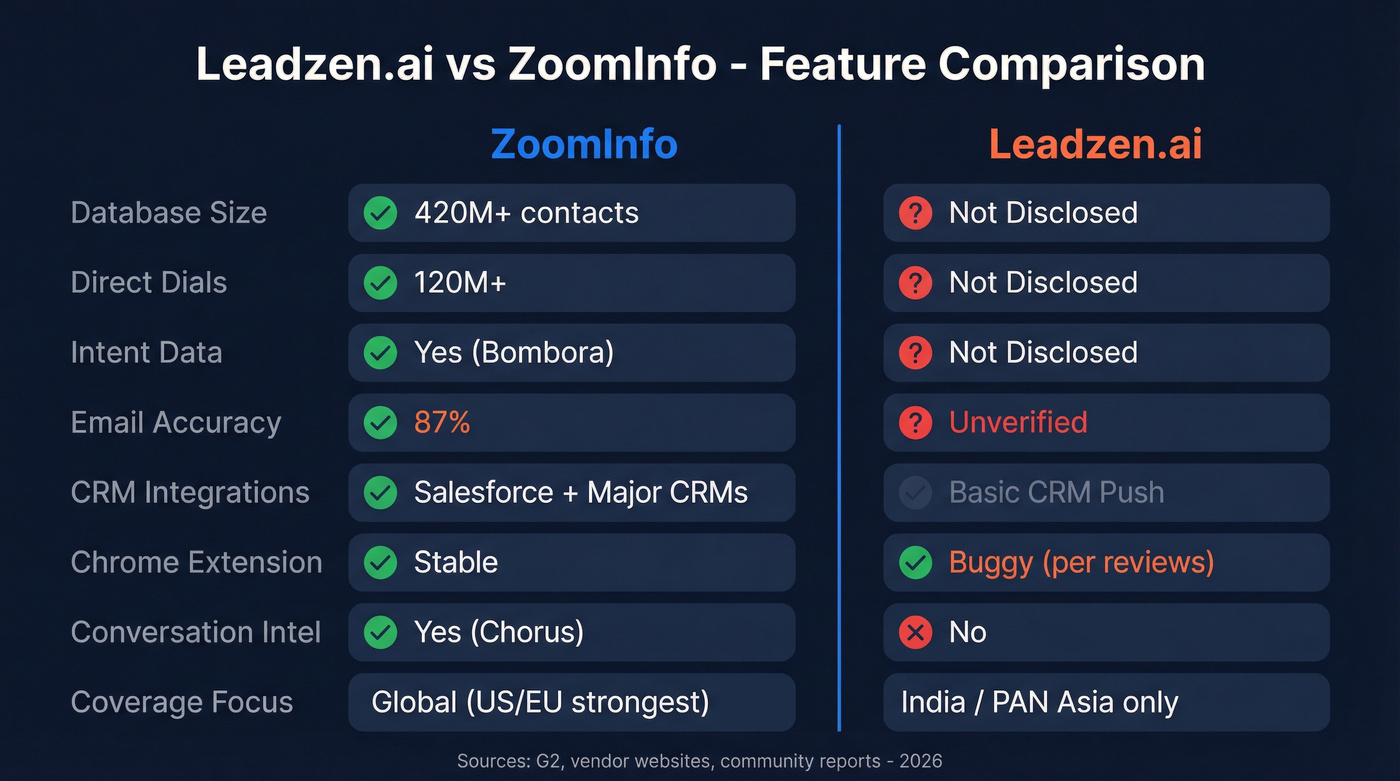
| Feature | ZoomInfo | Leadzen.ai |
|---|---|---|
| Database size | 420M+ contacts | Not disclosed |
| Direct dials | 120M+ | Not disclosed |
| Intent data | Yes (Bombora) | Not disclosed |
| Email accuracy | 87% | Unverified |
| CRM integrations | Salesforce + major CRMs | Basic CRM push |
| Chrome extension | Yes | Yes (bugs flagged in reviews) |
| Conversation intel | Yes (Chorus) | No |
| Coverage focus | Global (US/EU strongest) | India / PAN Asia |
Community-reported email accuracy for tools like Apollo (65-70%) and Lusha (60-65%) shows how much the industry struggles with data quality. We've tested enough platforms to know: always run your own 200-contact sample before committing budget.
If you're building a stack around outbound, it helps to separate the database from the workflow layer (sequencing, follow-ups, etc.) - see our breakdown of SDR tools and outbound lead generation tools.
Pricing Breakdown
ZoomInfo's pricing is opaque by design. Leadzen.ai's pricing is confusing by accident.
ZoomInfo Pricing (2026 Estimates)
| Tier | Annual Cost | What You Get |
|---|---|---|
| ZoomInfo Lite | $0 | 10 credits/mo (25 with Community Edition), up to 10 visitor reveals/day |
| Professional | ~$15,000/yr | Core search + export |
| Advanced | ~$24,000/yr | + intent data (Bombora) |
| Elite | ~$40,000+/yr | + Chorus + Engage |
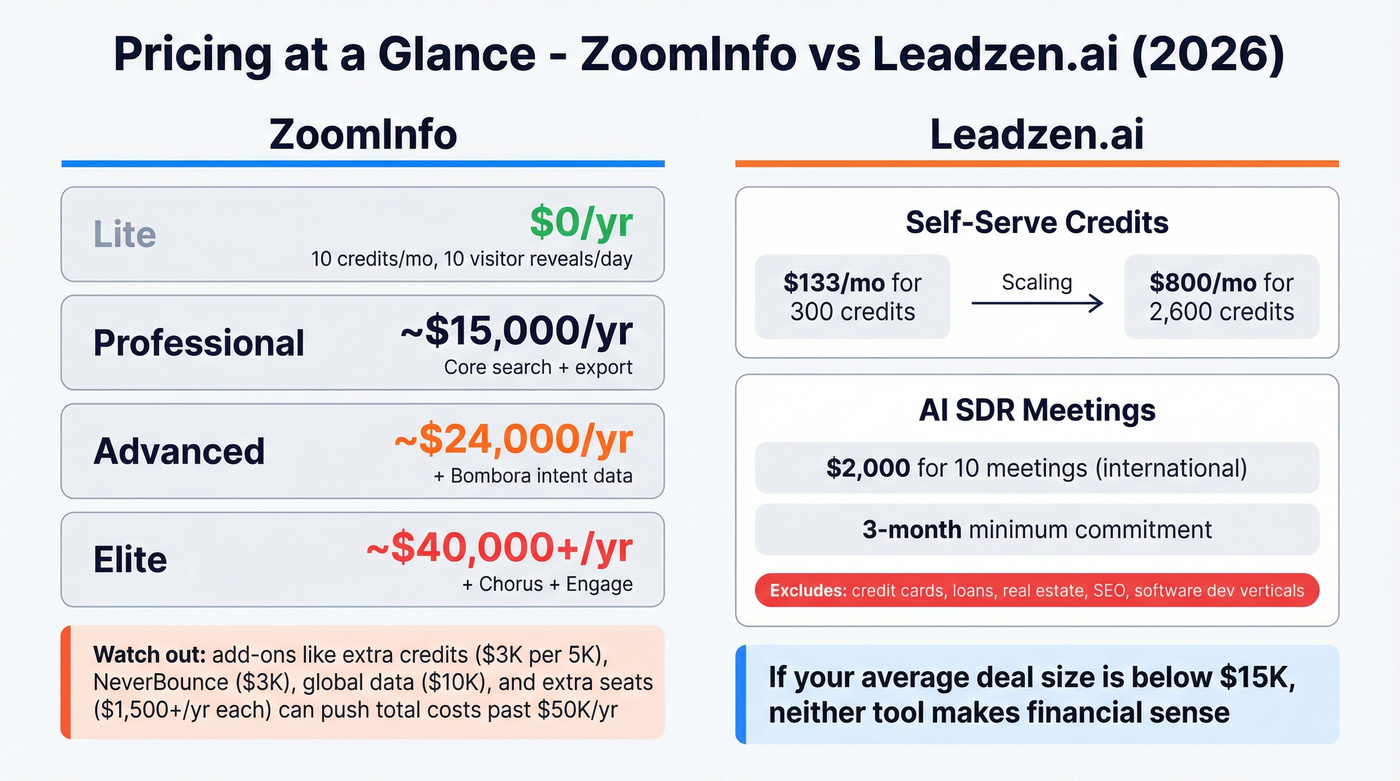
Add-ons pile up fast. Extra credits run ~$3,000 per 5,000. NeverBounce verification is ~$3,000. Global data access is ~$9,995. Additional seats cost ~$1,500+/year each. Teams regularly report all-in costs approaching $50,000/year, and auto-renewal windows of 60-90 days make it genuinely hard to leave.
If you're trying to sanity-check cost-per-lead, it helps to map pricing back to your lead generation metrics and expected sales conversion rate.
Leadzen.ai Pricing (2026)
Leadzen.ai runs two completely different pricing motions - and the relationship between them is never explained.
Self-serve credits start at $133/user/month for 300 credits, scaling to $800/user/month for 2,600 credits. AI SDR "confirmed meetings" packages start at $2,000 for 10 meetings (international) with a 3-month minimum commitment. India-domestic packages run ₹1.2L-₹4.8L for 10-60 meetings. The meetings packages exclude entire verticals like credit card sales, loan sales, real estate, SEO/digital marketing/SMS software, and software/app/web dev projects.
Here's the thing: if your average deal size sits below $15K, neither tool makes financial sense. ZoomInfo's cost-per-lead math only works at enterprise deal sizes, and Leadzen.ai's $200/meeting floor price demands high close rates to justify itself.
If you're still early in list-building, you may get more mileage from free lead generation tools and tightening your sales prospecting techniques before paying enterprise rates.

ZoomInfo charges $15K+ for 87% email accuracy. Leadzen.ai won't even disclose theirs. Prospeo delivers 98% verified accuracy at ~$0.01/email with the same Bombora intent data ZoomInfo locks behind its Advanced tier - no contracts, no sales calls.
Stop overpaying for data that bounces. Start free with 75 verified emails.
The Trust Problem
ZoomInfo has 4.5/5 on G2 with 8,806 reviews and 4.1/5 on Capterra with 317 reviews. Leadzen.ai has zero G2 reviews, 5.0/5 on Capterra with 2 reviews, and 5.0/5 on Software Advice with 2 reviews.
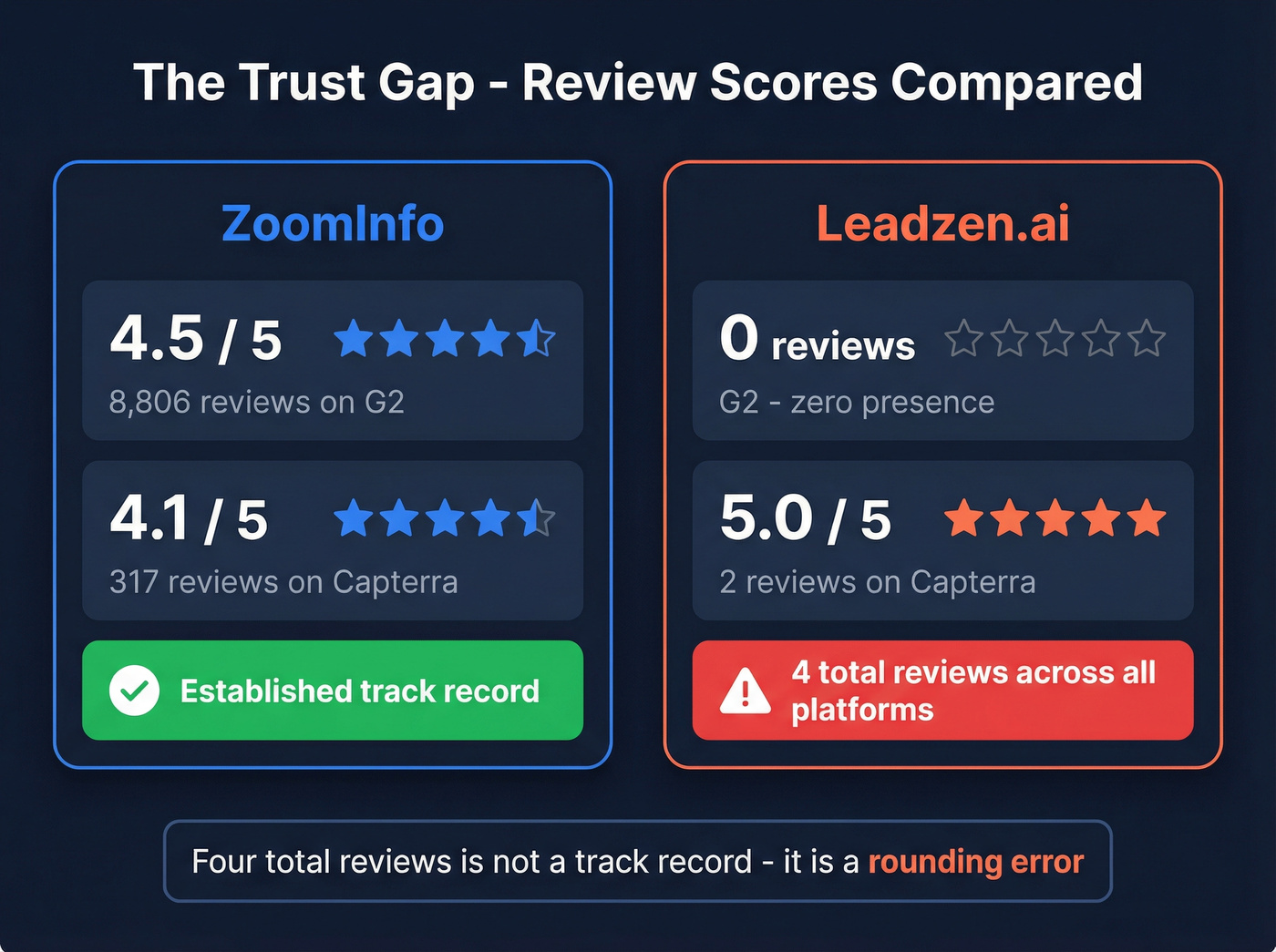
Four total reviews across two platforms. That's not a track record - it's a rounding error.
The reviews that exist mention "trending leads" and a geolocator feature as standouts, but they also flag bugs in the Chrome extension and geolocator. More telling: many "Leadzen.ai vs X" comparison results are Leadzen.ai's own blog posts. When the only content about a tool comes from the tool itself, no VP of Sales is signing off on that vendor.
If you're evaluating vendors, it’s worth pressure-testing claims with a small enrichment + verification run - our guide to data enrichment services covers what to look for.
Who Should Pick Which
Enterprise teams with 50+ reps selling into US/EU markets belong on ZoomInfo. The intent data, Chorus integration, and workflow depth justify the cost at that scale. If you're already spending $40K+/year on sales tools and need a single platform that covers everything from prospecting to conversation intelligence to website visitor identification, ZoomInfo earns its price tag - though we'd still recommend verifying a sample of their emails independently before trusting deliverability claims.
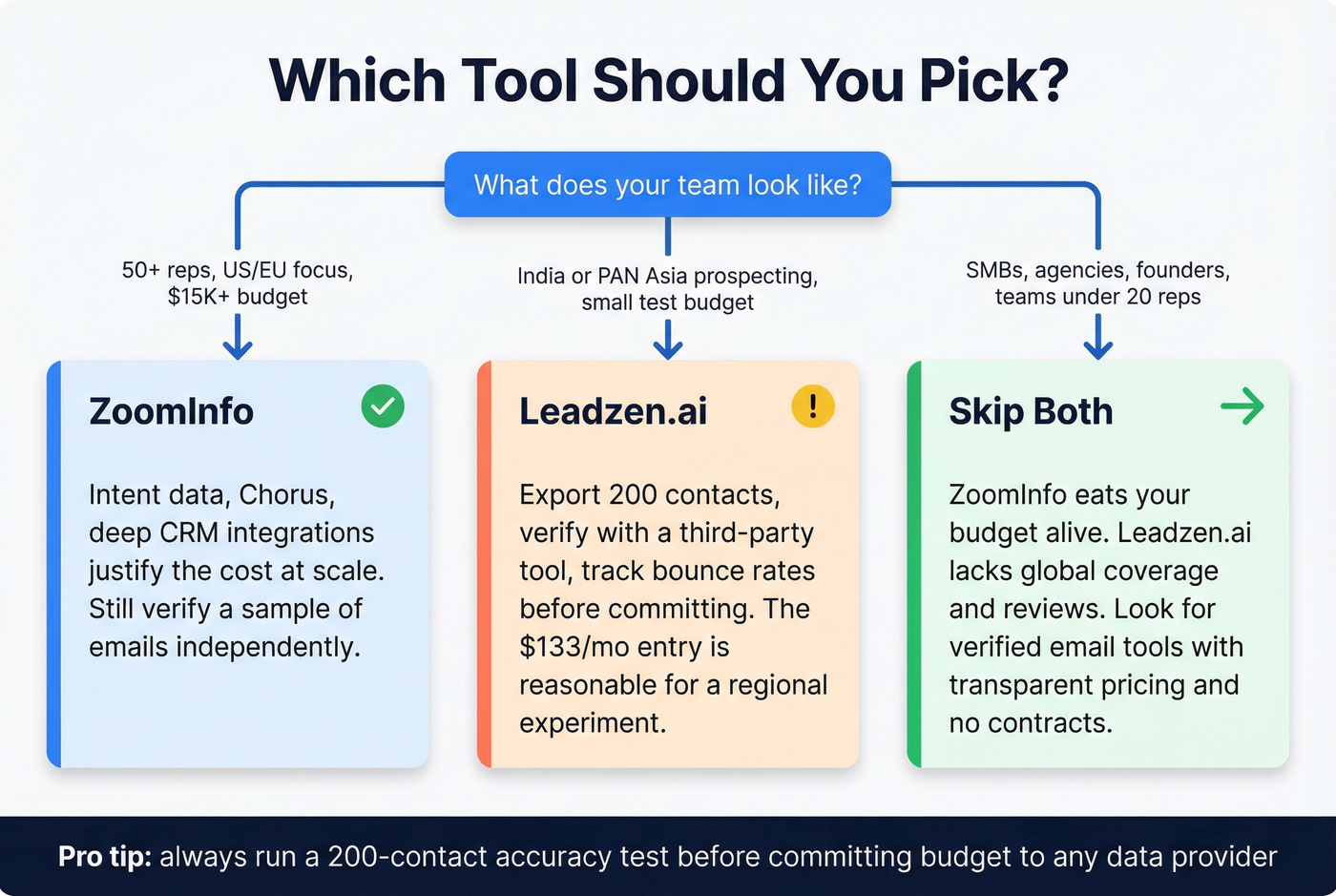
India/PAN Asia prospectors can give Leadzen.ai a small test. Export 200 contacts, verify them with a third-party tool, and track bounce rates before committing. The $133/mo entry point is reasonable for a regional experiment.
If you're doing that test, track deliverability properly (not just opens) - start with email bounce rate and a basic email deliverability guide.
Everyone else should skip both. SMBs, agencies, founders, and teams under 20 reps will find ZoomInfo eats their budget alive, and Leadzen.ai doesn't have the review footprint or global coverage to be anyone's primary data source.
A Stronger Option for Most Teams
Let's be honest - most teams reading this comparison aren't choosing between a $40K enterprise platform and an unproven regional tool. They need verified emails that actually land in inboxes, at a price that doesn't require board approval.

Prospeo covers 300M+ professional profiles with 143M+ verified emails, refreshes data every 7 days instead of the industry-standard 6 weeks, and includes Bombora-powered intent data across 15,000 topics - the same provider ZoomInfo charges extra for. Self-serve, starts free at 75 emails/month plus 100 Chrome extension credits/month, and scales at ~$0.01/email. No contracts, no sales calls.
The accuracy gap is the real story. At 98% verified email accuracy vs ZoomInfo's 87%, the difference compounds across thousands of sends - fewer bounces, healthier sender domains, more replies hitting primary inboxes. Snyk's 50 AEs cut bounce rates from 35-40% to under 5% and grew AE-sourced pipeline 180%. Meritt tripled weekly pipeline from $100K to $300K. Those aren't hypotheticals.
If you're scaling outbound, pair better data with better messaging - these sales follow-up templates can help tighten the sequence.
Meritt tripled pipeline from $100K to $300K/week. Snyk's 50 AEs cut bounce rates from 35-40% to under 5%. The difference isn't effort - it's 300M+ profiles refreshed every 7 days instead of 6 weeks, verified at 98% accuracy.
Get enterprise-grade data without the enterprise price tag.
FAQ
Does ZoomInfo have a free plan?
Yes. ZoomInfo Lite includes 10 monthly credits (25 with Community Edition) and up to 10 visitor reveals per day. It's enough to test data quality, but most reps burn through credits in a single session.
Is Leadzen.ai a real ZoomInfo alternative?
Only for India and PAN Asia prospecting. Zero G2 reviews, a confusing dual pricing model, and no independent accuracy data make it a risky replacement for global teams. Test regionally with 200 contacts before committing budget.