


Lemlist Reviews 2026: What 1,345+ Users Actually Think
You just renewed your Lemlist seat, added two reps, and watched your monthly bill jump $200. The tool works - open rates are fine, replies are trickling in - but you're wondering if you're actually paying for the right things. We dug into 1,345+ lemlist reviews on G2, 156 Trustpilot ratings, and dozens of Reddit threads to find out what users really say when they're not writing for a referral bonus.
30-Second Verdict
Lemlist earns a 4.6/5 on G2 from 1,345 reviews and a 4.5/5 on Trustpilot from 156 reviews. The distribution skews heavily positive: 76% five-star, 20% four-star, with only 2% at three stars or lower.
It's the best multichannel sequencing tool for teams of 3-15 who need email, LinkedIn, and calls in one UI. Skip it if you're a solo founder sending fewer than 50 emails a day, an agency managing 10+ clients, or a team that only needs email.
The thing most reviews get wrong: they blame the tool for bad campaign results when the real problem is upstream data quality. Verify your contacts before they hit any sequencer, and most "deliverability issues" vanish.
Cold Email Baselines You Should Know
Before evaluating any tool, set realistic expectations. The most recent industry benchmarks show roughly 42% open rates, 3% reply rates, and 7.5% bounce rates. Apple's Mail Privacy Protection inflates open rates, so replies and meetings booked are the metrics that actually matter. If a tool or guru promises dramatically better numbers, the variable isn't the software - it's list quality. Every single time.
What Lemlist Does Well
Multichannel Sequences
Lemlist's core strength is combining email, LinkedIn actions, calls, and WhatsApp into a single campaign flow. One sequence, one interface: email on day one, LinkedIn connection request on day three, call task on day five. This theme dominates G2's review aggregation - deep personalization plus multichannel sequencing shows up 370 times across reviews.
The AI personalization layer saves real time when you're running 5+ campaigns simultaneously. Custom icebreakers, dynamic variables, voice-cloned notes - it handles the tedious parts so you can focus on copy strategy. You still need good instincts, but the automation earns its keep.
LinkedIn Automation
Lemlist's LinkedIn automation includes a built-in ramp-up system: newly connected accounts start at 2 invitations per day, increasing by +2/day until hitting your configured cap. The recommended setup is a 20 invites/day cap. Conservative by design, because sudden spikes get accounts restricted. The ramp-up resets if you stop sending for several days, so consistency matters.
LinkedIn automation always carries risk. Lemlist handles it more carefully than most tools, but no platform can guarantee your account won't get flagged.
Database and Deliverability Tools
Every plan includes access to a 600M+ leads database, lemwarm for warm-up and deliverability boosting, deliverability protections, and inbox rotation across multiple senders per campaign. If you're comparing list sources, start with data enrichment services and a dedicated sales prospecting database before you blame the sequencer.
Pricing Breakdown
Plans and Costs
| Plan | Monthly | Annual (per user) | Senders | Credits/mo |
|---|---|---|---|---|
| Email Pro | $79/mo | $63/mo | 3 | 200 |
| Multichannel Expert | $109/mo | $87/mo | 5 | 400 |
| Enterprise | Custom | Custom | Custom | Custom |
Both paid plans include the leads database, AI personalization, CRM integrations, and lemwarm. Multichannel Expert adds LinkedIn automation, the call dialer, and a unified multichannel inbox. Enterprise gets SSO, custom roles, and a dedicated account manager.
Add-Ons
| Add-On | Price |
|---|---|
| Additional email sender | $9/mo per email |
| WhatsApp automation | $20/mo/user* |
| Extra deliverability protection | $20/mo/user |
| New calling number | $15/mo/number |
| Claap AI meeting agent | $60/mo/user |
*The WhatsApp add-on shows $20/user on one section of the pricing page and $29/user in the calculator. That's sloppy, and it's been that way for months.
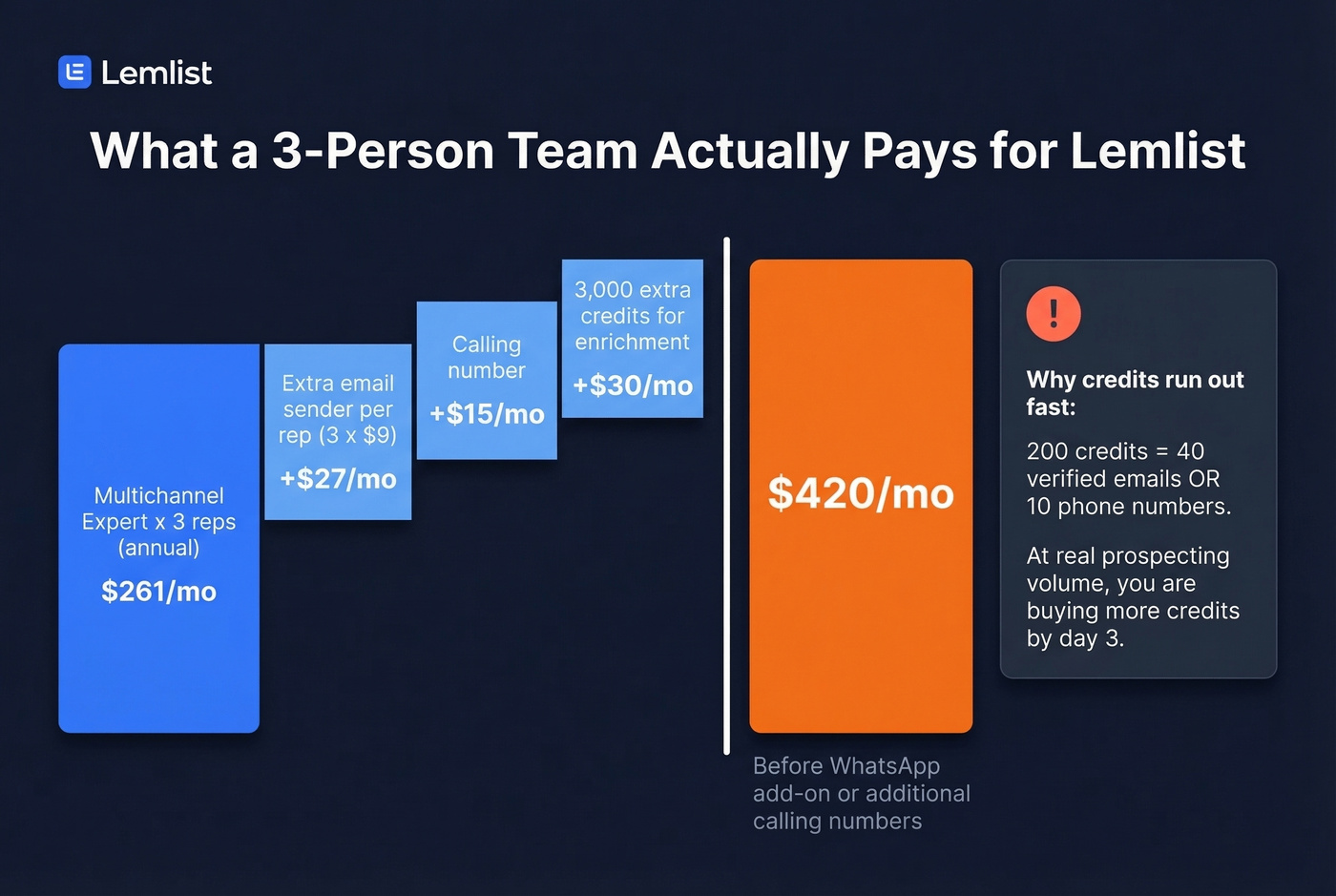
Here's the thing about credits: 200 free credits per month sounds generous until you do the math. Verified emails cost 5 credits each, phone numbers cost 20. That means 200 credits gets you exactly 40 verified emails - or 10 phone numbers. If you're prospecting at any real volume, you're buying credits by day three. (If you want a deeper framework for this kind of cost math, see lead enrichment.)
What a 3-Person Team Actually Pays
Three reps on Multichannel Expert (annual): $87 x 3 = $261/mo. Add one extra email sender per rep ($27/mo), a calling number ($15/mo), and 3,000 extra credits for enrichment ($30/mo). That's roughly $420/mo before the WhatsApp add-on or additional calling numbers. Not cheap, but it replaces 2-3 separate subscriptions if you're genuinely using all the channels.

Lemlist gives you 40 verified emails per month on 200 credits. Prospeo gives you 75 free emails at 98% accuracy - and when you need more, it's $0.01 each. No per-seat pricing, no credit math, no surprise add-ons.
Stop feeding credits into a sequencer. Feed it verified data instead.
What Users Praise and Complain About
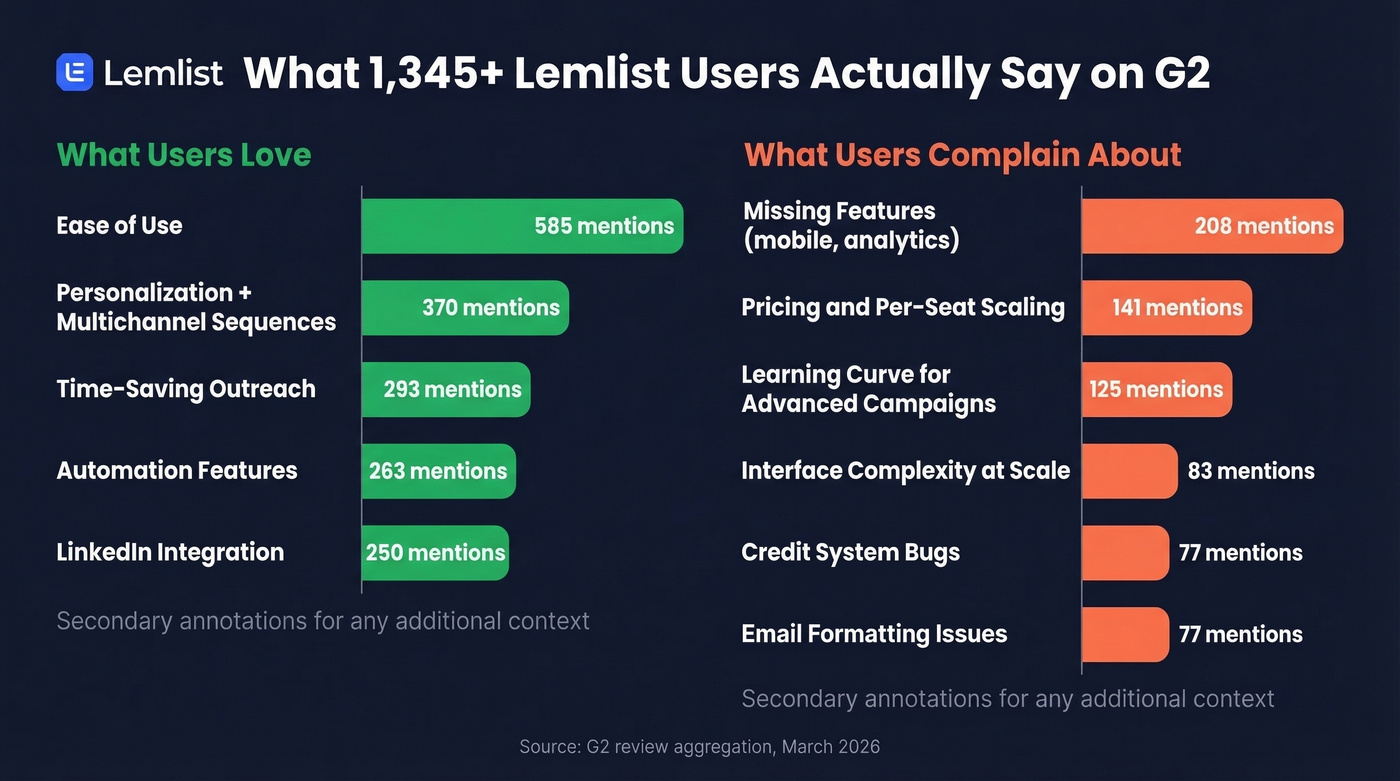
Ease of use dominates the positive mentions with 585 references, followed by deep personalization plus multichannel sequencing (370), time-saving multichannel outreach (293), general automation features (263), and LinkedIn integration (250). Lemlist's UX is genuinely intuitive once you get past initial setup - we've found the learning curve front-loaded but manageable. If you're building a broader stack, this is where SDR tools and sales prospecting techniques matter more than the UI.

The complaints tell a sharper story. "Missing features" leads with 208 mentions - users want a mobile app, deeper engagement analytics, and better reporting. Pricing concerns hit 141 mentions, almost entirely about per-seat scaling. The learning curve for advanced campaigns gets 125 mentions, and interface complexity at scale gets 83. Credit system bugs and email formatting issues round it out at 77.
On Trustpilot, support gets praised consistently for fast responses and helpful staff, while day-to-day reliability gets called buggy by a vocal minority. CRM integrations are a recurring sore point. One Reddit user specifically calls out HubSpot workflows that "don't work how they wanted." If your CRM is central to your process, run a proof-of-concept before committing (and make sure your connect outreach tool to CRM setup is solid).
Deliverability - The Real Story
Deliverability is where lemlist reviews get the most heated, and where most reviewers evaluate the wrong thing entirely.
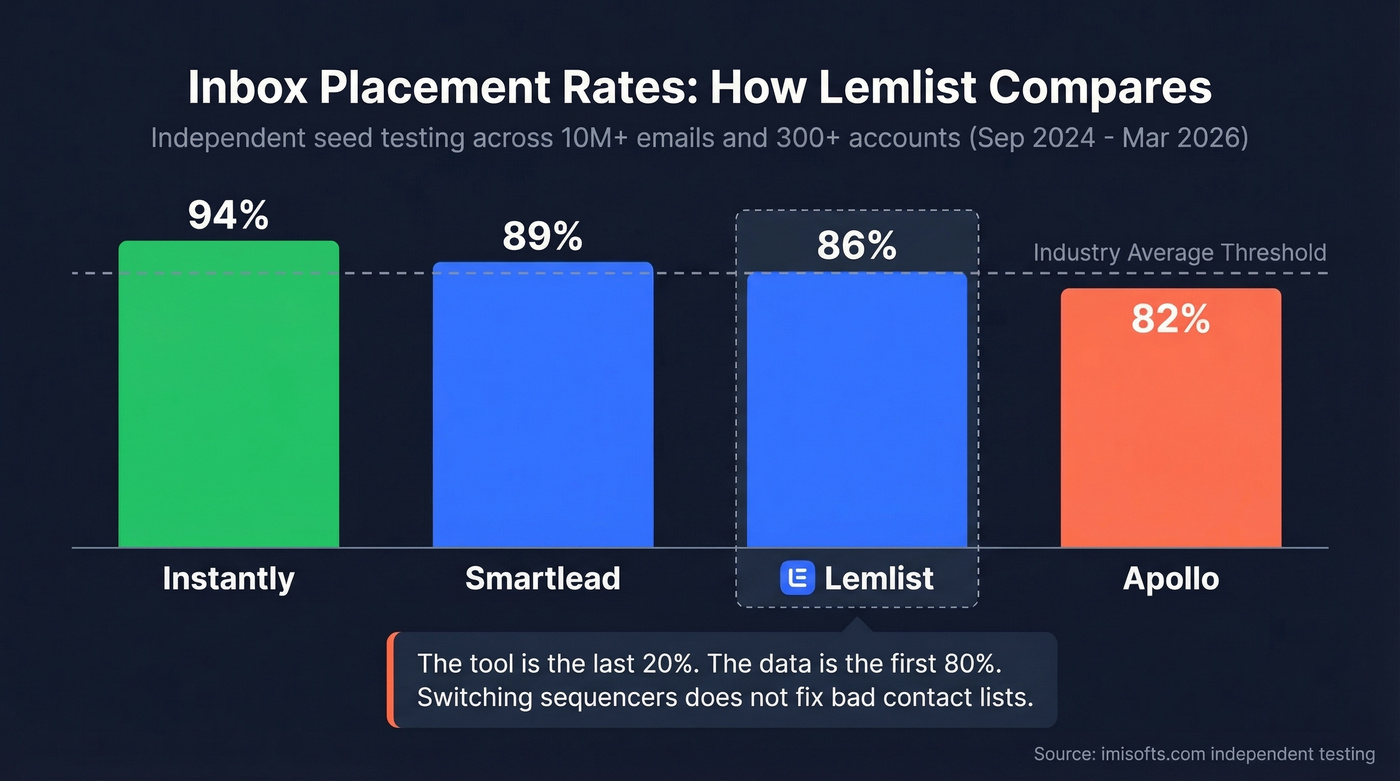
In independent seed testing across 10M+ emails and 300+ sending accounts (Sep 2024-Mar 2026), Lemlist hit 86% inbox placement. Decent, not best-in-class. Instantly scored 94%, Smartlead 89%, Apollo 82%.
But those numbers don't capture the operator variable. One Reddit agency owner reported spending 10+ hours per month on email infrastructure - three Google Workspace disconnections and a blacklisted domain - after switching from Woodpecker to Lemlist. Same problems, different tool. Another user sending 100-200 emails/day watched domain reputation decline and wondered if Apollo would fix it. Spoiler: it wouldn't.
Meanwhile, one experienced operator who's sent low six figures of emails through Lemlist reports 60-70% open rates and 7-12% reply rates. The critical detail: they don't use Lemlist's built-in data. They build lists externally, verify everything through separate tools, then import clean contacts.
That's the pattern we see over and over. We've tested Lemlist across multiple campaigns, and the results track directly with data quality - not tool settings. Switching outreach tools doesn't fix bad data. The tool is the last 20%. The data is the first 80%. If you need a tighter process, use an email deliverability guide and track your email bounce rate like a KPI.
Lemlist's 86% inbox placement is perfectly fine for most teams. If your deliverability is suffering, you almost certainly have a data problem, not a tool problem. Stop shopping for a new sequencer and start auditing your contact lists.
Every deliverability complaint in those 1,345 reviews traces back to the same root cause: bad upstream data. Prospeo's 5-step verification and 7-day refresh cycle keep bounce rates under 4% - so your sequencer actually delivers.
Fix the data before it hits your sequencer. 98% email accuracy, verified weekly.
Who It's For (and Who Should Look Elsewhere)
Use Lemlist if you're a sales team of 3-15 reps running multichannel outbound, you want warm-up, sequencing, and a unified inbox without stitching tools together, and you're willing to invest in list verification upstream.
Skip Lemlist if you're a solo founder sending fewer than 50 emails a day - Instantly at roughly $30/mo is more proportionate. For agencies managing 10+ clients, the math breaks fast: $87/user x 10 clients is $870/mo minimum before add-ons, and you'll burn through the included 200 credits in days. And if you only need email sequences, Instantly and Smartlead offer flat-fee pricing that scales far better for high-volume email-only workflows. If you're still dialing alongside email, build a real cold calling system so the channel mix actually works.
Alternatives Worth Considering
| Tool | Best For | Pricing | Inbox Placement |
|---|---|---|---|
| Instantly | Email-only at scale | Flat fee, ~$30/mo | 94% |
| Apollo | All-in-one + database | Per seat, ~$49/mo | 82% |
| Smartlead | Budget email scaling | Flat fee, ~$39/mo | 89% |
| Saleshandy | High-volume email | Flat fee, ~$25/mo | ~87% |
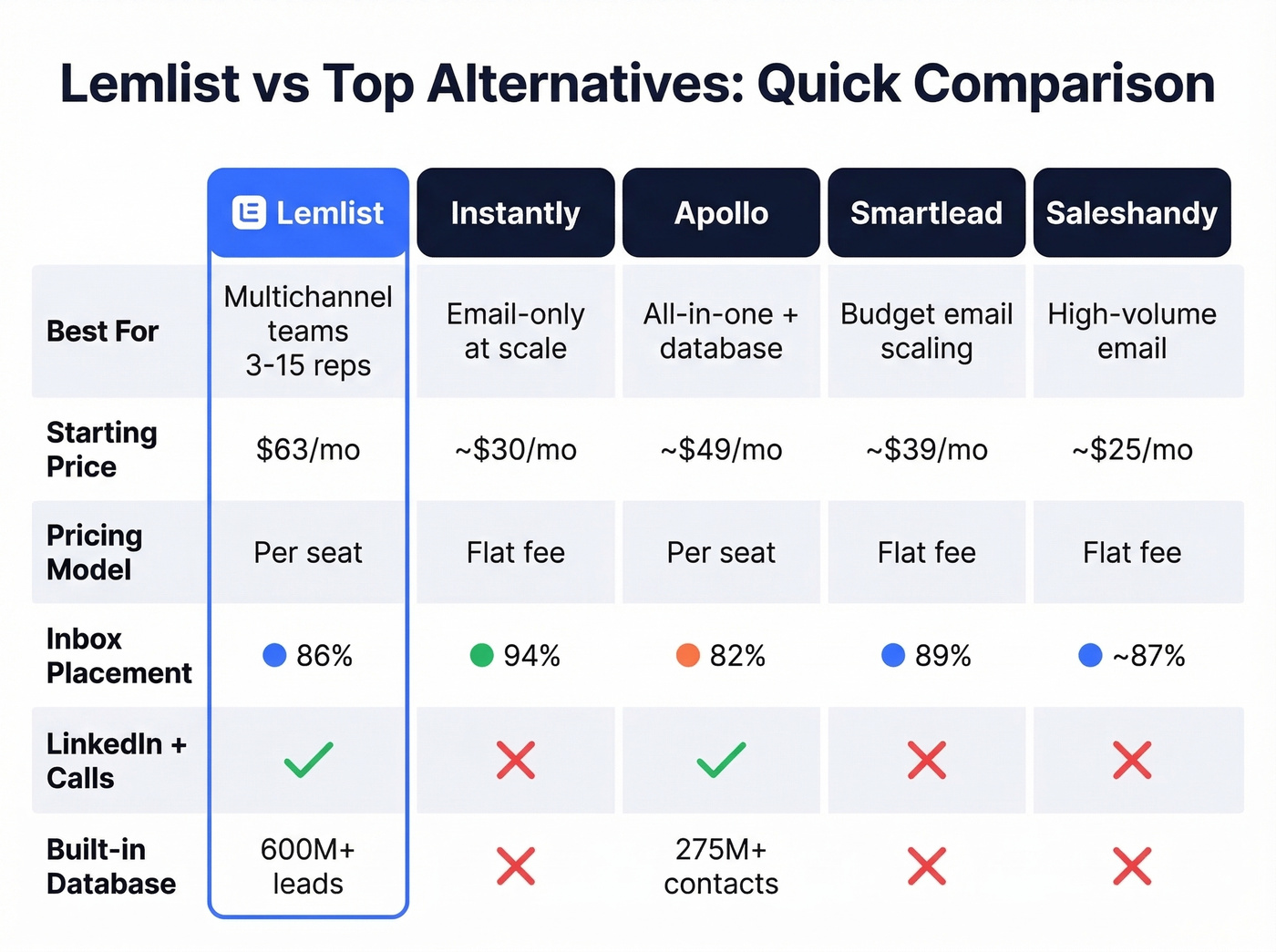
Instantly is the move if you only need email. Flat-fee pricing and 94% inbox placement make it the price-performance leader for pure cold email. No LinkedIn, no calls - that's the tradeoff.
Apollo is the most common tool people consider switching to, based on Reddit threads. It bundles a 275M+ contact database with sequencing, so you're not paying separately for data. Similar per-seat pricing, but the included database offsets cost if you're currently buying leads elsewhere.
Smartlead and Saleshandy both run flat-fee models. Smartlead hits 89% inbox placement; Saleshandy is the budget pick at $25/mo. Less polished, but the economics work for high-volume senders. If you're evaluating other senders, compare against an AI bulk email sender shortlist and keep an eye on email velocity.
FAQ
Is Lemlist worth it in 2026?
Yes, for multichannel teams of 3-15 reps who need email, LinkedIn, and calls in one platform. It's overkill for solo senders and gets expensive for agencies past 10 clients. Your results depend almost entirely on data quality and sending discipline.
How much does Lemlist actually cost?
$63-$87 per user on annual billing. A 3-person team with typical add-ons pays roughly $420/month. Credits deplete fast - 200 free credits equals just 40 verified emails.
Is Lemlist good for deliverability?
Lemlist scored 86% inbox placement in independent seed testing - decent, not best-in-class. Deliverability depends far more on list hygiene, DNS configuration, and sending volume than on which tool you pick.
What's the best alternative for email only?
Instantly at roughly $30/mo with 94% inbox placement. Smartlead at $39/mo is the runner-up. Both use flat-fee pricing instead of per-seat, which scales better for high-volume senders.
How do I improve Lemlist campaign results?
Verify your contact data before import - tools like Prospeo with 98% email accuracy make this a one-step process. Beyond data, keep emails short, ramp sending volume gradually, and monitor reply rates over open rates.