

List of Email Domains: Categorized and Ranked
You exported 200,000 contacts from your CRM last quarter. After deduping by domain, you're still staring at 3,000 unique domains - and you can't tell if 126.com is a Chinese freemail provider or a company you should be prospecting. That classification problem is exactly why a categorized list of email domains matters, and why most of the ones floating around the internet - uncategorized text files with zero context - are functionally useless.
You don't need 10,000 domains in a flat dump. You need the top free providers categorized by region, awareness that 160,000+ disposable domains exist (so you can't block them manually), and a verification tool for everything else.
Quick Reference
- Top free email domains for CRM filtering? Scroll to the categorized tables below - organized by volume, region, and type.
- Maintained blocklist for disposable domains? Grab the disposable-email-domains GitHub repo - 160,000+ domains, used by PyPI for account registration blocking.
- Need to verify the actual addresses behind these domains? Domain classification tells you the type of address; verification tells you if it's real. Prospeo checks emails at 98% accuracy with a 75-email free tier.
Why Email Domain Lists Matter
The email ecosystem is staggering. 4.59 billion people use email globally, sending over 376 billion messages daily - projected to reach 392.5 billion per day by the end of 2026. The average user manages 1.86 email accounts, which means your contact database is full of duplicates, personal addresses, and throwaway signups hiding behind domains you've never heard of.
For B2B teams, the pain is specific: you need to separate corporate domain addresses you'd actually want to prospect from public provider domains that signal low-intent form fills and disposable domains that are outright junk. Get this wrong and you're burning send reputation on addresses that bounce, complain, or simply don't exist anymore.
The classification starts with knowing which domains belong in which bucket.
Common Email Domains by Volume
GMass tracks the top 100 domains receiving email across their platform - 563,185,814 emails sent. Here are the heavyweights:
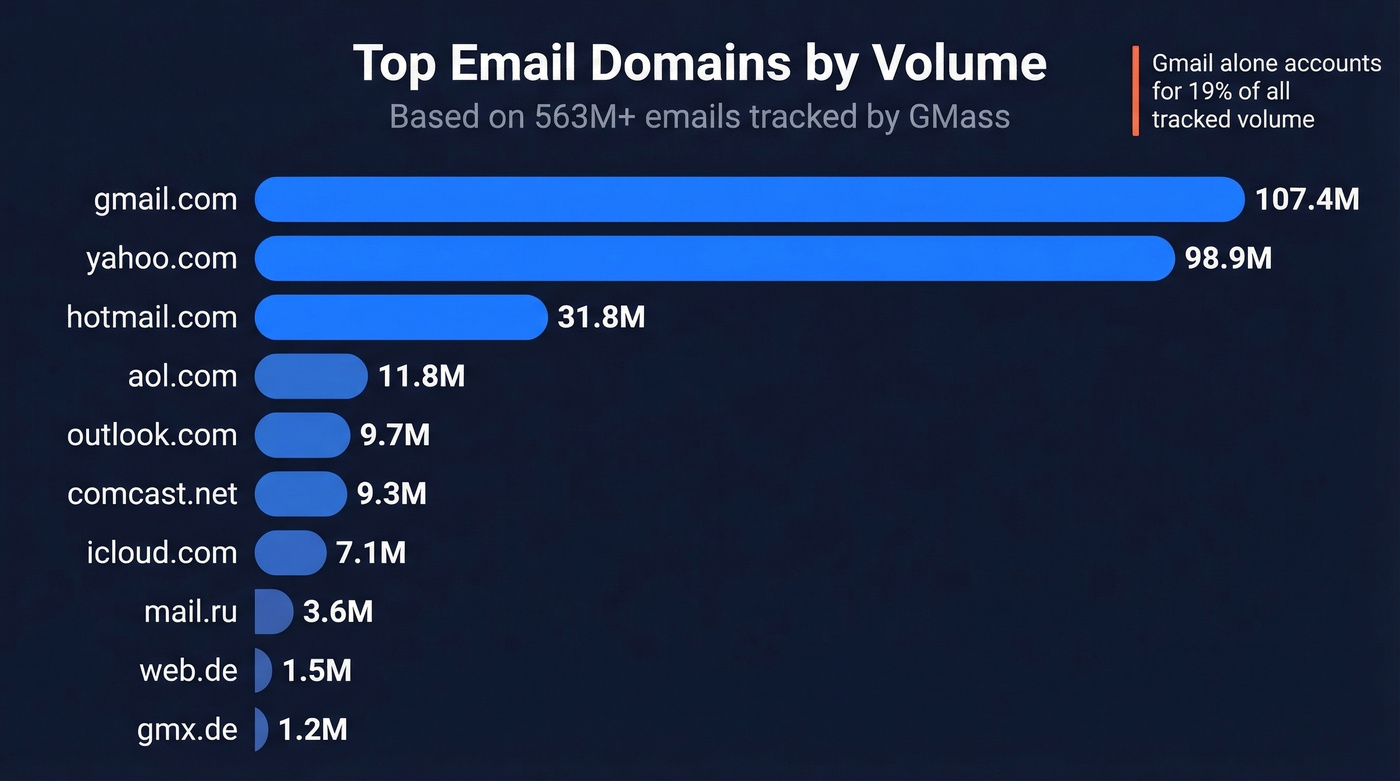
| Domain | GMass Volume | Provider |
|---|---|---|
| gmail.com | 107,413,999 | |
| yahoo.com | 98,895,904 | Yahoo |
| hotmail.com | 31,839,178 | Microsoft |
| aol.com | 11,826,511 | AOL/Yahoo |
| outlook.com | 9,663,112 | Microsoft |
| comcast.net | 9,274,437 | Comcast/Xfinity |
| icloud.com | 7,101,124 | Apple |
| mail.ru | 3,583,276 | Mail.ru |
| web.de | 1,467,512 | 1&1 |
| gmx.de | 1,226,544 | 1&1 |
| 163.com | 1,080,325 | NetEase |
| naver.com | 1,066,813 | Naver |
| yandex.ru | 911,300 | Yandex |
| qq.com | 903,178 | Tencent |
Gmail dominates with 1.8 billion active accounts globally. But here's a nuance that trips people up:
Litmus's January 2026 data shows Apple at 46.56% of email opens, with Gmail at just 25.45%. That's client share - how emails are opened - not domain share, where the mailbox lives. An iPhone user reading their Gmail still counts as an Apple open. Don't confuse the two when making deliverability decisions.
The top four popular email domains - Gmail, Microsoft (Outlook/Hotmail), Yahoo, and Apple iCloud - often represent 80% or more of a typical B2C email list. For B2B, the distribution shifts heavily toward corporate domains, but these free providers still flood form submissions and imported lists.
Free Email Domains
These are the common provider domains you'll want to filter when qualifying B2B leads. Every one offers free personal accounts:
| Domain | Provider | Notes |
|---|---|---|
| gmail.com | Largest globally | |
| yahoo.com | Yahoo | Still huge, esp. US |
| hotmail.com | Microsoft | Legacy, still active |
| outlook.com | Microsoft | Current MS brand |
| live.com | Microsoft | Legacy variant |
| aol.com | Yahoo (owned) | Skews older US demo |
| icloud.com / me.com | Apple | Growing with iOS |
| protonmail.com / proton.me | Proton | Privacy-focused |
| zoho.com | Zoho | Also offers biz plans |
| mail.com | 1&1 | US-facing freemail |
| gmx.com / gmx.net | 1&1 | Popular in DACH |
| yandex.com | Yandex | Russian origin, global |
| yahoo.co.uk | Yahoo | UK variant |
| yahoo.co.jp | Yahoo Japan | Japan-specific |
This isn't the full list - HubSpot's downloadable CSV contains thousands of free and disposable domains, regularly updated. It's the best free starting point for marketing teams who need a production-ready blocklist without building one from scratch.
The Kikobeats free-email-domains npm package wraps HubSpot's list into a developer-friendly format - freeEmailDomains.includes('gmail.com') returns true. Simple, maintained, and MIT-licensed.
Regional and International Providers
This is where domain classification gets tricky. A thread on r/email described someone with 5,000+ domains to classify who didn't realize 126.com is a Chinese freemail provider, not a company. Regional providers are the blind spot in most English-centric blocklists.
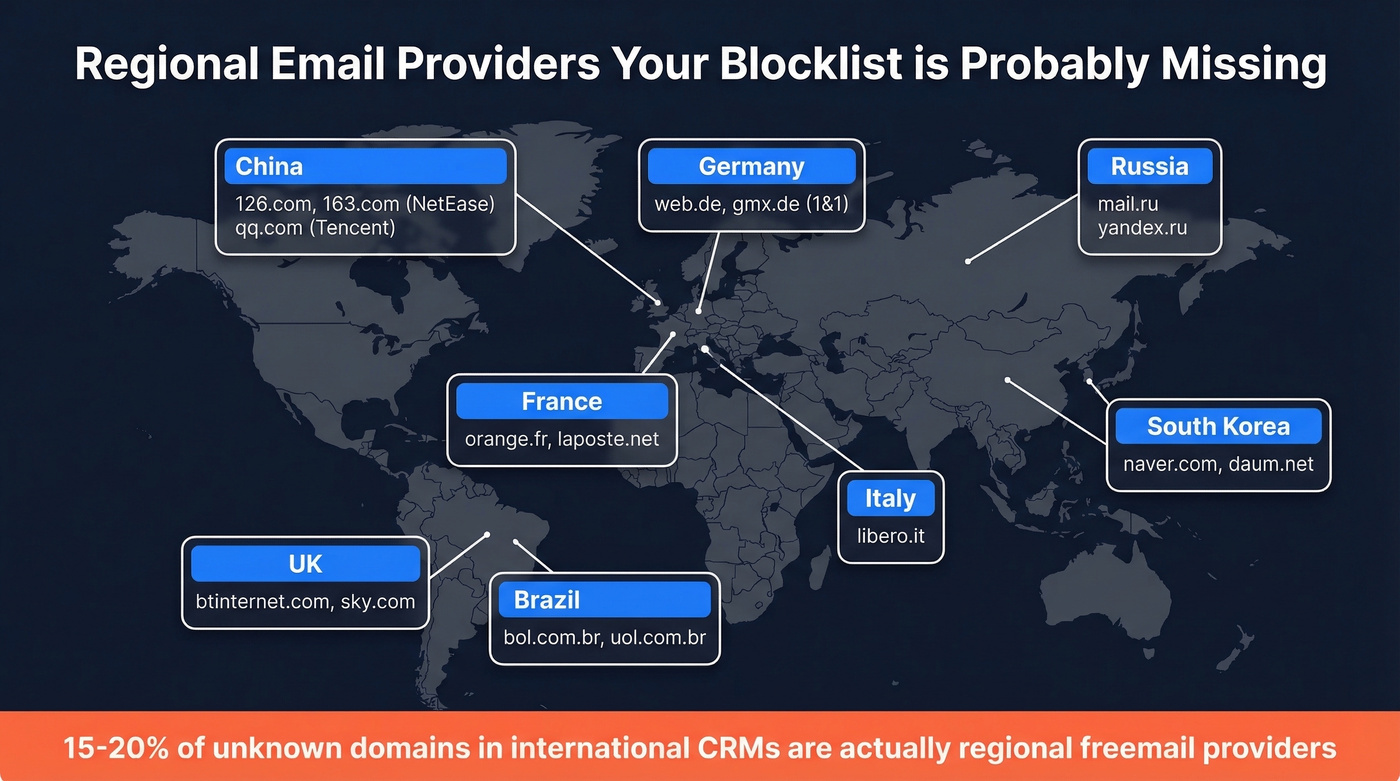
Rather than another table, let's break this down by region. In China, NetEase runs 126.com and 163.com while Tencent operates qq.com - together they account for nearly 2 million emails in GMass's dataset alone. Russia's Mail.ru pulls 3,583,276, with Yandex adding 911,300 more. Germany's 1&1 group powers web.de and gmx.de. South Korea has Naver (naver.com) and daum.net. France has orange.fr and laposte.net. Italy has libero.it. The UK has btinternet.com and sky.com. Brazil has bol.com.br and uol.com.br.
If your CRM has international contacts and your blocklist only covers Gmail/Yahoo/Outlook, you're missing a significant chunk of freemail addresses. We've audited lists where 15-20% of "unknown" domains turned out to be regional providers that any international blocklist would have caught.

Filtering free and disposable domains from your CRM is step one. Step two is verifying the corporate emails that remain. Prospeo's 5-step verification catches catch-all domains, spam traps, and honeypots - returning 98% accurate emails at $0.01 each.
Start with 75 free verified emails - no credit card, no sales call.
ISP and Telecom Domains
These are the addresses people got with their internet service in 2004 and never stopped using:
| Domain | Provider | Country |
|---|---|---|
| comcast.net | Comcast/Xfinity | US |
| att.net | AT&T | US |
| verizon.net | Verizon | US |
| sbcglobal.net | AT&T (legacy) | US |
| cox.net | Cox | US |
| charter.net | Spectrum | US |
| btinternet.com | BT | UK |
| sky.com | Sky | UK |
| shaw.ca | Shaw | Canada |
ISP domains are declining as users migrate to Gmail and Outlook, but they're still significant in B2C lists - especially for older demographics. Don't ignore them for segmentation, but don't expect them to grow.
Disposable and Temporary Domains
Here's the thing: static blocklists lose this war. The disposable email ecosystem runs 160,000+ active domains, and as one r/Emailmarketing poster put it, you need a "constantly updated" list because blocking disposable domains manually is a fight you'll always lose.
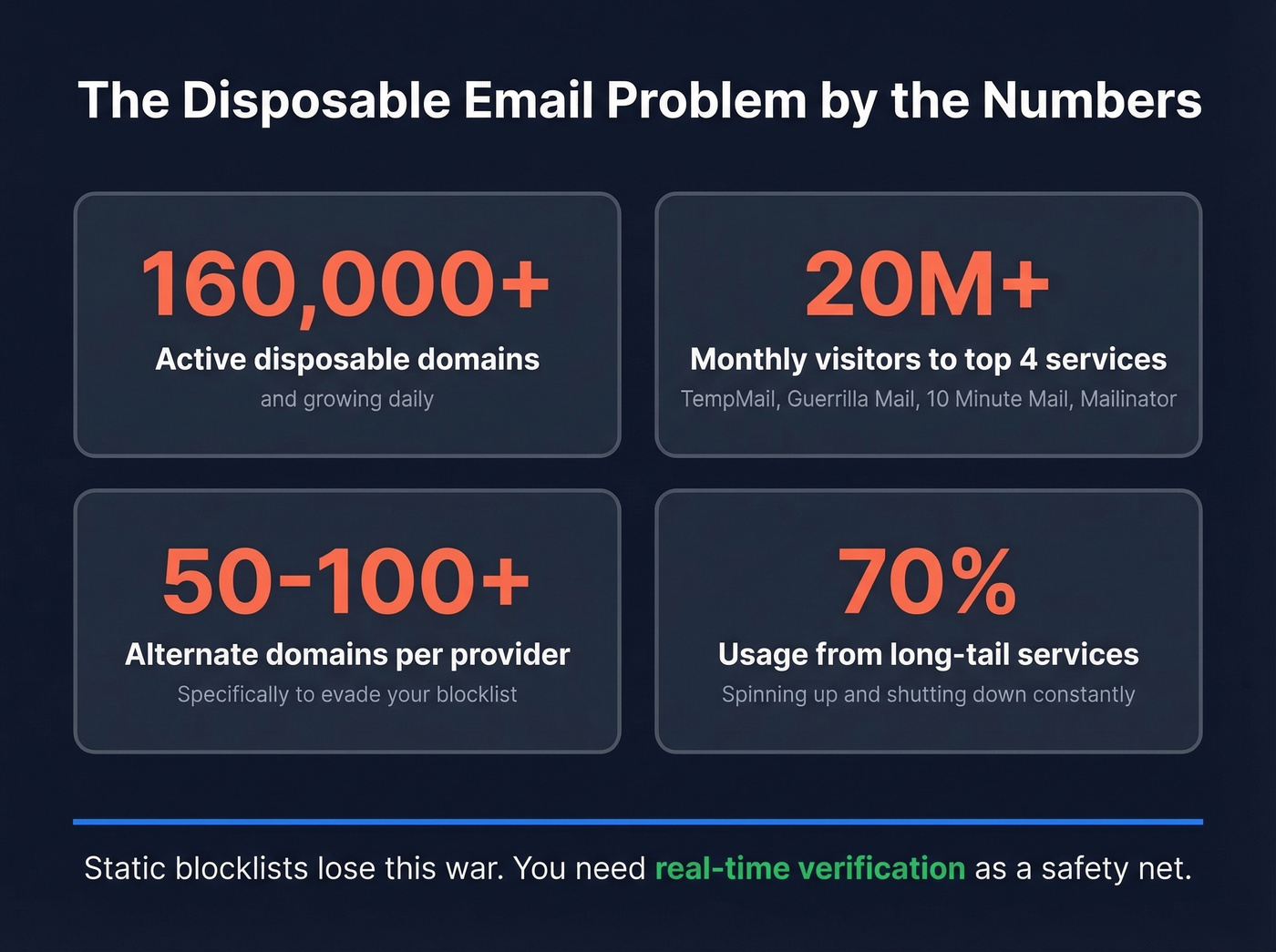
The scale of the problem: TempMail draws about 8 million monthly visitors, Guerrilla Mail about 5 million, 10 Minute Mail about 4 million, and Mailinator about 3 million. Each operates 50-100+ alternate domains specifically to evade blocklists. The top 10 providers represent roughly 30% of disposable usage. The remaining 70% is a long tail of services that spin up and shut down constantly.
This is why the disposable-email-domains repo matters - it's community-maintained, used by PyPI for registration blocking, and includes an allowlist.conf for domains that get falsely flagged. One implementation detail that trips up developers: the repo uses second-level domains, so you need to handle public suffix matching correctly. An address at xxx.yyy.zzz needs to match against yyy.zzz, not the full subdomain.
No blocklist catches every disposable domain. Not today, not ever. Real-time email verification is the safety net - the blocklist handles known threats, verification handles everything else.
Privacy-Focused Domains
Don't lump these in with disposable domains. They're long-term accounts held by real people who care about privacy.
| Domain | Provider | Notes |
|---|---|---|
| proton.me, protonmail.com | Proton | Privacy-focused |
| tuta.io, tutanota.com | Tuta | Privacy-focused |
| fastmail.com | Fastmail | Paid email service |
| hey.com | HEY | Opinionated email service |
| hushmail.com | Hushmail | Healthcare/legal focus |
| mailfence.com | Mailfence | Privacy-first |
| posteo.de | Posteo | Eco-friendly |
For B2B qualification, a proton.me address is closer to a Gmail address than a TempMail address. The person is real; they just don't want to be tracked.
How to Use This Domain Reference
B2B Lead Qualification
The simplest use case: filter free email domains out of form submissions. In HubSpot, enable "Block free email providers" in your form settings - it uses their maintained blocklist automatically. For other CRMs, import a domain list and create a validation rule that flags or blocks submissions from known free providers.
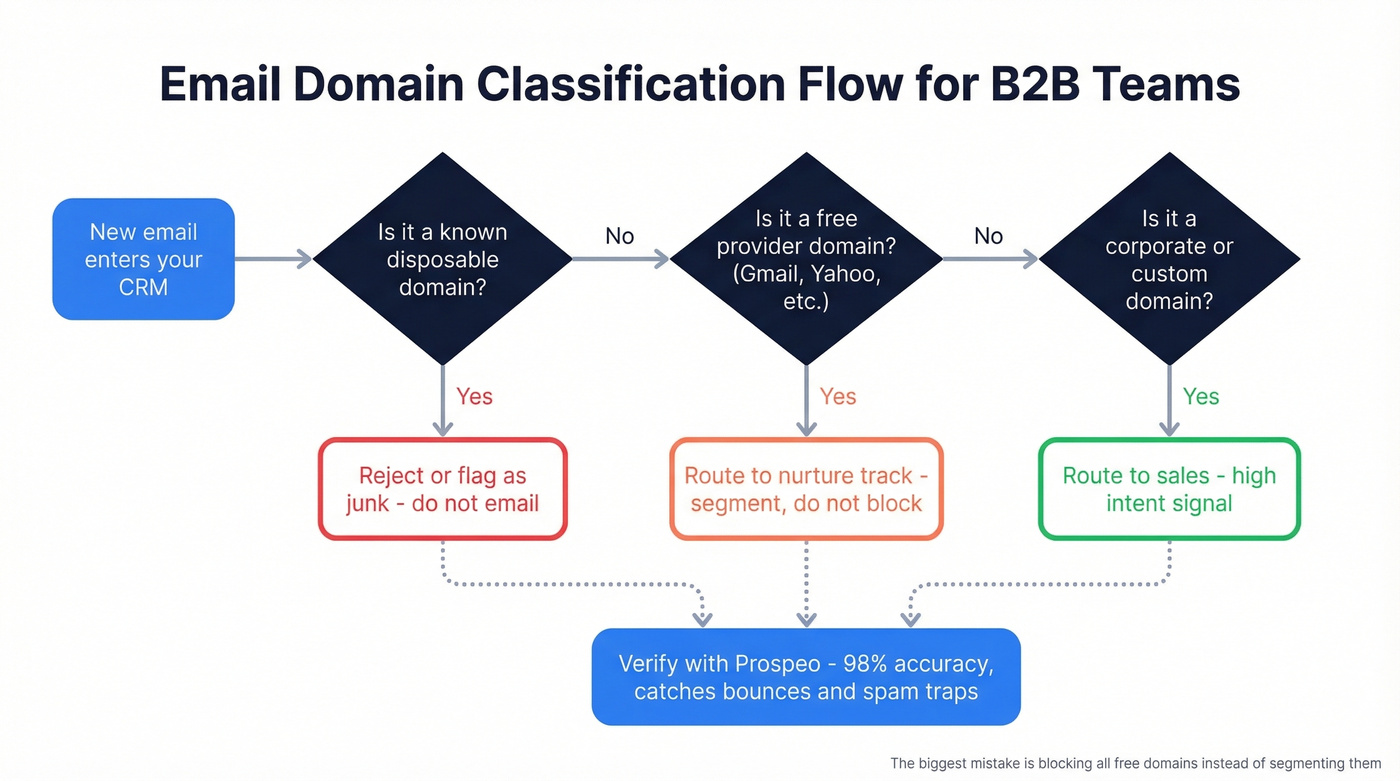
This isn't about rejecting every Gmail address. A founder at a 5-person startup legitimately uses Gmail for business. The goal is segmentation: route free-domain submissions to a nurture track and corporate domain submissions to sales. In our experience, the biggest mistake teams make is blocking all free domains instead of segmenting them - you lose real prospects that way. If you're formalizing this, it helps to define an Ideal Customer Profile and align it with your lead scoring rules.
List Cleaning and Segmentation
For bulk list operations in HubSpot, here's a workflow that saves hours:
- Copy your domain list into Excel
- Add semicolons as separators between each domain
- Paste the entire string into the Email domain filter for an active list - HubSpot interprets semicolons as OR conditions
- Add a 1-minute delay in your workflows before branching, because list membership takes time to populate (without that delay, contacts hit the wrong branch)
Fair warning - pasting thousands of domains at once can crash your browser. Paste in batches of 200-300.
Classifying domains is step one. Verifying the actual addresses is step two. Prospeo's Email Finder covers 143M+ verified emails at 98% accuracy with a 7-day refresh cycle - upload a CSV or connect your CRM and invalid addresses get flagged before they tank your bounce rate. If you're running outbound, pair this with an email deliverability checklist and ongoing sender reputation monitoring.
Developer Implementation
For programmatic domain checking, two resources stand out. The Kikobeats npm package wraps HubSpot's free-domain list into a single function call. Install via npm install free-email-domains and check any domain in one line.
For disposable domain detection, the disposable-email-domains repo provides multi-language code examples and handles the public suffix matching that most naive implementations get wrong. If you're building verification into your stack, see our guide on how to check if an email exists and the practical tradeoffs in email reputation tools.
You just spent hours classifying 3,000 domains. Now imagine skipping that entirely. Prospeo's 300M+ profile database only returns verified business emails - regional freemails, disposables, and ISP addresses are already filtered out.
Get clean B2B contacts without building blocklists from scratch.
Best Maintained Domain Resources
| Resource | Type | Coverage | Freshness | Best For |
|---|---|---|---|---|
| HubSpot CSV | Free download | Thousands of domains | Regularly updated | Marketing teams |
| Kikobeats npm | npm / MIT | Based on HubSpot | Mar 2026 release | Developers |
| disposable-email-domains | GitHub repo | 160K+ disposable | Community-maintained | Blocking throwaway signups |
| ammarshah gist | GitHub gist | Tens of thousands | Last active Feb 2026 | Broad starting point |
| SendGrid provider stats | Docs page | Mailbox provider stats | Maintained | Deliverability teams |
The ammarshah gist is the broadest collection (366 stars, 103 forks, combined from 12+ lists), but it explicitly admits some domains are probably defunct. Use it as a starting point for research, not as a production blocklist. HubSpot's CSV and the disposable-email-domains repo are the two you can actually trust in production.
FAQ
Where can I find a complete list of email domains?
The ammarshah GitHub gist aggregates tens of thousands of domains from 12+ sources and is the broadest open-source collection available. For production use, HubSpot's downloadable CSV covers thousands of free providers with regular updates, while the disposable-email-domains repo tracks 160,000+ temporary domains. No single list captures everything - new disposable services launch faster than any static file can track.
What are the most common email domains?
Gmail (107M+ in GMass tracking), Yahoo (98M+), Hotmail (31M+), Outlook (9.6M+), and AOL (11.8M+) rank as the five highest-volume domains worldwide. Regionally, Mail.ru dominates Russia, 163.com and qq.com lead in China, and naver.com is the top provider in South Korea. Together, the top five global providers cover roughly 80% of a typical B2C contact list.
How do I block free email domains in HubSpot?
Enable "Block free email providers" in your form settings to use HubSpot's maintained blocklist automatically. For list-based filtering, paste domains into the Email domain field separated by semicolons in batches of 200-300 to avoid browser crashes. Add a 1-minute workflow delay before branching so list membership has time to populate correctly.
Can a domain list replace email verification?
No. Domain classification and email verification solve different problems. A domain list tells you the type of address (free, corporate, disposable), but it can't confirm whether a specific mailbox exists or accepts mail. You need both: classify first, then verify what's left.