

15 Better Alternatives to "Looking Forward to Hearing From You" (2026)
The average professional receives about 121 emails per day. Your closing line is competing with 120 others for a reply - and "looking forward to hearing from you" doesn't stand out. Inc. frames it as passive-aggressive: it imposes an obligation to respond without giving the recipient a clear reason to do it.
You need better alternatives. Here's what actually works.
What the Data Says About Email Closings
Boomerang analyzed 350,000+ email threads and measured response rates by closing line:
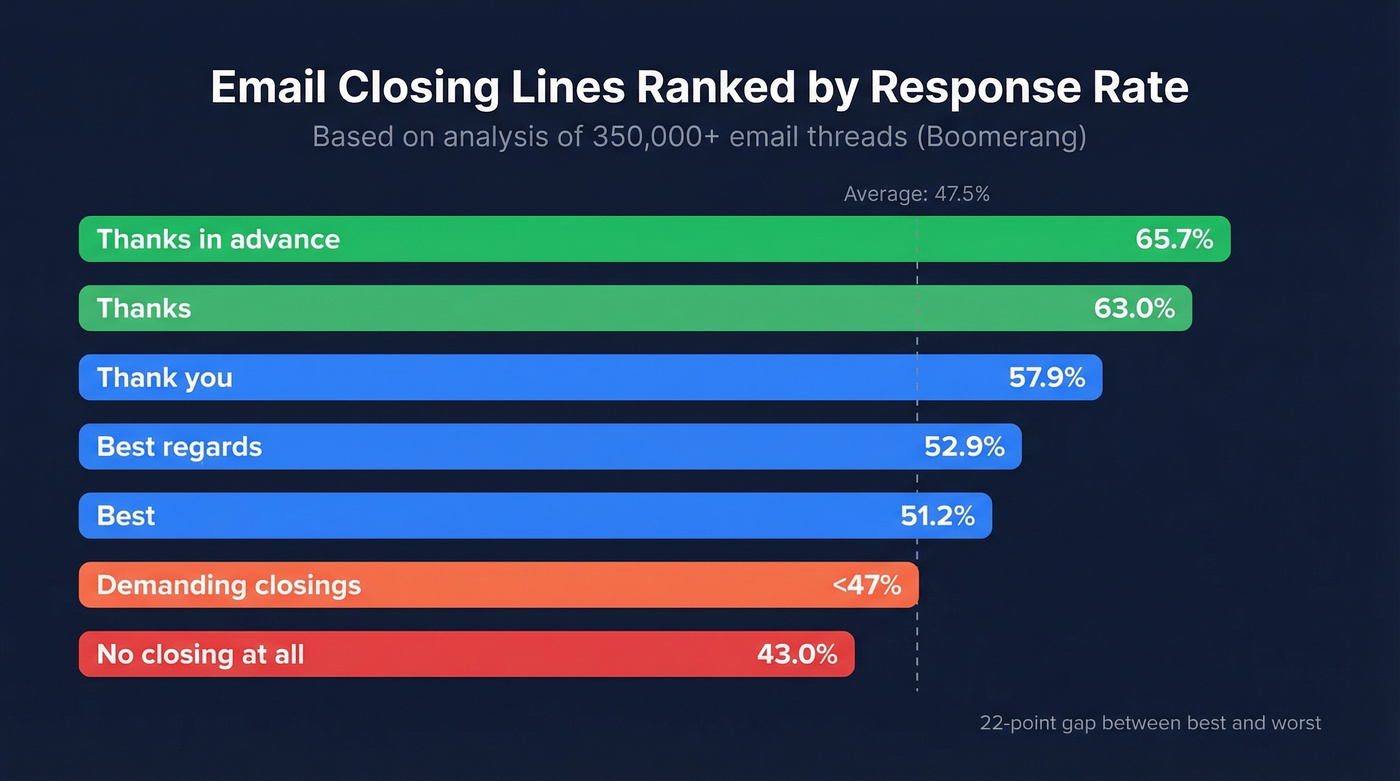
| Closing Line | Response Rate | Best For |
|---|---|---|
| Thanks in advance | 65.7% | Warm asks |
| Thanks | 63.0% | General emails |
| Thank you | 57.9% | Formal contexts |
| Best regards | 52.9% | Conservative industries |
| Best | 51.2% | Quick internal notes |
| Demanding closings | <47% | Nothing - skip these |
| No closing at all | 43.0% | Never do this |
That's a 22-point gap between the best closing and no closing at all. The baseline average across all threads was 47.5%. Your sign-off matters more than most people realize.
15 Better Alternatives, by Situation
Three factors determine the right closing: your relationship with the recipient, the context of the email, and industry norms. Let's break it down.
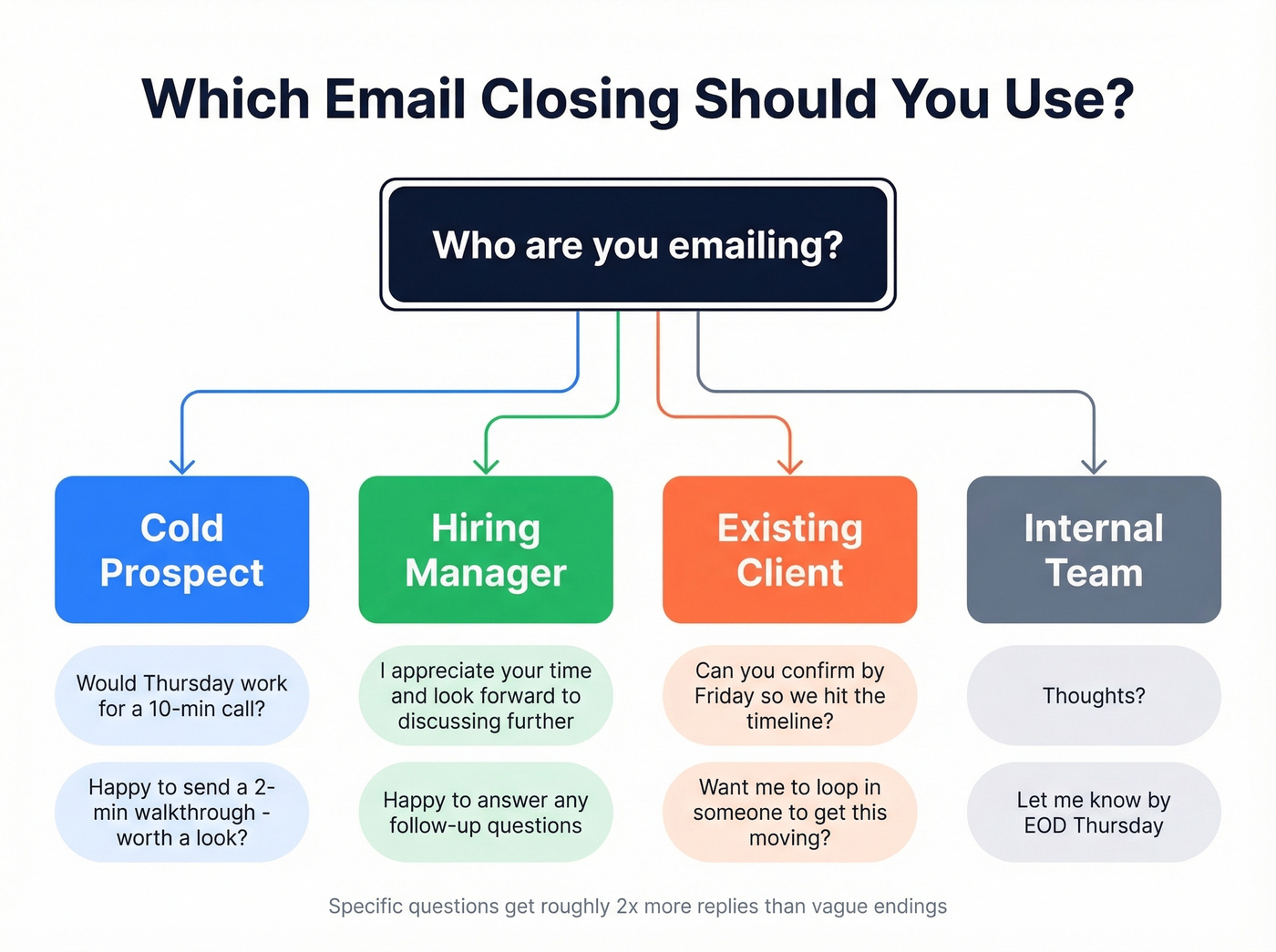
Cold Outreach and Sales
Closing with a question gets roughly 2x more replies than vague endings. Specificity is everything.
1. "Would Thursday or Friday work for a quick 10-minute call?" Specific day plus specific duration. It removes friction by giving the recipient something concrete to say yes or no to - no mental gymnastics required.
2. "Happy to send over a 2-minute walkthrough - worth a look?" Low commitment, high curiosity. Works when you're introducing something the prospect hasn't asked for.
3. "If this isn't relevant, no worries - who on your team handles [X]?"
This one's underrated. Here's what it looks like in practice:
Weak: "Let me know your thoughts." Strong: "If this isn't your area, totally fine - who handles outbound tooling on your team?"
People are far more likely to redirect than ignore. You advance the conversation either way.
4. "I'll follow up next Tuesday if I don't hear back - just want to stay on your radar." Sets a clear expectation without being pushy. (If you need timing rules, see when to follow up on an email.)
Job Applications and Interviews
Professionalism and gratitude carry more weight than urgency here. Sound eager, not desperate.
5. "I appreciate your time and look forward to discussing this further." The gold standard for post-interview follow-ups - warm, professional, and forward-looking without being presumptuous.
6. "Please don't hesitate to reach out if you need any additional information." Puts the ball in their court gently. Best after submitting materials or completing an interview round.
7. "I'm excited about this opportunity and happy to answer any follow-up questions."
One caveat: if they clearly said "we'll be in touch," using this reads like you weren't listening. Save it for rounds where you've had substantive conversation.
Client Follow-Ups
With existing clients, you've earned familiarity. The goal is moving things forward without nagging.
8. "Can you confirm by Friday so we can hit the timeline?" Direct, time-bound, tied to a shared goal. The deadline feels collaborative, not demanding.
9. "I've attached the next steps - let me know if anything needs adjusting." Assumes forward motion. Instead of asking if they want to proceed, you're asking how.
10. "Want me to loop in [colleague] to get this moving?"
A closing that does something instead of just asking for something. We've found this works especially well when a deal has stalled and you need to re-engage a different stakeholder.
11. "I'll plan on [next step] unless you'd prefer a different approach." The assumptive close. Powerful with busy clients who appreciate you taking the lead.
Internal and Team Emails
Nobody wants a flowery sign-off on a Slack-era internal email.
12. "Thoughts?"
One word. Works beautifully when you've laid out a proposal or shared a document.
13. "Let me know by EOD Thursday and I'll handle the rest." Clear ownership, clear deadline. Your teammates will thank you for not making them guess.
Formal and Legal Contexts
Some contexts demand convention. Don't get creative with a contract negotiation.
14. "I await your confirmation at your earliest convenience." Yes, it's formal. That's the point. Legal and compliance contexts reward precision over personality.
15. "Please confirm receipt and advise on next steps." Standard in procurement, legal, and finance. Direct without being casual.
What to Avoid
Lemlist's list of 100 alternatives includes gems like "Later gator" and "Till our next epic convo." In B2B, these make you look like you're trying too hard. And while people love debating whether "Best" is overused, cringe closings are worse than boring ones every time.
Here's the thing about "Thanks in advance" - it tests highest at 65.7%, but it only works when you've already established what you're asking for. Drop it in a first-touch cold email where the recipient hasn't agreed to anything, and it reads as presumptuous.
If you're sending follow-ups, borrow a structure from these sales follow-up templates and keep the close specific.

The best closing line in the world won't get a reply if your email never reaches the inbox. Teams using Prospeo cut bounce rates from 35% to under 4% - because every email goes through 5-step verification before you send. 98% accuracy, $0.01 per email, no contracts.
Fix your deliverability first. The perfect sign-off comes second.
Cross-Cultural Considerations
Your closing line carries cultural weight. A BBC study found that roughly 40% of Korean academics perceived Australian emails as impolite, compared to just 28% the other way around.
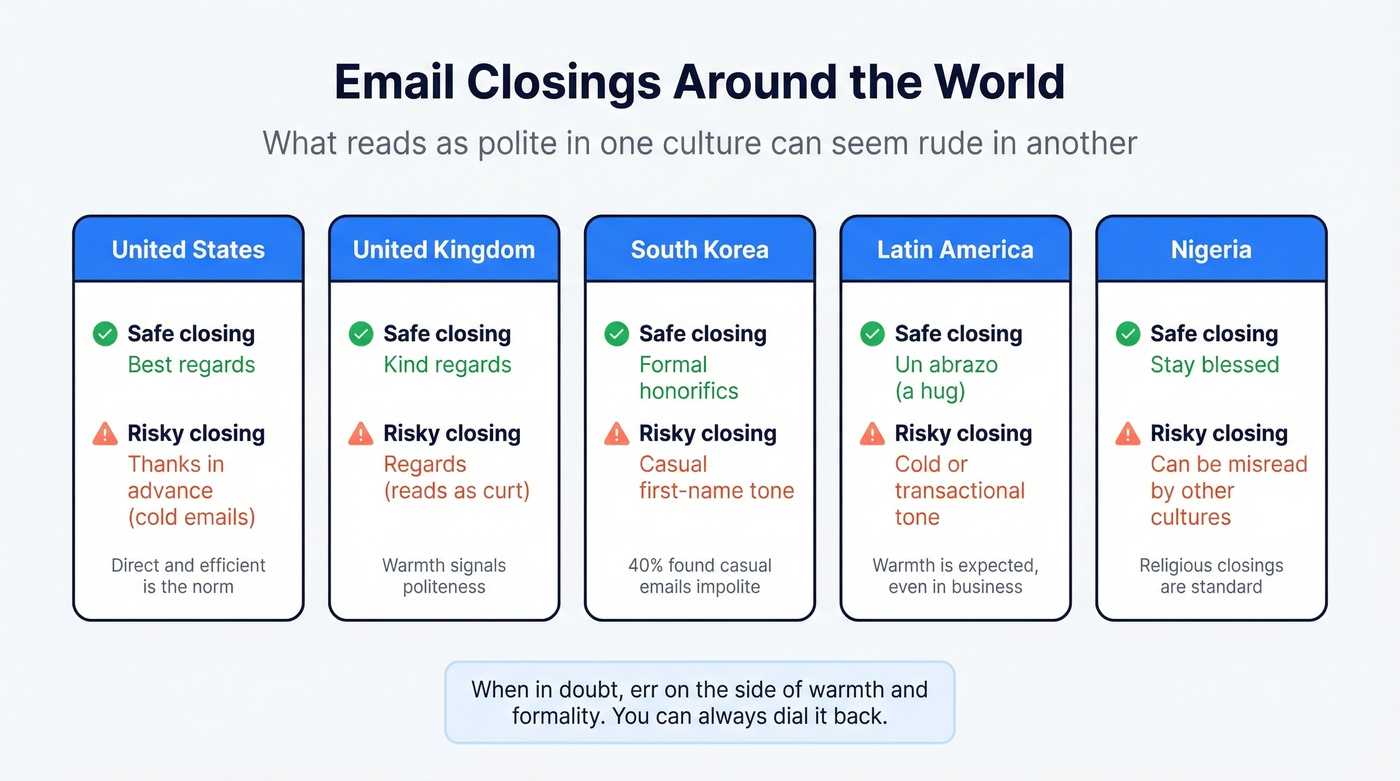
In the UK, "Regards" alone reads as curt - "Kind regards" is the safer default. In Latin America, closings trend warmer, and the equivalent of "a hug" isn't unusual in professional correspondence. In Nigeria, religious closings like "Stay blessed" are standard, but a US recipient once mistook one for a scam pattern. When emailing across cultures, err on the side of warmth and formality. You can always dial it back once you've built rapport.
Your Closing Line Won't Save a Bad Email
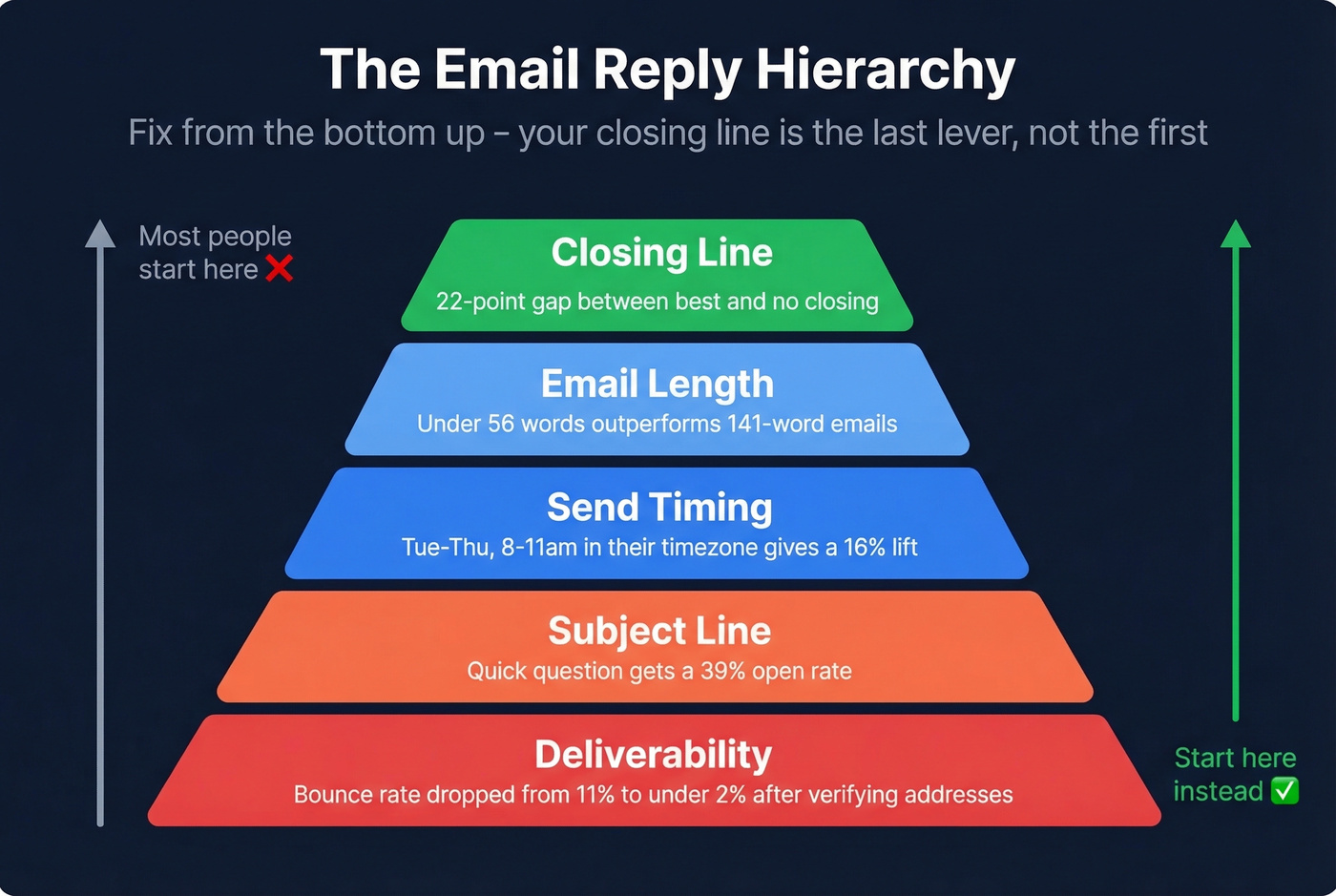
Look - most teams obsessing over email sign-offs are ignoring the five things that actually drive replies. We've seen teams double response rates without changing a single closing line, just by fixing deliverability.
One Reddit practitioner shared their journey from a 3% to 6% cold email reply rate. The average cold email reply rate sits around 8.5%, so this person started well below that. The closing line wasn't the main lever.
What actually moved the needle was a combination of structural changes: cutting email length from 141 words to under 56, sending Tuesday through Thursday between 8-11am in the recipient's timezone (a 16% lift in opens), using "Quick question" as a subject line (39% open rate), and adding branded signatures with name, title, and company - which improved reply rates by up to 22%. Most critically, their bounce rate dropped from 11% to under 2% after they stopped buying lists and started verifying every address. (More on bounce benchmarks and fixes: email bounce rate.)
Think of it as a hierarchy: reach the inbox, get opened, get read, get a reply. Your closing line only matters at that last step. If your email bounces, nothing else matters. Prospeo verifies emails in real time with 98% accuracy on a free tier with no contracts, but any verification tool works. The point is: verify before you send. If you want a deeper breakdown of safe sending practices, see email velocity and email spam checker.
Grammar Quick Reference
Per Grammarly's guidance:
- "I look forward to hearing from you" - grammatically correct, perfectly professional
- "Looking forward to hearing from you" - missing a subject, but widely accepted in casual emails
- "I look forward to hear from you" - always wrong. "Look forward to" requires a gerund
If you're writing to someone who cares about grammar - lawyers, editors, academics - use the full construction. For everyone else, the fragment is fine.
If you're also tightening the rest of the message (not just the sign-off), use a simple email copywriting checklist and test a few email subject line examples.
You just picked a sharper closing line. Now make sure it lands in front of the right person. Prospeo's 300M+ verified profiles with 30+ filters - including buyer intent and job changes - let you reach decision-makers who actually want to hear from you.
Send better emails to better prospects. That's how you double reply rates.
FAQ
Is "looking forward to hearing from you" unprofessional?
No - it's grammatically correct and polite. The problem is overuse. In cold outreach it pressures a response without offering a reason to reply. In warm relationships, it's perfectly fine.
What's the best email closing for cold outreach?
A specific question. "Would Thursday work for a 10-minute call?" outperforms vague closings by roughly 2x in reply rates, based on Boomerang's analysis of 350,000+ threads.
Does the closing line really affect reply rates?
Yes. Boomerang's study found a 22-point gap between the best closing ("Thanks in advance" at 65.7%) and no closing at all (43%). At scale across hundreds of emails, that difference compounds fast.
Should I use "Thanks in advance"?
It tests highest at 65.7%, but skip it in first-touch cold emails where the recipient hasn't agreed to anything. Use it when you've already established context and the ask is clear.
What matters more than my closing line?
Deliverability. If your email bounces or lands in spam, your closing is irrelevant. Verify your contact list first, then focus on email length, subject line, send timing, and personalization. Those structural factors drive far more lift than any sign-off.