


10 Lusha Alternatives That Won't Burn Through Your Credits
Your SDR just burned through their entire monthly Lusha credit allotment in nine business days. Not because they were reckless - because revealing phone numbers costs 10 credits each, and 70 free credits gets you exactly seven phone numbers. That's not a prospecting budget. That's a rounding error.
The math doesn't improve much on paid plans. Lusha Pro runs $22.45/user/month on an annual contract, and the credit burn rate stays the same. Credits are issued upfront on annual plans, and unused ones vanish at the end of the cycle - they don't roll over. If your reps need both emails and direct dials, you're either upgrading to Premium at $52.45/user/month or rationing contacts like it's wartime.
Smart teams evaluate alternatives before their next renewal. Here's where to start.
Our Top Picks (TL;DR)
| Tool | Best For | Starting Price | Email Accuracy | G2 Rating |
|---|---|---|---|---|
| Prospeo | Email accuracy, self-serve | Free (75 emails/mo) | 98% | - |
| Apollo.io | All-in-one U.S. SMBs | Free / $49/mo | Verify before sending | 4.7/5 (9,510) |
| Cognism | European coverage + compliance | ~$22,500/yr (5 seats) | Strong with verification | 4.6/5 |
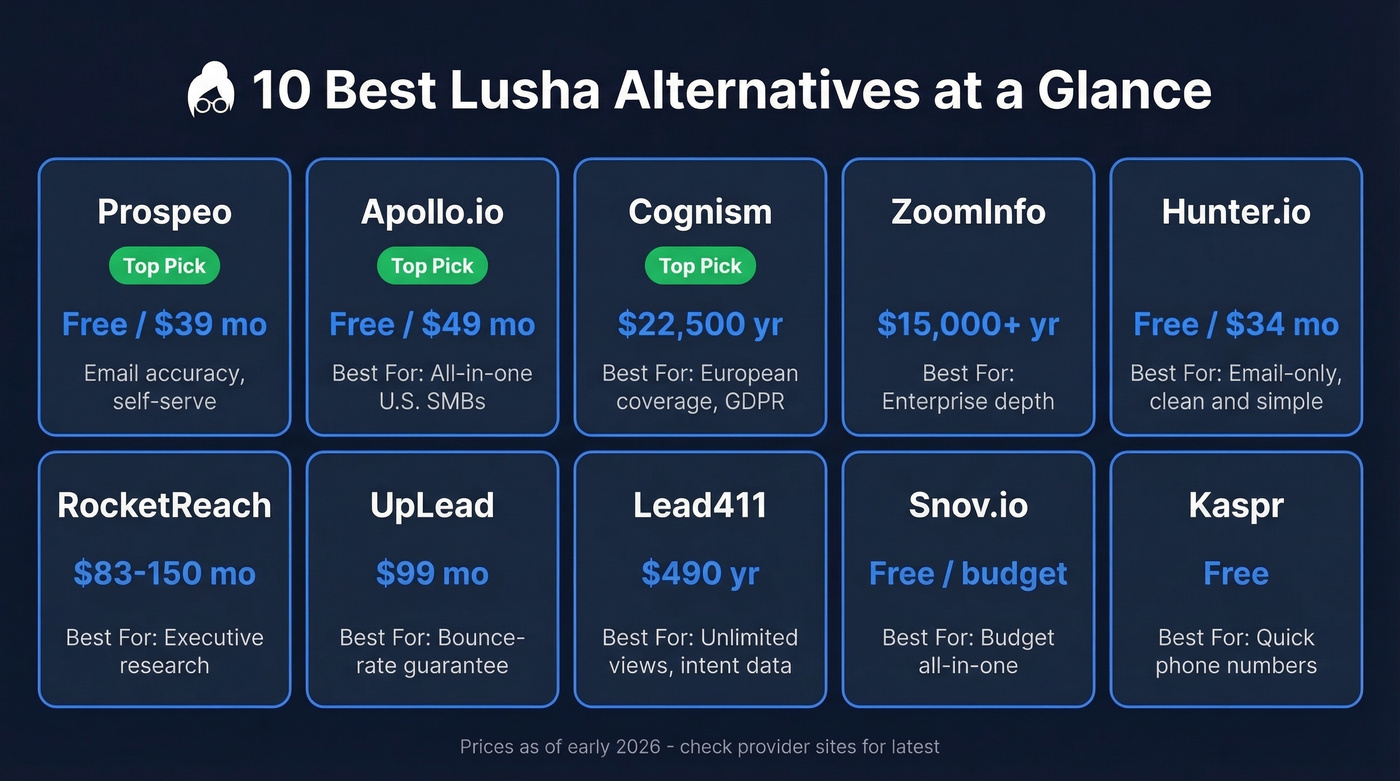
Budget under $100/month? Prospeo's free tier plus Hunter Starter covers email finding, verification, and basic prospecting. Budget unlimited? ZoomInfo for depth, with a verification layer to catch the stale records it inevitably serves.
Why Teams Leave Lusha
The credit math is the obvious trigger, but it's not the only one.
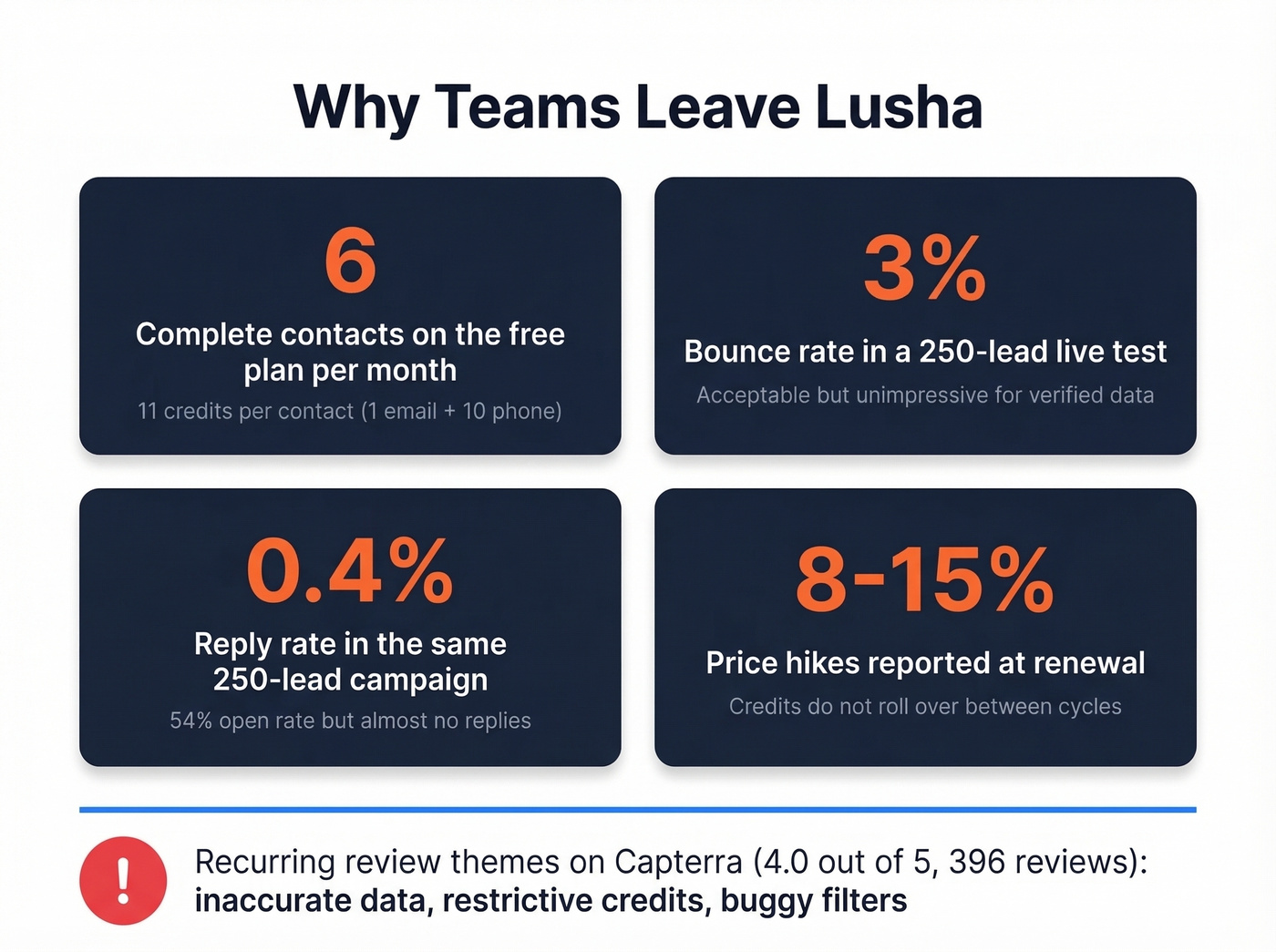
Start with the free plan. An email reveal costs 1 credit, a phone number costs 10. If you need both for each prospect - and cold outbound usually demands both - that's 11 credits per contact. Your free plan covers roughly six complete contacts per month. Six.
Even on Pro, the economics are tight. And the data you're paying for isn't always there. Lusha carries a 4.0/5 on Capterra across 396 reviews, and the recurring theme in negative reviews is blunt: inaccurate or missing data, a restrictive credit system, and filtering that bugs out when you stack multiple criteria.
CRM integration issues are less discussed but equally painful. One Reddit user documented their HubSpot sync overriding deal ownership when Lusha merged contact records. That's not a minor inconvenience - that's a comp-plan dispute waiting to happen. Teams also report price hikes of 8-15% at renewal, and when someone tested Lusha's output in a live campaign of 250 leads, the results told the story: a solid 54% open rate but a disappointing 0.4% reply rate, with a 3% bounce rate that's acceptable but unimpressive for "verified" data.
We've seen this pattern repeatedly: teams sign up for Lusha's speed and simplicity, hit the credit wall within a quarter, and start shopping.
Best Lusha Alternatives for 2026
Prospeo
Use this if: You care about email accuracy above everything else and want self-serve pricing without a sales call.
Skip this if: You need a built-in dialer or full sales engagement suite - pair Prospeo with Instantly or Lemlist for sequencing.
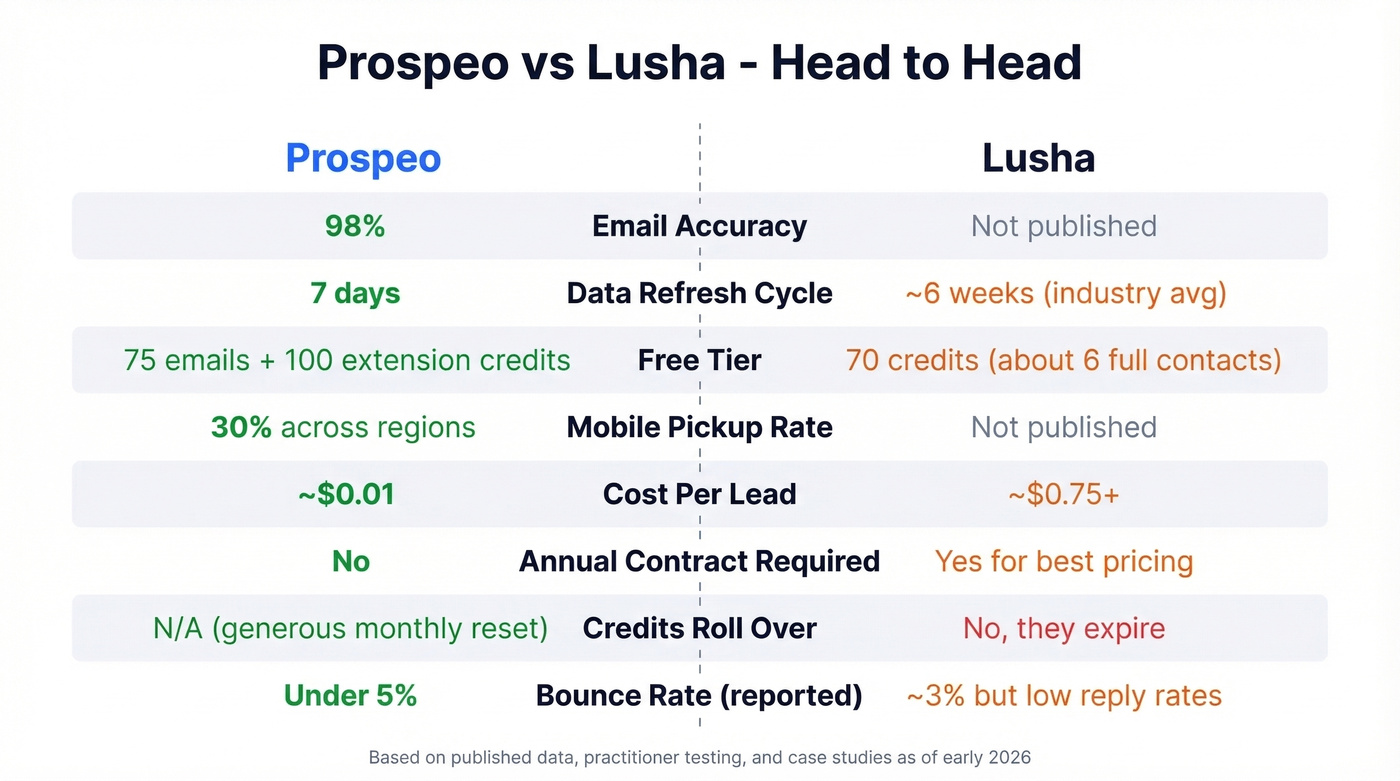
Prospeo's database covers 300M+ professional profiles with 143M+ verified emails and 125M+ verified mobile numbers. The standout number is 98% email accuracy, backed by a proprietary 5-step verification process that includes catch-all handling, spam-trap removal, and honeypot filtering. Where Lusha refreshes data on a standard cycle, Prospeo runs a 7-day refresh - the industry average is six weeks.
The mobile data is equally strong: a 30% pickup rate across all regions, compared to 12.5% for ZoomInfo and 11% for Apollo. Teams using Prospeo book 26% more meetings than ZoomInfo users and 35% more than Apollo users. At roughly $0.01 per lead versus $1 per lead on ZoomInfo, the cost difference is staggering.
The proof point that matters most: Snyk's 50-person AE team was running bounce rates of 35-40% with their previous provider. After switching, bounces dropped under 5%, and AE-sourced pipeline jumped 180%. That's not a marginal improvement - that's a different category of data quality.
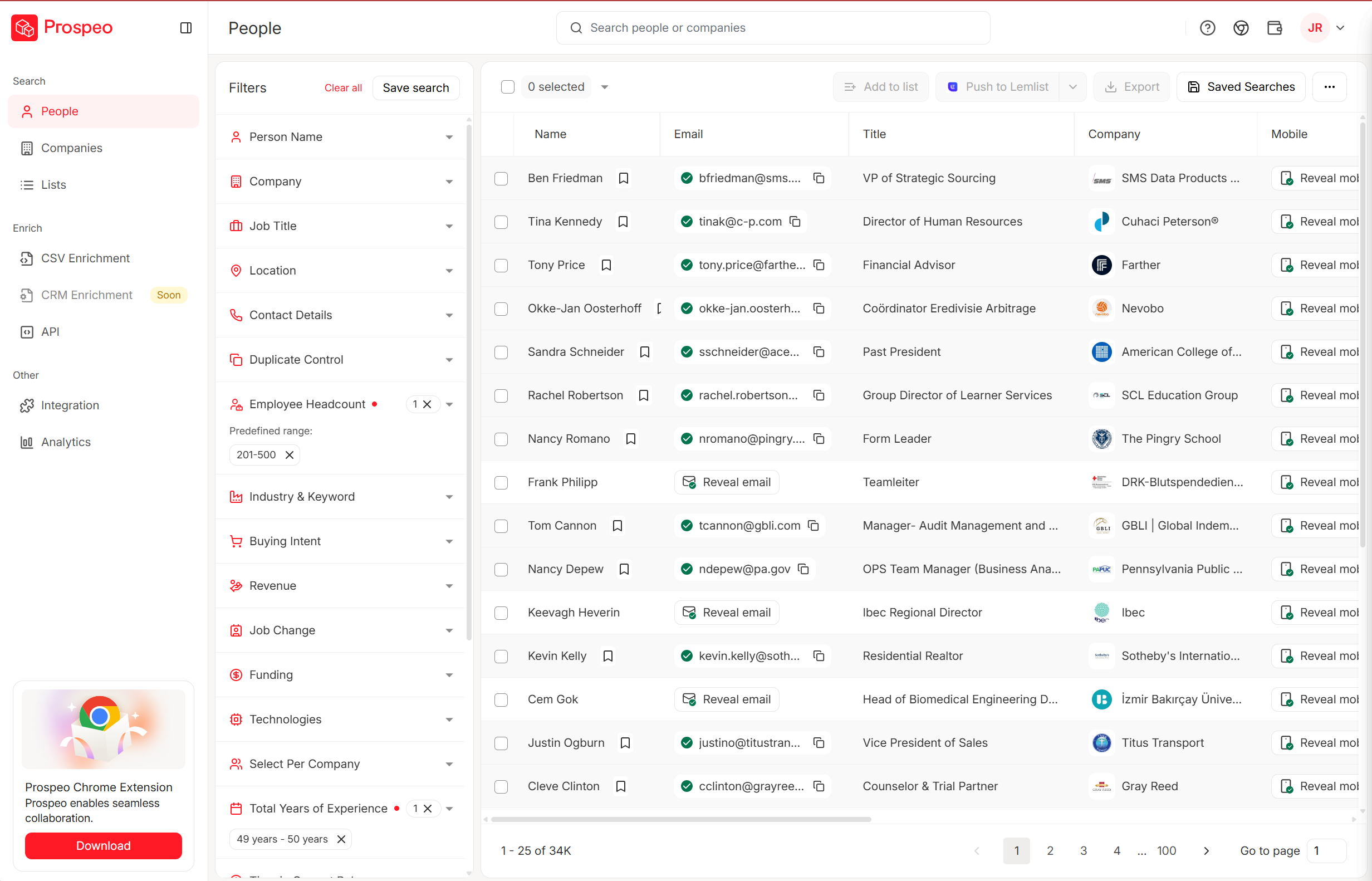
The free tier gives you 75 emails and 100 Chrome extension credits per month. The Chrome extension has 40,000+ users and works across professional profiles, company websites, and CRMs. Intent data covers 15,000 Bombora topics, and the API returns a 92% match rate for enrichment workflows. Integrations include Salesforce, HubSpot, Instantly, Lemlist, Smartlead, Clay, and Zapier.
If you're building a stack around verified contacts, start with a lead generation database that matches your ICP.
Apollo.io
Use this if: You want prospecting, sequencing, and a database in one platform and your market is primarily U.S.-based.
Skip this if: You need a verification layer before sending at scale.
Apollo is the obvious starting point for most SMB teams evaluating Lusha alternatives. It carries a 4.7/5 on G2 with 9,510 reviews - massive social proof. The free plan offers unlimited email credits (with limits on exports and sequences) plus 5 mobile credits per month. Paid tiers run $49, $79, and $119/month per user.
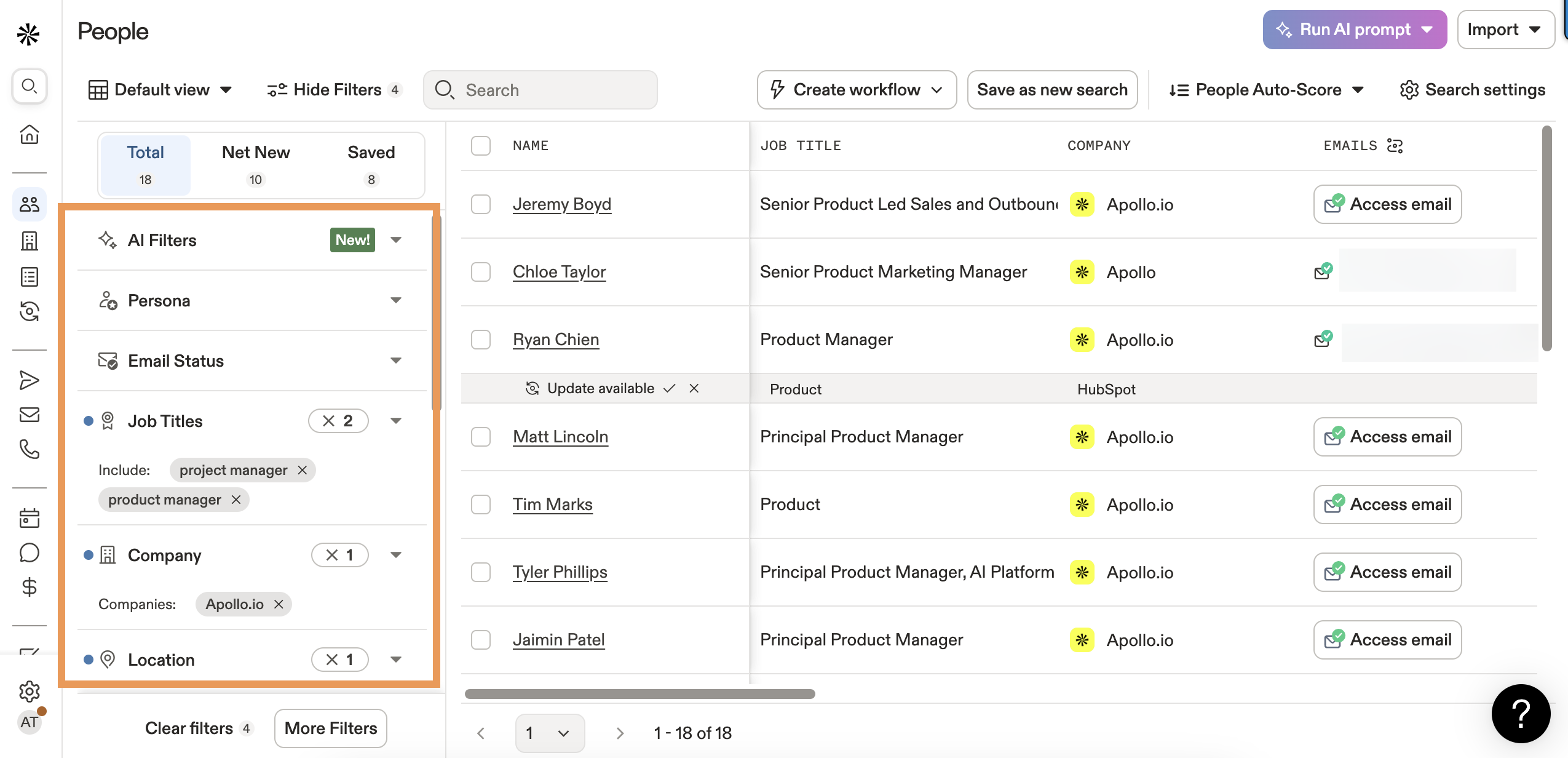
Here's our take after testing: Apollo is a great all-in-one, but it's not a great data source on its own. Practitioner testing on r/coldemail puts Apollo's bounce rates at 32-38% - significantly higher than Lusha's 22-28%. Credits don't roll over between billing cycles, and accuracy drops noticeably outside North America. If you're running Apollo, you need a verification step before sending.
If you're scaling outbound, pair this with a deliverability-first cold email software setup.
Where Apollo beats ZoomInfo: price and speed to value. Where ZoomInfo wins: database depth and workflow breadth.
Cognism
Use this if: You're selling into Europe and GDPR compliance isn't optional (it isn't).
Skip this if: You're a U.S.-only team on a startup budget.
Cognism's Diamond Data feature phone-verifies numbers before serving them, which is genuinely differentiated. For EMEA prospecting, it's the real deal - the compliance infrastructure is built in rather than bolted on.
Pricing runs ~$22,500/year for 5 users on the Grow plan and ~$37,500/year for 5 users on Elevate. A 10-user Elevate contract lists at ~$50K but negotiates down to ~$32K, roughly 36% off. Annual contracts are standard. One detail that doesn't get enough attention: Cognism applies fair-use limits of approximately 2,000 records per user per month, so "unlimited" access has practical ceilings. Cognism isn't the affordable alternative some guides position it as - it's a premium tool with premium pricing that's justified if your market is Europe.
ZoomInfo
Here's the thing: ZoomInfo is still the best all-in-one enterprise platform. But most teams don't need all-in-one, and they definitely don't need to spend $25K+ to find out.
The database is massive, the intent data is deep, and the workflow capabilities are unmatched. It also starts at $15,000/year for a basic Professional package and climbs to $35,000-$45,000+ for Elite. Annual contracts only. Renewal uplifts of 10-20% are standard. You can negotiate 30-65% discounts, but you'll need procurement leverage.
The G2 profile tells an interesting story: 4.5/5 with 9,037 reviews, but "Inaccurate Data" and "Outdated Data" are top-listed cons. We see this pattern repeatedly - teams buy ZoomInfo for the database, then realize they're paying for intent, chat, and workflow features they never turn on. For 90% of teams reading this, ZoomInfo is more platform than you need.
If you're evaluating enterprise data, it helps to understand ABM data vs. pure contact databases.
Hunter.io
Hunter is the cleanest email-only tool on the market. No phone data whatsoever - that's the tradeoff, and it's absolute.
The pricing is refreshingly transparent. Free gets you 50 credits/month. Starter runs $34/month on annual billing with 2,000 credits. Finding an email costs 1 credit; verifying costs 0.5. All plans include unlimited users, which makes Hunter surprisingly cost-effective for teams. One detail worth knowing: extra credit packs expire in 3 months.
For teams that only need email addresses, Hunter plus a mobile finder is a clean, affordable stack.
If you're comparing tools specifically for finding addresses, see our guide to company email address lookup.
RocketReach
RocketReach is solid for targeted executive research, but the per-contact economics break down past 500 contacts per month. Individual Pro runs $150/month for 375 lookups. Team Pro drops to $83/user/month on annual billing with 3,600 lookups per user. Extra lookups cost $0.30-$0.45 each.
For exec targeting, it also helps to know how to write a high-signal executive email.
UpLead
Use this if: You want a mid-market database with a bounce-rate guarantee and credit refunds on bad data.
UpLead's 95% accuracy guarantee with credit refunds on bounces is a strong differentiator. Essentials starts at $99/month, Plus at $199/month. In practitioner testing, bounce rates run around 20% - and credits do get refunded. It's a solid middle-ground option for teams that want better data than Apollo without ZoomInfo's price tag. Skip it if you need the largest possible database; UpLead's coverage is smaller than Apollo or ZoomInfo.
Lead411
Lead411's Spark plan runs $490/year with unlimited email and phone views, though export limits apply. Bombora intent data is included, which is unusual at this price point. The database is smaller than Apollo or ZoomInfo, but for teams that prospect within a defined ICP, the unlimited access model eliminates the credit-burn problem entirely. If you're tired of rationing contacts, this is worth a look.
If you're deciding between these two specifically, see Lead411 vs Lusha.
Three More Worth Knowing
Snov.io combines email finding, verification, and outreach sequences starting free, with paid plans in the budget range. Bounce rates in practitioner testing run 28-35%. A solid option if you need an all-in-one on a tight budget, but verify before sending.
Kaspr offers a free plan with a lightweight credit-based model, purpose-built for individual prospectors who need quick phone numbers from professional profiles. It's Lusha's closest cousin - similar extension-first approach, similar limitations at scale.
Clay isn't a data provider - it's an orchestration layer that waterfalls across multiple sources to maximize coverage. Practitioner testing shows 10-14% bounce rates with the multi-source approach, the best in this list. Expect to pay $150-500/month depending on volume. Clay earns its 4.9/5 G2 rating, but it requires setup time and technical comfort that simpler tools don't demand.
If you want the underlying framework, read our full guide to waterfall enrichment.

Lusha gives you 7 phone numbers on the free plan. Prospeo gives you 75 verified emails plus 100 Chrome extension credits - with 98% accuracy and a 7-day data refresh cycle. No credit anxiety, no annual contracts, no sales calls.
Stop rationing credits. Start prospecting for real.
What 200 Emails + 100 Phones Cost
One SDR, one month: 200 verified emails and 100 direct dials. Here's what you'd actually pay.
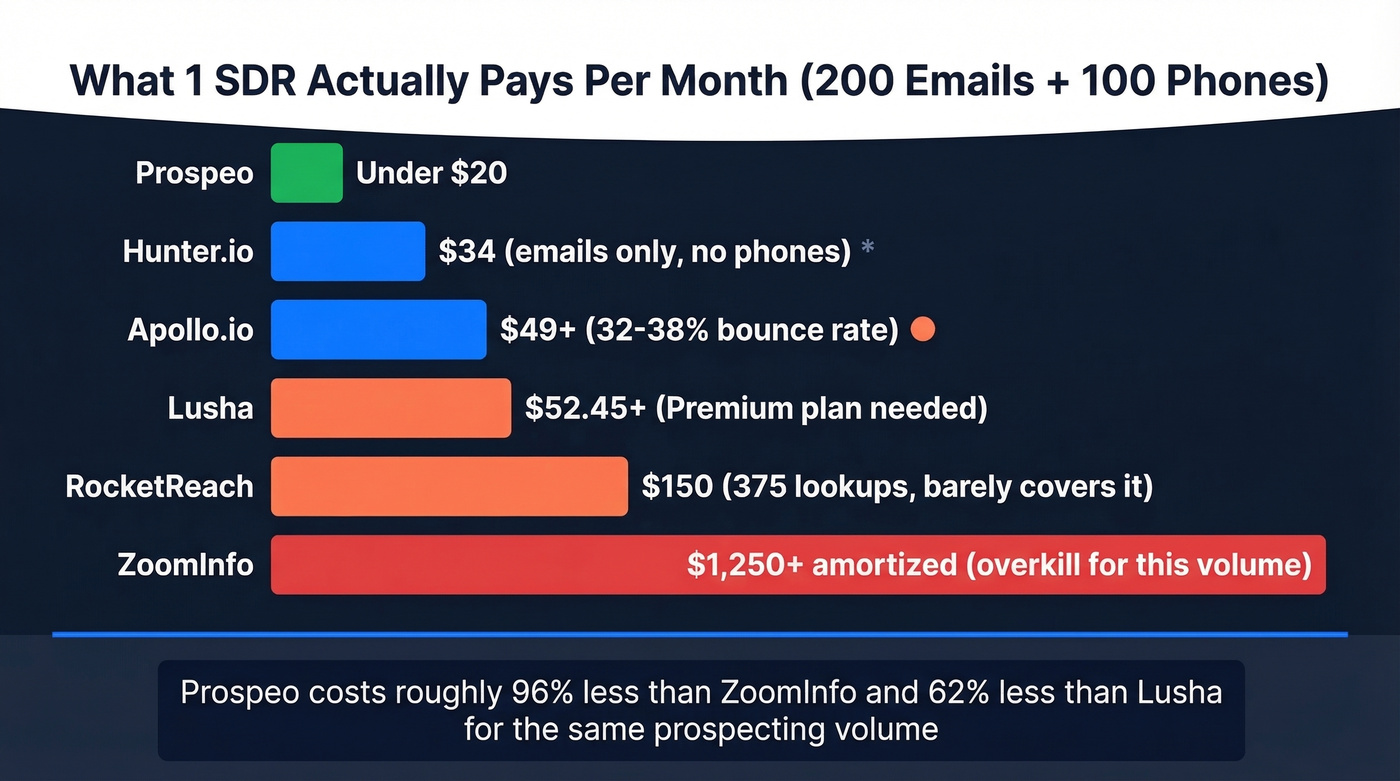
| Tool | Monthly Cost | Notes |
|---|---|---|
| Lusha | $52.45+/user/mo | Premium plan needed; still might run short |
| Prospeo | Under $20 | Free tier covers 75 emails + 100 ext credits |
| Apollo | $49+/user/mo | 5 free mobiles; 32-38% bounce rate on emails |
| Hunter | $34/mo | Covers emails easily; zero phone numbers |
| ZoomInfo | $1,250+/mo (amortized) | Overkill for this volume |
| RocketReach | $150/mo | 375 lookups covers it, barely |
Lusha: 200 emails at 1 credit each plus 100 phones at 10 credits each equals 1,200 credits per month. The free plan covers 70. Pro gives you limited credits at $22.45/user/month - you'd need Premium at $52.45/user/month to get close, and even then you might run short.
Apollo: The free plan gives unlimited email credits but only 5 mobile credits and 10 exports per month. You'd need a $49+ plan and still face bounce rates of 32-38%, meaning a big chunk of those emails won't land without verification.
Hunter: 200 email finds plus 200 verifications equals 300 credits. The Starter plan at $34/month covers 2,000 credits - plenty of headroom. But zero phone numbers.
A good target is $0.05 or less per verified email. That's not a hot take - it's just the math.
Data Accuracy Benchmarks
Accuracy claims are everywhere. Independent testing tells a different story.
A 2026 independent benchmark tested 307 verified contacts across multiple providers - 153 U.S., 154 global. Accuracy ranged from 63% to 91%. Coverage ranged from 26% to 92%. The spread is enormous, which tells you that no single provider covers everything.
The r/coldemail community paints a similar picture. One practitioner tested 500-1,000 leads per tool and verified with NeverBounce. Apollo bounced at 32-38%. Lusha came in at 22-28% - better, but credits run out fast. The Clay waterfall approach hit 10-14%, the best result, though Clay isn't a data source itself.
If you're trying to reduce bounces systematically, start with the right email verification workflow.

Let's be honest: verification before sending isn't optional regardless of which provider you choose. The question is whether your primary source handles it natively or you're bolting on NeverBounce after the fact. Tools with built-in multi-step verification - catch-all handling, spam-trap removal, honeypot filtering - save you that extra step and the extra cost.
If you're scaling volume, follow a deliverability-safe plan to scale outbound campaigns without wrecking your domain.
When to Stack Tools
Here's a contrarian take: you don't need 10 Lusha competitors on your shortlist. You need one or two good sources and a verification step.
The waterfall enrichment concept - running a contact through multiple providers sequentially - is why Clay's bounce rates hit 10-14%. Each source fills gaps the others miss. But you don't need Clay to do this. A simpler stack works: use a high-accuracy primary source for verified emails and mobiles, add Apollo or Cognism for supplementary coverage in specific regions, and verify everything before it hits your sequences.
We've run bake-offs where the "best database" lost because it created 4,000 duplicate contacts in Salesforce in the first week. The tool with the highest accuracy and the cleanest CRM integration won - not the one with the biggest database. The goal isn't maximum data. It's maximum usable data.
If you're tightening process, these SDR best practices help prevent bad data from becoming bad outreach.
Snyk's 50 AEs cut bounce rates from 35-40% to under 5% and grew AE-sourced pipeline 180% after switching. With 300M+ profiles, 125M+ verified mobiles, and a 30% pickup rate, Prospeo replaces Lusha at roughly $0.01 per lead.
Book 26% more meetings than ZoomInfo users - at 1% of the cost.
FAQ
What's the best free alternative to Lusha?
Prospeo's free tier gives you 75 verified emails and 100 Chrome extension credits monthly - the strongest free option for data quality at 98% accuracy. Apollo's free plan offers unlimited email credits but only 5 mobile credits and 10 exports, making it better for volume at the cost of 32-38% bounce rates. For accuracy, Prospeo wins. For sheer volume, Apollo.
Is Apollo better than Lusha?
Apollo has a higher G2 rating (4.7 vs 4.3) and a far more generous free tier, making it better value overall. But bounce rates tell a different story: Apollo runs 32-38% in practitioner testing versus Lusha's 22-28%. Apollo is better value - not necessarily better data. Verify before sending regardless.
How much does Lusha cost per phone number?
Each phone reveal costs 10 credits. On the free plan with 70 credits, you get exactly seven phone numbers per month. On Lusha Pro at $22.45/user/month annually, your effective cost depends on plan credit allocation. Enterprise teams on the Scale plan pay approximately $37,000/year for 25 seats.
Can I use multiple B2B data providers together?
Yes - this is called waterfall enrichment, and it's the most effective approach. Clay orchestrates this automatically across multiple sources, achieving 10-14% bounce rates versus 20-38% with single tools. You can also build a simpler stack: pull contacts from your primary source, enrich gaps with a second provider, then verify everything before sending.