

Lead411 vs Lusha: Which B2B Data Tool Actually Delivers?
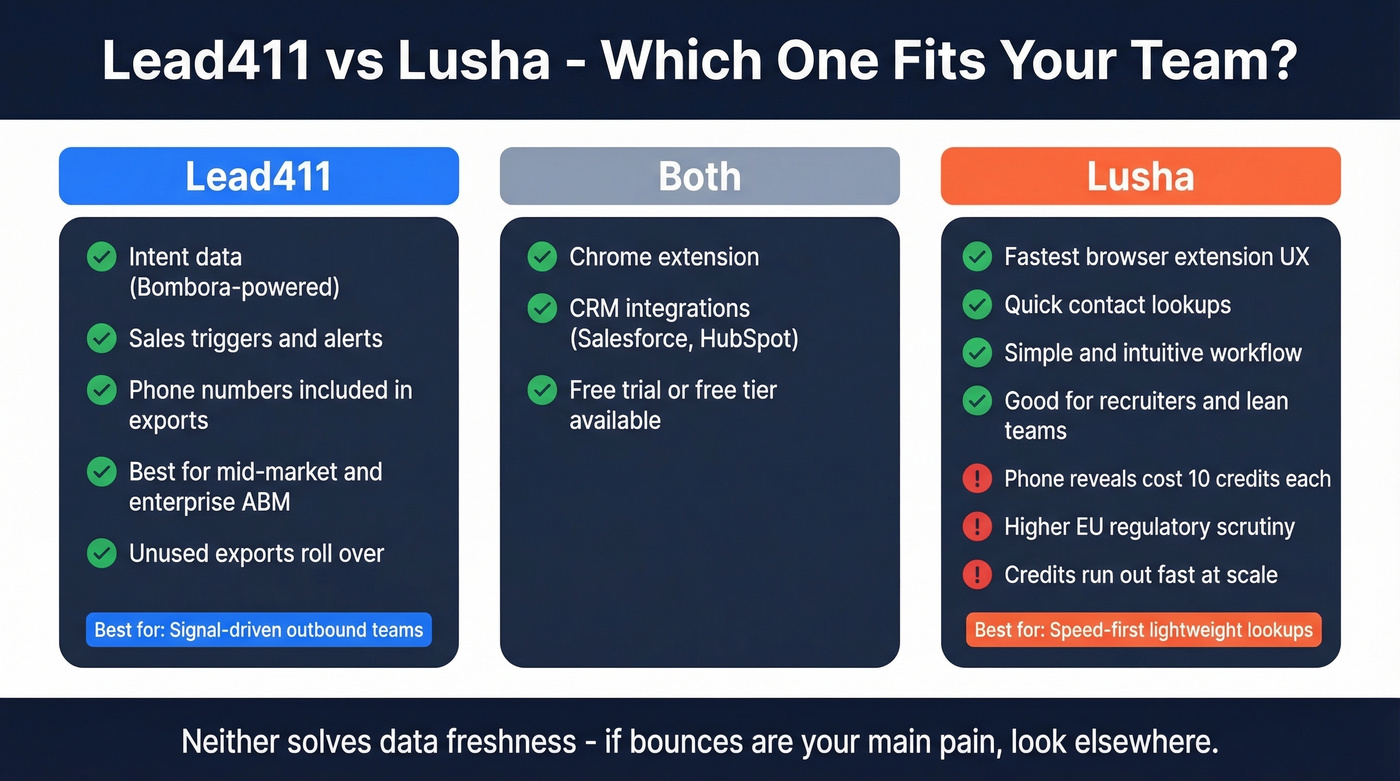
Lead411 and Lusha solve different problems for different buyers, but most comparisons treat them like the same product with different logos. They're not. The real split is simple: Lead411 is built for outbound teams that want account signals (including Bombora-powered intent on annual plans) plus alerts you can sell off of. Lusha is built for speed - a quick browser lookup that keeps you moving.
Pick the wrong one and you'll either burn money on credits you didn't plan for, or you'll sign a contract for features your team won't use.
Let's break it down like a buyer, not like a brochure.
30-Second Verdict
- Pick Lead411 if intent signals and sales triggers are part of your outbound motion, and you prospect into mid-market or enterprise accounts.
- Pick Lusha if you want a fast browser extension for quick contact lookups and you don't need intent, alerts, or deeper account workflows.
- Skip both if your main pain is bounces, stale records, and wasted dials. That's a data freshness problem, not a UI problem. (If that’s you, start with email deliverability and email bounce rate.)
We publish Prospeo, so you'll see it mentioned as a third option. We'll keep it straight and call out where Lead411 and Lusha genuinely win.
Lead411 at a Glance
Lead411 positions itself as sales intelligence, not just a contact list. The headline feature is buyer intent data powered by Bombora on annual plans, which helps you prioritize accounts showing in-market behavior by topic instead of guessing who to call next.
It also includes sales triggers you can use as clean openers: hiring surges, funding, exec changes, and other "something changed" moments that make outreach feel less random. In our experience, those triggers matter most when your team already has a tight ICP and a real outbound process; if you're still spraying and praying, you won't magically become strategic because you bought intent. (If you want to operationalize this, see how to track sales triggers and identifying buying signals.)
Lead411 also offers a Chrome extension, Salesforce and HubSpot integrations, and an AI search assistant for natural-language queries. One practical perk: unused exports can roll over, which is rare in this category and makes forecasting less annoying.
Lusha at a Glance
Lusha's strength is simplicity. The extension is fast: open a profile, pull contact info, move on. That "quick hit" workflow is why recruiters and lean outbound teams keep it around even when they also pay for a bigger database.
Lusha sources data from web sources and its user community. The free plan is attractive on paper, but the credit rules matter a lot in real life: phone reveals cost more than email reveals, and teams often discover the real cost only after a few weeks of heavy usage.
If your reps live in the browser and hate switching tabs, Lusha's UX is the best part of the product.
Pricing Breakdown (and the Credit Math People Miss)
A lot of posts still repeat old Lead411 pricing. Right now, Lead411's Spark plan starts at $49/month, and that's the tier many small teams should start with.
Here's the clean comparison:
| Plan | Lead411 | Lusha |
|---|---|---|
| Free | $0 / 7-day trial | $0 / up to 70 credits/month |
| Entry | Spark $49/month | Pro ~$30-39/user/month |
| Mid | Ignite from $150/month | Premium ~$70/user/month |
| Annual entry | Spark $490/year (includes buyer intent data) | Pro ~$22.45/user/month billed yearly |
| Annual mid | Ignite from $1,500/year | Scale ~$37K/year for 25 seats |
| Enterprise | Blaze (custom) | Custom |
Here's the thing: Lusha's pricing only makes sense if your usage matches the credit model. We've done this math with real teams and it gets ugly fast.
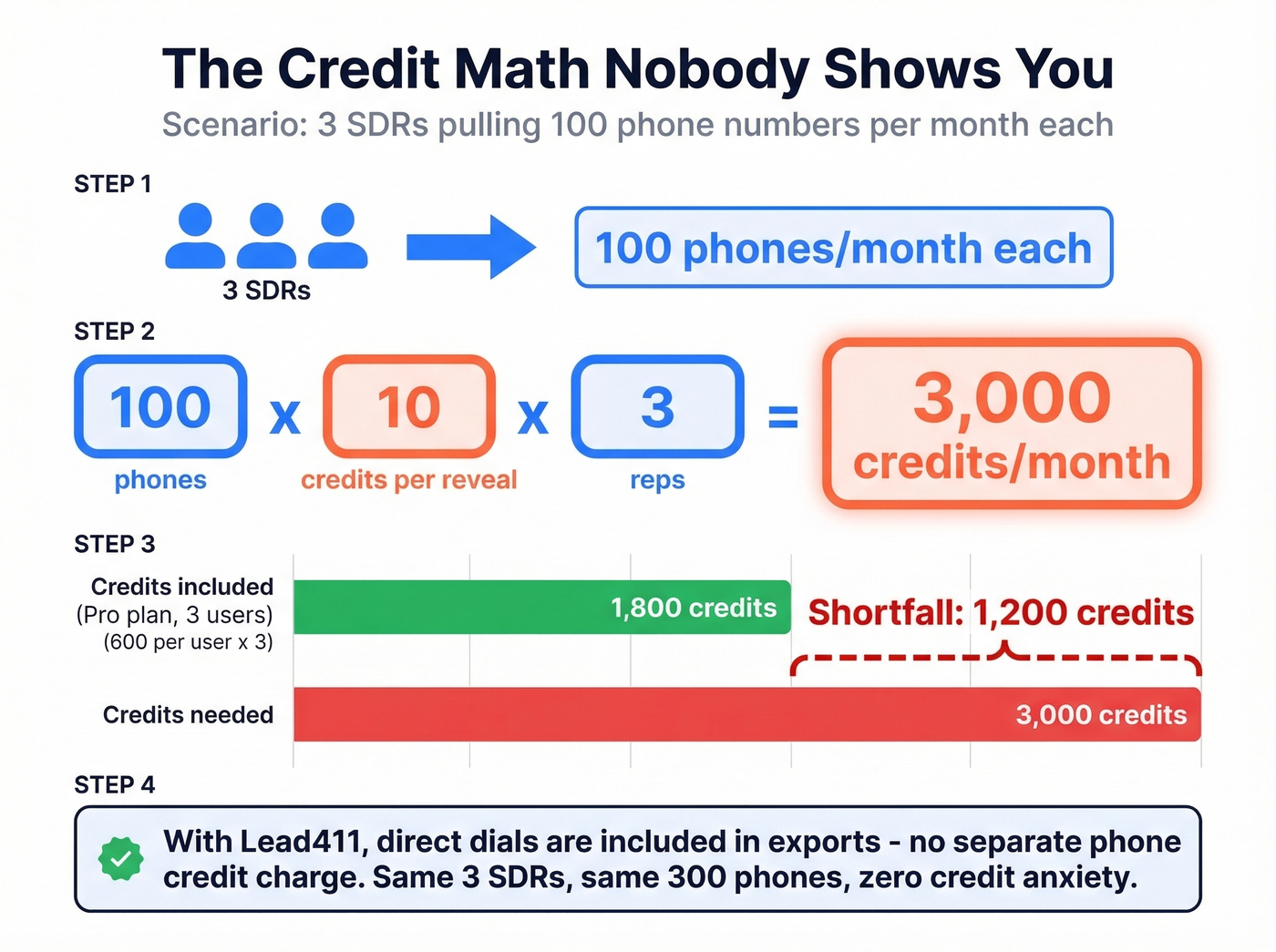
Scenario: three SDRs, each pulling 100 phone numbers/month.
- Lusha charges 10 credits per phone reveal
- 100 phones x 10 credits x 3 reps = 3,000 credits/month
If you're on a plan that includes 600 credits per user, you're short. Now you either upgrade, buy add-ons, or reps start rationing lookups and your activity drops. That's the part that frustrates teams: the workflow doesn't change, but the tool suddenly becomes a throttle.
Lead411's model is simpler for phone-heavy prospecting because direct dials are included in exports (no separate "phone reveal" charge). If phones are central to your motion, Lead411 usually wins on cost predictability.
One more nuance: credits don't only disappear on reveals. In a lot of orgs, exports and workflow habits end up consuming more than expected, and nobody notices until the team hits the wall mid-month.
Feature Comparison (What Actually Matters)
| Feature | Lead411 | Lusha | Edge |
|---|---|---|---|
| Database size | 450M+ contacts | 100M+ professional profiles | Lead411 |
| Intent data | Bombora-powered (annual plans) | None | Lead411 |
| Email verification | Triple-verified | Standard | Lead411 |
| Phone access | Included in exports | 10 credits each | Lead411 |
| Chrome extension | Yes | Yes (best-in-class UX) | Lusha |
| CRM integrations | Salesforce, HubSpot | Salesforce, HubSpot | Tie |
| API access | Ignite+ plans | Available (plan-dependent) | Tie |
| Regulatory posture | Primarily US-focused | Higher EU scrutiny | Lead411 |
Lead411's standout is the Bombora intent layer plus triggers. If your team runs account-based outbound, that combination can change who you call first and what you say in the first 10 seconds. (Related: account-based selling best practices and intent based segmentation.)
Lusha's standout is the extension experience. It's quicker and more intuitive than Lead411's, and that matters when you're doing high-volume sourcing. In our testing, Lead411's filters get the job done, but the UI feels older and slower to work through during a live prospecting session.

Lusha's phone credits add up fast. Lead411's data goes stale. Prospeo gives you 125M+ verified mobiles with a 30% pickup rate and 98% email accuracy - all on a 7-day refresh cycle. No per-phone surcharges, no annual contract traps.
Stop rationing credits. Start reaching real buyers at $0.01 per email.
What Real Users Say (and Where the Complaints Cluster)
User feedback is consistent across review sites and community threads:
Lead411 complaints tend to focus on outdated contacts and a search experience that can feel finicky. On Reddit threads in communities like r/coldemail, the blunt criticism is usually some version of "the data's old" or "pricing changed and it stopped being a no-brainer."
Lusha complaints are more often about accuracy, especially phone numbers. TrustRadius reviews regularly mention the pain of calling the wrong number. And if you've ever had an SDR confidently dial a "direct line" that goes to a random front desk, you know how fast a team loses trust in a data tool.
Ratings snapshots:
| Platform | Lead411 | Lusha |
|---|---|---|
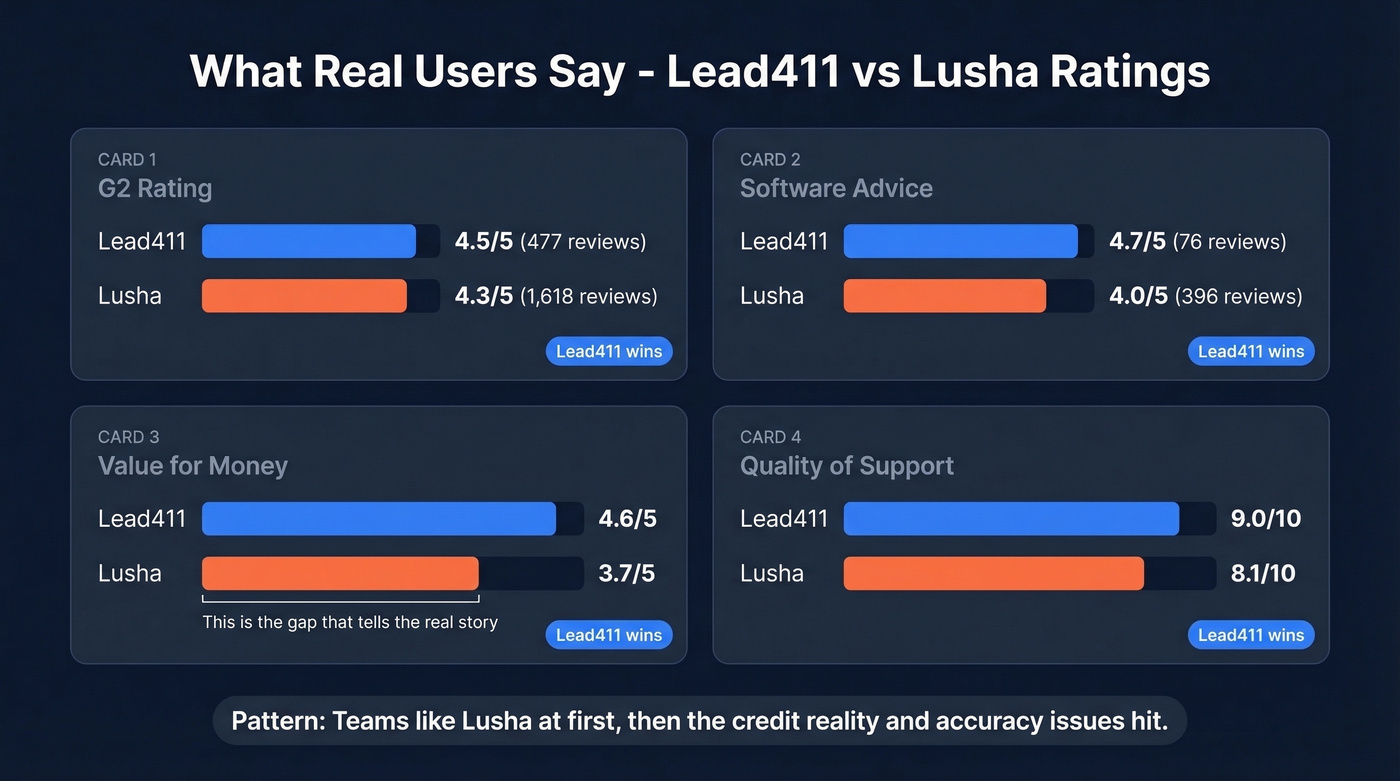
| G2 | 4.5/5 (477 reviews) | 4.3/5 (1,618 reviews) |
| Software Advice | 4.7/5 (76 reviews) | 4.0/5 (396 reviews) |
| Value for Money | 4.6/5 | 3.7/5 |
| Quality of Support | 9.0 | 8.1 |
That value-for-money gap tells the story: teams like Lusha at first, then the credit reality hits.
Compliance and GDPR (Don't Ignore This If You Sell Into EMEA)
If your team prospects in the EU, you can't treat compliance like a footnote. In April 2025, Italy's Data Protection Authority (Garante) opened an investigation into Lusha over alleged privacy breaches, including questions about whether data was collected and shared without proper consent.
There have also been public discussions about GDPR Article 27 requirements (EU representative obligations). If you're running EMEA outbound, this isn't "legal theater." It's a real operational risk: procurement asks questions, security reviews slow down, and your legal team ends up in the loop.
Lead411 is primarily US-focused and doesn't carry the same level of EU regulatory noise. Still, whichever tool you choose, your safest move is to align with counsel on your outreach policy and vendor DPAs. For GDPR basics, the European Commission's overview is a good starting point: https://commission.europa.eu/law/law-topic/data-protection_en. For the actual law text, use the official GDPR portal: https://gdpr.eu/.
A Quick Scenario (So You Can Picture the Fit)
One of our favorite "sanity checks" is to imagine a rep's Tuesday.
- If your SDR is building a list of 200 accounts, watching for buying signals, and writing outreach that references hiring, funding, or a specific intent topic, Lead411 fits the motion. (You’ll get more mileage with a tighter ideal customer profile, too.)
- If your recruiter is sourcing candidates or your AE is doing opportunistic prospecting and just needs a number right now, Lusha fits the motion.
If your team is mostly saying, "Our bounces are killing us and our domains are getting cooked," neither of those scenarios solves the real problem.
If Neither Tool Fits: The Data Freshness Problem
Both Lead411 and Lusha share a weakness that matters more than most teams admit: freshness.
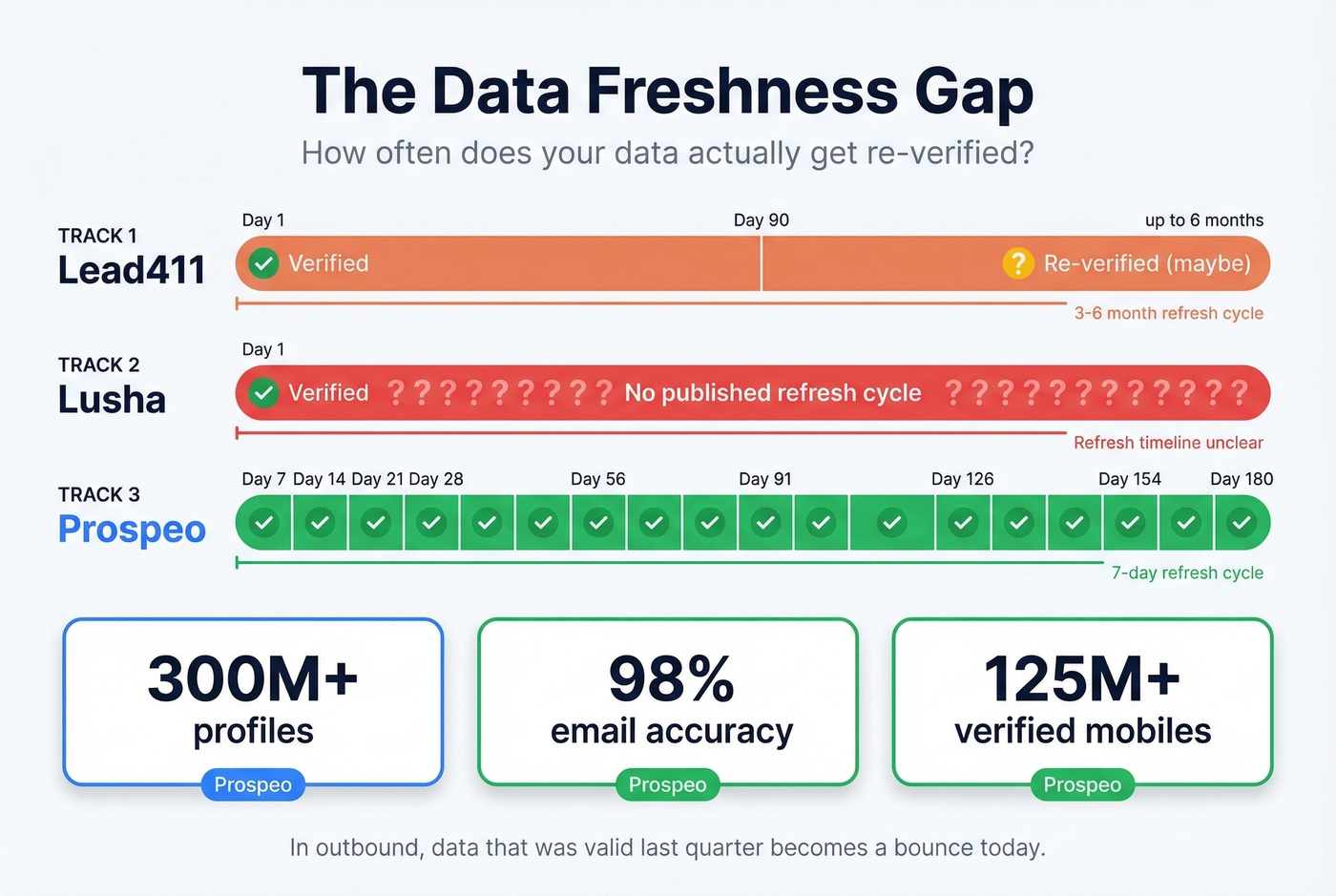
Lead411 re-verifies emails every 3-6 months. Lusha doesn't clearly publish a refresh cycle. If you're doing serious outbound, 3-6 months is a long time. People change jobs, aliases change, domains get swapped, and "valid last quarter" becomes "bounce today."
Prospeo is built for teams that care about deliverability first. It runs a 7-day data refresh cycle across 300M+ professional profiles, with 98% email accuracy, 143M+ verified emails, and 125M+ verified mobile numbers. It's self-serve, no annual contract, and you can verify in real time so reps don't have to "trust the database" and hope. (If you’re building a stack around this, see data enrichment services.)
Prospeo also includes Bombora-powered intent data across 15,000 topics, so you don't have to choose between freshness and intent signals.
Anecdote we see a lot: a team starts with Lusha because it's easy, then they add another tool to verify emails because bounces spike, then they add a third tool for intent. Now they're paying for three products and still arguing about which record is correct. That's the point where consolidating around a fresher dataset saves money and sanity.
For general deliverability guidance (separate from any vendor), Google's sender guidelines are worth bookmarking: https://support.google.com/a/answer/81126?hl=en. And if you want the industry baseline for authentication, DMARC's official site is the most direct reference: https://dmarc.org/.

Both Lead411 and Lusha users complain about the same thing: bad numbers and bounced emails. Prospeo's 5-step verification and proprietary email infrastructure deliver 98% accuracy - and data refreshes every 7 days, not every 6 weeks.
Your reps deserve data that actually connects. 75 free emails to prove it.
Bottom Line
Choose Lead411 if your outbound motion benefits from intent and triggers, and you want predictable phone-heavy prospecting without getting nickeled-and-dimed by credits.
Choose Lusha if speed is the whole point and you're doing lightweight lookups where the extension UX matters more than deep intelligence.
Choose Prospeo if email accuracy and data freshness are the make-or-break metrics for your team. In outbound, that's usually the metric that decides whether your pipeline grows or your domains get burned. (More tactics: sales prospecting techniques.)
One strong opinion before we wrap: if you're buying a data tool to "fix outbound," and you don't measure bounce rate and reply rate weekly, you're flying blind. Tools don't fix process, but bad data will absolutely wreck a good process.
FAQ
Is Lead411 or Lusha more accurate?
Neither publishes an independent accuracy benchmark. Review sites consistently show Lead411 getting pushback on outdated contacts and Lusha getting pushback on inaccurate phone numbers. Accuracy varies by industry, region, and seniority, so verify emails before sending no matter which tool you pick.
Does Lusha have a free plan?
Yes. It includes up to 70 credits per month. Since phone reveals cost 10 credits each, you'll burn the whole monthly allowance after 7 phone lookups. For email-only usage, the credits stretch further.
What's a good free alternative to both tools?
Prospeo's free tier includes 75 verified emails/month plus 100 Chrome extension credits/month, which is easier to use for email-heavy outbound than a phone-expensive credit model. If you want an all-in-one platform with sequencing, Apollo.io is also worth a look. For enterprise budgets, ZoomInfo remains the deepest US database, and Cognism is commonly evaluated for EMEA-focused teams that care about compliant European data.