


Lusha vs QuickEnrich: Which B2B Data Tool Wins?
Your SDR manager just asked why half the phone numbers from Lusha are burning credits but not connecting. Meanwhile, someone on ops is evaluating QuickEnrich's API for list enrichment. You're comparing two tools that solve different halves of the same problem - and picking the wrong one means stalled reps or messy CRM data.
30-Second Verdict
- Pick Lusha if you prospect from professional profiles and need a Chrome extension workflow. It's built for reps.
- Pick QuickEnrich if you've got existing lists to enrich via API or CSV and want flat per-record pricing with no credit games.
Feature Comparison at a Glance
Lusha helps reps find contacts in the moment. QuickEnrich helps ops fix and enrich contacts at scale. That's the core split, and it shapes everything from pricing to integrations.
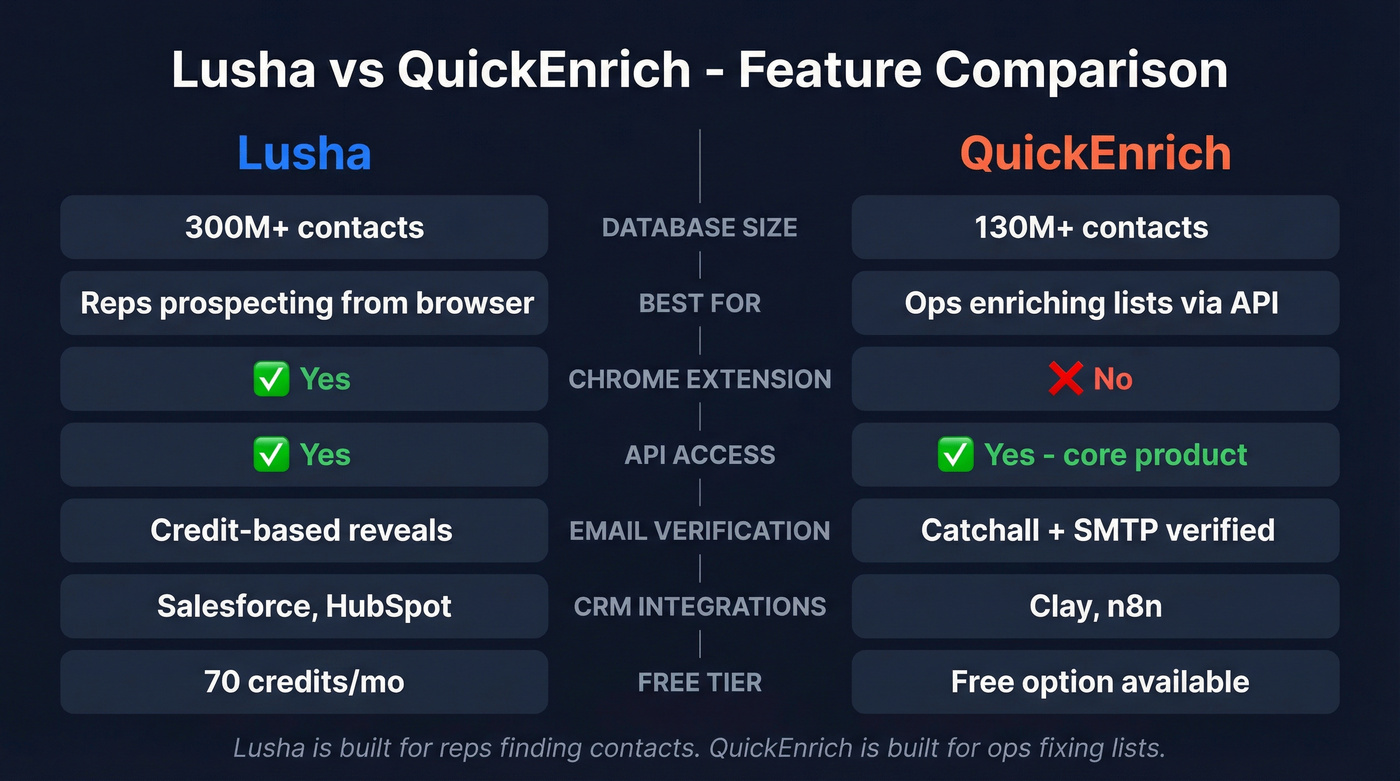
| Feature | Lusha | QuickEnrich |
|---|---|---|
| Database size | 300M+ contacts | 130M+ contacts |
| Email verification | Credit-based reveals (1 credit per email) | Catchall + SMTP verified |
| Chrome extension | Yes | No |
| API access | Yes | Yes (core product) |
| CRM integrations | Salesforce, HubSpot | Clay, n8n |
| Free tier | 70 credits/mo | Free option available |
| Starting price | $29.90/user/mo | $29/mo |
Pricing Breakdown
This is where the comparison gets interesting - and where most teams make their decision.
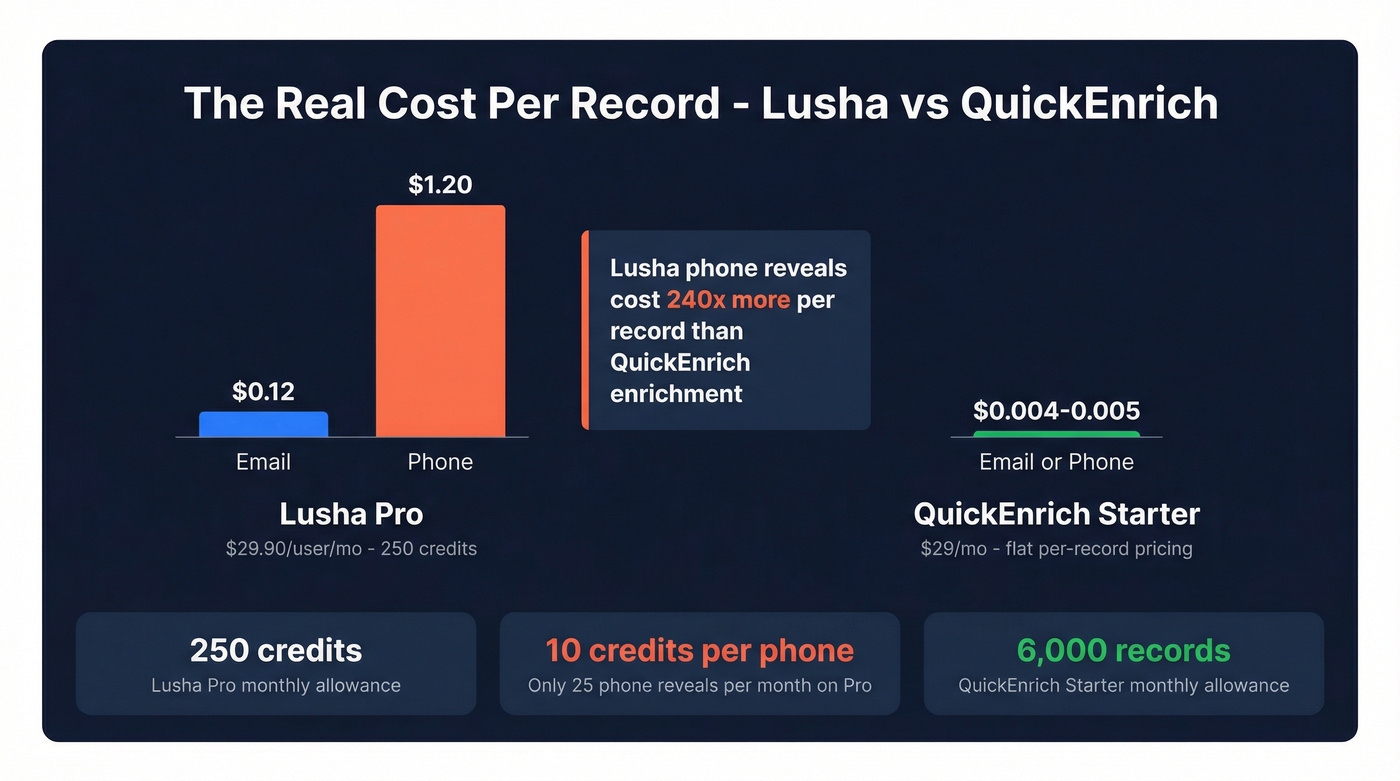
Lusha charges 1 credit per email and 10 credits per phone reveal. The common entry point is $29.90/user/month for 250 credits. Do the math: that's roughly $0.12 per email and $1.20 per phone. Phone numbers feel "included," but they're really a premium SKU hiding inside the credit model. We've seen teams burn through a month of Lusha credits in under a week once reps start pulling direct dials. Monthly plan credits roll over and accumulate up to 2x your plan limit; annual credits reset at the end of the cycle.
| Plan | Price | Credits/mo | Cost per Email / Phone |
|---|---|---|---|
| Free | $0 | 70 | $0 / $0 |
| Pro | $29.90/user/mo | 250 | ~$0.12 / ~$1.20 |
| Premium | $69.90/user/mo | 600 | ~$0.12 / ~$1.17 |
| Scale | Custom | Custom | Custom |
QuickEnrich is the opposite: flat enrichment economics. On Starter, it works out to $0.00483 per found email or phone (mobiles included when available). Annual plans stretch further - Starter at $24/mo gets 72,000 found records; Growth at $83/mo gets 300,000.
| Plan | Monthly | Annual | Records (Annual) | Per Record |
|---|---|---|---|---|
| Starter | $29/mo | $24/mo | 72,000 | ~$0.004 |
| Growth | $99/mo | $83/mo | 300,000 | ~$0.003 |
| Unlimited | Custom | Custom | Custom | Custom |
One frustration worth flagging: QuickEnrich's pricing page shows inconsistent record counts inside the same plan blocks. A small trust ding when you're buying an API product.
If your average deal size sits below $5k, Lusha's phone credits will eat your margin alive. QuickEnrich or a flat-rate alternative is the smarter play.

Lusha burns credits on phones. QuickEnrich has no Chrome extension. Prospeo gives you both - a 40K+ user Chrome extension for reps and an API with 92% match rate for ops - with 98% email accuracy and 125M+ verified mobiles at ~$0.01/email.
One platform, both workflows, no credit games.
Data Quality and Verification
Neither tool delivers fire-and-forget accuracy. Let's be honest - no single-source enrichment tool does.
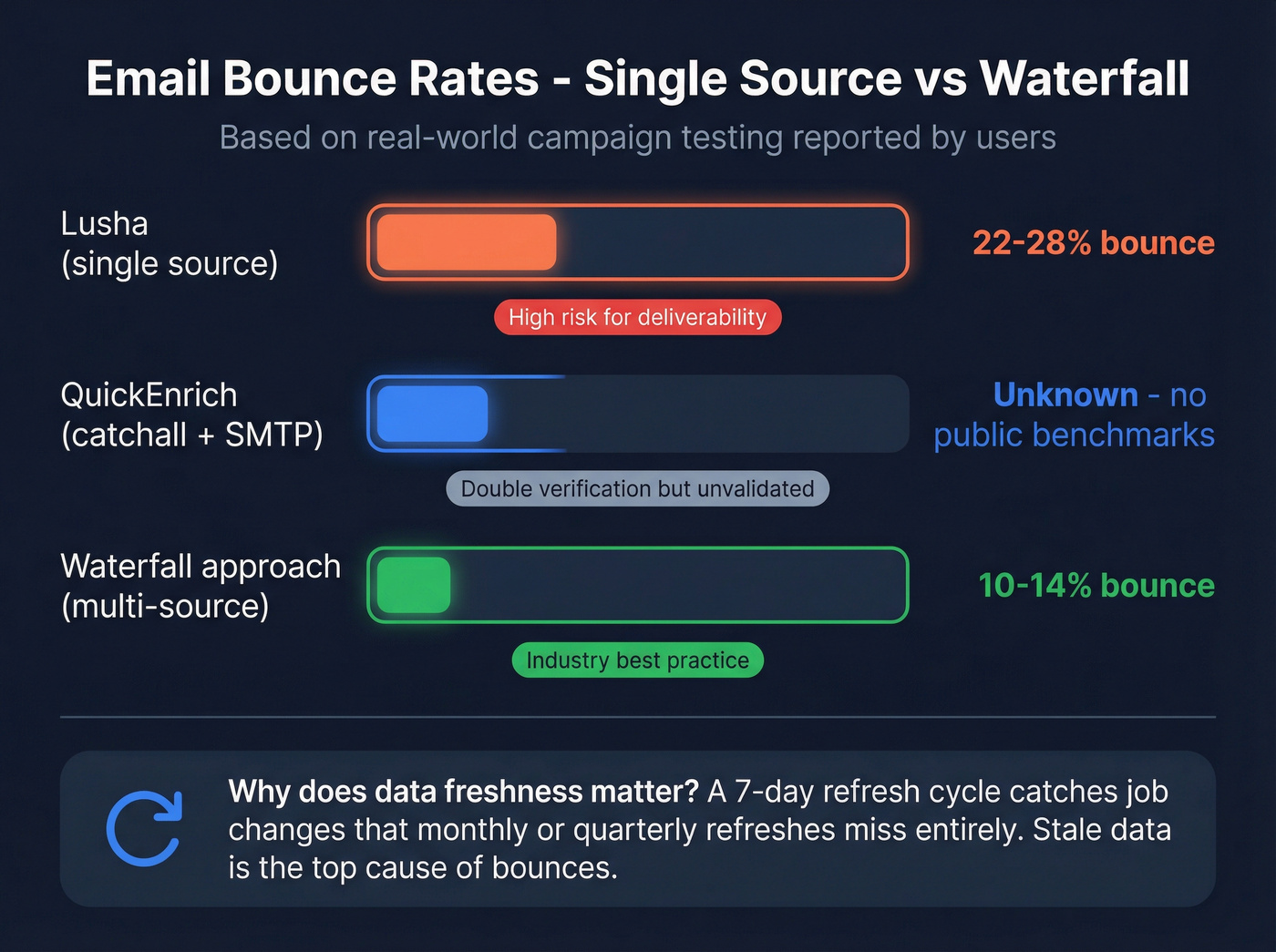
A Reddit user who tested multiple lead sources reported Lusha bouncing roughly 22-28% in real campaigns. For context, a Clay waterfall approach hit about 10-14% bounce in the same test - that's the benchmark for "good." The reason cascading across multiple sources tends to outperform single-source lookups is simple: most enrichment tools license overlapping underlying databases, so stacking them fills gaps that any one provider misses.
QuickEnrich runs double verification (catchall + SMTP) and stamps a verification date for recency. That's a solid process, but independent bounce benchmarks aren't publicly available to validate real-world performance.
If you care about deliverability at scale, the bar is simple: use data that's verified at the point of use and refreshed constantly. A 7-day refresh cycle, like what Prospeo runs, catches job changes and role shifts that a monthly or quarterly refresh misses entirely. (If bounce is a recurring issue, see Cold Email Bounce Rate and Email List Hygiene.)
Workflow and Integrations
Lusha is rep-native. Chrome extension, quick reveals, easy pushes into Salesforce or HubSpot. If your team lives in a browser and needs the "grab contact, push to CRM, sequence" motion, Lusha fits. The downside: that credit model punishes phone-heavy workflows, and reps who prospect aggressively will blow through credits before the month's half over. (If you're standardizing the motion, map it to a repeatable cold calling system and prospecting for leads.)
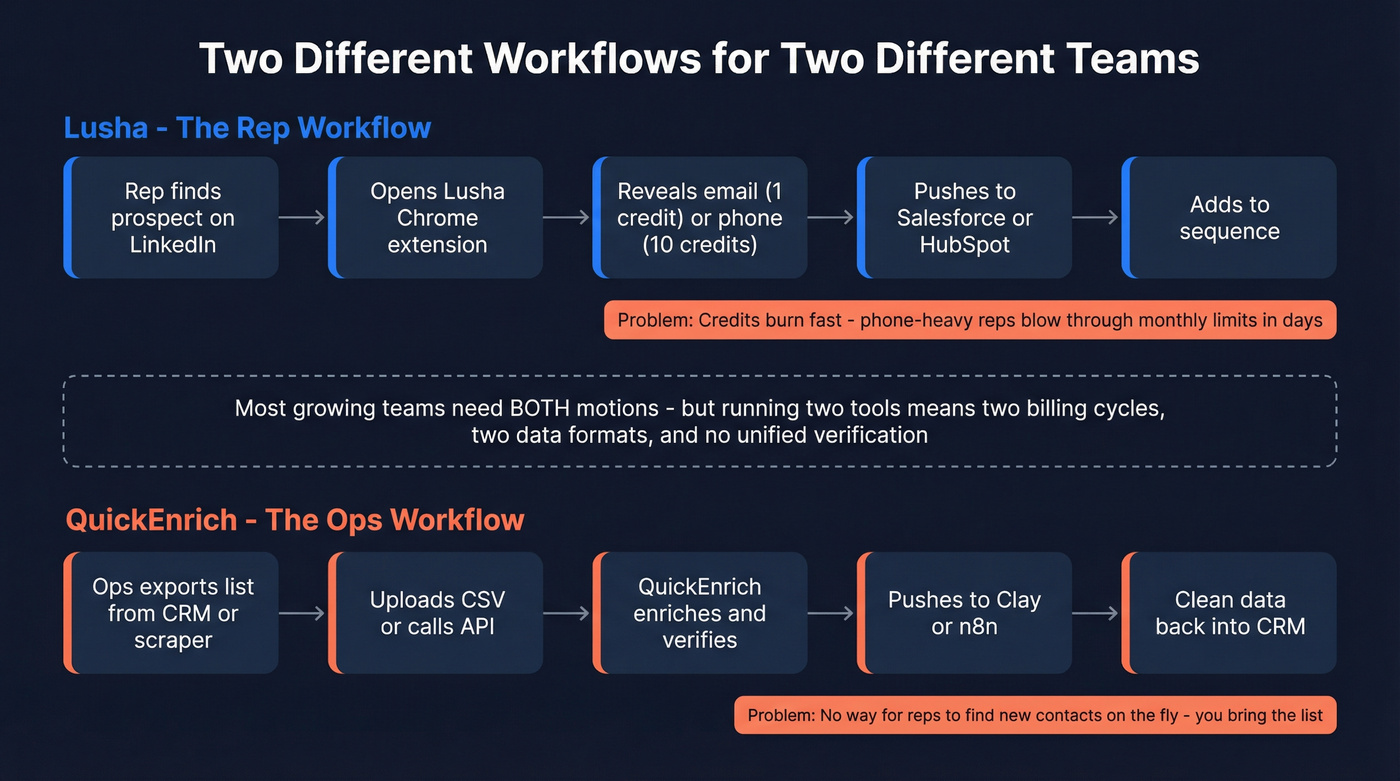
QuickEnrich is built for ops. API-first enrichment, CSV import, and it plugs into Clay and n8n. Flat per-record pricing is exactly what you want for predictable enrichment costs at scale. The downside: no Chrome extension and no rep-first prospecting UI. You bring the list; it improves the list. That's it. (If you're building this into RevOps, start with Sales Data Enrichment and Data Enrichment for Cold Email.)
Here's the thing - most growing teams need both motions. Reps need to find new contacts on the fly, and ops needs to clean and enrich lists in bulk. Running two separate tools for that creates two billing cycles, two data formats, and no unified verification standard.
Consider a Third Option
If Lusha feels good for prospecting but expensive for phones, and QuickEnrich feels good for enrichment but can't help reps find net-new contacts, Prospeo is the clean option that covers both. It combines a Chrome extension with API enrichment, 300M+ professional profiles, 98% email accuracy, 125M+ verified mobiles, and a 7-day refresh cycle. Native integrations include Salesforce, HubSpot, Clay, and Zapier. Free tier: 75 emails + 100 Chrome extension credits/month, no contracts. (If you're comparing broader options, use our Best B2B Databases and Best Data Quality Tools roundups.)

Tired of 22-28% bounce rates from single-source tools? Prospeo's 5-step verification and 7-day data refresh cycle keep your lists clean - not monthly, not quarterly, weekly. That's why teams book 26% more meetings than with ZoomInfo and 35% more than Apollo.
Stop guessing which tool has fresher data. Test Prospeo free today.
FAQ
Is QuickEnrich better than Lusha for phone numbers?
QuickEnrich includes mobiles at roughly $0.005 per found record on Starter versus Lusha's $1.20 per phone on Pro. For phone-heavy outreach, QuickEnrich wins on unit economics - though coverage sits around 25%. If pickup rate matters most, Prospeo offers 125M+ verified mobiles with a 30% pickup rate across all regions.
Does QuickEnrich have a Chrome extension?
No. It's API-first with CSV import and Clay/n8n integrations. If your reps need a browser extension to prospect, Lusha works for that. For a single platform that covers both extension-based prospecting and bulk enrichment, Prospeo handles both workflows natively.
Can I use both Lusha and QuickEnrich together?
You can - Lusha for rep-level prospecting and QuickEnrich for bulk list enrichment via API. But running two tools means two billing cycles, two data formats, and no unified verification standard. Most teams we've talked to find a single platform that handles both workflows simpler and cheaper to maintain long-term.