

How to Prospect for Leads in 2026: Benchmarks, Templates, and Tools That Work
A RevOps lead we know ran a 3-tool bake-off last quarter. The "best" database created 4,000 duplicate contacts in Salesforce in five days. The cheapest one had better phone connect rates. Prospecting for leads hasn't gotten easier - it's gotten noisier, and the gap between teams who do it well and teams who burn budget has never been wider.
What Prospecting and Lead Generation Actually Mean
Prospecting is the act of identifying, researching, and initiating contact with people who fit your buyer profile but haven't raised their hand yet. It's the upstream work that fills your pipeline before marketing qualified leads ever show up.
The distinction matters. Leads are typically warmer because they've already engaged with your brand or content. Prospects are the people your team targets and reaches out to directly, often before any inbound engagement. Leads come to you. Prospects get found. These are complementary motions, not interchangeable terms, and confusing them leads to misaligned handoffs between marketing and sales that quietly bleed pipeline.
Here's the frustrating part: reps spend just 28% of their time actually selling. The rest goes to admin, internal meetings, and bad workflows that eat hours without producing pipeline. Every minute you save on list building and data cleanup is a minute back in front of buyers.
What You Need (Quick Version)
- Fix your data first. Verification matters more than copywriting. A brilliant email that bounces is worth zero. (If you’re troubleshooting bounces, start with bounce rates and deliverability.)
- Match channel to pain urgency. Call when the pain is urgent (tax, compliance, security). Email when it's not (marketing tools, design services). Go hybrid when you're unsure.
- The only stack you need: a data platform for finding and verifying contacts, a sequencer for multi-touch outreach, and a CRM for tracking everything. Three tools. No contracts required to get started. (If you’re evaluating CRMs, see examples of a CRM.)
The 6-Step Lead Prospecting Process
RAIN Group's research shows top prospectors set 2.7x more meetings than the rest. They don't have a secret script. They have a repeatable process.
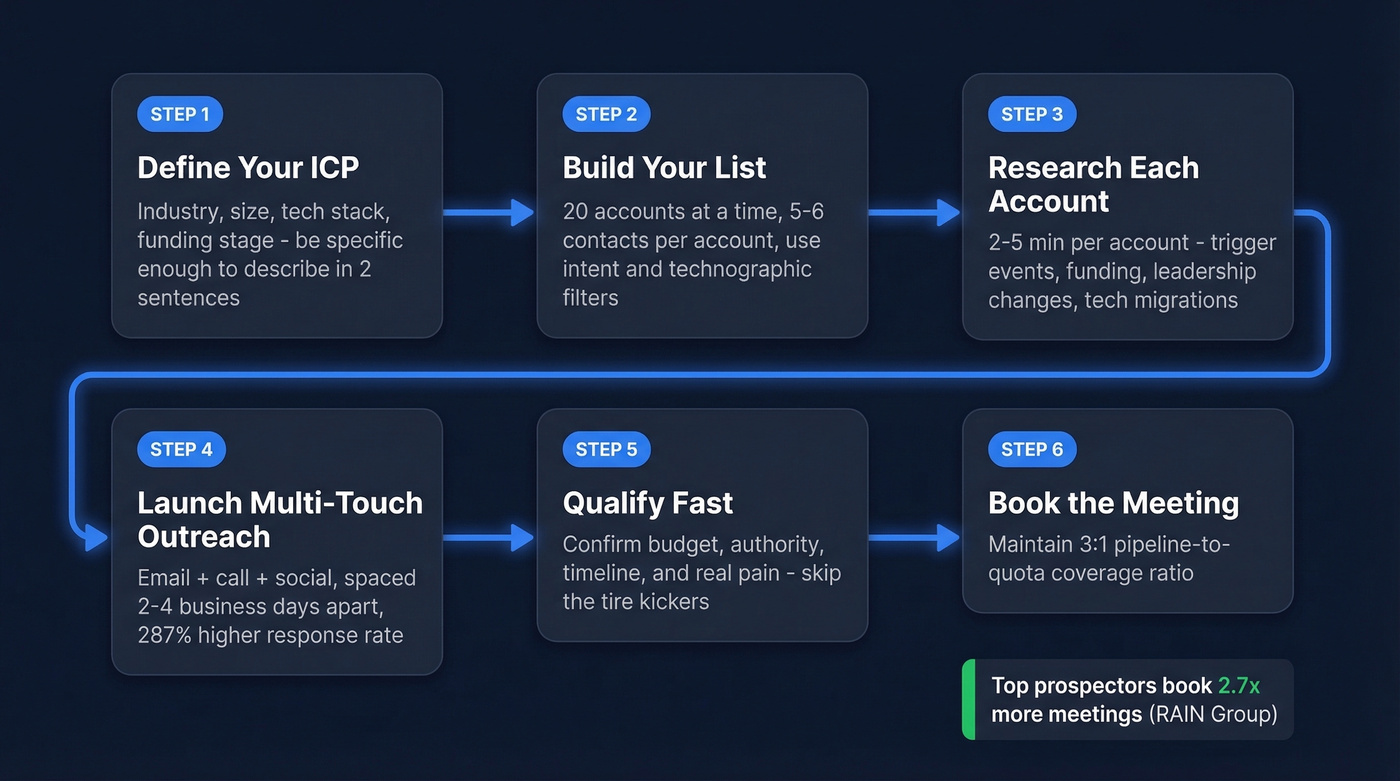
Think of it like drilling for oil: the teams that invest in geological surveys before they drill hit pay dirt more often than the ones who just start punching holes. Research and targeting upfront save you from dry wells later.
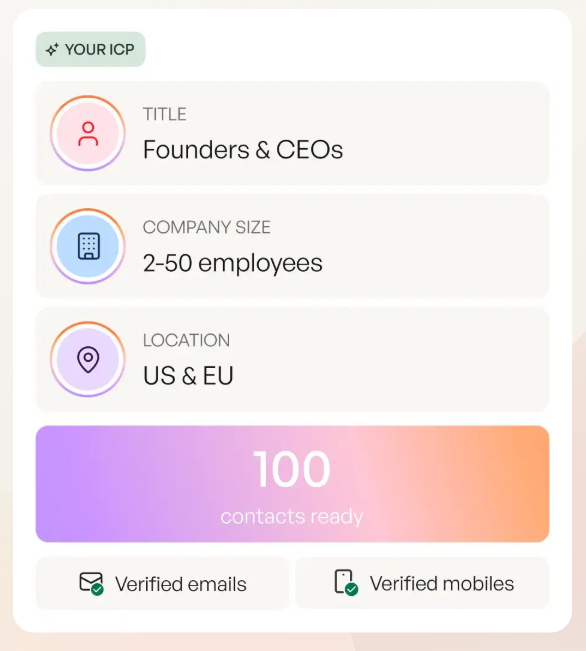
1. Define your ICP. Get specific. Industry, company size, tech stack, funding stage, department headcount. Vague targeting is the #1 reason prospecting fails. If you can't describe your ideal buyer in two sentences, you're not ready to start.
2. Build your list. This is where most teams leak time. Use Prospeo's 30+ search filters - buyer intent, technographics, job changes, headcount growth, funding - to pull verified contacts that match your ICP. Target roughly 20 accounts at a time with 5-6 contacts per account. Multi-threading isn't optional anymore. (If you want a deeper workflow, see Clay list building.)
3. Research each account. Spend 2-5 minutes per account, not per contact. Look for trigger events: new funding, leadership changes, tech migrations, earnings calls mentioning your problem space. AI tools cut this from 20 minutes to 2 when you have the right workflow. (More on operationalizing this: how to track sales triggers.)
4. Launch multi-touch outreach. Email, call, and social touches in a coordinated sequence. Multichannel outreach lifts response rates by 287% versus single-channel. Space touches 2-4 business days apart. (If you need a structure, use a B2B cold email sequence.)
5. Qualify fast. Not every reply is a qualified opportunity. Use your first conversation to confirm budget authority, timeline, and whether the pain is real. Don't waste a demo slot on someone who's "just exploring." (If you want a tighter framework, use MEDDIC sales qualification.)
6. Book the meeting. Maintain a 3:1 pipeline-to-quota coverage ratio. If your quota is $500K, you need $1.5M in pipeline. That math drives how many prospects you need to touch each week. (To pressure-test your numbers, track pipeline health.)
When to Call vs. When to Email
The consensus on r/coldemail is surprisingly clear: it depends on how urgent the prospect's pain is.
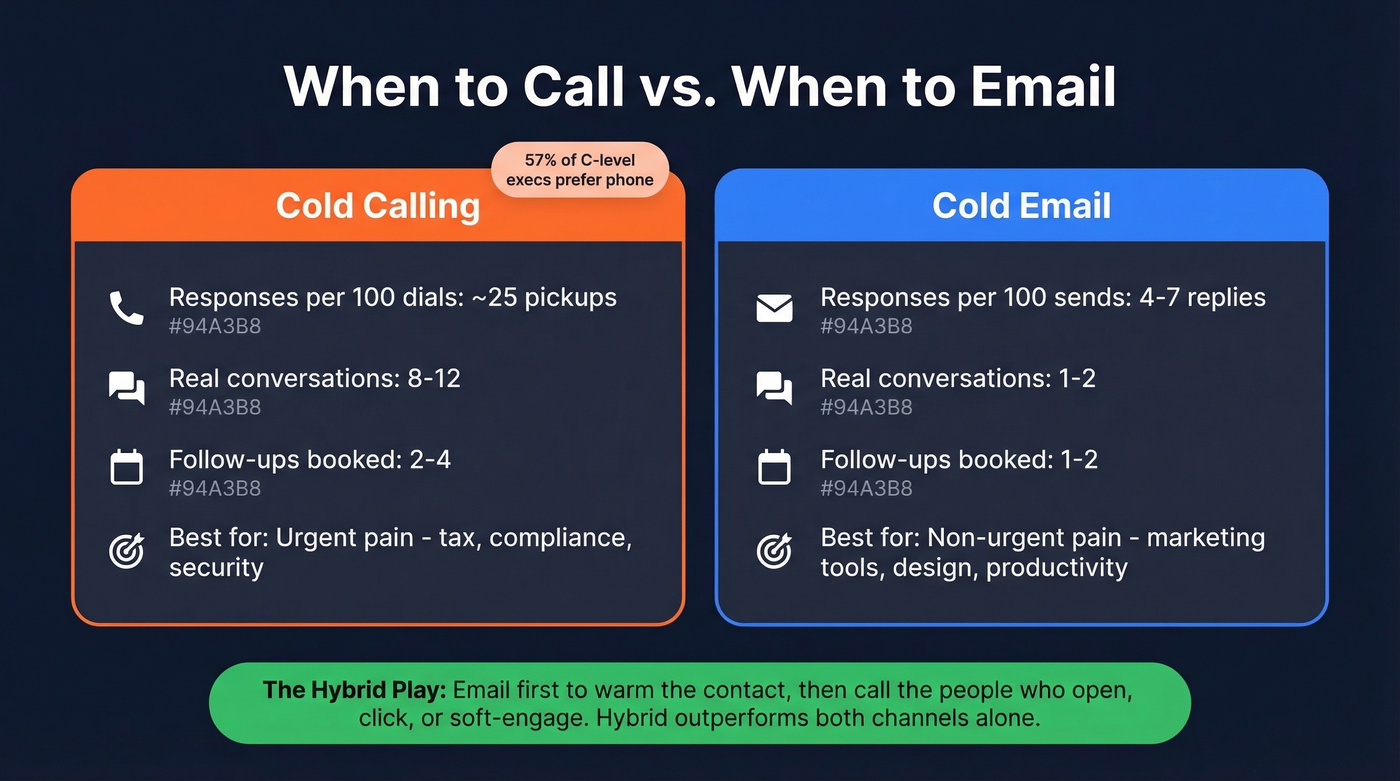
| Metric | Cold Calling (per 100 dials) | Cold Email (per 100 sends) |
|---|---|---|
| Responses | ~25 pickups | 4-7 replies |
| Real conversations | 8-12 | 1-2 |
| Follow-ups booked | 2-4 | 1-2 |
| Best for | Urgent pain niches | Non-urgent pain |
For urgent-pain niches - tax deadlines, compliance gaps, security incidents - cold calling wins. People pick up the phone when the problem is burning. 57% of C-level executives prefer phone over any other outreach channel.
For non-urgent pain - marketing tools, design services, productivity software - email performs better. The prospect isn't in crisis mode, so an interruption call feels intrusive. A well-timed email lets them engage on their schedule.
The hybrid approach outperforms both: email first to warm the contact, then call the people who open, click, or soft-engage. On social platforms, referencing a shared commonality lifts acceptance rates by 46%. One practitioner on r/coldemail put it simply - "email first, call responders" - and the data backs it up.
Cold Email Sequences That Work
The 3-Touch Sequence
Space these 2-4 business days apart. Three touches is the minimum viable sequence - most teams should run 4-5, but this framework covers the essentials.
Touch 1 - The Intro:
Subject: [Trigger event] at [Company]
Hi [Name], saw [Company] just [trigger event]. When that happens, teams usually run into [specific problem]. We helped [similar company] [specific result]. Worth a 15-min call this week?
Touch 2 - The Value Add:
Subject: Re: [original subject]
[Name], quick follow-up. [One-sentence insight relevant to their situation]. [Link to case study]. Happy to walk through how this applies to [Company] - Thursday or Friday?
Touch 3 - The Breakup:
Subject: Should I close the file?
[Name], I've reached out a couple times - totally fine if now's not the right time. Should I take this off my list, or is there a better window? Either way, no hard feelings.
The breakup email consistently pulls the highest reply rates. People respond to the implied finality.
Personalization That Moves Numbers
Generic outreach averages a 3.4% reply rate. Signal-based personalization - referencing a trigger event, a specific pain point, or a shared connection - hits 18%. That's a 5x difference from the same effort.
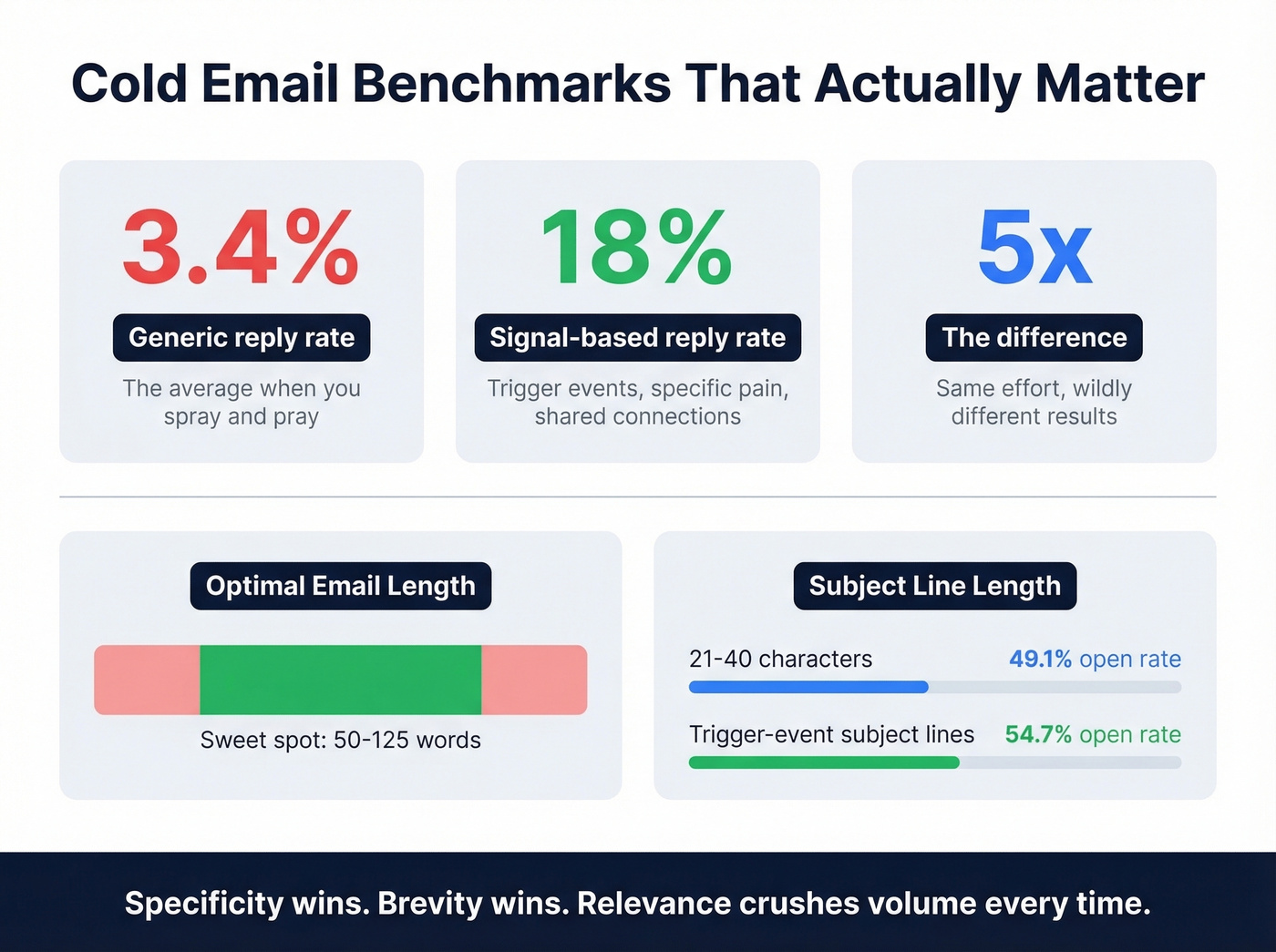
Keep emails between 50-125 words. Subject lines between 21-40 characters hit a 49.1% average open rate, and trigger-event subject lines push even higher at 54.7%. Specificity wins, brevity wins, and relevance crushes volume every time. (If you want more options, pull from these cold email subject line examples.)

Step 2 is where most teams leak hours. Prospeo's 30+ search filters - buyer intent, technographics, job changes, headcount growth, funding - build verified prospect lists in minutes, not days. 98% email accuracy means your brilliant outreach actually lands.
Stop punching dry wells. Start with data that connects.
Cold Calling in 2026
Cold calling isn't dead. It's just harder to do badly and get away with it.
The average success rate sits at 2.3%, and it takes about 8 attempts to reach a prospect. Those numbers sound brutal, but they're averages dragged down by reps dialing bad numbers with no research. 49% of buyers actually prefer cold calls as a first touch - especially in urgent-pain verticals.
Two tactics that move the needle: opening with "how've you been?" lifts success rates to 10.01% based on Gong's analysis of millions of calls, and mentioning a shared group or connection increases meeting chances by 70%. Both work because they break the "stranger calling" frame and create a moment of familiarity. (If you’re building a repeatable motion, use a cold calling system.)
Here's the thing: the biggest bottleneck isn't your script, your opener, or your confidence. It's your phone data. If 40% of your mobile numbers are wrong, your 2.3% success rate drops to effectively zero. Fix the data first, then worry about your delivery.
Fix Your Data Before Your Copy
Picture this: it's Monday morning, you launch a 500-contact sequence, and by noon your bounce rate is sitting at 35%. Your domain reputation just took a hit that'll haunt you for weeks. Your sequences are dead before the copy even matters.
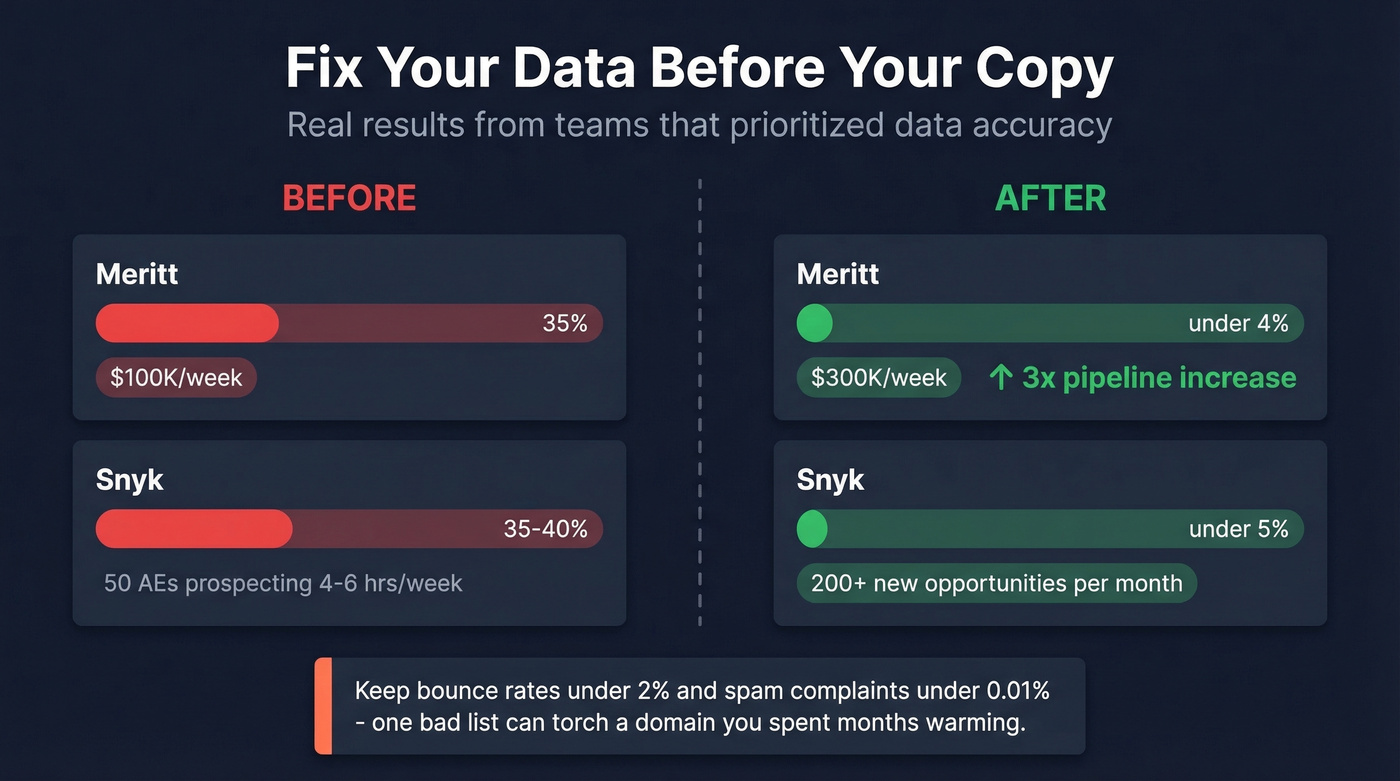
This isn't hypothetical. ~17% of cold emails get blocked or land in spam, and the guardrails are tight - you need bounce rates under 2% and spam complaint rates under 0.01%. One bad list can torch a domain you spent months warming. (If you’re diagnosing reputation issues, start with email reputation tools.)
The Reddit practice of running two verifiers minimum exists for a reason. But the better move is starting with a platform that gets verification right the first time.
The proof is in the results. Meritt went from a 35% bounce rate to under 4% after switching, and their pipeline tripled from $100K to $300K per week. Snyk - with 50 AEs prospecting 4-6 hours per week - dropped bounces from 35-40% to under 5% and now generates 200+ new opportunities per month.
How AI Changes Prospecting
LivePerson cut prospect research time from 20 minutes per account to 2 minutes and saw a 35% lift in engagement rates. That's not a marginal improvement - it's a structural shift in how the economics of finding and qualifying buyers work.
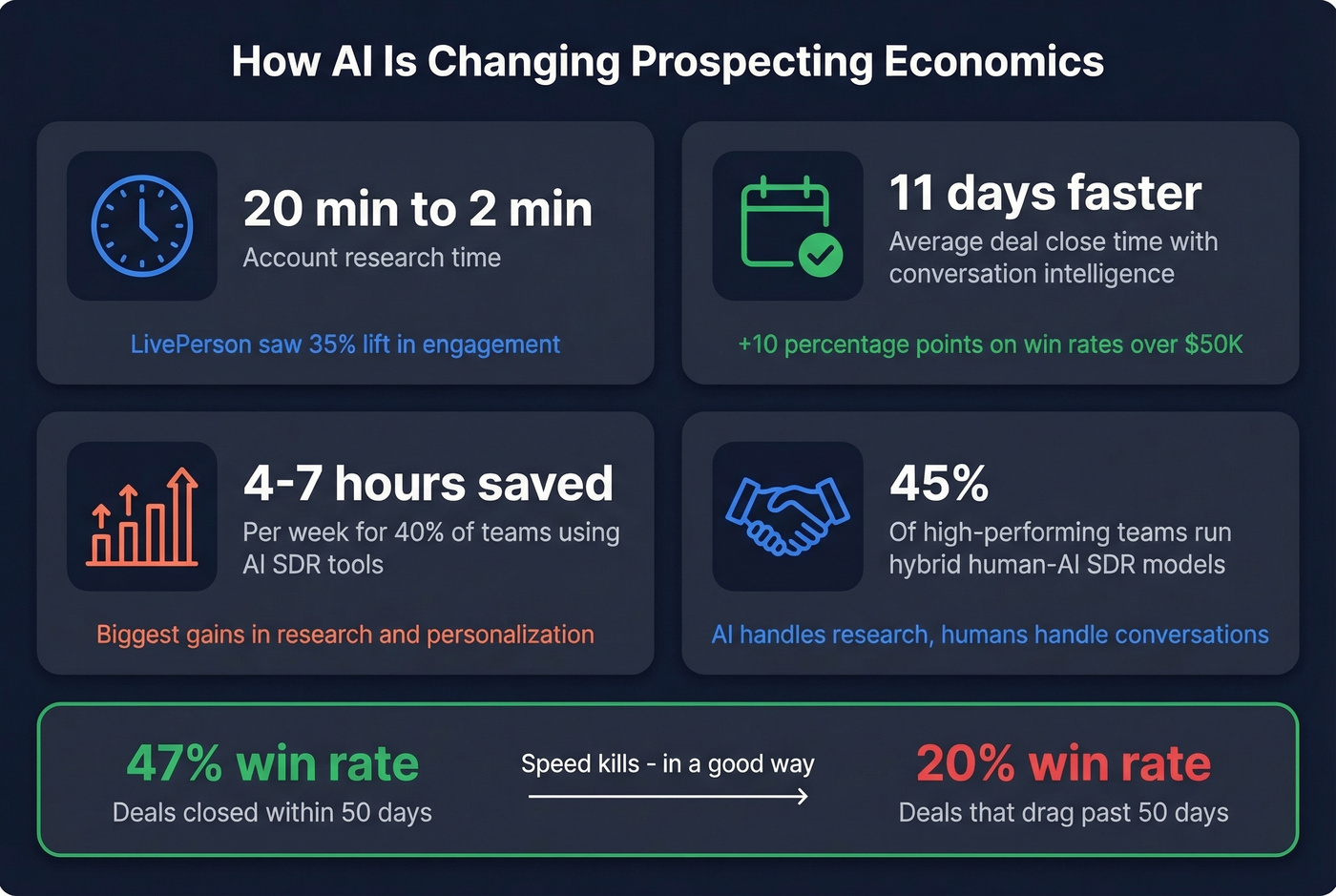
Across the board, 40% of teams using AI SDR tools save 4-7 hours per week on outbound activities. The biggest gains come from account research and personalization - having AI scan 10-Ks, earnings calls, and news to surface relevant talking points. Conversation intelligence tools close deals 11 days faster on average and add 10 percentage points to win rates on deals over $50K. (If you’re building the stack, compare SDR tools.)
Speed matters too. Deals closed within 50 days carry a 47% win rate. Beyond 50 days, that drops to 20%. AI doesn't just save time - it compresses your sales cycle, which directly lifts win rates. Meanwhile, 45% of high-performing sales teams now run hybrid human-AI SDR models where AI handles research and initial personalization, and humans handle the actual conversations.
Prospecting Tools and What They Cost
| Tool | Best For | Starting Price | Free Tier? |
|---|---|---|---|
| Prospeo | Verified data + accuracy | ~$0.01/email | Yes |
| Apollo | All-in-one prospecting | ~$49/mo | Yes |
| ZoomInfo | Enterprise data | ~$15-40K/yr | No |
| Instantly | Email sequencing | ~$30/mo | No |
| Hunter.io | Email discovery | Free | Yes |
| Snov.io | All-in-one outreach | $39/mo | Yes |
| LeadIQ | CRM sync + capture | Free | Yes |
| Reply.io | Multichannel sequences | $99/mo | No |
| Close | CRM + outreach | $49/mo | No |
| UpLead | Verified B2B contacts | $99/mo | No |
Prospeo
Prospeo covers 300M+ professional profiles (143M+ with verified emails and 125M+ verified mobile numbers) with 30+ search filters spanning buyer intent, technographics, job changes, funding, and headcount growth. At ~$0.01 per email with a free tier of 75 emails and 100 Chrome extension credits per month, it's the self-serve option that doesn't require a sales call or annual contract. The 98% email accuracy and 7-day data refresh make it the strongest data foundation on this list.
Apollo
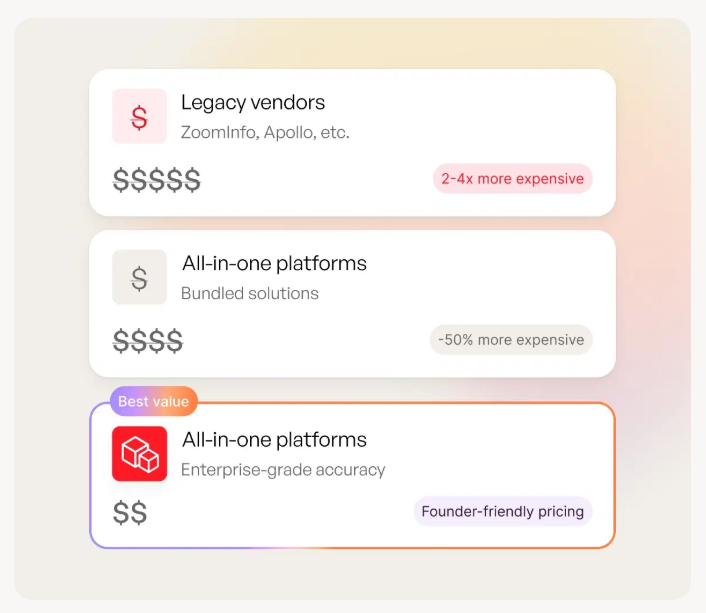
Apollo is the obvious starting point for teams that want data and sequencing in one platform without paying enterprise prices. The free tier is genuinely useful, and paid plans run ~$49-99/mo per user. The database is massive, the sequencing tools are solid, and the learning curve is gentle. The tradeoff: email accuracy runs at 79%, which means you'll want a verification layer on top. In our experience, teams that pair Apollo's database with a dedicated verifier get better results than using Apollo alone.
ZoomInfo
Skip this if your team is under 50 reps or your deal sizes don't justify five-figure annual tooling costs. ZoomInfo's US database depth is unmatched, and the intent data, conversation intelligence, and workflow tools justify the price - if you're actually using them. Expect to pay $15-40K/year depending on seats and modules. Email accuracy sits at 87%. For a 200+ person sales org with budget and implementation resources, ZoomInfo makes sense. For everyone else, you're paying for features you'll never turn on.
Instantly
Instantly is a sequencing tool, not a data platform - and that's fine. Starting around $30/mo for sending, it handles inbox rotation, campaign separation, and deliverability management well. The data add-on is separate and priced on credits. Use this if you already have clean data and need a reliable way to send at scale.
Hunter.io
Hunter does one thing well: finding email addresses associated with a domain. Free tier available, paid plans from ~$49/mo. It's a discovery tool, not a full prospecting platform. Pair it with a verifier and a sequencer for a lightweight stack.
Other Notable Tools
Snov.io ($39/mo) handles email finding, verification, and drip campaigns in one place - solid for solopreneurs. LeadIQ (free tier) captures contacts during research and syncs to your CRM. Reply.io ($99/mo) runs multichannel sequences across email, calls, and social. Close ($49/mo) combines CRM with built-in calling and email for small sales teams. UpLead ($99/mo) focuses on verified B2B contacts with strong data accuracy. Reddit threads on r/sales also mention ReachInbox and ManyReach for inbox rotation and multichannel execution - worth watching if you're scaling outreach infrastructure.
Signal-based personalization hits 18% reply rates - but only if your emails reach real inboxes. Prospeo's 5-step verification and 7-day data refresh keep bounce rates under 4%, so every personalized touch you craft actually gets delivered. At $0.01 per email, bad data is no longer an excuse.
Your sequences deserve contacts that don't bounce.
Mistakes That Kill Your Pipeline
Giving up too early. 44% of reps stop after a single attempt. Meanwhile, 80% of deals require 5+ touches, and 43% of buyers who accept meetings say being contacted 5+ times is perfectly fine. Persistence isn't annoying - quitting after one email is. (If you need copy, use these sales follow-up templates.)
Going single-channel. Email-only or call-only leaves the 287% multichannel lift on the table. Use both, plus social touches.
Sending generic blasts. Personalized B2B emails achieve 14% higher open rates and 10% higher CTR than generic messages. Signal-based personalization pushes reply rates to 18%. The effort-to-return ratio on personalization is absurdly good. (For a broader playbook, see personalized outreach.)
Ignoring GDPR and privacy laws. Fines run up to EUR 20M or 4% of global annual revenue. Even if you're US-based, selling into the EU without compliance is a ticking clock.
Running on stale data. If your data refreshes every 6 weeks, a meaningful chunk of your list has changed jobs, switched emails, or left the company entirely. Weekly refresh cycles exist for a reason.
Skipping intent signals. Outreach without intent data means you're guessing who's in-market. Teams that layer intent into their targeting focus effort on accounts that are actually researching solutions right now.
Showing up unprepared. 58% of sales meetings aren't valuable to buyers. If you booked the meeting but didn't research the account, you've wasted everyone's time and burned the relationship.
Strategies That Scale Beyond Individual Effort
The difference between teams that plateau at 10 meetings per month and teams that consistently book 40+ comes down to repeatable systems, not heroic individual effort. (If you want more tactics, see sales prospecting techniques.)
Start by segmenting your target accounts into tiers. Tier 1 accounts get full personalization, multi-threaded outreach, and phone follow-up. Tier 2 gets semi-personalized sequences with trigger-based calls. Tier 3 gets automated sequences with light personalization. This tiered approach lets you scale without sacrificing quality on your highest-value targets.
Let's be honest - prospecting for leads also requires a feedback loop that most teams skip. Review your sequence performance weekly: which subject lines pull replies, which call openers book meetings, which personas convert. We've seen teams double their meeting rates in a single quarter just by iterating on this data instead of running the same stale playbook month after month.
FAQ
How many touches does it take to book a meeting?
Most deals require 5+ touches across multiple channels, and 43% of buyers who accept meetings say that frequency is perfectly fine. The real problem is that 44% of reps give up after just one attempt. Build sequences with at least 5 touches spanning email, phone, and social.
What's a good cold email reply rate?
Average cold email reply rates sit between 1-5%. Signal-based personalized emails hit 18%. If you're consistently below 1%, the issue is almost certainly data quality or targeting - not your copy. Fix the list before rewriting the email.
Is cold calling dead in 2026?
No. 57% of C-level buyers prefer phone contact, and 49% of all buyers are open to cold calls. The 2.3% average success rate is dragged down by bad data and untargeted dialing. Urgent-pain niches see significantly higher connect rates when reps use verified mobile numbers.
What's the best free tool for prospecting?
Prospeo's free tier (75 emails + 100 Chrome extension credits/month) paired with HubSpot CRM (free) and a sequencer like Instantly (~$30/mo) gives small teams verified data, a CRM, and outreach automation - no annual contracts, no sales calls required.
How does AI help with sales prospecting?
AI cuts prospect research time by up to 90% and saves teams 4-7 hours per week. The biggest lift comes from account research and personalization - surfacing trigger events, analyzing financials, and drafting tailored outreach. It augments human reps rather than replacing them.