

The Complete Mail Campaign Guide: Email & Direct Mail for 2026
Every mail campaign starts with the same question: is this worth it? Someone on r/smallbusiness asked exactly that - whether a $2,500 direct mail campaign justified the spend targeting women over 60. The real answer depends on your list, your offer, and whether you're tracking anything at all.
Whether you're planning an email blast to 50,000 subscribers or a 5,000-piece postcard drop to a local zip code, both qualify as a mail campaign. The direct mail advertising market sits at roughly $69.37B, and email reaches 4.7B global users sending around 392B messages daily. These aren't competing channels - they're complementary ones.
The Short Version
Before you read 2,500 words, here's what matters:
- Email campaign? Clean your list, authenticate your domain (SPF/DKIM/DMARC), and segment before you send. Do it right and you'll hit a 31% open rate - the 2026 average across 183,000+ brands.
- Direct mail campaign? Budget $0.55-$1.75 per piece all-in. Target your house list first for 5-9% response rates. Track everything with QR codes or personalized URLs.
- Either way: The list is 80% of the outcome. Bad data kills campaigns faster than bad creative - which is why verifying your list with a tool like Prospeo before sending is the single highest-ROI step you can take.
Email vs Direct Mail - Head-to-Head
The numbers tell a clear story, but it's not the one most people expect.
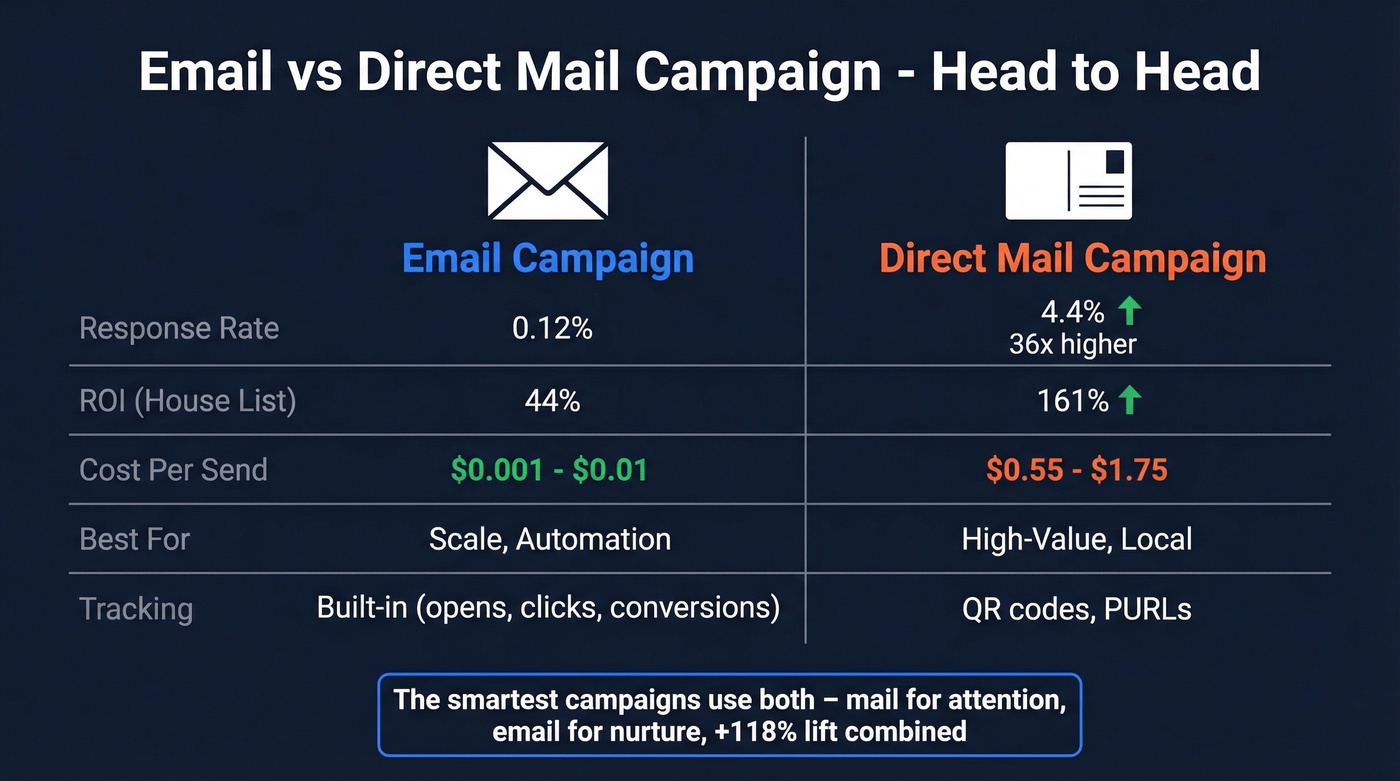
| Metric | Email Campaign | Direct Mail Campaign |
|---|---|---|
| Response rate | 0.12% | 4.4% |
| ROI (house list) | 44% | 161% |
| Cost per send | $0.001-$0.01 | $0.55-$1.75 |
| Best for | Scale, automation | High-value, local |
| Tracking | Built-in (opens, clicks, conversions) | QR codes, PURLs |
Direct mail's response rate is over 36x higher than email's. But email costs a fraction of a cent per send, which means you can afford massive scale and still come out ahead on total conversions. Email can generate up to 3,600% ROI when the fundamentals are right - a number that reflects the near-zero marginal cost of every additional send.
Here's what most marketers miss: the physical mailbox is a less contested space than the inbox. That's a big reason direct mail response rates stay high, even while 77% of consumers still choose email as their preferred channel for receiving promotions. The smartest campaigns use both.
The hybrid funnel works like this: map your target area or audience, send physical mail to grab attention, include a QR code that drives to a landing page, then follow up with an email sequence. Mail for attention, email for nurture. That combination lifts response rates by +118% according to Merkle's research.
Skip direct mail entirely if your customer value is low and you don't have repeat purchases. It gets expensive fast. Put everything into email and paid digital until your unit economics justify physical mail.
How to Plan an Email Campaign
Five steps. None of them are optional.
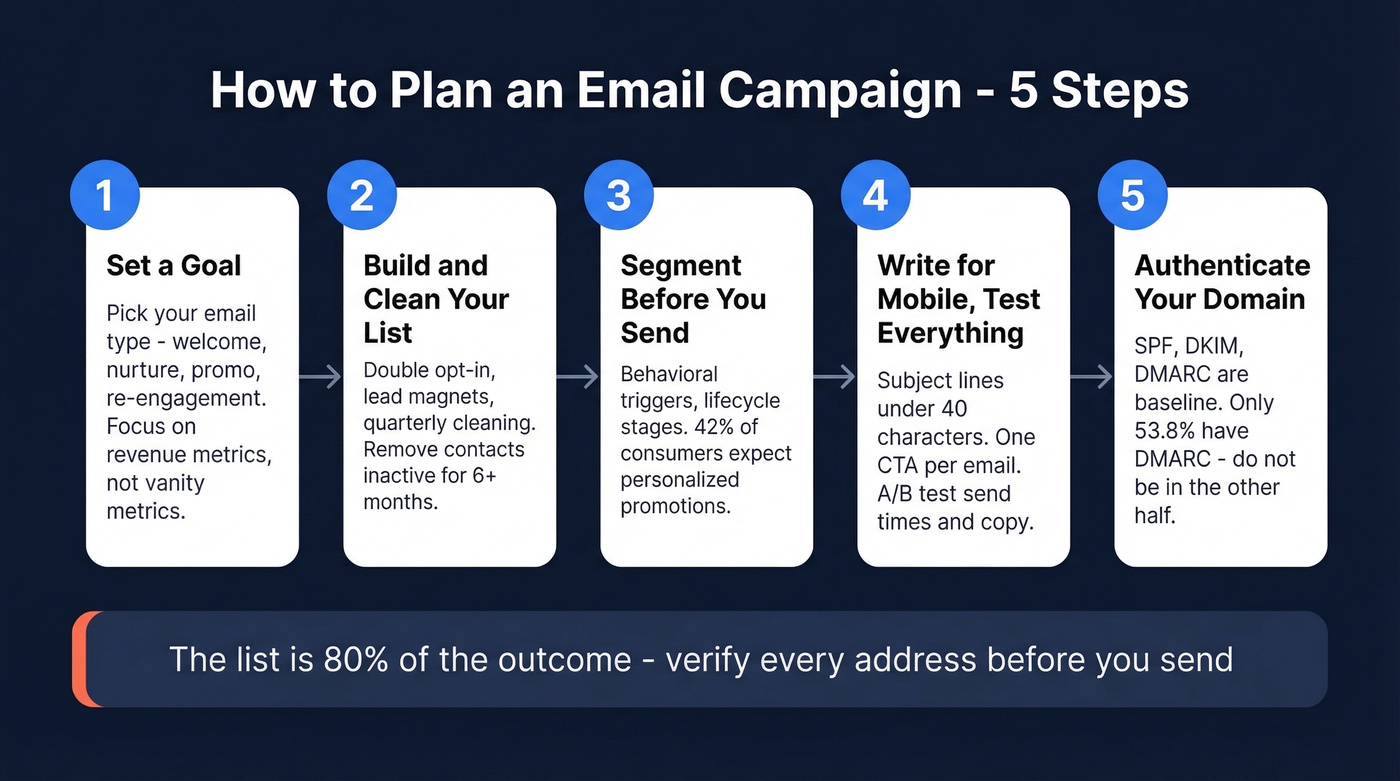
Set a Goal and Pick Your Type
Start with what you want the campaign to do - not what you want to say. Revenue-focused metrics like conversion rate, customer lifetime value, and pipeline generated beat vanity metrics every time.
Then pick your email type. Adobe's taxonomy is a useful framework: welcome emails for new subscribers, nurture sequences for leads who aren't ready to buy, newsletters for ongoing engagement, promotional emails for offers and launches, and re-engagement campaigns for contacts going cold. Each type has different benchmarks and different cadences. Don't try to do everything in one send.
Build and Clean Your List
Permission-based collection is the only path that works long-term. Lead magnets like ebooks, free trials, discounts, and webinar access give people a reason to hand over their email. Double opt-in adds friction but dramatically reduces spam complaints and fake signups.
Clean your list every quarter. Contacts who haven't opened in six months or clicked in a year get a re-engagement campaign first, then removal if they stay dark. The consensus on r/coldemail is blunt: emailing stale lists is the fastest way to wreck deliverability. We've seen teams lose months of sender reputation progress from a single send to an uncleaned list - it's not worth the risk.
Segment Before You Send
Generic blasts are the fastest way to train Gmail to ignore you. Segment by behavioral triggers like opens, site visits, purchase history, and cart abandonment - and by lifecycle stage: new subscriber, engaged prospect, first-time customer, repeat buyer, at-risk.
About 42% of consumers now expect personalized promotions, and roughly 30% expect brands to use their purchase history. Even basic segmentation - active vs. inactive, customer vs. prospect - outperforms a single-list blast by a wide margin. The more relevant the message, the higher the engagement, and the better your sender reputation gets over time.
Write for Mobile, Test Everything
Most people read email on their phones. Subject lines should stay under 40 characters. One clear CTA per email - not three. Never send from a no-reply address; it signals you don't care about the conversation.
A/B test subject lines, send times, and CTAs. In our experience, testing almost always reveals surprises - the "ugly" subject line outperforms the clever one, the Tuesday 2pm send beats the Monday 9am send. The best send time for your audience isn't what a blog told you. It's whatever your data says after a month of testing.
If you need ideas fast, pull from proven subject lines and adapt them to your segments.
Authenticate Your Domain
SPF, DKIM, and DMARC aren't optional in 2026. They're the baseline. Right now, 66.2% of senders use both SPF and DKIM, and only 53.8% have a DMARC policy in place - many set to p=none, which does almost nothing. If you're in the other half, your campaigns are hitting spam.
BIMI - the protocol that displays your brand logo in the inbox - requires an enforced DMARC policy. Authentication gets your emails past the server. Verification gets them past the bounce filter. Prospeo's 5-step verification process catches spam traps, honeypots, and catch-all domains at 98% accuracy before you hit send, so your sender reputation stays clean and your messages actually land.
If you're troubleshooting deliverability, start with the fundamentals in this email deliverability guide and then tighten your sender reputation over time.

This article makes one thing clear: the list is 80% of the outcome. Prospeo's 5-step verification catches spam traps, honeypots, and catch-all domains at 98% accuracy - so your mail campaign lands in inboxes, not spam folders. At $0.01 per email, cleaning your list costs less than a single bounced send costs your domain reputation.
Stop guessing which addresses are real. Verify before you send.
Segmentation only works when your contact data is accurate. Prospeo enriches every record with 50+ data points - job title, company size, intent signals - so your mail campaigns hit the right person with the right message. 83% of leads come back enriched, refreshed every 7 days.
Better segments start with better data. Enrich your list in minutes.
Email Benchmarks Worth Tracking in 2026
Klaviyo's 2026 benchmark report covers 183,000+ brands. Here's where the numbers land:
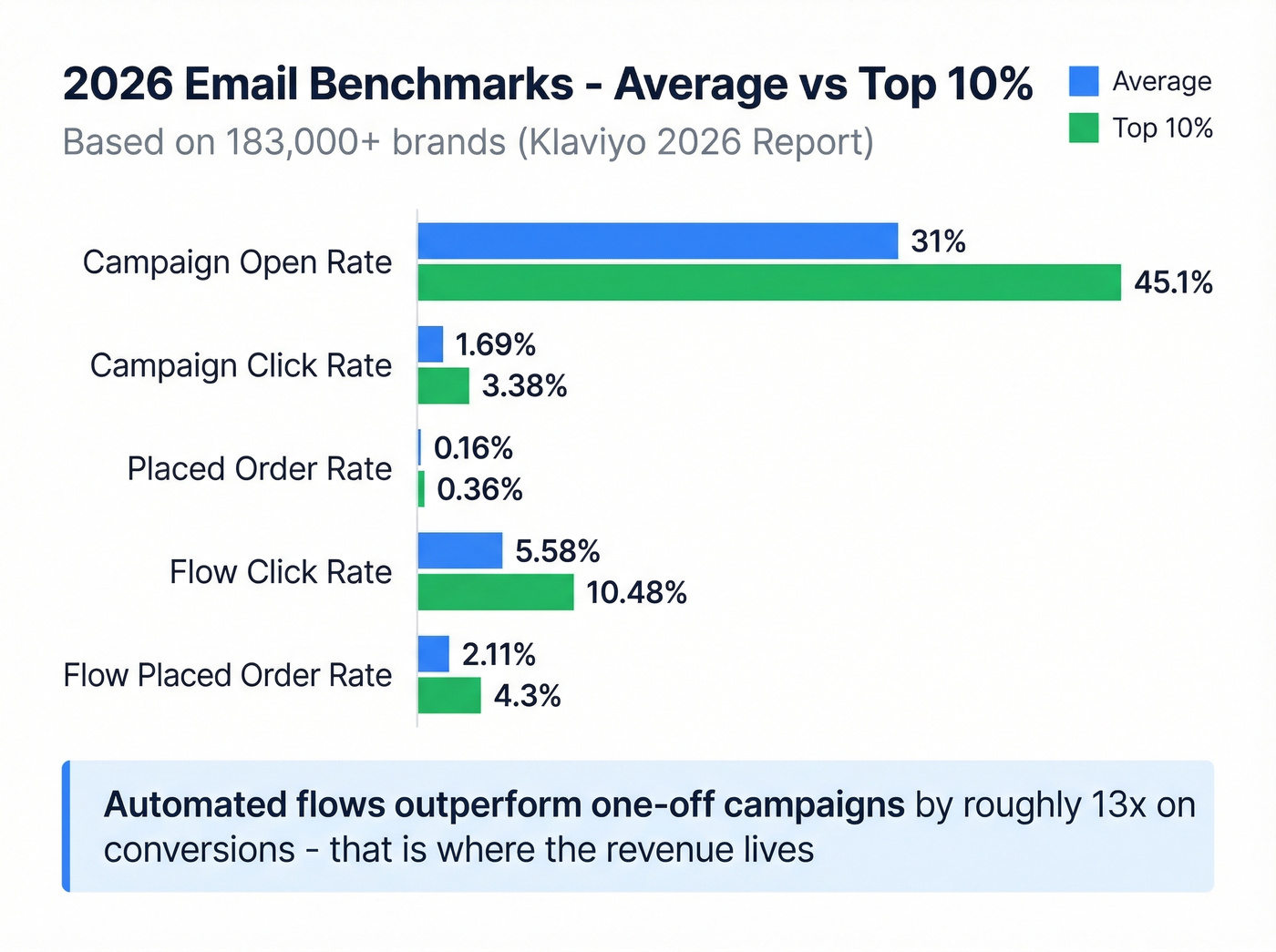
| Metric | Average | Top 10% |
|---|---|---|
| Campaign open rate | 31% | 45.1% |
| Campaign click rate | 1.69% | 3.38% |
| Placed order rate | 0.16% | 0.36% |
| Flow click rate | 5.58% | 10.48% |
| Flow placed order rate | 2.11% | 4.3% |
The gap between campaigns and automated flows is staggering. Automated flows outperform one-off campaigns by roughly 13x on conversion. Stop batch-and-blasting and invest in triggered sequences - welcome flows, abandoned cart, post-purchase. That's where the revenue lives.
One caveat: Apple's Mail Privacy Protection inflates open rates by pre-loading tracking pixels. Open rate is directionally useful but no longer precise. Click rate and conversion rate are the metrics that actually matter. For unsubscribe rate, Mailchimp's baseline of 0.22% across all industries is a reasonable benchmark - if you're consistently above that, you're over-sending or under-segmenting.
If you're diagnosing performance, it helps to track your email bounce rate alongside clicks and conversions.
How to Plan a Direct Mail Campaign
Define Your Audience
Set a measurable goal before you design anything. Leads generated, store visits, coupon redemptions, demo requests - pick one primary metric.
House lists pull 5-9% response rates. Prospect lists run 2-5%. EDDM (Every Door Direct Mail) saturates a geographic area without needing individual addresses - ideal for local businesses. About 56% of marketers use a mix of house and prospect lists. When you're scaling beyond your house list, lookalike modeling from first-party data is the most effective way to build a prospect list that converts.
The verticals that consistently see the best direct mail ROI are home services, healthcare, real estate, and restaurants - industries where the customer is local, the lifetime value is high, and the decision is often made by one person in the household.
If you're using mail to generate pipeline, this deeper guide on direct mail for lead generation is worth a read.
Pick Your Format and Offer
Format drives both cost and response rate:
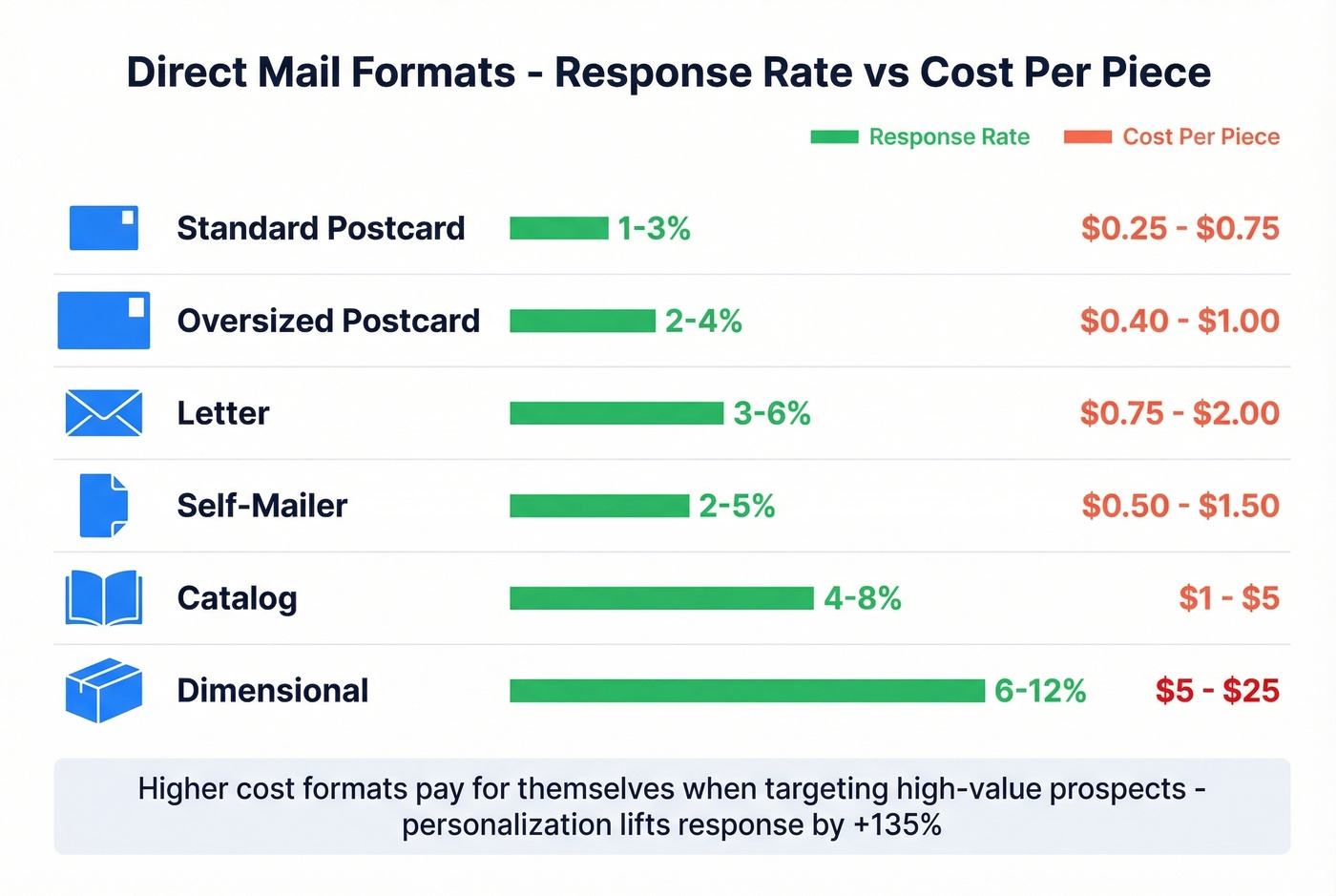
| Format | Response Rate | Cost/Piece |
|---|---|---|
| Standard postcard | 1-3% | $0.25-$0.75 |
| Oversized postcard | 2-4% | $0.40-$1.00 |
| Letter | 3-6% | $0.75-$2.00 |
| Self-mailer | 2-5% | $0.50-$1.50 |
| Catalog | 4-8% | $1-$5 |
| Dimensional | 6-12% | $5-$25 |
Lead with the benefit, not the product name. One clear CTA. Personalization lifts response by +135% - variable printing costs more but pays for itself quickly when your response rate doubles.
Print, Mail, and Track
Test one variable at a time. If you change the offer and the format simultaneously, you won't know which one moved the needle. 82% of marketers now use online tracking methods like QR codes and personalized URLs - up from 67% in 2022. If you're not tracking digitally, you're guessing.
Maintain suppression lists and honor opt-outs. Follow up fast - a postcard that arrives Monday should trigger a follow-up email by Wednesday, not two weeks later.
For cleaner attribution, set up a dedicated tracking domain for your campaign links and QR destinations.
Integrate with Digital Channels
Direct mail works best when it's not a standalone channel. We've seen teams treat it as a "brand awareness" play with no digital follow-up, and the results are always disappointing.
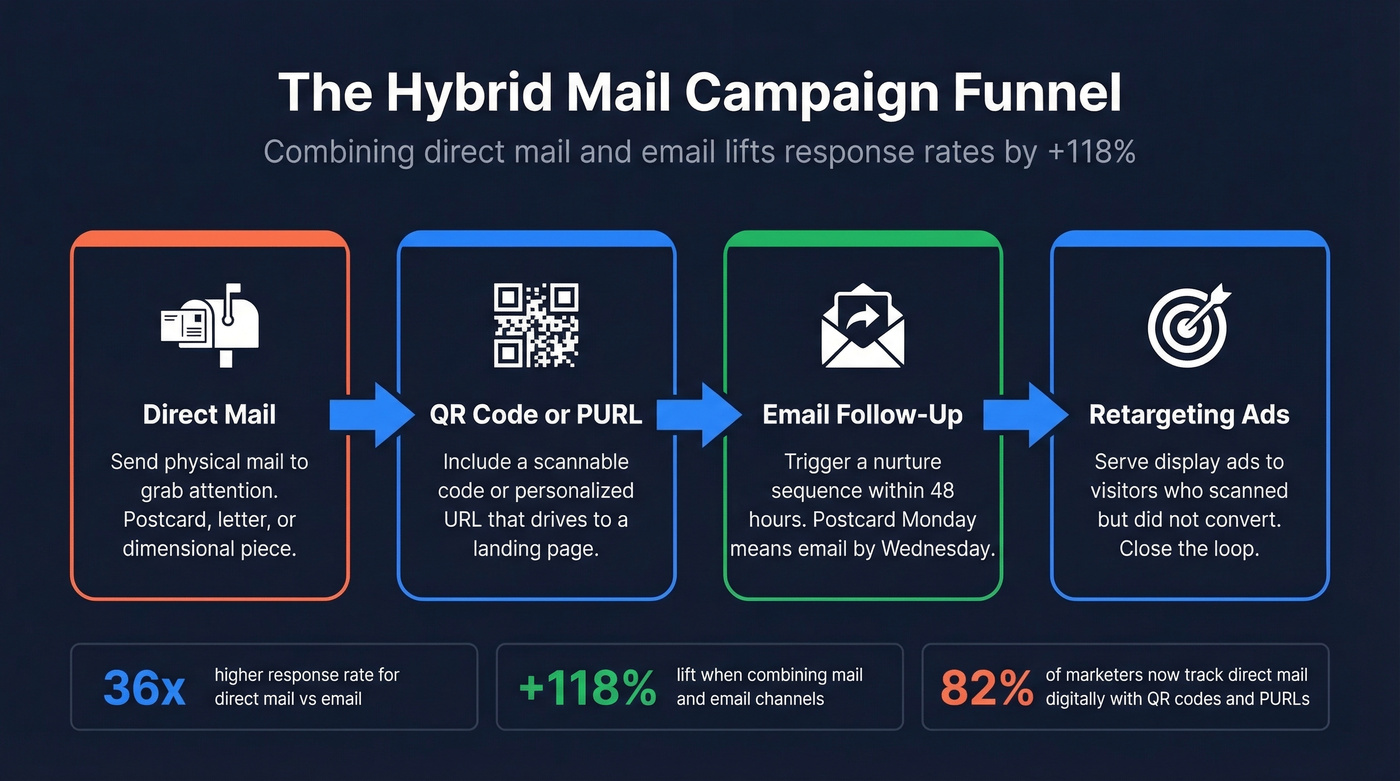
Let's be honest: a postcard sitting on someone's kitchen counter isn't going to close a deal by itself. The omnichannel sequence that consistently outperforms goes like this - physical mail for attention, email for follow-up, retargeting ads for reinforcement. USPS Informed Delivery adds another touchpoint where recipients preview incoming mail digitally before the physical piece arrives. Every piece of mail should drive to a trackable digital destination: a landing page, a QR code, a unique promo code. The physical piece opens the door. Digital closes it.
If you're building a full funnel, map your stages using an AIDA Sales Funnel framework so each touch has a job.
How Much Does a Mail Campaign Cost?
Email Costs
| Item | Cost |
|---|---|
| Platform (free plans or trials) | $0 to start |
| Platform (5K-50K contacts) | $20-$300/mo |
| Email verification | ~$0.01/email |
| Effective cost per send | $0.001-$0.01 |
Email is absurdly cheap at scale. The real cost isn't the platform - it's the time spent on list building, segmentation, and creative.
If you're scaling outbound, watch your email velocity so you don't spike complaints or bounces.
Direct Mail Costs
| Format | Postage (USPS) | Printing | All-In/Piece | 5,000-Piece Run |
|---|---|---|---|---|
| Postcard | $0.43 | $0.32-$0.45 | $0.55-$1.20 | $2,750-$6,000 |
| Letter | $0.43 | $0.32-$0.45 | $0.75-$1.75 | $3,750-$8,750 |
| Self-mailer | $0.43 | $0.32-$0.45 | $0.50-$1.50 | $2,500-$7,500 |
| EDDM postcard | $0.19 | $0.32-$0.45 | $0.51-$0.64 | $2,550-$3,200 |
Postage rates are based on USPS Marketing Mail automated rates. EDDM is the cheapest option at $0.19/piece for postage - no mailing list required, just pick your carrier routes.
The CPA Math That Matters
5,000 postcards at $0.90/piece = $4,500 total. At a 4.4% response rate, that's 220 responses. If 20% convert, you've got 44 new customers at a CPA of roughly $102.
Is that good? Depends entirely on your lifetime value. If customer LTV is $1,500, that's a 14:1 return. The $2,500 quote from that Reddit thread? Probably reasonable - if your LTV supports it. For teams selling $30 products with no repeat purchase, direct mail math gets ugly fast.
If you want to pressure-test your economics, start with a clean cost to acquire customer model.
Common Mistakes That Kill Campaigns
Most failures aren't creative failures - they're list failures. Here are the five that kill the most campaigns:
Sending to stale or unverified lists. For email, bounces tank your sender reputation and can get your domain blacklisted. For direct mail, roughly 5% of addresses go undeliverable due to moves and closures - that's 2,500 wasted pieces on a 50,000-piece run.
No tracking or attribution. No QR codes on your mail pieces, no UTM parameters on your email links. If you can't measure it, you can't improve it - and you can't justify the budget next quarter.
One-and-done sends. Follow-up sequences outperform single touches every time. One postcard or one email isn't a campaign. It's a hope.
Skipping authentication. SPF/DKIM/DMARC for email isn't a nice-to-have. Without them, your emails go to spam.
Optimizing creative before fixing targeting. A mediocre postcard to the right 5,000 people beats a beautiful postcard to 50,000 random addresses. Fix the list first, then worry about the design.
FAQ
How often should I send email campaigns?
Most B2B brands see the best results at 1-2 sends per week; B2C can push higher with strong segmentation. Watch your unsubscribe rate closely - if it consistently exceeds 0.3%, you're over-sending and training subscribers to leave.
What's a good response rate for direct mail?
The average direct mail response rate is 4.4%. House lists typically hit 5-9%, while prospect lists run 2-5%. If you're below 2.5%, your targeting or offer needs work - not your design.
Is direct mail or email better for ROI?
Direct mail to house lists returns 161% ROI vs. 44% for email on a per-piece basis. But email costs a fraction of a cent per send, making it far more scalable - and capable of generating up to 3,600% ROI at volume. The best approach uses both: mail for attention, email for follow-up and nurture.
How do I track direct mail results?
QR codes and PURLs (personalized URLs) are the standard - 82% of marketers now use online tracking for direct mail. Unique promo codes and dedicated phone numbers also work. The key is assigning every piece a trackable action so you can tie responses back to the campaign.
What's the best free tool for email list verification?
Prospeo's free tier includes 75 email verifications per month with full 5-step verification - spam-trap removal, honeypot filtering, and catch-all handling at 98% accuracy. For small lists, that's enough to clean a segment before every send without paying a cent.