


Mail Rocket vs Apollo.io: You're Comparing a Bicycle to a Freight Truck
These two tools don't even share a category. Mail Rocket is a $9/month Gmail add-on. Apollo.io is a $49+/user/month sales engagement platform with a built-in contact database, multi-channel sequences, and a credit system. People keep confusing Mail Rocket with RocketReach, which muddies the comparison further - so let's sort it out properly.
Why This Comparison Doesn't Work
Search "Mail Rocket vs Apollo" and you'll mostly get results for RocketReach vs Apollo - a completely different product. Comparison pages on Capterra and G2 do the same thing.
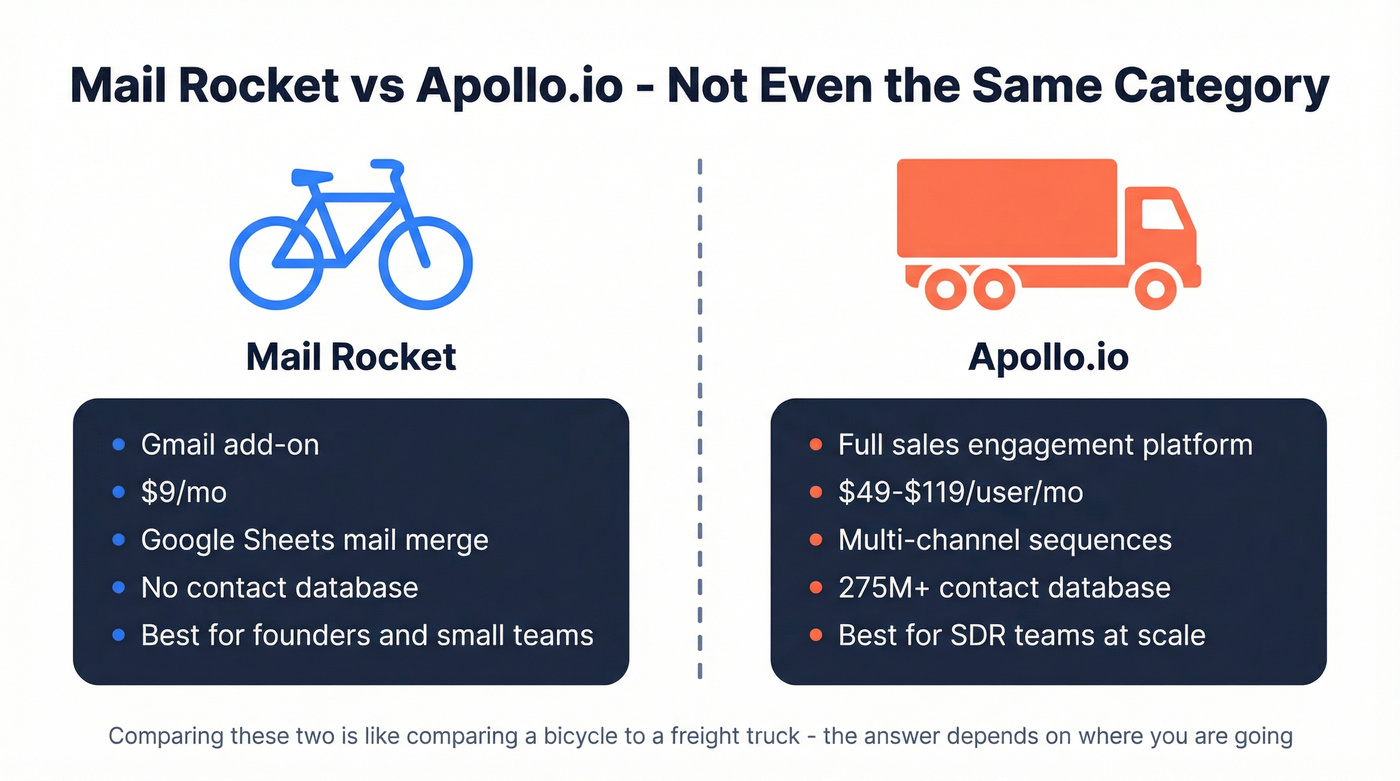
Here's the thing: Mail Rocket is a Google Sheets add-on that sends personalized emails from your Gmail inbox. Apollo.io is a full GTM platform with a 275M+ contact database and multichannel sequencing. Asking which one you need is like asking whether you need a bicycle or a freight truck - the answer depends entirely on where you're going and how much you're hauling.
The 30-Second Verdict
Use Mail Rocket if you're sending fewer than 500 personalized emails a day from Gmail and want a dead-simple $9/month add-on.
Use Apollo.io if you need a sales engagement platform with built-in data, multi-step sequences, and multichannel outreach for an SDR team (see our roundup of SDR tools).
Skip both if your real problem is finding accurate contact data. Neither tool solves that well. Prospeo gives you 98%-accurate verified emails at ~$0.01 each - then plug them into whatever sender you prefer.
Feature Comparison at a Glance
| Mail Rocket | Apollo.io | |
|---|---|---|
| Category | Gmail mail merge add-on | Sales engagement platform |
| Price | $9/mo (or $199 lifetime) | $49-$119/user/mo (annual) |
| Sending limit | Gmail quotas (500/day @gmail.com; 2,000/day Google Workspace) | ~50 emails/day per mailbox recommended |
| Contact database | None - bring your own list | Built-in (275M+ contacts) |
| Deliverability | Gmail-native sending | Platform sequencer + warmup options |
| Best for | Founders, small teams | SDR teams at scale |
For inbox placement, Gmail-native sending can help at low volume, especially when you've recently emailed the recipient directly. At scale, dedicated cold email senders like Instantly or SmartLead typically beat both - and that's a common operator takeaway in r/coldemail. If you're trying to stay under safe limits, email velocity matters more than most people think.


Mail Rocket has no database. Apollo's database has 500+ 'inaccurate data' flags on G2. Prospeo gives you 300M+ profiles with 98% email accuracy - verified through a 5-step process and refreshed every 7 days. At ~$0.01 per email, plug clean data into whatever sender you already use.
Stop debating senders. Fix the data that feeds them.
What Is Mail Rocket?
Mail Rocket is a Google Sheets add-on that turns your spreadsheet into a mail merge engine for Gmail. You build your contact list in Sheets, write your email with dynamic variables, and Mail Rocket sends personalized messages directly from your Gmail account. Setup takes about five minutes.
What works:
- Native Gmail + Google Sheets integration - genuinely easy to set up
- Batched sending with delays to avoid triggering spam filters (more on email deliverability)
- Open/click tracking, scheduling, personalized attachments
- Hard-to-beat pricing: $9/month, $49/year, or a $199 lifetime deal
- Gmail-native sending can help messages land in Primary rather than Promotions
What doesn't:
- AppSumo reviews paint a rough picture - 2.3/5 from 3 reviews, with one user reporting "90% of recipients mention the emails go straight to spam"
- Another user reported activating the lifetime deal but the account still showing as free, a billing issue that hasn't been publicly resolved
- No contact database whatsoever - you source your own list
- Sends from your primary Gmail, so spam complaints damage your domain reputation directly (see how to improve sender reputation)
Mail Rocket's own site claims 4.9/5 from 60+ reviews, but those numbers don't appear on any third-party platform we could find. For a founder sending 200 personalized emails from a Google Sheet, it's functional. For cold outreach at scale, it's a risk to your domain.
What Is Apollo.io?
Apollo.io is an AI-powered sales engagement platform with a 4.7/5 rating from 9,500+ G2 reviews. It combines a massive contact database with multi-step, multichannel sequences - email, calls, tasks - plus timing controls and CRM integrations. For SDR teams running structured outbound, the workflow integration saves real time, and the free tier is generous enough to test properly.
The tradeoffs are real, though.
Sticker price is $49-$119/user/month on annual plans, but real costs run $150-$400/user/month for heavy teams once you factor in credit overages and add-ons. Phone number credits cost 8x email credits, and overages run $0.20 each with a 250-credit minimum purchase. "Inaccurate Data" is one of the most common negative tags on G2 - over 500 reviews flag it. Reddit's r/coldemail is full of practitioners saying Apollo "sucks" for deliverability compared to Instantly or SmartLead, and the recommended sending limit is just 50 emails/day per mailbox, meaning you need multiple mailboxes for real volume.
Our take: Apollo is the obvious choice if you need a full platform. But most teams don't need a full platform. They need accurate data and a good sender - and Apollo isn't the best at either of those things individually. It's a decent everything-in-one that excels at nothing in particular. If you're evaluating data quality specifically, start with data enrichment services and a dedicated verifier.
Which Tool Fits Your Workflow?
The answer almost always comes down to three scenarios.
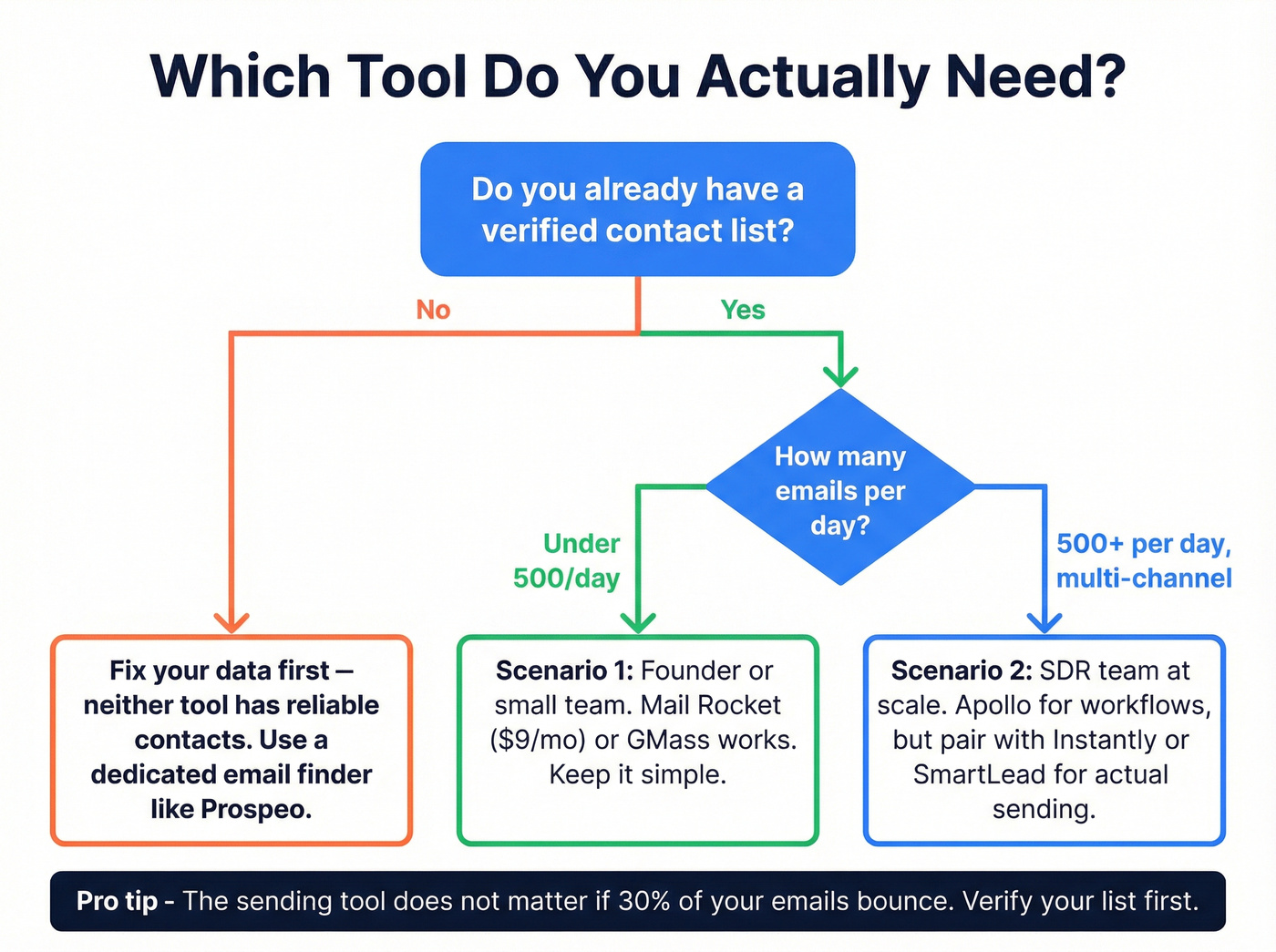
Scenario 1: Founder or small team, 200 prospects in a Google Sheet. Mail Rocket works here, but GMass or YAMM are often safer bets with larger user bases and longer deliverability track records. We've seen too many solo founders torch their primary domain with untested Gmail add-ons.
Scenario 2: SDR team running multichannel sequences at scale. Apollo is the right category. Pair it with Instantly or SmartLead for the actual sending - experienced operators consistently prefer dedicated senders for deliverability. If you're building repeatable outbound, sequence management becomes the real lever.
Scenario 3: You need accurate contact data before you can send anything. Neither tool solves this well. Mail Rocket has zero database. Apollo's database gets 500+ "inaccurate data" complaints on G2. You need a data layer first - and that's a separate decision from your sending tool. Also worth noting: Apollo is SOC 2 compliant, but check regional data handling if you're targeting EU prospects. GDPR compliance matters more than most teams realize (and so does is it illegal to buy email lists).
Fix Your Data First
The sending tool doesn't matter if your list is garbage.
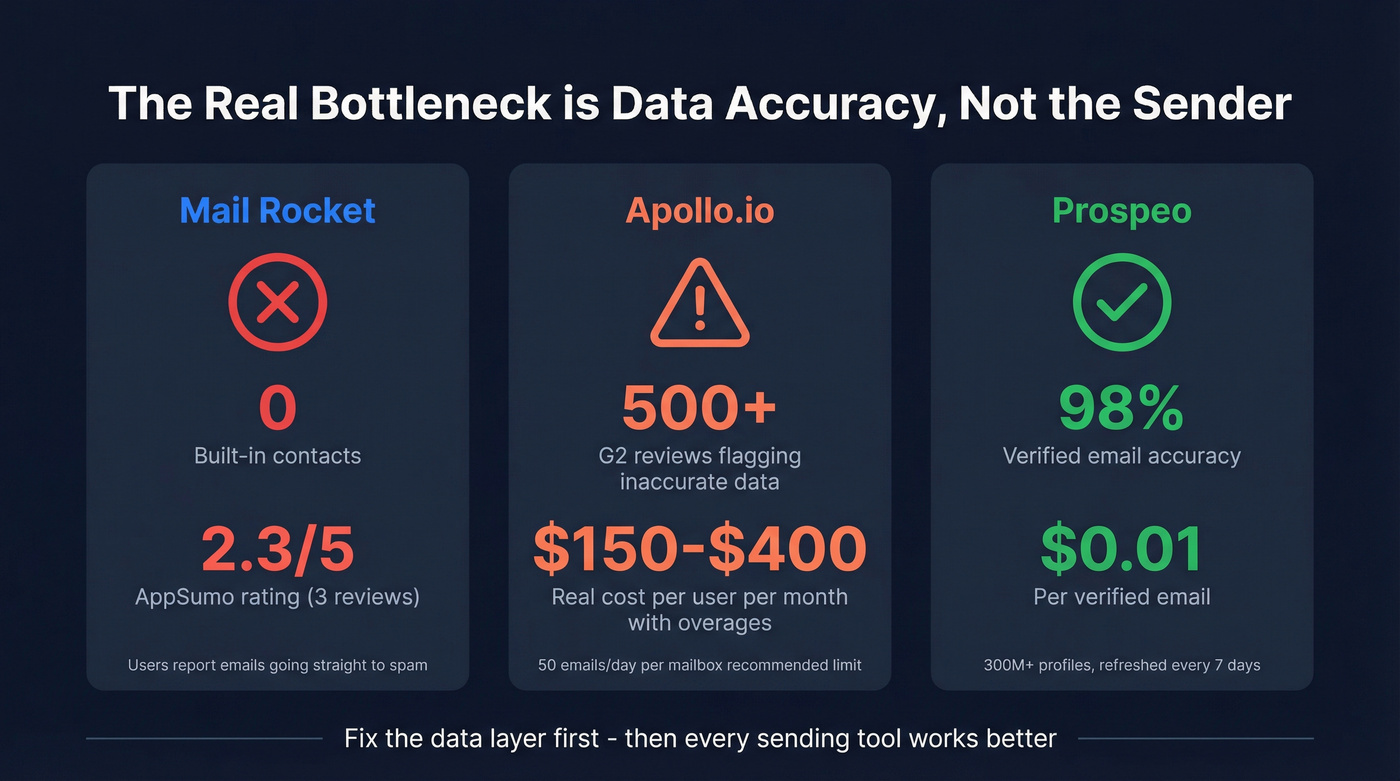
Mail Rocket requires you to bring your own contacts. Apollo gives you a database, but its accuracy issues are well-documented across G2 and Reddit. In our experience testing both, the data accuracy gap is the real bottleneck - not the sending platform. We've watched teams spend weeks optimizing subject lines and send schedules when the actual problem was 30% of their emails bouncing. If you're diagnosing that, start with email bounce rate benchmarks and fixes.
Teams using Prospeo book 35% more meetings than Apollo users - not because of better sequences, but because 98% of their emails actually reach real inboxes. No built-in sender to lock you in. Just verified contacts you export to Mail Rocket, Instantly, SmartLead, or whatever you prefer.
Get the data layer right and every sending tool works better.
FAQ
Is Mail Rocket the same as RocketReach?
No. Mail Rocket is a $9/month Gmail mail merge add-on built on Google Sheets. RocketReach is a $49/month B2B contact database and email finder. They share the word "Rocket," but they're completely different products in different categories.
Can Apollo.io replace a Gmail mail merge tool?
Technically yes - Apollo has email sequences. But it's overkill at $49+/user/month if you just need personalized Gmail sends. Its recommended limit is 50 emails/day per mailbox, and r/coldemail users regularly prefer dedicated sending tools at higher volumes. A $9/month Gmail add-on does the job for simple campaigns.
Is Mail Rocket safe for cold email?
Risky. It sends through your personal Gmail, so spam complaints damage your primary domain. AppSumo reviewers report emails landing in spam. For cold outreach, use separate domains with a dedicated sender like Instantly or SmartLead - and verify your list first to keep bounce rates under 3%.