

The 15 Best Marketing Intelligence Tools for 2026
Every "marketing intelligence tools" list is broken the same way. They lump competitive intelligence platforms next to BI dashboards next to social listening tools, rank them 1-15 as if they're interchangeable, and call it a day. You end up comparing Crayon to Tableau like they solve the same problem. They don't.
We've organized this by function, included real pricing, and flagged the trade-offs nobody else mentions.
Our Picks (TL;DR)
| Best for | Tool | Why | Starting Price |
|---|---|---|---|
| B2B prospect data | Prospeo | 98% email accuracy, 7-day refresh | Free (75 emails/mo) |
| Competitive enablement | Crayon | Battlecards + win/loss | ~$28,750/yr median |
| Digital/SEO intelligence | Semrush | Keywords, traffic estimates, PPC intel | $139.95/mo |
| Data centralization | Improvado | 500+ connectors, enterprise | ~$20K-$100K+/yr |
| Free BI layer | Looker Studio | Dashboards at $0 | Free |
Now let's unpack what marketing intelligence actually means, why the categories matter, and which tools earn your budget.
What Marketing Intelligence Actually Means
Marketing intelligence means everything and nothing. Vendors use it to describe keyword tracking, CRM enrichment, social sentiment analysis, and a dozen other things. That's useless when you're trying to build a stack.
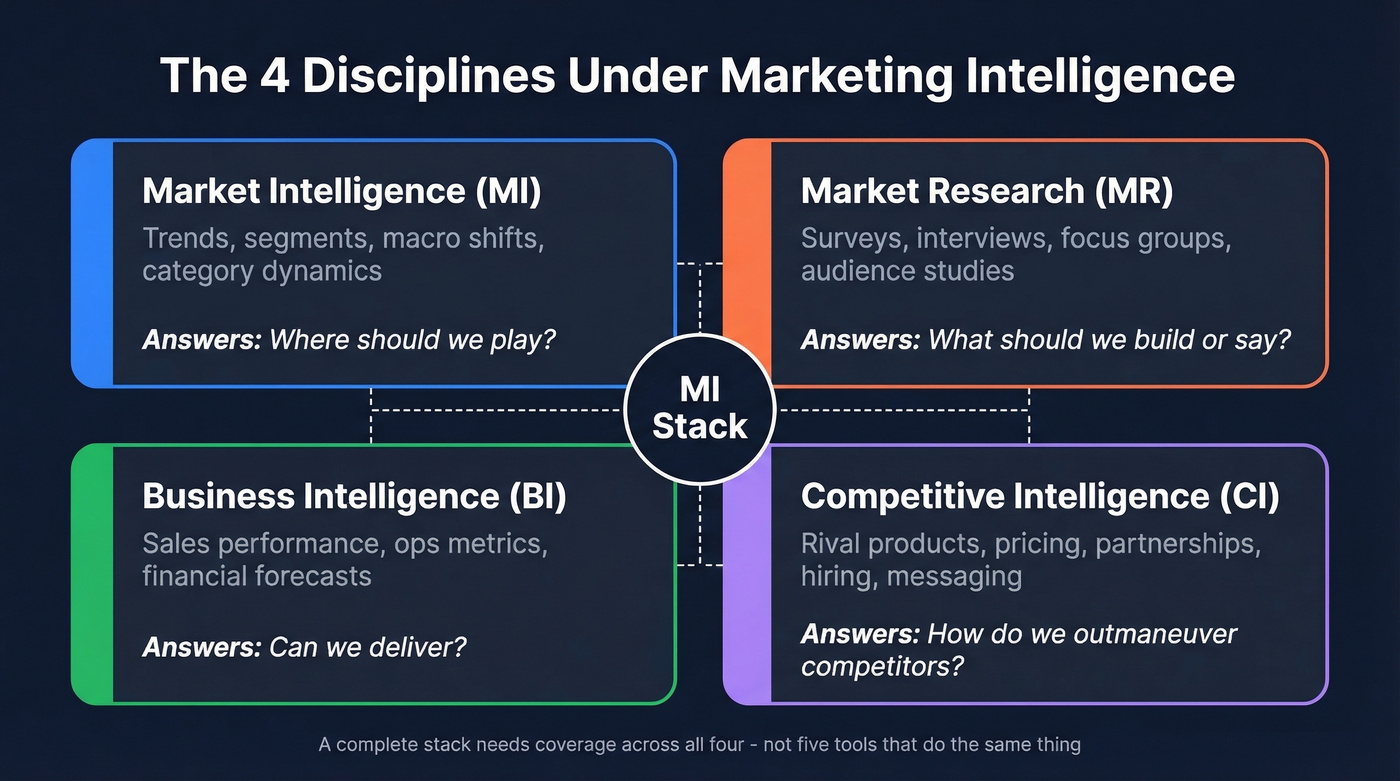
Here's a cleaner framework: four distinct disciplines get conflated under the MI umbrella.
- Market Intelligence (MI): The 360-degree view of your external market - trends, customer segments, macro shifts, category dynamics. MI answers "where should we play?"
- Market Research (MR): Targeted, primary research on a specific audience through surveys, interviews, and focus groups. MR answers "what should we build or say?"
- Business Intelligence (BI): Continuous analysis of internal data - sales performance, operational metrics, financial forecasts. BI answers "can we deliver?"
- Competitive Intelligence (CI): Systematic tracking of rivals - products, pricing, partnerships, hiring, messaging. CI answers "how do we outmaneuver competitors?"
Why does this matter practically? Sellers face competitors in 68% of their deals, and CI gaps alone cost companies $2M-$10M/year in winnable deals left on the table. The CI tools market is projected to hit $1.46B by 2030, and the broader alternative data market is on track to reach $42.3B by 2032 - a signal of how aggressively enterprises are investing in non-traditional intelligence sources.
Marketing teams that lack intelligence don't just miss insights. They lose revenue to competitors who have it.
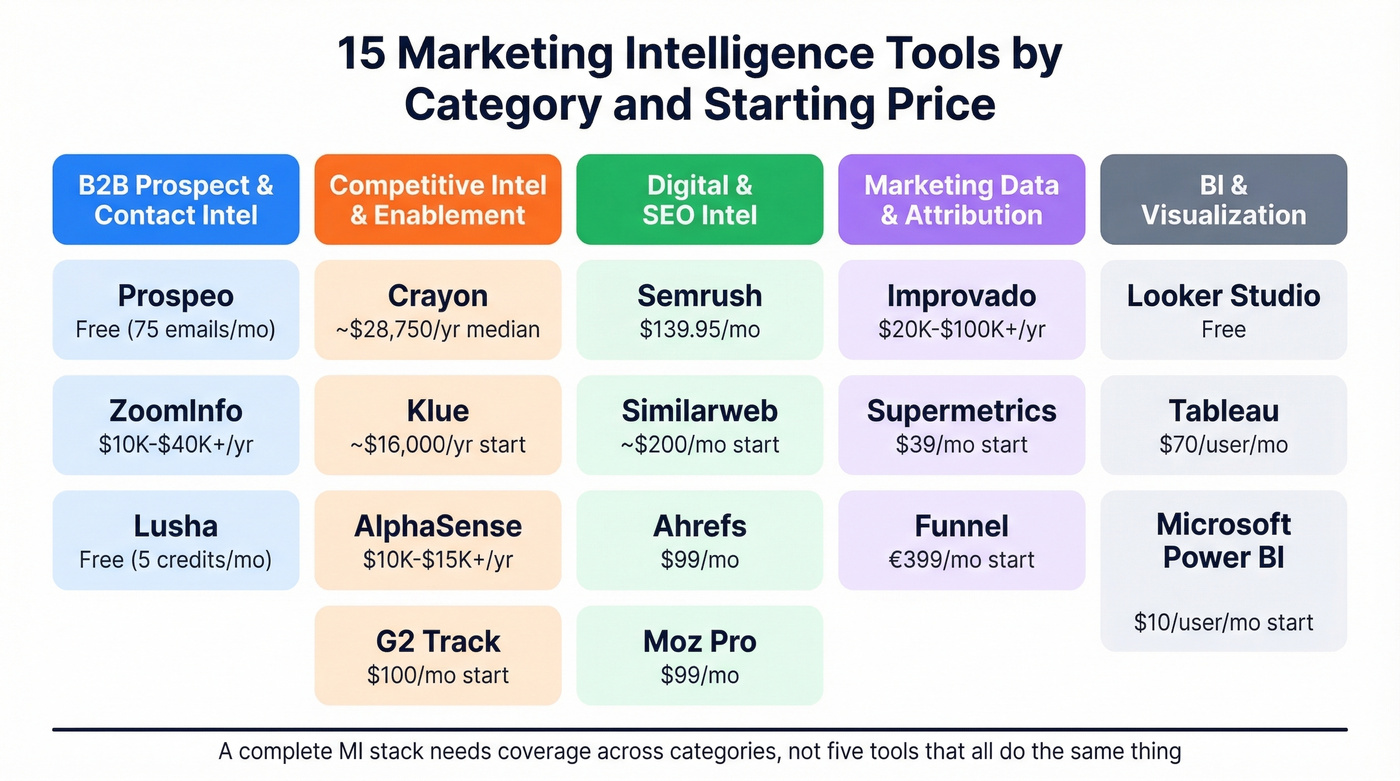
The 15 tools below span all four quadrants. A complete MI stack needs coverage across categories, not five tools that all do the same thing.
How to Choose the Right Platform
Before you evaluate any tool, know what you're solving for. Seven non-negotiables:
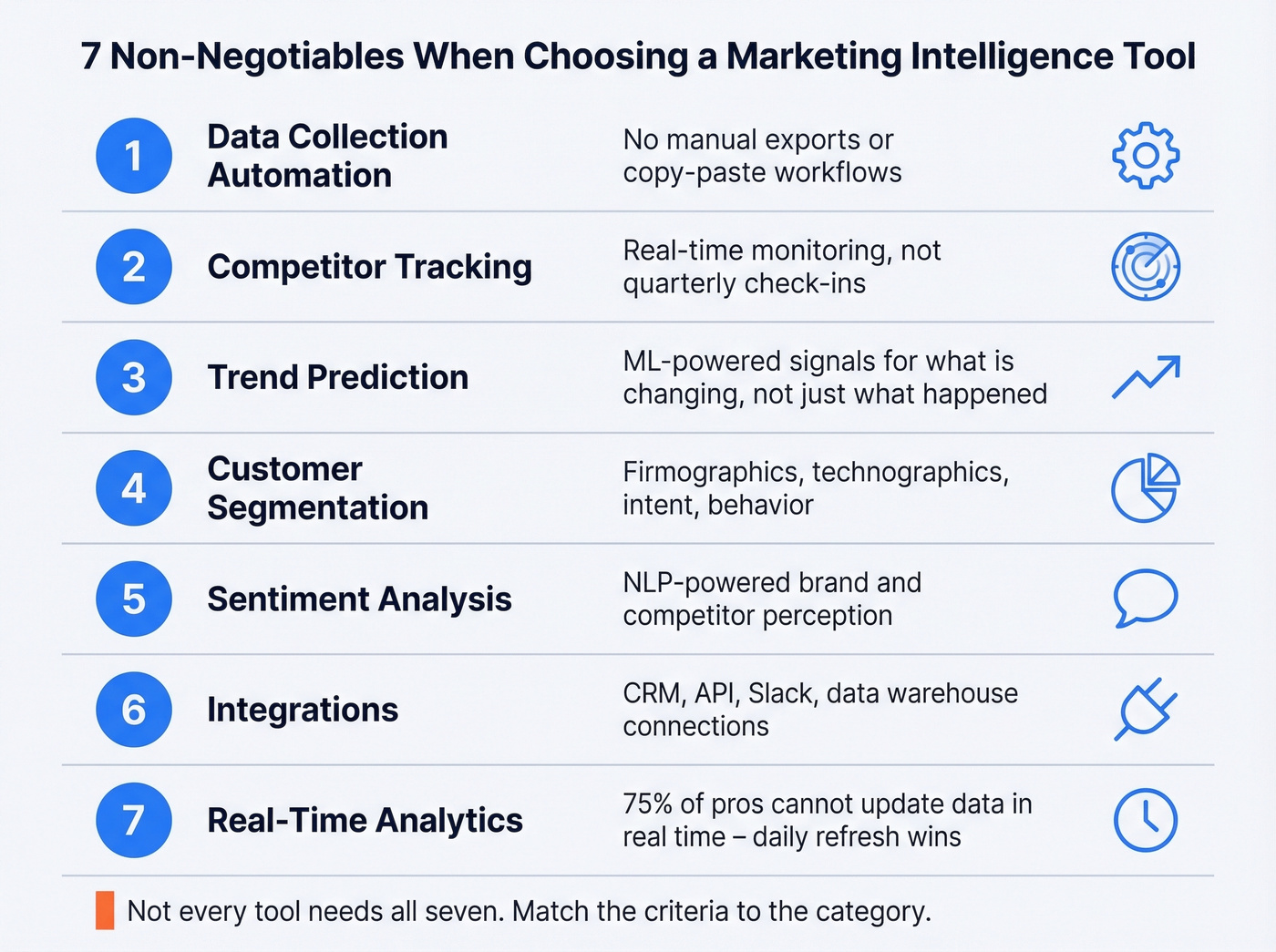
- Data collection automation - Can it pull data without manual exports and copy-paste workflows? If your team spends hours compiling reports, the tool isn't doing its job.
- Competitor tracking - Does it monitor competitor moves in real time, or are you relying on quarterly check-ins?
- Trend prediction - ML-powered trend identification separates intelligence from reporting. Look for tools that surface what's changing, not just what happened.
- Customer segmentation - Can you slice your market by firmographics, technographics, intent signals, or behavior?
- Sentiment analysis - NLP-powered analysis of how your brand and competitors are perceived across channels.
- Integrations - CRM, API, Slack, and data warehouse connections. A tool that doesn't plug into your stack creates another silo.
- Real-time analytics - 75% of procurement professionals can't update data in real time. Tools with daily or weekly refresh cycles have a structural advantage.
Not every tool needs all seven. A BI dashboard doesn't need sentiment analysis. A social listening tool doesn't need CRM enrichment. Match the criteria to the category.

Marketing intelligence tools identify the right targets. But intelligence without accurate contact data is just a report no one acts on. Prospeo bridges that gap with 300M+ profiles, 98% email accuracy, and 30+ filters including buyer intent across 15,000 topics - refreshed every 7 days, not 6 weeks.
Turn your market intelligence into booked meetings, not bounced emails.
The 15 Best Tools by Category
B2B Prospect & Contact Intelligence
Your intelligence is only useful if you can reach the people it identifies. These tools close the gap between knowing your market and contacting it.
Prospeo
Prospeo's database covers 300M+ professional profiles, 143M+ verified emails, and 125M+ verified mobile numbers. The 98% email accuracy rate comes from a proprietary 5-step verification process with catch-all handling, spam-trap removal, and honeypot filtering. Data refreshes every 7 days - the industry average is 6 weeks, which means most databases are serving you contacts who've already changed jobs.

The 30+ search filters go beyond basic firmographics: buyer intent across 15,000 Bombora-powered topics, technographics, job changes, headcount growth, funding signals, and department-level headcount. The Chrome extension has 40K+ users for on-the-fly prospecting from any website.
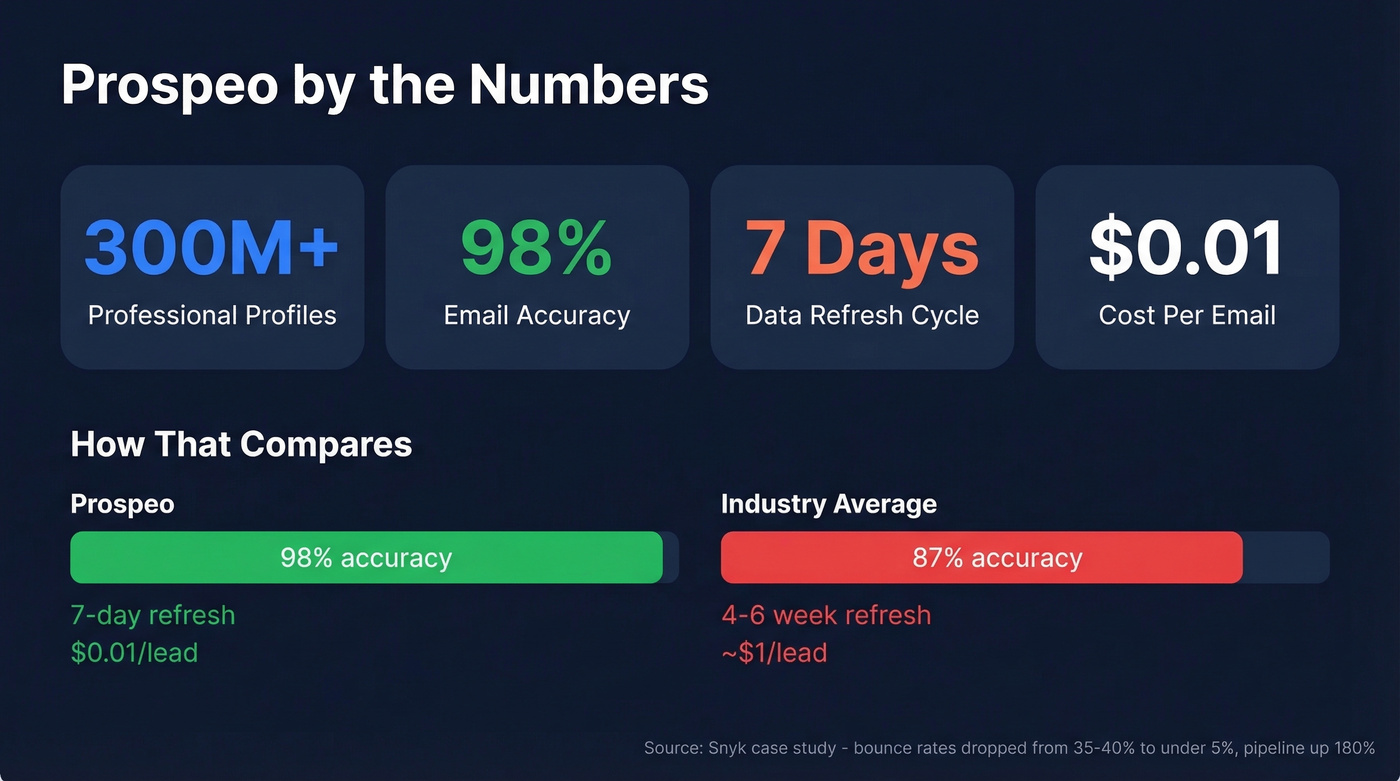
Real-world proof: Snyk's 50 AEs saw bounce rates drop from 35-40% to under 5%, with AE-sourced pipeline up 180% and 200+ new opportunities per month. Pricing starts at $0/month with 75 free emails, scaling to roughly $0.01/email. No contracts, no sales calls required. If you need built-in email sequences and a dialer, pair Prospeo with a sequencer - it handles the data, your sequencer handles the outreach.
ZoomInfo
Use this if: You're a large sales org that needs a single platform for data, intent, engagement, and workflow automation - and you have the budget.
Skip this if: You're a lean team that just needs accurate contact data without paying for modules you won't use.
ZoomInfo is the enterprise default for B2B data, and it earns that position with database breadth and workflow depth. But the pricing reflects it: expect $10,000-$40,000+/year with annual contracts required. The accuracy gap is real - 87% email accuracy vs. 98% from top competitors, and a 4-6 week refresh cycle vs. 7 days. At roughly $1/lead vs. $0.01/lead, ZoomInfo makes sense when you need the full GTM suite. For contact data alone, it's expensive overkill.
If you're comparing providers, start with a shortlist of B2B company data providers and validate how each one handles refresh cycles and verification.
Competitive Intelligence & Enablement
Crayon
Use this if: You have 5+ competitors and a sales team that needs battlecards, win/loss analysis, and competitive alerts flowing into their workflow.
Skip this if: You're a small team tracking 1-2 competitors - a shared doc and Google Alerts will get you 80% of the way there.
Crayon follows a clean Monitor, Aggregate, Analyze, Distribute workflow. It pulls competitor signals like pricing changes, messaging shifts, product launches, and hiring patterns, then packages them into battlecards that live inside your CRM and Slack. The ROI case is strong: 71% of businesses using battlecards report improved win rates, and 93% of those report increases over 20%.

Pricing runs a median of $28,750/year based on 90 purchases tracked by Vendr, with a range of $15,000-$100,000+/year depending on competitors tracked, seats, and tier. Add-ons for integrations, dedicated CS, and professional services can tack on 15-30% more.
If you're building a program around this, use a documented competitive intelligence strategy so the tool doesn't become shelfware.
Klue
Klue is the tool that keeps coming up in B2B marketing forums when people ask for a Crayon alternative - and the appeal is obvious. The UX is genuinely cleaner, the modular pricing with separate CI and Win-Loss modules lets you adopt incrementally, and the starting price of ~$16,000/year is more accessible. Users consistently praise how it "shows up within the workflow." Klue's Compete Agent delivers a 28% win-rate improvement against top competitors. The historical knock - battlecards falling behind on updates - has been addressed, but Crayon still has the edge for the deepest battlecard ecosystem and the most mature competitive analytics.
To operationalize battlecards, align them with your sales battle cards process (ownership, update cadence, and distribution).
AlphaSense
Who actually uses this: 85% of S&P 100 companies, plus strategy teams, M&A groups, and investor relations departments that need deep research intelligence across filings, earnings calls, and research documents.
AlphaSense's $930M acquisition of Tegus cemented its position as the enterprise strategic intelligence platform. Pricing starts around $10,000-$15,000+/year. This isn't a tool for your marketing team's daily workflow - it's for the executive team making market-entry decisions and the strategy team running competitive landscape analyses. If you need real-time competitive alerts for sales enablement, look at Crayon or Klue instead.
Digital & SEO Intelligence
Semrush
Semrush starts at $139.95/month and delivers daily keyword data updates - a meaningful advantage over tools with monthly refresh cycles. The platform covers SEO audits, PPC competitor analysis, content gap identification, and backlink monitoring. It's the default for content and SEO-driven marketing teams, and for good reason.
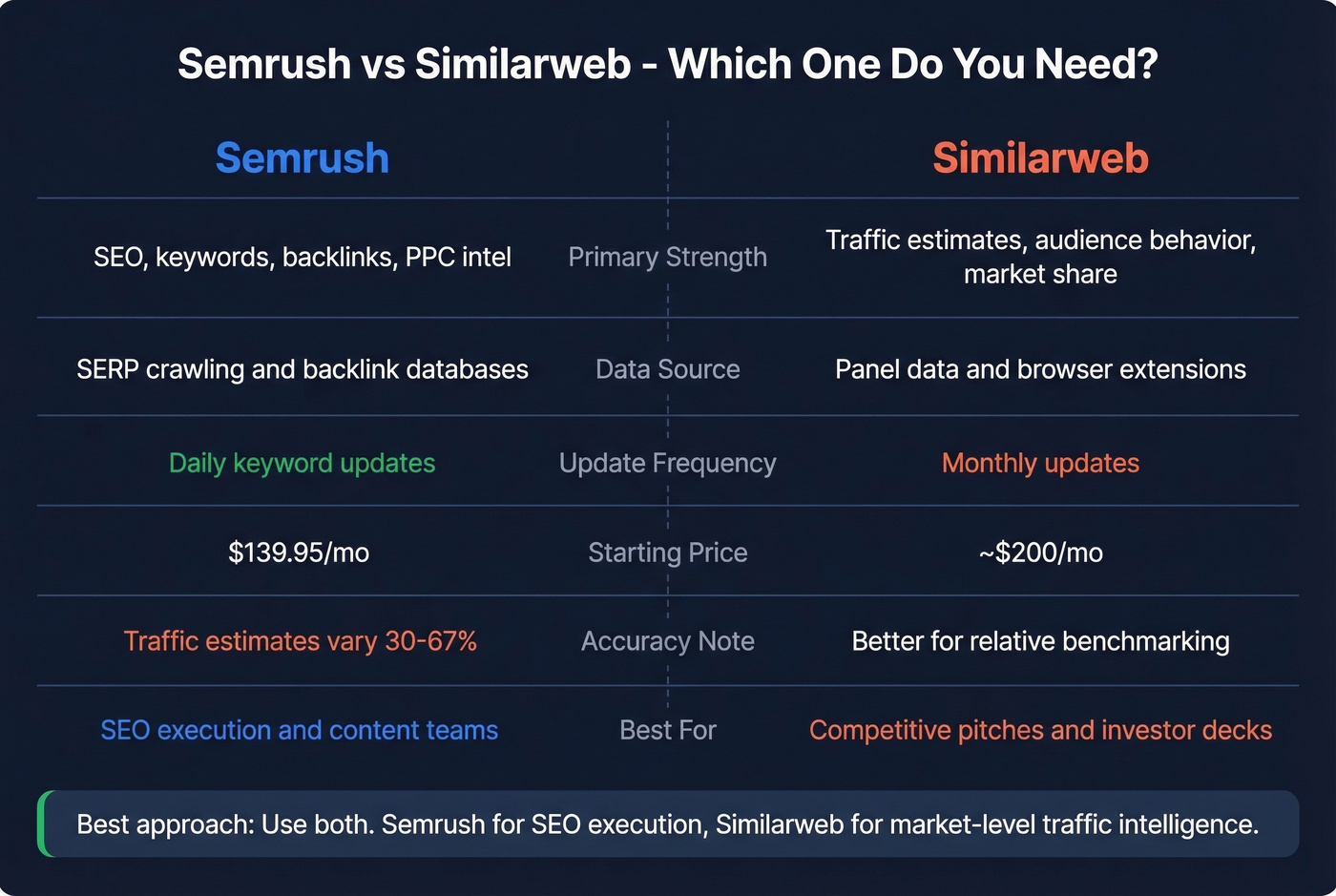
The accuracy caveat matters though. Traffic estimates can vary 30-45% for high-traffic sites and up to 67% for smaller sites. Use Semrush for benchmarking trends and competitive positioning, not for reporting absolute numbers to your board. If your marketing team runs on SEO, content, and PPC, this is table stakes. If you need accurate absolute traffic numbers, keep reading.
Similarweb
Similarweb and Semrush get compared constantly, but they solve different problems. Similarweb uses panel data and browser extensions for traffic and audience behavior analysis. Semrush crawls SERPs and backlink databases for SEO performance. For traffic benchmarking, audience overlap analysis, and market share data - especially for competitive pitches and investor decks - Similarweb wins. For deep SEO and keyword intelligence, that's Semrush's territory.
Pricing typically starts around $200/month, with team and enterprise plans running $10,000-$35,000+/year. The trade-off: monthly updates vs. Semrush's daily cadence. In our experience, the best approach is using both - Semrush for SEO execution, Similarweb for market-level traffic intelligence.
Marketing Data & Attribution
Improvado
500+ pre-built connectors. Three tiers by annual data volume - Growth at 200M rows/year, Advanced at 600M rows/year, Enterprise at 1B rows/year. Sync frequency scales from 4x daily up to hourly at the enterprise tier. SOC 2 Type II, HIPAA, GDPR, and CCPA compliance for regulated industries.
No public dollar pricing - expect ~$20,000-$100,000+/year depending on volume and services. Improvado's AI Agent automates up to 99.5% of analytics routines, saving roughly 30 hours per week. That's ambitious, but even half that number justifies the investment for teams currently stitching together data manually. If you're running fewer than 10 data sources, the complexity and cost aren't justified. For teams pulling from dozens of ad platforms, CRMs, and analytics tools, it's the most capable marketing data pipeline available.
If you're measuring impact end-to-end, define your funnel metrics before you centralize data.
Funnel
Funnel removed its free plan and its pricing calculator in 2026, forcing everyone into "book a demo" flows. The r/PPC community wasn't happy about it. Starter is around $200/month now, down from ~$400/month previously. Connector counts scale from 121 at Starter to 579 at mid-tier to 590 at Enterprise. The product itself is solid for data normalization and pipeline automation - mid-market teams that need clean data pipelines from ad platforms to their warehouse will find real value here. The buying experience has gotten worse.
SegmentStream
AI-powered attribution and media mix modeling for teams spending $50K+/month on ads. Starts at $5,000/month. SegmentStream uses server-side modeling to reconstruct conversions that cookie-based tracking misses, closing the loop from dashboards to actual media optimization decisions. Useful if you've outgrown last-click attribution but aren't ready for a full MMM consultancy - particularly for e-commerce and lead-gen teams where every channel claims credit for the same conversion.
Social Listening & Consumer Intelligence
Brandwatch
Use this if: You're a brand-heavy company that needs NLP-powered sentiment analysis across social, news, forums, and review sites.
Skip this if: You just need basic social media scheduling and reporting. Brandwatch is overkill for that.
Brandwatch runs three modules: Consumer Intelligence, Social Media Management, and Influencer Marketing. Custom pricing, typically $800-$3,000+/month for mid-market teams. The Consumer Intelligence module is where the real value lives - NLP-powered sentiment tracking across millions of online sources. It's the category leader for a reason, though the price tag means it's hard to justify unless brand perception directly impacts your revenue.
Sprout Social
From $199/seat/month. Social media management, listening, and analytics in one platform. Best for teams that want social intelligence baked into their publishing workflow without buying a separate tool like Brandwatch.
BuzzSumo
From $199/month. Content performance and trending topic intelligence across social channels. Best for content marketers who need to know what's resonating in their niche before they write, not after.
BI & Visualization
Tableau
From $75/user/month for a Creator license. Enterprise-grade visualization with the deepest customization options. Best for teams with dedicated analysts who need complex, interactive dashboards. Overkill if you just need to visualize marketing spend.
Power BI
From $14/user/month. The budget BI option that integrates natively with the Microsoft ecosystem. If your org runs on Excel, SharePoint, and Teams, Power BI is the path of least resistance.
Looker Studio
Free, with Pro from $9/user/project/month. Google ecosystem native - connects directly to Google Ads, GA4, BigQuery, and Sheets. Best for teams already on Google's stack who need dashboards without adding another line item.
If you're standardizing reporting, it helps to map dashboards to your lead generation metrics so teams don't optimize the wrong numbers.
2026 Pricing Breakdown
This is the pricing table the SERP won't give you. Use it to shortlist before committing to demos.
| Tool | Category | Starting Price | Model |
|---|---|---|---|
| Prospeo | B2B Data | Free (75 emails/mo) | Credits, ~$0.01/email |
| ZoomInfo | B2B Data | ~$10K/yr | Annual contract |
| Crayon | CI/Enablement | ~$28,750/yr median | Annual contract |
| Klue | CI/Enablement | ~$16K/yr | Annual, modular |
| AlphaSense | Strategic Intel | ~$10K/yr | Annual contract |
| Semrush | Digital/SEO | $139.95/mo | Monthly/annual |
| Similarweb | Digital/SEO | ~$200/mo | Monthly/annual |
| Improvado | Data Pipeline | ~$20K-$100K+/yr | Volume-based |
| Funnel | Data Pipeline | ~$200/mo | Tiered, opaque |
| SegmentStream | Attribution | $5,000/mo | Monthly |
| Brandwatch | Social Listening | ~$800/mo | Custom |
| Sprout Social | Social/Listening | $199/seat/mo | Per seat |
| BuzzSumo | Content Intel | $199/mo | Monthly/annual |
| Tableau | BI/Viz | $75/user/mo | Per user |
| Power BI | BI/Viz | $14/user/mo | Per user |
| Looker Studio | BI/Viz | Free | Free / $9 Pro |
5 Mistakes That Kill Your Intelligence Stack
1. Relying only on generic sources. Press releases, supplier websites, and industry reports aren't intelligence - they're PR. Real MI requires triangulating data from multiple sources: competitor product pages, job postings, patent filings, pricing changes, and customer reviews. If your "competitive analysis" is a quarterly slide deck built from press releases, you're behind.
2. Using stale data. 75% of procurement professionals can't update their data in real time. That stat extends to marketing teams too. A contact list that's 6 weeks old has already decayed - people change jobs, companies get acquired, phone numbers rotate. Tools with weekly or daily refresh cycles aren't a luxury; they're a baseline requirement.
If you're seeing deliverability issues, start by benchmarking your email bounce rate and fixing list hygiene before scaling volume.
3. Over-indexing on AI without human judgment. AI-powered tools can surface patterns and anomalies faster than any analyst. But they can't tell you whether a competitor's pricing change is a strategic pivot or a desperate move. The best intelligence setups combine automated monitoring with human interpretation. Don't let the algorithm make your strategy decisions.
4. Buying tools before defining your intelligence questions. We've seen teams buy Crayon, Semrush, and Brandwatch in the same quarter - then realize nobody defined what questions they were trying to answer. Start with the questions. "Which competitors are winning deals we lose?" is a question. "We need competitive intelligence" is a budget request.

5. Ignoring contact data quality. Here's the thing: your CI investment is wasted if 12% of your outreach list bounces. You can have the best battlecards, the sharpest competitive positioning, and the most precise ICP - but if your emails don't land, none of it converts. This is where your contact intelligence layer matters most, and where 98% email accuracy with real-time verification closes the gap between insight and action at a fraction of the cost of the platforms upstream.
If you're building lists at scale, use a repeatable lead generation workflow so data quality doesn't degrade over time.
Which Marketing Intelligence Tools Do You Actually Need?
Let's be honest: if your average deal size is under $10K, you don't need half the tools on this list. A lean stack that your team actually uses will outperform an enterprise suite that collects dust. Most teams start with too many tools and consolidate later. Start lean, prove value, then expand.
You need 3-5 tools that cover different jobs, not 10 tools that overlap. Stack by budget:
SMB ($500/mo budget): Prospeo + Semrush + Looker Studio. Verified emails and mobiles with intent data, digital competitive intel covering keywords, traffic, and PPC, plus free dashboards. Under $200/month covers 80% of what mid-market teams need - the rest is manual hustle.
If you're doing outbound alongside this stack, keep a simple playbook of sales prospecting techniques so the tools translate into pipeline.
Mid-market ($2K-$5K/mo): Add Crayon or Klue for competitive enablement, plus Brandwatch if brand perception drives your revenue. Your CI tools tell you who to target; your contact intelligence layer gives you verified ways to reach them.
Enterprise ($50K+/year): Layer in Improvado or Funnel for data centralization, AlphaSense for strategic intelligence, and Tableau or Power BI for custom visualization. At this level, the challenge isn't finding the right platform - it's making them talk to each other.
Snyk's 50 AEs dropped bounce rates from 35-40% to under 5% and added 200+ opportunities per month. Stack Optimize built a $1M agency with under 3% bounce rates. The difference wasn't strategy - it was data quality. Prospeo starts free with 75 verified emails per month and scales at $0.01/email. No contracts.
Stop paying enterprise prices for stale data that damages your domain.
FAQ
What's the difference between marketing intelligence and business intelligence?
Marketing intelligence monitors the external market - competitors, trends, customer behavior, and market dynamics. Business intelligence analyzes internal data - sales performance, operational metrics, and financial forecasts. MI looks outward to inform strategy; BI looks inward to measure execution. Most teams need both, served by different tools.
Do I need both a competitive intelligence tool and a marketing analytics tool?
Yes - they solve fundamentally different problems. CI tools like Crayon and Klue track competitor moves and arm sales teams with battlecards. Analytics tools like Improvado and Funnel centralize your own performance data. One tells you what competitors are doing; the other tells you how your campaigns are performing.
What's the cheapest way to start with marketing intelligence?
Prospeo's free tier plus Semrush at $139.95/mo plus Looker Studio at $0 gets you under $200/month. That stack covers verified prospect data, competitive keyword and traffic intelligence, and a visualization layer - the core needs of most growing teams without expensive enterprise contracts.
How accurate are traffic estimation tools like Semrush and Similarweb?
Directionally useful but not precise. Semrush traffic estimates can vary 30-45% for high-traffic sites and up to 67% for smaller ones. Use them for benchmarking trends and competitive positioning, not for reporting absolute numbers to your board. Cross-reference both tools when accuracy matters.
How often should intelligence data be refreshed?
Weekly at minimum for contact data, daily for SEO and competitive signals. Stale data compounds errors across your entire funnel - from targeting to outreach to reporting. The best contact data platforms refresh every 7 days vs. the 6-week industry average, which means fewer bounced emails and more accurate prospect targeting.