

Marketing Sourced Revenue: What It Is, How to Measure It, and Why It's Still Worth Tracking
It's budget season. Your CEO just asked what percentage of revenue marketing drove last year, and you're staring at a CRM that can't give you a clean answer. You're not alone - 71% of content teams say their attribution data is "sort of accurate but not the full picture."
The metric is imperfect. It's also one of the clearest ways to defend marketing spend when budgets get scrutinized.
The short version: Marketing sourced revenue = closed-won revenue from opportunities that began with a marketing-originated lead (first touch). Report it alongside marketing-influenced revenue. Use hybrid attribution - CRM tracking plus self-reported "how did you hear about us?" - and fix your CRM data before you touch your attribution model. Present results to leadership by cohort month, not conversion month.
What Marketing Sourced Revenue Actually Is
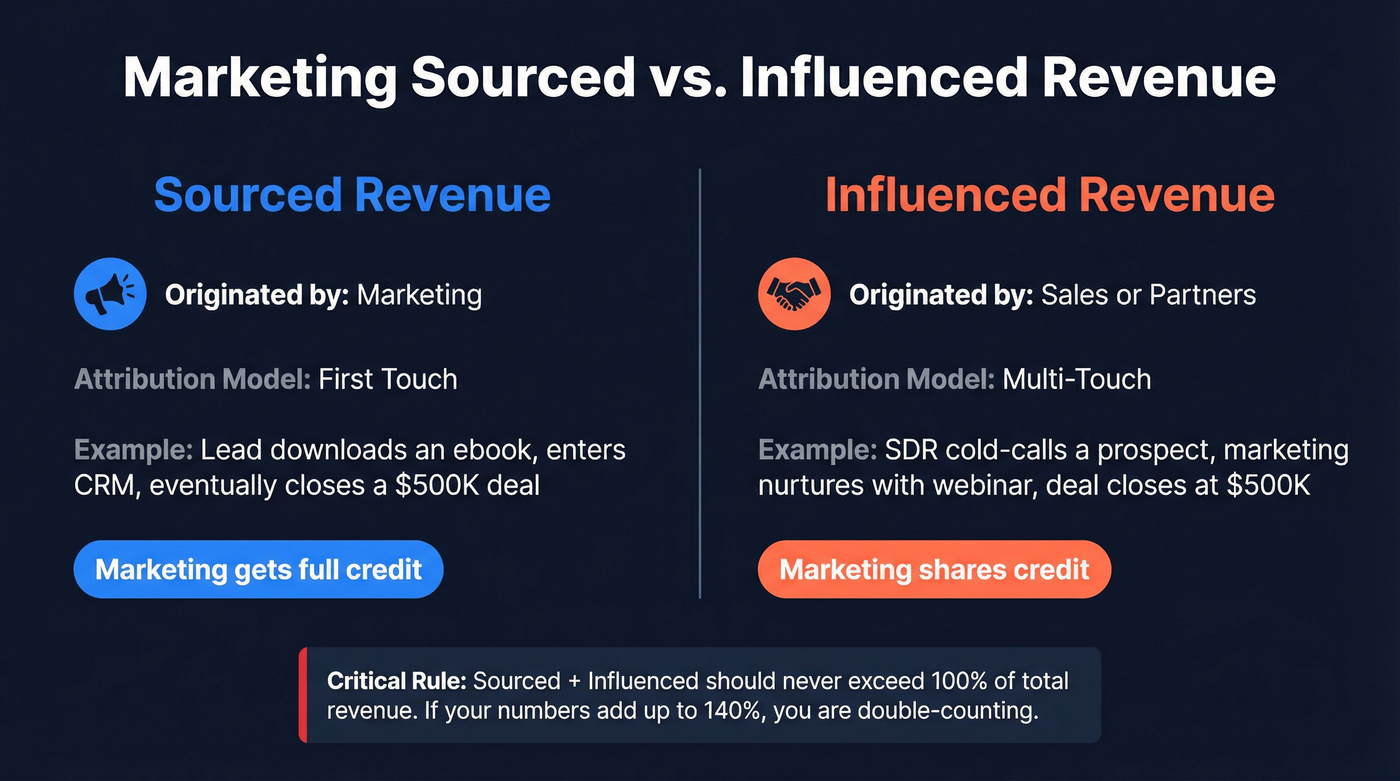
This metric tracks closed-won revenue from opportunities where marketing originated the lead through first touch. The key word is originated. Marketing created the initial interaction that brought the prospect into your pipeline. If an SDR cold-called the lead and marketing later nurtured them through a webinar, that's not sourced - that's influenced.
Here's a worked example. Your company closes $2M in Q1 across 20 deals. Of those, 12 deals ($1.2M) came from leads that first entered the CRM through a marketing channel - a content download, a paid ad click, an event registration. That $1.2M is your marketing sourced revenue. The remaining 8 deals ($800K) were originated by sales outbound, but 5 of those ($500K) had meaningful marketing touches during the sales cycle. That $500K is marketing-influenced revenue.
The critical guardrail, per the Pedowitz Group framework: sourced + influenced should never exceed 100% of total revenue. If your numbers add up to 140%, you're double-counting. Your CFO will notice.
57% of marketers now use both sourced and influenced measures. That's the right approach - one metric alone tells an incomplete story.
Sourced vs. Influenced
| Sourced | Influenced | |
|---|---|---|
| Who originated | Marketing | Sales / partners |
| Attribution model | First-touch | Multi-touch |
| Example | $500K deal from a webinar lead | $500K deal from cold outbound, nurtured by marketing |
Why It's Controversial (and Why You Need It Anyway)
The criticism is real. MarketingWeek's pizza-flyer analogy nails the gaming problem: marketers can end up taking credit for prospects who were already likely to buy, the same way a pizza shop claims credit for a flyer delivered to someone already walking toward the restaurant. Forrester analyst Ross Graber has argued that sourcing indicators have outlived their usefulness in complex B2B buying cycles.
Fair points. But the alternative to imperfect measurement isn't no measurement.
CFOs don't fund black boxes. The median marketing spend for private B2B SaaS is 8% of ARR. If you can't show what that 8% is doing, expect cost-center treatment at the next board meeting.
Here's the thing: the metric is most reliable for lower-ACV, shorter-cycle deals - think sub-$15K contracts with a 60-day sales cycle. For enterprise deals stretching 10+ months across a dozen stakeholders, influenced revenue tells a far more complete story. But even in enterprise, marketing sourced revenue gives your CFO a starting point. Use it. Just don't pretend it's precise.

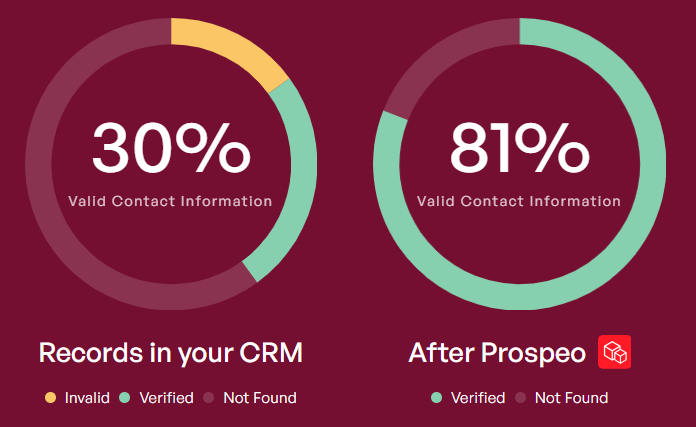
Attribution breaks when CRM records are missing emails, titles, or phone numbers. Prospeo's enrichment fills those gaps with 50+ verified data points per contact at a 92% match rate - refreshed every 7 days, not every 6 weeks.
Fix the data foundation before you debate attribution models.
How to Measure It Right
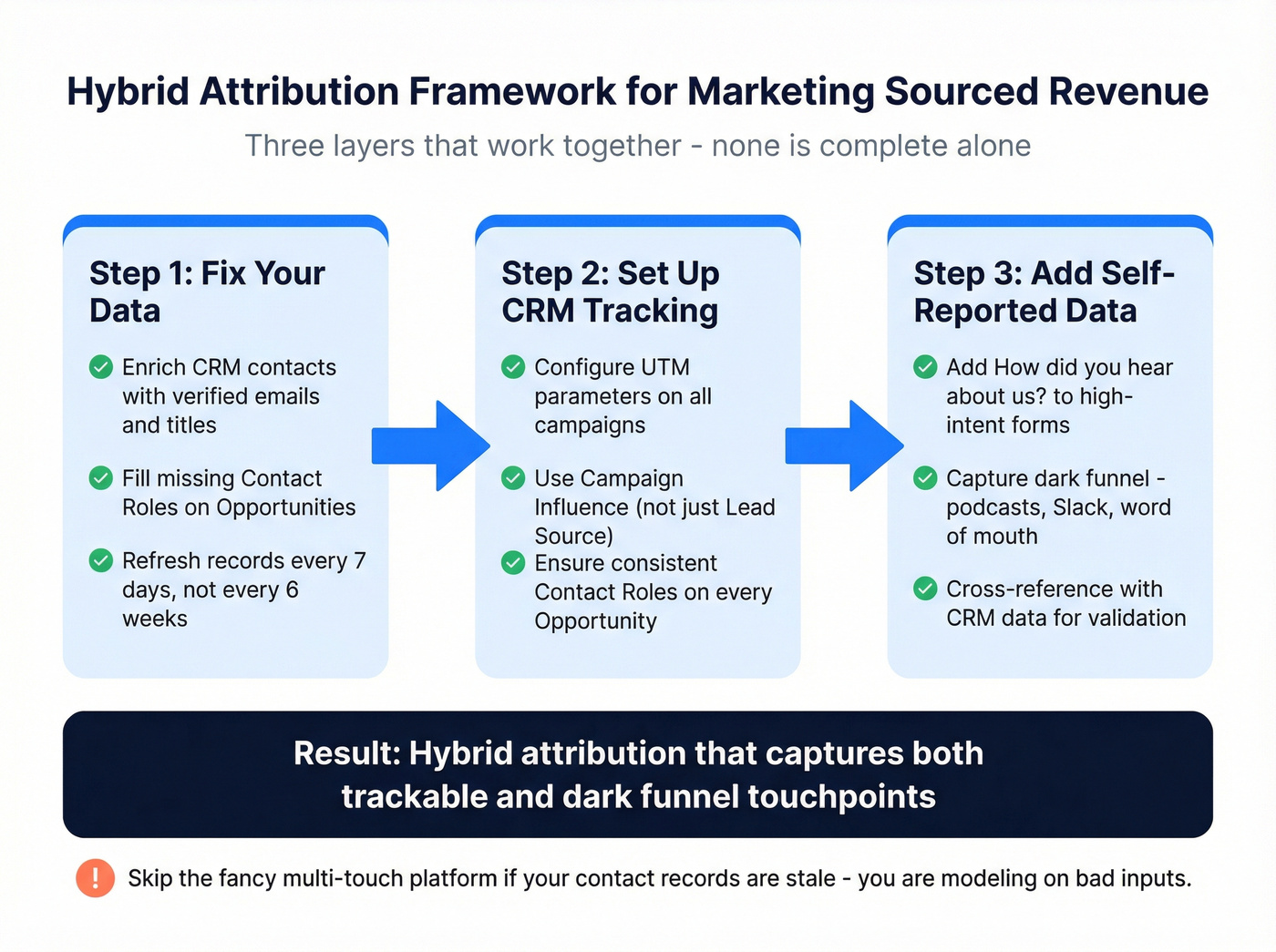
The average B2B deal involves 25+ touchpoints over roughly 10 months with 11+ stakeholders. No single attribution model captures that complexity. The answer is hybrid attribution: combine CRM tracking, UTM parameters, and self-reported data. But none of it works if your underlying data is garbage.
If you're tightening your lead generation workflow at the same time, align your form fields and lifecycle stages now - otherwise you'll be debugging attribution forever.
Set Up Your CRM
HubSpot offers three attribution report types: contact create, deal create, and revenue attribution. Deal create and revenue attribution are gated to Marketing Hub Enterprise. If you're on a lower tier, you're limited to contact-level attribution, which won't get you to sourced revenue.
Salesforce gives you three layers. Lead Source is manual and error-prone. Primary Campaign Source auto-assigns last-touch credit. Customizable Campaign Influence is what you actually want - it supports multiple campaigns per opportunity with percentage-based credit allocation. Salesforce's default influence models include first-touch, last-touch, and even distribution, and you can expand from there depending on your setup. The critical dependency: consistent Contact Roles on Opportunities. If your reps skip that field, your attribution breaks before it starts.
We've seen teams spend months debating attribution models when their CRM data hygiene is the real blocker. Let's be honest - the biggest attribution gap isn't the model. It's missing Contact Roles on Opportunities.
Add Self-Reported Attribution
Put "How did you hear about us?" on every high-intent form. This captures the dark funnel - the podcast mentions, Slack conversations, and word-of-mouth referrals that UTMs can't track. The consensus on r/sales and r/marketing is that neither self-reported nor CRM data is complete on its own. Together, they're close enough to be useful.
If you want to make this more actionable, pair it with a simple lead scoring model so sales can prioritize the highest-intent sources.
Fix Your Data First
If your CRM records are missing basics like emails, phone numbers, or job titles, your sourced revenue numbers will be wrong before you even pick a model. Attribution depends on matching contacts to campaigns to opportunities. Missing fields break that chain.
This is where CRM enrichment matters more than most teams realize. Prospeo's enrichment returns 50+ verified data points per contact on a 7-day refresh cycle, compared to the 6-week industry average, with a 92% API match rate. You're fixing the foundation before you build the measurement layer on top.
If you're evaluating vendors, start with a shortlist of data enrichment services and compare refresh cadence and match rates - not just record volume.
Benchmarks - What Good Looks Like
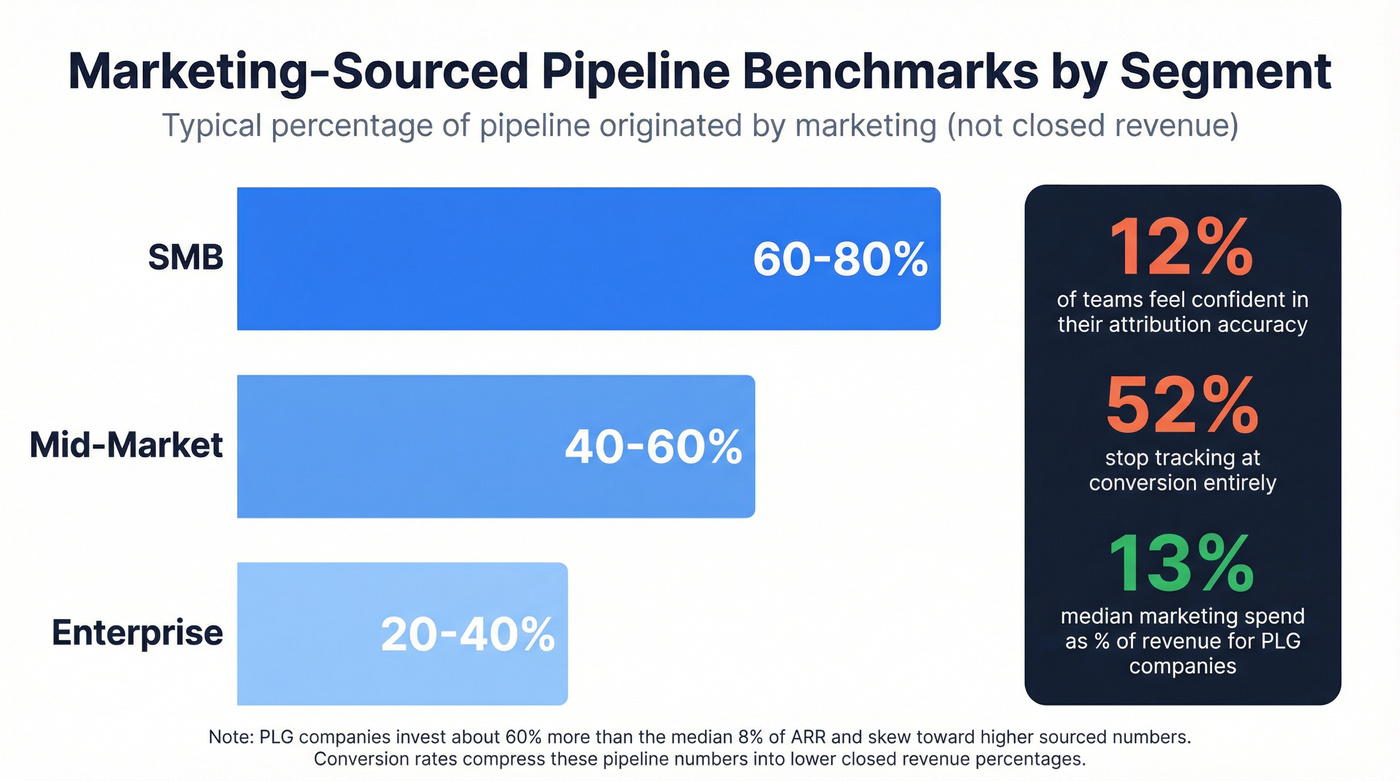
Marketing-sourced pipeline benchmarks vary dramatically by segment:
| Segment | Typical Marketing-Sourced Pipeline % |
|---|---|
| Enterprise | 20-40% |
| Mid-Market | 40-60% |
| SMB | 60-80% |
These are pipeline numbers, not closed revenue - conversion rates compress the revenue percentages further. PLG companies invest more heavily in marketing, with a median 13% of revenue vs. 9% for sales-led and 10% for hybrid motions, and tend toward the higher end of sourced pipeline. For context, the median overall marketing spend for private B2B SaaS sits at 8% of ARR, so PLG companies are spending about 60% more than the median to drive those higher sourced numbers.
If you're pressure-testing your funnel math, it helps to sanity-check against sales pipeline benchmarks and your average B2B lead conversion rate.
The uncomfortable truth: only 12% of teams feel confident in their attribution accuracy, under 25% rate their measurement practices as fair, and 52% stop tracking at conversion entirely. If you're measuring sourced revenue at all, you're ahead of most.
How to Present It to Your CFO
CFOs don't care about attribution model debates. They care about spend efficiency. Present your data in their language:
If you need a clean way to frame the conversation, anchor it to CAC and payback - then show how sourced revenue trends by cohort.
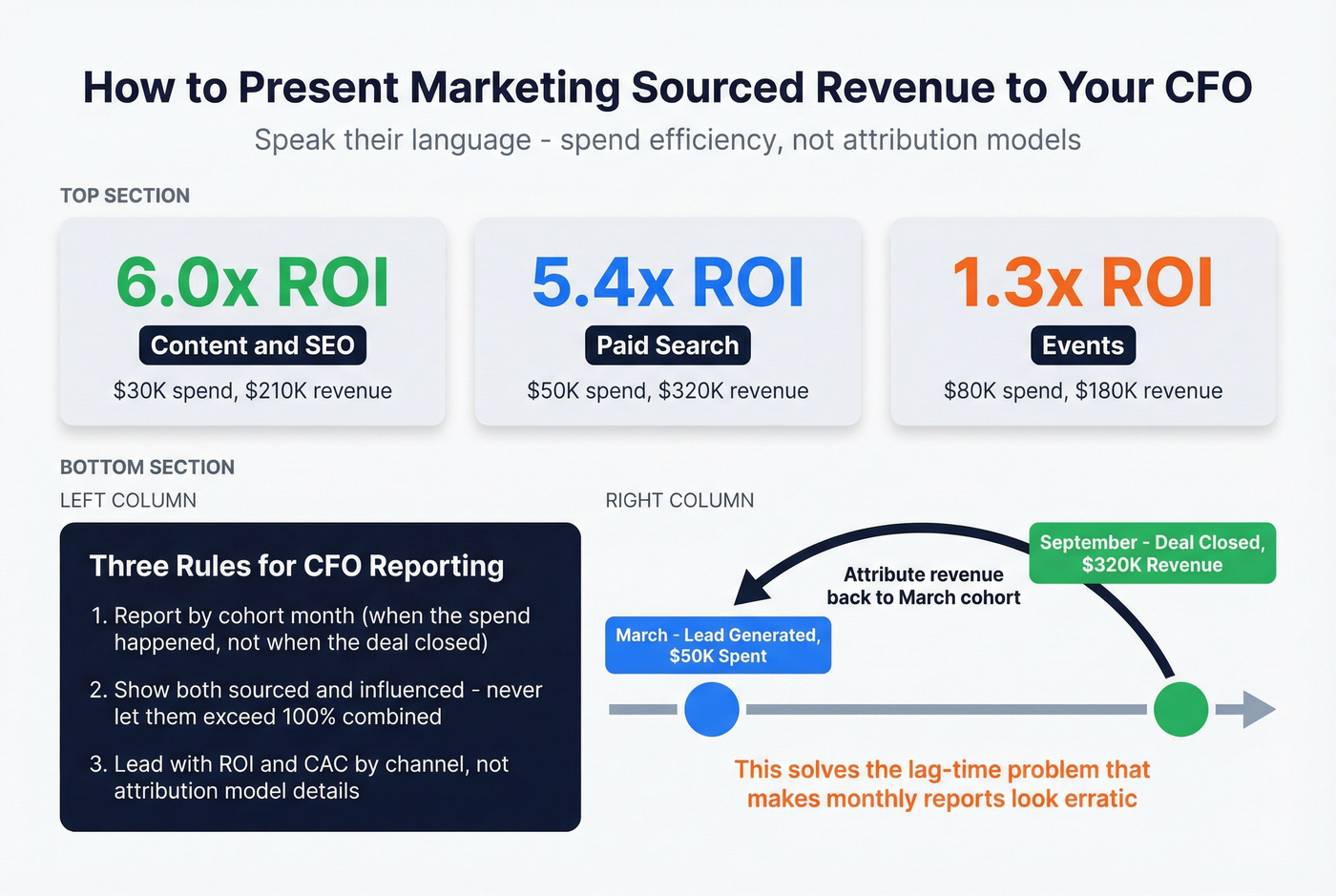
| Channel | Spend | Revenue | ROI | CAC |
|---|---|---|---|---|
| Paid search | $50K | $320K | 5.4x | $890 |
| Content/SEO | $30K | $210K | 6.0x | $620 |
| Events | $80K | $180K | 1.3x | $2,100 |
Report by cohort month - when the spend happened, not when the deal closed. A lead generated in March that closes in September should attribute back to March's spend. This solves the lag-time problem that makes monthly reports look erratic.
The principle is direction over perfection. Your CFO wants to know which channels to invest more in and which to cut. In our experience, the gap between "sort of accurate" and "CFO-trustworthy" almost always comes down to data freshness. Stale CRM records create attribution gaps that no model can fix. Skip the fancy multi-touch platform if your contact records haven't been updated in six months - you're modeling on bad inputs.
You can't prove marketing sourced revenue if contacts aren't matched to campaigns and opportunities. Prospeo gives you 98% accurate emails and 125M+ verified mobiles so every record in your CRM ties cleanly to pipeline - at $0.01 per email.
Stop losing attribution credit to incomplete records.
FAQ
What's the difference between sourced and influenced revenue?
Sourced revenue comes from deals where marketing originated the lead through first touch - the prospect entered your pipeline via a marketing channel. Influenced revenue comes from deals originated by sales or partners where marketing touched the opportunity during the cycle. Report both, but make sure they never exceed 100% of total revenue combined.
What percentage of pipeline should marketing source?
SMB companies typically see 60-80% marketing-sourced pipeline; mid-market 40-60%; enterprise 20-40%. PLG companies invest more in marketing (median 13% of revenue) and skew toward the higher end. These are pipeline benchmarks - closed revenue percentages will be lower after conversion rates compress them.
How do I improve the accuracy of my revenue attribution data?
Start with CRM data quality. Stale contacts and missing fields break attribution before your model even runs. Layer in self-reported attribution alongside UTM tracking for dark funnel coverage. And if you're debating first-touch vs. multi-touch models, stop - pick one, run it for a quarter, and iterate. The worst attribution model is the one you never ship.