

Meetings Booked: What It Really Means, What Good Looks Like, and How to Book More
Sixty meetings booked last month. The Slack channel lit up with confetti emojis. Then reality hit: 42 actually showed, 14 were qualified, and 3 closed. That's a 5% conversion from "booked" to revenue - and nobody flagged it until the quarterly review.
This is the most celebrated and least understood metric in B2B sales. Let's fix that.
The Quick Version
- "Meetings booked" has no standard definition. Your team must pick one and enforce it across every tool, dashboard, and comp plan.
- Stop tracking booked appointments alone. Track show rate, close rate, and revenue per appointment alongside it.
- If you're booking fewer than 12 meetings per month outbound, the problem is almost always bad data, single-channel outreach, or insufficient daily activity.
What "Meetings Booked" Actually Means
Ask three sales tools what this metric means and you'll get three different answers. HubSpot defines it as "the number of times visitors used the scheduling page to set up a meeting" - a scheduling-page event that counts when someone clicks a Calendly-style link and picks a time. Amplemarket defines it as "the total number of calendar invites sent to external guests, regardless of acceptance." One counts prospect action. The other counts rep action.
Neither is wrong. But if your SDR team uses one definition and your CRM dashboard uses another, your pipeline math is fiction. The fix is simple but rarely done: document your definition in writing, enforce it in your CRM, and make sure comp plans reference the same version. "Booked" should mean one thing at your company. Pick it and move on.
Booked vs. Held vs. Qualified
The raw count on your dashboard is the most dangerous metric in sales. Not because it's useless - because it's incomplete. Without distinguishing qualified opportunities from raw calendar fills, you're measuring activity instead of pipeline quality.
| Metric | Definition | Who Counts It | Why It Matters |
|---|---|---|---|
| Booked | Meeting is scheduled (per your internal definition) | SDR/BDR | Activity volume |
| Held | Prospect actually showed | SDR + AE | Real engagement |
| Qualified | ICP fit + buying potential | AE | Pipeline quality |
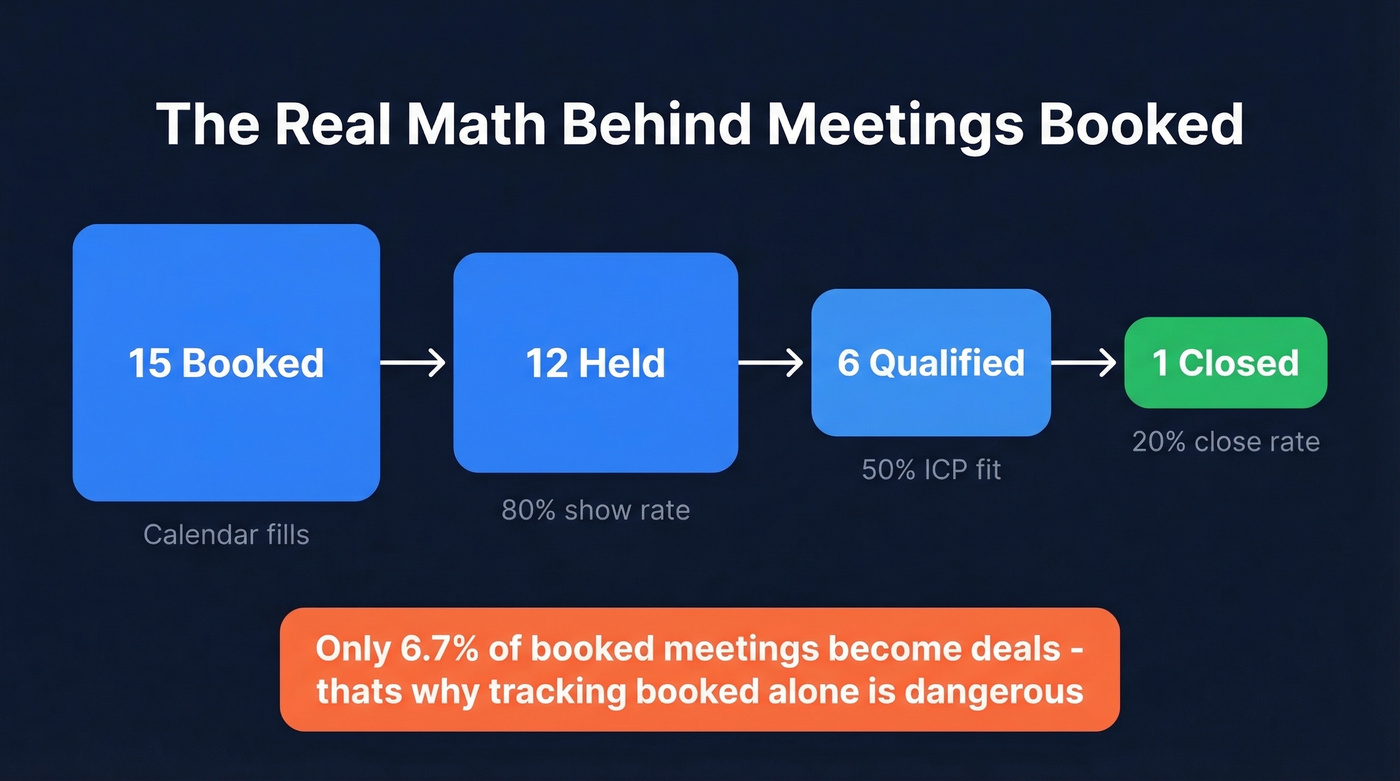
The math is straightforward. If you book 15 meetings and your show rate is 80%, you held 12. If 50% of those are qualified, you've got 6 real opportunities. A 20% close rate means roughly 1 deal from 15 scheduled conversations.
On r/sales, a common complaint about meetings-set comp plans is gaming - reps booking unqualified meetings just to hit numbers. That's a symptom of tracking booked without tracking held and qualified. The three metrics that actually matter alongside your booking count: show rate, close rate, and revenue per appointment. Track all three or you're flying blind. We've seen teams celebrate a 40% increase in calendar fills while pipeline actually shrank because show rates cratered and qualification dropped.
SDR Benchmarks for 2026
Let's put numbers on "good." The metric that matters most isn't appointments per month - it's held meetings per rep hour, the number that captures both efficiency and quality in a single figure.
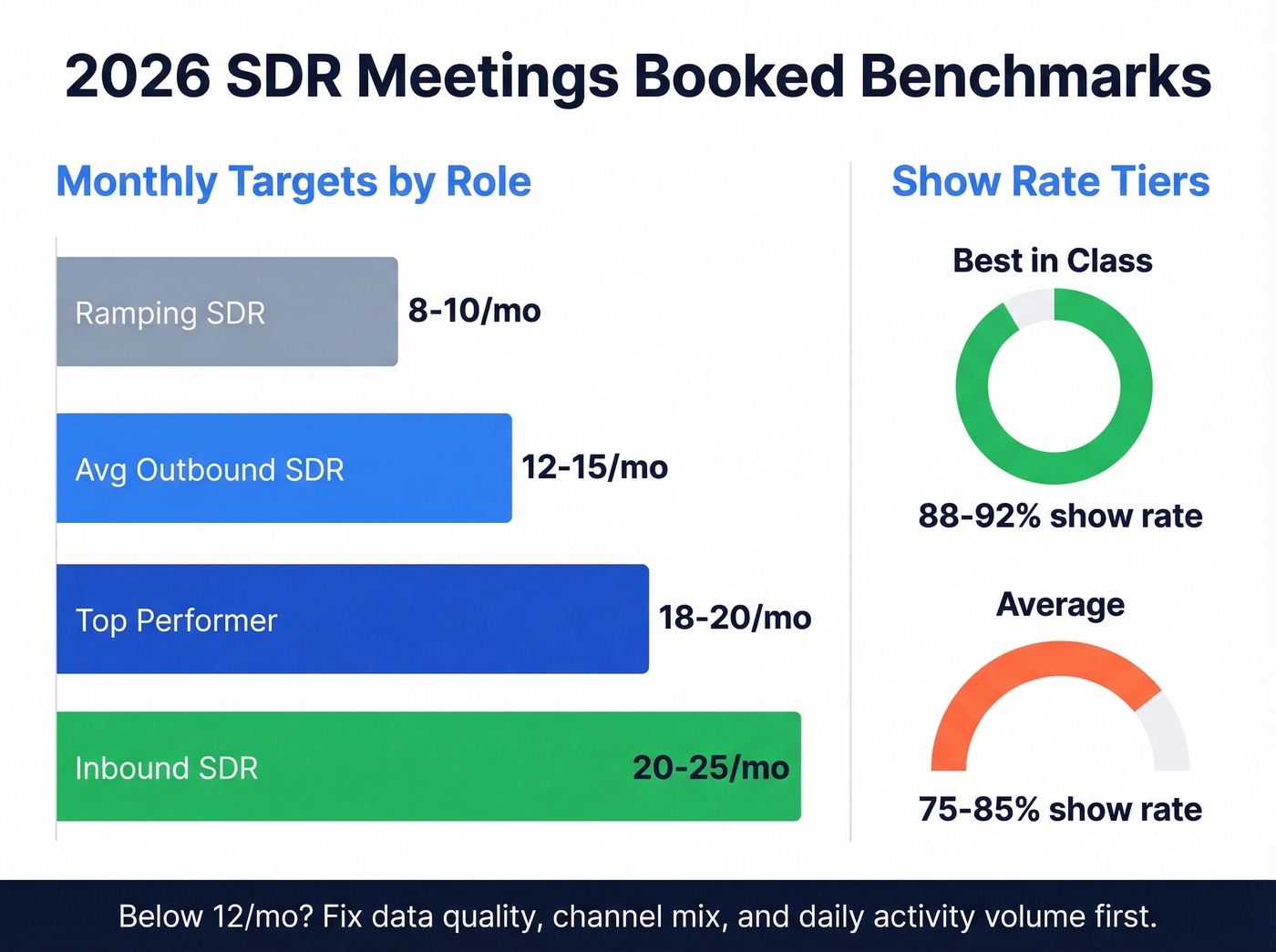
Monthly Targets by Role
| SDR Type | Monthly Target | Weekly Pace |
|---|---|---|
| Ramping SDR | 8-10 | ~2/week |
| Avg Outbound SDR | 12-15 | ~3-4/week |
| Top Performer | 18-20 | ~4-5/week |
| Inbound SDR | 20-25 | ~5-6/week |
Show-Rate Benchmarks
| Tier | No-Show Rate | Show Rate |
|---|---|---|
| Best-in-class | 8-12% | 88-92% |
| Average | 15-25% | 75-85% |
On the outreach side, cold email reply rates average 5-6% with top campaigns hitting 8-12%. Cold calling converts at roughly 2-2.3% of dials to meetings, meaning an SDR making 80 dials a day should expect 1-2 appointments from phone alone. Multichannel is what moves the needle.
In our experience, teams consistently below 12 per month per outbound rep don't need to tweak subject lines. They need to fix the fundamentals: data quality, channel mix, and daily activity volume.

If your team books fewer than 12 meetings per month, the problem is almost always bad data. Prospeo's 300M+ profiles refresh every 7 days - not 6 weeks - so your reps reach real people at current companies. Teams switching to Prospeo book 26% more meetings than ZoomInfo users and 35% more than Apollo.
Stop losing meetings to outdated data. Start booking with verified contacts.
How to Increase SDR Meetings Booked
Go Multichannel or Go Home
Single-channel outreach is dead. Teams running email, phone, and social touches together see 200-280% higher response rates compared to email-only. That's not a marginal improvement - it's a different game entirely.
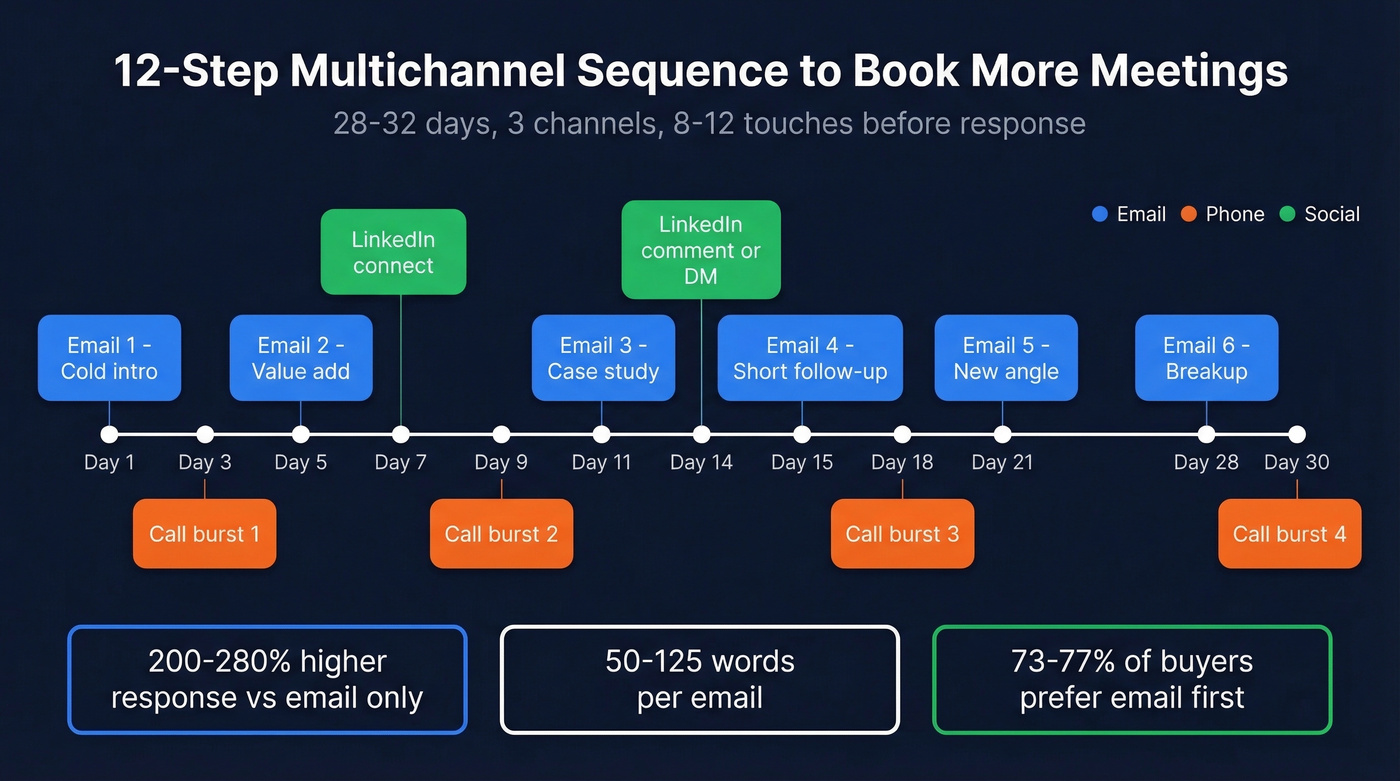
What works is a 12-step sequence spread across 28-32 days. Mix email touches with 4 parallel dial bursts around days 3, 9, 18, and 30, and weave social touches in between. Most prospects need 8-12 touches before they respond. Keep emails between 50-125 words - ruthlessly cut anything that doesn't earn the next sentence. And 73-77% of B2B buyers still prefer email as the initial contact channel, so lead with it.
If you need help tightening copy, start with email subject lines and a simple B2B cold email sequence you can actually run consistently.
Fix Your Data First
Here's the thing: if your bounce rate is above 5%, you don't have a meetings problem. You have a data problem. Your target is under 2% bounce rate and under 5% spam placement.
Think about it this way. An SDR making 80 calls a day on a list where 30% of numbers are disconnected is really making 56 effective calls. That's 24 wasted dials, every single day. Multiply that across a team of 10 reps and you're burning hundreds of hours per month on dead numbers.
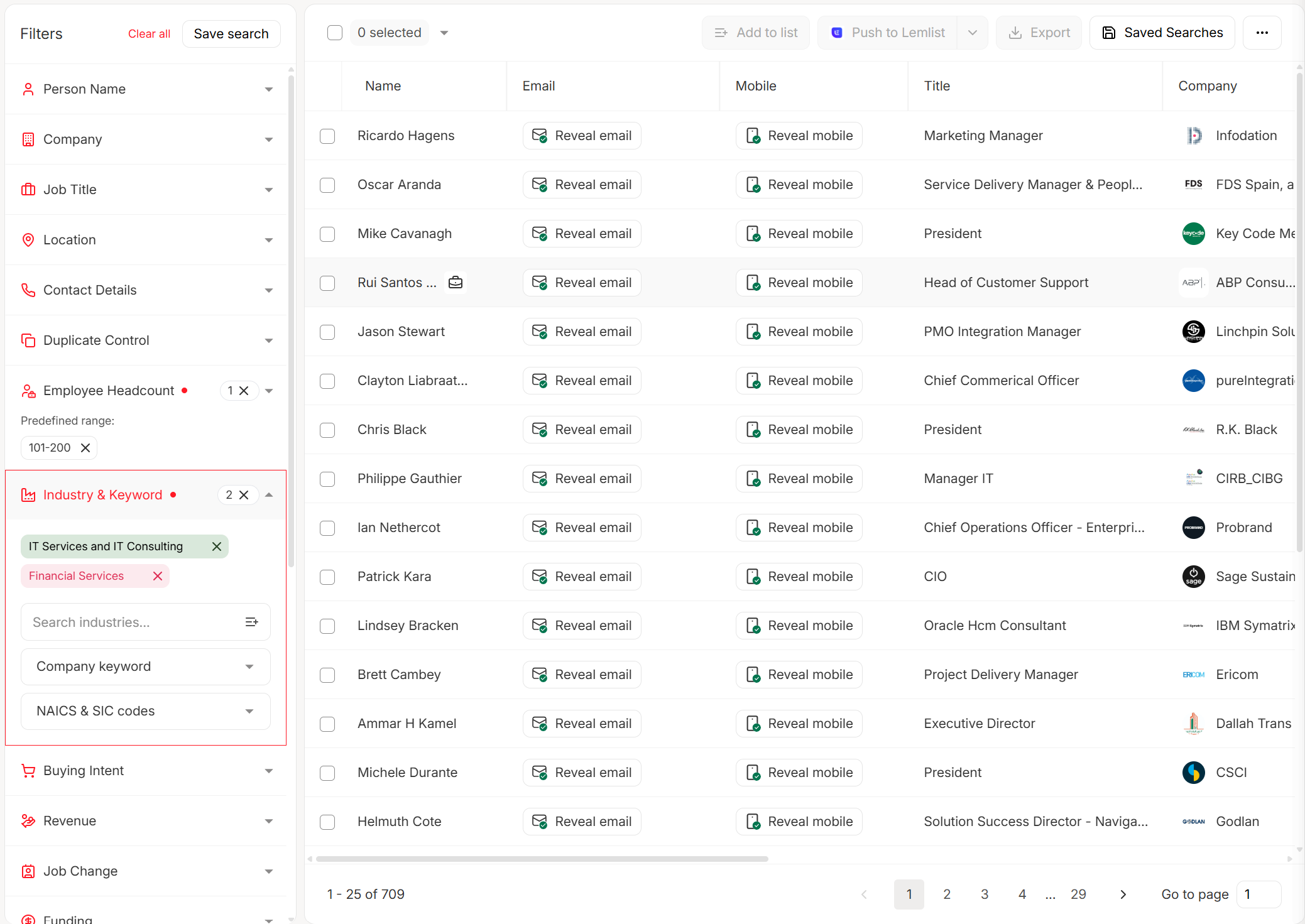
Prospeo's database covers 300M+ professional profiles with 143M+ verified emails at 98% accuracy and 125M+ verified mobile numbers delivering a 30% pickup rate. The data refreshes every 7 days - compared to the 6-week industry average - so you're not calling people who changed jobs last month. Teams using Prospeo book 26% more meetings compared to ZoomInfo and 35% more compared to Apollo, largely because the data actually reaches people.
The proof is in the numbers. Meritt, an outbound agency, saw their bounce rate drop from 35% to under 4% after switching. Their connect rate tripled to 20-25%, and pipeline went from $100K to $300K per week.
If you're diagnosing deliverability, start with email bounce rate and a practical email deliverability guide before you scale volume.
Your multichannel sequence is only as good as the numbers behind it. Prospeo delivers 143M+ verified emails at 98% accuracy and 125M+ mobile numbers with a 30% pickup rate - turning those 80 daily dials into real conversations instead of dead air. Meritt tripled their connect rate to 20-25% after switching.
Fix your data and watch your show rate climb. 75 free emails, no contract.
Prioritize With Intent Signals
Not all prospects are equally ready to take a meeting. Calls to accounts showing active buying signals convert 2-3x better than cold dials. When timing is right, call connect-to-meeting conversion runs 10-25% - a massive jump from the 2% baseline on pure cold calls.
The trick isn't making more calls. It's making smarter ones. Layer buying intent on top of firmographic filters so reps call the right accounts first. This single change can transform your pipeline generation without adding headcount.
How to Improve Your Show Rate
The Real Cost of No-Shows
Missed appointments cost U.S. businesses an estimated $150 billion annually, with a single no-show running $200+ when you factor in rep time, opportunity cost, and pipeline delay. Every sales team Slacks a confetti emoji when a meeting lands on the calendar. Nobody tracks what happens next.
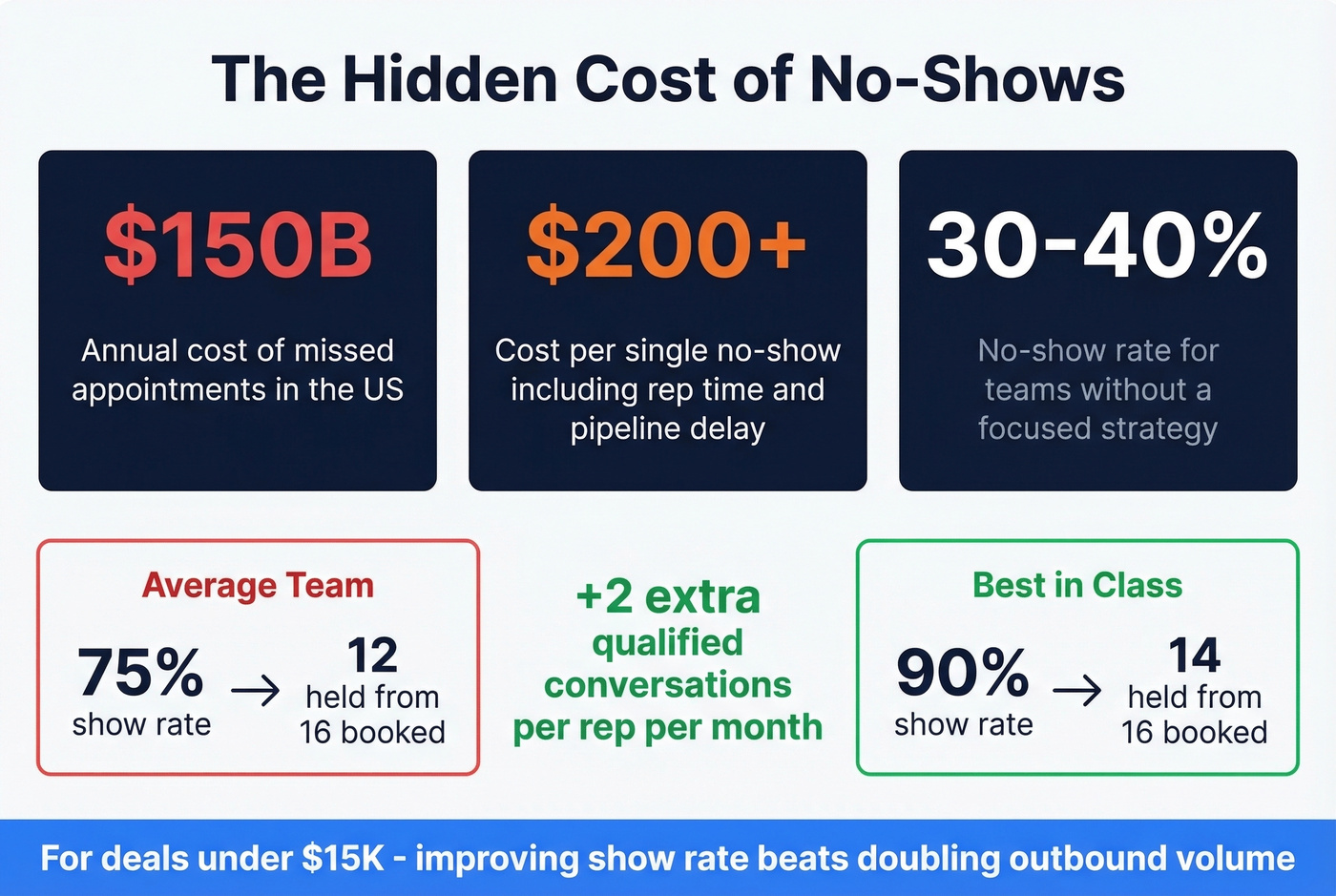
An 18% no-show rate is close to the national average. Some B2B segments without a focused strategy see 30-40%. Best-in-class teams keep it at 8-12%. The gap between average and great is worth real revenue.
I'll say it plainly: if your average deal size is under $15K, improving show rate from 75% to 90% will do more for your pipeline than doubling your outbound volume. Most teams are over-investing in top-of-funnel and under-investing in conversion.
Reduce No-Shows
This isn't about sending more reminders, though that helps. It's about building a system that filters low-intent prospects before they ever get calendar access.
Qualify before giving calendar access. Use lead scoring, enrichment data, and pre-call forms to ensure the person is worth a slot. Skip this step and you'll fill calendars with people who were never going to buy.
Add intentional friction. A short intake form feels counterintuitive, but it filters out people who aren't serious. If they won't spend 90 seconds answering three questions, they weren't going to show.
Run a multi-touch reminder cadence. Immediate confirmation, then reminders at 48 hours, 24 hours, and 2-4 hours before the meeting. SMS for the same-day reminder if you have mobile numbers.
Add a confirmation step. A second opt-in - "Reply YES to confirm" - secures commitment and lets you auto-release dead slots. This alone can cut no-shows by 15-20%.
Schedule close to booking time. The longer the gap between booking and meeting, the higher the no-show rate. Aim for 24-48 hours when possible.
Send pre-meeting value. A relevant case study or one-page overview gives the prospect a reason to show up and frames the conversation before it starts.
Track Meetings in Your CRM
HubSpot Setup
HubSpot's Meetings dashboard tracks three core metrics: Views, Meetings booked, and Conversion rate. Two caveats most teams miss: HubSpot doesn't backfill data - analytics only start from when you set up the meetings tool. And if you change the Brand associated with a meeting link, it resets all analytics.
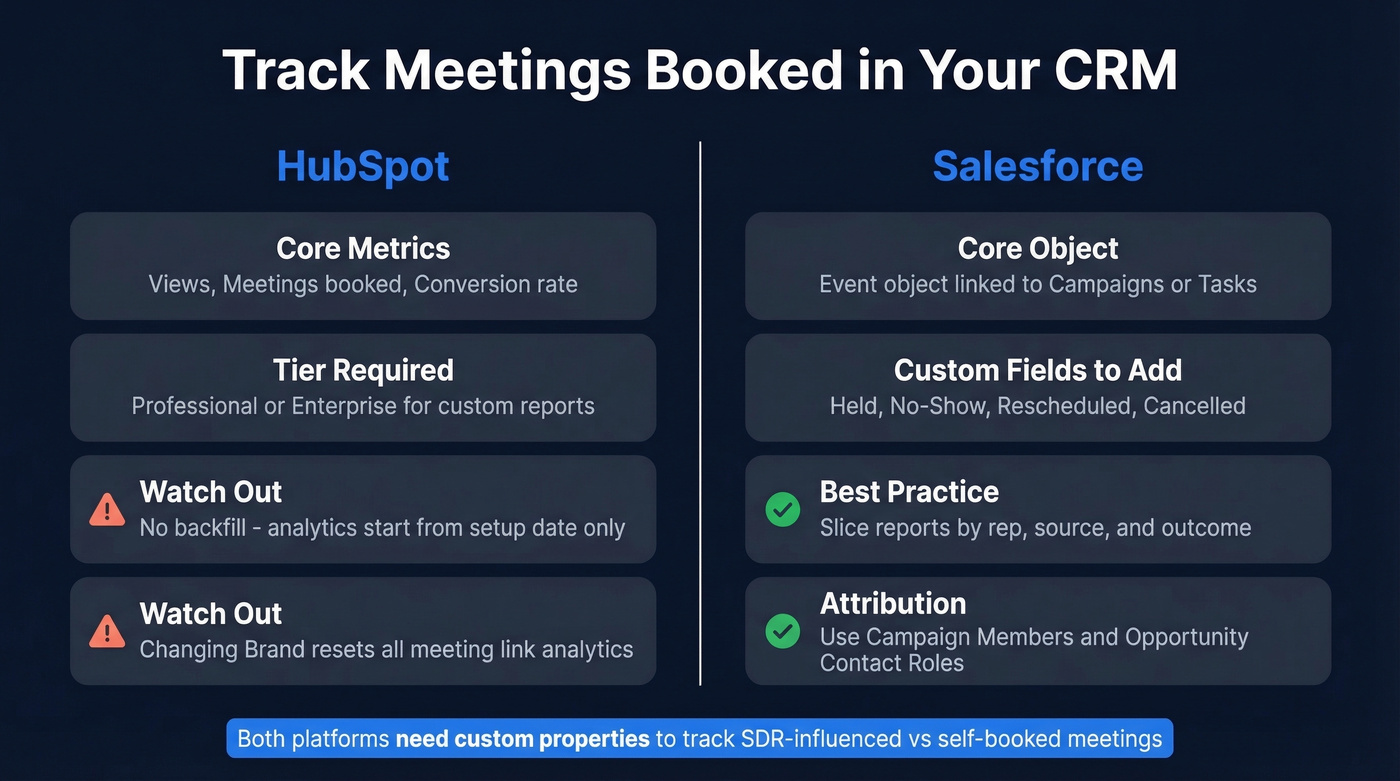
Professional or Enterprise tiers unlock custom reports where you can cross-reference meetings with contact properties and deal stages. The real attribution challenge is when an SDR does outreach but the prospect self-books via your website. You'll need custom properties to track both direct-booked and SDR-influenced meetings, otherwise you'll systematically undercount your outbound team's impact.
Salesforce Setup
Salesforce tracks meetings through the Event object. Associate Events with Campaigns or Tasks, and add custom meeting outcome fields: Held, No-Show, Rescheduled, Cancelled. Build reports that slice meetings by rep, by source, and by outcome. For attribution, use Campaign Member records and Opportunity Contact Roles to connect scheduled meetings back to pipeline. It takes an afternoon to set up properly and saves months of attribution arguments.
AI SDRs and Meeting Booking
AI SDR tools are real, but they're overhyped. We've tested several of these platforms - none are plug-and-play yet.
| Factor | Human SDR | AI SDR |
|---|---|---|
| Annual cost | ~$75-100K loaded | ~$6-24K/year |
| Monthly output | 15-20 qualified opps | 40-60 qualified opps |
| Time to ROI | 2-3 months | 3-6 months (clean data) |
The cost advantage looks compelling on paper. But expect 40-60 hours of data prep before launch, and 6-9 months to see ROI if your data and processes are messy. Start with 100-200 test accounts, not your entire TAM. Platforms worth watching include Artisan, 11x.ai, Clay, Apollo, and Salesforce Agentforce. They're best used to augment human SDRs on high-volume, lower-complexity segments - not to replace your team on enterprise deals. For scheduling at scale, AI can handle initial outreach and calendar coordination while humans run the actual conversations.
If your data isn't clean, skip AI SDRs entirely until it is. Garbage in, garbage out applies doubly when there's no human in the loop to course-correct.
FAQ
How many meetings should an SDR book per month?
Outbound SDRs typically book 12-15 qualified meetings per month, roughly 3-4 per week. Top performers hit 18-20. Inbound SDRs handling warm leads average 20-25. Ramping reps should target 8-10 while building pipeline. Expect 15-25% drop-off between booked and held.
What's a good meeting show rate?
Best-in-class B2B teams maintain 88-92% show rates, meaning only 8-12% no-show. The industry average sits closer to 82%. If yours is below 75%, focus on pre-meeting qualification and reminder cadences rather than adding more top-of-funnel volume.
How does data quality affect meetings booked?
Bad contact data silently destroys meeting volume. If 30% of your phone numbers are disconnected and 10% of emails bounce, you're wasting 20-40% of outreach effort before a prospect even sees your message. Meritt cut their bounce rate from 35% to under 4% and tripled connect rates after switching to verified, weekly-refreshed data.
What's the difference between booked and held?
A booked meeting is an accepted calendar invite; a held meeting is one where the prospect actually showed up. The gap between the two is your no-show rate - typically 15-25% for outbound-sourced meetings. Always track both, but optimize for held. A rep booking 20 with a 50% show rate is less valuable than one booking 12 at 90%.