

MQL to SQL Conversion: What Good Looks Like and How to Get There
You're spending $25k a month on paid channels, leads are flowing in, and your MQL to SQL conversion rate is sitting below 10%. Sound familiar? A manufacturing marketer on r/PPC described exactly this scenario - running Google, Meta, and paid social, drowning in unqualified leads, and watching their agency shrug.
Your conversion rate depends on industry, channel mix, and follow-up speed - not a single "13%" benchmark. If you're below 10%, the fix is almost always tighter MQL definitions, faster follow-up, or cleaner contact data.
What Is MQL to SQL Conversion?
This metric measures how many marketing qualified leads become sales qualified leads - the handoff point where sales agrees a lead is worth pursuing. The concept traces back to the SiriusDecisions Demand Waterfall framework, which gave B2B teams a shared vocabulary for pipeline stages.
The formula: (SQLs / MQLs) x 100 = conversion rate.
Here's where most teams get it wrong: they measure same-month snapshots instead of cohort-aligned conversion. If you generated 400 MQLs in Q1 and 52 eventually became SQLs, your rate is 13%. But "eventually" matters - the average conversion time from Lead to Opportunity is 84 days according to Geckoboard's analysis of Implisit data. Measuring January MQLs against January SQLs gives you garbage data. Track MQLs created in a given period against their SQL outcomes 60-90 days later.
An MQL shows intent plus fit - engagement with your content and ICP match. An SQL has been vetted by sales with a booked or completed meeting. That distinction is the foundation of any reliable pipeline metric.
Conversion Rate Benchmarks by Industry
The "13% average" that every benchmark article cites is nearly useless without segmentation. That number comes from a single Implisit analysis recycled across dozens of KPI pages for years.
Industry Breakdown
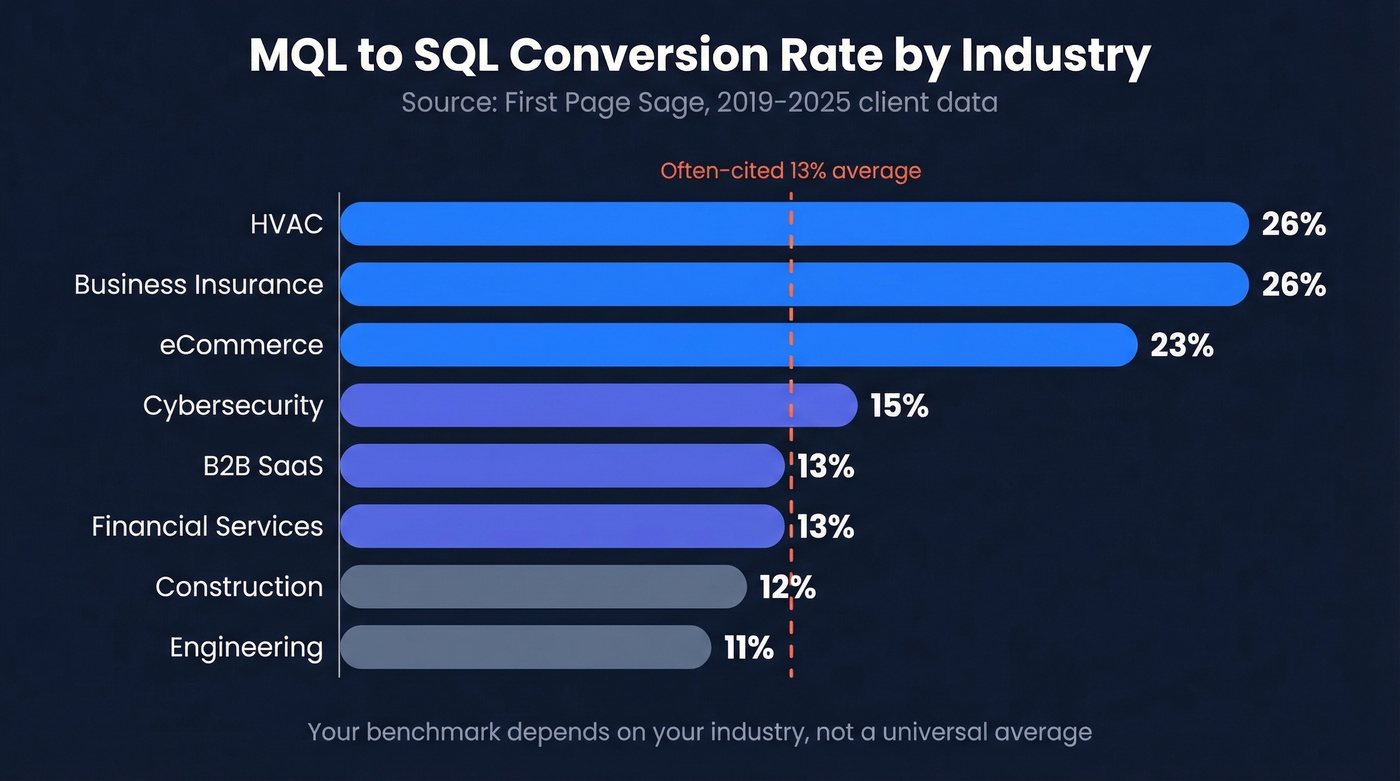
First Page Sage analyzed client data from 2019-2025 and published industry-specific rates that are far more actionable:
| Industry | MQL to SQL Rate |
|---|---|
| HVAC | 26% |
| Business Insurance | 26% |
| eCommerce | 23% |
| Cybersecurity | 15% |
| B2B SaaS | 13% |
| Financial Services | 13% |
| Construction | 12% |
| Engineering | 11% |
If you're in HVAC hitting 15%, you're underperforming. If you're in engineering hitting 15%, you're crushing it. In our experience, the moment teams segment by industry and channel, their "terrible" conversion rate often looks perfectly reasonable.
By Business Model
B2B companies generally land between 12-21%, with a median around 13-15%. B2C and D2C brands run higher at 18-22% because the buyer is the end user - no committee, shorter cycle, clearer purchase signals.
PLG companies using product-qualified leads (PQLs) see 15-30%. Product usage is a much stronger intent signal than a whitepaper download.
By Lead Source
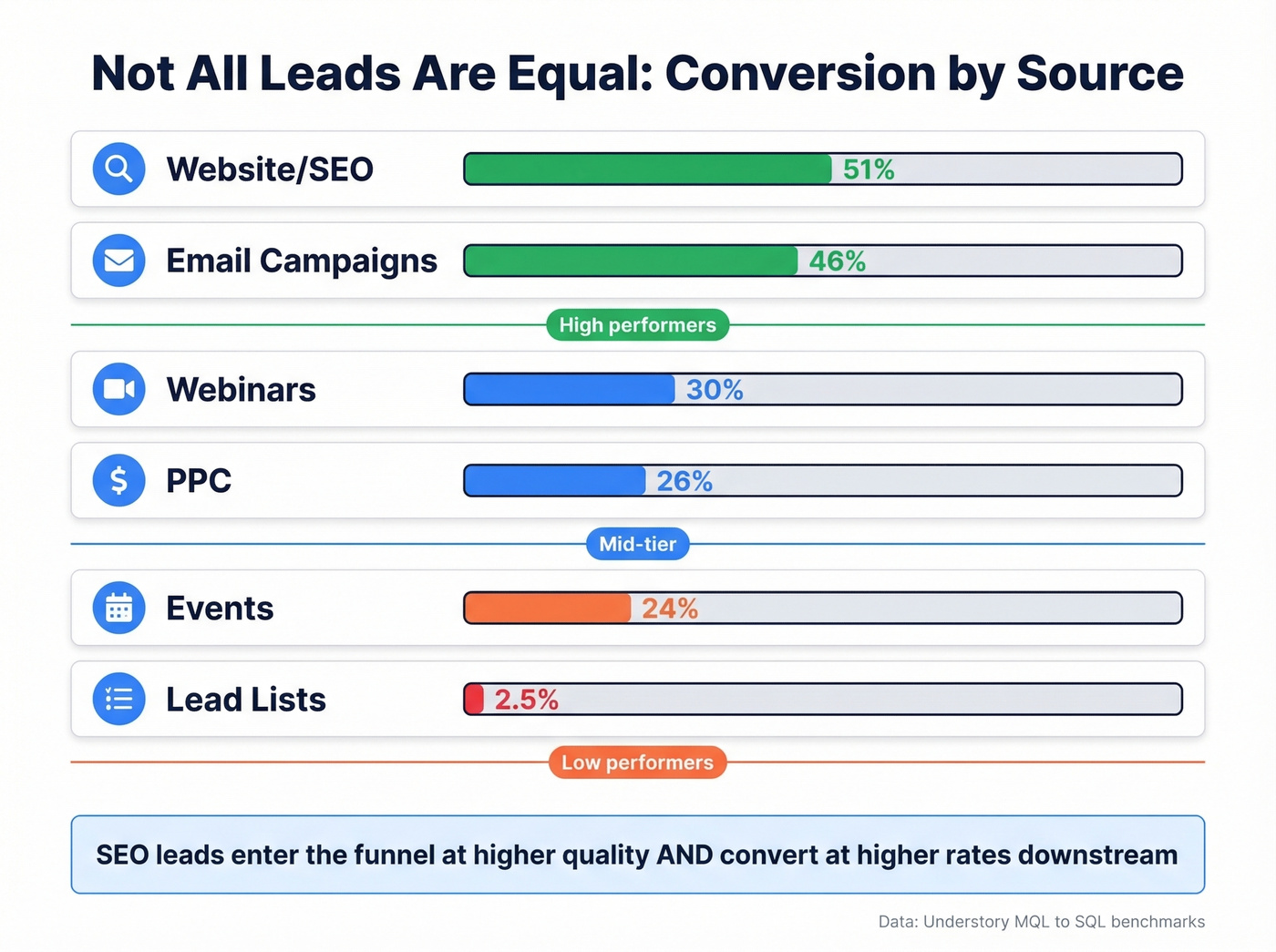
Not all leads are created equal. The channel they came from predicts conversion better than almost any other variable.
| Lead Source | Implisit (Lead to Opportunity)* | Understory (MQL to SQL) |
|---|---|---|
| Website / SEO | 31.3% | 51% |
| Referrals | 24.7% | - |
| Email campaigns | 0.9% | 46% |
| Webinars | 17.8% | 30% |
| PPC | - | 26% |
| Events | 4.2% | 24% |
| Lead Lists | 2.5% | - |
Implisit measures Lead to Opportunity, which is broader than a strict MQL to SQL definition. Expect your MQL to SQL rates to be higher than these figures.
The pattern is consistent across both datasets: website/SEO and referrals dramatically outperform events, lead lists, and email campaigns. And this compounds upstream too - First Page Sage data shows SEO converts Lead to MQL at 41% while events convert at just 24%, so SEO leads enter the funnel at higher quality AND convert at higher rates downstream. If your channel mix is heavy on content syndication and paid social, your blended rate will look terrible - and it's not because your sales team is lazy.
Let's be honest: if your average deal size is under $15k, you probably don't need a 20%+ rate to hit your numbers. You need enough volume at 12-15% with fast cycle times. Stop benchmarking against enterprise motions that don't match your business.

Bad contact data is one of the top five reasons MQL to SQL conversion tanks. Teams running 35%+ bounce rates can't qualify leads they can't reach. Prospeo's 98% email accuracy and 125M+ verified mobile numbers mean your reps connect with MQLs before competitors do - turning speed-to-lead from a theory into a reality.
Stop losing SQLs to bounced emails and wrong numbers.
Why Your Conversion Rate Is Low
Five root causes explain the vast majority of low MQL to SQL conversion rates. Most teams have at least two running simultaneously.
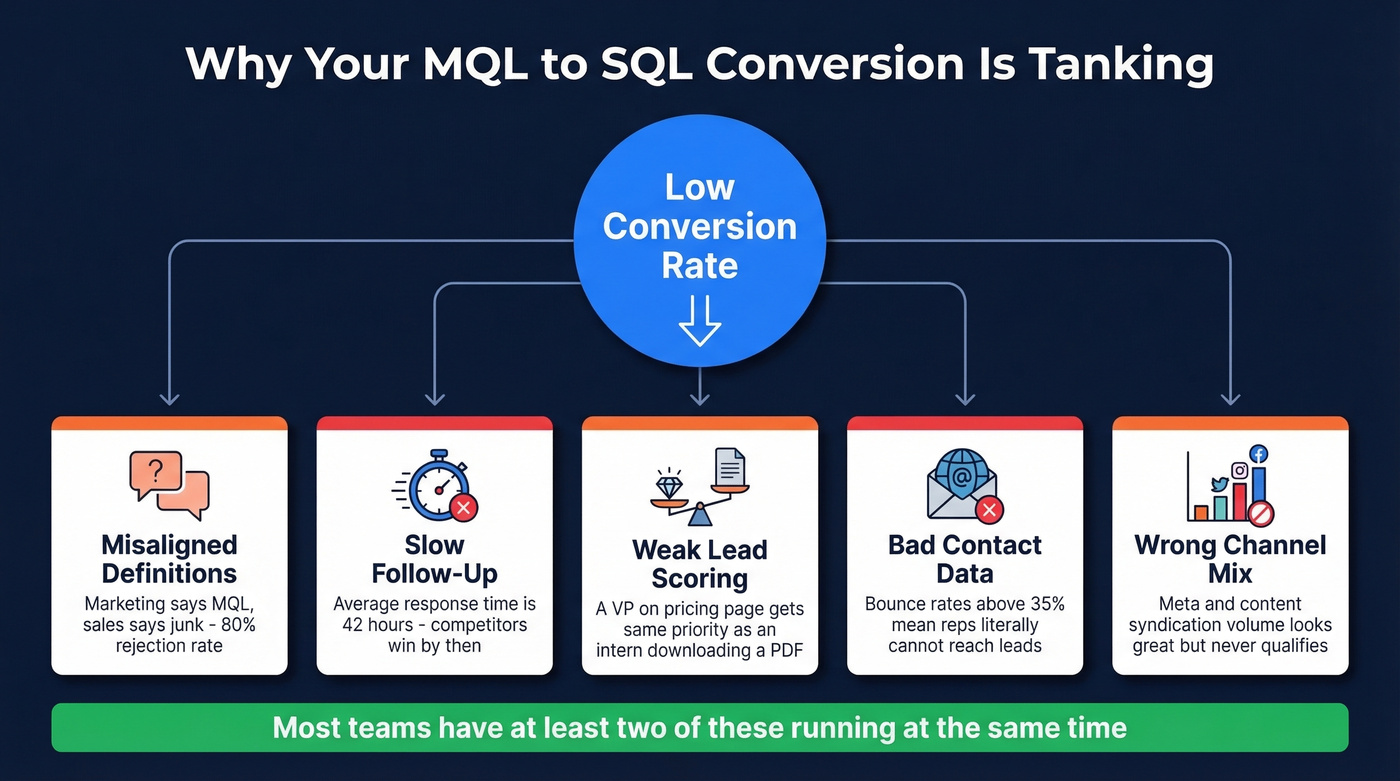
Misaligned MQL/SQL definitions. If your MQL definition includes "downloaded a whitepaper," you don't have MQLs - you have a content audience. When sales rejects 80% of leads, the problem is the definition, not the reps.
Slow follow-up. The average lead response time is 42 hours. By the time most reps pick up the phone, the lead has already talked to a competitor or lost interest entirely. If you need a starting point, use proven sales follow-up templates to standardize first-touch.
Weak lead scoring. Without scoring, every MQL looks the same. A VP who visited your pricing page three times gets the same treatment as an intern who downloaded a PDF. That's maddening. (If you want a deeper build, see our guide to lead scoring.)
Bad contact data. Bounced emails, wrong numbers, outdated titles. We've seen teams running bounce rates above 35% before they clean up enrichment and verification - and no qualification framework saves you if reps can't reach the lead. If this is a recurring issue, start with email bounce rate benchmarks and fixes.
Wrong channel mix. A thread on r/b2bmarketing captured this perfectly - teams generating MQLs via Meta and content syndication but struggling to qualify any of them. Volume isn't the problem. Source quality is.
How to Improve MQL to SQL Conversion
If you're going to fix one thing this quarter, fix speed-to-lead. It's the cheapest, fastest lever with the biggest impact. But here are all six levers that actually move the number.
Align Definitions and Build an SLA
Get marketing and sales in a room. Define shared MQL criteria - not "engaged with content," but specific behavioral and demographic thresholds. The handoff process breaks down when each team uses different language for the same pipeline stage. Your SLA should include required fields at handoff (company size, role, budget signal), conversation history and engagement timeline, next-step suggestions for the SDR, and a feedback loop where sales outcomes adjust scoring criteria.
The feedback loop is the part everyone skips, and it's the most important piece. Without it, marketing keeps sending the same quality leads and wondering why sales ignores them. HubSpot's State of Sales Report found that aligned sales and marketing teams are 3x more likely to exceed acquisition goals. For the qualification conversation itself, use a framework like PACT - Pain, Authority, Consequence, Timeline - to structure discovery calls so reps qualify consistently. (For a more formal approach, compare it to MEDDIC sales qualification.)
Build a Lead Scoring Model
Split your model into two dimensions - demographic fit and behavioral engagement:
- +25 Director-level or above
- +15 Company size 200-1,000 employees
- +10 Pricing page visit
- +20 Demo booking
- -10 30+ days without engagement
Set your MQL threshold at 60-80 points. Leads below stay in nurture. Leads above get routed to sales immediately.
Review quarterly - scoring models decay as your market evolves. The negative scoring matters more than most teams realize. Without decay, a lead who was hot six months ago still looks hot in your CRM, and stale "MQLs" tank your conversion rate. A well-calibrated scoring model is the single best way to move marketing qualified leads to sales qualified leads at a predictable rate.
Fix Speed-to-Lead
The data here is brutal. Qualification rates drop off a cliff within minutes:
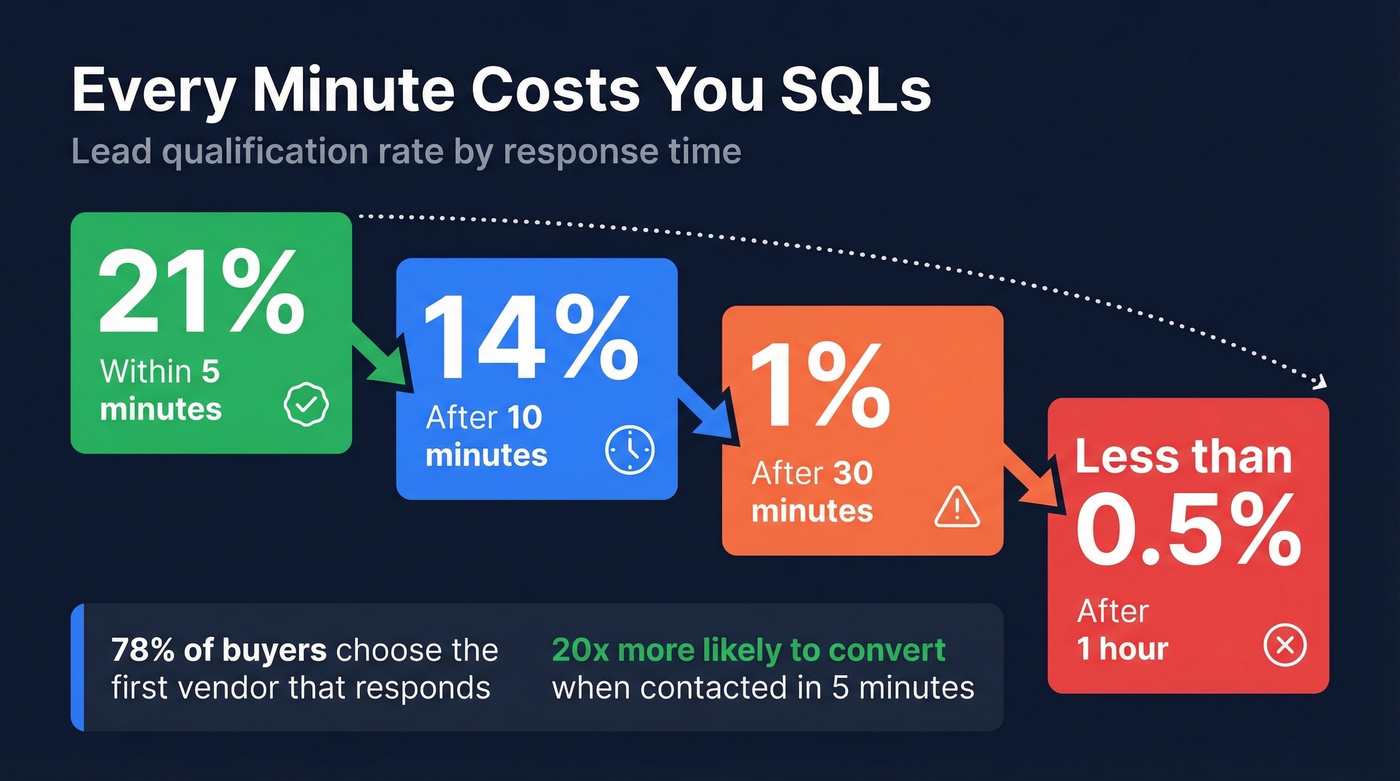
| Response Time | Qualification Rate |
|---|---|
| Within 5 minutes | 21% |
| After 10 minutes | 14% |
| After 30 minutes | 1% |
| After 1 hour | <0.5% |
Leads responded to within 5 minutes are 20x more likely to convert. 78% of buyers choose the first vendor that responds. We've seen conversion rates jump simply by tightening response time SLAs and forcing immediate first-touch on high-intent leads.
Your target: under 1 hour for high-scoring leads. If you can't staff for that, automate the first touch - even a personalized email that acknowledges the action and books a call buys you time. Many teams operationalize this with an SDR tool or a lightweight sales engagement stack.
Clean Your Data Before Handoff
Skip this section if your email bounce rate is already under 5% and your SDRs aren't complaining about wrong numbers.
For everyone else: you can nail your scoring model, respond in under five minutes, and still watch conversion rates stall if your contact data is garbage. We use Prospeo to enrich MQLs before handoff - it returns 50+ data points per contact at 98% email accuracy, with a 7-day data refresh cycle. One customer, Meritt, saw their bounce rate drop from 35% to under 4% after switching, and their pipeline tripled from $100K to $300K per week. Enriching 500 MQLs costs roughly $5 at Prospeo's credit rates. Whatever verification tool you use, verify before you hand off. The accuracy gap between tools is real, and bad data compounds fast. If you’re evaluating vendors, start with a shortlist of data enrichment services.
Segment Nurture Tracks
Not every unconverted lead is dead. A high-fit, low-engagement lead needs a different nurture track than a low-fit, high-engagement lead.
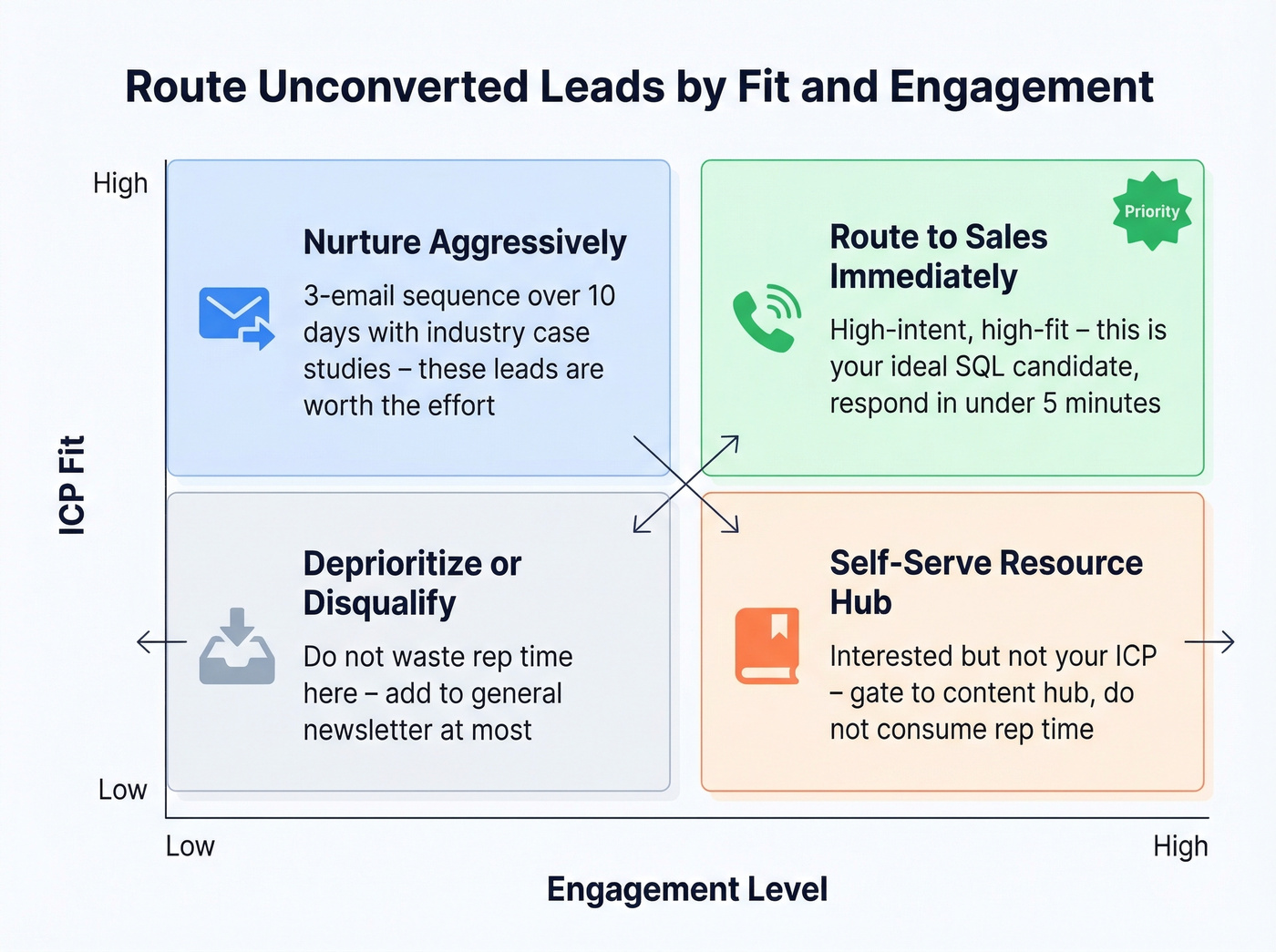
In practice, that means high-fit, low-engagement leads get a 3-email sequence over 10 days featuring case studies from their industry, while low-fit, high-engagement leads get gated to a self-serve resource hub where they can educate themselves without consuming rep time. Build at least three tracks based on score composition and source channel - PPC leads who clicked a competitor comparison ad have fundamentally different intent than SEO leads who found your pillar content organically. If you want a cleaner way to structure this, use intent based segmentation.
Measure and Optimize Quarterly
Stop obsessing over the conversion rate in isolation. Track velocity - how long it takes an MQL to become an SQL, not just whether it does. A 15% conversion rate with a 30-day cycle is dramatically better than 15% with a 120-day cycle.
Run closed-won analysis quarterly. Which MQLs that became SQLs actually closed? If your highest-converting MQL source produces SQLs that never close, your scoring model is optimizing for the wrong signal. Feed closed-won data back into scoring criteria. The funnel is a loop, not a line. If you need a broader KPI set, track it alongside other funnel metrics.
Your lead scoring model is only as good as the data behind it. Prospeo enriches every contact with 50+ data points - job title, company size, department headcount, funding - so your scoring actually reflects fit. At $0.01 per email with a 92% match rate, enrichment pays for itself the first week.
Score leads on real data, not guesswork. Start enriching for free.
Is MQL Dead?
Half right. For enterprise deals with 6-10 person buying committees, single-lead MQLs are a poor signal. You need buying group metrics - 3+ stakeholders interacting within 30 days, influence mapping, and group velocity through stages. (This is where enterprise B2B sales motions diverge from SMB playbooks.)
But for SMB and mid-market motions, the lead-to-pipeline framework still works if you define it honestly. The framework isn't broken - it's been abused by teams counting whitepaper downloads as "qualified." The teams declaring MQL dead are usually the ones who never defined it properly in the first place.
FAQ
What is a good MQL to SQL conversion rate?
B2B SaaS averages 13%, eCommerce 23%, and HVAC 26% - so "good" depends entirely on your industry and channel mix. Above 15% with honest MQL definitions means you're outperforming most teams. Below 10% signals a definition or data quality problem worth investigating immediately.
How do you move an MQL to SQL efficiently?
Combine lead scoring, sub-5-minute response times, and verified contact data. Score leads on both demographic fit and behavioral engagement, respond immediately to high-intent actions, and enrich contacts before handoff so reps aren't chasing dead ends.
How often should you measure this conversion rate?
Monthly for trending, quarterly for optimization decisions. Use cohort-aligned measurement - track MQLs created in a given month against SQL outcomes 60-90 days later, not same-month snapshots. Same-month reporting understates true conversion by 30-50%.
What's the difference between MQL and PQL?
An MQL is qualified by engagement and fit signals like content downloads and demographic match. A PQL is qualified by actual product usage - common in PLG companies. PQLs convert at 15-30%, roughly double traditional MQLs, because in-product behavior is a stronger intent signal than any marketing interaction.