

How to Run Multi-Stakeholder Sales Meetings That Actually Close Deals
You walk in expecting two people and find fourteen. Your champion "forgot to mention" procurement and legal were joining. Your deck is built for a VP of Engineering, and now the CFO is asking about total cost of ownership while someone from IT security quietly types questions into the chat.
Most sales guides tell you to "identify the decision-maker." That advice is a decade out of date - the average B2B deal now involves 13 internal stakeholders and 9 external participants. Your job isn't to find the one person who says yes. It's to prevent any one person from saying no. (If you want the deeper playbook, this is multithreading in sales in practice.)
Here's the thing: 70% of meetings are unproductive, and sales reps already spend roughly 70% of their time on non-selling tasks. Multiply that waste across a 14-person buying committee and you're not just losing a meeting - you're losing momentum, alignment, and deal velocity all at once. Running multi-stakeholder sales meetings well is the single highest-leverage skill in enterprise selling today.
What You Need (Quick Version)
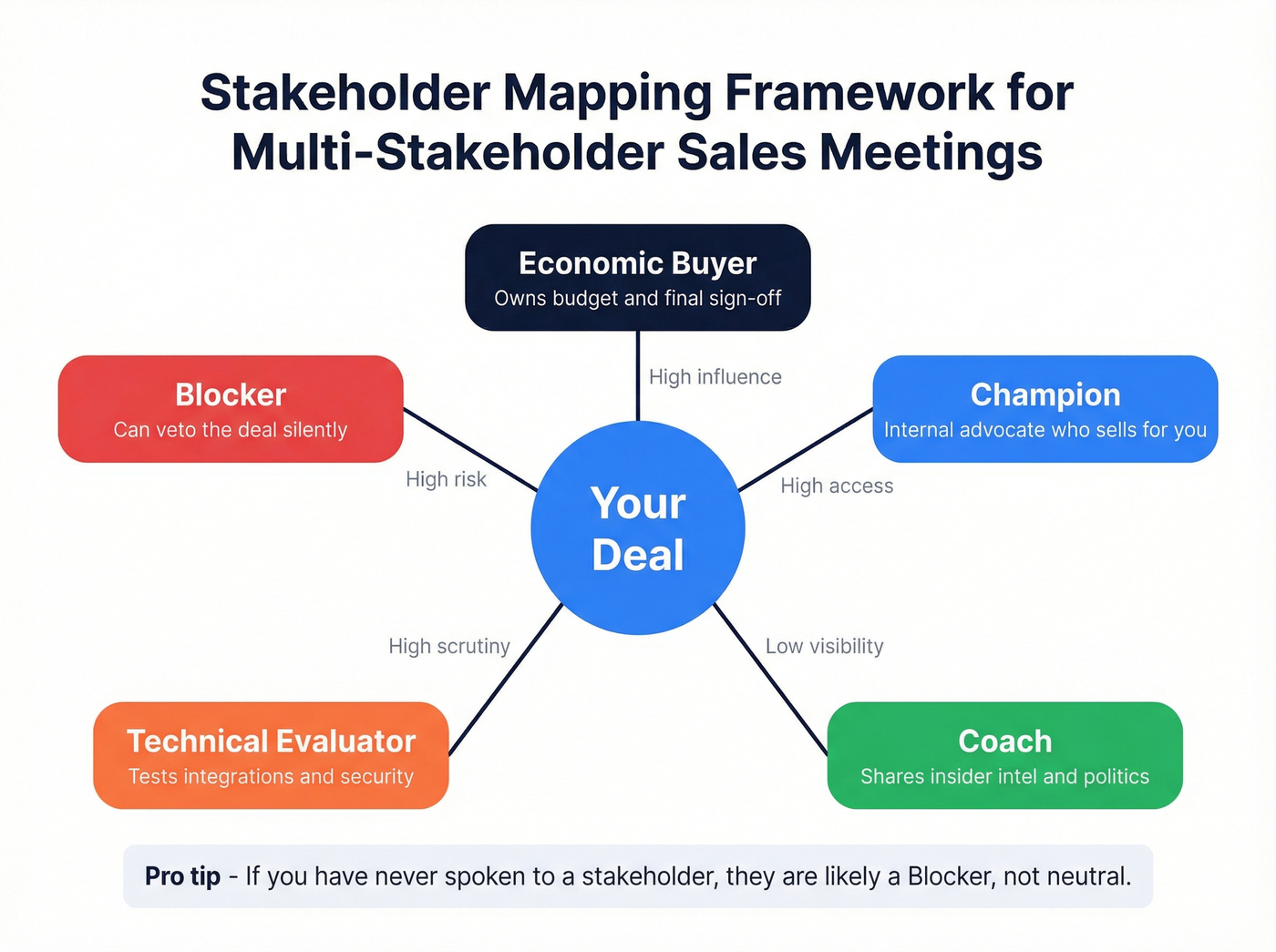
- A stakeholder mapping framework - map every person in the room before you walk in. Economic Buyer, Champion, Technical Evaluator, Coach, Blocker.
- A facilitation structure - Align, Impact, Commit. Not a slide deck. A structured conversation that ends with owners and deadlines.
Why Every Deal Is a Committee Decision
The buying group isn't growing because companies love meetings. It's growing because the stakes are higher and the risk surface is wider.
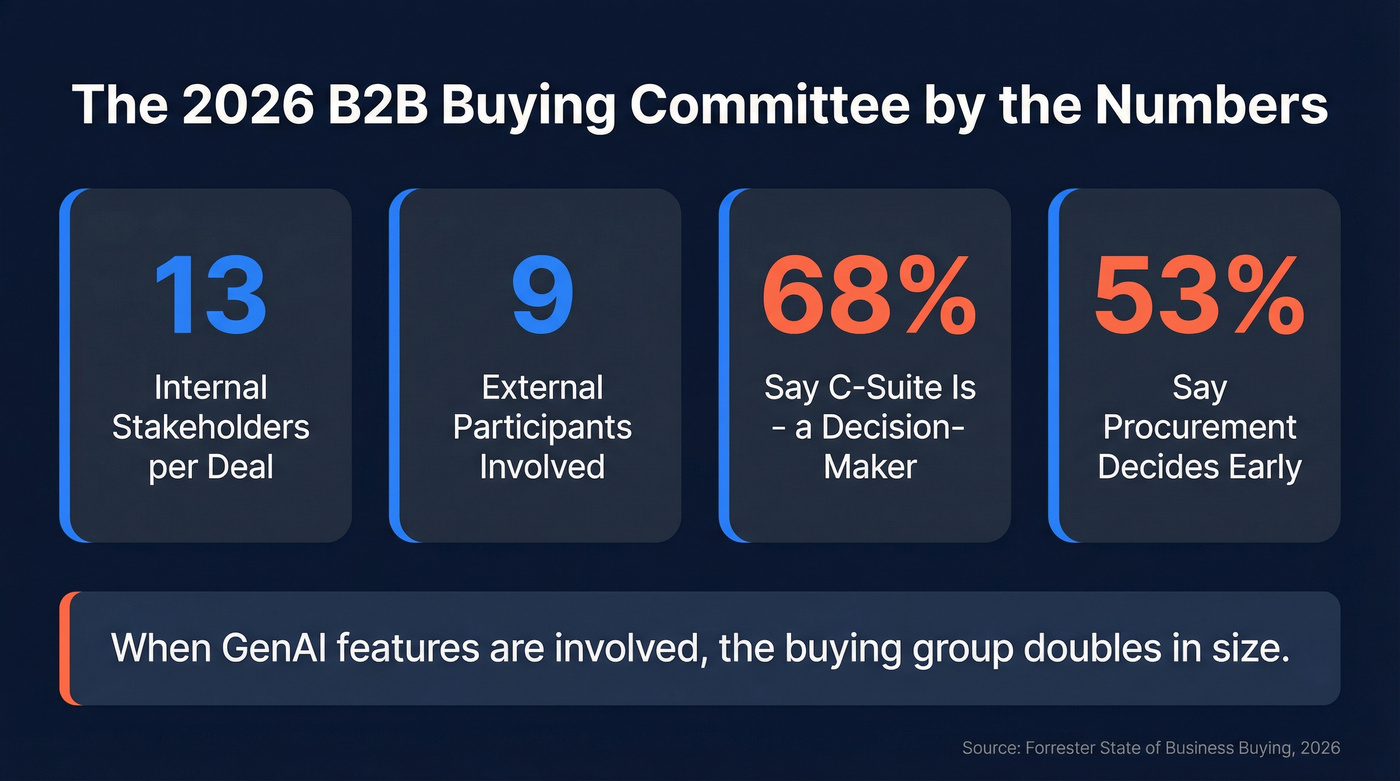
Forrester's State of Business Buying, 2026 paints a clear picture: 13 internal stakeholders and 9 external participants touch the average B2B purchase. Procurement is identified as a decision-maker by 53% of respondents - involved from the earliest stages, not just at contract review. C-suite leaders are flagged as decision-makers by 68%. And over 60% of buyers engaged in a trial or proof-of-concept before committing, which means your stakeholder meeting is part of an active evaluation, not a passive briefing.
When purchases include generative AI features, the buying group doubles in size. That's not a typo. GenAI purchases pull in compliance, data governance, security, and AI ethics stakeholders who didn't exist in buying cycles two years ago. And here's the kicker: 36% of buyers said genAI research made them more confident, but 20% said it made them less confident. That split means your stakeholders are walking into the room with contradictory conclusions drawn from the same technology.
It gets worse. A typical buying group of 6-10 decision-makers each brings 4-5 pieces of independent research. That's 30-50 conflicting data points before anyone opens your proposal. Your meeting has to reconcile all of them - or the deal stalls.
Preparation That Prevents Disasters
Map Every Stakeholder to a Role
Teams that adopt MEDDIC see 20-30% higher close rates. The framework works because it forces you to name what's true about the deal: who owns budget, how decisions get made, what criteria matter, and where internal support actually exists. The practical move is simple - assign each attendee a role before you're in the room improvising, identify whitespace, and fill those gaps before the meeting, not during it.
| Name | Role | Priorities | Influence | Strength (1-5) | Last Interaction |
|---|---|---|---|---|---|
| Jane D. | Economic Buyer | Budget, ROI | High | 3 | Demo (Mar 4) |
| Tom R. | Champion | Workflow gains | Medium | 5 | Call (Mar 10) |
| Sarah K. | Tech Evaluator | Integration, security | High | 2 | Email (Feb 28) |
| Mike L. | Coach | Internal politics | Low | 4 | 1:1 (Mar 8) |
| Lisa P. | Blocker | Compliance risk | Medium | 1 | None |
That last row is the one that kills deals. Lisa has medium influence, you've never spoken to her, and her priority is compliance risk. If you don't address her concerns in the meeting, she'll raise them in an internal review you're not invited to.
Find Contact Data for Every Attendee
A pattern we see constantly: you're prepping for an 11-person stakeholder meeting, and you have direct contact info for three of them. The other eight? You're relying on your champion to forward emails, make introductions, and relay follow-up materials. That "champion bottleneck" is where committee-driven deals go to die. That's not a sales process. It's a game of telephone. (This is also where B2B contact data decay quietly wrecks follow-up.)
Coach Your Champion 48-72 Hours Out
The days before a committee meeting matter more than the meeting itself.
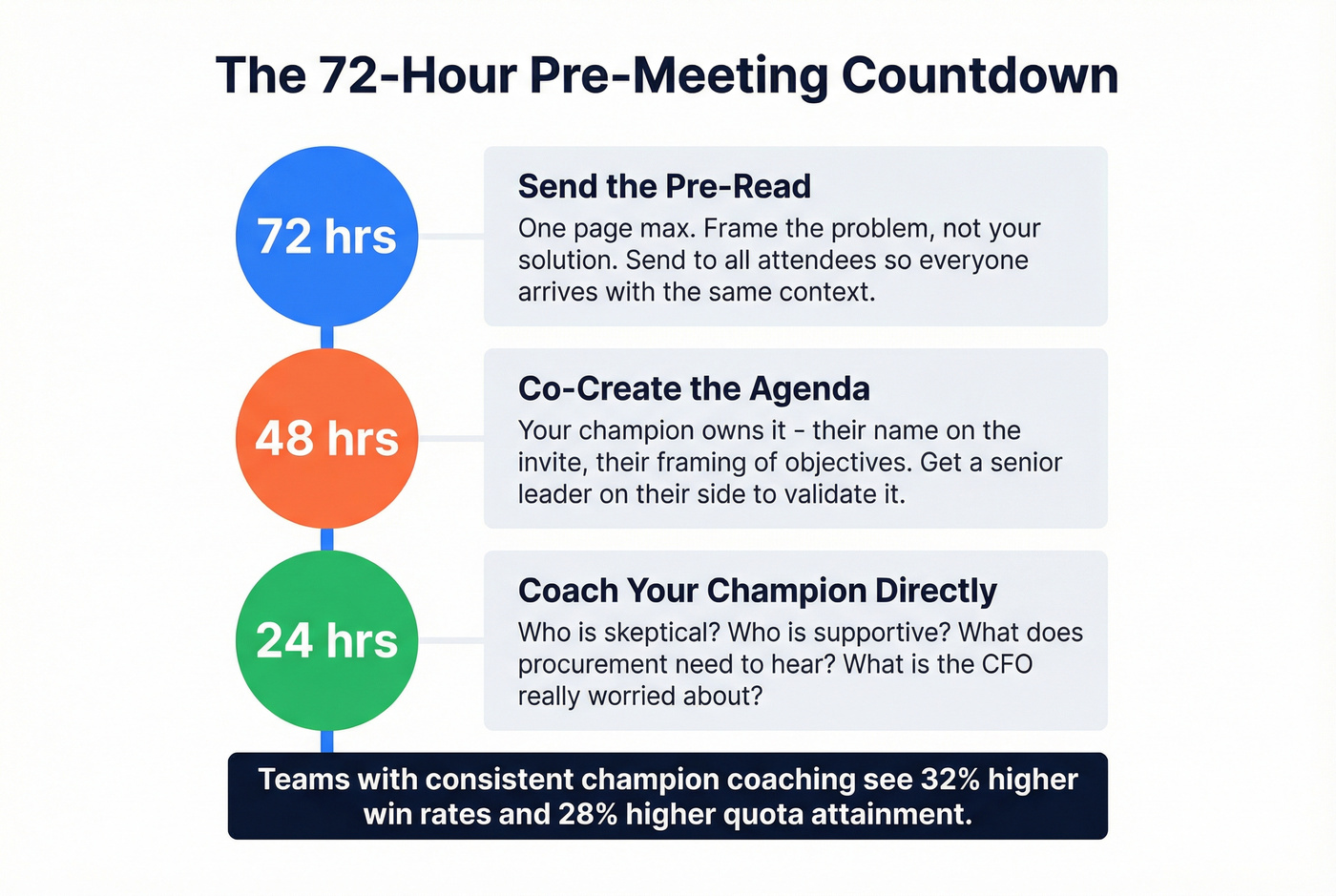
72 hours out: Send a pre-read to all attendees. One page max. Frame the problem, not your solution.
48 hours out: Co-create the agenda with your champion. They should own it - their name on the invite, their framing of the objectives. Build executive sponsorship by having a senior leader on their side validate the agenda.
24 hours out: Coach your champion directly. Who's skeptical? Who's supportive? What does procurement need to hear? What's the CFO's real concern?
This isn't optional. Consistent sales coaching correlates with 32% higher win rates and 28% higher quota attainment. Your champion is your proxy in rooms you'll never enter. Invest in them. (If you need a system, start with sales coaching best practices.)

You mapped 11 stakeholders but only have direct contact info for 3. That champion bottleneck kills committee deals. Prospeo gives you verified emails (98% accuracy) and direct dials for every person on the buying committee - across 300M+ profiles with 30+ filters including job role, seniority, and department.
Reach every stakeholder directly. No more games of telephone.
The Meeting Agenda: Align, Impact, Commit
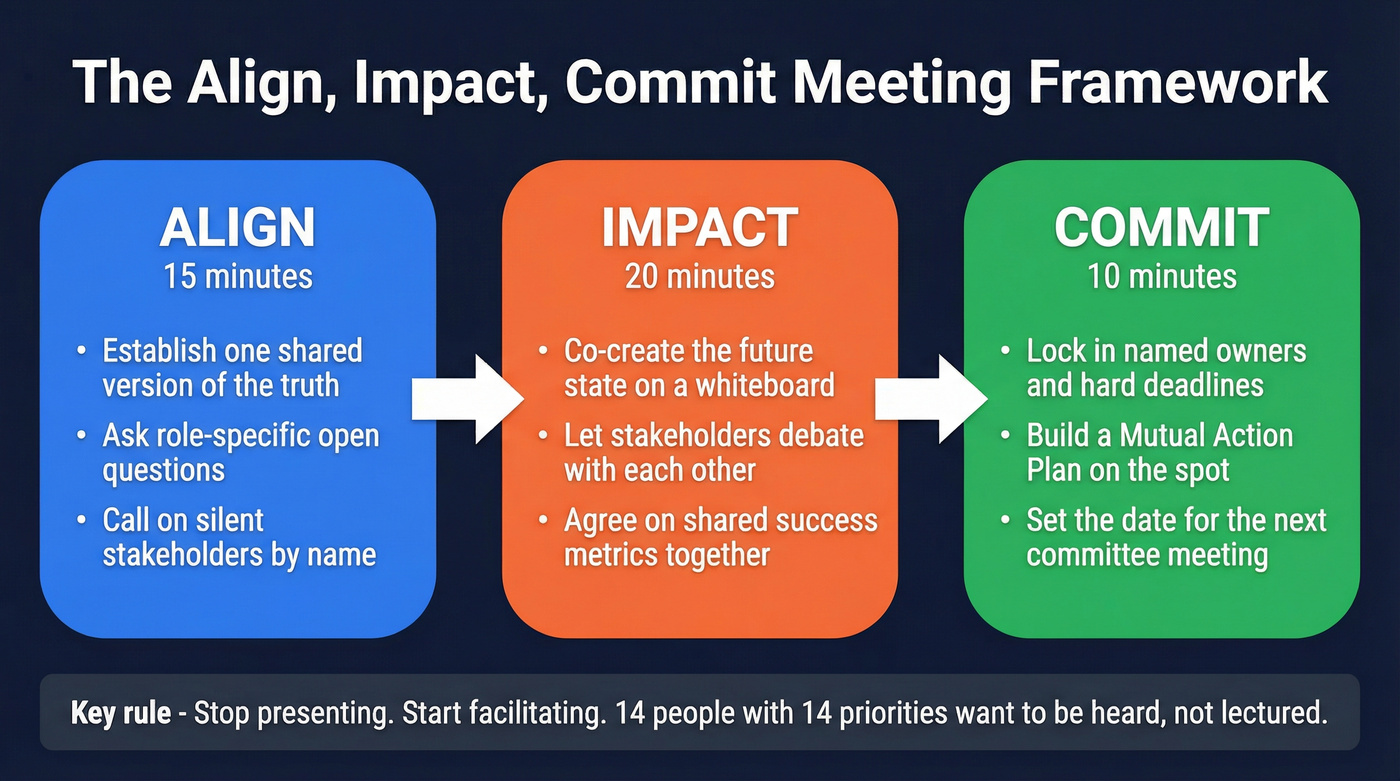
The Winning by Design stakeholder meeting blueprint frames these sessions as alignment and co-creation, not presentation. The moment you start presenting, you've lost the room - 14 people with 14 different priorities don't want to watch slides. They want to be heard. (If your team still defaults to decks, use this sales presentation guide to reset the approach.)
Hot take: If your deal size is under $50k, you probably don't need a 45-minute meeting with 14 people. Skip it. A tighter group of 5-7 with a 30-minute Align, Impact, Commit session will close faster. Save the full committee for six-figure deals where consensus is genuinely required.
Align - Establish the Current State
Get everyone on the same page about what's true today. In a typical buying group, there are 10 different versions of the truth floating around. Your job in the first 15 minutes is to collapse those into one shared reality.
Ask open questions directed at specific roles: "Sarah, from a technical standpoint, what's working today? Where are the gaps?" "Tom, from an ops perspective, what does the current workflow cost you in hours per week?" Don't let anyone hide behind silence - if someone hasn't spoken in the first ten minutes, call on them by name and role. (Keep a bank of open-ended sales questions ready.)
Bring a second person from your team whose only job is to take notes. You can't facilitate and transcribe simultaneously. For in-person meetings, sketch a seating map with names and roles so you can track who raised which concern. For virtual meetings, keep a visual attendee map with roles visible on your second screen.
Impact - Co-Create the Future State
This is where deals are won or lost.
Co-create the future state on a whiteboard. When the CFO sees her metric on the board, it becomes her initiative, not your pitch. We've watched this dynamic play out dozens of times - the shift from "vendor presentation" to "our shared project" happens the moment a stakeholder picks up a marker or types into a shared canvas.
Work toward shared metrics: revenue impact, time saved, risk reduced. These shared metrics often become the decision criteria later in the process. If you can get the room to agree on what success looks like, you've done 80% of the work. Let stakeholders debate with each other - that's alignment happening in real time, and it's far more persuasive than anything you could say.
Commit - Lock In Owners and Deadlines
If nobody commits to anything before the call ends, the deal goes dark. Great conversation, lots of nodding, zero follow-through. We've all been there.
Before anyone leaves, capture these specifics:
- Decision process: Who approves what, and in what order? Use a RACI or DACI framework if the group is large.
- Mutual Action Plan: Specific next steps with named owners and hard deadlines. "We'll review the security docs" isn't a commitment. "Sarah will complete the security review by March 21 and share findings with the group" is.
- Timeline: When does the buying committee reconvene? What needs to happen before that date?
A Mutual Action Plan is the structural backbone of every committee-driven deal. Hope isn't a strategy. (If deals keep stalling here, diagnose your sales pipeline challenges.)
Navigating Virtual and Hybrid Meetings
Many enterprise stakeholder meetings are now video-first. That changes the dynamics more than people admit.
Camera-on is non-negotiable - state it in the invite. People behave differently when they're visible. Pre-reads matter even more virtually because you can't read body language and adjust on the fly, so front-load context and make the meeting discussion, not education.
Use digital whiteboarding tools like Miro, FigJam, or Mural instead of screen-sharing slides. Shared canvases keep remote participants engaged in a way that a static deck never will. Assign someone on your team to monitor chat and surface questions at natural breaks.
Watch for invisible attendees - people who join, mute, and never speak. Call on them directly: "Lisa, we haven't heard your perspective on the compliance piece. What's top of mind for you?" Silence from a stakeholder is a risk signal, not agreement.
Role-Specific Follow-Up
One generic recap email sent to 14 people with 14 different priorities. That's malpractice.
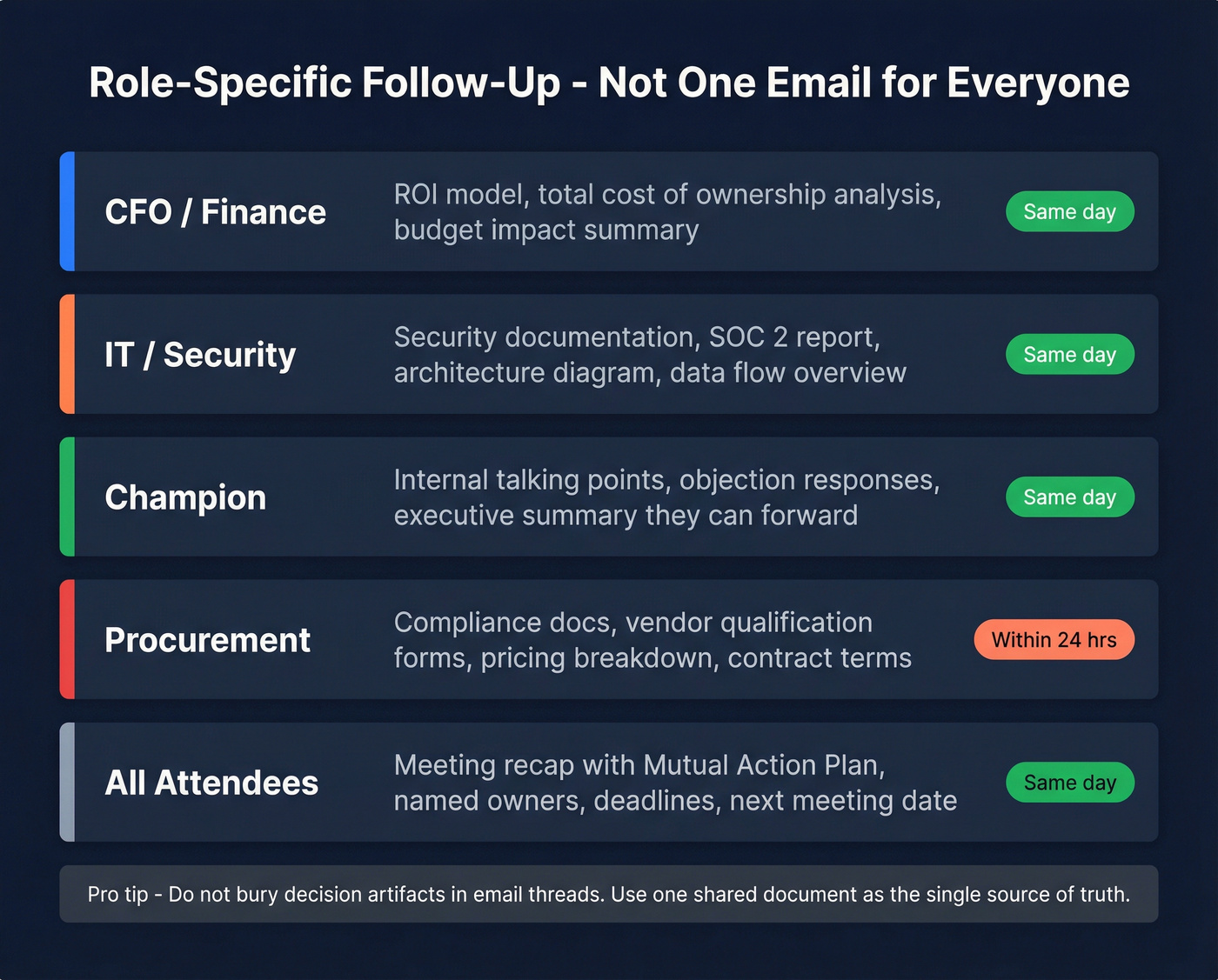
| Stakeholder | Follow-Up Content | Timing |
|---|---|---|
| CFO / Finance | ROI model, TCO analysis | Same day |
| IT / Security | Security docs, SOC 2, architecture diagram | Same day |
| Champion | Internal talking points, objection responses | Same day |
| Procurement | Compliance docs, vendor forms, pricing | Within 24 hrs |
| All attendees | Meeting recap + MAP with owners/deadlines | Same day |
Don't bury decision artifacts in email threads - they get lost. Use a shared document as the single source of truth for the Mutual Action Plan. Every stakeholder should be able to see their commitments, deadlines, and the overall timeline in one place.
Maintain a 48-hour check-in cadence with your champion and a weekly MAP review with the broader group. Every touchpoint should reference specific commitments from the meeting - not generic "just checking in" language. Your champion won't reliably carry your ROI model to the CFO with the right context. Reach the CFO directly - pull verified contact data from professional profiles in one click and send that TCO analysis straight to the person who needs it. (If you need a tighter cadence, borrow from this prospect follow up playbook.)
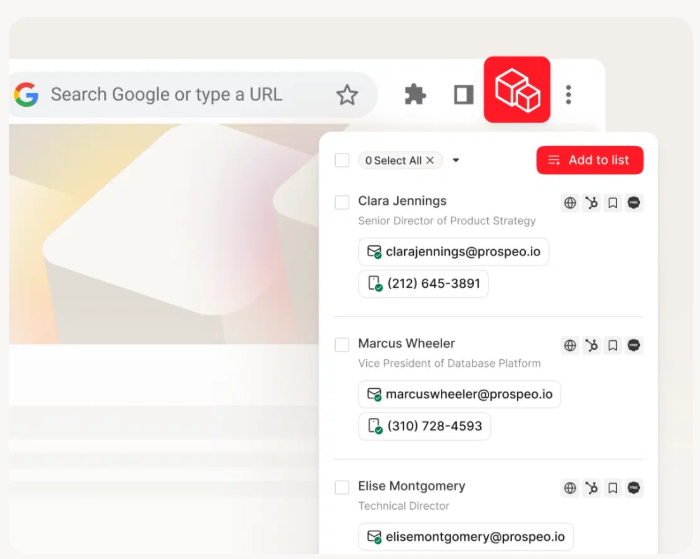
Coaching your champion 48 hours before a 14-person meeting means nothing if you can't follow up with each stakeholder individually. Prospeo's Chrome extension lets you pull verified emails and mobile numbers for every attendee in one click - so your post-meeting outreach hits every decision-maker, not just the ones who gave you a business card.
Follow up with the full committee, not just your champion.
Mistakes That Kill These Deals
No pre-alignment with your champion. Walking into a 14-person meeting without knowing who's skeptical and what procurement needs is like showing up to a board meeting without reading the packet. Ask the right questions 48 hours before.
Presenting instead of co-creating. The moment you share your screen and click through slides, you've turned 13 stakeholders into an audience. Audiences don't buy. Whiteboard. Ask questions. Let them argue.
One generic follow-up email. The CFO doesn't care about the integration timeline. IT doesn't care about the ROI model. Tailor every follow-up to the stakeholder's role.
Ignoring procurement until the contract stage. Procurement is a decision-maker in 53% of deals from the earliest stages. Invite them early. Give them what they need upfront.
No decision process established before the meeting. If you don't know who approves what, in what order, and by when - you don't have a deal. You have a conversation.
FAQ
How many stakeholders are in a typical B2B buying group?
The average B2B purchase in 2026 involves 13 internal stakeholders and 9 external participants, per Forrester. Gartner's widely cited figure is 6-10 decision-makers, each bringing 4-5 pieces of independent research. When generative AI features are part of the purchase, the buying group doubles.
What framework works best for stakeholder mapping?
MEDDIC is the gold standard for complex, committee-driven deals. Map each attendee to a role - Economic Buyer, Champion, Technical Evaluator, Coach, or Blocker - and score relationship strength from 1-5. Teams using MEDDIC consistently report 20-30% higher close rates.
What's the best agenda format for multi-stakeholder sales meetings?
Align, Impact, Commit. Spend 10-15 minutes establishing the current state, 15-20 minutes co-creating the future state on a whiteboard, and 10 minutes locking in owners and deadlines with a Mutual Action Plan. Skip the slide deck - facilitate a conversation instead.
How do you get direct contact info for every attendee?
Use a B2B data platform before the meeting to look up each attendee individually. Prospeo's Chrome extension lets you pull verified emails and direct dials from company websites or professional profiles in one click - 98% email accuracy across 300M+ profiles. This eliminates the champion bottleneck for post-meeting follow-up.