

How to Write a Networking Follow Up Email That Actually Gets a Reply
You met someone great at a conference. You swapped cards, had a real conversation, maybe even talked about collaborating. Now you're staring at a blank draft, cursor blinking, wondering how to say "hey, remember me?" without sounding desperate. Meanwhile, that person's inbox just absorbed another batch of the roughly 121 emails they get every day. Your networking follow up email is competing with all of them.
Three Rules Before You Write
- Send within 24 hours. Response rates drop 50% after 72 hours post-conference.
- Keep it under 5 sentences with one specific detail from your conversation. Not "great to meet you" - the book they recommended, the problem they described, the joke about the hotel coffee.
- Nail the subject line. 35% of recipients decide whether to open based on the subject line alone.
Why Following Up Matters
Conference contacts get 5x the response rate compared to cold outreach. Most people waste that advantage by never sending the email. The number-one reason, according to threads on r/MBA, isn't laziness - it's fear of being annoying.
Here's the thing: not following up is worse than a mediocre follow-up. A Belkins study analyzing 16.5M cold emails across 93 business domains found that the highest reply rate - 8.4% - came from the very first email, with performance declining on each additional touch. Even in cold outreach contexts, your first post-event message is your best shot. Don't overthink it. Just send it.
When to Send Your Follow-Up
The 24-48 hour window isn't arbitrary. Memory fades fast, and so does goodwill. Wait a week and you're essentially cold-emailing someone who vaguely remembers your face.
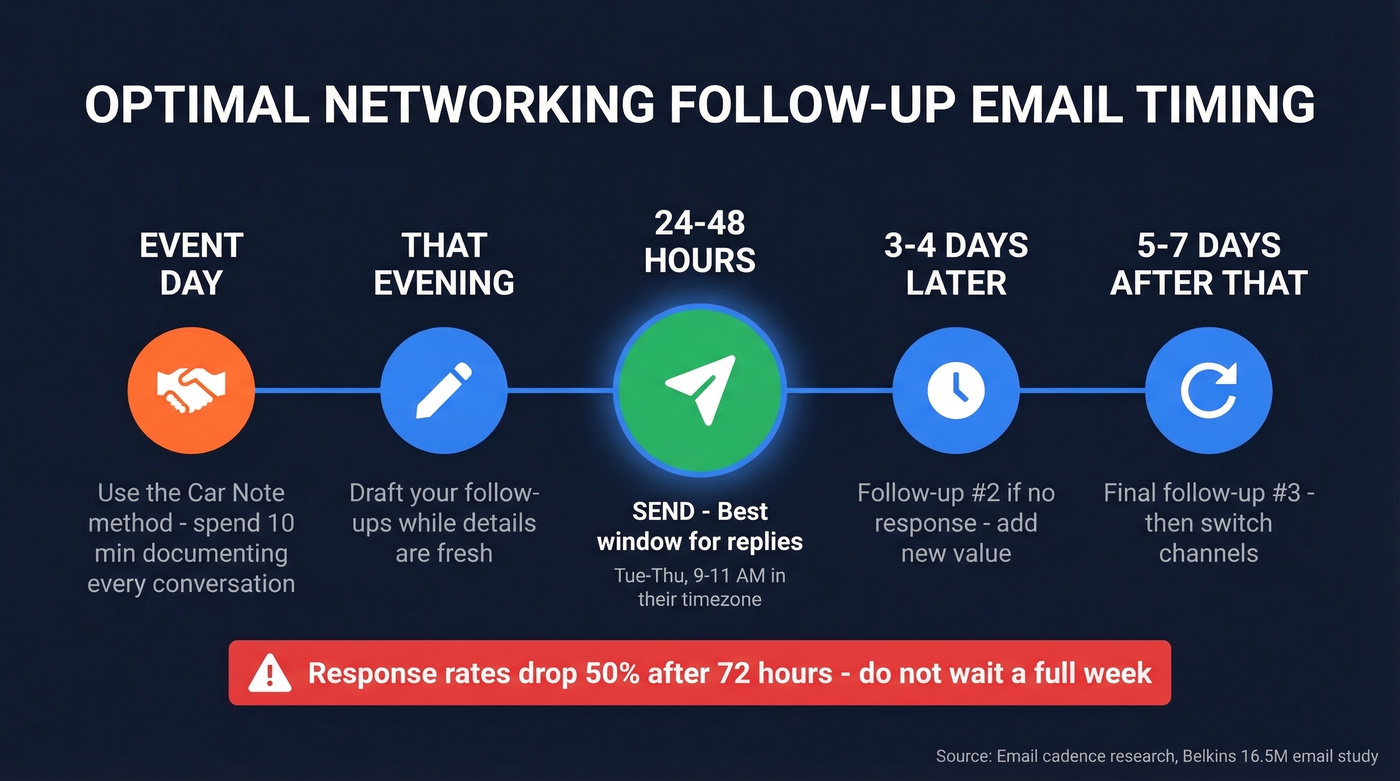
Best send times: Tuesday through Thursday, 9-11 AM in the recipient's timezone. That's when open rates peak across most email cadence research. Avoid Monday mornings (inbox triage mode) and Friday afternoons (mentally checked out).
The real hack happens before you sit down to write. Use the Car Note method - spend 10 minutes immediately after the event, in the car, on the train, in the elevator, documenting every conversation worth following up on. Names, topics, promises made, anything specific. This raw material is what turns a generic "great to meet you" into something they'll actually reply to. We've found that the notes you jot down in those first ten minutes are worth more than an hour of trying to reconstruct conversations the next morning.
- ✅ Document conversations within 10 minutes of leaving
- ✅ Draft follow-ups that evening or early next morning
- ✅ Schedule sends for 9-10 AM in their timezone
- ✅ Prioritize the 3-5 contacts who matter most
Subject Lines That Get Opened
69% of recipients will mark an email as spam based on the subject line alone. That stat should terrify you into caring about these few words more than the body copy.
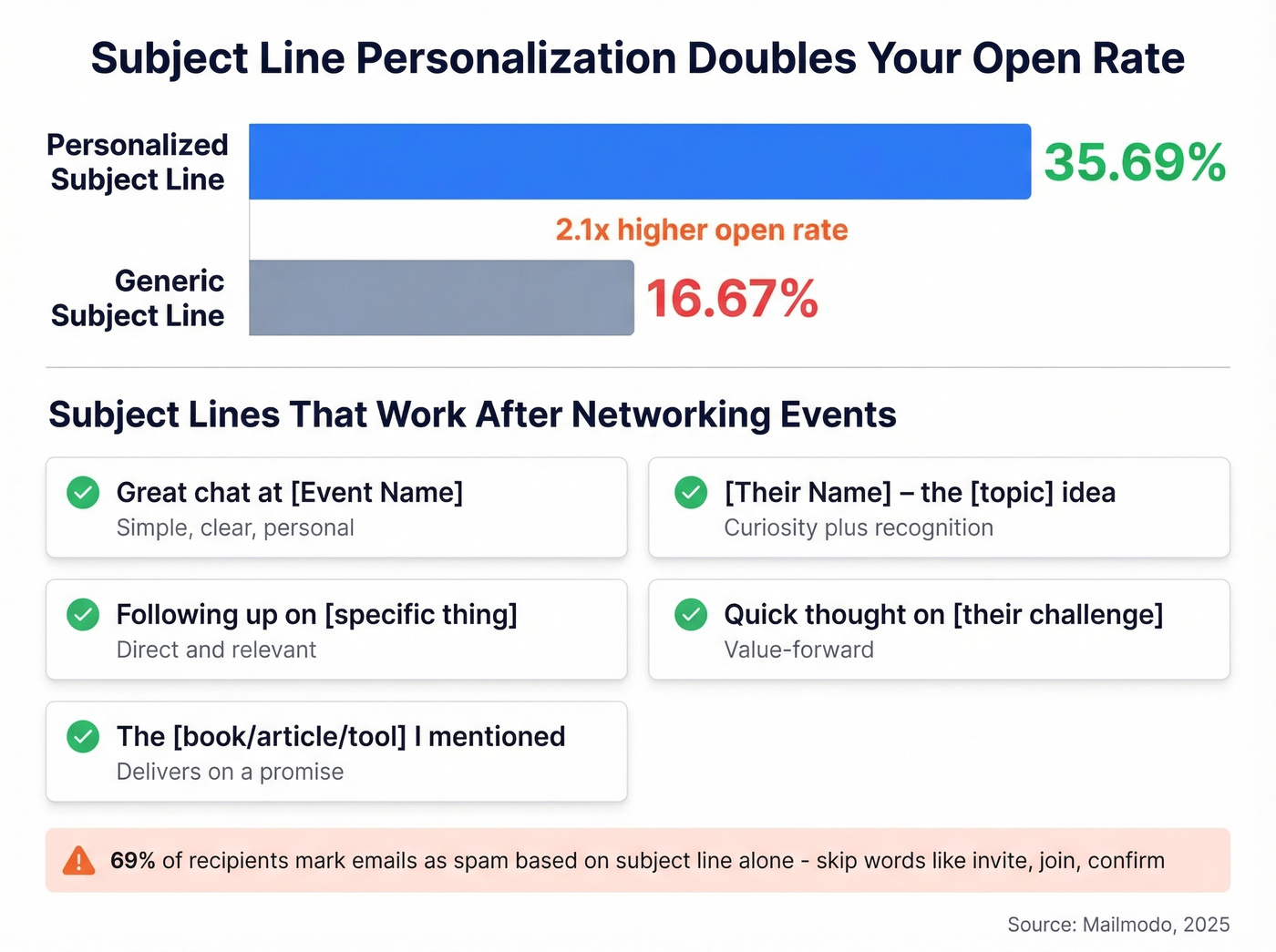
Personalization is the biggest lever. Personalized subject lines pull a 35.69% open rate vs 16.67% for generic ones - more than double. The fix is dead simple: include the event name, their name, or a topic you discussed. Keep it around 17-40 characters so it doesn't get chopped on mobile. If you want more ideas, borrow from these email subject line examples.
These subject lines consistently perform well after networking events:
- "Great chat at [Event Name]" - simple, clear, personal
- "[Their Name] - the [topic] idea" - curiosity + recognition
- "Following up on [specific thing]" - direct and relevant
- "Quick thought on [their challenge]" - value-forward
- "The [book/article/tool] I mentioned" - delivers on a promise
Skip words like "invite," "join," and "confirm." They trigger spam filters and read like marketing. If you're testing deliverability, run a quick check with an email spam checker.
Writing the Perfect Follow-Up
Five-part formula. Works for conferences, coffee chats, informational interviews, and everything in between.
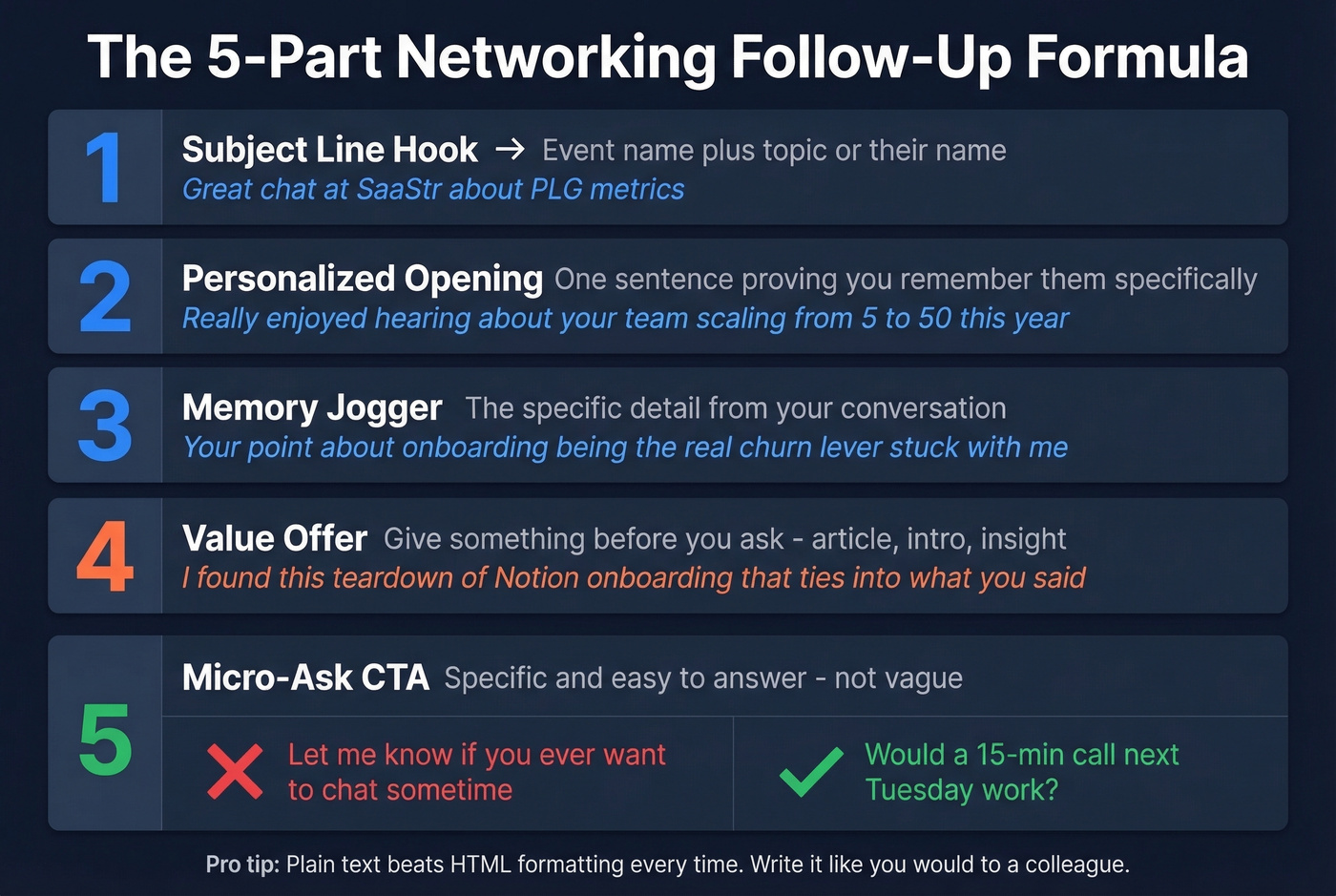
- Subject line hook - event name + topic or their name
- Personalized opening - one sentence proving you remember them specifically
- Memory jogger - the specific detail from your conversation
- Value offer - give something before you ask (an article, an intro, a relevant insight). If you need a framework for this, see how to add value in sales.
- Micro-ask CTA - not "let me know if you'd like to chat sometime." Try "Would a 15-minute call next Tuesday work?" (More options in this guide on email wording to schedule a meeting.)
Plain text beats HTML formatting. No logos, no signatures with 14 social icons. Write it like you'd write to a colleague. If you want more proven structures, adapt these sales follow-up templates.

You nailed the conversation and wrote the perfect follow-up - but it bounced. 35% of professional emails go stale within a year. Prospeo verifies every email through a 5-step process with 98% accuracy, so your networking follow-ups actually land.
Don't let a bad email address waste a great connection.
Templates for Every Scenario
Six templates you can steal and customize. The personalization placeholders are where the magic happens - don't skip them.
After a Conference or Event
Subject: Great connecting at [Event Name]
Hi [Name], really enjoyed our conversation about [specific topic] at [Event]. Your point about [specific detail] stuck with me.
I came across [article/resource] that ties into what you mentioned: [link].
Would you be open to a 15-minute call next week?
[Your name]
After a Coffee Chat
Subject: Thanks for the coffee, [Name]
Hi [Name], your advice on [specific takeaway] was exactly what I needed - especially the part about [detail].
Would it make sense to reconnect in a month once I've [applied their advice]?
[Your name]
This works because there's no immediate ask. You're signaling you'll actually act on their advice, which flatters and builds trust.
After an Informational Interview
Subject: Appreciate your time, [Name]
Hi [Name], the way you described [specific insight] gave me a much clearer picture of [industry/role]. I'll be [applying that advice] this week.
Happy to return the favor - if I can ever help with [your area of expertise], say the word.
[Your name]
To a Senior Executive or Speaker
Keep this one brutally short. Executives scan.
Subject: Your [Event] talk on [topic]
Hi [Name], your session on [topic] was the highlight of the day. The insight about [one specific point] is something I'm bringing back to my team.
Thanks for sharing it.
[Your name]
No ask. No "can I pick your brain." Just genuine appreciation with a specific detail. If they reply, you've earned the right to ask for something later.
To a Peer or Colleague
Subject: [Event] - let's keep this going
Hey [Name], sounds like we're both dealing with [shared challenge]. I just finished [article/book/project] relevant to what you mentioned about [topic] - want me to send it over?
Also happy to jump on a quick call to swap strategies.
[Your name]
Re-Engagement After a Long Gap
Subject: [Name] - been a while
Hi [Name], I saw [their recent news] and it reminded me of our conversation about [topic] at [Event]. Congrats on [the news].
Would love to catch up for 15 minutes this month if you're open to it.
[Your name]
Across all of these, avoid "just checking in" as an opener. It signals you have nothing to say. Every follow-up should give a reason for the email to exist.
How Many Follow-Ups to Send
Three emails total. One initial follow-up plus two additional touches if they don't respond. That's it.
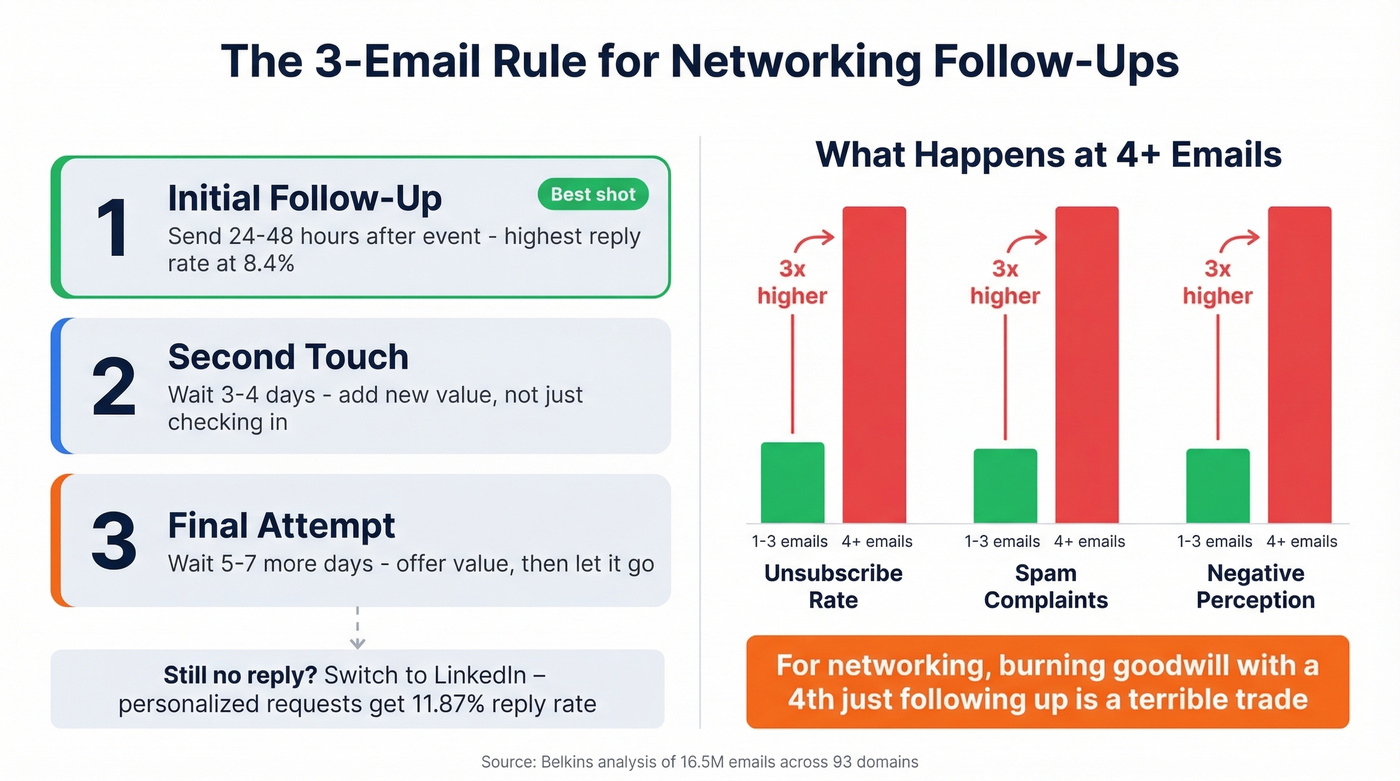
Space them out: 3-4 days after the first, then 5-7 days after that. This cadence balances persistence with respect, and it's backed by Mailreach's research on optimal follow-up timing. If you're unsure when to nudge again, use this guide on when should i follow up on an email.
Why not push beyond three? Data from the same 16.5M-email dataset shows that 4+ emails in a sequence triple unsubscribe rates and more than triple spam complaints. For networking - where the relationship is the whole point - burning goodwill with a fourth "just following up" is a terrible trade.
After three emails with no response, switch channels. A personalized message on a professional network paired with a profile visit hit an 11.87% reply rate in the same dataset. Sometimes people just don't live in their inbox.
Mistakes That Kill Your Reply Rate
These are the patterns we see over and over. All fixable.
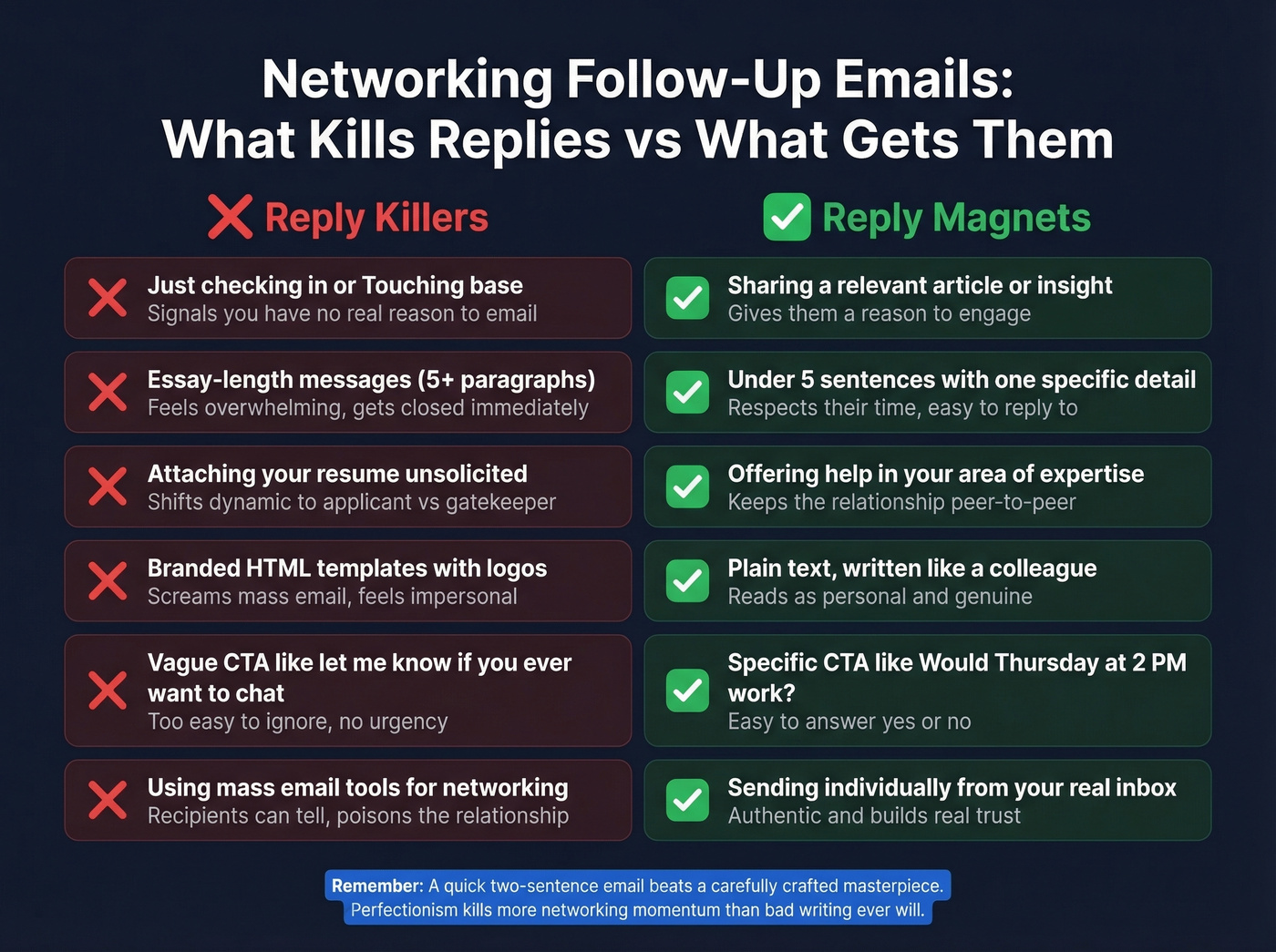
"Just checking in" / "Touching base" tells the recipient you have no real reason to email. Most follow-up guides flag this, yet people keep doing it. Essay-length messages are another killer - a common pattern on r/linkedin is someone writing a long, heartfelt message asking for 15 minutes, and the recipient feels overwhelmed and closes the tab. Attaching your resume unsolicited shifts the dynamic from peer-to-peer to applicant-to-gatekeeper unless they specifically asked for it. If you need alternatives, here are better ways on how to say just checking in professionally.
On the formatting side, branded HTML templates with logos scream "mass email." Plain text reads as personal. And vague CTAs like "let me know if you'd ever want to chat" are easy to ignore, while "Would Thursday at 2 PM work?" is easy to answer.
One more: don't run networking follow-ups through mass email tools. Recipients can tell, and it poisons the relationship before it starts. If you do use tooling, keep it lightweight and personal (see follow up email software).
What to Say After No Response
Let's be honest - most people who say "let's stay in touch" at events mean it in the moment and forget by Monday. That doesn't mean the connection is dead.
After two follow-ups with no reply, wait 5-7 days and try a different channel. The key shift on attempt three: offer value instead of asking for something. Share an article relevant to their work. Congratulate them on a recent win. A well-crafted follow-up after no response reframes the conversation around what you can give, not what you need.
Still silence? Let it go. A thread on r/PublicRelations captures the anxiety perfectly - someone handed out 50 cards, two executives suggested next steps, then went quiet. Sometimes "let's stay in touch" was just politeness. Move on to the contacts who do respond.
I'll say something that might be unpopular: if the opportunity you're chasing is worth less than a few thousand dollars, you probably don't need to agonize over networking follow-ups at all. A quick two-sentence email beats a carefully crafted masterpiece every time. Perfectionism kills more networking momentum than bad writing ever will.
How to Find Their Email Address
Here's the practical blocker every other networking guide ignores: you have a name and a company, but no email address. Maybe they didn't have cards. Maybe the event app didn't share contact details.
For contacts where email doesn't surface, personalized connection requests on professional networks get accepted 7x more often than generic ones. Use that as your backup channel, but email remains the gold standard for networking follow-ups - it's more private, more professional, and doesn't compete with a social feed. If you're doing this at scale, a name to email workflow helps you move faster without guessing.
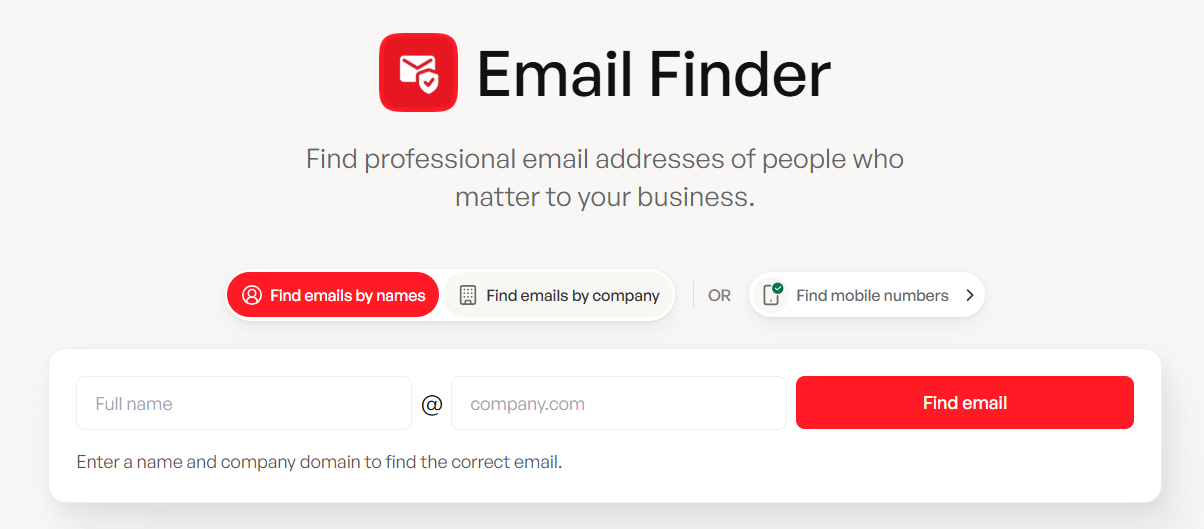
You left the event with a name and a company but no email? Prospeo's Chrome extension finds verified contact data from any LinkedIn profile or company website in one click - used by 40,000+ professionals to turn conversations into connections.
Turn every business card into a verified, reachable email address.
FAQ
How long should a networking follow-up email be?
Three to five sentences, under 150 words. Reference one specific detail from your conversation, include a clear micro-ask, and stop. Longer emails get read but not replied to - the recipient feels like responding requires matching your effort, so they put it off indefinitely.
Should I follow up via email or a professional network?
Email for executives and people you exchanged cards with. Professional networks for peers and casual industry contacts. If email gets no reply after two attempts, switch channels - a message paired with a profile visit can hit nearly 12% reply rates. The channel switch itself signals persistence without being pushy.
What if I don't have their email address?
Use an email finder tool like Prospeo - search by name and company to get a verified address in seconds. The free tier covers 75 lookups per month, which handles most post-event lists. If email truly isn't findable, a personalized connection request on a professional network is your next best move.
What should I say in a follow-up after no response?
Lead with value, not a repeat of your original ask. Share a relevant article, congratulate them on a recent achievement, or reference something new in their industry. Keep it to two or three sentences - the goal is to restart the conversation, not guilt them into replying.