

How to Build a New Product Sales Presentation That Actually Wins Deals
Every sales presentation guide on the internet assumes you have case studies and brand recognition. This one doesn't.
A rep on r/sales described losing a massive deal because he got "feature happy" - 22 slides of technical specs, zero time on the buyer's actual problem. Deals closed within 50 days hit a 47% win rate; after that, win rates crater to roughly 20%. Your new product sales presentation doesn't have the luxury of a slow build. It needs to land fast, land hard, and work without you in the room.
Nine slides. Lead with the buyer's problem, not your company story. Use "borrowed proof" instead of testimonials you don't have yet. And reach the full buying committee - not just one champion.
Why New Products Are Harder to Sell
Gartner data shows buyers spend just 17% of their buying time meeting with suppliers. The rest is independent research, internal alignment, and comparing you to alternatives they found on their own.
Here's the thing: your deck has to sell when you're not presenting it. Buying committees at mid-sized firms average 7 people. Your champion will forward your slides to 6 colleagues who've never heard your voice and have maybe 4 minutes of attention to give. Personalized decks get 68% more complete reads and are shared internally 2.3x more often - so generic slides die in someone's inbox.
The 9-Slide Template
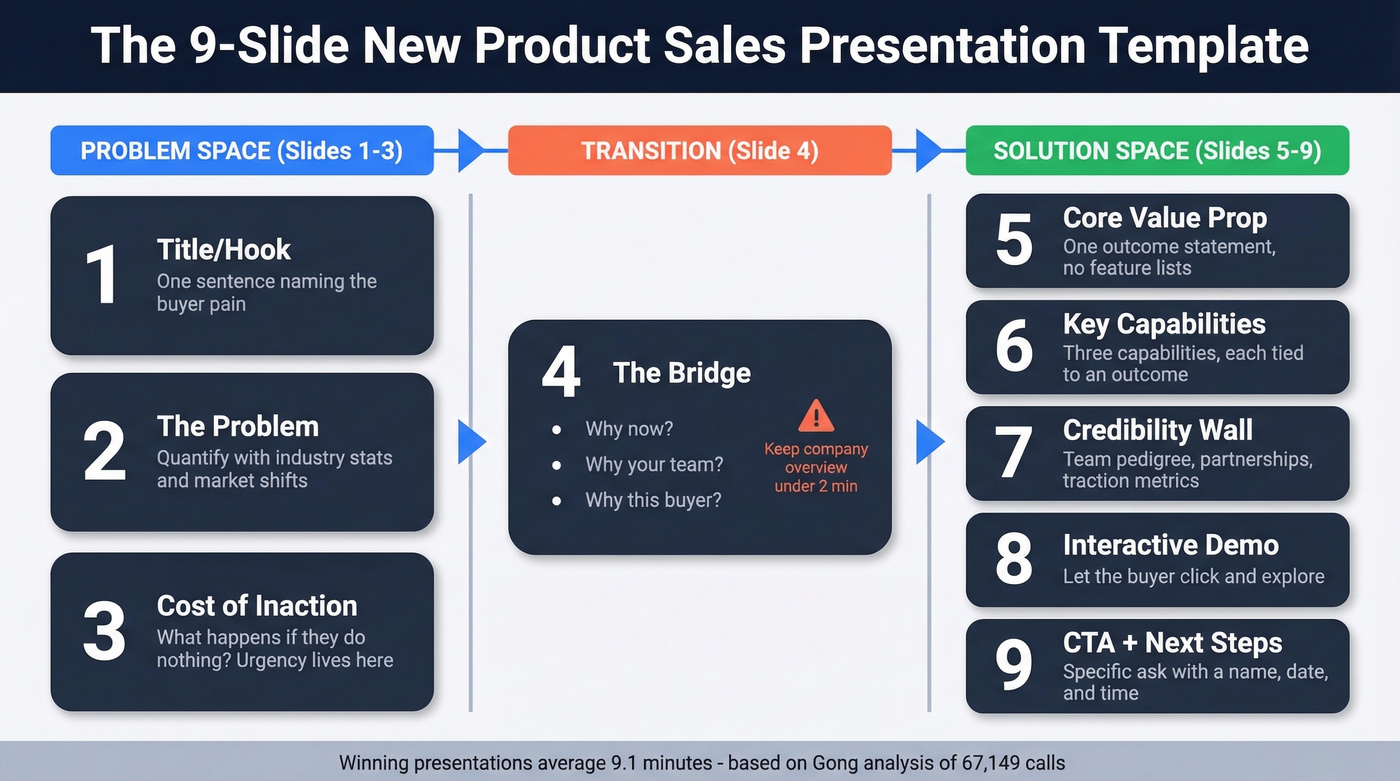
This framework draws from a proven 3-part structure (Problem Space, Transition, Solution Space) and is informed by Gong's analysis of 67,149 recorded sales presentations. Winning presentations average 9.1 minutes. Every slide earns its place.
Problem Space (Slides 1-3)
Slide 1 - Title/Hook. One sentence that names the buyer's pain. Not your product name, not your logo, not your founding story.
Slide 2 - The Problem. Quantify it with industry stats, market shifts, or regulatory changes. Gong data shows winning demos follow an "upside-down pyramid" - start with the buyer's top priority, not yours.
Slide 3 - Cost of Inaction. What happens if they do nothing? This is where urgency lives. Don't save it for the end.
Transition (Slide 4)
You've spent 6 months building this product. Don't waste the first 5 minutes on your company's founding story - win rates drop when company overviews exceed 2 minutes early in the presentation. Slide 4 answers three questions in one frame: Why is this the right moment? Why is your team the one to solve it? Why is this specific buyer the right fit?
Solution Space (Slides 5-9)
Slide 5 - Core Value Prop. One clear statement of what you do and the outcome it creates. No feature lists. No architecture diagrams.
| Slide 6: Do This | Not That |
|---|---|
| Pick three capabilities, show the outcome each drives | List every feature and hope something sticks |
| "Cuts onboarding from 6 weeks to 3 days" | "AI-powered onboarding module" |
Slide 7 - Credibility Wall. Team credentials from prior roles, named partnerships with specifics, traction metrics. In our experience, this is where new products win or lose. More on building this below.
Slide 8 - Interactive Demo. Don't show screenshots. Let the buyer click, explore, react. Interaction is the goal, not a monologue. (If you want a tighter flow, use a product demo checklist before you present.)
Slide 9 - CTA + Next Steps. "Can we schedule a 30-minute pilot walkthrough with your VP of Ops next Tuesday?" beats "Let us know if you're interested."
Building Credibility With Zero Case Studies
Tesla's early pitch deck raised $192M with zero customer testimonials. The sequence: team pedigree first, then partnerships with specifics - a $50M Toyota investment, a $30M Panasonic partnership - then traction metrics like 1,400 Roadsters shipped across 31 countries and 8 million miles driven.
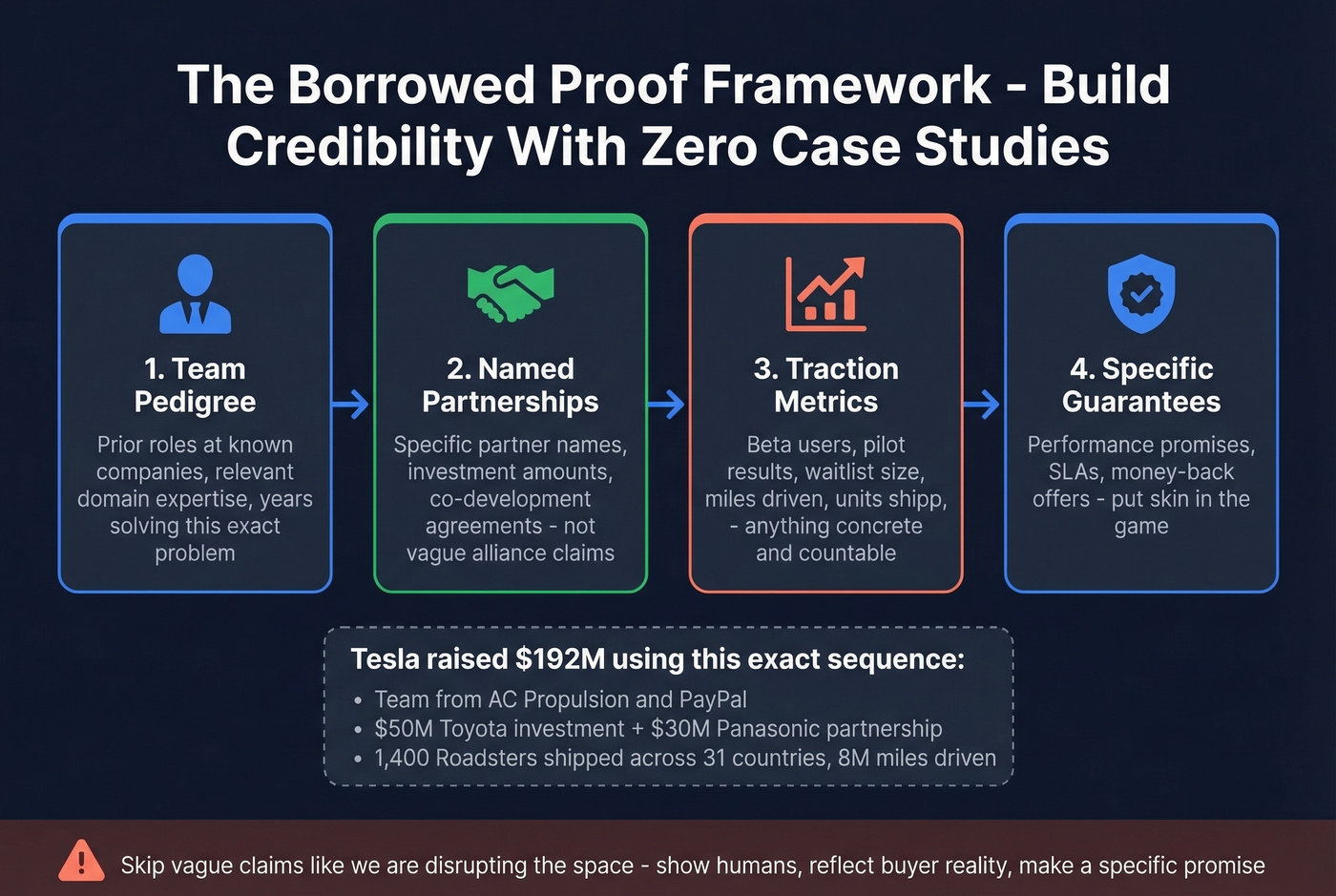
Mirror this with partner logos, industry statistics, specific guarantees, and early traction. Beta users, pilot results, waitlist size - anything concrete.
Skip vague claims like "we're disrupting the space." The product doesn't speak for itself yet. Show the humans behind it, reflect the buyer's reality back to them, and make a specific promise backed by a guarantee if you can.
5 Mistakes That Kill Your Pitch
- Company overview longer than 2 minutes. Recorded call analysis shows win rates drop sharply past the 2-minute mark. Get to the point.
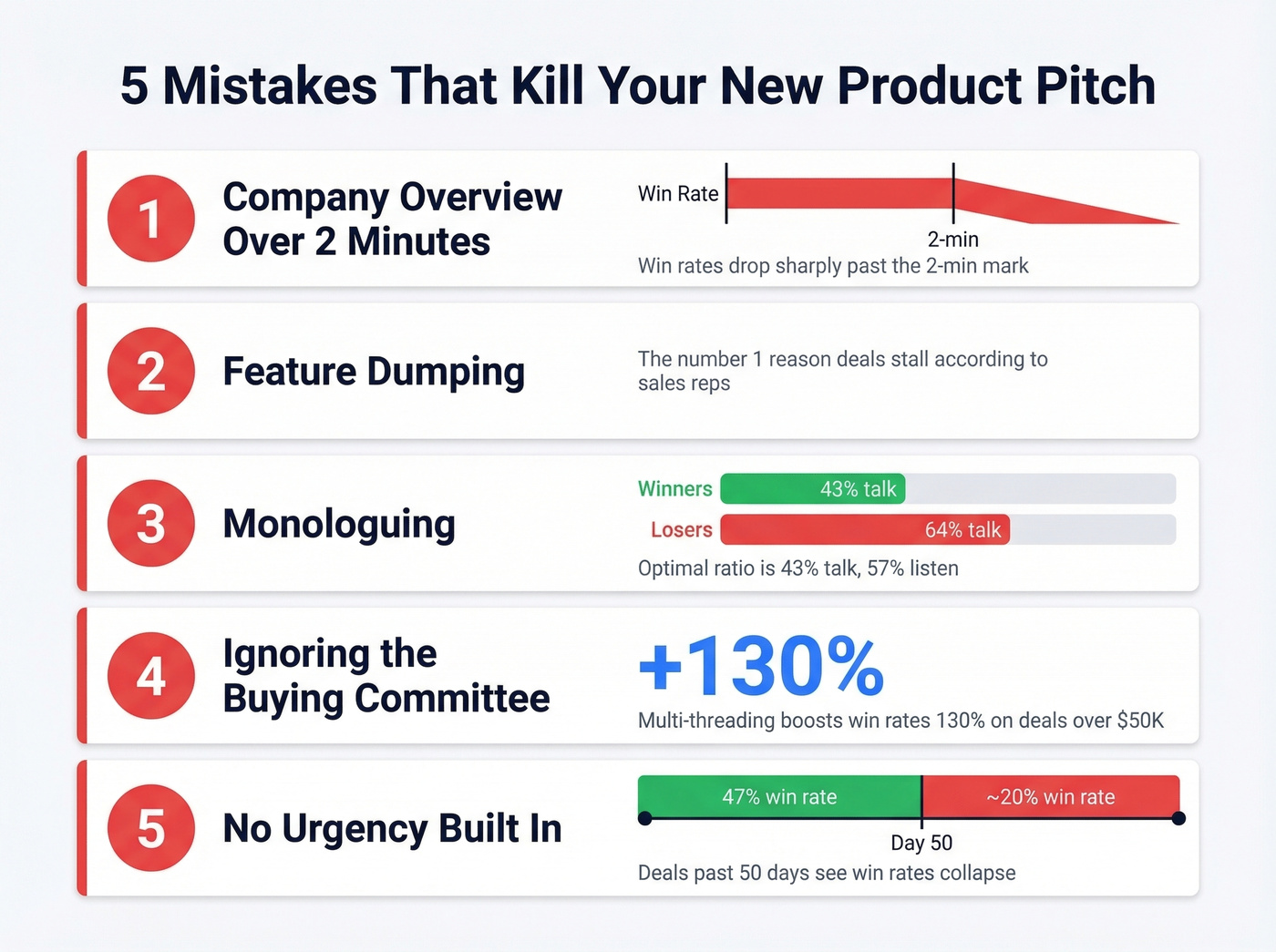
Feature-dumping. That r/sales rep who got "feature happy"? He's the norm, not the exception. Reps on r/sales consistently cite this as the #1 reason deals stall. (If you need a better narrative arc, borrow a few sales deck storytelling patterns.)
Monologuing. The optimal talk-to-listen ratio is 43% talk / 57% listen. Low performers swing to 64% talk in lost deals. Tighten your sales communication so buyers do more of the talking.
Ignoring the buying committee. Multi-threading - engaging multiple stakeholders - boosts win rates 130% on deals over $50K. Presenting to one person and hoping they'll sell internally for you is a losing bet. (This is also why account-based selling works so well for new products.)
No urgency. Deals that drag past 50 days see win rates collapse. Build time pressure into the presentation itself with cost-of-inaction framing, limited pilot slots, or competitive timing.

Multi-threading boosts win rates 130% on deals over $50K. But you can't multi-thread if you only have one contact. Prospeo's 300M+ profiles and 30+ filters - including department headcount, job changes, and buyer intent - let you map the full buying committee before you even open your slide editor.
Stop presenting to one champion and praying. Reach all seven decision-makers.
Test Your Messaging First
Before you open a slide editor, pressure-test what you're actually going to say. Most failed launches don't have a product problem - they have a message-market fit problem. The deck looks polished, but the words don't resonate with the buyer's world.
Start with a minimum viable message: one sentence that connects your product to a specific pain the buyer already feels. Run it past 5-10 prospects in discovery calls or cold outreach. If it consistently sparks follow-up questions, you've found traction. If prospects nod politely and go silent, rewrite before you build a full deck around it. (A simple ideal customer profile makes this 10x easier.)
Think of your pre-sales pitch - the informal version you'd give in an elevator or a DM - as the acid test. If that 30-second version doesn't land, 9 beautifully designed slides won't save you. If you’re stuck, steal a few sample elevator pitches and adapt them.
Delivery Tips From 67K Recorded Calls
Top performers ask 30% fewer questions but provoke a third more from buyers. They tease enough to spark curiosity instead of interrogating. Consistency in your talk-to-listen ratio matters more than nailing the exact 43/57 split - high performers keep a steady cadence whether they win or lose, while low performers swing wildly between calls. (Use a tighter set of discovery questions to guide the conversation.)
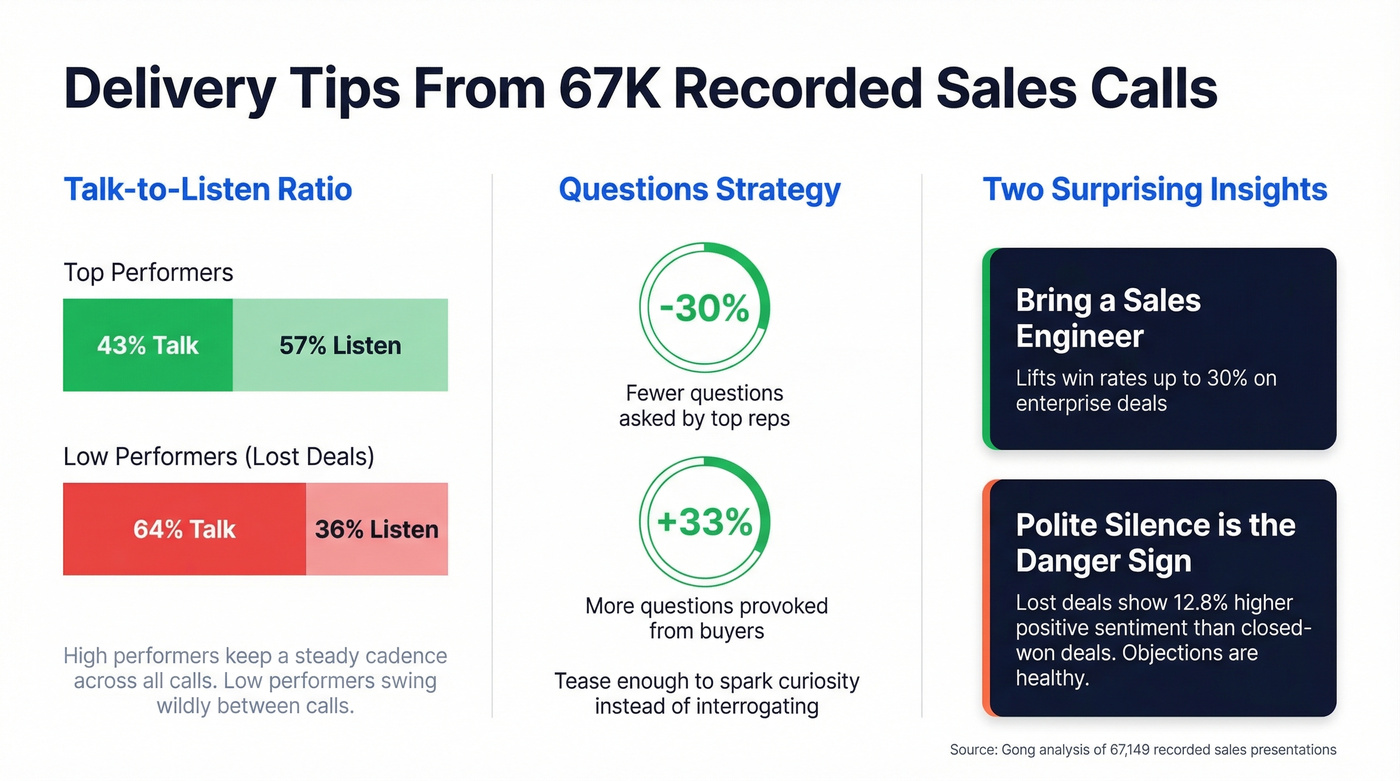
Bring a sales engineer for enterprise deals. It can lift win rates by up to 30%. If you’re selling upmarket, align your deck to an enterprise B2B sales motion.
And don't panic when buyers push back. Lost deals actually show 12.8% higher positive sentiment than closed-won deals. Objections are healthy. Polite silence is the real danger sign.
Find the Full Buying Committee Before You Present
Let's be honest: your mediocre deck reaching 5 stakeholders beats your perfect deck reaching 1. Closed-won deals have 2x as many buyer contacts as lost deals. Strategic enterprise deals average 17 contacts. Your 9-slide deck reaching one champion is a losing strategy.
We've seen this pattern over and over - reps nail the presentation, then lose because they only had one thread into the account. The fix isn't a better deck. It's better coverage. Use a B2B database like Prospeo to search 300M+ professional profiles with 30+ filters - job title, department, company size, headcount growth - and pull verified emails and mobile numbers for every decision-maker on the committee. Email accuracy sits at 98%, and the free tier gives you 75 emails plus 100 Chrome extension credits per month, so you can start mapping stakeholders before you spend a dollar. (If you’re comparing options, see our breakdown of sales prospecting databases.)

Your new product presentation needs to reach every stakeholder - with verified contact data, not guesswork. Prospeo delivers 98% email accuracy and 125M+ verified mobile numbers so your perfect deck actually lands in front of the people who sign the check. At $0.01 per email, building your launch list costs less than a cup of coffee.
Find direct dials and verified emails for every decision-maker on the deal.
AI Tools to Build Your Deck Faster
Sellers who frequently use AI generate 77% more revenue. Sales reps spend 31% of working hours creating content - these tools cut that dramatically. (If you want more options, compare generative AI sales tools before you commit.)
| Tool | Best For | Skip If... | Price Range |
|---|---|---|---|
| Gamma | Interactive, web-native decks | You need offline PPT files | Free; paid ~$10-$20/user/mo |
| Beautiful.ai | Design polish without a designer | You want a strong free plan | ~$12-$40/user/mo |
| Canva AI | Budget-friendly with a solid free tier | You need strict enterprise branding controls | Free; Pro ~$13/user/mo |
| Pitch | Real-time team collaboration | You're a solo rep | Free; paid ~$8-$20/user/mo |
Gamma is our top pick for new product decks specifically because the output is web-native - buyers can click through it without downloading anything, which matters when your champion forwards it to 6 people who won't bother opening a .pptx attachment. If you're working with a design team already, skip the AI tools and invest that time in messaging instead.
FAQ
How many slides should a new product sales presentation have?
Nine. Winning presentations average 9.1 minutes according to Gong's analysis of 67K+ calls - cover problem, transition, solution, proof, and CTA. Every slide beyond that dilutes attention and risks the "feature happy" trap.
What goes on the proof slide when you have no customers yet?
Use borrowed proof: team credentials from prior roles, partner logos, industry statistics that validate the problem, specific guarantees, and early traction metrics like beta users or waitlist size. Tesla raised $192M with this exact sequence - pedigree, partnerships, then traction numbers.
How do I find the right people to present to?
Map the full buying committee - typically 5-7 stakeholders at mid-sized firms. Search by job title, department, and company size using a B2B database, then pull verified contact info for every decision-maker instead of relying on a single champion to forward your deck.
Should I finalize my deck before testing my messaging?
No. Validate your minimum viable message with real prospects first. A few discovery calls will reveal whether your core claim resonates or falls flat - refining message-market fit early saves you from redesigning an entire deck later.