

No Response After a Follow-Up Email: What the Data Says and What to Do Next
You sent the follow-up. You waited. You refreshed your inbox eleven times before lunch. Nothing.
Getting no response after a follow-up email is one of the most common frustrations in professional communication - and one of the most misunderstood. Maybe you're a job seeker replaying every word from a final-round interview, wondering if that one answer about "your biggest weakness" torpedoed everything. Maybe you're a sales rep staring at a prospect who lit up during the demo, asked all the right questions, then vanished like they entered witness protection. Either way, the silence hits the same. With 392.5 billion emails expected daily by 2026, your message is competing with an avalanche.
The good news: the data on what actually works after silence is surprisingly clear, and most people get it wrong.
The Short Version
- If it's been less than 3-5 business days, wait. Don't follow up the next day.
- If you're following up again, add new value. Never just "bump." Aim for 25-50 words.
- Before blaming the recipient, check whether your email arrived. A 3.6% industry bounce rate across 31M emails means millions of messages never land. Verify your contacts with Prospeo's email finder before you spiral.
What the Data Actually Says
Most follow-up advice is built on vibes. The numbers tell a different story.
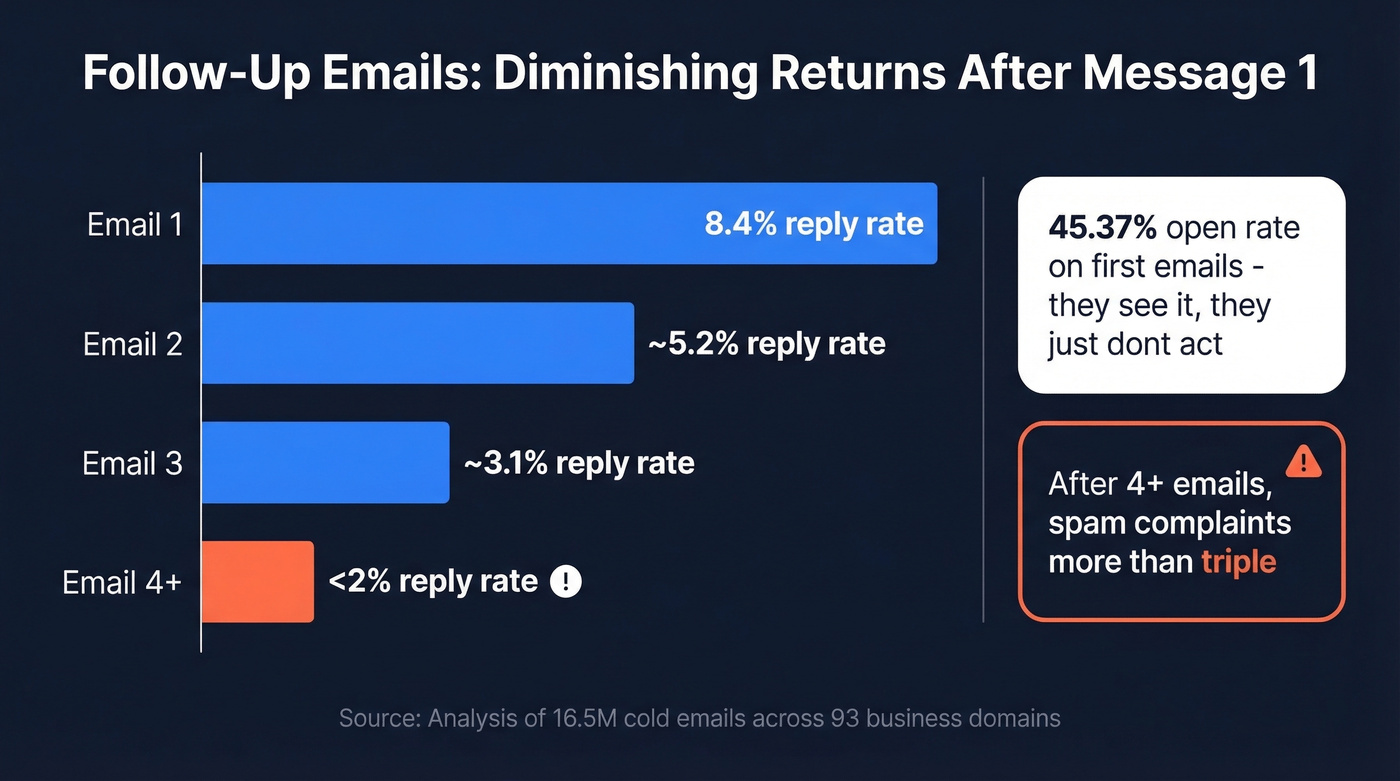
An analysis of 16.5 million cold emails across 93 business domains found something counterintuitive: the highest reply rate - 8.4% - came from the first email alone. Each subsequent follow-up saw diminishing returns, and with 4+ emails in a sequence, unsubscribes and spam complaints more than tripled. That same dataset showed a 45.37% open rate on first emails, which means people see your message. They just don't act on it.
A separate study of 31 million emails paints a more nuanced picture. Three messages versus one increases total replies by 106%. So follow-ups work - but only up to a point. The average cold email reply rate sits at just 4.5%, with a 30% open rate and a 3.6% bounce rate. For most cold outreach sequences, three total messages is the ceiling.
Why You Haven't Heard Back
The reasons for silence differ wildly depending on context. Understanding which bucket you fall into changes your next move entirely.
Job Search Reasons
Most hiring silence isn't personal - it's structural. ATS systems create delays that have nothing to do with your candidacy. Internal budget holds freeze roles mid-process. The person who interviewed you often isn't the person who makes the final call, and that handoff creates dead air.
One recruiter on r/recruiting described handling 200+ candidates per week, with roughly 70% vanishing after first contact and their own cadence stopping after 5 days. The silence goes both ways.
Sales and Outreach Reasons
Executives receive an average of 120 emails a day. Yours looked like the other 119.
Beyond inbox overload, you might be emailing the wrong person entirely. Research shows 65% of decision-makers say cold emails fail because they feel too sales-focused, and 61% cite outright irrelevance. Then there's the deliverability problem: your email may have landed in spam, bounced silently, or hit a catch-all domain that accepted it but never routed it to a human.
The Psychology of Silence
Humans are meaning-making machines, and silence is the worst possible input for that process. A Psychology Today analysis on digital communication found that people consistently interpret silence as rejection when emotional stakes are high - even when the silence has nothing to do with them.
Email strips away every nonverbal cue we normally use to read intent. No facial expressions, no tone of voice, no body language. So your brain fills the gap with the worst-case scenario. This is normal. It's also almost always wrong. The person who hasn't replied probably hasn't thought about your email since they glanced at the subject line between meetings three days ago.
Your follow-up isn't competing with rejection. It's competing with forgetting.

A 3.6% bounce rate means millions of follow-ups never arrive. Before you rewrite your subject line or stress over timing, make sure the email address is real. Prospeo's 5-step verification catches catch-all domains, spam traps, and dead inboxes - delivering 98% accuracy at $0.01 per email.
Stop following up with ghosts. Verify first.
Writing Follow-Ups That Get Replies
Subject Lines
Never use "Follow-up" or "Checking in" as your subject line. These are the most common anti-patterns - they signal zero new value and get mentally filed as noise. Try "I forgot to mention..." or "Quick question about [specific topic]." Better yet, reply in the same thread so the subject line carries context from your original message.
Every follow-up must earn its place with new information. "Bumping" with no new value rarely changes outcomes. If you don't have something new to say, you don't have a reason to send.
If you want more options, pull from proven subject line patterns instead of guessing.
Same Thread or New Email?
Same topic, same thread. New angle or a thread that's been dead for weeks - start a new email. Replying in-thread preserves context and feels less intrusive. Starting fresh makes sense when you're changing the conversation entirely.
Counterintuitive Tactics That Work
The data on what actually moves reply rates is surprising. Across the 31M-email dataset:
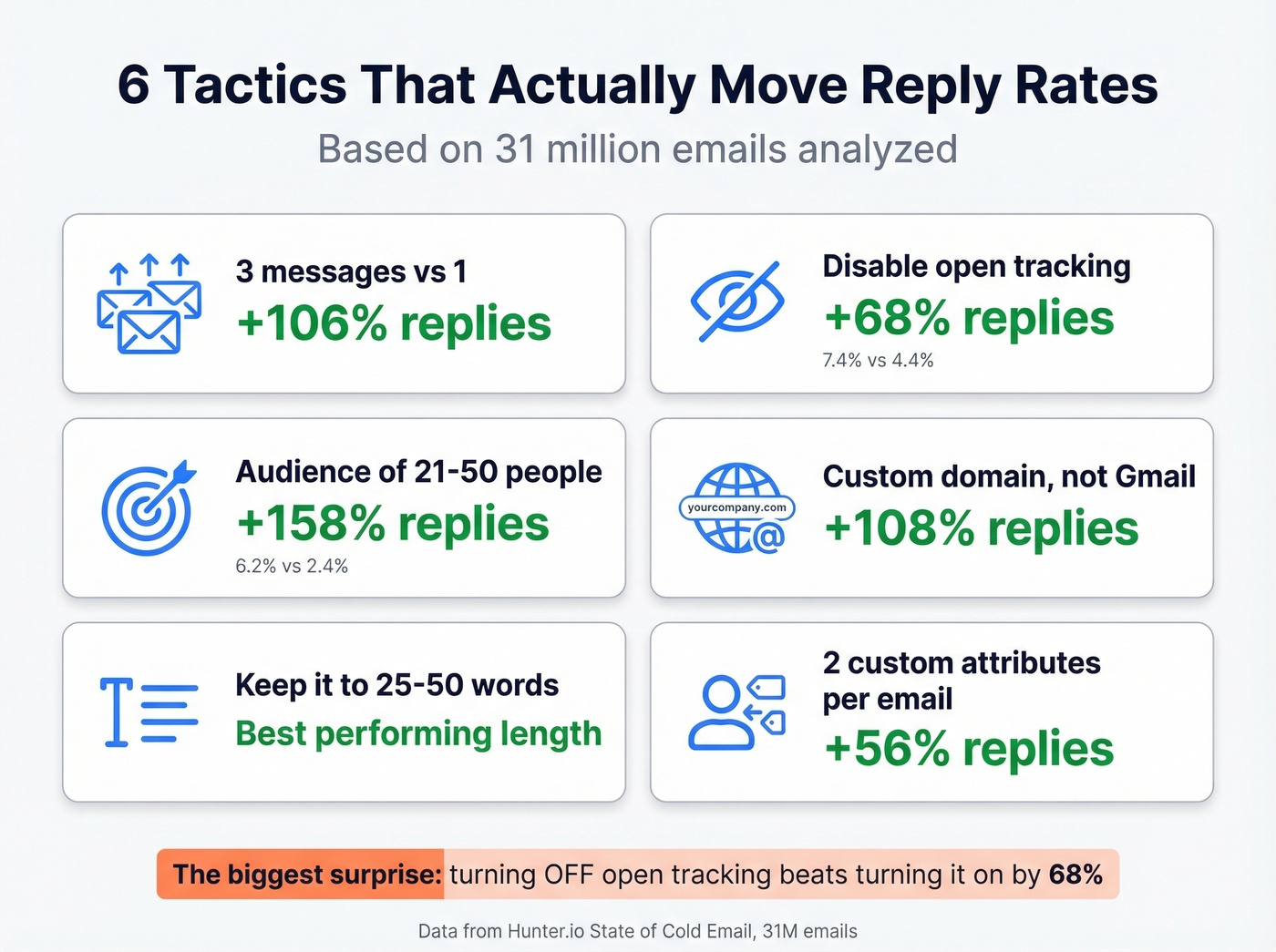
| Tactic | Impact on Reply Rate |
|---|---|
| 3 messages vs. 1 | +106% |
| Disable open tracking | +68% |
| 2 custom attributes | +56% |
| Custom domain vs. Gmail | +108% |
| Audience 21-50 vs. 500+ | +158% |
| 25-50 word emails | Best performing length |
| 20-49 emails/day/account | Optimal send volume (5.7% reply rate) |
The open tracking stat surprises people most. Campaigns without tracking pixels see a 68% higher reply rate - 7.4% versus 4.4%. If you're optimizing for replies over vanity metrics, turn them off. Tracking pixels also tend to create friction with deliverability and trust (and can impact your sender reputation over time).
The audience size finding is equally striking. Sending to 21-50 highly targeted recipients yields a 6.2% reply rate versus 2.4% for blasts of 500+. Small businesses with 2-50 employees start at a 9.2% reply rate - smaller targets are simply more responsive.
Keep your emails short. 25-50 words outperform longer messages consistently.
If you're building a sequence, use a structured B2B cold email sequence approach so each touch has a job.
When Email Isn't Working
Here's the thing: if you've sent two emails with no response, a third email is almost never the answer. Switch channels. Data from the 16.5M-email study shows that a professional profile message plus a profile visit hits an 11.87% reply rate - nearly triple the average cold email. Separately, 50.5% of decision-makers say they prefer being contacted on professional networking platforms over email.
Stop banging on a door nobody's answering and walk around to the window.
Templates That Work
Job Search - First Follow-Up
Send this 5-7 business days after your interview, or once the timeline they gave you has passed. 80% of hiring managers say thank-you notes affect their decision-making, yet fewer than 60% of candidates send them. That's free advantage most candidates leave on the table.
Subject: Following up on [Role] conversation
Hi [Name],
Thanks again for the conversation on [day]. I've been thinking about [specific topic discussed] and I'm even more excited about the opportunity. Wanted to check in on timing - happy to provide anything else that's helpful.
Best, [You]
Job Search - Final Follow-Up
Two weeks of silence after your follow-up is the answer. If you sent a follow-up email and received nothing back, it's time to accept the signal and redirect your energy. Let's be honest: companies that ghost candidates after in-person interviews are failing at basic professional courtesy. It's not you.
Subject: Checking in one last time
Hi [Name],
I wanted to follow up once more on the [Role] position. I understand timelines shift - if the role has been filled or put on hold, no worries at all. I'd appreciate a quick update either way.
Thanks, [You]
Sales - Value-Add Follow-Up
Never send "just bumping this up." Attach a one-page resource, share a relevant case study, or drop a data point that connects to their specific situation. We've seen teams double their reply rates simply by giving something useful instead of asking for time.
Subject: [Relevant insight] for [Company]
Hi [Name],
Came across [specific data point/article/case study] that reminded me of what you mentioned about [their challenge]. Thought it might be useful regardless of whether we connect.
Worth a quick look? [Link]
For more plug-and-play options, see these sales follow-up templates.
The Breakup Email
This is the highest-performing template format in our experience, and it works because it flips the power dynamic. Instead of chasing, you're offering an exit. The Superhuman "Should I close your file?" framework gives the recipient three easy options and removes all pressure.
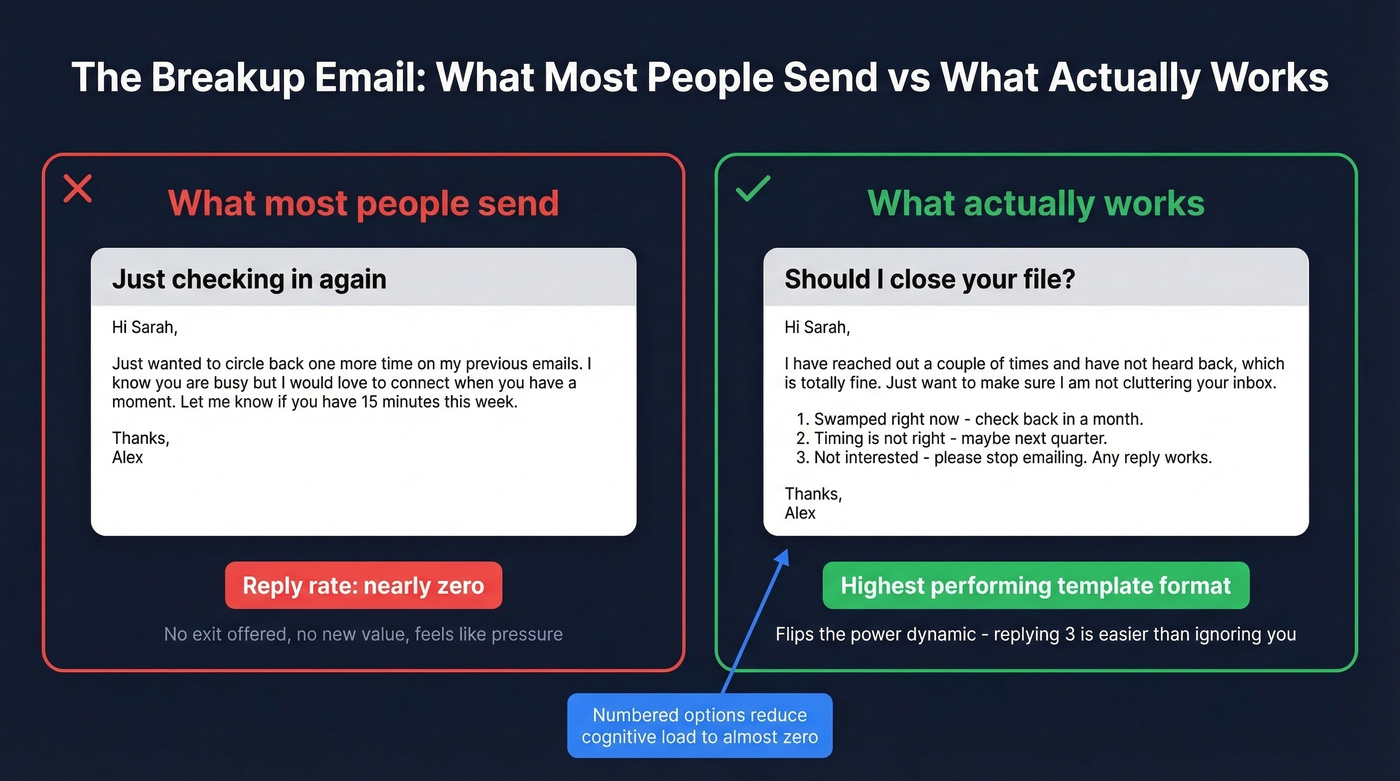
What most people send: "Just wanted to circle back one more time..."
What actually works:
Subject: Should I close your file?
Hi [Name],
I've reached out a couple of times and haven't heard back, which is totally fine. Just want to make sure I'm not cluttering your inbox.
- Swamped right now - check back in a month
- Timing isn't right - maybe next quarter
- Not interested - please stop emailing
Any reply works. Thanks, [You]
The numbered options reduce cognitive load to almost zero. People reply because clicking "3" is easier than continuing to ignore you.
Five Mistakes That Kill Replies
Bumping with no new information. "Just checking you saw this" tells the recipient you have nothing new to offer. Every follow-up needs a reason to exist.
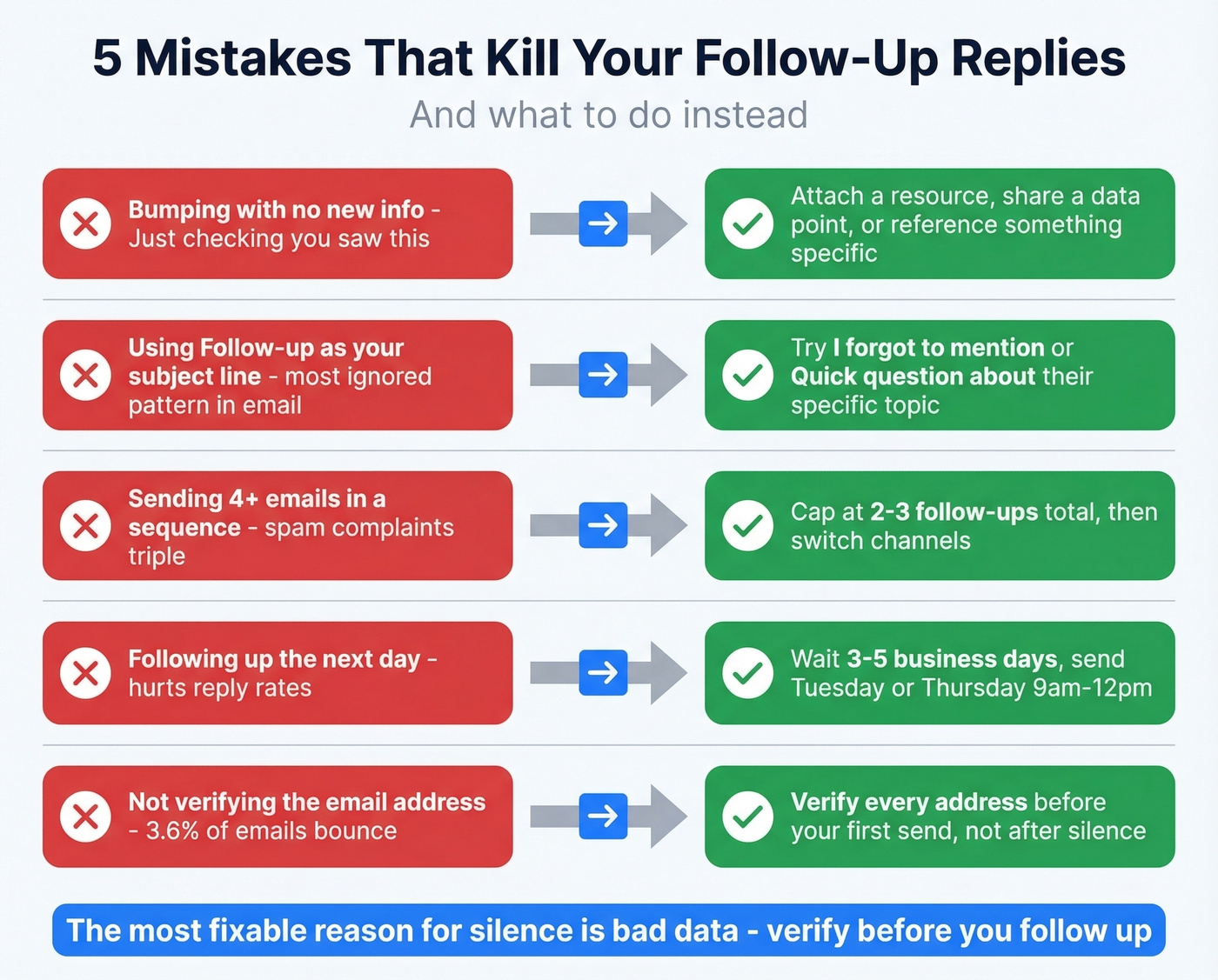
Using "Follow-up" as your subject line. It's the most commonly ignored subject-line pattern in email. Use something specific that signals value.
Sending 4+ emails in a sequence. Spam complaints more than triple after 4+ messages. Two to three follow-ups is the ceiling (and good sequence management helps you avoid over-sending).
Following up the next day. Next-day follow-ups negatively impact reply rates. Wait 3-5 business days minimum. Best send windows are 9am-12pm on Tuesday or Thursday (see the data on the best time to send cold emails).
Not verifying the email address first. Bad data is the most fixable reason for silence, and we see it constantly - someone sends three follow-ups to an address that was never valid in the first place (learn how to check if an email exists).
Before You Blame Them, Check This
Here's a scenario we see constantly: someone sends three follow-ups, gets frustrated, assumes they're being ghosted - and the email never reached the inbox in the first place.

The 3.6% bounce rate across 31 million emails only captures visible failures. Invisible ones - spam filters, catch-all domains that accept everything but route nothing, promotions tabs - push the real non-delivery rate much higher. Before sending another follow-up, verify the address. Prospeo's 5-step verification process, including catch-all handling, spam-trap removal, and honeypot filtering, delivers 98% email accuracy so you know your message actually has a chance of landing.
If you want to go deeper on the mechanics, start with an email deliverability audit and fix the root cause.
Often, the problem isn't your message. It's that your message never arrived.
The data is clear: smaller, hyper-targeted lists crush mass blasts - 6.2% reply rate vs 2.4%. Prospeo's 30+ filters let you build lists of 21-50 perfect-fit prospects with verified emails and direct dials, refreshed every 7 days so you never chase outdated contacts again.
Send fewer emails to better contacts. Book more meetings.
FAQ
How long should I wait before sending another follow-up?
Wait 5-7 business days for job searches and 3-5 business days for sales outreach. Sending the next day actively hurts reply rates. If you've sent two follow-ups with no reply, switch channels entirely - try a phone call, a professional networking message, or a different contact at the company.
How many follow-up emails is too many?
Data from 16.5 million emails shows spam complaints triple after 4+ messages in a sequence. Two to three follow-ups is the sweet spot - after that, you're damaging your sender reputation more than improving your chances of a reply.
What should I do if there's still silence after my follow-up?
First, verify the recipient's email address to rule out deliverability issues. If the address is valid, send one more message that adds genuine new value or use the breakup email template. After three total messages, switch channels or move on.
Could my follow-up email have gone to spam?
Yes, and it's more common than most people realize. With a 3.6% industry bounce rate and increasingly aggressive spam filters, a meaningful percentage of emails never reach the inbox. Verifying the recipient's email address before sending eliminates this variable entirely.