

No-Show Follow-Up Email Templates for Every Scenario
You blocked 30 minutes, prepped your deck, and sat staring at an empty Zoom room for twelve minutes before accepting the obvious. Now you've got to write a polite follow-up pretending you're not annoyed.
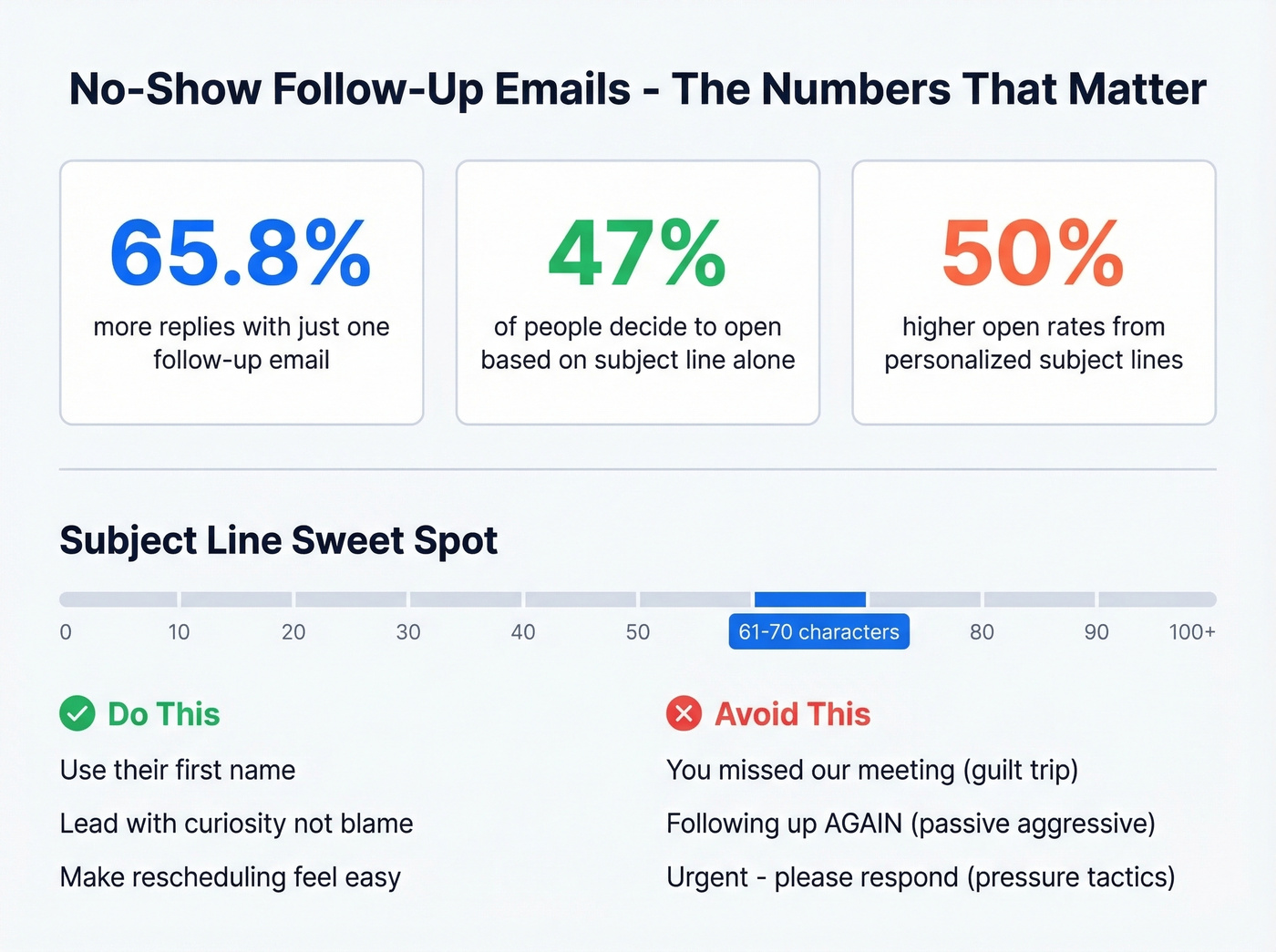
A single follow-up increases replies by 65.8%, so the email is worth sending. But most guides hand you one template and call it a day. A no-show is a data and process problem, not a single-email problem. The template gets them back; the system keeps them from ghosting again.
The short version: pick the template for your scenario, send it within 1-24 hours (ideally within an hour), and follow the 5-touch cadence if they don't reply.
Subject Lines That Get Opened
47% of recipients decide whether to open based on the subject line alone, and personalized subject lines deliver 50% higher open rates. The sweet spot is 61-70 characters. Keep it short, blame-free, and easy to act on.
If you want more options, pull from these subject lines and adapt them to your no-show scenario.
- [First name] - let's try this again
- Sorry I missed you - quick reschedule?
- Still interested in [topic]?
- We had [time] on the calendar - want to rebook?
- Missed you today - here's what I planned to share
- [First name], everything okay?
- Open slot this week if you'd like to reconnect
Avoid anything guilt-trippy. "You missed our meeting" reads like a passive-aggressive text from a partner. Lead with curiosity, not accusation.
No-Show Meeting Email Templates
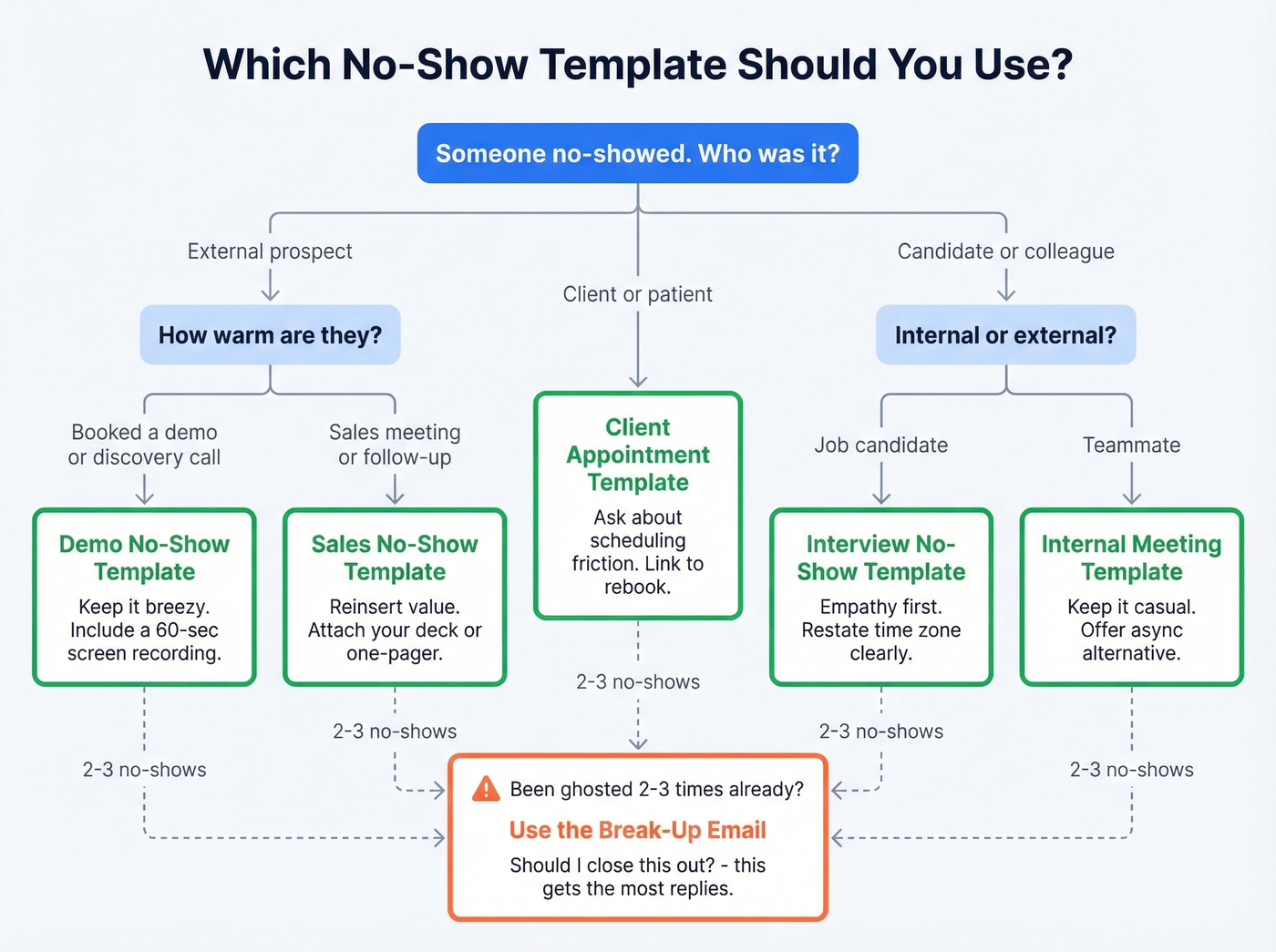
Sales / Prospect No-Show
This is the highest-stakes no-show because the prospect was already warm enough to book. Reinsert value - attach the resource you planned to share so they get something useful even if they never reschedule.
If you need more variations beyond no-shows, keep a swipe file of sales follow-up templates for different stages.
Subject: [First name] - let's try this again
Hi [First name],
I had us down for [time] today to walk through [meeting topic]. No worries at all - things come up. I've attached the [resource/deck/one-pager] I planned to share so you can take a look on your own time.
If it's still relevant, here's my calendar link to grab 15 minutes this week: [scheduling link]
Either way, happy to help whenever the timing's right.
[Your name]
Demo / Discovery Call No-Show
The prospect agreed to a demo, not a blood oath. A lighter, breezier tone outperforms anything formal here. Make rescheduling one click.
If you want to tighten your demo flow so prospects show up (and convert), use a product demo checklist.
Subject: Missed you today - here's what I planned to show you
Hey [First name],
Looks like we missed each other for the [product] demo today. Totally understand - calendars get chaotic.
I'd love to still walk you through [specific feature/use case]. Pick a time that works: [scheduling link]
Talk soon, [Your name]
Pro tip: Include a 60-second screen recording of the feature they wanted to see. It gives them value without requiring another calendar hold, and we've seen it double reschedule rates compared to text-only follow-ups.
Client / Service Appointment No-Show
For service businesses, a missed appointment usually signals scheduling friction, not disinterest. Skip the pleasantries and go straight to feedback.
Subject: We missed you today - want to rebook?
Hi [First name],
We had your [appointment type] scheduled for [date/time] and noticed you weren't able to make it.
If there's anything about our scheduling process that made it difficult, we'd genuinely like to know. Otherwise, you can rebook here anytime: [scheduling link]
Looking forward to seeing you, [Your name/business]
Interview / Recruiting No-Show
Empathy first. Candidates miss interviews for a dozen legitimate reasons - emergencies, time zone confusion, anxiety. Restate the details clearly and leave the door open.
Subject: [First name], everything okay? Happy to reschedule
Hi [First name],
We had your interview for the [role title] position scheduled for [date, time, time zone]. We didn't get a chance to connect, and I wanted to check in.
If something came up, no judgment - we'd be happy to find a new time. Just reply or book directly here: [scheduling link]
Best, [Your name]
Repeat No-Show / Break-Up Email
After two or three no-shows, you need a direct priority check. HubSpot calls this the three-strike rule, and it's the right move - you're not being rude, you're being respectful of everyone's time. This is the email that actually gets replies, because closing the loop creates urgency that politeness alone can't.
Subject: Should I close this out?
Hi [First name],
We've tried to connect a few times now for [meeting topic], and I know schedules get packed. I don't want to keep pinging you if this isn't a priority right now.
If the timing's off, just let me know and I'll circle back in [timeframe]. Otherwise, I'll close this out on my end. No hard feelings either way.
[Your name]
Internal Meeting No-Show
This is a colleague, not a prospect. Don't overthink it.
Subject: Missed our sync - async instead?
Hey [Name], looks like we missed our [meeting name] today. Want to handle this over Slack instead? I can drop my notes in [channel/DM] and we can align async. Otherwise, let me know a better time this week.
If you’re building a repeatable process for this, document it as part of your sales process optimization.

A no-show stings most when your pipeline is thin. Prospeo gives you 300M+ professional profiles with 98% verified emails so one ghosted meeting never derails your week. Build targeted lists in minutes, not hours - and always have the next call ready to book.
Stop depending on one meeting. Fill your pipeline for $0.01 per lead.
The 5-Touch Follow-Up Cadence
Here's the thing: one email isn't a strategy. 44% of salespeople quit after a single follow-up, but 80% of sales require five or more touches. The common rule of thumb is to wait 10-15 minutes past the start time, then trigger your cadence.
If you want to automate this without sounding robotic, use AI sales follow-up workflows and keep the human “why” in the first line.
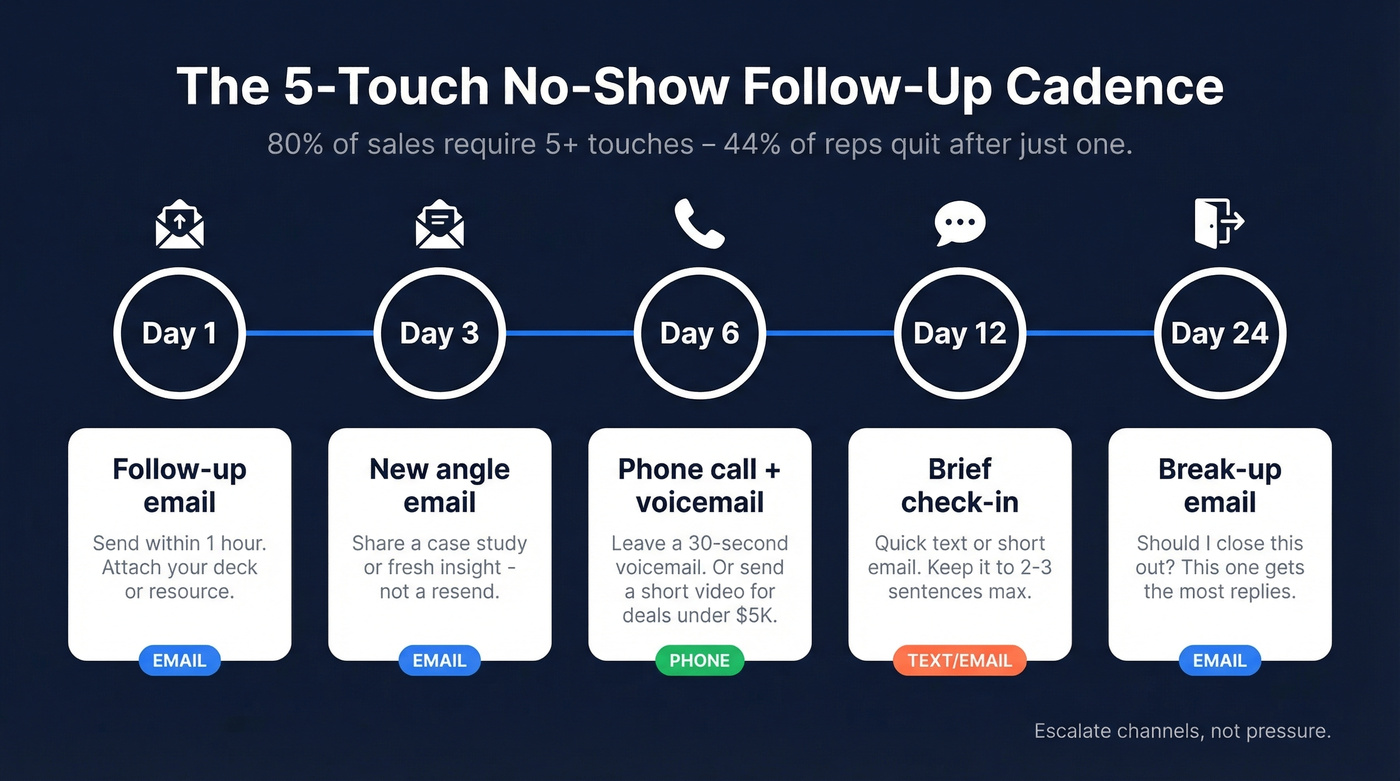
| Day | Action | Channel |
|---|---|---|
| Day 1 | Follow-up email after no-show (template above) | |
| Day 3 | Second email, new angle or resource | |
| Day 6 | Phone call + voicemail | Phone |
| Day 12 | Text or brief email check-in | Text/Email |
| Day 24 | Break-up email (close the loop) |
The channel escalation matters. Email gets you part of the way - adding phone and text into the mix catches people where they're actually responsive.
In our experience, the Day 3 email with a fresh angle gets the highest reply rate of the entire sequence. Don't just resend. Share a different resource, a relevant case study, or a one-line insight about their company that shows you did your homework. Tag every no-show in your CRM with a notification for meeting no-shows in the last 7 days, and assign re-engagement to a dedicated SDR for the first week before handing off to other reps for days 8-20 if there's still no response.
If your average deal is under $5K, skip the phone call on Day 6 and send a short video message instead. The ROI on cold-calling a small-deal prospect who already ghosted you is basically zero.
To keep the sequence consistent across reps, standardize it in your sequence management playbook.
How to Prevent No-Shows
Stop treating no-shows as a communication problem. They're a systems problem. Forgetfulness causes 36-38% of missed appointments - that's fixable.
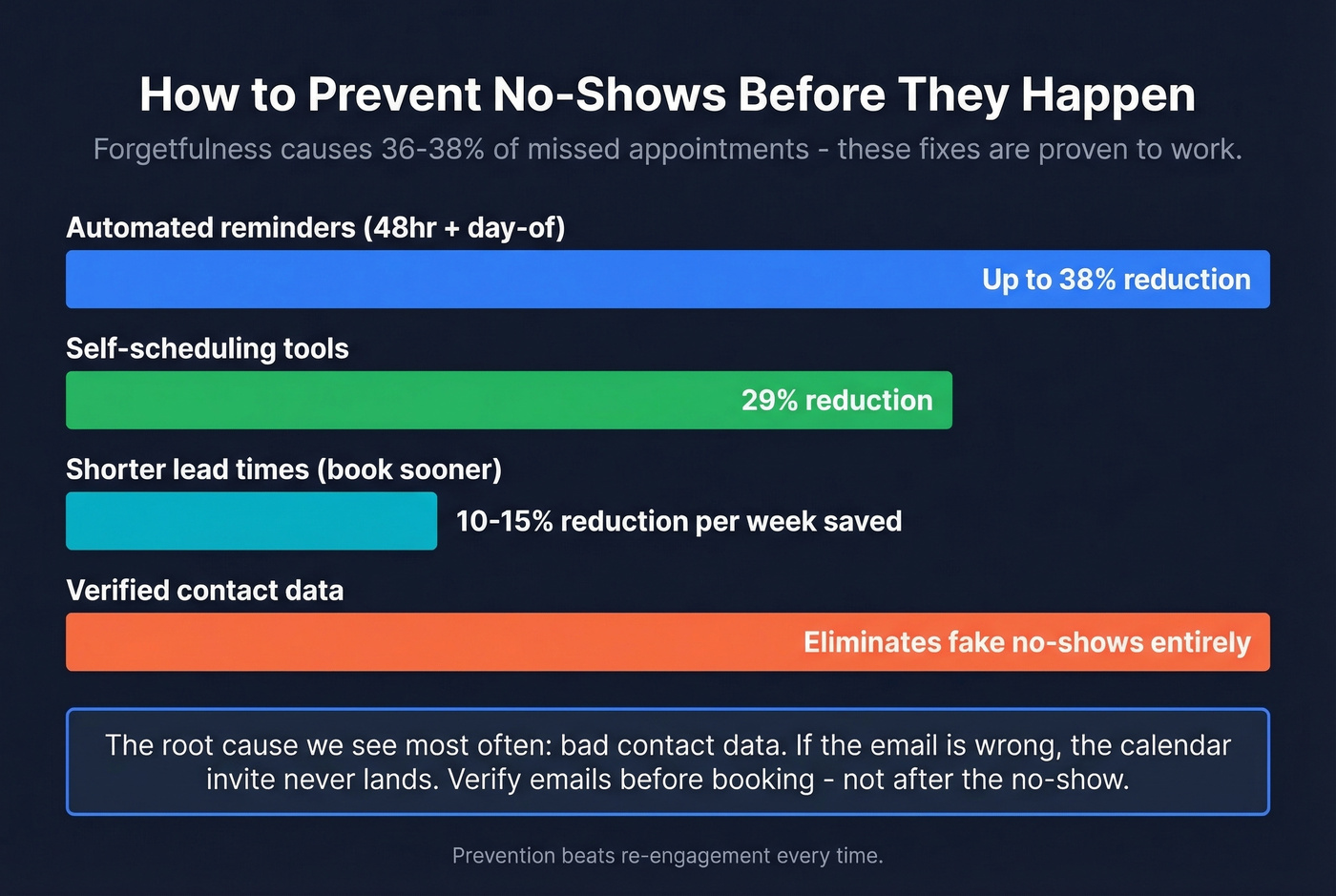
Automated meeting reminders at 48 hours and day-of reduce no-shows up to 38% in outpatient settings, and the same principle applies to sales calls. Pair reminders with self-scheduling tools, which cut no-shows by 29%. People show up more when they picked the time themselves.
Shorter lead times make a measurable difference too. Each week of reduced lead time decreases no-show likelihood 10-15%, so book closer to now, not three weeks out. Give prospects an easy out with two-way texting and reschedule links - it turns a ghost into a reschedule. MGMA data confirms practices using digital reminders and live outreach see the most stable no-show rates.
Let's be honest about the root cause we see most often on our team: bad contact data. If the email address is wrong, the calendar invite never lands, and your follow-up after a missed meeting goes nowhere. Verifying emails before the meeting is even booked - using a tool like Prospeo with 98% accuracy and a 7-day data refresh cycle - eliminates the entire category of "no-shows" who never got the invite in the first place. Prevention beats re-engagement every time, but when prospects do slip through, a solid no-show follow-up email template brings them back.
If you’re fixing this at the source, start with data enrichment services and a clean lead generation workflow so invites actually land.
Your Day 6 cadence step says call them - but only if you have the right number. Prospeo's 125M+ verified mobile numbers hit a 30% pickup rate, 3x higher than ZoomInfo. When email follow-ups go cold, a direct dial turns a no-show into a rescheduled demo.
Get direct dials that actually connect. No more voicemail dead ends.
No-Show Follow-Up Email FAQ
How soon should I send a follow-up after a no-show?
Within one hour for the best results - same-day at the latest. The sooner you follow up, the more likely the person remembers context and reschedules. For service appointments, include a direct rebooking link so they can act in one click.
How many times should I follow up after a missed meeting?
Up to five times over 24 days using the Day 1, 3, 6, 12, 24 cadence outlined above. Escalate across channels - email, then phone, then text. No response after the fifth touch means it's time for a break-up email. Then move on.
What's the best way to re-engage no-show prospects?
Lead with value, not guilt. Attach the resource you planned to share, include a one-click scheduling link, and escalate across channels. The consensus on r/sales is that the break-up email ("Should I close this out?") actually gets the most replies of any touch in the sequence - people hate losing options.
Should I charge a fee for client no-shows?
Only if you've clearly communicated the policy upfront - ideally at booking confirmation. Most service businesses see a 25-30% drop in no-shows after introducing a cancellation fee, but springing it on clients without warning damages trust and increases churn. Skip this if you're in a competitive market where clients can easily switch providers.