Outbound Audience Research: The 5-Step Process That Actually Works
You send 500 cold emails. 180 bounce. Another 200 land in inboxes of people who'd never buy your product in a million years. The remaining 120 get ignored because the messaging sounds like it was written for "anyone with a pulse."
That's not an outbound problem - it's an audience research problem.
60% of prospects are lost due to poor targeting, and 44% disengage the moment messaging feels irrelevant. The fix isn't better copy or a fancier sequencer. It's doing the research that most teams skip entirely - or do so badly it doesn't matter. And here's the benchmark most people never hear: only 2-5% of initial outbound contacts convert to meetings. Your targeting has to be surgical, because you're working with razor-thin margins.
The Process at a Glance
Five steps. That's it.
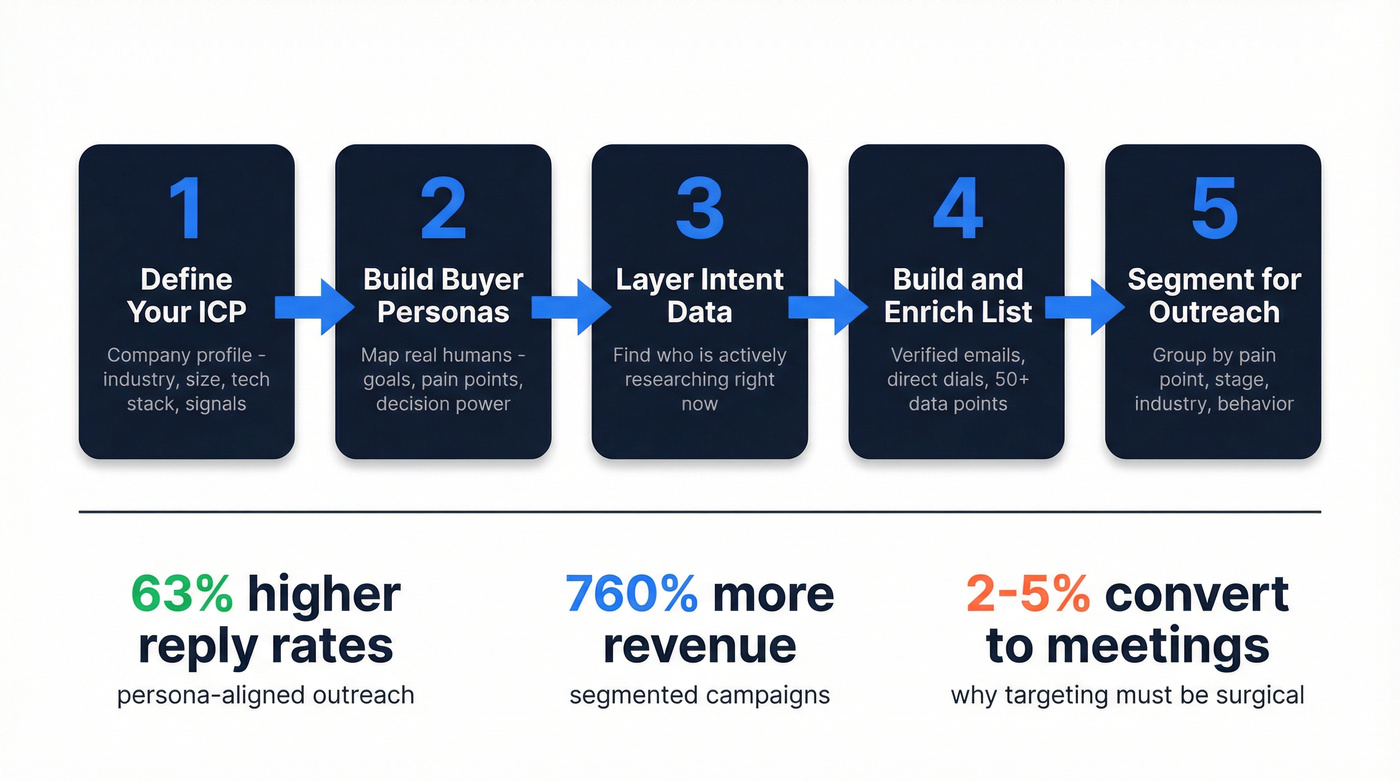
- Define your ICP - the company profile you're built to serve.
- Build buyer personas - the humans inside those companies who actually buy.
- Layer intent data - find which accounts are actively researching your category.
- Build and enrich your account list - turn research into verified, reachable contacts.
- Segment for outreach - group contacts so every sequence feels relevant.
The core stack is simpler than you think: an enrichment platform, a CRM (HubSpot free works), and two hours per quarter for ICP review. Three tools. Everything else is optional optimization.
Persona-aligned outreach lifts reply rates by 63% and can drive up to 18x more revenue than broadcast campaigns. Segmented campaigns generate 760% more revenue than non-segmented blasts. Time investment? Budget 5-15 minutes per account for light research, 20-45 minutes when you're mapping full buying committees.
The 5-Step B2B Research Process
Step 1: Define Your ICP
Your Ideal Customer Profile isn't a wish list - it's a filter. It describes the company (not the person) most likely to buy, stay, and expand. Every outbound decision flows from this.
If you need a tighter framework for deciding who makes the cut, start with account qualification.
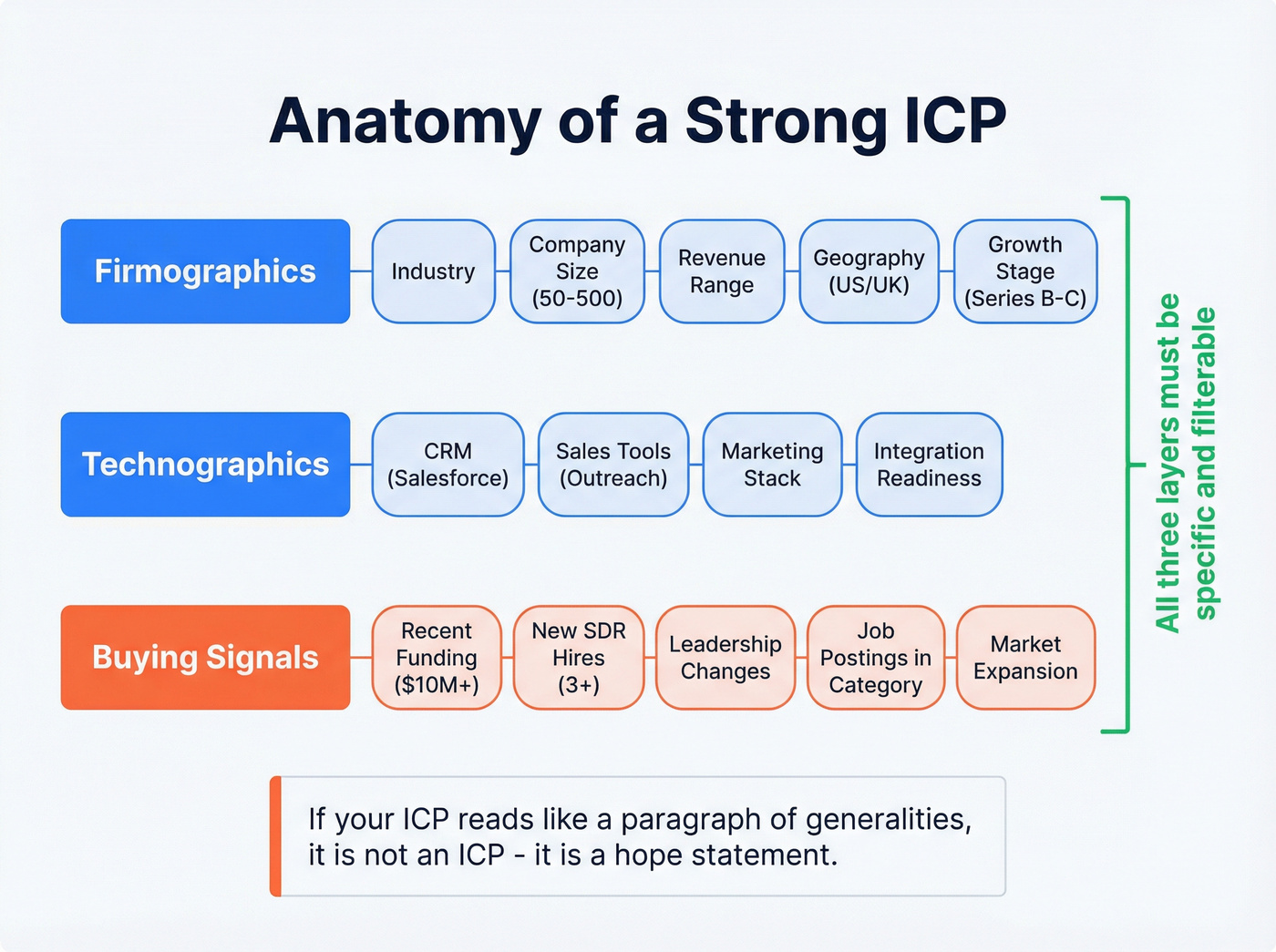
A solid ICP covers three layers:
- Firmographics: industry, company size, revenue range, geography, growth stage
- Technographics: what tools they already use and what that signals about readiness
- Buying signals: recent funding, leadership changes, job postings in your category, expansion into new markets
The most common mistakes we see? Overgeneralizing ("any B2B SaaS company with 50+ employees"), building the ICP in a marketing silo without sales input, and treating it as a one-time exercise. Your ICP should evolve quarterly based on win/loss data and pipeline analysis.
Here's the thing: if your ICP is wrong, everything downstream - personas, lists, sequences - is wasted effort. Spend the time here. Interview your best customers. Look at your fastest-closing deals. Find the pattern. Then write it down in concrete terms.
Example ICP: Series B-C B2B SaaS companies, 50-500 employees, US or UK headquarters, using Salesforce + Outreach in their stack, hired 3+ SDRs in the last 6 months, raised $10M+ in the last 18 months, selling to mid-market or enterprise buyers.
That's specific enough to filter on. If your ICP reads like a paragraph of generalities, it's not an ICP - it's a hope statement.
Step 2: Build Buyer Personas
Once you know the company, you need to know the people. A buyer persona is a research-based profile representing a segment of your buyers - their behaviors, motivations, goals, pain points, and decision criteria. Not just their title.
What personas are NOT: a demographic snapshot, an individual customer profile, a static document, or a set of assumptions you made in a conference room without talking to anyone.
71% of companies exceeding revenue goals have documented buyer personas. The other 29% are either lying or lucky.
B2B buying decisions involve multiple stakeholders. A mid-market deal might touch a VP of Sales (economic buyer), a RevOps manager (technical evaluator), and a CFO (financial influencer). Your research needs to map all of them - not just the person you'd prefer to email. (If you want a clean way to structure this, use buying group personas.)
Example Persona: VP of Sales at a Series B SaaS company. Manages a 30-person sales team. Primary frustration: rep ramp time is too long and pipeline coverage is inconsistent. Evaluates tools based on CRM integration and time-to-value. Reports to the CRO. Cares about quota attainment metrics, not feature lists.
Build personas from real data: CRM analysis, call recordings, win/loss interviews, and objection patterns. Then update them quarterly using fresh call data and market shifts. A persona built two years ago that hasn't been touched since is just fiction with a job title.
You can also mine social signals - analyze who follows your competitors, what communities they participate in, and which industry hashtags they engage with to sharpen your persona research.
Step 3: Layer Intent Data
Intent data tells you which accounts are actively researching your category right now. It's the difference between cold outreach and warm outreach to a cold contact.
If you want to operationalize this beyond "gut feel," build a simple system around intent signals.
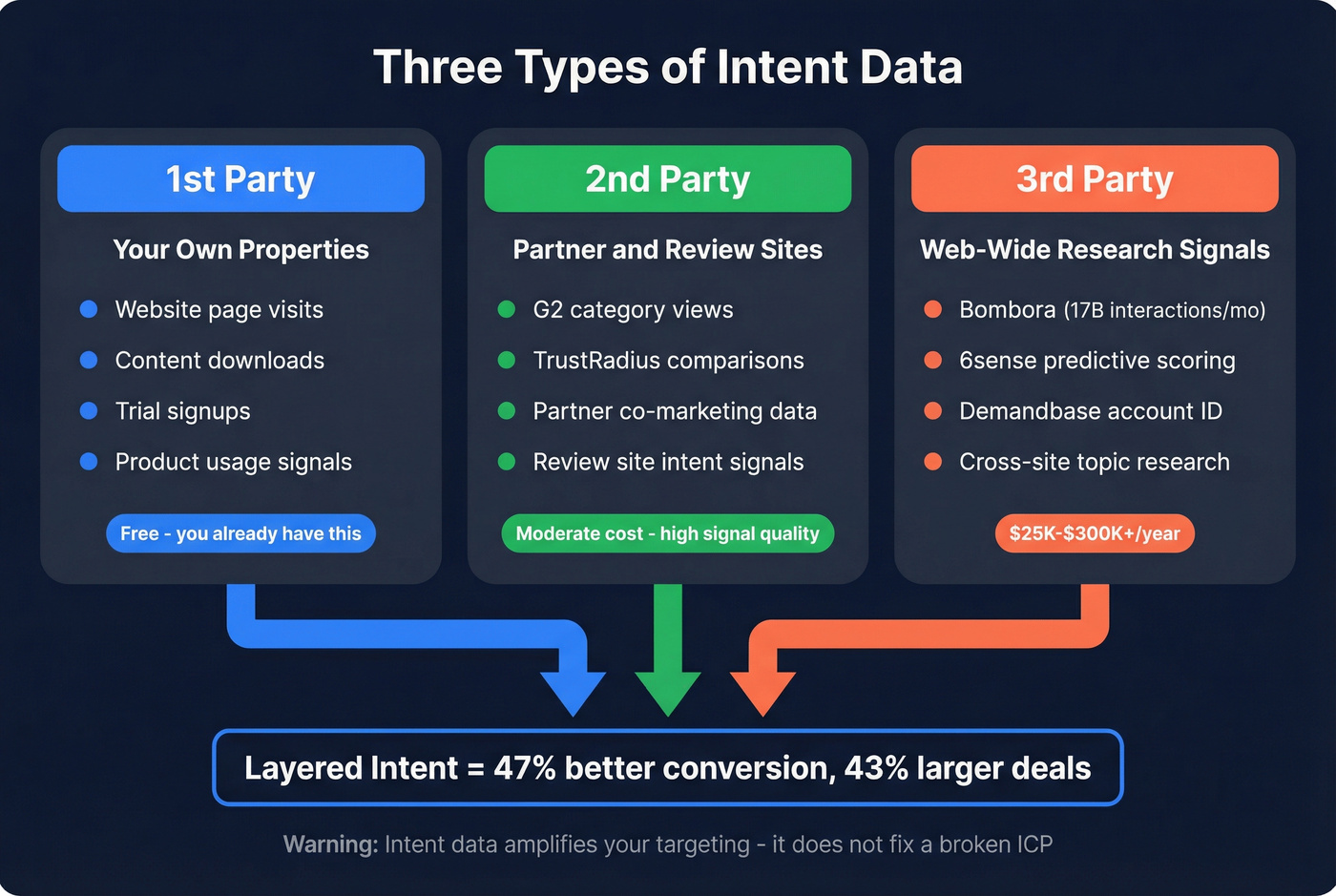
Three types:
- First-party: engagement on your own site and product - page visits, content downloads, trial signups
- Second-party: behavior on partner or review sites like G2 and TrustRadius
- Third-party: web-wide research signals aggregated across thousands of sites (Bombora tracks 17B interactions monthly across 5,000+ sites)
The B2B intent data market hit $4.49B in 2026, and 91% of B2B marketers use some form of it. But only 24% report exceptional ROI. Why the gap? Most teams layer intent on top of a broken ICP. Intent data amplifies your targeting - it doesn't fix it.
The major standalone providers are Bombora ($25K-$100K/year), 6sense ($60K-$300K+/year), and Demandbase (custom pricing, typically $30K-$100K+/year). Layered intent programs drive 47% better conversion rates and 43% larger deal sizes. But don't start here. Get Steps 1 and 2 right first.
Step 4: Build and Enrich Your List
This is where research becomes a list - and where most outbound programs quietly break. You can nail the ICP, build sharp personas, and layer intent signals, but if the contact data bounces or the phone numbers are dead, none of it matters.
Data quality is the make-or-break variable. We've watched teams run campaigns with 35-40% bounce rates and wonder why their domain reputation tanked. Snyk had exactly this problem - bounce rates dropped from 35-40% to under 5% after switching to verified data, and AE-sourced pipeline jumped 180%.
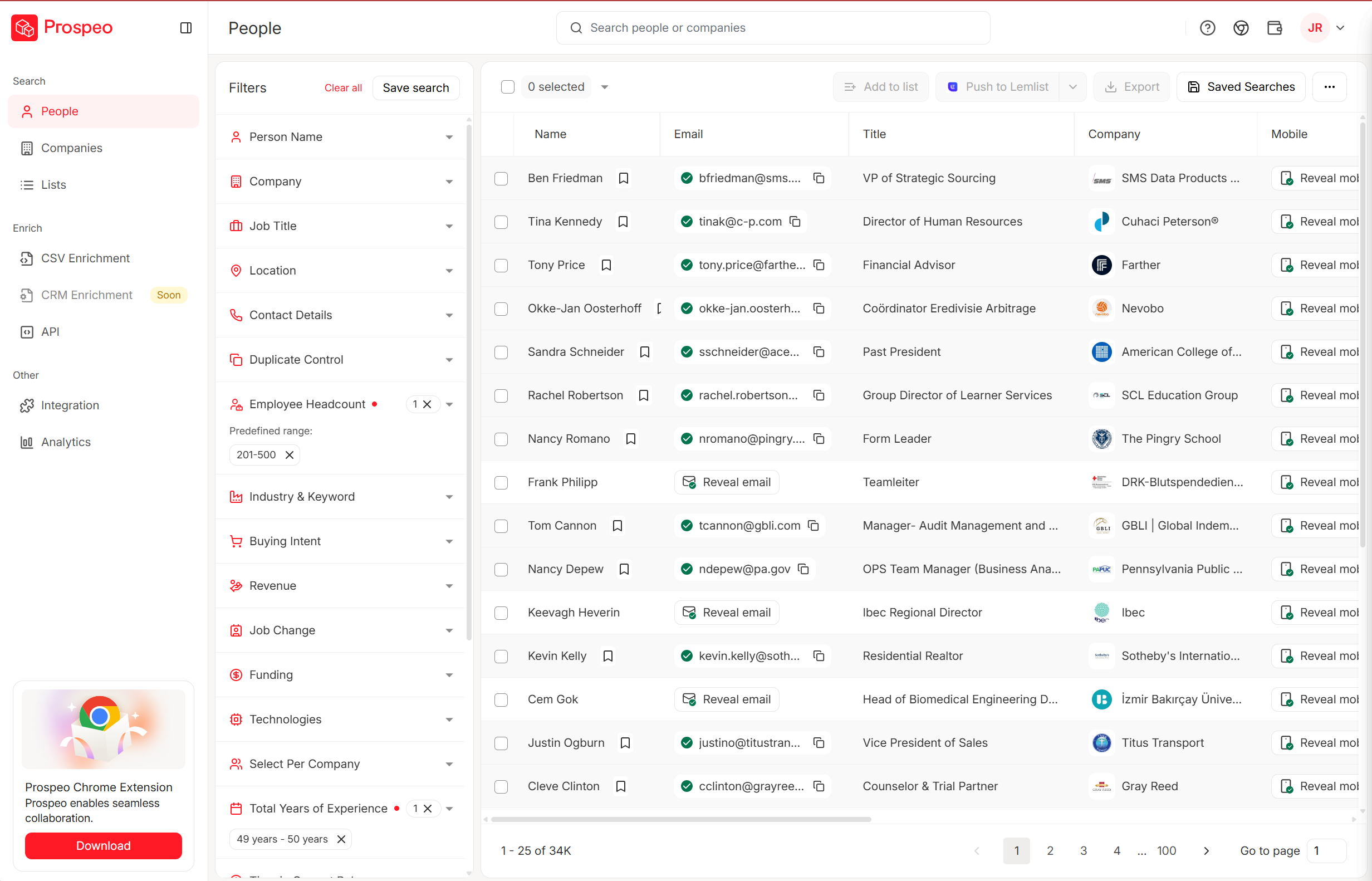
The workflow is straightforward: define your filters based on your ICP, pull contacts matching your buyer personas, and export verified emails and direct dials. This is where targeting shifts from theory to execution.
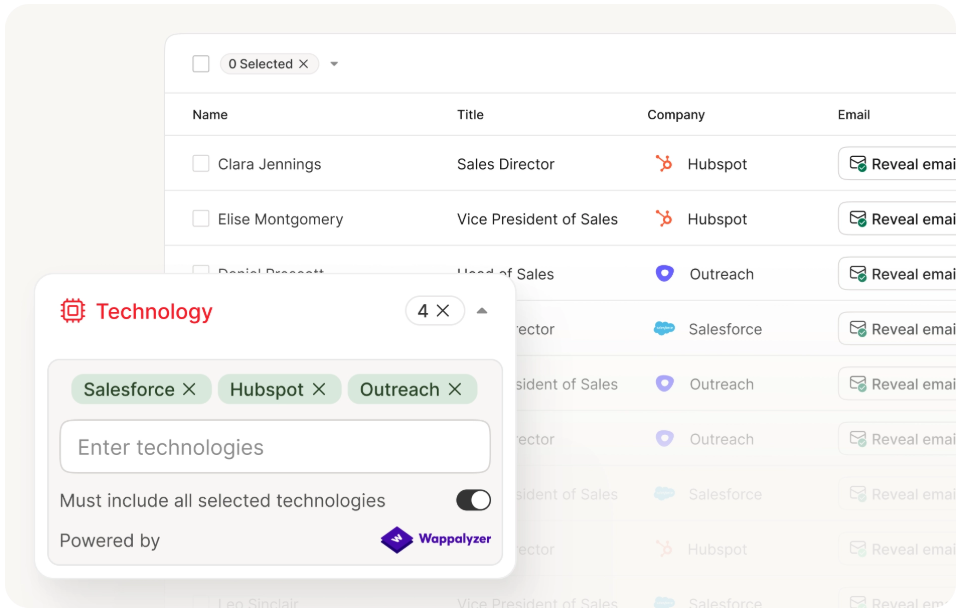
Look for a platform that returns enough data points per contact to fuel personalization. CRM and CSV enrichment that returns 50+ data points per contact gives you real ammunition for first lines, and you can layer in filters like technographics, job changes, headcount growth, funding, revenue, and buyer intent.
Many self-serve enrichment tools offer a free tier, which lets you validate data quality before committing budget. Budget 15-30 minutes to build and verify a list of 50 accounts. That's the kind of time investment that pays for itself on the first reply.
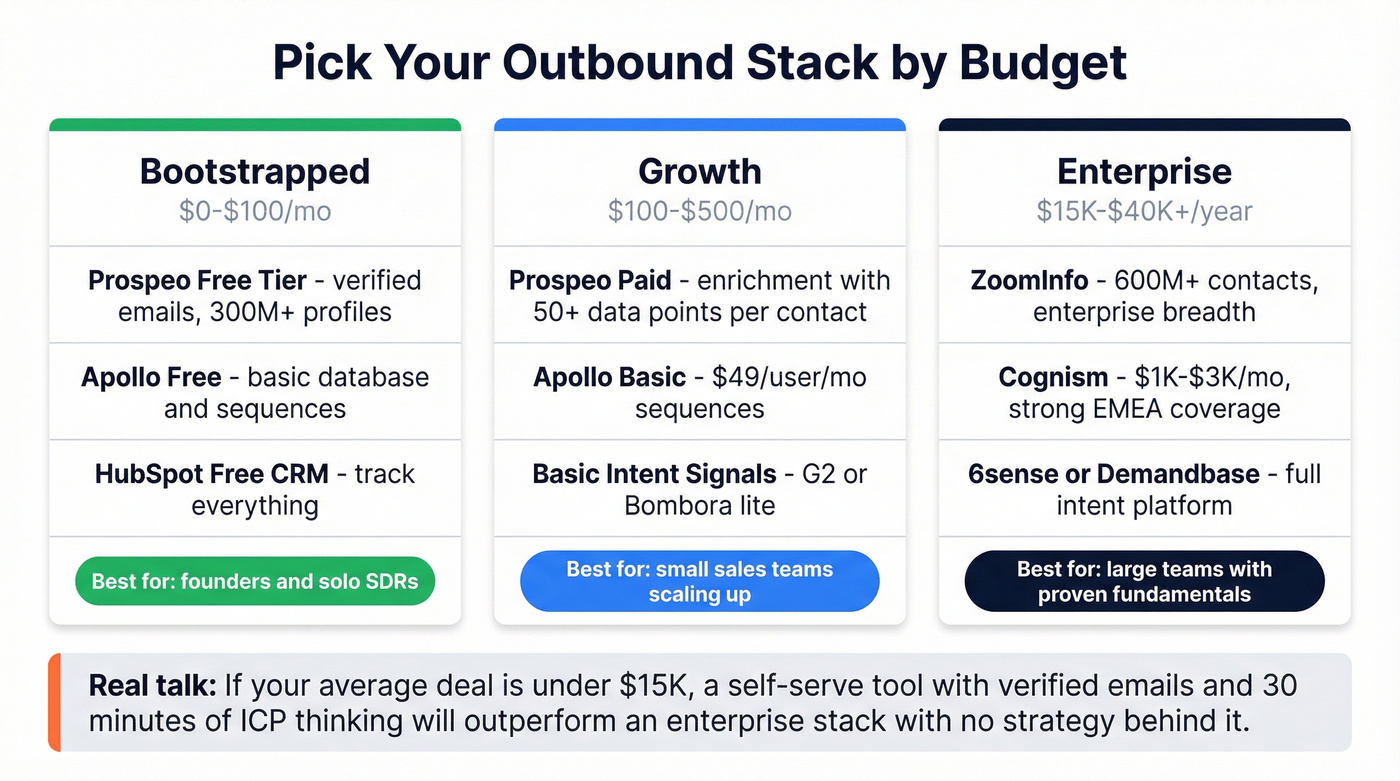
Real talk: If your average deal size is under $15K, you almost certainly don't need a $40K+ data platform. A self-serve enrichment tool with verified emails and 30 minutes of ICP thinking will outperform an enterprise stack with no strategy behind it. Save the big spend for when your fundamentals are converting. The consensus on r/sales backs this up - founders with a spreadsheet and good targeting routinely outperform teams drowning in six-figure tool subscriptions.
If you're seeing bounces creep up over time, it's usually B2B contact data decay - not "bad copy."
Step 5: Segment for Outreach
A verified list is useless if you send the same message to everyone on it.
That 760% revenue lift from segmented campaigns? It comes from treating different buyers like different people - because they are.
Segment along dimensions that actually change your messaging:
- Firmographic: industry vertical, company size, growth stage
- Behavioral: intent signals, content engagement, recent job changes
- Pain point: the specific problem each segment cares about most
- Buying stage: problem-aware vs. solution-aware vs. actively evaluating
Your research outputs from Steps 1-4 become direct inputs to your sequences. A VP of Engineering at a Series B fintech company showing intent signals for "API security" gets a completely different email than a CTO at an enterprise healthcare company evaluating compliance tools. Same product, different angle, dramatically different response rate.
Structured follow-up sequences increase response rates by 22%. The research you did in Steps 1-4 should inform every follow-up, not just the opener. If your second email is a generic "just checking in," you've wasted the research.
If you want a more rigorous way to do this, use a behavioral segmentation model instead of ad-hoc tags.
Speed matters too. Responding to an inbound signal within 5 minutes makes you 21x more likely to convert that contact. When your intent data flags an account, act on it the same day.
If you need a playbook for acting fast, see buying signals follow up.

You just defined your ICP and built personas. Now turn that research into a reachable list. Prospeo gives you 30+ search filters - buyer intent, technographics, job changes, funding, headcount growth - across 300M+ profiles with 98% verified emails.
Stop researching audiences you can't actually reach.
Recommended Tool Stack
The outbound industry has an over-tooling problem. Here's what you actually need at each budget level.
If you're rebuilding from scratch, start with a lean B2B sales stack before adding more tools.
| Tool | Database | Verified Emails | Pricing | Best For |
|---|---|---|---|---|
| Prospeo | 300M+ profiles | 143M+ | Free; ~$0.01/email | Verified data, 7-day refresh |
| ZoomInfo | 600M+ contacts | Not disclosed | ~$15K-$40K+/yr | Enterprise breadth |
| Apollo | 210M+ contacts | Not disclosed | Free-$99/user/mo | Budget all-in-one |
| Cognism | 400M+ contacts | Not disclosed | ~$1K-$3K/mo | EMEA coverage |
| Lusha | 280M+ contacts | Not disclosed | Free-$36+/user/mo | Quick lookups |
Bootstrapped ($0-$100/mo): Prospeo's free tier plus Apollo free plus HubSpot free CRM. Verified emails, a basic database, and somewhere to track it all. Enough to run a real outbound motion.
Growth ($100-$500/mo): Paid enrichment plus Apollo Basic plus basic intent signals. You're now running enriched, intent-layered outbound with verified data. This is the sweet spot for most teams under 10 reps.
Enterprise ($1K+/mo): ZoomInfo or Cognism plus Bombora or 6sense plus Outreach or Salesloft. Full-stack outbound with dedicated intent, sequencing, and analytics. Only worth it if you've already nailed Steps 1-3. Skip this tier if your ICP isn't converting at the growth level first.
If you're evaluating vendors, compare options in our guide to sales prospecting platforms.
Bounce rates above 5% destroy domain reputation and waste every hour you spent on audience research. Prospeo's 5-step verification and 7-day data refresh keep bounce rates under 4% - the same data that helped Snyk's 50 AEs grow pipeline 180%.
Your targeting is surgical. Make sure your data matches.
Mistakes That Tank Results
We see the same five mistakes kill pipeline over and over:
Skipping ICP work entirely. Jumping straight to list-building without defining who you're targeting is like running ads with no audience filter. You'll generate activity, not pipeline.
Using stale data. If your data source refreshes every six weeks or worse, you're emailing people who've changed jobs and inboxes that no longer exist. Bounce rates above 5% are a data problem, not a volume problem. In our experience, teams that switch to weekly-refresh data see immediate improvements in deliverability and reply rates - often within the first campaign.
If you're troubleshooting deliverability, use an email deliverability checklist before you scale volume.
Not mapping multiple stakeholders. Emailing one person per account and hoping they champion your deal internally is a strategy built on hope. Map the buying committee. A mid-market deal typically involves 3-5 decision-makers, and reaching only one of them cuts your odds dramatically.
Research that never reaches messaging. You spent 45 minutes researching an account and then sent a generic template. If the research doesn't change your first line, it was wasted time.
Over-tooling without strategy. Buying six data tools and three intent platforms doesn't make your outbound better. It makes your tech stack expensive. Start with strategy, then add tools to fill specific gaps.
FAQ
How long does audience research take per account?
Light research runs 5-15 minutes per account - firmographics, key contacts, basic personalization hooks. Deep research with multi-stakeholder mapping and intent signal review takes 20-45 minutes. Most teams batch-research 20-50 accounts per session to stay efficient without sacrificing quality.
What's a good bounce rate for outbound email?
Under 5% is the benchmark. Anything above that signals a data-quality problem, not a sending-infrastructure issue. A 7-day data refresh cycle and real-time verification are the two biggest factors in keeping bounce rates low.
Do I need intent data to start outbound?
No. A solid ICP paired with verified contact data will outperform a $60K intent contract layered on a broken ICP every time. Get your fundamentals converting first - Steps 1, 2, and 4 - then add intent data to prioritize accounts and improve timing.
What's the minimum tool stack for outbound audience research?
An enrichment platform with verified emails, a CRM to track outreach, and your own brain for ICP definition. A free-tier enrichment tool plus HubSpot free CRM covers the essentials. Everything beyond that - intent platforms, sequencing tools, analytics - is optimization on top of a working foundation.
How often should I update my ICP?
Quarterly, at minimum. Review your win/loss data, identify which deals closed fastest and expanded most, and adjust your firmographic and technographic filters accordingly. Markets shift, your product evolves, and the ICP that worked six months ago might be sending you after the wrong accounts today.