The Data-Backed Sales Personalization Strategy That Actually Moves Reply Rates
You spent 20 minutes researching a prospect - their funding round, their new VP hire, the podcast episode where they complained about their CRM. You wrote a genuinely thoughtful email. It bounced.
That's the state of sales personalization strategy in 2026: the thinking keeps getting smarter, but the infrastructure underneath it is rotting. A Belkins study of 16.5M cold emails found the average reply rate dropped to 5.8%, down 15% year-over-year. Meanwhile, only 13% of businesses personalize the sales experience at all. The teams still winning aren't personalizing harder - they're personalizing smarter, on data that actually delivers.
What Separates the Winners
Three things separate teams with double-digit reply rates from everyone else:
- Signal-based triggers over mail merge. First name and company name aren't personalization - they're table stakes. Real personalization starts with why you're reaching out now (more on signal-based outbound).
- Tiered effort by account value. Spending 30 minutes personalizing an email to a $5K deal is a misallocation of pipeline time (use a simple account qualification rule).
- Verified contact data. None of this matters if your emails bounce (start with email verification for outreach).
This guide is for SDRs, AEs, and sales leaders running outbound. Let's get into it.
The Personalization Spectrum
Most teams operate at Tier 1 and wonder why reply rates are cratering. Here's the full spectrum:
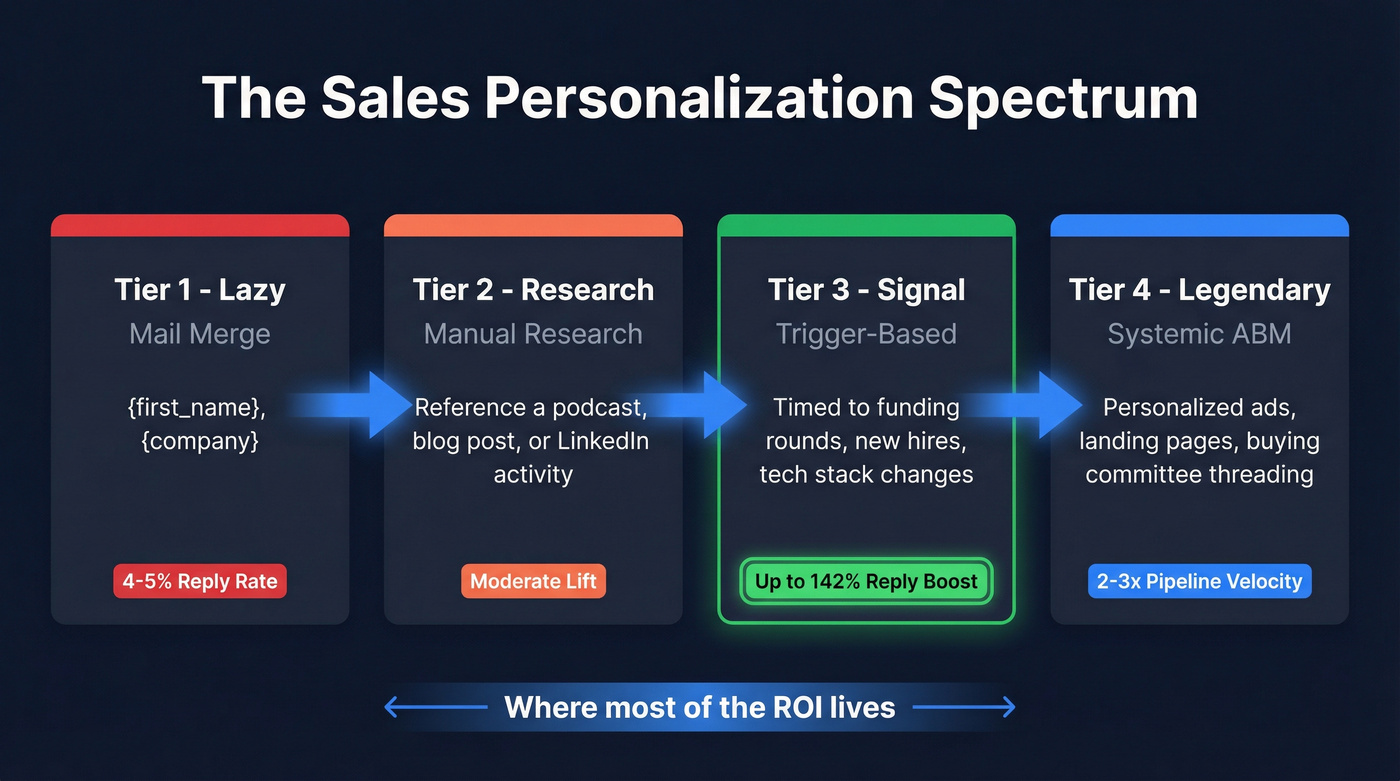
| Tier | Label | What It Looks Like | Expected Impact |
|---|---|---|---|
| 1 - Lazy | Mail merge | {first_name}, {company} | Baseline (4-5% reply) |
| 2 - Research | Manual research | Reference a podcast, blog post, or activity | Moderate lift |
| 3 - Signal | Trigger-based | Outreach timed to funding, hires, tech changes | Up to 142% reply-rate boost per Woodpecker's 20M+ email analysis |
| 4 - Legendary | Systemic ABM | Personalized ads + landing pages + buying committee threading | 2-3x pipeline velocity |
The jump from Tier 1 to Tier 3 is where most of the ROI lives. Tier 4 is for enterprise teams with dedicated ABM resources. If you're an SDR running 50+ accounts, Tier 3 is your target - and it's where the most effective personalized outreach programs converge. McKinsey's research backs this up at the macro level: personalization increases revenue 10-15%, and the effect compounds across touchpoints.
Signals That Actually Move Reply Rates
Merge tags tell a prospect you have their name. Signals tell them you understand their moment. Here are the seven triggers that consistently drive replies.
Funding rounds. A company that just raised is actively spending. The window is 30-90 days post-announcement. "Congrats on the Series B - when teams scale from 50 to 150, [specific problem] usually hits around month three."
Executive hires. New VPs and C-suite leaders are most open to vendor conversations in their first 90 days - before they've locked in their stack. "Saw you just joined as VP of Revenue - most new rev leaders inherit a tech stack they didn't choose." (This pairs well with job change sales outreach.)
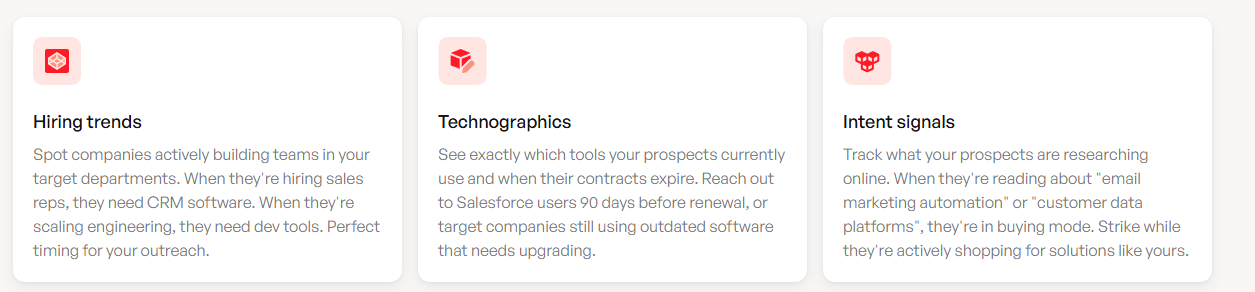
Hiring patterns. When a company posts 8 SDR roles in a month, they're scaling outbound. That's a buying signal for data tools, sequencers, and coaching platforms. The sweet spot is a 60-120 day window after the cluster appears.
Tech stack changes. If a prospect just switched marketing automation platforms, their entire martech layer is in flux. Technographic filters make this discoverable at scale - Prospeo's technographics plus job-posting and growth signals help surface accounts mid-transition across 300M+ professional profiles without manual research (see firmographic and technographic data).
Product launches. A company launching a new product line needs supporting infrastructure. Sales enablement, analytics, data - all of it gets re-evaluated.
M&A activity. Mergers create chaos. Two CRMs, two data vendors, two sequencing tools. The consolidation conversation is a natural entry point.
Regulatory shifts. New compliance requirements force tool and process changes. If you sell anything adjacent to compliance, these are gold.
Here's the thing: the first seller to reach a prospect after a trigger event is 5x more likely to win the deal. On the subject line side, Gong benchmarks show fewer than 4 words performs best, while salesy language reduces opens by up to 17.9%. Short, signal-driven, specific. That's the formula.
How Much to Personalize Per Tier
The average prospect needs 5 touches to engage. Executives need about 9, per Outreach's data. But not every account deserves the same depth of effort.
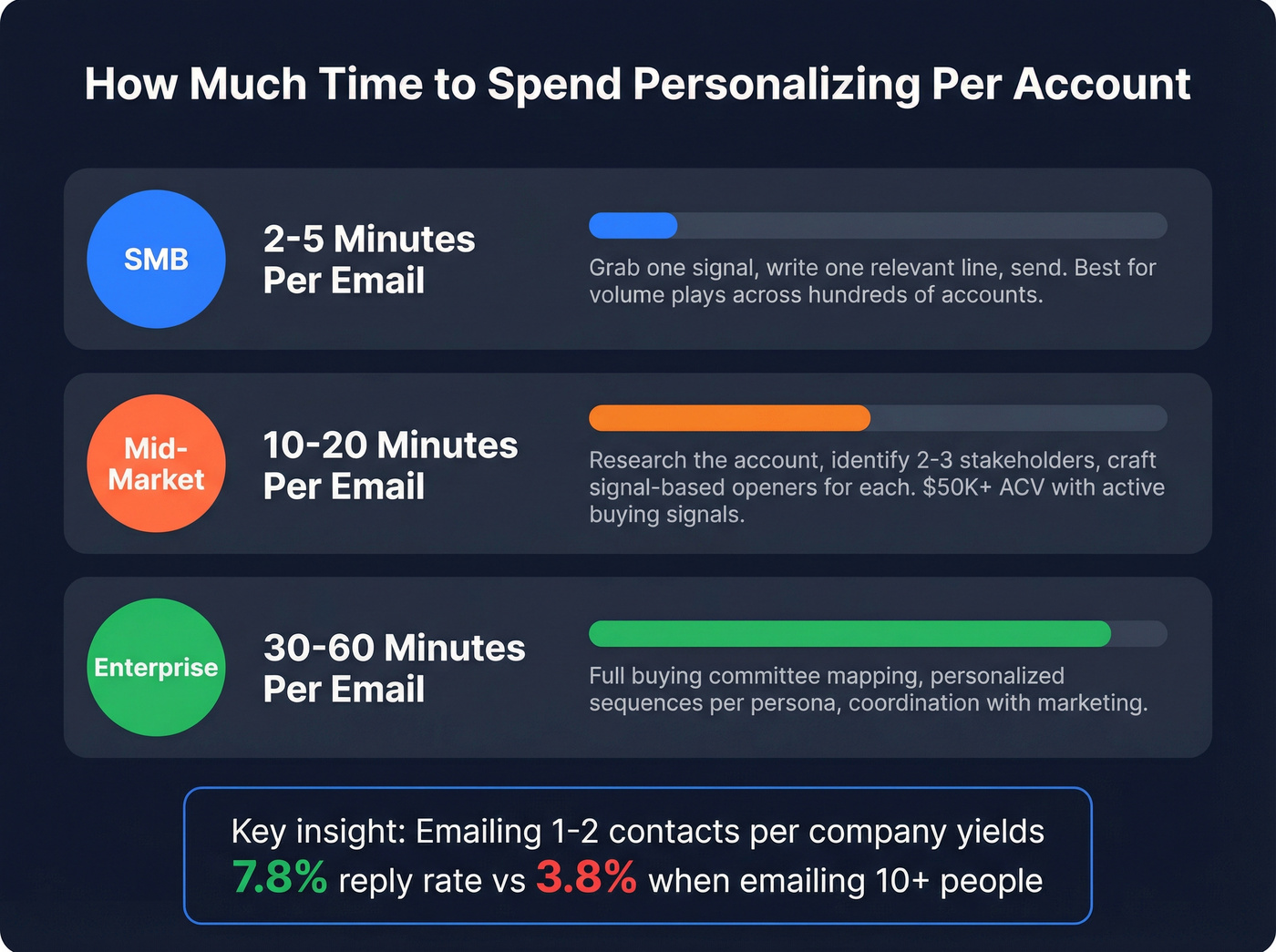
Go deep when the account is mid-market or enterprise ($50K+ ACV), you've identified active buying signals, or you're reaching a C-suite contact. Stay light when the account is SMB with smaller deal sizes, there are no active signals, or you're running volume plays across hundreds of accounts.
Practical time budgets:
- SMB: 2-5 minutes per email. Grab one signal, write one relevant line, send.
- Mid-market: 10-20 minutes. Research the account, identify 2-3 stakeholders, craft signal-based openers for each (use a repeatable prospect research before outreach system).
- Enterprise: 30-60 minutes. Full buying committee mapping, personalized sequences per persona, coordination with marketing.
One counterintuitive finding from the Belkins data: emailing 1-2 contacts per company yields a 7.8% reply rate vs 3.8% when you email 10+ people at the same company. More contacts doesn't mean more replies - it means more noise. Be surgical.
Multithreading the Buying Committee
Modern B2B deals involve an average of 13 stakeholders. You can't personalize for one person and hope the deal closes (this is the core of what is multithreading in sales).
The personalization angle changes by role. For the economic buyer (CFO, VP), lead with ROI and risk reduction. For the technical evaluator, lead with integration complexity and implementation timeline. For the end user, lead with daily workflow impact and ease of adoption. Same product, three completely different emails.
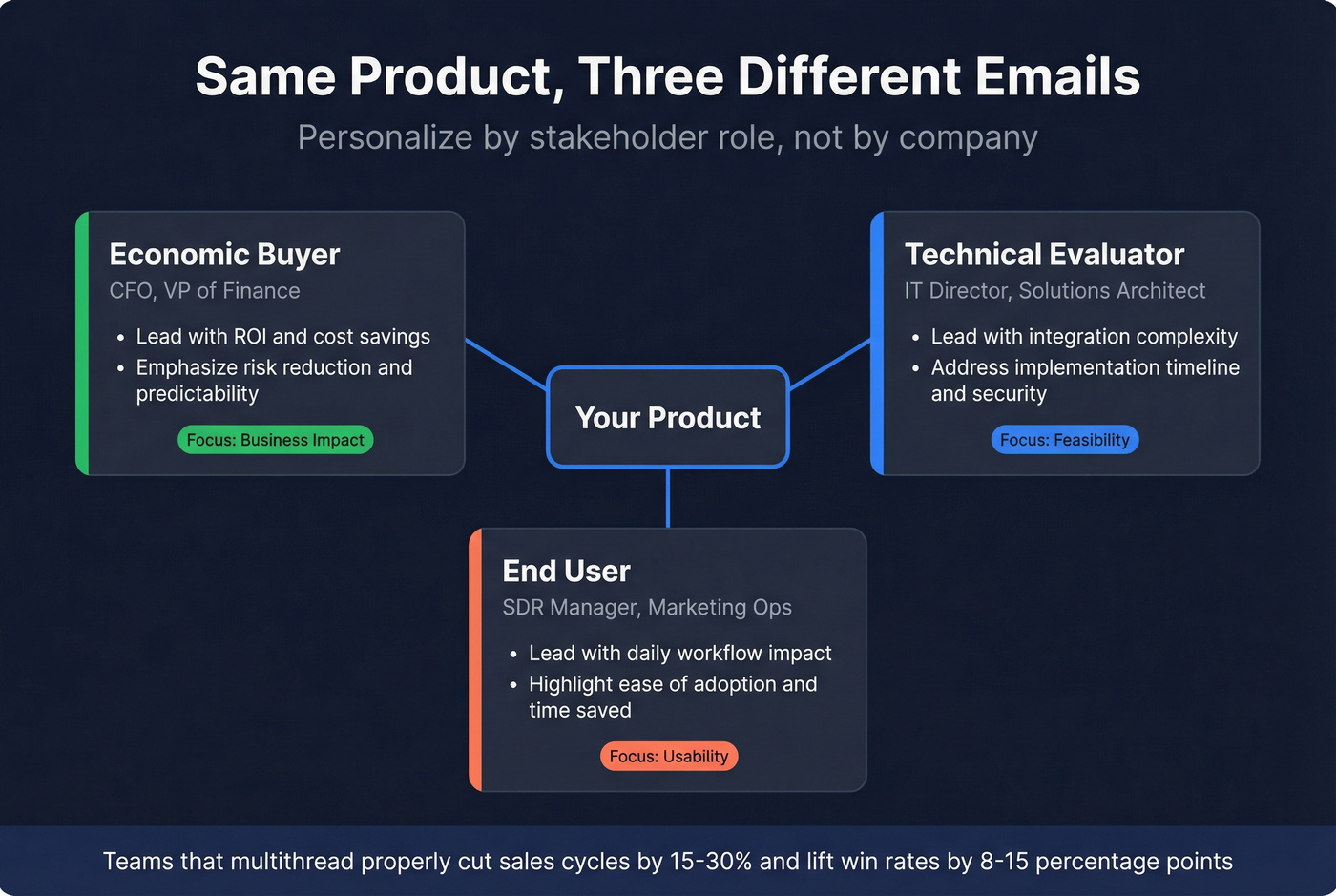
The mistake most reps make is writing one email and CC'ing the committee. That's not multithreading - that's lazy. Each stakeholder gets their own sequence, their own signal, their own reason to care. We've seen teams that multithread properly cut sales cycles by 15-30% and lift win rates by 8-15 percentage points. The more precisely you tailor each message to the recipient's priorities, the faster the deal moves through committee.

You just read how signal-based personalization can lift reply rates by 142%. But none of that matters if your emails bounce. Prospeo gives you 98% verified emails, technographic filters, hiring signals, and funding data across 300M+ profiles - so every personalized email actually lands.
Stop crafting perfect emails that bounce. Start with data that delivers.
Sequence and Timing
Single-email sequences actually have the highest reply rate at 8.4%. Your first follow-up can add up to 49% more replies - that's worth sending. Optimal email length is 6-8 sentences, and under 200 words outperforms longer emails consistently. Thursday is the best send day (6.87% reply rate) vs Monday at 5.29%, with evenings between 8-11 PM peaking at 6.52% (benchmarks vary by list quality and email deliverability).
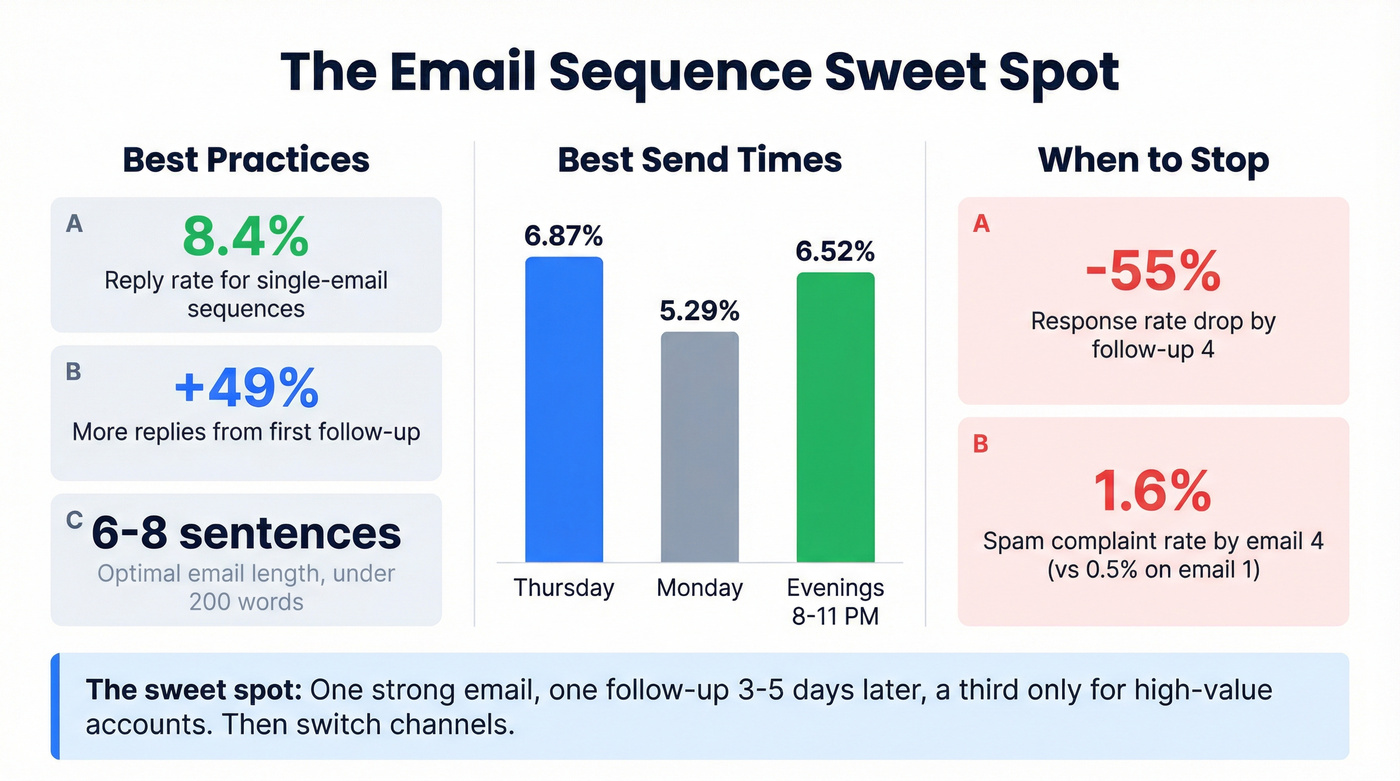
Now for what kills performance. By follow-up #4, response rates drop 55% compared to earlier emails. Spam complaint rates jump from 0.5% on the first email to 1.6% by the fourth.
The sweet spot for most teams: one strong email, one follow-up 3-5 days later, and a third only if the account is high-value. After that, switch channels or switch contacts (or pull from proven outreach email template patterns).
Scaling With AI (Without the Cringe)
AI should automate your research, not write your emails. We've all gotten those "I noticed your company is doing amazing things in the [industry] space" messages. They're worse than no personalization at all - and prospects spot them instantly.
Where AI actually earns its keep:
Research automation. A rep takes roughly an hour to research one account manually. Tools like Clay can research 500 accounts overnight - pulling funding data, tech stack changes, hiring patterns, and news mentions into a structured brief (see prospect research automation).
Email scoring. Lavender analyzes your draft in real time and flags when you're too long, too formal, or too salesy. Think of it as a writing coach, not a ghostwriter.
Conversation intelligence. Gong-style tools analyze call recordings and surface what the prospect actually cares about, so your follow-up email references their words, not your assumptions.
The "creepy line" matters. AI should never automate references to family details, vacation photos, or "I saw you viewed my profile." Keep AI in the research layer and keep the human in the writing layer.
Beyond Email - Full Journey Personalization
Email is where most teams start, but the biggest personalization gains happen when you extend beyond the inbox. As Eric Siu puts it, "99% of your market isn't ready to buy right now."
One ABM example from CXL: teams running ads that dynamically included the target company's logo and name saw a 2-3x CTR lift and cut CPL from $2-3K down to $500-$1K. Adding matching personalized landing pages increased conversion rates another 15-30%. Video personalization is another tactic gaining ground - short Loom-style walkthroughs tailored to a prospect's specific use case. Digital sales rooms, where you replace the generic PDF follow-up with a personalized microsite containing the prospect's agenda and relevant case studies, are picking up steam too. These tactics extend the same signal-driven thinking from your inbox to every touchpoint in the buyer journey (use an account-based marketing plan to operationalize it).
The Personalization Tool Stack
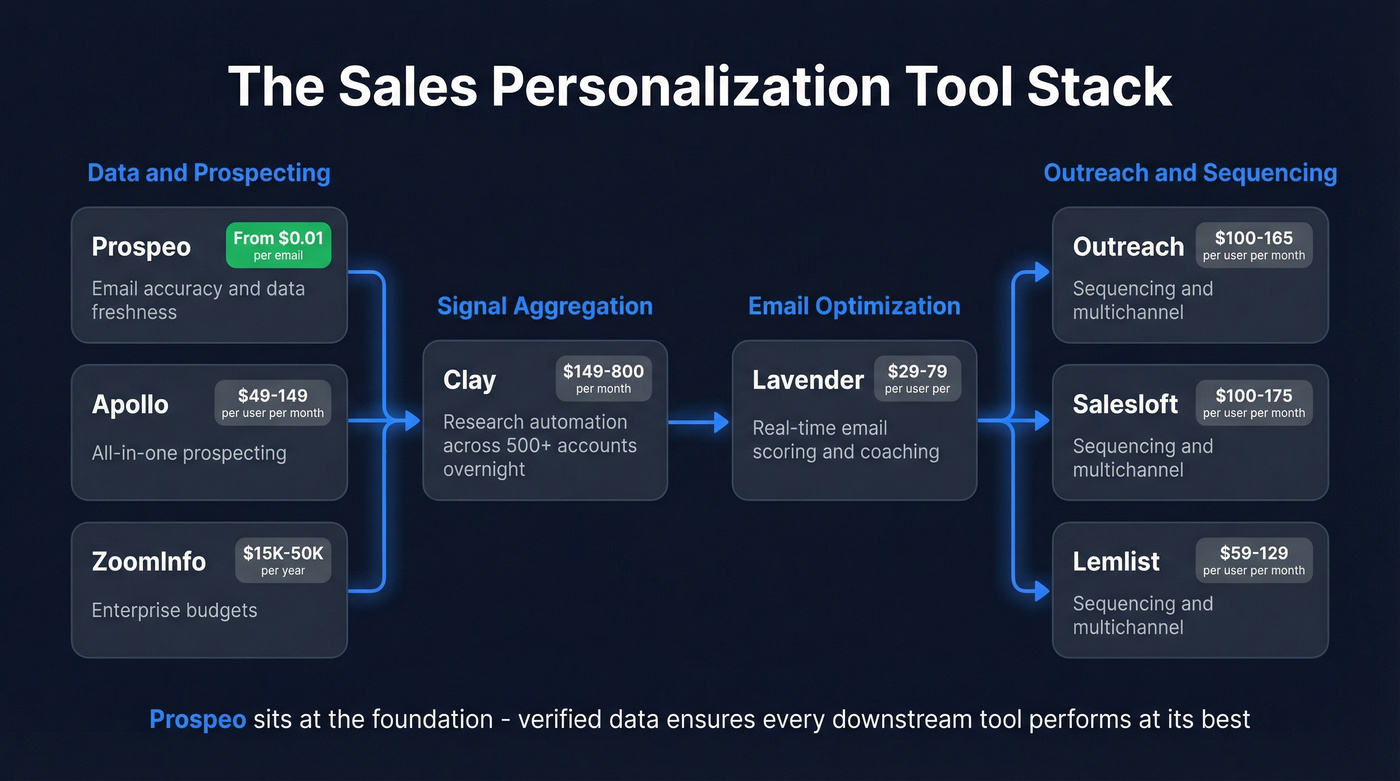
Here's what the stack looks like in practice:
| Category | Tool | Starting Price | Best For |
|---|---|---|---|
| Data & Prospecting | Prospeo | Free; ~$0.01/email | Email accuracy + data freshness |
| Data & Prospecting | Apollo | $49-149/user/mo | All-in-one prospecting |
| Data & Prospecting | ZoomInfo | $15K-50K/yr | Enterprise budgets |
| Signal Aggregation | Clay | $149-800/mo | Research automation |
| Email Optimization | Lavender | $29-79/user/mo | Real-time email scoring |
| Outreach | Outreach | $100-165/user/mo | Enterprise sequencing |
| Outreach | Salesloft | $100-175/user/mo | Enterprise sequencing |
| Outreach | Lemlist | $59-129/user/mo | SMB multichannel |
| Conversation Intel | Gong | ~$100-150/user/mo | Call analysis + follow-ups |
Clay is the best signal aggregation tool on the market right now. It pulls data from dozens of sources, enriches it, and outputs structured research briefs. At $149-800/mo it isn't cheap, but it replaces hours of manual research per account. If you're running Tier 3 personalization across 50+ accounts, Clay pays for itself in the first week (compare options in best sales signals platforms).
Apollo is the obvious starting point for teams that want prospecting and sequencing in one platform. The free tier is generous and the $49-149/user/mo range is accessible. Where it falls short: email accuracy sits around 79%, and data freshness lags behind platforms that refresh weekly.
Lavender scores your emails in real time and tells you exactly what to fix. At $29-79/user/mo, it pays for itself if it lifts reply rates even a few percentage points. Our team saw measurable improvement in email quality within the first week of rolling it out.
Outreach and Salesloft are the enterprise sequencing platforms - pick based on your existing tech stack. Lemlist is the SMB alternative with solid multichannel features at a lower price point. Gong rounds out the stack with conversation intelligence that makes follow-up emails dramatically more relevant.
Why Data Quality Makes or Breaks Personalization
A perfectly crafted personalized email that bounces is worth zero.
Let's be honest - this is the part of the conversation nobody wants to have, because it's not sexy. But it's the single biggest lever most teams are ignoring. Reddit threads on r/sales come back to this constantly: reps blame their messaging when the real problem is their data (and B2B contact data decay is accelerating).
Look at what happened with Snyk: 50 AEs prospecting 4-6 hours per week, and their bounce rate was running 35-40%. Nearly half their personalization effort was hitting dead inboxes. After switching to a platform with 5-step verification and weekly data refreshes, bounce rates dropped under 5%, AE-sourced pipeline jumped 180%, and they were generating 200+ new opportunities per month.
The math is brutal. If your bounce rate is 35%, you need about 1.54x the send volume to get the same number of delivered emails. That burns your domain reputation, which tanks deliverability on the emails that do have valid addresses - a death spiral. Skip the fancy personalization playbook if your data layer isn't solid. Get that right first, and every sales personalization strategy you deploy works harder.
Multithreading a buying committee means reaching 3-5 stakeholders with tailored messages. Prospeo's 30+ search filters - including department headcount, job changes, and buyer intent across 15,000 topics - let you map the full committee and find verified contacts for each role in minutes, not hours.
Map the committee, find the contacts, send with confidence.
FAQ
What's the difference between sales and marketing personalization?
Sales personalization targets individual prospects with 1:1 outreach based on their role, active triggers, and deal stage. Marketing personalization segments audiences at scale for campaigns and ad targeting. The key difference is granularity - sales is about one person, one moment, one reason to reply. 84% of consumers say being treated like a person, not a number, is critical to winning their business.
How many emails should a personalized sequence include?
Data from 16.5M cold emails shows single-email sequences have the highest reply rate at 8.4%. One follow-up adds up to 49% more replies. Stop at three - spam complaints spike after that, and response rates drop 55% by the fourth follow-up.
What's the fastest way to find personalization signals?
Use a signal aggregator like Clay to surface funding rounds, hiring patterns, and tech stack changes automatically. Layer in intent data tracking and job-change filters to catch accounts actively researching solutions - replacing hours of manual research with structured, actionable briefs.
Does AI-written personalization actually work?
AI-generated emails that sound AI-generated perform worse than generic templates. Use AI to automate research and surface signals, then write or heavily edit the email yourself. The human layer is what makes personalization feel personal - prospects spot fully automated outreach within seconds.
How much time should I spend personalizing each email?
Tier by account value: 2-5 minutes for SMB, 10-20 for mid-market, 30-60 for enterprise. Spending half an hour on a four-figure deal is a misallocation of pipeline time - save the deep research for accounts where the ACV justifies it.